양송이버섯 추출물의 산화적 스트레스 억제효과 및 항돌연변이 효과
윤미자1․오세인2․이미숙1†
1한남대학교 식품영양학과
2서일대학 식품영양과
Antioxidative and Antimutagenic Effects of Agaricus bisporus Ethanol Extracts
Mi-Ja Yun1, Se-In Oh2, and Mee Sook Lee1†
1Dept. of Food and Nutrition, Hannam University, Daejeon 305-811, Korea
2Dept. of Food and Nutrition, Seoil College, Seoul 131-702, Korea
Abstract
This study was performed to investigate the antioxidative effects such as the inhibition of malondialdehyde (MDA) and bovine serum albumin (BSA) conjugation reaction, inhibition of Fe2+-induced lipid peroxidation and the scavenging effect on 1,1-diphenyl-2-picryl-hydrazyl (DPPH) radical, as well as antimutagenic capacities as Ames test in ethanol extracts of Agaricus bisporus. Agaricus bisporus ethanol extracts inhibited Fe2+-in- duced lipid peroxidation and scavenged DPPH radical. The IC50 of Agaricus bisporus ethanol extracts were 78.63 mg/assay for inhibition of MDA with BSA conjugation reaction, 4.06 mg/ assay for inhibition of Fe2+-induced lipid peroxidation and 1.08 mg/assay for scavenging effect on DPPH radical. So, among the methods used in this study, the most effective antioxidative capacity in ethanol extracts of Agaricus bisporus was the scaveng- ing effect on DPPH radical. The indirect and direct antimutagenic effects of ethanol extracts of Agaricus bispo- rus were examined by Ames test using Salmonella Typhimurium TA98 and TA100. The inhibitory effects on direct mutagenicity mediated by sodium azide in Salmonella Typhimurium TA100 and 2-nitrofluorene in Sal- monella Typhimurium TA98 were 100%. The inhibition rates on indirect mutagenicity mediated by 2-anthra- mine were 86.09% in the Salmonella Typhimurium TA98 and 81.93% in the Salmonella Typhimurium TA100.
The ethanol extracts of Agaricus bisporus showed considerable antioxidative activity and strong antimutagenic capacity.
Key words: MDA & BSA conjugation reaction, lipid peroxidation, DPPH radical scavenging effect, Ames test, antimutagenicity
†Corresponding author. E-mail: [email protected]
†Phone: 82-42-629-8794, Fax: 82-42-629-8789
서 론
최근 식용 및 약용으로 사용되는 버섯의 효능에 관하여 일반인들의 관심이 높아지고 자연식품, 무공해 식품, 저칼로 리 식품으로 버섯의 소비가 증가하고 있다. 버섯은 독특한 맛과 향기를 지니고 있고 탄수화물, 단백질, 지질, 무기질 및 비타민 등의 각종 영양소를 함유하고 있을 뿐만 아니라 버섯에 함유된 다양한 생리활성물질들은 항암작용(1), 항산 화 효과(2), 항돌연변이 효과(3), 혈당강하(4), 콜레스테롤 저 하(5), 항종양 작용(6)등의 기능을 나타내므로 성인병에 대 한 예방 및 개선효과가 기대되는 좋은 소재라 할 수 있다.
한국산 버섯은 992종이 분류되어 있는데 그중 식용이 가 능한 버섯은 100여종이며, 이중 양송이버섯은 느타리버섯 다음으로 가장 식용정도가 높은 버섯으로 향미성분과 약리 효과가 있어 국내에서도 식용 및 약용으로 널리 이용된다
(7). 양송이버섯에 관한 연구로는 유기산 및 지방산 조성(8), 유리당과 당알코올 조성(9), 휘발성 향미성분(10)과 유리아 미노산 및 전아미노산 조성(11), ergocalciferol과 cholecal- ciferol의 함량(12) 등에 관한 연구가 있으며 양송이버섯의 항산화효과 및 아질산염 소거작용(13)과 도파민 베타 수산 화효소에 대한 저해활성 검색(14), 항돌연변이 억제효과 (15), 조직 혈액응고인자에 대한 저해활성(16), 장내 유산균 증식효과(17) 등이 있다. 또한 10종의 식용버섯 자실체에 대 한 항보체 활성검색에서 양송이버섯은 가장 높은 활성을 나 타냈다고(18) 하며, 양송이버섯의 항보체활성 단백다당획분 을 분리하고 활성부위와 특성에 관한 보고(19)도 있다.
최근 생체 내 각 조직에서 활성산소의 반응물질이 증가되 어 암, 당뇨, 간경화증, 심혈관계질환 등의 여러 가지 질병이 나 노화를 가져오는 것으로 보고되고 있다(20). 암화 과정의 개시단계에서 발생하는 세포 돌연변이는 DNA의 산화적 손
상에 의해 초래되며 그 원인물질 중 하나가 산소를 소비하는 정상적인 세포 대사과정에서도 다량 생성되는 free radical 이다. 즉 친전자성을 띤 free radical들은 세포 내 DNA의 친핵성 부위와 결합함으로써 세포변이를 일으키게 된다. 따 라서 대사과정 중 free radical 생성은 세포의 암화과정과 긴밀하게 연관되어 관여하는 것으로 보인다(21). 버섯류의 항산화 활성은 버섯류 추출물의 polyphenol 함량에 따라 free radical 제거활성, reducing power, Fe2+ 이온의 chelat- ing effect 등이 농도 의존적으로 증가하며(1-3) 버섯류로부 터 추출한 단백 다당체에 의한 free radical 제거활성도 보고 되었다(4,5).
따라서 본 연구에서는 양송이버섯 추출물의 생리적 기능 에 대한 활성을 탐색하기 위하여 양송이버섯의 항산화와 항 돌연변이 효과를 측정해 보고자 한다. 즉, 양송이버섯 에탄 올 추출물의 malondialdehyde(MDA)에 대한 단백질의 보호 효과와 Fe2+-induced lipid peroxidation 저해효과, 1,1-di- phenyl-2-picryl-hydrazyl(DPPH) radical 소거효과를 측정 하여 단백질의 산화 및 유지류의 과산화 반응에 대한 항산화 효과를 알아보았다. 또한 Ames test를 이용하여 양송이버섯 에탄올 추출물의 직접 및 간접 돌연변이 유발 억제능을 탐색 하였다.
재료 및 방법
실험재료
양송이버섯(Agaricus bisporus(Lange) Imbach)을 대전 중앙시장에서 구입하여 수세한 다음 동결건조하고, 분쇄한 후 밀봉․냉동보관(-20oC)하여 시료로 사용하였다.
에탄올 추출물의 제조
양송이버섯의 에탄올 추출물은 건조시료 일정량(5 g)에 20배의 95% 에탄올을 가하여 실온에서 24시간 동안 2회 반 복 추출하여 Whatman 여과지 No. 6로 여과한 후 여과액을 회전 진공증발기(EYELA, Rotary vacuum evaporator N-N series, Tokyo, Japan)로 감압 농축한 후 냉동보관하였다가 dimethyl sulfoxide(DMSO)에 녹여 지질과산화억제활성, DPPH 라디칼 소거활성, Ames test를 위한 시료로 사용하였 고, MDA와 BSA(Bovine serum albumin, Sigma, MO, USA) conjugation 억제활성 실험을 위해서는 건조시료를 80% 에탄올로 추출한 다음 여과하여 농축시켜 사용하였다.
항산화효과 측정
지질과산화물과 단백질의 결합 억제효과: Park(22)의 방 법에 따라 2 mg/mL BSA, 20 mM MDA, 양송이버섯 추출 물, 0.1 M PBS를 혼합하여 37oC에서 24시간 반응시켰다.
이때 BSA 단백질정량은 Bradford법을 사용하였고 MDA는 Gómez-Sánchez(23)의 방법에 따라 제조하였다. 반응시킨 시료 500 μL를 Centricon(Amicon, Centricon YM-10, USA)
에 넣고 1,400×g에서 2시간 동안 원심분리하여(Beckman, Model J2-21 centrifuge, Oregon, USA) MDA와 BSA의 결 합물을 분리한 후, 증류수 700 μL를 넣고 1,400×g에서 2시 간 동안 원심분리하여 여분의 염 등을 세척하였다. 세척은 동일한 방법으로 3회 실시하였다. 세척한 시료를 분리하여 12% SDS-PAGE(SDS polyacryl amide gel electro- phoresis)를 120 V에서 3시간 동안 실시한 후, gel을 Coomas- sie 염색하여 Densitometer(Vilber Lourmat, BIO-1D Image Analysis, Vilber Lourmat, Germany)로 정량한 다음, 저해 율(inhibition rate, %)을 산출하였다.
지질과산화 억제효과 측정: Saija 등(24)과 Haase와 Dunkley(25)의 방법에 따라 Fe2+로 linoleate의 과산화를 유 도시킨 후, 이를 억제하는 효과를 측정하였다. Linoleate의 과산화 정도는 TBA(thiobarbituric acid, Sigma, MO, USA) 로 발색시켜 측정하였다. 10 mL의 10 mM linoleate 용액에 시료 20 μL를 가하고 37oC shaking incubator에서 1시간 동 안 shaking 시킨 후, 0.05 M iron sulfate(FeSO4․7H2O) 20 μL를 첨가한 다음 다시 37oC에서 2시간 동안 shaking하여 과산화 반응을 유발시켰다. 처리된 linoleate 용액 800 μL를 4oC에서 10 min 동안 tempering시키고, 400 μL의 TBA를 첨가한 다음 잘 혼합한 후 boiling water bath에서 15 min 동안 처리한 후 흐르는 물에 냉각시켰다. 냉각된 용액에 n-butanol 1,120 μL 가하고 잘 섞은 다음 250×g로 20 min 동안 원심분리하여(Hanil, Union 5KR, Incheon, Korea) n-butanol 층을 취하여 535 nm에서 흡광도를 측정(Molecu- lar Devices, SpectraMAX 340pc, CA, USA)하였다. Fe2+에 의해 유도된 linoleate의 과산화에 대한 억제활성은 TBA로 발색시킨 것을 100%로 가정하였을 때, 양송이버섯 에탄올 추출물을 첨가하여 50%로 감소시킬 수 있는 농도와(IC50)로 나타내었고, inhibition rate(%)를 산출하였다.
DPPH 라디칼 소거활성: Chen 등(26)의 방법에 따라 DMSO 10 μL(대조구)와 DMSO에 녹여 농도별로 희석한 시료 10 μL에 200 μM DPPH/ethanol 190 μL를 가한 후, 37oC 에서 30 min 동안 반응시킨 다음 517 nm에서 흡광도를 측정 하였다. 대조구에 대해 시료를 넣었을 때의 흡광도의 감소 정도를 측정하였다. 대조구의 흡광도를 100%로 하였을 때 양송이버섯 에탄올 추출물을 첨가하여 DPPH 라디칼을 50% 소거하는 시료의 농도를 IC50으로 나타내고, inhibition rate(%)를 산출하였다.
항돌연변이능 측정
Salmonella Typhimurium TA98, TA100 균주를 이용하 여 항돌연변이능을 측정하였다. 정기적으로 이들 균주의 histidine 요구성, deep rough(rfa)돌연변이, uvrB 돌연변이 와 R factor 등의 유전형질을 확인하였다. 이들 균주는 nutrient broth(Difco)에 접종, 배양하여 현탁액 1 mL당 DMSO 90 μL를 가하여 냉동보관용 tube에 채워 액체질소 (Thermolyne, Bio CaneTM 20)에 보관하면서 사용하였다.
Master plate에 배양한 균주를 nutrient broth에 접종하여 37oC에서 14~16시간 동안 진탕배양(KMC-8480S, Vison Scientific CO., Seoul, Korea)한 후 1~2×10⁹ cells/mL의 밀 도가 되도록 하여 실험에 사용하였다.
돌연변이 유발물질로는 간접 또는 직접돌연변이 물질을 사용하였는데 간접돌연변이 물질로는 환경성 돌연변이 물 질인 2-anthramine(2-AA, Sigma, MO, USA)을 사용하였 고, 직접돌연변이 물질로는 2-nitrofluorene(2-NF, Aldrich, WI, USA)와 Sodium azide phosphate(Sigma, USA)를 사용 하였다. 2-AA와 2-NF는 DMSO에 녹여 사용하였고, so- dium azide phosphate는 증류수에 녹여 사용하였다. 각 돌연 변이 유발물질은 2-AA의 경우 TA98과 TA100에서 2.5 μg/
plate, 2-NF는 TA98에서 4 μg/plate, sodium azide phos- phate는 TA100에서 2 μg/plate의 농도로 사용하였다.
항돌연변이 유발실험을 위한 배지 및 시약의 조제는 Maron과 Ames(27)의 방법에 따라 행하였으며 Matsushima 등(28)의 방법에 따라 실험하였다. 모든 실험은 ice bath상에 서 행하였고 중복 실험하였다. 대사활성 물질이 필요한 간접 돌연변이 물질을 사용할 때는 S9 mix(11-01L RAT LIVER LS-9, Moltox, NC, USA)를 첨가하였다. DMSO에 녹인 시 료 90 μL와 배양한 실험균주 0.1 mL, 돌연변이 유발물질 10 μL, 직접돌연변이원에는 0.5 mL의 0.1 M phosphate buf- fer(pH 7.4)를, 간접돌연변이원에는 0.5 mL의 S9 mix를 멸 균된 시험관에 첨가한 후 가볍게 vortex하여 37oC shaking water bath(KMC-1205SW1, Vison Co., Seoul, Korea)에서 30분 동안 예비 배양하였다. 0.5 mM histidine/biotin 용액을 100 mL당 10 mL 첨가한 45oC 정도의 Top agar를 2 mL씩 각 시험관에 붓고 3초간 vortex한 후 minimal glucose agar plat에 부어 여러 방향으로 기울여 고루 퍼지게 한 후 굳게 하였다. 그 다음 plates를 뒤집어 37oC incubator(VS-1203P3, Vison scientific Co., Seoul, Korea)에서 48시간 배양한 후 각각의 복귀돌연변이주(revertant colonies)를 계수하였고 돌연변이 억제율(inhibition rate, %)을 구하였다.
통계처리
실험의 결과는 SAS Package(Statistical Analysis System, ver. 5.1)을 이용하여 처리하였다. 각 실험군마다 데이터의 평균과 표준오차를 산출하였고, 각 실험군의 평균 치간의 차이의 유의성은 ANOVA 실시 후 p<0.05 수준에서 Duncan's multiple range test로 검정하였다.
결과 및 고찰
항산화효과
지질과산화물과 단백질의 결합 억제효과: 양송이버섯이 체내에서 생성된 지질과산화물이 단백질과 결합하는 반응 을 억제하는지를 알아보고자 전기영동한 후 이를 대조군의
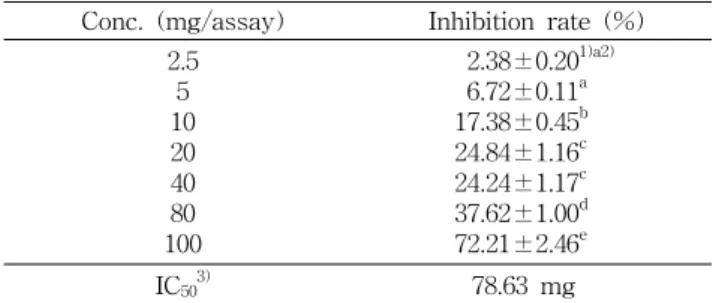
Table 1. Inhibition rate of ethanol extracts of Agaricus bis- porus on the conjugated MDA with BSA
Conc. (mg/assay) Inhibition rate (%) 2.5
5 10 20 40 80 100
2.38±0.201)a2) 6.72±0.11a 17.38±0.45b 24.84±1.16c 24.24±1.17c 37.62±1.00d 72.21±2.46e IC503)
78.63 mg
1)Values are mean±SE.
2)Values followed by different letters are significantly different at p<0.0001.
3)Inhibitory activity was expressed as the mean of 50% in- hibitory concentration of triplicate determines, obtained by in- terpolation of concentration-inhibition curve.
a b c d e f g h I Fig 1. Inhibitory effects of ethanol extracts of Agaricus bis- porus on conjugation of malondialdehyde with protein.
SDA-PAGE of extracts with MDA and BSA on 12% acryamide gel. a: BSA (100 μL)+PBS (900 μL), b: BSA (100 μL)+MDA (100 μL)+PBS (800 μL), c: BSA (100 μL)+MDA (100 μL)+ex- tract (2.5 μL)+PBS (797.5 μL), d: BSA (100 μL)+MDA (100 μL)
+extract (5 μL)+PBS (795 μL), e: BSA (100 μL)+MDA (100 μL)+extract (10 μL)+PBS (790 μL), f: BSA (100 μL)+MDA (100 μL)+extract (20 μL)+PBS (780 μL), g: BSA (100 μL)+MDA (100 μL)+extract (40 μL)+PBS (760 μL), h: BSA (100 μL)+
MDA (100 μL)+extract (80 μL)+PBS (720 μL), I: BSA (100 μL)
+MDA (100 μL)+extract (100 μL)+PBS (700 μL).
결합정도에 대한 저해율로 표시한 결과는 Table 1과 Fig.
1과 같다. 시료의 농도가 10 mg/assay이었을 때 17.38%, 시 료의 농도가 그의 10배인 100 mg/assay이었을 때 저해율은 72.21%로 양송이버섯 에탄올 추출물의 농도가 증가할수록 MDA와 BSA의 결합 band가 점점 사라지는 것을 볼 때(Fig.
1), 양송이버섯 에탄올 추출물에는 지질과산화물인 MDA가 단백질인 BSA와 결합하는 것을 억제시키는 성분이 있음을 알 수 있었다. 지질과산화물이 단백질과 결합하는 것을 50%
억제하는 IC50은 78.63 mg/assay이었으며 이를 건조시료무 게로 환산하면 190.00 mg이다.
지질과산화 억제효과: Fe2+에 의해 유도된 linoleate의 과 산화에 대한 양송이버섯 에탄올 추출물의 억제효과를 살펴 본 결과는 Table 2와 같다. 양송이버섯 에탄올 추출물의 농 도 0.1 mg/assay 시 6.46%, 1.0 mg/assay 시 18.41%, 2.0 mg/assay 시 24.96%의 저해율을 보였으며, 에탄올 추출물 의 농도가 증가할수록 지질과산화의 억제정도가 증가하였
Table 4. Effects of ethanol extracts from Agaricus bisporus on direct mutagenicity mediated by 2-nitrofluorene in Salmonella Typhimurium TA98 and sodium azide in Salmonella Typhimurium TA100
Extracts Conc. (mg/plate)
Salmonella Typhimurium TA98 Salmonella Typhimurium TA100 Revertants/plate Inhibition rate (%) Revertants/plate Inhibition rate (%) 0.5
1.0 3.0 5.0 7.0 9.0
791±261) 736±21 183±33 55±05 1±01 0±00
0.21±0.21a2) 0.69±0.69a 73.97±4.50b 94.67±1.04c 100±00c 100±00c
- 1317±73 731±24 432±27 16±03 1±00
- 0a 39.29±2.65b 67.99±5.08c 100±00d 100±00d
1)Values are mean±SE. 2)Values followed by different letters are significantly different at p<0.0001.
Table 2. Antioxidative effects of ethanol extracts of Agari- cus bisporus on Fe+-induced linoleate peroxidation
Conc. (mg/assay) Inhibition rate (%) 0.01
0.03 0.10 0.30 1.00 2.00
0.48±0.381)a2) 3.73±1.48ab 6.46±1.08c 10.76±1.24c 18.41±2.80d 24.96±1.51e IC503)
4.06 mg
1)Values are mean±SE.
2)Values followed by different letters are significantly different at p<0.0001.
3)Inhibitory activity was expressed as the mean of 50% in- hibitory concentration of triplicate determines, obtained by interpolation of concentration-inhibition curve.
으나 그 저해 정도는 비교적 낮았다. Fe2+에 의해 유도된 li- noleate의 과산화에 대한 억제활성을 TBA로 발색시킨 것을 100%로 가정하였을 때, 양송이버섯 에탄올 추출물을 첨가 하여 50%로 지질과산화를 감소시킬 수 있는 농도(IC50)는 4.06 mg/assay이었으며 이를 건조무게로 환산하면 22.36 mg이다.
DPPH 라디칼 소거효과: 양송이버섯 에탄올 추출물의 항산화능을 DPPH에 대한 전자공여능(electron donating ability) 즉, DPPH 라디칼 소거능으로 측정한 결과는 Table 3과 같다. 양송이버섯 에탄올추출물의 DPPH 라디칼 소거율 은 시료농도 0.02 mg/assay 시 6.43%, 0.20 mg/assay 시 36.90%, 1.0 mg/assay 시 52.75%의 라디칼 제거능을 나타내 었다. 양송이버섯 에탄올 추출물의 처리농도가 증가할수록 DPPH 라디칼 소거활성이 증가함을 알 수 있었다. 또한 DPPH를 첨가하여 안정한 라디칼을 발생시키는 농도를 100%로 하였을 때, 양송이버섯 에탄올 추출물을 첨가하여 DPPH 라디칼을 50% 소거하는 시료의 농도(IC50)는 1.08 mg/assay였고, 이를 건조중량으로 환산하면 2.97 mg이다.
전자공여 작용은 활성 라디칼에 전자를 공여하여 식품중의 지방질 산화를 억제하는 목적으로 사용되고 있을 뿐만 아니 라 인체 내에서 활성라디칼에 의한 작용을 억제한다. 영지버 섯 에탄올추출물의 DPPH 라디칼 소거율은 시료농도 1.0 mg/assay 시 67.20%의 라디칼 제거능을 나타내었고(29) 표 고버섯은 같은 농도에서 26.90%의 라디칼 제거능을 나타내
Table 3. Scavenging effects of DPPH radical by ethanol ex- tracts of Agaricus bisporus
Conc. (mg/assay) Inhibition rate (%) 0.002
0.006 0.020 0.060 0.200 0.500 1.000
0.34±0.171)a2) 1.93±0.46a 6.43±0.29b 15.97±1.29c 36.90±1.40d 45.09±1.13e 52.75±1.55f IC503)
1.08 mg
1)Values are mean±SE.
2)Values followed by different letters are significantly different at p<0.0001.
3)Inhibitory activity was expressed as the mean of 50% in- hibitory concentration of triplicate determines, obtained by interpolation of concentration-inhibition curve.
어(30) 양송이버섯은 영지버섯에 비해 DPPH 라디칼 소거활 성이 낮았고 표고버섯보다는 높은 것을 알 수 있었다. Lee 등(13)도 양송이와 표고버섯에서 부탄올 추출물에서는 각각 94.33% 및 96.09%로서 전자공여 작용이 높게 나타났고, di- ethylether 추출물에서는 전자공여 작용이 상대적으로 낮게 나타났지만 전체적으로 볼 때, 버섯류의 전자공여 작용은 우수한 것으로 판단되었다고 보고하였다.
이와 같은 라디칼 제거활성은 주로 버섯 자실체 추출물 내에 존재하는 flavonoids 및 기타 phenol성 물질들이 산화 성 생물활성 자유라디칼에 전자를 공여함으로써 산화를 억 제하는 효과가 있기(31,32) 때문이라고 사료된다.
항돌연변이능
Ames test로 양송이버섯 에탄올 추출물의 직접작용 항돌 연변이능을 측정하기 위하여 직접돌연변이 물질인 2-nitro- fluorene(4 μg/plate)를 틀변경 변이주인 Salmonella Typhi- murium TA98에, sodium azide(2 μg/plate)를 염기쌍 치환 변이주인 Salmonella Typhimurium TA100에 처리하여 실험 한 결과는 Table 4와 같다. 직접작용 돌연변이능에 대한 저해 효과는 Salmonella Typhimurium TA98의 경우 양송이버섯 에탄올 추출물 농도 1.0 mg/plate에서는 0.69%의 낮은 항돌연 변이능을 보여주었으나 3.0 mg/plate 농도에서 73.97%, 7.0 mg/plate 농도에서 100%의 항돌연변이능을 보여주었고, Salmonella Typhimurium TA100인 경우는 0.5~1.0 mg/
Table 5. Effects of ethanol extracts from Agaricus bisporus on indirect mutagenicity mediated by 2-anthramine in Salmonella Typhimurium TA98 and Salmonella Typhimurium TA100 with S9mix
Extracts Conc. (mg/plate)
Salmonella Typhimurium TA98 Salmonella Typhimurium TA100 Revertants/plate Inhibition rate (%) Revertants/plate Inhibition rate (%) 0.5
1.0 3.0 5.0 7.0 9.0
2176 2139 1501 938 252
-
±221)
±19
±08
±41
±20
- 0a2)
0a 10.43±1.39b 44.49±3.03c 86.09±1.22d
1411 1328 1134 858 768 328
±34
±37
±37
±38
±14
±09
0a 0a 5.02±2.08a 30.25±4.69b 39.25±1.14c 81.93±1.02d
1)Values are mean±SE. 2)Values followed by different letters are significantly different at p<0.0001.
plate 농도에서 돌연변이 억제능이 없었으며 3.0 mg/plate 농도에서 39.29%, 5.0 mg/plate 농도에서 67.99%였으며 그 이상의 농도에서는 100%의 항돌연변이능을 보여주었다.
환경성 돌연변이 물질인 2-anthramine(2.5 μg/plate)을 사용하여 Salmonella Typhimurium TA98과 Salmonella Typhimurium TA100으로 양송이버섯 에탄올 추출물의 간 접작용 항돌연변이능을 측정한 결과는 Table 5와 같다. 양송 이버섯 에탄올 추출물의 간접작용 돌연변이능에 대한 저해 효과는 Salmonella Typhimurium TA98에서 3.0 mg/plate 농도까지 효과가 없었으나 5.0 mg/plate에서 10.43%, 7.0 mg/plate에서 44.49%, 9.0 mg/plate에서 86.09%의 돌연변이 저해효과가 있었다. Salmonella Typhimurium TA100에서 는 양송이버섯 에탄올 추출물의 농도가 1.0 mg/plate까지 효과가 없었으나 3.0 mg/plate일 때 5.02%, 5.0 mg/plate일 때 30.25%, 9.0 mg/plate일 때 81.93%의 돌연변이 억제능을 보여주었다.
Oh와 Ham(15)은 과실, 야채류의 효소적 갈변반응 물질들 이 돌연변이원에 대하여 억제활성이 있는 것으로 보고하였 다. 특히 양송이로부터 polyphenol oxidase를 추출한 후 네 종류의 polyphenol 화합물과 반응시켜 갈변물질을 얻고, 이 갈변물질들이 발암물질에 대한 돌연변이 억제활성이 있는 지를 연구한 결과, 시료 300 μL 첨가 시 돌연변이원 물질인 benzo(α)pyrene(B(α)P, 20 μL)에 대하여 Salmonella Typh- imurium TA98 및 TA100 두 균주에서 catechol-mushroom enzymatic browning reaction products(Ca-MEBRPs)와 hydroxyhydroquinone(HHQ)-MEBRP는 91~95%, homo- catechol(HCa)-MEBRP와 pyrogallol(Py)-MEBRP는 50~
80%의 억제활성을 나타내었다고 한다. 돌연변이원 물질인 Trp-P-1(2 μL)에 대해서도 4가지 시료 모두 억제활성을 나 타내었다고 한다(15). 표고버섯 에탄올 추출물의 간접작용 돌연변이능에 대한 저해효과는 Salmonella Typhimurium TA100에서 96.60%, Salmonella Typhimurium TA98에서 91.67%로 탁월한 효과를 보였고, 직접작용 돌연변이능에 대 한 저해효과는 Salmonella Typhimurium TA98에서 5.34%, Salmonella Typhimurium TA100에서 22.93%로 낮게 나타 나 표고버섯 에탄올 추출물은 간접작용 돌연변이능을 억제 하는데 효과적이라고 보고(30)하였다. 영지버섯 에탄올 추
출물은 간접작용 돌연변이능에 대한 저해효과가 Salmonella Typhimurium TA98에서 99.78%, Salmonella Typhimurium TA100에서 95.54%로 매우 높았으나, 직접작용 돌연변이능 에 대한 저해효과는 Salmonella Typhimurium TA98에서 7.81%, Salmonella Typhimurium TA100에서 82.96%로 나타 나 간접작용 돌연변이능 저해효과에 비해 비교적 적었다(29).
양송이버섯의 항돌연변이능과 표고버섯과 영지버섯의 항 돌연변이능을 비교해 볼 때, 표고버섯과 영지버섯은 간접작 용 돌연변이 저해효과에 있어서는 양송이버섯보다 약간 더 우수하지만, 직접작용 돌연변이 저해효과에 있어서는 양송 이버섯이 이 두 버섯보다 매우 우수함을 알 수 있었다. 따라 서 양송이버섯 에탄올 추출물은 표고버섯이나 영지버섯과 는 달리 간접작용 돌연변이 저해효과뿐만 아니라 직접작용 돌연변이 저해효과도 매우 우수하다고 사료된다.
요 약
식용 및 약용으로 예로부터 널리 이용하는 양송이버섯 추 출물의 생리적 기능에 대한 활성을 탐색하기 위하여 양송이 버섯(Agaricus bisporus)의 에탄올 추출물의 항산화 효과와 Ames test를 통한 돌연변이 유발 억제능을 탐색하였다. 지 질과산화물에 대한 단백질 보호효과를 알아본 결과, 양송이 버섯 에탄올 추출물은 MDA와 BSA의 교차결합 형성을 100 mg/assay이었을 때 72.21% 저해하였다. Fe2+에 의해 유도된 지질의 과산화에 대한 저해율은 2.0 mg/assay일 때 24.96%
였으며, DPPH 라디칼 소거 활성을 측정한 결과 1.0 mg/as- say일 때 52.75%의 저해율을 보였으며 처리농도가 증가할 수록 저해율은 증가하였다. IC50 값으로 항산화능의 상대적 비교를 하였을 때 양송이버섯 추출물은 DPPH 라디칼 소거 활성이 가장 강하였으며, 그 다음은 지질과산화 억제능이었 고 MDA와 BSA의 교차결합 억제능이 가장 낮았다. Ames test를 이용하여 돌연변이 유발 억제능을 알아본 결과, 양송 이버섯 에탄올 추출물은 Salmonella Typhimurium TA98 및 TA100 두 균주에서 직접작용 돌연변이능을 각각 100%
저해하여 매우 효과적이었다. 간접작용 돌연변이능 저해효과 는 Salmonella Typhimurium TA98에서 86.09%, Salmonella Typhimurium TA100에서는 81.93%로 나타나 양송이버섯
에탄올 추출물은 직접, 간접작용 돌연변이능에 대한 저해효 과가 우수하다고 사료된다. 본 연구 결과를 종합해 볼 때, 양송이버섯은 항산화성과 항돌연변이성이 우수하므로 기능 성식품으로 개발할 수 있는 가능성이 있다고 본다.
감사의 글
이 논문은 2008년도 한남대학교 학술연구조성비 지원에 의하여 연구되었으며, 이에 감사드립니다.
문 헌
1. Lee IS, Nishikawa A. 2003. Polyzellus multiplex, a Korean wide mushroom, as a potent chemopreventive agent against stomach cancer. Life Sci 73: 3225-3234.
2. Cheung LM, Cheung PCK, Ooi VEC. 2003. Antioxidant ac- tivity and total phenolics of edible mushroom extracts.
Food Chem 80: 1-7.
3. Ham SS, Oh SW, Kim YK, Shin KS, Chang KY, Chung GH. 2003. Antimutagenic and cytotoxic effects of ethanol extract from the Inonotus obliquus. J Korean Soc Food Sci Nutr 32: 1088-1094.
4. Konno S, Tortorelis DG, Fullerton SA, Samadi AA, Hettiarachchi J, Tazaki H. 2001. A possible hypoglycemic effect of Maitake mushroom on type 2 diabetic patients.
Diabetic Medicine 18: 1010-1011.
5. Kim BK, Shin GG, Jeong BS, Cha JY. 2001. Cholesterol- lowering effect of mushrooms power in hyperlipidemic rats.
J Korean Soc Food Sci Nutr 30: 510-515.
6. Lee JW, Chung CH, Jeong HJ, Lee KH. 1990. Anticomple- mentary and antitumor activities of the lkal, extract from the mycelia of Lentinus edodes IY-105. Kor J Appl Micro- biol Biotechnol 18: 571-577.
7. Kim JS, Han JS, Lee JS. 1994. A survey on mushroom uses.
Korean J Food Sci 10: 291-295.
8. Hong JS, Kim YH, Lee KR, Kim MK, Cho CI, Park KH, Choi YH, Lee JB. 1988. Composition of organic acid and fatty acid in Pleurotus ostreatus, Lentinus edodes and Agaricus bisporus. Kor J Food Sci Technol 20: 100-105.
9. Hong JS, Kim TY. 1988. Contents of free-sugars &
free-sugaralcohols in Pleurotus ostreatus, Lentinus ed- odes & Agaricus bisporus. Kor J Food Sci Technol 20:
459-462.
10. Kwon JH, Byun MW, Yoon HS. 1990. Monitoring of volatile flavor components and amino acids in fresh mushroom (Agaricus bisporus) associated with shelf-life extension.
Kor J Food Sci Technol 22: 514-519.
11. Hong JS, Kim YH, Kim MK, Kim YS, Sohn MK. 1989.
Contents of free amino acids and total amino acids in Agaricus bisporus, Pleurotus ostreatus and Lentinus edodes. Kor J Food Sci Technol 21: 58-62.
12. Lee JS, Ahn RM, Choi HS. 1997. Determinations of ergo- calciferol and cholecalciferol in mushrooms. Kor J Soc Food Sci 13: 173-178.
13. Lee GD, Chang HG, Kim HK. 1997. Antioxidative and ni- trite-scavenging activities of edible mushroom. Kor J Food Sci Technol 29: 432-436.
14. Hwang KH, Kim HK, Han TN. 1997. Screening of in-
hibitory activity of edible mushrooms on dopamine β- hydroxylase. Kor J Food Sci Technol 29: 194-197.
15. Oh HS, Ham SS. 1992. Antimutagenic effects of enzymatic browning reaction products of polyphenol compounds by polyphenoloxidase derived from mushroom (Agaricus bis- porus). Kor J Food Sci Technol 24: 341-346.
16. Hwang KH, Kim HK, Han YN. 1977. Inhibitoryactivity of edible mushrooms on the tissue thromboplastin (tissue fac- tor). Kor J Food Sci Technol 29: 161-166.
17. Han MJ, Bae EA, Rhee YK, Kim DH. 1996. Effect of mush- rooms on the growth of intestinal lactic acid bacteria. Kor J Food Sci Technol 28: 947-952.
18. Kweon MH, Lim EJ, Sung HC. 1988. Studies on bioactive polysaccharide isolated from Agaricus bisporus. Agric Chem Biotechnol 41: 60-66.
19. Kim BH, Kweon MH, Lim WJ, Sung HC, Yang HC. 1998.
Structural characterization of anti-complementary and macrophage activating polysaccharides isolated from Agaricus bisporus. Kor J Food Sci Technol 30: 709-716.
20. Park MH, Oh KY, Lee BW. 1998. Anticancer activity of Lentinus edodes and Pleurotus astreatus. Kor J Food Sci Technol 30: 702-708.
21. Chihara G. 1985. Immune modulation agents and their mechanism (lentinan, a T celloriented immunopotentiator).
Basal 19: 409-439.
22. Park YH. 2000. Effect of polyamine on modification of bio- modics by aldehyde. PhD in Medicine Thesis. Seoul National University.
23. Gómez-Sánchez A, Hermonsin I, Maya I. 1990. Cleavage andoligomerization of malondialdehyde under physiological conditions. Tetrahedron Letters 31: 4077-4080.
24. Saija A, Scalese M, Lanza M, Marzullo D, Bonina F, Castelli F. 1995. Flavonoids as antioxidant agents: Importance of their interaction with biomembranes. Free Radic Biol Med 19: 481-486.
25. Haase G, Dunkley WL. 1969. Ascorbic acid and copper in linoleate oxidation. I. Measurement of oxidation by ultra- violet spectrophotometry and the thiobarbituric acid test.
J Lipid Research 10: 555-560.
26. Chen HM, Muramoto K, Yamauchi F, Fujimoto K, Nokihara K. 1998. Antioxidative properties of histidine-containing peptides designed from peptide fragments found in the di- gests of a soybean protein. J Agric Food Chem 46: 49-53.
27. Maron DM, Ames BN. 1983. Revised methods for the Salmonella mutagenicity test. Mutat Res 113: 173-215.
28. Mutsushima T, Sugimura T, Nagao M, Yahagi T, Shirai A, Sawamura M. 1980. Factors modulating mutagenicity in microbial test. In Short-term test, systems for detecting carcinogens. Norphth KH, Garner RC, eds. Springer, Berling. p 273.
29. Oh SI, Lee MS. 2005. Antioxidative and antimutagenic ef- fects of Ganoderma lucidum krast extracts. Kor J Food
& Nutr 18: 54-62.
30. Oh SI, Lee MS. 2007. Antioxidative and antimutagenic ef- fects of Lentinus edodes extracts. Kor J Food & Nut 20:
341-348.
31. Kang YH, Park YK, Lee GD. 1996. The nitrite scavenging and electron donating ability of phenolic compounds. Kor J Food Sci Technol 28: 232-239.
32. Kang MY, Kim SY, Yun HJ, Nam SH. 2004. Screening of physiological functionality for unmarketable browned oak mushroom (Lentinus edodes). J Kor Soc Appl Biol Chem 47: 396-402.
(2008년 11월 10일 접수; 2008년 12월 31일 채택)