• 검색 결과가 없습니다.

Ag-functionalized SnO<sub>2</sub> Nanowires Based Sensor for NO<sub>2</sub> Detection at Low Operating Temperature

N/A
N/A
Protected

Academic year: 2021

Share "Ag-functionalized SnO<sub>2</sub> Nanowires Based Sensor for NO<sub>2</sub> Detection at Low Operating Temperature"

Copied!
7
0
0

로드 중.... (전체 텍스트 보기)

전체 글

(1)

NO 2

감응을 위한 Ag 금속입자가 기능화된 SnO

2

나노선 기반 저온동작 센서

최명식·김민영·안지혜·최승준·이규형 연세대학교 신소재공학과

Ag-functionalized SnO 2 Nanowires Based Sensor for NO 2 Detection at Low Operating Temperature

Myung Sik Choi, Min Young Kim, Jihye Ahn, Seung Joon Choi, and Kyu Hyoung Lee

Department of Materials Science and Engineering, Yonsei University, 50 Yonsei-ro, Seoul 03722, Korea

(Received May 15, 2020: Corrected June 3, 2020: Accepted June 19, 2020)

초 록: 본 연구에서는 Ag 금속입자가 기능화된 SnO2나노선을 제작 및 저온 NO2

가스 센싱 특성을 평가하였다.

Vapor–liquid–solid

공법을 이용하여 SnO2나노선을 합성하였고, flame chemical vapour deposition 공법을 이용하여 Ag 금속입자를 SnO2나노선 표면에 기능화하였다. 합성된 Ag 금속입자가 기능화된 SnO2나노선을 이용하여 50o

C

에서 NO2

10 ppm에 대한 가스 센싱 테스트를 진행한 결과, 감응도(R

g

/R

a

) 1.252

를 얻었다. 본 연구를 통하여, 금속입자가 기능화된 나노선을 이용한 저온동작 반도체식 가스센서의 산업 적용을 현실화 할 수 있을 것으로 기대된다.

Abstract: In this study, Ag-functionalized SnO

2

nanowires are presented for NO

2

gas sensitive sensors at low temperatures (50

o

C). SnO

2

nanowires were synthesized using vapor-liquid-solid method, and Ag metal particles were functionalized on the surface of SnO

2

nanowires using flame chemical vapor deposition method. As a result of the sensing test about Ag-functionalized SnO

2

nanowires based sensor, the response (R

g

/R

a

) to 10 ppm NO

2

was 1.252 at 50

o

C. We believe that metal-functionalizing is a one of good way to increase the feasibility about semiconductor gas sensor.

Keywords: NO

2

, Sensor, SnO

2

, Ag, Nanowires

1. 서

급속한 산업화 및 도시화의 결과로, 자동차 배기 가스 및 공장 매연 등의 배출로 인하여 심각한 대기 오염이 발 생하여 인간의 건강에 큰 위협을 주고 있다. 또한, 가연 성 및 폭발성 가스 누출의 경우 인명 손실 및 재산 피해 가 발생할 수 있다. 따라서, 현대 사회에서는 유해 가스 를 실시간으로 효과적으로 감지하는 가스 센서의 중요성 이 절실히 요구되고 있다.1,2)

유해 가스의 검출을 위하여 반도체 저항식 가스센서,3,4) 광학식 가스센서,5,6)전기화학식 가스센서7,8)등 다양한 타 입의 가스센서 관련 연구가 활발히 진행되고 있다. 이 중, 반도체식 가스센서는 소형화 제작이 가능하고, 비교적 공 정이 간단하며, 가격이 싸고, 빠른 응답속도를 보이는 장 점이 있다. 하지만 가장 큰 취약점으로 작동 온도가 200

~ 400

o

C

의 높은 온도로 히터가 필수적이다. 이에 따라, 많

은 연구자들이 작동온도를 낮춘 반도체 저항식 가스센서 에 대한 연구가 많이 진행되고 있다.9-12)

NO

2가스의 경우 매우 독성이 강한 가스로서 인간이 노출되었을 때 폐 기능을 약화시키며 적혈구의 산소량을 감소시킨다. 또한, 산성비의 주요 원인 중 하나로 알려져 있다. 따라서, NO2가스 검출을 위한 가스센서의 개발이 매우 중요하다.13)

본 연구에서는 다양한 분야에서 사용하고 있는 나노

14,15)기반으로 저온에서 동작하는 NO2가스센서에 대

한 연구를 진행하였다. 우선, SnO2금속 산화물 나노선을 제작한 후, 본 연구자가 제안한 flame chemical vapor

deposition (FCVD)

공법을 적용하여 매우 빠른 시간 안에

(5

초 이내) Ag 금속 나노입자를 나노선 표면에 기능화 시 켰다. 합성된 Ag-functionalized SnO2 나노선의 저온

(50

o

C)

에서 NO2가스에 대하여 감응 특성을 분석하였다.

Corresponding author E-mail: [email protected]

© 2020, The Korean Microelectronics and Packaging Society

This is an Open-Access article distributed under the terms of the Creative Commons Attribution Non-Commercial License(http://creativecommons.org/

licenses/by-nc/3.0) which permits unrestricted non-commercial use, distribution, and reproduction in any medium, provided the original work is

properly cited.

(2)

마이크로전자 및 패키징학회지 제27권 제2호 (2020)

2. 실험 방법

2.1 SnO2 나노선 합성

Sn

분말 1 g (Daejung company, purity: 99.9%)을 알루미 나 도가니에 잘 펴서 둔다. DC 스퍼터를 이용하여 Au 3

nm

를 알루미나 기판에 증착하고, 알루미나 도가니 위에 올려둔다. 알루미나 도가니를 쿼츠 튜브 중앙에 놓고 고 온 퍼니스 안으로 넣는다. 10o

C/min

의 속도로 퍼니스의 온도를 900o

C

까지 올려주고, 900 o

C

에서 1시간 동안 2 Torr 의 압력으로 O2와 Ar 을 흘려준다. SnO2나노선 합성에 관한 자세한 합성 방법은 기 출판된 논문을 참고하였다.16)

2.2 Ag 금속입자 기능화

Silver nitrate (AgNO

3

) 0.34 g, 2-propanol 99.5%

((CH

3

)

2

CHOH) 2 g,

초순수 18 g을 교반기를 이용하여 1 시간 동안 섞어준다. 잘 섞인 용액을 SnO2나노선이 합성 된 기판 위에 (2*2 cm2

) 3 ml

를 떨어트려준다. 그 후, 자 체 제작된 FCVD 장비를 이용하여 1,300o

C

온도의 Flame 을 5초동안 대기 상태에서 직접 가해준다. FCVD를 이용 한 금속입자 기능화에 대한 자세한 합성 방법은 기 출판 된 논문을 참고하였다.17)

2.3 물질 분석

합성된 샘플의 형상을 측정하기 위하여 scanning

electron microscopy (SEM; Hitachi S-4200), transmission electron microscope (TEM; Philips CM-200)

을 사용하였 다. 또한, 결정 구조 및 조성 분석을 위하여 energy-

dispersive X-ray spectroscopy (EDS; Philips CM-200), X- ray diffraction (XRD; D/MAX Rint 2000)

을 사용하였다.

2.4 가스 센싱 테스트

합성된 Ag-functionalized SnO2나노선 위에 DC 스퍼 터를 이용하여 interdigitated electrodes (IDE)를 증착하였 다. IDE 로는 Ti 50 nm, Au 300 nm를 사용하였다. IDE가 증착된 샘플을 와이어 본딩을 통해 센서 소자를 제작하 였다. 2 ppm, 6 ppm, 그리고 10 ppm의 NO2가스를 총 유

량 500 sccm으로 50o

C

에서 측정 분석하였다. Base 가스 로 air를 사용했고 air와 NO2 가스에 각각 mass flow

controller (MFC)

를 설치하였다. MFC를 통해 가스 농도 및 유량을 조절하여 chamber 안으로 가스를 투입하였다.

저항은 multimeter (Keithley 2400) 를 센서 소자에 연결하 여 측정하였다. 이때 감응도(response) 는 Rg

/R

a

(R

g

: NO

2 가스를 흘려주었을 때의 저항, Ra

: air

를 흘려주었을 때의 저항) 로부터 산출되었다. Fig. 1에는 센서 측정 시스템에 대한 모식도를 나타냈다.

3. 결과 및 고찰 3.1 물질 합성 결과 분석

합성된 Ag-functionalized SnO2나노선의 형상학적 특성 분석을 위하여 SEM 분석을 진행하였으며, 그 결과를 Fig.

2

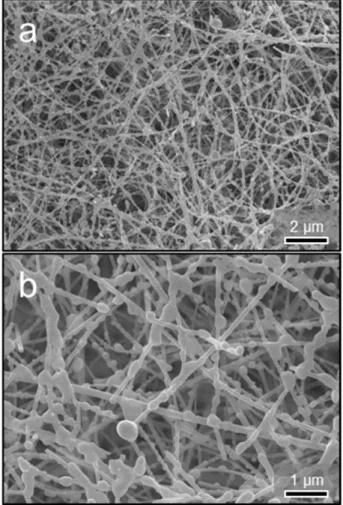
에서 나타냈다. 6,000배율의 SEM 이미지의 경우, 매끈 했던 SnO2나노선 표면에 다양한 사이즈의 Ag 금속입자 가 형성되어 있는 것을 확인할 수 있었다(Fig. 2(a)) 18,000 배율의 SEM 이미지에서는 나노선 상층부 표면과 나노선 하층부 표면 모두 Ag 금속입자가 전반적으로 균일하게 분포되어 있는 것을 확인할 수 있었다(Fig. 2(b)).

금속입자의 사이즈를 확인하기 위하여 TEM 분석을 진

Fig. 1. Schematic of gas sensor system.

Fig. 2. SEM images of (a) 6,000 magnification and (b) 18,000

Fig. 2. SEM images of (a) 6,000 magnification and (b) 18,000 magnification of Ag-functionalized SnO

2

nanowires.

Fig. 3. (a)-(d) TEM images of various magnifications of Ag-

(3)

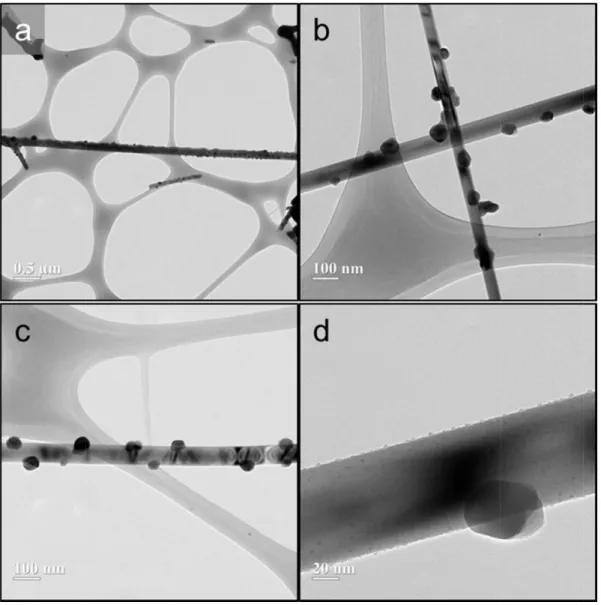
행하였으며, Fig. 3에 합성된 Ag-functionalized SnO2나노 선의 다양한 배율의 TEM 이미지를 나타냈다. Fig. 3(a-c) 에서 80 ~ 100 nm의 SnO2나노선 표면에 20 ~ 40 nm의 Ag 금속입자가 형성 되어 있는 것을 확인할 수 있었다. Fig.

3(d)

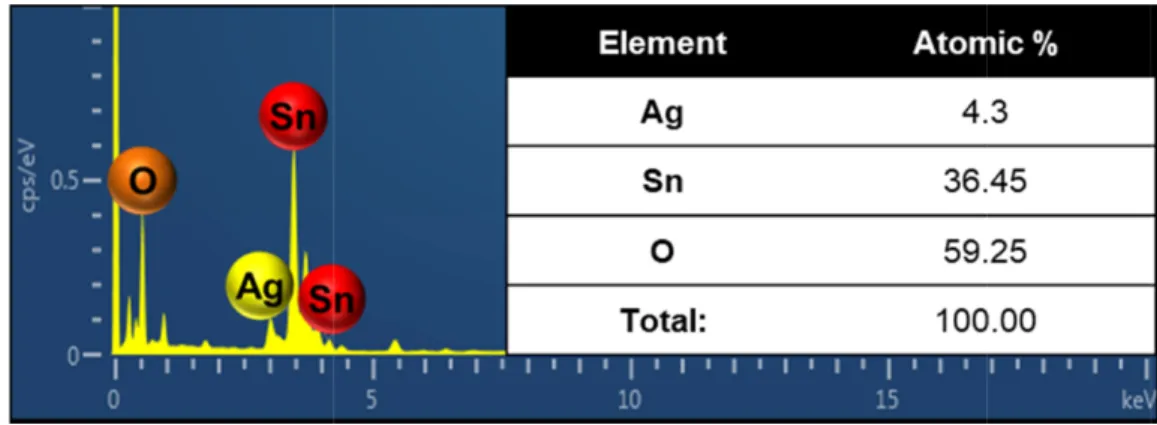
의 TEM 고배율 이미지를 통해서, 40 nm의 큰 금속 나노입자 이외에도 5 nm 이하의 매우 작은 금속 나노입 자도 균일하게 형성되어 있음을 확인하였다. 또한, 합성 된 나노 물질이 어떤 원소로 구성되어 있는지 확인하기 위하여 TEM EDS 분석을 진행하였다. EDS 분석 결과, 합 성된 물질이 Ag, Sn, O 원소로 이루어져 있음을 확인하 였다. Sn과 O로 이루어진 나노선에 Ag가 나노입자로 나 노선 표면에 형성되어 있음을 확인할 수 있었다(Fig. 4(a-

d))

그리고 정확한 구성 원소를 측정해본 결과, Ag, Sn, O 원소가 각각 4.3, 36.45, 59.25 at% 로 구성되어 있음을 확 인하였다(Fig. 5).

Ag-functionalized SnO

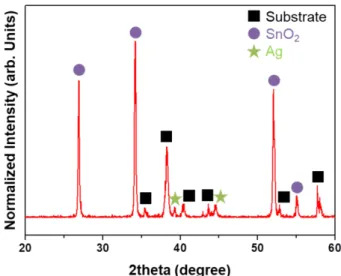
2나노선의 결정 구조를 분석하 기 위하여 XRD 분석을 진행하였고, 이를 Fig. 6에 나타냈 다. JCPDS card No. 41-1445를 참고하여 SnO2

(110), (101),

(211), (220)

면을 확인하였고, JCPDS card No. 65-2871을 참고하여 Ag (111), (200) 면을 확인할 수 있었다.

SEM, XRD, TEM

분석을 통해, FCVD 방법을 이용하 여 매우 빠른 시간인 5초 이내에 SnO2나노선 표면에 Ag 금속입자를 형성할 수 있었음을 증명하였다. 또한, 한가 지 사이즈의 Ag 금속입자가 아닌 다양한 사이즈의 균일 한 형성으로 인해 가스 감응도 향상을 기대할 수 있었다.

3.2 가스 센싱 테스트 및 메커니즘 해석

Ag-functionalized SnO

2나노선의 NO2가스 2, 6, 10 ppm 에 대하여 저온 50o

C

에서 가스 센싱 테스트를 진행한 결 과값을 Fig. 7에서 나타냈다. Fig. 7(a-c)에서 NO2가스 2,

6, 10 ppm

에 대한 Dynamic response curves를 나타냈고,

Fig. 7(d)

에서 NO2가스 감응도 결과를 나타냈다. 산화성 가스인 NO2가스를 n-type 반도체 물질인 SnO2나노선에 노출시켜 저항이 증가하는 것을 확인할 수 있었다. NO2

가스 2, 6, 10 ppm에 대하여 저온 50o

C

에서 감응도를 각 각 1.096, 1.155, 1.252의 결과값을 얻었다. 본 연구에서

Fig. 3. (a)-(d) TEM images of various magnifications of Ag-functionalized SnO

2

nanowires.

(4)

마이크로전자 및 패키징학회지 제27권 제2호 (2020)

제안한 FCVD를 이용하여 제작된 Ag-functionalized SnO2

나노선은 저온 50o

C

에서 높은 NO2가스 센싱 감응도를 나타낸 것을 확인하였다.

Fig. 8

에서는 Ag-functionalized SnO2나노선의 NO2 스 센싱 메커니즘에 관한 모식도를 나타냈다. SnO2나노 선의 경우, NO2가스에 노출 되면 나노선 표면에 존재하 는 산소 이온과 반응하거나 SnO2와 직접 반응하여 흡착

될 수 있다. SnO2와 NO2가스 사이의 산화 반응은 다음 과 같이 나타낼 수 있다.18)

NO

2

(g) + e

↔ NO2

(ads) (1)

NO

2

(ads) + O

2

(ads) + 2e

→ NO2

(ads) + 2O

(ads) (2) Fig. 4. (a) TEM image of Ag-functionalized SnO

2

nanowires. Results of EDS analysis; (b) Ag, (c) Sn and (d) O.

Fig. 5. TEM EDS elemental mapping with the corresponding compositional table of Ag-functionalized SnO

2

nanowires.

(5)

NO

2

(gas) + O

(ads)

↔ NO+

+ 2O

(3)

이미 많은 문헌에서 Ag 금속입자를 사용하여 금속 산 화물 반도체식 가스 센서의 가스 감응도 향상에 대한 연 구가 진행되고 있는 것을 확인할 수 있었다.19-25)또한, 다 양한 물질을 이용한 반도체식 가스 센서의 저온 가스 센 싱에 대한 결과를 Table 1에 나타냈다.26-31)다양한 문헌을 통해, Ag 금속입자에 의한 NO2가스 감응도 향상에 대한 몇 가지 이유를 추측할 수 있었다.

첫 번째 이유는 SnO2나노선에 부착된 Ag 금속 입자에 의해 맴돌이 효과(spillover effect) 를 통해 NO2가스 분자 의 흡착에 더 많은 활성 부위를 제공 할 수 있다는 점이 다. Ag 금속입자에 의해 맴돌이 효과에 의해 NO2가스 분자의 흡착이 촉진되었다. 따라서 전자 공핍층 (electron

Fig. 6. XRD result of Ag-functionalized SnO

2

nanowires.

Fig. 7. Dynamic response curves of NO

2

gas to (a) 10, (b) 6 and (c) 2 ppm of Ag-functionalized SnO

2

nanowires at 50

o

C. (d) Summarized gas response.

Fig. 8. Schematic of NO

2

gas sensing mechanism in Ag-functionalized SnO

2

nanowires

(6)

마이크로전자 및 패키징학회지 제27권 제2호 (2020)

depletion layers)

의 크기는 bare SnO2나노선보다 훨씬 더 커질 수 있으며, 전도길목(current path)의 감소로 이어진 다. 전도도의 감소가 커질수록 NO2센싱 감도 향상과 같 은 의미이고, 이는 bare SnO2대비 같은 양의 NO2가스로 도 더 많은 활성 부위 제공으로 인해 더 높은 감도를 얻 을 수 있는 효과를 나타냈다.32)

두 번째 이유는 일 함수(work function)의 차이로 인하 여 센싱 감응도 향상이 일어날 수 있었다. Ag의 일 함수 는 SnO2보다 낮으므로, Ag의 전자는 SnO2로 이동하여

bare SnO

2보다 많은 전자 공핍층이 Ag와 SnO2계면 주 위에 형성된다. Bare SnO2 나노선과 Ag-functionalized

SnO

2 나노선이 같은 양의 NO2가스의 흡착으로 전자 공 핍층의 다름으로 인해 가스 감응도의 차이를 야기시킬 수 있다. 또한, Ag 금속입자는 공기 중에서 Ag2

O

를 형성하 는 경향이 있어 SnO2나노선으로부터 전자를 추출하는 동안보다 강한 전자 공핍층의 형성을 촉진하여 전체적인 저항을 증가시키며, Ag와 SnO2계면 주변 영역이 센싱 감응도를 보다 민감하게 만들었다.33)

4. 결

SnO

2나노선에 5초 이내의 FCVD 공법을 적용하여, Ag 금속 입자가 기능화된 나노물질을 합성하였다. 다른 공 정에 비하여 매우 짧은 시간, 비교적 쉬운 공정 방법으로 물질 합성에 성공하였다. SEM, XRD, TEM 등의 분석장 비를 이용하여 형태학적, 조성적, 구조적 분석을 통해 나 노 물질의 검증이 이루어 졌으며, NO2가스 2, 6, 10 ppm 에 대하여 저온 50o

C

에서 감응도를 각각 1.096, 1.155,

1.252

의 결과값을 얻었다. 본 연구에서 제시된 저온 동작

Ag-functionalized SnO

2나노선 물질은 반도체 저항식 가 스센서의 재료적 측면에서 실제 산업 적용 가능성을 높 였다고 판단된다. 또한, 본 연구에서 제시한 FCVD 장비 를 이용한 금속입자 합성법은 여기에 소개된 SnO2에만 국한되지 않고, 시간적이나 경제적으로 실용성에서 월등 한 경쟁력을 보이기 때문에 향후 많은 분야에서 활용 가 능할 것으로 판단된다.

감사의 글

This research was supported by Basic Science Research Program through the National Research Foundation of Korea (NRF) funded by the Ministry of Education (NRF- 2019R1A6A1A11055660).

References
1. S. G. Chatterjee, S. Chatterjee, A. K. Ray, and A. K.

Chakraborty, “Graphene–metal oxide nanohybrids for toxic gas sensor: A review”, Sens. Actuators B-Chem., 221, 1170 (2015).

2. N. Yamazoe, “Toward innovations of gas sensor technology”, Sens. Actuators B-Chem., 108, 2 (2005).

3. S. Mahajan and S. Jagtap, “Metal-oxide semiconductors for carbon monoxide (CO) gas sensing: A review”, Appl. Mater.

Today, 18, 100483 (2020).

4. A. Dey, “Semiconductor metal oxide gas sensors: A review”, Mater. Sci. Eng., B 229, 206 (2018).

5. R. S. E. Shamy, D. Khalil, and M. A. Swillam, “Mid infrared optical gas sensor using plasmonic Mach-Zehnder interfer- ometer”, Sci. Rep., 10, 1293 (2020).

6. K. M. Yoo, J. Midkiff, A. Rostamian, C. Chung, H. Dalir, and R. T. Chen, “InGaAs membrane waveguide: a promising plat- form for monolithic integrated mid-infrared optical gas sen- sor”, ACS Sens., 5, 861 (2020).

7. H. Wan, Y. Gan, J. Sun, T. Liang, S. Zhou, and P. Wang,

“High sensitive reduced graphene oxide-based room tempera- ture ionic liquid electrochemical gas sensor with carbon-gold nanocomposites amplification”, Sens. Actuators B-Chem., 299, 126952 (2019).

8. M. A. H. Khan, M. V. Rao, and Q. Li, “Recent advances in electrochemical sensors for detecting toxic gases: NO

2

, SO

2

and H

2

S”, Sens., 19, 905 (2019).

9. N. Joshi, T. Hayasaka, Y. Liu, H. Liu, O. N. Oliveira Jr., and L. Lin, “A review on chemiresistive room temperature gas sensors based on metal oxide nanostructures, graphene and 2D transition metal dichalcogenides”, Microchim. Acta., 185, 213 (2018).

10. R. Godbole, S. Ameen, U. T. Nakate, M. S. Akhtar, and H.- S. Shin, “Low temperature HFCVD synthesis of tungsten oxide thin film for high response hydrogen gas sensor appli- Table. 1. Comparison of the semiconductor gas sensor operated low temperature

Materials Temp.

(

o

C) Target gas Conc.

(ppm)

Response

(R

a

/R

g

or R

g

/R

a

) Reference

CeO

2

NWs RT H

2

S 100 1.98 26

Au-SnO

2

-ZnO NWs RT CO 50 1.62 27

Pt-SnO

2

NWs 50 NO

2

30 1.3 28

Pt-SnO

2

composites 100 C

2

H

5

OH 100 11.2 29

Ag/ZnO-Graphene 150 C

2

H

2

100 21.2 30

Pd coated SnO

2

NFs 160 H

2

100 28 31

Ag-SnO

2

NWs 50 NO

2

10 1.252 This work

(7)

cation”, Mater. Lett., 254, 398 (2019).

11. Q. Wang, J. Bai, B. Huang, Q. Hu, X. Cheng, J. Li, E. Xie, Y. Wang, and X. Pan, “Design of NiCo

2

O

4

@SnO

2

hetero- structure nanofiber and their low temperature ethanol sensing properties”, J. Alloys Compd., 791, 1025 (2019).

12. R. S. Ganesh, M. Navaneethan, V. L. Patil, S. Ponnusamy, C.

Muthamizhchelvan, S. Kawasaki, P. S. Patil, and Y. Haya- kawa, “Sensitivity enhancement of ammonia gas sensor based on Ag/ZnO flower and nanoellipsoids at low temperature”, Sens. Actuators B-Chem., 255, 672 (2018).

13. R. Kumar, O. Al-Dossary, G. Kumar, and A. Umar, “Zinc oxide nanostructures for NO

2

gas–sensor applications: A review”, Nanomicro Lett., 7, 97 (2015).

14. J. Y. Park, W. J. Lee, H. J. Nam, and S.-H. Choa, “Technology of stretchable interconnector and strain sensors for stretchable electronics”, J. Microelectron. Packag. Soc., 25(4), 25 (2018).

15. Y. B. Shin, Y. H. Ju, and J.-W. Kim, “Technical trends of metal nanowire-based electrode”, J. Microelectron. Packag.

Soc., 26(4), 15 (2019).

16. M. S. Choi, J. H. Bang, A. Mirzaei, W. Oum, H. G. Na, C.

Jin, S. S. Kim, and H. W. Kim, “Promotional effects of ZnO- branching and Au-functionalization on the surface of SnO

2

nanowires for NO

2

sensing”, J. Alloys Compd., 786, 27 (2019).

17. M. S. Choi, H. G. Na, S. Kim, J. H. Bang, W. Oum, S. -W.

Choi, S. S. Kim, K. H. Lee, H. W. Kim, and C. Jin, “Synthesis of Au/SnO

2

nanostructures allowing process variable con- trol”, Sci. Rep., 10, 346 (2020).

18. M. S. Choi, J. H. Bang, A. Mirzaei, H. G. Na, C. Jin, W. Oum, S. S. Kim, and H. W. Kim, “Exploration of the use of p-TeO

2

- branch/n-SnO

2

core nanowires nanocomposites for gas sens- ing”, Appl. Surf. Sci., 484, 1102 (2019).

19. V. N. Singh, B. R. Mehta, R. K. Joshi, F. E. Kruis, and S.

M. Shivaprasad, “Enhanced gas sensing properties of In

2

O

3

:Ag composite nanoparticle layers; electronic interaction, size and surface induced effects”, Sens. Actuators B-Chem., 125, 482 (2007).

20. J. Zhang and K. Colbow, “Surface silver clusters as oxidation catalysts on semiconductor gas sensors”, Sens. Actuators B- Chem., 40, 47 (1997).

21. Q. Xiang, G. Meng, Y. Zhang, J. Xu, P. Xu, Q. Pan, and W.

Yu, “Ag nanoparticle embedded-ZnO nanorods synthesized via a photochemical method and its gas-sensing properties”, Sens. Actuators B-Chem., 143, 635 (2000).

22. P. Hu, G. Du, W. Zhou, J. Cui, J. Lin, H. Liu, D. Liu, J. Wang, and S. Chen, “Enhancement of ethanol vapor sensing of TiO

2

nanobelts by surface engineering”, ACS Appl. Mater. Inter- faces., 2, 3263 (2010).

23. Z. Wen, L, Tian-mo, and L. De-jun, “Formaldehyde gas sens- ing property and mechanism of TiO

2

–Ag nanocomposite”, Physica B-Condens. Matter, 405, 4235 (2010).

24. J. Wang, B. Zou, S. Ruan, J. Zhao, and F. Wu, “Synthesis, characterization, and gas-sensing property for HCHO of Ag- doped In

2

O

3

nanocrystalline powders”, Mater. Chem. Phys., 117, 489 (2009).

25. Y. Wang, Y. Wang, J. Cao, F. Kong, H. Xia, J. Zhang, B. Zhu, S. Wang, and S. Wu, “Low-temperature H

2

S sensors based on Ag-doped

α-Fe2

O

3

nanoparticles”, Sens. Actuators B-Chem., 131, 183 (2008).

26. Z. Li, X. Niu, Z. Lin, N. Wang, H. Shen, W. Liu, K. Sun, Y.Q.

Fu, and Z. Wang, “Hydrothermally synthesized CeO

2

nanow- ires for H

2

S sensing at room temperature”, J. Alloys Compd., 682, 647 (2016).

27. J.-H. Kim, A. Mirzaei, H. W. Kim, and S. S. Kim, “Low power-consumption CO gas sensors based on Au-functional- ized SnO

2

-ZnO core-shell nanowires”, Sens. Actuators B- Chem., 267, 597 (2018).

28. S.-W. Choi, S.-H. Jung, J. Y. Park, and S. S. Kim, “Improve- ment in sensing properties of SnO

2

nanowires by functional- izing with Pt nanodots synthesized by

γ-ray radiolysis”, J.

Nanosci. Nanotechno., 12, 1526 (2012).

29. L. Wang, Y. Wang, K. Yu, S. Wang, Y. Zhang, and C. Wei,

“A novel low temperature gas sensor based on Pt-decorated hierarchical 3D SnO

2

nanocomposites”, Sens. Actuators B- Chem., 232, 91 (2016).

30. A. S. M. I. Uddin, D.-T. Phan, and G.-S. Chung, “Low tem- perature acetylene gas sensor based on Ag nanoparticles- loaded ZnO-reduced graphene oxide hybrid”, Sens. Actuators B-Chem., 207, 362 (2015).

31. F. Wang, K. Hu, H. Liu, Q. Zhao, K. Wang, and Y. Zhang,

“Low temperature and fast response hydrogen gas sensor with Pd coated SnO

2

nanofiber rods”, Int. J. Hydrog. Energy, 45, 7234 (2020).

32. S. Matsushima, Y. Teraoka, N. Miura, and N. Yamazoe,

“Electronic interaction between metal additives and tin diox- ide in tin dioxide-based gas sensors”, Jpn. J. Appl. Phys., 27, 1798 (1988).

33. X. Xu, Y. Chen, G. Zhang, S. Ma, Y. Lu, H. Bian, and Q.

Chen, “Highly sensitive VOCs-acetone sensor based on Ag-

decorated SnO

2

hollow nanofibers”, J. Alloys Compd., 703,

572 (2017).

수치

Fig. 1. Schematic of gas sensor system.
Fig. 3. (a)-(d) TEM images of various magnifications of Ag-functionalized SnO 2  nanowires.
Fig. 5. TEM EDS elemental mapping with the corresponding compositional table of Ag-functionalized SnO 2  nanowires.
Fig. 7. Dynamic response curves of NO 2  gas to (a) 10, (b) 6 and (c) 2 ppm of Ag-functionalized SnO 2  nanowires at 50 o C

참조

관련 문서

Second, what effect does psychodrama have on sub-factors of personal relationship; satisfaction, communication, trust, intimacy, sensitivity, openness,

Among the sub-factors of autonomy support coaching behavior, strategy recognition had the most direct influence on the grit of athletes, followed by

In the case of inherently conducting polymers like PANI or PPY, the conductivity values of the metal oxide based composites showed wide variations excepting in PPY-ZrO 2 , and

Fourth, for the sub-factors of personality traits according to weight lifters’ education, while there was a high difference in neuroticism and agreeableness

Fluorescence Amplication and Development of VOCs Sensor Based on Anisotropic Porous Silicon Derivatives..

For the sub-factors of selection attributes and customer value according to screen golf course handicap, convenience, professionality, facilities, price,

&#34;Relationship between variations of 7Be, 210Pb and 212Pb concentrations and sub-regional atmospheric transport: simultane- ous observation at distant

• Inertial sub-layer, viscosity plays a minor role. • Main turbulent