• 검색 결과가 없습니다.

Wireless Channel Management Scheme for ASMD Groups in Wireless N-screen Services

N/A
N/A
Protected

Academic year: 2021

Share "Wireless Channel Management Scheme for ASMD Groups in Wireless N-screen Services"

Copied!
7
0
0

로드 중.... (전체 텍스트 보기)

전체 글

(1)

1. INTRODUCTION

N-screen is an emerging technology and de- mand of future to support multimedia multicasting, content sharing, content convergence, media scal- ability, media synchronization, and seamless mobi- lity. The initial N-Screen service has begun from three-screen services of AT&T in 2007 and has meant the service that enables the users to utilize content with various ways by connecting TV, PC, and mobile phone the most commonly used by users [1-2]. In recent years, as various kinds of smart devices such as smart phones are emerging, and the subject of communication such as M2M (Machine-to-Machine) have expanded, services that target various devices reborn as a new con- vergence services through a continuing evolution

from OSMU (One Source Multi Use) to ASMD (Adaptive Source Multi Device) N-screen services [1-3].

N-screen service transmits the service content via a wired or wireless network. Since the increase of the requirement for high quality image service causes the increase of network bandwidth required for service, the technology for the efficient use of network resource is essential. Thus, the service providers should obtain the technology that uses service network efficiently and the technology that provides the highest quality content seamlessly [1-3].

A wireless interface to connect each N-screen network device is required to carry out the com- munication in wireless network environment. IrDA, Bluetooth, etc. are applied in commercial product

Wireless Channel Management Scheme for ASMD Groups in Wireless N-screen Services

Kyeong Hur

ABSTRACT

In this paper, a Wireless USB (WUSB) protocol is adopted for development of ASMD (Adaptive Source Multi Device) N-screen wireless services. WUSB is the USB technology merged with WiMedia PHY and Distributed-MAC (D-MAC). However, the current WUSB protocol can’t provide seamless N-screen streaming services to moving WUSB devices in home network environment. Therefore, to provide the ASMD N-screen services through WUSB based on D-MAC protocol, a channel management scheme is proposed to support seamless mobility between adjacent ASMD groups for wireless IPTV N-screen services. In simulation results, proposed ASMD channel management (ACM) scheme is compared with conventional WUSB channel management scheme in view points of throughput, average path interference and energy consumption according to various numbers of nodes and elapsed simulation times. Through simulation results, it is explained that proposed ASMD channel management (ACM) scheme should be adopted in the WUSB protocol to realize ASMD N-screen wireless services.

Key words: Adaptive Source Multi Device, Distributed MAC, N-screen, WiMedia, Wireless USB

※ Corresponding Author : Kyeong Hur, Address: (13910) Gyeonggi-do Anyang-si Manan-gu, Sammak-ro 155, Dept. of Computer Education, Gyeongin National Univer- sity of Education Gyeonggi Campus, Korea, TEL : +82-31-470-6292, FAX : +82-31-470-6299, E-mail : khur

@ginue.ac.kr

Receipt date : Sep. 19, 2016, Revision date : Oct. 24, 2016 Approval date : Nov. 14, 2016

Dept. of Computer Education, Gyeongin National

University of Education

(2)

as wireless interface, and the research for wireless USB (Universal Serial Bus) to merge USB tech- nology with WiMedia Distributed Medium Access Control (D-MAC) and UWB (Ultra Wide Band) technology has been investigated in recent years [4-6]. USB can support 12Mbps data transfer rate, while serial port support the data transfer rate up to 100Kbps. Also, USB can reduce the installation of complex adapter between network devices and PC peripheral devices. Therefore, USB connectiv- ity makes content convergence possible through PC host and is essential for the ASMD N-screen services [1-3].

In this paper, a Wireless USB (WUSB) protocol is adopted for development of ASMD N-screen wireless services. WUSB is designed to support the communication through the point-to-point connection between PC host and its device.

However, the current WUSB protocol can’t provide seamless N-screen streaming services to moving WUSB devices in home network environment.

Therefore, to provide the ASMD N-screen serv- ices through WUSB based on D-MAC protocol, an ASMD channel management (ACM) scheme is proposed in Section 2, to support seamless mobility between adjacent ASMD groups for wireless IPTV N-screen services. And in Section 3, we designed the ASMD GROUP network and simulated it for performance evaluation. In Section 4, conclusions for this paper are presented.

2. PROPOSED MULTI-CHANNEL MANAGE- MENT FOR ASMD GROUPS

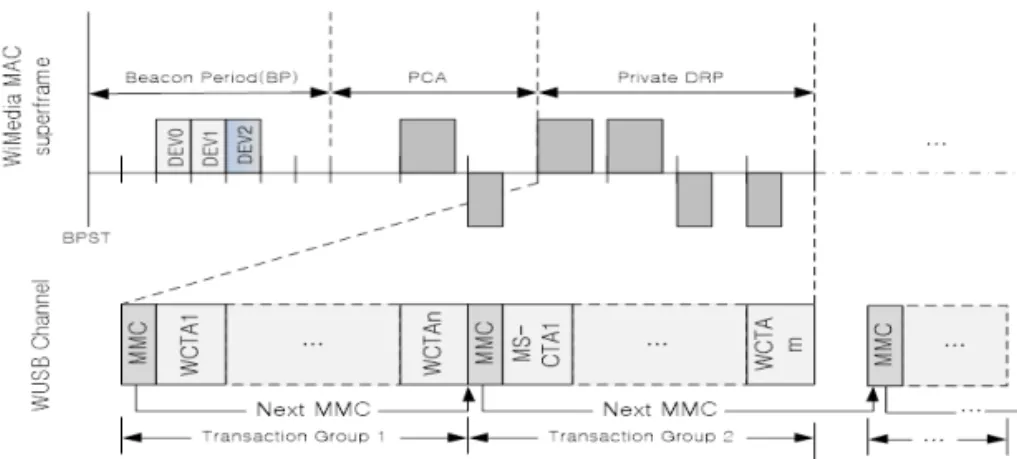
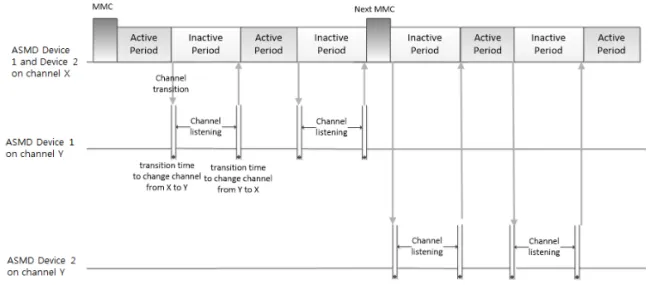
WUSB protocol works on WiMedia D-MAC su- perframe [4-5], and WUSB Channel consists of a set of Private DRP (Distributed Reservation Proto- col) time reservations within WiMedia D-MAC superframe. As shown in Fig. 1, WUSB defines a WUSB Channel which is encapsulated within a set of WiMedia D-MAC superframes via a set of Private DRPs. The WUSB Channel is a continuous sequence of control packets, called MMCs (Micro- scheduled Management Commands). An MMC contains WCTA (wireless USB channel time allo- cation) IE (Information Element) to indicate the in- formation of WUSB Channel utilization in WUSB Transactions. In Fig. 2, WUSB devices in ASMD GROUP cluster 1 communicate using Private DRP duration 1 and WUSB devices in ASMD GROUP cluster 2 communicate using Private DRP duration 2 with their corresponding host.

In ASMD N-screen networks, one more bridge devices exist to communicate with external net- work, and they communicate with external net- work using Ethernet protocol. Also, bridge device initializes and configures an ASMD group of WUSB cluster. At the initial stage, ASMD bridge device automatically is registered by configuring new ASMD GROUP and can only communicate with members registered in its own ASMD

Fig. 1. Architecture of WUSB Channel.

(3)

GROUP. After client devices register in the exist- ing ASMD GROUP, it can communicate with de- vices belonging to the registered ASMD GROUP.

Prior to configure new ASMD GROUP, bridge device first finds the existence of another ASMD GROUP to select own ASMD GROUPID and idle channel. The bridge device that configures ASMD GROUP broadcasts beacon frame including ASMD GROUPID to advertise the information of its own ASMD GROUP. A device that is already enrolled in an existing ASMD GROUP is referred to as a registrar, and a device seeking to enroll in the ASMD GROUP is referred to as an enrollee. When enrollee receives a beacon frame sent by registrar, it sends an association frame to registrar to asso- ciate ASMD GROUP. Device that detects the in- terference or collision must notify the collision to bridge device belonging to its own ASMD GROUP.

In our proposed ASMD channel management (ACM) scheme, the bridge device that receives ASMD GROUP Collision IE selects one of idle channel and announces the channel to move to ASMD GROUP members. To provide the in- formation of channel migration to ASMD GROUP

members, the bridge device broadcasts a MMC packet including the ASMD GROUP Channel Change IE. Fig. 3 shows the format of ASMD GROUP Channel Change IE.

To change the ASMD GROUP channel, the bridge device must scan the idle channel. In order to scan the idle channel, bridge device selects the idle device. The selected device scans the idle channel during idle period. To balance an energy load, bridge device changes the device that scans an idle channel periodically. Fig. 4 shows the idle channel scan process during inactive period.

Bridge device stores the information of channel to move in New Channel Number field and stores the information of superframe to perform the chan- nel migration in Channel Change Countdown field.

ASMD GROUP members that have received the ASMD GROUP Channel Change IE move to the selected channel and continue to perform the exist- ing communication in the new ASMD GROUP.

Also, in our proposed ASMD channel management (ACM) scheme, the bridge device broadcasts the ASMD GROUP Channel Change IE to the adjacent ASMD GROUPs through Ethernet. Bridge devices Fig. 2. WUSB channel time allocations for ASMD group communications.

tc

Fig. 3. The format of ASMD GROUP Channel Change IE.

(4)

that have received the ASMD GROUP Channel Change IE broadcast MMC packet including ASMD GROUP Channel Utilization Information IE.

Devices that have received the ASMD GROUP Channel Utilization Information IE update channel map information, and use the information in the new ASMD GROUP. Fig. 5 shows the format of the ASMD GROUP Channel Utilization Informat- ion IE.

Fig. 5. ASMD GROUP Channel Utilization Information IE.

3. PERFORMANCE EVALUATION

We designed an ASMD group network using a PARSEC (PARallel Simulation Environment for Complex systems) simulation platform with D- MAC and WUSB simulation parameters shown in Table 1 [8]. Fig. 6 shows our simulation model of a network where multiple ASMD GROUPs coexist [1-3]. Let us assume that Device 1 (D1) is asso- ciated with bridge 1(B1). B1 operates normally on channel X and knows that other ASMD GROUP operates on channel Y through ASMD GROUP

Channel Change IE. Device 1 (D1) in the over- lapped region of the transmission ranges of bridge 1 (B1) and bridge 2 (B2) receives IPTV streaming Fig. 4. ASMD GROUP idle channel scan process.

Table 1. Simulation Parameters

Parameter Value

Transmission Power -41.3dB/Mhz

Bandwidth 528Mhz

Frame Size 512, 1024, 2049, 4096 Bytes

Symbol Length 312.5ns

Preamble Length 9.375us

Header Length 3.75us

SIFS 10us

MISF 1.875us

Fig. 6. Simulation Model of an ASMD GROUP network.

(5)

data from B1. When D1 moves into the region of B2, it cannot receive IPTV data streaming from channel X of B1. However, by using our ACM scheme, D1 can change the channel into channel Y since it know the clean channel of B2 through ASMD GROUP Channel Change IE from B2. Thus, D1 can receive IPTV streaming data seamlessly from B2 through Ethernet, after D1 updates chan- nel map information of B2 through receiving ASMD GROUP Channel Utilization Information IE from B2.

We considered a multimedia application with a wireless IPTV and a personal video recorder (PVR) recording the same program. At some point, the user picks up a remote control and tunes the set-top box (STB : B1) to start the IPTV program.

The PVR in the STB simultaneously starts to re- cord the same program to a wirelessly connected external hard disk drive (D1) that is located in a closet next to the living room. Assume the video source of the service provider generates an MPEG-4 stream using Real-Time Transport Pro- tocol (RTP) as transport.

To create the environment in which the data frame collision occurs at both B1 and B2, we set up that two ASMD GROUPs reserve the over- lapped Private DRP durations and transmit N- screen data frames in reserved Private DRP on the same channel. The simulations are run for 1000 seconds and the D-MAC and WUSB simulation parameters are summarized in Table 1. The ASMD GROUP 1 starts its operation at 0.0 second and the ASMD GROUP 2 starts its operation at 500 second [6-8].

To compare the performance of the proposed al- gorithms, we use the following two measurements:

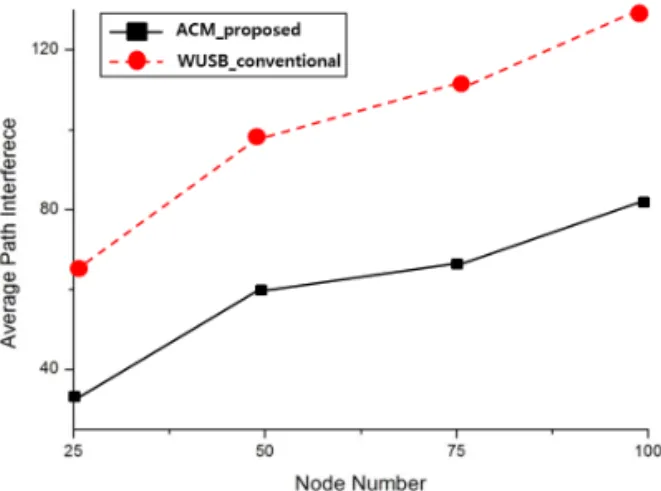
total energy consumption and average path inter- ference of all the node pairs. Fig. 7 shows that pro- posed ACM scheme can achieve the better per- formance of path interference than conventional WUSB protocol. This result is caused by the re- duced collisions through fast assigning clean chan-

nel of new ASMD group to moving devices. It is also caused by fast finding new clean channel of Bridges in WUSB clusters during idle periods.

In Fig. 8, the dissipated power consumption of device (D1) located in the overlapped region of the transmission ranges of ASMD bridge devices (B1 and B2) is observed. The dissipated power con- sumption of device that uses ACM scheme is equal to that of device operated before a time that data frames collide as seen in this figure. The device that uses conventional WUSB performs channel scan at 500 second where beacon frames collide first. In the simulation, the device that uses con- ventional WUSB tries to synchronize with the

Fig. 7. Comparison of average path interference of ACM over conventional WUSB.

Fig. 8. Comparison of Energy consumption of ACM over

conventional WUSB.

(6)

ASMD bridge, but cannot receive beacon frame and then failed to synchronize due to beacon frame collisions from both bridges. In the conventional WUSB, adjacent WUSB bridges (B1 and B2) do not try to find non-overlapped clean channel and cannot notify new channel to their devices before collisions occur due to the same channel. Finally, the device that uses conventional WUSB turns off and does not consume the energy after 505 seconds.

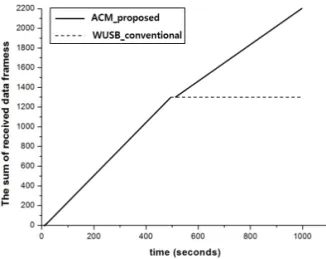
Fig. 9 depicts the sum of received data frames with respect to simulation time. The sum of re- ceived data frames do not increase, since device D1 does not receive data anymore after a data frame collides in the conventional WUSB protocol.

However, the sum of received data frames in- creases after some delay time when using ACM scheme. If the bridge B2 finds the clean channel Y against B1 to switch after a data frame collision at 500 second, it notify to D1 through the ASMD GROUP Channel Change IE.

4. CONCLUSIONS

In this paper, WUSB protocol is adopted for de- velopment of ASMD N-screen wireless services.

Because proposed ACM scheme usually performs idle channel scans in inactive durations, ASMD group can move the wireless channel fast after data

frame collision occurs. Thus, it can minimize the disconnection of ASMD network occurred by the channel collision. Through simulation results, it is explained that proposed ASMD channel manage- ment (ACM) scheme should be adopted in the WUSB protocol to realize ASMD N-screen wire- less services. By applying these research results of wireless N-screen services, an implementation framework for the next-generation smart commu- nication system can be configured.

REFERENCE

[ 1 ] C. Yoon, T. Um, and H. Lee, “Classification of N-Screen Services and Its Standardiza- tion,” Proceeding of IEEE 2012 14th Interna- tional Conference on Advanced Communica- tion Technology, pp. 597-602, 2012.

[ 2 ] J.K. Woo and F. Ullah, “Dynamic Addition and Deletion of Device in N-screen Environment,”

Proceeding of Fourth International Confer- ence on Ubiquitous and Future Networks, pp.

118-122, 2012.

[ 3 ] J. Lee, K. Lim, H. Kahng, J. Park, and K. Lee,

“A Hybrid Transmission Scheme for Multiple IPTV Streams in UWB Bridged Networks,”

Proceeding of IEEE ICOIN, pp. 21-24, 2009.

[ 4 ] WiMedia MAC Release Specification 1.5, http://www.wimedia.org/en/specs.asp?id=

specs (accessed Nov., 30, 2016).

[ 5 ] J.W. Kim, K. Hur, and S.R. Lee, “A QoS Provisioning Mechanism of Real-time Wire- less USB Transfers for Smart HDTV Multi- media Services,” Wireless Personal Commu- nications, Vol. 77, No. 2, pp. 1585-1604, 2014.

[ 6 ] K. Hur, “Distributed Medium Access Control for N-Screen Multicast Services in Home Networks,” Journal of Korea Multimedia Society, Vol. 19, No. 3, pp. 567-572, 2016.

[ 7 ] S. Wie and J. Jang, “Distributed Mobility Management Strategy with Pointer Forward- ing Technique,” Journal of Information and Fig. 9. Throughput of ACM scheme compared to con-

ventional WUSB protocol.

(7)

Communication Convergence Engineering, Vol. 13, No. 4, pp. 248-256, 2015.

[ 8 ] K. Hur and W.S. Sohn, “An Energy Efficient Time Synchronization Technique Based on WUSB over WBAN Protocol for Wearable Computer Systems,” Journal of Korea Multi- media Society, Vol. 15, No. 7, pp. 879-884, 2012.

Kyeong Hur

He is currently a professor in the Department of Computer Education at Gyeongin National University of Education, Repub- lic of Korea, since September 2005. He was senior researcher with Samsung Advanced Insti- tute of Technology (SAIT), Korea from September 2004 to August 2005. He received a M.S. and Ph.D.

in Department of Electronics and Computer Engineer- ing from Korea University, Seoul, Korea, in 2000 and 2004, respectively. His research interests include;

Medium access control, computer network QoS, and

Mobile-IP networks.

수치

Fig. 1. Architecture of WUSB Channel.
Fig. 5. ASMD GROUP Channel Utilization Information IE.
Fig. 7. Comparison of average path interference of ACM  over conventional WUSB.
Fig. 9 depicts the sum of received data frames with respect to simulation time. The sum of  re-ceived data frames do not increase, since device D1 does not receive data anymore after a data frame collides in the conventional WUSB protocol.

참조

관련 문서

It is built as the automated fruit warehouse management system based on the wireless sensor network in the fruit warehouse through the RFID/USN can use

In compact rectenna design, wireless power transmission technology is expected to be low power and low voltage in order to drive wireless

In this paper, we propose tree-based greedy algorithm to solve the minimum power broadcasting problem for minimizing the total transmit power on broadcasting in wireless

The purpose of this study is to examine a scheme for growth, management rationalization and reform measure of domestic coastal shipping companies, and Ihope that this will be

LOPO devotes on improvement of public services of public organizations by establishing transparency on management and achieve the rational management of public

• In an unbiased sampling scheme with total n samples for these two strata, nP(A) or na samples are used for stratum A and nP(R~A) or n(1-a) are used for stratum R~A..

WIRELESS NETWORKING, 430.752B, 2020 SPRING SEOUL NATIONAL UNIVERSITY.. Technical Issues in Wireless Networking - Mobility

• In an unbiased sampling scheme with total n samples for these two strata, nP(A) or na samples are used for stratum A and nP(R~A) or n(1-a) are used for