INTRODUCTION
Hydrogels have been studied in every field because of their peculiar material forms, which can be swollen in water, buffered, or physiological solutions without dissolution due to the presence of chemical or physical cross-links (Lucille et al. 2003; Safaa et al. 2007). In order to prepare the hydro-gels, cross-linking agents are necessary to initiate the poly-merization process, however, the unreacted cross-linkers and initiators reduce their biocompatibility due to their inherent cytotoxicity (Gupta and Jabrail 2007). As for their practical use, it is mainly limited to applications of high water absorp-tion because gels have inferior mechanical strength. Indeed gels become stronger with cross-linking, but there is the
pos-sibility that the flexibility and the water content decrease (Peppas and Merrill 1976; Karadeg et al. 1996; Krasnov et al. 2004). Lately, it has been shown that hydrogels with high water content, strength and elasticity can be synthesized easily by γ-ray irradiation to an aqueous solution of poly (vinyl alcohol) (PVA) without any initiators or cross-linkers, which may be harmful and difficult to remove (Rosiak and Ulanski 1999).
Glycerol, typical glass-forming material, has multi-hydrox-yl moiety structure which possesses the strong ability to in-teract with a polysaccharide matrix through hydrogen bond-ing interaction (Suyatma et al. 2005). As a result, the appli-cations of glycerol in polymer blending systems such as PVA/gelatin, PVA/algae, and PVA/gellan have greatly im-proved their mechanical flexibility, ductility, and chain mo-bility (Arvanitoyannisa et al. 1998; Chiellini et al. 2008). In addition, the glycerol has been used to provide the desirable elasticity and hydroscopic nature, as well as a high
absorp-─ ─ 89 ──
Hydrogen Bonding Effect on γ-Ray Irradiated Poly(vinyl alcohol)
Hydrogels in Different Drying Conditions
Hui-Jeong Gwon*, Sun Young Jo, Eun Ji Park, Young Min Shin, Jong-Bae Choi, Jong-Seok Park, Youn-Mook Lim, Young-Chang Nho and Phil Hyun Kang Research Division for Industry & Environment, Advanced Radiation Technology Institute,
Korea Atomic Energy Research Institute, Jeongeup 580-185, Korea
Abstract -- Three-dimensional network hydrogels were prepared by γγ-irradiation of aqueous solutions of poly(vinyl alcohol) (PVA) and glycerol (Gly). Oven-drying was used to measure the gel fraction (G), hydration (H) or swelling behavior (S) of the prepared hydrogels. This study made a hypothesis that hydrogen bonds due to addition of glycerol and change of dry states such as freeze-drying (FD), room-drying (RD) and oven-drying (OD) acts on the G, H, and S. Interesting results on the hydrogen bonding effect in the prepared hydrogels are monitored at different drying conditions. The FD samples have a higher G values with increase in glycerol content as compared with the OD and RD samples. The formation of strong hydrogen bonding network among Gly mol-ecules and hydrogel matrix was considered as the main driving force, resulting in the changes in the G, H, and S of the hydrogels under different drying conditions.
Key words : Gel-dry, Glycerol, Hydrogen bonding, γγ-Irradiation, Poly(vinyl alcohol)
* Corresponding author: Hui-Jeong Gwon, Tel. +82-63-570-3087, Fax. +82-63-570-3079, E-mail. [email protected]
tive capacity, to the hydrogels for improved wound healing (Huang and Yang 2008). In particular, the glycerol is soluble in wound fluid and skin moisture and creates an osmotic gradient that draws healing agents into the wound and con-centrates them there by absorbing the watery portion of the wound fluid.
Exploring some basic interactions in polymeric hydrogel preparation is of great significance for designing biomedical devices such as wound dressing, tissue scaffold, and drug delivery carriers with controlling structure and properties (Peppas et al. 2000; Hoffman 2002; Ratner and Bryant 2004; Gwon et al. 2010). This study suggests that changes of drogen bonding network among glycerol molecules and hy-drogel matrix are considered as the main driving force result-ing in changes in the gel fraction (G), hydration (H), and swelling behavior (S) of hydrogels under different drying conditions. In order to understand the experimental results, it is necessary to clarify the relationship of the structure, hy-dration, and bonding properties in the precursor gels as well as the hydrogels. In addition, this kind of understanding should also be important for designing PVA hydrogels with suitable properties for medical use.
MATERIALS AND METHODS
1. Materials
Poly(vinyl alcohol) (PVA) (Mw==8.5×10⁴~1.46×10⁵, 98% hydrolyzed) was purchased from the Aldrich Chemical Company (WI, USA). Glycerol (Gly) was obtained from DC Chemical Co. (Korea). Unless otherwise specified, water was distilled and deionized using a Milli-Q System (Millipore Co., USA) prior to use. All other chemicals were regent grade and used without further purification.
2. Preparation of PVA/Gly hydrogel
As previously reported (Nho 2004), the PVA and Gly were mixed into the desired proportions and dissolved in distilled water at 120�C for 20 min using an autoclave (KMC 1221, Korea). The contents of Gly in the 20 wt% PVA solution were 0, 5, 10, and 15 wt%. To remove bubbles and prevent drying of the homogeneous solutions, the solutions were placed in a water bath at 70�C for 30 min. These solutions were casted and irradiated at doses of 20, 40, and 60 kGy,
respectively, from 60Co γ-source (MDS Nordion, CA, IR221n wet storage type C-188, Advanced Radiation Technology Institute, Korea, dose rate: 10 kGy∙h-1). Thereafter, oven-drying (OD), freeze-oven-drying (FD) and room-oven-drying (RD) of the hydrogels were carried out in an oven at 75±2�C, in a freeze dryer at -40�C, and at room temperature (20±2�C) up to constant a constant weight, respectively. The gel frac-tion (G), hydrafrac-tion (H) and swelling behavior (S) properties of the gels under the different drying conditions were then measured.
3. Determination of gel fraction ratio (G)
Samples of the dried hydrogels (Gi) at different conditions were put into a stainless steel net of 200 mesh size and ex-tracted in distilled water by immersing at 50�C for 72 h. The remaining gels were kept in a 60�C oven for 48 h to com-pletely dry the samples. The G was calculated gravimetri-cally by G (%)==(Gd/Gi)×100, where Gdis the dried gel weight after extraction and Giis the initial weight of the dried gel before extraction.
4. Determination of swelling behavior (S) and hydration (H)
The most important properties of hydrogels are the ability to imbibe water and then swell. To measure the swelling (S) and hydration (H), the hydrogel samples were cut into an area of 2 cm×2 cm (thickness: 5 mm), and weighed dry. Afterwards, these dried gels were immersed in distilled wa-ter for different time inwa-tervals at room temperature until an equilibrium state of swelling was achieved. In each time, the excessive surface water was removed with filter paper and the weight of the swollen gel was measured. The H was calculated as He/Hi, and the percentage of S was evaluated by S (%)==[(Ss-Si)/Si]×100, where Heis the weight of the swollen gel at an equilibrium state, Ssis the weight of the swollen gel at various time intervals, and Hiand Siare the initial weight of the dried gel.
5. Thermal analysis
During a measurement using differential scanning calori-metry (DSC, DSCQ100 TA Instrument Company), the ex-tracted dry hydrogels were heated from 30 to 240�C under a N2atmosphere with a heating rate of 10�C∙min-1.
RESULTS AND DISCUSSION
1. Formation of PVA/Gly network hydrogel by gamma irradiation
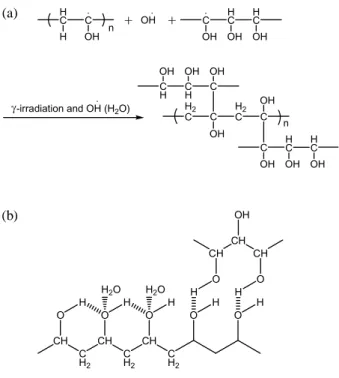
The radiation technique is a very convenient tool for the improvement or modification of polymer materials through cross-linking, grafting, or degradation (Zhao et al. 2004). Cross-linking by radiation transforms a linear polymer into a three-dimensional molecule, resulting in a significant in-crease in the molecular mass and lower solubility in organic solvents, and improves the mechanical properties. Degrada-tion results in a decrease in molecular mass, and has the oppo-site effect on the physical properties of the polymer. When an aqueous mixture of PVA and glycerol is exposed to gam-ma irradiation, free radicals are formed on the chains of both species. Also, the radiolysis products of water especially hy-droxyl free radicals, are very effective in generally free radi-cals on both PVA and glycerol. Therefore, glycerol is bond-ed in the presence of PVA chains. The formation of free rad-icals along the PVA chains leads to the formation of PVA
and glycerol networks as illustrated in Fig. 1, in which poly-merization and cross-linking occur simultaneously. On the other hand, the formation of intramolecular hydrogen bonds between OH groups of PVA and Gly in an aqueous solution has also been formed.
2. Gel fraction ratio (G)
Fig. 2 shows the effect of Gly contents on the gel fraction of the PVA/Gly hydrogels formed by γ-irradiation at a dose of 20 kGy and different drying conditions. FD samples have a higher gel fraction value at 10 and 15 wt% of Gly as com-pared with OD and RD samples. It can be seen that the in-crease of Gly ratio causes an inin-crease in the total gel fraction from 55, 68, and 77% for pure PVA to 83, 92, and 78% for the OD, FD, and RD hydrogels prepared from 15 wt% of Gly, successively. This could be explained as a consequence of decreased freeze damage in the FD sample by the Gly and the thermal instability in the OD sample at 75�C, which affect the cross-linking density. When an unstable hydrogel is frozen and later thawed, its texture and structure begin to degrade through physical changes. Therefore, the Gly could be minimized freeze damage due to ice formation and pro-mote structural stability by maintaining some flexibility as well as the original function by forming hydrogen bonds in the aqueous polymer solution. This also may imply that the glycerol in the FD samples helps to prevent the destruction of some of the cross-linked networks at lower temperature and the dissociating of hydrogen bonds at higher tempera-ture for the OD samples. In case of the OD samples without H C C H OH n C HC OH OH OH H C + OH + -irradiation and OH (H2O) H2 C C H2C OH C H CH OH OH OH C OH C C HC OH OH OH H C n (a) CH C H2 CH C H2 CH C H2 O O H O H H O H O H H2O CH CH CH O OH O H H H2O
intra-molecular hydrogen bonding PVA-water hydrogen bonding (b)
γ
Fig. 1. Formation of PVA/Gly network hydrogel by γ-irradiation in aqueous solution; (a) PVA/Gly network by radical, (b) hy-drogen bonding consist of PVA-PVA and PVA-Gly.
Glycerin content (wt%) 0 5 10 15 Gel f racti on (%) 0 20 40 60 80 100 OD FD RD
Fig. 2. Gel fractions for OD, FD, and RD hydrogels prepared from 5, 10, and 15 wt% Gly at 20 kGy.
Gly, the physically cross-linked polymer chain segments obtained more thermal energy and moved faster, which may destroy some of the crystallites and dissociate the hydrogen bonds, resulting in a decrease in the cross-linking density. As for the RD samples, the gel fraction increased with in-creasing the Gly contents due to the formation of their hydro-gen bonding, but decreased when the Gly contents increased above 5 wt%. This is probably due to the decrease of ordered associations of PVA molecules by the increase of glycerol. For this reason, as in the cross-linking density, the gel frac-tion increased with an increase in glycerol content.
3. Hydration (H) and swelling behavior (S)
Water-imbibed properties of the hydrogels in the OD, FD, and RD samples have been investigated with time and Gly concentration. The changes of H and S over time for the OD, FD, and RD samples prepared at various Gly contents and a fixed dose of 20 kGy are shown in Figs. 3~5. The changes of H follow the same patterns as those found in the case of S. The only difference manifested here is the data that emerge from different equations as defined for the swelling and hy-dration. The samples prepared without Gly showed higher H and S values. In particular, the OD samples have higher H and S values as compared with other samples except 15 wt% of Gly. In addition, the H and S are observed to reduce with the rise of Gly content for all samples but the RD sam-ple. The S was generally found to increase rapidly for the first day, and thereafter no significant variations appeared. Maximum swelling occurred at day 3 for all types of samples.
In the case of water swelling, the changes of hydrogel could be explained as a consequence of the hydrophilic character and the existing pressure involved between the polymer net-work and imbibed water that act to expand or shrink the poly-mer network. Initially, the hydrogels show a sharp rise of swelling because of their greater affinity to uptake water, and swollen equilibrated state results from a balance between the osmotic driving forces that cause the water to enter into the hydrogel and then eventually becomes saturated. On the other hand, similar to that of gel fraction, the H and S also are explained readily as the cross-linking density of the hy-drogels. In the case of a hydrogel with different cross-link-ing density, the balanccross-link-ing force in the gel no longer remains the same. These cross-links restrict the extensibility of the polymer chains induced by swelling and thus the hydrogel Glycerin content (wt%) 0 5 10 15 Hydration ( % ) 0 50 100 150 200 250 300 OD FD RD
Fig. 3. Hydration for OD, FD, and RD hydrogels prepared from 5,
10, and 15 wt% Gly at 20 kGy.
Time (d) 0 1 2 3 4 5 Degree of swelling (%) 0 5000 10000 15000 20000 25000 30000 OD-0 wt% Gly FD-0 wt% Gly RD-0 wt% Gly
Fig. 4. Time dependence swelling for OD, FD, and RD hydrogels
prepared without Gly at 20 kGy.
Time (d) 0 1 2 3 4 5 Degree of swelling (%) 0 5000 10000 15000 20000 25000 30000 OD-15 wt% Gly FD-15 wt% Gly RD-15 wt% Gly
Fig. 5. Time dependence swelling for OD, FD, and RD hydrogels
with extensive cross-links is collapsed under the water rather than expanding. Therefore, increasing the cross-linking re-duces the H and S. Therefore, H and S decrease with an in-crease of Gly content.
4. Thermal analysis
The thermal properties were measured by DSC. Table 1 shows the melting temperatures of the PVA/Gly hydrogels prepared by using γ-irradiation at different drying conditions. The pure PVA has an endothermic peak at about 227.8�C, corresponding to the melting points of the PVA. The melting temperature for the PVA/Gly blends increases with increas-ing Gly content for OD and FD samples. Because the ther-mal behaviors for the samples are similar to those of the above explanation for G or H and S, its discussion is omitted. As for the effect of irradiation, an increase in the irradiation dose results in a reduction in the melting temperature for all samples. This is probably due to the morphological changes involved in the degree of crystallinity and the chemical changes involved in the cross-linking and degradation by irradiation. These changes often decrease the degree of crystallinity with increasing irradiation dose. The higher dose makes comparatively higher population of bonding or cross-linking. Therefore, the melting temperature decreases with an increase of irradiation dose. This indicates that irradiation influenced the thermal behavior of PVA/Gly hydrogels.
CONCLUSION
In this study, the cross-linking of PVA/Gly hydrogels was performed with radiation processing technology using a 60Co
γ-source. The influence of time, concentration and dose on hydration or swelling behavior and gel fraction of the hydro-gel treated in different conditions such as oven-drying (OD), freeze-drying (FD), and room-drying (RD) has been
investi-gated. The hydration of the hydrogels increased rapidly with time for the first day, and then become nearly constant throughout days 3~5. The prepared hydrogels at higher glycerol contents exhibit a higher G value but they repre-sent a fall of these values at higher irradiation doses. These occur mainly as a result of the increase of cross-linking density and hydrogen bonding in the hydrogel. More parti-cularly, the addition of glycerol has significant abilities to improve miscibility of the polymer blends and entangle-ment of polymer chains, which promote the formation of new and strong hydrogen bond network in the polymer chains. It therefore resulted in the increase of gel fraction. FD samples have higher G values with increase in glycerol content as compared with OD and RD samples. Consider-ing this, the quality control of hydrogels for biomedical applications could be established to certain extent by employ-ing various processemploy-ing conditions. Moreover, glycerol is an important factor in controlling the structure of PVA blends through the formation of a new hydrogen bond networks.
ACKNOWLEDGMENT
This work was supported by Nuclear R&D program throu-gh the Korea Science and Engineering Foundation funded by the Ministry of Education, Science and Technology, Korea.
REFERENCES
Arvanitoyannisa IS, Nakayama A and Aiba S. 1998. Chitosan and gelatin based edible films: state diagrams, mechanical and permeation properties. Carbohydr. Polym. 37:371-382. Chiellini E, Cinelli P, Ilieva VI and Martera M. 2008. Biodegra-dable thermoplastic composites based on poly(vinyl alcohol) and algae. Biomacromolecules 9:1007-1013.
Gupta KC and Jabrail FH. 2007. Glutaraldehyde cross-linked Table 1. Melting temperatures (�C) for PVA/Gly hydrogels from different drying conditions at 20 kGy
Sample type OD FD RD
Gly content Irradiation dose (kGy)
(wt%) 20 40 60 20 40 60 20 40 60
0 193.8 191.7 189.0 199.5 195.3 191.2 204.3 202.8 201.1
5 196.7 194.9 192.8 204.0 200.5 196.1 209.8 206.9 204.3
10 201.2 199.3 197.5 208.7 205.5 203.7 208.0 204.8 203.3
chitosan microspheres for controlled release of centchroman.
Carbohyd. Res. 342:2244-2252.
Gwon HJ, Lim YM, Nho YC, Shim JW, Kwon I, Chang HN and Kim SE. 2010. New route for synthesizing poly(eth-ylene glycol)-acrylic acid hydrogels using γ-irradiation for drug delivery carrier. Biotechnol Bioproc E. 15:392-399. Hoffman AS. 2002. Hydrogels for biomedical applications. Adv.
Drug. Deliv. Rev. 54:3-12.
Huang MH and Yang MC. 2008. Evaluation of glucan/poly (vinyl alcohol) blend wound dressing using rat models. Int.
J. Pharm. 346:38-46.
Karadeg ED, Saraydin D and Guven O. 1996. In vitro swelling studies and preliminary biocompatibility evaluation of acry-lamide-based hydrogels. Biomaterials 17:67-72.
Krasnov AP, Afonicheva OV, Popov VK and Volozhin AI. 2004. Polymer-polymer complex at the interface of poly-methylmetacrylate with hydroxyapatite. Polym. Mater. 53(1):1-10.
Lucille VA, Lorna SR, Charito TA and Alumanda MDR. 2003. Properties of radiation synthesized PVP-kappa carrageenan hydrogel blends. Radiat. Phys. Chem. 68:901-908. Nho YC. 2004. Radiation synthesis and characteristics of
char-coal filled PVA/PVP hydrogels. Radiat. Phys. Chem. 69: 351-353.
Peppas NA, Bures P, Leobandung W and Ichikawa H. 2000. Hydrogels in pharmaceutical formulations. Eur. J. Pharm
Biopharm. 50:27-46.
Peppas NA and Merrill EW. 1976. Differential scanning calo-rimetry of crystallized PVA hydrogels. J. Appl. Polym. Sci. 20(6):1457-1465.
Ratner BD and Bryant SJ. 2004. Biomaterials: Where we have been and where we are going. Annu. Rev. Biomed. Eng. 6: 41-75.
Rosiak JM and Ulanski P. 1999. Synthesis of hydrogels by irra-diation of polymers in aqueous solution. Radiat. Phys.
Chem. 55:139-151.
Safaa GAA, Horia MNE and Abdel WME. 2007. Structure and swelling-release behaviour of poly(vinyl pyrrolidone) (PVP) and acrylic acid (AAc) copolymer hydrogels prepared by gamma irradiation. Eur. Polym. J. 43:2987-2998.
Suyatma NE, Tighzert L and Copinet AJ. 2005. Effects of hy-drophilic plasticizers on mechanical, thermal, and surface properties of chitosan films. Agric. Food. Chem. 5:3950-3957.
Zhao L, Mitomo H, Yoshii F and Kume TJ. 2004. Preparation of crosslinked carboxymethylated chitin derivatives by irra-diation and their sorption behavior for copper (II) ions. Appl.
Polym. Sci. 91:556-562.
Manuscript Received: February 20, 2012 Revised: March 2, 2012 Revision Accepted: March 12, 2012