pISSN 2005-9159 eISSN 2093-0569
INTRODUCTION
Surgical trauma and the accompanying pain are associ-ated with postoperative alterations of the neuroendocrine, metabolic, and immune systems [1,2]. Proper
postopera-tive pain management can prevent these alterations and reduce the cardiopulmonary and metabolic complica-tions. Therefore, the use of appropriate analgesics helps improve the outcome of surgery [3]. On the other hand, it is known that some anesthetics and analgesics, apart from
This is an open-access article distributed under the terms of the Creative Commons Attribution Non-Commercial License (http://cre-ativecommons.org/licenses/by-nc/4.0/), which permits unrestricted non-commercial use, distribution, and reproduction in any medium, provided the original work is properly cited.
© The Korean Pain Society, 2021
Author contributions: Jung Hyun Park: Writing/manuscript preparation; Seung Hee Cho: Computation; Rip Kim: Computation; Sang Hoon Na: For-mal analysis; Eun-sun Kang: Investigation; Mi-young Yeom: Investigation; Yeon Jang: Study conception.
Experimental Research Article
Effect of pregabalin on nociceptive thresholds and immune
responses in a mouse model of incisional pain
Jung Hyun Park1, Seung Hee Cho2, Rip Kim2, Sang Hoon Na2, Eun-sun Kang3, Mi-young Yeom3, and Yeon Jang1
1Department of Anesthesiology and Pain Medicine, Incheon St. Mary’s Hospital, College of Medicine, The Catholic University of Korea, Incheon, Korea 2Department of Anesthesiology and Pain Medicine, Catholic Medical Center, College of Medicine, The Catholic University of Korea, Seoul, Korea 3Institute for Bio-Medical Convergence, The Catholic University of Korea, Incheon St. Mary’s Hospital, Incheon, Korea
Received October 14, 2020 Revised December 26, 2020 Accepted December 28, 2020
Handling Editor: Jong Yeon Park
Correspondence
Yeon Jang
Department of Anesthesiology and Pain Medicine, Incheon St. Mary’s Hospital, College of Medicine, The Catholic University of Korea, 56 Dongsu-ro, Bupyeong-gu, Incheon 21431, Korea Tel: +82-32-280-5992
Fax: +82-32-280-5416 E-mail: [email protected]
Seung Hee Cho’s current affiliation:
Department of Anesthesiology and Pain Medicine, Incheon St. Mary’s Hospital, College of Medicine, The Catholic University of Korea, Incheon, Korea
Background: It is known that some analgesics as well as pain can affect the mune system. The aim of this study was to investigate the analgesic effect and im-munomodulation of pregabalin (PGB) in a mouse incisional pain model.
Methods: A postoperative pain model was induced by hind paw plantar incision in male BALB/c mice. Mice were randomly divided into four groups (n = 8): a saline-treated incision (incision), PGB-saline-treated incision (PGB-incision), sham controls with-out incision or drug treatment (control), and a PGB-treated control (PGB-control). In the PGB treated groups, PGB was administered intraperitoneally (IP) 30 minutes before and 1 hour after the plantar incision. Changes of the mechanical nociceptive thresholds following incision were investigated. Mice were euthanized for spleen harvesting 12 hours after the plantar incision, and natural killer (NK) cytotoxicity to YAC 1 cells and lymphocyte proliferation responses to phytohemagglutinin were compared among these four groups.
Results: Mechanical nociceptive thresholds were decreased after plantar incision and IP PGB administration recovered these decreased mechanical nociceptive thresholds (P < 0.001). NK activity was increased by foot incision, but NK activity in the PGB-incision group was significantly lower than that in the Incision group (P < 0.001). Incisional pain increased splenic lymphocyte proliferation, but PGB did not alter this response.
Conclusions: Incisional pain alters cell immunity of the spleen in BALB/c mice. PGB showed antinocieptive effect on mouse incisional pain and attenuates the activa-tion of NK cells in this painful condiactiva-tion. These results suggest that PGB treatment prevents increases in pain induced NK cell activity.
Key Words: Analgesics; Immunity, Cellular; Immunomodulation; Killer Cells, Natural; Mice; Pain, Postoperative; Pregabalin; Spleen.
their analgesic effects, themselves have immunosuppres-sive effects. This means that the choice of analgesic drug is important in immunocompromised patients [4-7].
The antiepileptic drug pregabalin (PGB) has been used extensively to treat various types of neuropathic pain, including diabetic polyneuropathy and post-herpetic neu-ralgia [8]; it also reduces acute and chronic postoperative pain and postoperative opioid consumption [9,10]. We pre-viously examined the effects of PGB treatment on immune reactions in chronic neuropathic mice. In that study, mice with chronic neuropathy, due to constriction of the sciatic nerve, exhibited immune upregulation and PGB treatment reversed this [7]. However, little further is known about the immunological effects of PGB administration in acute pain or painful postoperative conditions and the advan-tages of perioperative PGB treatment remain controversial [10].
The aim of the present study was to assess whether PGB treatment affects the immune reactions associated with postoperative pain. To investigate cell-mediated immune responses, we employed an incisional pain model in mice and evaluated the effects of PGB on natural killer (NK) cell activity and proliferation of splenic lymphocytes. At the same time, we assessed the antinociceptive effect of PGB using the paw withdrawal threshold (PWT) test. The mouse pain model devised by Pogatzki and Raja [11] is a modified mouse murine version of a well-established rat model of incisional pain. Pogatzki et al. [12] suggested that ongoing afferent input from the plantar incision wound in this model maintains sensitization of the dorsal horn neurons. As a result, the mechanical and heat hyperalge-sia continue for several days which is similar with variable surgical pain in humans.
MATERIALS AND METHODS
1. Animal use
All experiments were approved by the Institutional Ani-mal Care and Use Committee (Incheon St. Mary’s Hospi-tal, College of Medicine, The Catholic University of Korea, Permit Number was CIMH 2012-001). All procedures were conducted in accordance with the guidelines specified in the National Institutes of Health (NIH) Guide for the Care and Use of Laboratory Animals (NIH publication no. 86-23, revised 1985) as well as the Ethical Guidelines for Investigations of Experimental Pain in Conscious Ani-mals. The experiments were performed on 50 male BALB/ c mice (Orient Bio, Seoul, Korea) weighing 20 to 25 g and about 6 weeks of age. Mice were housed in groups of five per cage under standard conditions (i.e., a room
tempera-ture of 20°C to 25°C, relative humidity of 50% to 60%, and a 12/12 hr light/dark cycle, with the lights on at 08:00) and all experiments were performed at the animal laboratory between 7 am and 11 am. The mice were kept specific pathogen-free and allowed access to food and water ad libitum throughout the study. The mice were acclimatized for at least 1 week before the study.
2. Hind paw plantar incision
As an acute pain model, we used the mouse model of plantar incisional pain [11]. Mice were anesthetized with isoflurane 2%-3% that was delivered through a nose cone. After antiseptic preparation of the left hind paw with alco-hol, a No. 11 blade was used to make a 5 mm longitudinal incision on the surface of the plantar foot that traversed the skin and fascia. The underlying muscle was elevated with curved forceps. The muscle origin and insertion were left intact. The skin was closed with a single mattress su-ture by using a TG175-8 needle with 6-0 nylon (Ophthal-mic, 1716G: Ethicon, Somerville, NJ). Mice of the control group underwent anesthesia without plantar incision. All surgeries were performed by the same person to minimize experimental variability.
3. Experimental setting and drug treatment
Mice were randomized using block randomization into one of four groups (each n = 8), as follows: saline-treated hind paw plantar incision (the incision group); PGB-treated incision (the PGB-incision group); sham controls undergoing an identical anesthesia procedure but without incision or administration of drugs (the control group); and PGB-treated controls (the PGB-control group). In the PGB-incision group, PGB in saline was administered intraperitoneally at a dose of 30 mg/kg in a volume of 0.1 mL/10 g. In the incision group, the same volume of saline was injected intraperitoneally. For the extension of anal-gesic effect of PGB without deep sedation, the drugs were administered divided into two doses. The first intraperito-neal injection of PGB or saline was performed 30 minutes before the plantar incision. After the surgery, mice were allowed to recover for 30 minutes before testing for post-operative mechanical thresholds. One hour after the hind paw incision, a second intraperitoneal PGB injection was performed with the same dosage. Mice were euthanized by cervical dislocation under isoflurane anesthesia 12 hours after the plantar incision, and NK cytotoxicity and lymphocyte proliferation were measured by a person who was blinded to the procedures in these animals (Fig. 1).
4. Nociceptive testing
To determine the mechanical allodynia caused by the incision and the analgesic effect of preabalin on the pain, the mechanical nociceptive thresholds of the incision group and the PGB-incision group were compared with the control group. Mechanical nociceptive thresholds were assessed by PWT 30 minutes before plantar incision, 1 hour after the first and second PGB administrations, and 12 hours after surgery (the second day). The tests were per-formed by an investigator who was blinded to the drug or procedure that the mice had received. A dynamic plantar aesthesiometer (Ugo Basile, Gemonio, Italy) was used to measure the mechanical thresholds. Animals were placed individually in a test cage with a wire-mesh floor. A rigid-tipped filament was applied to the skin of the mid-plantar area of the hind paw. The filament was exerted with an increasing force, starting below the threshold of detec-tion and increasing to 5 g in 20 seconds, until the animal removed its paw. The PWT was expressed in grams (g). All measurements were performed in triplicate on the same hind paw at 30 second intervals. The mechanical thresh-old was defined as the mean value.
5. Cell preparation
Mice were euthanized by cervical dislocation under deep isoflurane anesthesia (3%-4%) and the spleen was asepti-cally excised and stored in tissue culture medium (RPMI 1640; Gibco BRL, Grand Island, NY). A single-cell suspen-sion was prepared by using a 5 mL syringe plunger to pass spleen tissue in fresh wash medium through a 70 µm mesh strainer (BD Falcon, San Diego, CA). The splenocytes were suspended in complete RPMI medium (RPMI 1640 supple-mented with 10% fetal bovine serum, 100 U/mL penicillin, 100 µg/mL streptomycin, and 2 mM L-glutamine). Cell
density and viability were estimated with a hemocytom-eter. Trypan blue exclusion was performed to identify the dead cells.
6. NK cell cytotoxicity assay
A lactate dehydrogenase (LDH) assay with YAC-1 (mouse lymphoma cells) targets was conducted to determine the effects of incisional pain and of PGB treatment on the tumoricidal activity of NK cells from the spleen of each mouse. Target YAC-1 lymphoma cells were grown in RPMI 1640 medium supplemented with antibiotics and fetal bovine serum. Effector splenocyte suspensions were prepared from each mouse, and various numbers of ef-fector cells were added to the wells of a microtiter plate containing 1 × 10⁴ target YAC-1 cells in 100 µL to achieve final effector to target cell ratios of 80:1, 40:1, and 20:1. The plates were incubated for 4 hours at 37°C in 5% CO2 at 90% humidity. The cells were then removed by centrifugation, and the supernatants were collected and transferred to a flat-bottom plate. After 100 µL of freshly prepared LDH detection mixture was added to each well, the plate was incubated at room temperature for 30 minutes to permit color development. The absorbance in each well was mea-sured at 490 nm with a plate reader, and the percentage of specific LDH release was determined according to the fol-lowing equation:
% Specific lysis = LDHexperimental – LDHeffector cells – LDHspontaneous × 100
LDHmaximal – LDHspontaneous
where LDHexperimental = LDH release from coculture of ef-fector cells and target cells; LDHeffector cells = LDH release from effector cells cultured on their own; LDHspontaneous = LDH release from YAC-1 cells cultured on their own (low control); and LDHmaximal = LDH release when YAC-1 cells
Procedures
Nociceptive test
Time 6:00PM 7:00 8:00 9:00AM 10:00 11:00 (MN)0:00 2:00 4:00 6:00 7:00 8:00AM
1st PGB injection
Foot incision
2nd PGB injection Blood sampling
Baseline Post-1st PGB Post-2nd PGB Next day
Fig. 1. Experimental procedure. At the beginning of the experiment, initial paw withdrawal threshold were assessed for mechanical nociceptive test (baseline). In the pregabalin (PGB)-incision and PGB-control groups, PGB in saline was administered intraperitoneally, at 30 mg/kg, in a volume of 0.1 mL/10 g. In the incision group, an identical volume of saline was injected intraperitoneally. Thirty minutes subsequent to the initial drug injection, plantar incision or anesthesia was applied in accordance with group. One hour following hind paw incision, a second intraperitoneal injection was performed at the same dosage. Mice were sacrificed by cervical dislocation 12 hours following plantar incision, and natural killer cytotoxicity and lymphocyte prolifera-tion were measured. The figure shows the whole experimental process using group 3 as an example.
were lysed in Triton X-100 (high control).
7. Splenic lymphocyte proliferation activity assay
The proliferative response of isolated splenocytes to phy-tohemagglutinin (PHA) was measured using a bromode-oxyuridine (BrdU) detection ELISA kit (Roche Molecular Biochemicals, Mannheim, Germany). The splenocytes from each mouse were aliquoted into 96-well micro plates at 2 × 10⁵ cells/well (100 µL/well) and cultured at 37°C in 5% CO2 at 90% humidity in the presence of PHA for 2 days; 5 µg PHA was added at the start of incubation and then again 24 hours later. For pulse labeling, 10 µL BrdU was added to each well (10 µM final concentration) and the cells were incubated for another 18 hours. The labeling medium was removed using a needle, the cells were air-dried, and 200 µL FixDenant (Roche Diagnostics, Indianapolis, IN) agent was added to each well to fix the cells and denature the genomic DNA, thereby exposing the incorporated BrdU to immunodetection. After removing the fixative, an anti-BrdU antibody (clone BMG 6H8, Fab fragment) was added to each well and the plate was incubated at room tem-perature for 90 minutes. After washing with phosphate-buffered saline and adding substrate (tetramethylbenzi-dine), the plate was incubated at 25°C for 20 minutes. The absorbance at 370 nm was then measured by using an au-tomated plate reader. Proliferation was determined as the stimulation index (SI), calculated as follows:
SI = ODPHA-stimulated wells/ODunstimulated wells where OD = optical density.
8. Measurement of the plasma concentration of PGB
To determine whether the remaining plasma PGB that was not metabolized affected immune response (i.e., NK cyto-toxicity and lymphocyte proliferation), plasma concentra-tions of PGB were measured in 3 separate groups of mice (n = 6). Mice were subjected to intraperitoneal injection of 30 mg/kg PGB, anesthesia, plantar incision, and a second injection of PGB 90 minutes after the first, as described above (Fig. 1). Plasma samples were obtained from the
or-bital sinus of each mouse 2, 6, or 12 hours (depending on the assigned group) after the first PGB injection and placed in a tube with sodium heparin. Each sample was centri-fuged and the plasma was harvested and stored at –80°C until the analysis was performed. Plasma PGB concen-trations were measured by validated high-performance liquid chromatography/mass spectrometry (HPLC; 1260 solvent delivery system/6460 tandem mass spectrometer, Agilent, Santa Clara, CA).
9. Statistical analysis
Data are reported as means ± standard deviation. All re-sults were analyzed using Sigma-Stat version 3.1 (SPSS Inc., Chicago, IL). Two-way repeated-measures analysis of variance (ANOVA; two-factor repletion) with pairwise multiple-comparisons (Holm-Sidak method) was used to analyze the results of the behavioral experiment. Two-way ANOVA and Bonferroni t-tests were performed to evalu-ate differences in NK cytotoxicity. One-way ANOVA and multiple comparison tests (Bonferroni t-tests) were used to evaluate differences in the splenocyte proliferative re-sponse of the different groups. The Kruskal–Wallis one-way ANOVA by ranks test was applied to compare the se-rum PGB concentrations at different time points. A value of P < 0.05 was taken to indicate statistical significance.
RESULTS
1. Effects of PGB treatment on PWT
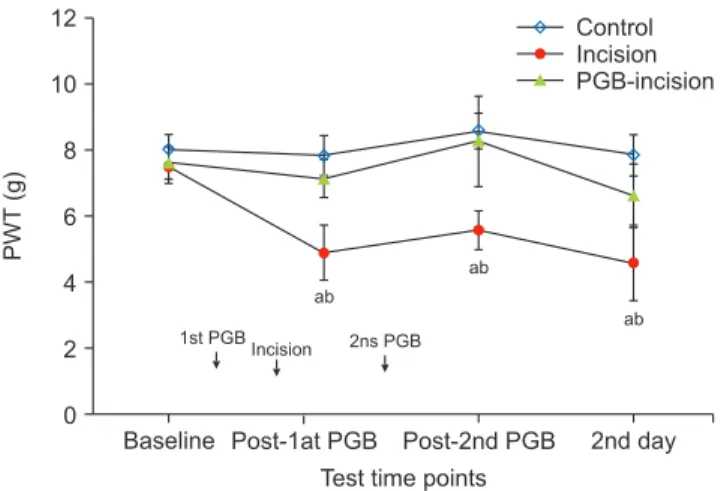
The PWT was decreased following plantar incision; re-duced mechanical thresholds were maintained until the following morning in the incision group, compared with the pre-surgery baseline mechanical threshold (P < 0.001). Double intraperitoneal injection of PGB (30 min before and 1 hr following incision, each at 30 mg/kg) produced significant antinociceptive effects (P < 0.001), and eleva-tion of the PWT, until the second day, compared with the incision group. There were no differences in the serial PWTs of the control and PGB-incision groups, following the first and second dose of PGB (P = 0.867; Fig. 2). During the experimental periods, except anesthesia and recovery periods, the mice maintained normal activity, posture, and appetite.
2. Effects of PGB on NK cell cytotoxic activity
On the second day, the tumoricidal activity of NK cells against NK-sensitive YAC-1 lymphoma cells from each mouse spleen was assessed. Results are displayed as plots of LDH release (Fig. 3). NK cell activity was significantly
higher in the incision group than in the control group (P < 0.001). Perioperative intraperitoneal PGB treatment, in the PGB-incision group, significantly reduced NK activ-ity compared with saline injection in the incision group. However, NK activity in the PGB treatment group (PGB-incision) remained higher vs. the control group (P < 0.001). However, there was no significant difference in the NK cell activity of PGB-control group mice and the control group (P = 0.925; Fig. 3).
3. Effects of PGB on splenocyte proliferation
The proliferative response of splenic lymphocytes to PHA
is presented as a SI plot (Fig. 4). Incision-induced pain
in both the incision and PGB-incision groups increased splenic lymphocyte proliferation to a greater degree com-pared with the control group (P = 0.012 and P = 0.003, respectively). However, there were no changes in the sple-nocyte proliferation responses of the incision group (24.38 ± 6.76%) and PGB-incision group (25.77 ± 6.94%). Further-more, PGB pretreatment in the PGB-control group did not induce significant changes in splenocyte proliferation compared with the control group (P = 0.786).
4. PGB concentrations following intraperitoneal
injection
We measured the blood PGB concentrations in a separate groups of mice to rule out the possibility of direct effects of PGB on immune responses. Two hours subsequent to in-traperitoneal PGB injection (two doses at 30 mg/kg, with a 90-min interval), plasma concentrations were 7.704 ± 0.963 µg/mL, but decreased to 0.583 ± 0.147 µg/mL (at 6 hr fol-lowing injection), and finally to 0.013 ± 0.003 µg/mL (at 12 hr following injection; Fig. 5).
DISCUSSION
The present study showed that immediately after plantar incision, mechanical allodynia developed. This response was maintained until the termination of the experiment 12 Baseline Post-1at PGB Post-2nd PGB 2nd day
12 10 8 6 4 2 PWT (g)
Test time points 0 Control Incision PGB-incision ab ab ab 1st PGB Incision 2ns PGB
Fig. 2. Time course of paw withdrawal threshold (PWT) after plantar inci-sion in mice (n = 8 per group). Foot inciinci-sion resulted in the development of marked mechanical allodynia until the day after the incision in the inci-sion group (saline + inciinci-sion). Intraperitoneal injection of pregabalin (PGB) at 30 mg/kg significantly reduced mechanical allodynia in the PGB-inci-sion group (PGB + inciPGB-inci-sion). There were no significant differences in the PWT between the control and PGB-incision groups throughout the experi-ment. In the control and PGB-incision groups, there were no significant changes in the PWT compared with the baseline PWT. Data represent means ± standard deviation. aP < 0.001 vs. the control and PGB-incision
groups. bP < 0.001 vs. baseline.
Incision PGB-incision Control PGB-control 20 15 10 5 % specific lysis 0 a b 80:1 40:1 20:1
Fig. 3. Effects of perioperative pregabalin (PGB) treatment on natural killer (NK) cell activity (% specific lysis) on the day after hind paw incision in mice (n = 8 per group). At various E:T ratios (80:1, 40:1, 20:1), the tumoricidal activities of NK cells (effector cells, E) against NK sensitive YAC-1 lymphoma cells (target cell, T) were calculated from lactate de-hydrogenase release. NK cell activity was significantly increased in the incision group (saline + incision). In the PGB-incision group (PGB + inci-sion), perioperative intraperitoneal PGB treatment significantly reduced NK activity compared with the incision group, but NK activity in the PGB-incision group remained higher than in the control group (P < 0.001). Data represent means ± standard deviation. aP < 0.001 vs. the
PGB-incision, control, and PGB-control groups. bP < 0.001 vs. the control and
PGB-control groups.
Incision PGB-incision Control PGB-control 40 35 30 25 20 15 10 5 Stimulation index 0 a a
Fig. 4. Effects of perioperative pregabalin (PGB) treatment on splenocyte proliferation in mice the day following foot incision (n = 8 per group). Pro-liferation in response to 5 µg of phytohemagglutinin mitogenic stimula-tion was determined as the percentage changes in the stimulastimula-tion index. Incision-induced pain, in both the incision and PGB-incision groups, in-creased splenic lymphocyte proliferation to a significantly greater degree compared with the control group. However, PGB pretreatment in the PGB-control and PGB-incision groups did not induce greater changes in splenocyte proliferation compared with the control and incision groups, respectively. Data represent means ± standard deviation. aP < 0.05 vs.
hours after the incision was made. The incision increased NK cell activity and splenocyte proliferation. Perioperative PGB treatment attenuated this incision-induced NK cell activation to some degree. However, it did not influence the incision-induced splenocyte proliferation at all.
PGB is increasingly being seen as a useful adjunct in the multimodal management of postoperative pain. This is supported by the study of Field et al. [9], who showed, with a rat model of post-incisional pain, that preoperative administration of PGB may reduce the tissue damage-induced hyperexcitability of the dorsal horn neurons, thereby reducing both acute postoperative pain and the development of postoperative chronic pain. Moreover, a meta-analysis of clinical trials showed that perioperative PGB administration effectively reduces postoperative opi-oid consumption, especially after major surgery that in-duces severe pain [10,13,14]. Notably, it has been reported that depending on the type of pain, the analgesic dose of PGB varies from 10 to > 200 mg/kg [15]. Behavior observa-tion studies in animals may be affected by sedaobserva-tion or de-creased motor function caused by the administered drug, but previous studies have shown that PGB did not cause severe sedation or gait abnormalities at the analgesic dose [16].
In our study, 30 mg/kg PGB was administered twice (30 min before surgery and 1 hr after surgery); we observed that the pain of the mice was effectively blocked despite the fact that the pain stimulus was ongoing. PGB-treated mice did not exhibit severe sedation. Moreover, during our preliminary experiment, we observed that the PWT of
the PGB-control group was not different from the PWT of the control group. These results imply that the therapeutic dose of PGB in mice does not inhibit PWT in the painless state, which is consistent with a previous study by Takeu-chi et al. [17].
Several studies have shown that severe or chronic pain in the postoperative period can have both immunostimu-latory and immunosuppressive effects. Sacerdote et al. [18] showed that abdominal surgery for uterine cancer suppresses mitogen-induced T cell proliferation. Sharify et al. [19] found that mice given heat shocks exhibited upregulation of NK cell activity and splenocyte prolifera-tion. Similarly, our previous study showed that when mice were subjected to chronic constriction injury of the sciatic nerve, their NK cell activity and splenocyte proliferation both rose [7]. Our present study observed similar effects from pain: we observed that plantar incision in mice significantly upregulated NK cell cytotoxic activity and mitogen-induced splenocyte proliferation. These findings probably reflect the fact that the immune and nervous sys-tems are known to interact [20,21]. These immunomodula-tory effects of pain can be harmful, especially if the pain is prolonged and severe, because it could limit the ability of the patient to resist infection [22]. Consequently, it is im-portant to properly manage severe postoperative pain.
However, this approach also has its pitfalls because some analgesic drugs can themselves significantly alter immune responses: several studies in humans and ani-mals show that opiates such as morphine suppress NK cell activity, T cell responses in delayed type hypersensitivity, cytotoxic T cell activity, T cell proliferation to mitogens, phagocytosis, and chemotaxis [18,20,23]. Moreover, in the absence of pain, mice treated with tramadol show upregu-lation of NK cell cytotoxicity and mitogen-induced sple-nocyte proliferation [6], while Lewis rats treated with mor-phine exhibit marked downregulation of these responses [24]. Notably, however, our present and previous [7] studies both showed that PGB treatment had no effect on the NK cell cytotoxicity or mitogen-induced splenocyte prolifera-tion of control (non-incised) mice. These discrepancies may reflect the varying effects of different analgesics.
Several studies show that analgesics can also alter the immune changes induced by pain [4-6]. In particular, our previous study showed that when mice with chronic constriction of the sciatic nerve were given twice-daily postoperative 30 mg/kg PGB treatment starting 2 days after surgery, their pain-upregulated NK cell activity and splenocyte proliferation 7 days after surgery were both significantly depressed [7]. Our present observations in our incision model differ somewhat: while pain increased both of these immune responses and PGB largely (but not completely) reversed the effect of pain on NK cell activity,
2 6 12 12 10 8 6 4 2 Pregabalin plasma concentration ( g/mL) 0
Time after pregabalin intraperitoneal administration (hr)
Fig. 5. Change in plasma pregabalin (PGB) concentration over time. In this auxiliary experiment, six mice underwent plantar incision and preop-erative and postoppreop-erative PGB treatment, and blood was taken 2, 6, and 12 hours after the first PGB injection. Plasma PGB concentrations were measured by using high-performance liquid chromatography/mass spec-trometry. Twelve hours after the first injection, which is when spleens were harvested for immune response analyses, the PGB concentration was close to zero (0.013 ± 0.003 µg/mL). Data represent means ± stan-dard deviation.
PGB treatment had no effect on mitogen-induced spleno-cyte proliferation 12 hours after surgery. These differences may reflect the fact that our present and previous [7] stud-ies employed different pain models and that the immune responses were observed at different times (12 hr and 7 days after surgery, respectively).
These observations led us to hypothesize that PGB has a positive immunomodulatory effect, namely, it significant-ly suppresses the immunostimulatory effects of pain on NK cell activity and, depending on the type of pain, lym-phocyte proliferation. This is important because patients with chronic neuropathic pain often require long-term use of PGB, and PGB is commonly prescribed as a supplement to opioids, which have immunosuppressive effects [10]: it is possible that PGB may ameliorate the pain-induced altera-tions in immune funcaltera-tions, although this requires further research. These findings together also suggest that the im-munomodulatory effects of pain and analgesics depend on the nature and duration of the stressor that is applied, the immunological variables that are being investigated, and the analgesic that is used [19].
To determine whether the immune responses we ob-served 12 hours after PGB injection was directly affected by the PGB in the plasma, we examined the changes in PGB plasma concentrations 2, 6, and 12 hours after the intraperitoneal injection of this analgesic. The blood PGB concentration was close to zero at the 12 hours timepoint. Moreover, our previous in vitro study showed that 3 µg/mL PGB does not decrease NK cell cytotoxic activity [7]. Thus, it seems that the immunomodulatory effects of PGB on NK cell activity are not a direct consequence of the drug re-maining in plasma; rather, it may be a pharmacodynamic consequence of the analgesic effect of the drug during the early postoperative period.
How pain activates NK cell functions is not clear. How-ever, because lymphocytes express variable hormone receptors, it has been suggested that hormones mediate stress-induced changes in immune function. In particu-lar, catecholamines seem to play an important role in the endocrine-neural-immune network [25,26]. Interestingly, a study by Takeuchi et al. [17] showed that intra-cisternal administration of catecholaminergic neurotoxin 6-hy-droxydopamine hydrobromide to decrease the central noradrenalin attenuated the analgesic effect of PGB. How PGB reverses the upregulatory effect of pain on NK cell activity is unclear. However, it is thought that the analge-sic effects of PGB involve a supraspinal mechanism that affects the locus coeruleus neurons that associate with the descending noradrenergic inhibitory system and spinal adrenergic receptors [17,27].
Thus, this supraspinal mechanism may also mediate the immunomodulatory effect of PGB. Our study provides the
framework for further investigations on the immunomod-ulatory effects of PGB. Future studies will aim to identify the multiple factors that affect immune responses to pain and PGB. These studies will include other types of pain, its effects on other immune responses, and other PGB treatment regimens. How PGB interacts with other anal-gesics in terms of its immunomodulatory effects should be assessed. In summary, foot incision in mice not only generated mechanical allodynia, it also increased NK cell cytotoxic activity and lymphocyte proliferation. Periop-erative PGB treatment largely prevented the pain-induced increase in NK cell activity. However, these effects of PGB on NK cell activity were not evident in the absence of inci-sional pain.
In conclusion, this study suggests that PGB may be able to modulate the immune response that accompanies tis-sue injury and postoperative pain. As a drug used to treat chronic pain patients, these immunomodulatory effects are of great clinical importance and deserve further study.
CONFLICT OF INTEREST
No potential conflict of interest relevant to this article was reported.
FUNDING
No funding to declare.
ORCID
Jung Hyun Park, https://orcid.org/0000-0001-6376-3433 Seung Hee Cho, https://orcid.org/0000-0003-3336-7717 Rip Kim, https://orcid.org/0000-0002-3893-4947 Sang Hoon Na, https://orcid.org/0000-0002-8507-7466 Eun-sun Kang, https://orcid.org/0000-0003-4261-1320 Mi-young Yeom, https://orcid.org/0000-0002-9525-6441 Yeon Jang, https://orcid.org/0000-0002-2078-6149
REFERENCES
1. Kennedy BC, Hall GM. Neuroendocrine and inflammatory aspects of surgery: do they affect outcome? Acta Anaesthe-siol Belg 1999; 50: 205-9.
2. Kiecolt-Glaser JK, Page GG, Marucha PT, MacCallum RC, Glaser R. Psychological influences on surgical recovery. Per-spectives from psychoneuroimmunology. Am Psychol 1998; 53: 1209-18.
3. Kehlet H, Holte K. Effect of postoperative analgesia on surgi-cal outcome. Br J Anaesth 2001; 87: 62-72.
4. Tsai YC, Won SJ, Lin MT. Effects of morphine on immune re-sponse in rats with sciatic constriction injury. Pain 2000; 88: 155-60.
5. Beilin B, Shavit Y, Trabekin E, Mordashev B, Mayburd E, Zeidel A, et al. The effects of postoperative pain management on immune response to surgery. Anesth Analg 2003; 97: 822-7.
6. Sacerdote P, Bianchi M, Manfredi B, Panerai AE. Effects of tramadol on immune responses and nociceptive thresholds in mice. Pain 1997; 72: 325-30.
7. Jang Y, Song HK, Yeom MY, Jeong DC. The immunomodula-tory effect of pregabalin on spleen cells in neuropathic mice. Anesth Analg 2012; 115: 830-6.
8. van Seventer R, Bach FW, Toth CC, Serpell M, Temple J, Mur-phy TK, et al. Pregabalin in the treatment of post-traumatic peripheral neuropathic pain: a randomized double-blind trial. Eur J Neurol 2010; 17: 1082-9.
9. Field MJ, Holloman EF, McCleary S, Hughes J, Singh L. Eval-uation of gabapentin and S-(+)-3-isobutylgaba in a rat model of postoperative pain. J Pharmacol Exp Ther 1997; 282: 1242-6.
10. Zhang J, Ho KY, Wang Y. Efficacy of pregabalin in acute post-operative pain: a meta-analysis. Br J Anaesth 2011; 106: 454-62.
11. Pogatzki EM, Raja SN. A mouse model of incisional pain. An-esthesiology 2003; 99: 1023-7.
12. Pogatzki EM, Vandermeulen EP, Brennan TJ. Effect of plan-tar local anesthetic injection on dorsal horn neuron activity and pain behaviors caused by incision. Pain 2002; 97: 151-61. 13. Hegarty DA, Shorten GD. A randomised, placebo-controlled
trial of the effects of preoperative pregabalin on pain inten-sity and opioid consumption following lumbar discectomy. Korean J Pain 2011; 24: 22-30.
14. Lam DMH, Choi SW, Wong SSC, Irwin MG, Cheung CW. Ef-ficacy of pregabalin in acute postoperative pain under dif-ferent surgical categories: a meta-analysis. Medicine (Balti-more) 2015; 94: e1944.
15. Chesler EJ, Ritchie J, Kokayeff A, Lariviere WR, Wilson SG, Mogil JS. Genotype-dependence of gabapentin and pregaba-lin sensitivity: the pharmacogenetic mediation of analgesia is specific to the type of pain being inhibited. Pain 2003; 106: 325-35.
16. Field MJ, Oles RJ, Lewis AS, McCleary S, Hughes J, Singh L. Gabapentin (neurontin) and S-(+)-3-isobutylgaba represent a novel class of selective antihyperalgesic agents. Br J Phar-macol 1997; 121: 1513-22.
17. Takeuchi Y, Takasu K, Ono H, Tanabe M. Pregabalin, S-(+)-3-isobutylgaba, activates the descending noradrenergic sys-tem to alleviate neuropathic pain in the mouse partial sciatic nerve ligation model. Neuropharmacology 2007; 53: 842-53. 18. Sacerdote P, Bianchi M, Gaspani L, Manfredi B, Maucione A,
Terno G, et al. The effects of tramadol and morphine on im-mune responses and pain after surgery in cancer patients. Anesth Analg 2000; 90: 1411-4.
19. Sharify A, Mahmoudi M, Izad MH, Hosseini MJ, Sharify M. Effect of acute pain on splenic NK cell activity, lymphocyte proliferation and cytokine production activities. Immuno-pharmacol Immunotoxicol 2007; 29: 465-76.
20. Eisenstein TK, Hilburger ME. Opioid modulation of immune responses: effects on phagocyte and lymphoid cell popula-tions. J Neuroimmunol 1998; 83: 36-44.
21. Ren K, Dubner R. Interactions between the immune and nervous systems in pain. Nat Med 2010; 16: 1267-76.
22. Zajączkowska R, Leppert W, Mika J, Kocot-Kępska M, Woroń J, Wrzosek A, et al. Perioperative immunosuppression and risk of cancer progression: the impact of opioids on pain management. Pain Res Manag 2018; 2018: 9293704.
23. Peterson PK, Molitor TW, Chao CC. Mechanisms of mor-phine-induced immunomodulation. Biochem Pharmacol 1993; 46: 343-8.
24. Lysle DT, Coussons ME, Watts VJ, Bennett EH, Dykstra LA. Morphine-induced alterations of immune status: dose de-pendency, compartment specificity and antagonism by nal-trexone. J Pharmacol Exp Ther 1993; 265: 1071-8.
25. Mössner R, Lesch KP. Role of serotonin in the immune sys-tem and in neuroimmune interactions. Brain Behav Immun 1998; 12: 249-71.
26. Madden KS, Moynihan JA, Brenner GJ, Felten SY, Felten DL, Livnat S. Sympathetic nervous system modulation of the immune system. III. Alterations in T and B cell proliferation and differentiation in vitro following chemical sympathec-tomy. J Neuroimmunol 1994; 49: 77-87.
27. Tanabe M, Takasu K, Takeuchi Y, Ono H. Pain relief by ga-bapentin and pregabalin via supraspinal mechanisms after peripheral nerve injury. J Neurosci Res 2008; 86: 3258-64.