The difference of clinical characteristics
and behavioral patterns in mild cognitive
impairment subtypes using Korean
version of neuropsychiatric inventory
Kang Soo Lee
Department of Medicine
The difference of clinical characteristics
and behavioral patterns in mild cognitive
impairment subtypes using Korean
version of neuropsychiatric inventory
Directed by Professor Hyun-Sang Cho
The Master's Thesis
submitted to the Department of Medicine,
the Graduate School of Yonsei University
in partial fulfillment of the requirements for the degree
of Master of Medicine
Kang Soo Lee
This certifies that the Master's Thesis of
Kang Soo Lee is approved.
---
Thesis Supervisor: Hyun-Sang Cho
---
Thesis Committee Member#1: Byoung Hoon Oh
---
Thesis Committee Member#2: Dong Goo Kim
The Graduate School
Yonsei University
ACKNOWLEDGEMENTS
I am grateful to my thesis supervisor Hyun-Sang Cho for all of
his mentoring and support throughout my time here at severance
psychiatry. I would also like to thank my advisor Byoung Hoon Oh and
Dong Goo Kim for their invaluable guidance, encouragement and
support throughout the entire thesis writing process. I would also like to
thank Professor Chang Hyung Hong, Hae Kwan Cheong, and Young
Chul Chung, as well as other faculty member for all their valuable advice
and help. I am particularly thankful to Il Ho Park and Eosu Kim, as well
as other colleagues for their consistent support and advice. I wish to give
a most special thank to Gwangju Mental Health Center. And finally I
would like to thank to my parents, brother and friends for their
unconditional love and support. Without them, the valleys would have
been much lower, and the peaks not as high.
TABLE OF CONTENTS
ABSTRACT ………..… 1
I. INTRODUCTION ………. 3
II. MATERIALS AND METHODS ……….. 6
1. MCI diagnostic criteria ……… 6
A. MCI subtypes according to cognitive features ……….. 7
B. MCI subtypes according to likely etiology ………... 7
C. MCI subtypes according to functional status ……… 7
2. Neuropsychiatric inventory………... 8
3. Statistical analysis ……… 8
III. RESULTS ………... 9
1. General characteristics of the subjects ………... 9
2. NPS in MCI subtypes according to cognitive features ………... 10
3. NPS in MCI subtypes according to likely etiology ……… 12
4. NPS in MCI subtypes according to functional status …………. 13
IV. DISCUSSION ………... 15
V. CONCLUSION ……….. 17
REFERENCES ………... 18
LIST OF TABLES
Table 1.
General characteristics of mild cognitive impairment
according to subtypes ··· 9
Table 2.
Prevalence of each domain of neuropsychiatric
inventory, according to MCI subtypes by cognitive feature
··· 11
Table 3.
Prevalence of each domain of neuropsychiatric
inventory, according to MCI subtypes by likely etiology
··· 12
Table 4.
Prevalence of each domain of neuropsychiatric
inventory, according to MCI subtypes by functional status
··· 13
ABSTRACT
The difference of clinical characteristics and behavioral patterns in
mild cognitive impairment subtypes using Korean version of
neuropsychiatric inventory
Kang Soo Lee
Department of Medicine
The Graduate School, Yonsei University
(Directed by Professor Hyun-Sang Cho)
Background: Mild cognitive impairment (MCI) has been subtyped
according to its cognitive features and its likely etiology. We aimed to
investigate the neuropsychiatric features of the MCI using the
Neuropsychiatric Inventory (NPI) and compare them according to
subtypes.
Methods: MCI patients were classified according to cognitive features
(e.g., amnestic MCI vs non-amnestic MCI), likely etiology (e.g., vascular
MCI, non-vascular MCI) and functional status (e.g., MCI-I vs MCI-II).
The percentage of subjects exhibiting each of the 12 behaviors in the NPI
was compared among the groups using a chi-square test.
Results: There were 382 subjects in the MCI group. In terms of each
neuropsychiatric symptom, there were no differences in frequency
between MCI groups subtyped according to cognitive features or likely
etiology. However, a significantly higher frequency of delusion,
aggression, irritability, and eating behavior has been observed in the
MCI-II group in comparison to the MCI-I group.
Conclusion: Differences in neuropsychiatric symptoms were distinctive
between MCI groups subtyped according to functional status.
---
Key words: mild cognitive impairment, subtypes, neuropsychiatric
inventory, neuropsychiatric symptoms
The difference of clinical characteristics and behavioral patterns in
mild cognitive impairment subtypes using Korean version of
neuropsychiatric inventory
Kang Soo Lee
Department of Medicine
The Graduate School, Yonsei University
(Directed by Professor Hyun-Sang Cho)
I. INTRODUCTION
Mild cognitive impairment (MCI) is a syndrome defined as a cognitive decline greater than expected for an individual’s age and education level, but which does not interfere notably with activities of daily living (ADL).1 MCI has been subtyped according to its cognitive features, clinical presentation, likely etiology, neuroimaging findings, genetic features, or according to its progression rate.2 The majority of data present in the literature refer to amnestic MCI and very few concern other subtypes of the condition. In terms of MCI subtyping by its cognitive features, which Peterson proposes, it is conceivable that amnestic MCI subjects have a high likelihood of progression to Alzheimer’s disease (AD), while non-amnestic MCI are assumed to convert more frequently to non-AD dementia.3 In MCI subtyping by its likely etiology and in accordance with the clinical categorization of dementia, non-vascular MCI subjects are considered to have a high likelihood of progression to AD,4 while those with vascular MCI are assumed to convert more frequently to vascular dementia.5
Vascular MCI resulting from cerebrovascular disease has been relatively understudied compared with the more pre-Alzheimer concept of MCI. However, community studies have shown a higher prevalence of presumed vascular MCI (2.6%) than vascular dementia (1.5%).5 The role of cerebrovascular disease in MCI is probably under-represented, particularly in population studies.6 Both cerebrovascular disease and neurodegenerative features were shown to contribute to MCI. MCI subtyping by its functional status has not been suggested until now, but incorporating difficulties in performing ADL has been found to ameliorate the original diagnostic algorithm for MCI and better detect subjects at risk of conversion to dementia.7
Although cognitive domains have been the core features of MCI up to now, there is an increasing awareness of neuropsychiatric symptoms (NPS), which include anxiety, depression, and irritability.8 NPS are commonly observed and clinically relevant in MCI. Depending on the population type studied and the methods used, prevalence can range from 35 to 75%.8-11 Several studies report rates of NPS according to MCI subtypes, but that subtyping has been limited to cognitive features criteria. In the case of predominately amnestic MCI, the percentage of individuals exhibiting NPS has ranged from 35%8 to 59%.10 Amnestic MCI is associated with significant NPS, especially mood disturbances and apathy.11 The prevalence of hallucinations, sleep disorders, or extrapyramidal signs was higher in non-amnestic MCI than in amnestic MCI.12 Behavioral symptoms were more severe in subcortical vascular MCI than amnestic MCI, although the differences were not statistically significant.13
Despite efforts to classify MCI according to several features, the preclinical stages of dementias other than AD are not well delineated.2 The distinction of which NPS occur in several MCI subtypes may be valuable and offer prognostic information. To our knowledge, there has been no one, comprehensive population-based estimate of the frequency of NPS in MCI patients, made according to cognitive features (e.g., amnestic vs non-amnestic), its likely
etiology (e.g., non-vascular vs vascular) or functional status (e.g., subtle instrumental ADL impairment or not). In the current study, we investigate the neuropsychiatric features of MCI using the Neuropsychiatric Inventory (NPI) and compare them by subtype.
II. MATERIALS AND METHODS
In all, 382 MCI subjects presenting with memory complaints were consecutively recruited from October 2005 to February 2007 from the community mental health center in Gwangju-si, Gyeonggi-do, Republic of Korea. The study was approved by institutional review boards and written informed consent was obtained after providing a complete description of the study to the subjects and their relatives. Diagnostic evaluation included gathering complete medical history, undertaking physical and neurologic examinations, and performing neuropsychological testing and dementia-related blood tests. The final diagnosis was reached by consensus of the neurologists and psychiatrists, using all available information.
1. MCI diagnostic criteria
To be eligible for the study, all participants had to meet the adapted operational criteria for MCI, including: (1) Complaints of subjective memory or other cognitive impairment by patients or informants, and (2) Evidence of objective memory or othercognitive function impairment in neuropsychological tests. Subjects with verbal and visuospatial memory impairment were defined as having scores below the cutoff values in the Seoul Verbal Learning Test (SVLT)14 for delayed recall and Simple Rey Figure Test (SRFT)15 for delayed recall, respectively. In addition, language and visuospatial function impairment was determined by the Korean version of the Boston Naming Test (K-BNT)16 and the copy score of the Simple Rey Figure Test, respectively. Frontal lobe function impairment was defined as the condition where more than two domains showed impairment in motor, fluency, and stroop domain. Motor function was assessed by contrasting program, go-no go, fist-edge-palm, and Luria loop. Motor impairment was defined as the condition where two or more of the tests showed abnormal results. Fluency was assessed by semantic and phonemic
Controlled Oral Word Association Test (COWAT). Abnormal stroop was defined as being below the cutoff values in stroop color reading. The last two adapted operational criteria for MCI, which all participants had to meet, include (3) ADL was largely maintained, and instrumental activity of daily living (IADL) was minimally impaired, and (4) the individual was not demented.
A. MCI subtypes according to cognitive features
MCI patients were classified as aMCI if they had prominent memory impairment, either alone or with other cognitive impairments, or as naMCI if a single nonmemory domain was impaired alone or in combination with other nonmemory deficits.
B. MCI subtypes according to likely etiology
Vascular MCI was defined as having conditions that satisfy the aforementioned MCI operational criteria. Additionally, there should be a Hachinski ischemia scale score > 7 and a neurologic examination abnormality. A neurologic examination abnormality is defined as one or more focal symptoms or signs, such as dysarthria, swallowing difficulty, pathologic laughing, external ocular movement disturbance, facial palsy, hemiparesis, sensory deficit, increased deep tendon reflex (DTR), Babinski sign, Chaddock sign, rigidity, bradykinesia, gait disturbance (e.g., stooped posture, decreased arm swing, short step gait, shuffling, multiple step turning, festination).
C. MCI subtypes according to functional status
MCI-II is different from MCI-I, in that complex instrumental function is impaired but not definite in dementia, as demonstrated by history or a Seoul Instrumental Activity of Daily Living (S-IADL)17 score greater than 7. There were many subjects who were neither normal nor demented, and whose complex instrumental functions were impaired according to Petersen’s criteria. If the operational definition of amnestic MCI proposed by Petersen is closer to
normal than dementia, our working criteria of MCI-II are closer to those for dementia than normal.
2. Neuropsychiatric Inventory
The NPI has scripted screening questions for each of 12 behaviors that had potentially been present in the preceding four weeks. The NPI was administered by a nurse who had completed NPI training and had been periodically retrained to prevent rater drift. She was blind to study hypotheses. The NPI has been shown to be valid and reliable.
3. Statistical analysis
The percentage of subjects exhibiting each of the 12 behaviors was compared with the two groups using a chi-square test with adjustment for type I errors of multiple comparisons, i.e., p < 0.005 (= 0.05/10). Descriptive statistics are presented as percentages, according to the nature of the variable. The two-sample t test was used to compare continuous variables and the chi-square test for dichotomous ones. All tests were two-tailed at a probability level of 0.05. All analyses were performed using SPSS software version 12.0.
III. RESULTS
1. General characteristics of the subjects
There were 382 subjects in the MCI group. The mean (SD) age was 72.26 (6.47) and the mean of years of education was 4.98 (4.58). There were 132 males (34.6%) and 250 females (65.4%). Illiteracy was 70 (18.4%). NPI score was 2.14 (4.07), and Geriatric depression scale (GDS) score was 6.02 (3.97). Table 1. General characteristics of mild cognitive impairment according to subtypes
Total MCI n=382 Total MCI n=382 Total MCI n=382 Amnestic MCI n=217 Non-amnestic MCI n=165 Non-vascular MCI n=335 Vascular MCI n=47 MCI-I N=324 MCI-II N=58 Age (yrs) 72.8±6.9 71.5±5.8 72.6±6.6 69.8±5.3** 71.5±6.1 76.3±7.1** Education (yrs) 4.9±4.7 5.1±4.4 4.6±4.4 7.4±5.0** 5.3±4.5 3.2±4.4** Height (cm) 155.2±9.3 155.3±8.4 154.8±8.9 158.4±8.4* 155.6±8.8 153.0±9.3 Weight (kg) 57.9±9.2 58.5±8.7 57.7±8.9 61.7±9.1** 58.7±8.9 54.8±8.9** K-MMSE 20.8±4.5 22.1±3.8** 21.3±4.3 22.1±3.9 22.0±3.9 18.9±3.7** CDR 0.5±0.3 0.4±0.2** 0.4±0.3 0.5±0.2 0.4±0.2 0.6±0.3** S-IADL 4.4±4.9 2.8±2.9** 3.6±4.0 4.3±5.3 2.6±2.6** 10.5±5.3** K-GDS 6.1±3.7 5.9±4.3 6.1±4.0 5.4±3.6 5.9±4.1 6.9±3.1 Gender(M/F) (M%) 82/135 (37.8%) 50/115 (30.3%) 110/225 (32.8%) 22/25 (46.8%) 117/207 (36.1%) 15/43 (25.9%) Literacy (illiteracy%) 46/171 (21.2%) 24/140 (14.6%) 63/271 (18.9%) 7/40 (14.9%) 49/275 (15.2%) 21/37 (36.2%)** ApoE4 105/25 (80.8%) 94/26 (78.3%) 179/46 (79.6%) 20/5 (80.0%) 177/44 (80.1%) 22/7 (75.9%) * p <.05 , ** p <.01
K-MMSE; Korean version of mini-mental state examination, CDR; clinical dementia rating scale, S-IADL; Seoul instrumental activity of daily living, K-GDS; Korean version of geriatric depression scale.
According to cognitive features, 217 patients were classified in the aMCI group, and 165 subjects in the naMCI group. According to likely etiology, 337 patients were classified in the non-vascular MCI group, and 47 patients in the vascular MCI group. Table 1 shows general characteristics of MCI according to subtype. The prevalence of at least one NPS was found to be 160 (41.2%). The most prevalent symptom was found to be depression (19.80%), followed by sleep disturbances (18.3%), irritability (12.8%), and anxiety (10.7%).
2. NPS in MCI subtypes according to cognitive features.
Table 2 lists the percentages of patients with symptoms in the 12 behavioral domains of the four groups.Among subjects with aMCI, the most prevalent symptom was depression (20.3%), followed by sleep disorders (18.0%) and irritability (16.6%). In the naMCI group, the most frequent symptoms were depression (18.8%) and sleep disorders (18.8%), followed by irritability (7.9%). Using the chi-square test to compare the four groups, no significant difference in the prevalence of NPS was found.
Table 2. Prevalence of each domain of neuropsychiatric inventory, according to MCI subtypes by cognitive feature
Total MCI n=382 Amnestic MCI n=217 Non-amnestic MCI n=165 Single n=52 Multiple n=123 Single n=154 Multiple n=53 p Delusions 0 (0%) 0 (0%) 3 (1.9%) 1 (1.9%) 0.331 Hallucinations 0 (0%) 0 (0%) 0 (0%) 0 (0%) Agitation/Aggression 0 (0%) 2 (1.6%) 4 (2.6%) 4 (7.5%) 0.074 Depression/Dysphoria 7 (13.5%) 22 (17.9%) 38 (24.7%) 8 (15.1%) 0.198 Anxiety 3 (5.8%) 15 (12.2%) 17 (11.0%) 6 (11.3%) 0.649 Elation/euphoria 0 (0%) 2 (1.6%) 1 (0.6%) 0 (0%) 0.576 Apathy/Indifference 3 (5.8%) 2 (1.6%) 4 (2.6%) 0 (0%) 0.237 Disinhibition 1 (1.9%) 3 (2.4%) 5 (3.2%) 1 (1.9%) 0.927 Irritability/lability 8 (15.4%) 13 (10.6%) 21 (13.6%) 7 (13.2%) 0.810 Aberrant motor behavior
1 (1.9%) 1 (0.8%) 1 (0.6%) 0 (0%) 0.724 Sleep/night-time behavior 7 (13.5%) 23 (18.7%) 30 (19.5%) 10 (18.9%) 0.806 Appetitie/eating disorders 1 (1.9%) 5 (4.1%) 11 (7.1%) 2 (3.8%) 0.402 No of NPI domain 0.596±1.209 0.715±1.120 0.877±1.265 0.736±1.211 0.462 No of subjects with NPI >=1
3. NPS in MCI subtypes according to likely etiology
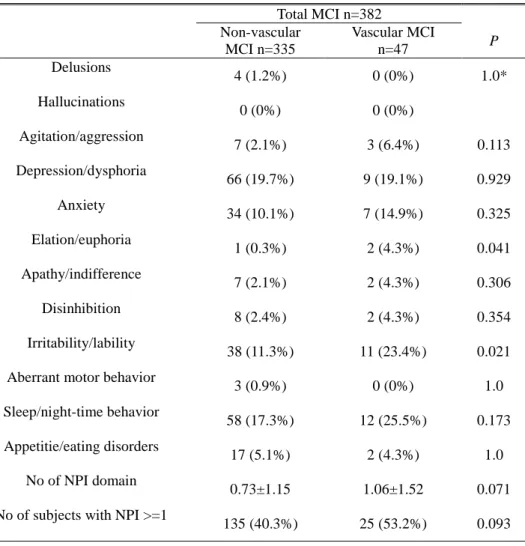
Table 3 lists the percentages of patients with symptoms in the 12 behavioral domains of the two groups.Among subjects with non-vascular MCI, the most prevalent symptom was depression (19.7%), followed by sleep disorders (17.3%) and irritability (11.3%).
Table 3. Prevalence of each domain of neuropsychiatric inventory. according to MCI subtypes by likely etiology
Total MCI n=382 Non-vascular MCI n=335 Vascular MCI n=47 P Delusions 4 (1.2%) 0 (0%) 1.0* Hallucinations 0 (0%) 0 (0%) Agitation/aggression 7 (2.1%) 3 (6.4%) 0.113 Depression/dysphoria 66 (19.7%) 9 (19.1%) 0.929 Anxiety 34 (10.1%) 7 (14.9%) 0.325 Elation/euphoria 1 (0.3%) 2 (4.3%) 0.041 Apathy/indifference 7 (2.1%) 2 (4.3%) 0.306 Disinhibition 8 (2.4%) 2 (4.3%) 0.354 Irritability/lability 38 (11.3%) 11 (23.4%) 0.021 Aberrant motor behavior
3 (0.9%) 0 (0%) 1.0 Sleep/night-time behavior 58 (17.3%) 12 (25.5%) 0.173 Appetitie/eating disorders 17 (5.1%) 2 (4.3%) 1.0 No of NPI domain 0.73±1.15 1.06±1.52 0.071 No of subjects with NPI >=1
In the vascular MCI group, the most frequent symptoms were sleep disorders (25.5%) and irritability (23.4%), followed by depression (19.1%). Using the chi-square test to compare the two groups, a significantly higher prevalence of elation and irritability was observed in the vascular MCI group, without multiple comparisons.
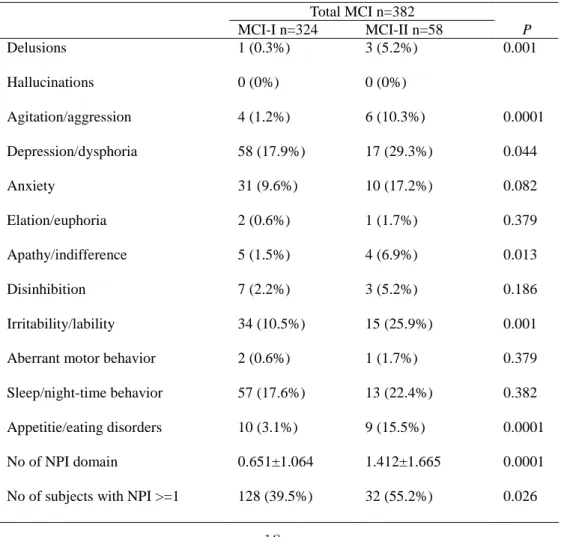
4. NPS in MCI subtypes according to functional status.
Table 4. Prevalence of each domain of neuropsychiatric inventory, according to MCI subtypes by functional status
Total MCI n=382 MCI-I n=324 MCI-II n=58 P Delusions 1 (0.3%) 3 (5.2%) 0.001 Hallucinations 0 (0%) 0 (0%) Agitation/aggression 4 (1.2%) 6 (10.3%) 0.0001 Depression/dysphoria 58 (17.9%) 17 (29.3%) 0.044 Anxiety 31 (9.6%) 10 (17.2%) 0.082 Elation/euphoria 2 (0.6%) 1 (1.7%) 0.379 Apathy/indifference 5 (1.5%) 4 (6.9%) 0.013 Disinhibition 7 (2.2%) 3 (5.2%) 0.186 Irritability/lability 34 (10.5%) 15 (25.9%) 0.001 Aberrant motor behavior 2 (0.6%) 1 (1.7%) 0.379 Sleep/night-time behavior 57 (17.6%) 13 (22.4%) 0.382 Appetitie/eating disorders 10 (3.1%) 9 (15.5%) 0.0001 No of NPI domain 0.651±1.064 1.412±1.665 0.0001 No of subjects with NPI >=1 128 (39.5%) 32 (55.2%) 0.026
Table 4 lists the percentages of patients with symptoms in the 12 behavioral domains of the groups.Using the chi-square test to compare the two groups, a significantly higher prevalence of delusion, aggression, depression, apathy, irritability, and eating disorders was observed in the MCI-II group. The number of NPS was 0.65±1.06 and 1.41±1.66 in MCI-I and MCI-II, respectively. The number of subjects with NPI scores greater than 1 was higher in the MCI-II group (55.2%) than in the MCI-I group (38.5%).
IV. DISCUSSION
The major objective of the present study was to examine the prevalence of NPS in a group of MCI patients, subtyped according to cognitive features, likely etiology, and functional status. There were two main findings: (1) There were no differences among neuropsychiatric symptoms in MCI subtyped according to cognitive features and likely etiology, and (2) differences in neuropsychiatric symptoms were distinctive between MCI groups subtyped according to functional status.
In our study, the prevalence of NPS was found to be 41.2%. The most prevalent symptom was found to be depression (19.8%), followed by sleep disturbances (18.3%), irritability (12.8%), and anxiety (10.7%). This pattern of symptoms is very consistent with the results reported in previous population-based studies that reported the prevalence of NPS as 43% and the prevalence of depression, irritability, and anxiety as 20%, 15%, and 10%, respectively.18 Another population study of 320 subjects with MCI confirmed that the most frequent clinically significant symptoms in MCI were sleep disturbances and irritability.8 Apathy commonly starts during the MCI stage and progressively increases as AD progresses19 ; in our study, the reported prevalence of apathy was relatively low in comparison to previous studies (36%). Apathy seems to be less commonly reported in Asian patients with dementia.20
The difference in NPS among MCI subjects subtyped according to cognitive features was not significant in our study. A previous study suggests that the prevalence of hallucinations, sleep disorders, and extrapyramidal signs is higher in non-amnestic MCI than in amnestic MCI.12 The observed differences are partly accounted for by the different sampling methods. Depression, anxiety, and agitation were less prevalent, while aberrant motor
behavior and irritability were more common in population-based versus tertiary care center studies.21 When community-dwelling subjects were studied, the frequencies of NPS based on the NPI were, in general, substantially lower than those of the clinically referred subjects.21 Other possible explanations are that previous studies analyzed only subjects whose NPI total score was greater than 0, and that multiple comparisons were not used.
NPS in vascular dementia and vascular cognitive impairment are very common,18 and the total prevalence of NPS was similar in the AD and vascular dementia groups. Our results were consistent with previous findings,13 that although NPS were more severe in subjects with vascular MCI than those with non-vascular MCI, the differences were not statistically significant.22 This finding also supports the assertion that there are no significant differences between patients with AD and those with vascular dementia.8
Our results show that a significantly higher prevalence of delusion, aggression, depression, apathy, irritability, and eating disorders was observed in the MCI-II group, whose complex instrumental function was impaired but not definite in dementia. NPS in MCI are associated with declining cognitive and functional ability.10,23-26 Depression, apathy, and agitation have been shown to increase the likelihood of later conversion to AD.10,27,28 Also, the degree of cognitive and functional impairment is greater in MCI with NPS, and the presence of NPS is associated with a more severe somatic comorbidity and functional disability, in terms of both ADL and IADL.29
The several limitations of this study should be acknowledged. First, this is a cross-sectional study, so it does not reflect symptom fluctuations during the longitudinal course. Second, we did not have MRI data, which would have been useful for MCI subtyping according to likely etiology. To compensate for this weak point, we used stringent working criteria comprising medical history, neurologic exam, and scoring according to the Hachinski ischemia scale.
of NPS in MCI patients dwelling within the community, according to cognitive features, likely etiology, and functional status. This study could therefore provide insight into the frequency and type of NPS observed in community-dwelling MCI patients, as categorized into a variety of subtypes.
V. CONCLUSION
There were no differences among neuropsychiatric symptoms in mild cognitive impairment subtyped according to cognitive features and likely etiology. Differences in neuropsychiatric symptoms were distinctive between mild cognitive impairment groups subtyped according to functional status.
REFERENCES
1. Petersen RC, Doody R, Kurz A, Mohs RC, Morris JC, Rabins PV, et al. Current concepts in mild cognitive impairment. Arch Neurol 0.2001;58:1985–92.
2. Luis CA, Loewenstein DA, Acevedo A, Barker WW, Duara R. Mild cognitive impairment: Directions for future research. Neurology 2003;61:438–44.
3. Petersen RC. Mild cognitive impairment as a diagnostic entity. J Intern Med 2004;256:183–94.
4. Kluger A, Ferris SH, Golomb J, Mittleman MS, Reisberg R Neuropsychological prediction of decline to dementia in nondemented elderly. J Geriatr Psychiatry Neurol 1999;12:168–79.
5. Rockwood K, Wentzel C, Hachinski V, Hogan DB, MacKnight C, McDowell I. Prevalence and outcomes of vascular cognitive impairment. Neurology 2000;54:447–51.
6. DeCarli C. Mild cognitive impairment: prevalence, prognosis, aetiology, and treatment. Lancet Neurol 2003;2:15–21.
7. Artero S, Petersen R, Touchon J, Ritchie K. Revised criteria for mild cognitive impairment: validation within a longitudinal population study, Dement Geriatr Cogn Disord 2006;22:465–70.
8. DeKosky S. Prevalence of neuropsychiatric symptoms in dementia and mild cognitive impairment. JAMA 2002;288:1475–83.
9. Geda YE, Smith GE, Knopman DS, Boeve BF, Tangalos EG, Ivnik RJ, et al. De novo genesis of neuropsychiatric symptoms in mild cognitive impairment (MCI). Int Psychogeriatr 2004;16:51–60.
10. Feldman H, Scheltens P, Scarpini E, Hermann N, Mesenbrink P, Mancione L, et al. Behavioral symptoms in mild cognitive impairment. Neurology 2004;62:1199–201.
11. Hwang TJ, Masterman DL, Ortiz F, Fairbanks LA, Cummings JL. Mild cognitive impairment is associated with characteristic neuropsychiatric symptoms. Alzheimer Dis Assoc Disord 2004;18:17–21.
12. Rozzini L, Vicini B, Chilovi M, Conti I, Delrio B, Borroni M, et al. Neuropsychiatric symptoms in amnestic and nonamnestic mild cognitive impairment. Dement Geriatr Cogn Disord 2008;25:32–6.
13. Galluzzi S, Sheu C-F, Zanetti O, Frisoni GB. Distinctive clinical features of mild cognitive impairment with subcortical cerebrovascular disease. Dement Geriatr Cogn Disord 2005;19:196–203.
14. Kang Y. Samsung neuropsychological screening battery. Seoul, The Korean Dementia Association, 1998.
15. Meyers JE, Meyers KR. The Meyers scoring system for the Rey Complex Figure and the recognition trial. Professional Manual. Odessa 1995.
16. Kim H, Na DL. Normative data on the Korean version of the Boston Naming Test. J Clin Exp Neuropsychol 1999;21:127–33.
17. Ku HM, Kim JH, Kwon EJ, Kim SH, Lee HS, Ko HJ, et al. A study on the reliability and validity of Seoul-Instrumental Activities of Daily Living (S-IADL). J Korean Neuropsychiatr Assoc 2004;43:189–99.
18. Lyketsos CG, Steinberg M, Tschanz JT, Norton MC, Steffens DC, Breitner JC. Mental and behavioral disturbances in dementia: findings from the Cache County study on memory in aging. Am J Psychiatry 2000;157:708–14.
19. Apostolova LG, Cummings JL. Psychiatric manifestation in dementia. Continuum Lifelong Learning Neurol 2007;13:165–79.
20. Fuh J-L, Lam L, Hirono N, Senanarong V, Cummings JL: Neuropsychiatric inventory workshop. behavioral and psychologic symptoms of dementia in Asia. Alzheimer Dis Assoc Disord 2006;20:314-7.
21. Apostolova LG, Cummings JL. Neuropsychiatric manifestations in mild cognitive impairment: a systematic review of the literature. Dement Geriatr Cogn Disord 2008;25:115–26.
22. Fernández-Martínez M, Castro J, Molano A, Zarranz JJ, Rodrigo RM, Ortega R. Prevalence of neuropsychiatric symptoms in Alzheimer's disease and vascular dementia. Curr Alzheimer Res 2008;5:61–9.
23. Ready RE, Ott BR, Grace J, Cahn-Weiner DA. Apathy and executive dysfunction in mild cognitive impairment and Alzheimer disease. Am J Geriatr Psychiatry 2003;11:222–8.
24. Chan DC, Kasper JD, Black BS, Rabins PV. Prevalence and correlates of behavioral and psychiatric symptoms in community-dwelling elders with dementia or mild cognitive impairment: the memory and medical care study. Int J Geriatr Psychiatry 2003;18:174–82.
25 Copeland MP, Daly E, Hines V, Mastromauro C, Zaitchik D, Gunther J, et al. Psychiatric symptomatology and prodromal Alzheimer’s disease. Alzheimer Dis Assoc Disord 2003;17:1–8.
26. Robert PH, Berr C, Volteau M, Bertogliati C, Benoit M, Mahieux F, Legrain S, Dubois B. Neuropsychological performance in mild cognitive impairment with and without apathy. Dement Geriatr Cogn Disord 2006;21:192–7.
27. Modrego PJ, Ferrandez J. Depression in patients with mild cognitive impairment increases the risk of developing dementia of Alzheimer type: a prospective cohort study. Arch Neurol 2004;61:1290–3.
28. Robert PH, Berr C, Volteau M, Bertogliati C, Benoit M, Sarazin M, et al. Apathy in patients with mild cognitive impairment and the risk of developing dementia of Alzheimer’s disease: a one-year followup study. Clin Neurol Neurosurg 2006;108:733–6.
29. Mariani E, Ercolani S, Caputo M, Rinaldi P, Monastero R, Senin U, et al. Amnestic mild cognitive impairment or very mild Alzheimer’s disease? Results from the ReGAl project, 10th ICAD, Madrid, July, 2006 [poster].
ABSTRACT (IN KOREAN)
한국판
한국판
한국판
한국판 neuropsychiatric inventory로
로
로 본
로
본
본
본 경도인지장애의
경도인지장애의
경도인지장애의 아형에
경도인지장애의
아형에
아형에
아형에
따른
따른
따른
따른 임상적
임상적
임상적
임상적 특징
특징
특징
특징 및
및
및
및 행동양식의
행동양식의
행동양식의 차이
행동양식의
차이
차이
차이
<지도교수 조 현 상>
연세대학교 대학원 의학과
이 강 수
서론 서론 서론서론: : : : 경도인지장애(mild cognitive impairment, MCI)는
정상인지기능과 치매의 중간단계로 알려져 있으며 현재까지 인지기능상의 특징 혹은 원인에 따라 여러 가지 아형으로 분류되어 왔다. 본 연구에서는 한국판 neuropsychiatric inventory를 이용하여 경도인지장애에서의 신경정신행동증상의 특징을 살펴보고 또한 경도인지장애의 각 아형별 신경정신행동증상의 차이를 규명해보고자 한다. 재료 재료 재료 재료 및및및 방법및 방법방법방법:::: 신경심리검사, 신경학적 검사, 정신상태 검사, 보호자 문진등의 정보를 종합한 후에 신경과 및 정신과 전문의 2인 이상의 동의에 의하여 경도인지장애로 진단하였다. 1차적으로 경도인지장애를 진단한 후에 인지기능상의 특징에 따라 (amnestic vs non-amnestic), 원인에 따라 (non-vascular vs vascular), 기능수준에 따라 (MCI-I vs MCI-II) 2차적으로 아형별로 분류하였다. 신경정신행동증상은 한국판 neuropsychiatric inventory를 사용하여 숙련된 간호사가 환자 및 보호자와의 인터뷰를 통해 측정하였다. 결과 결과 결과 결과:::: 382명의 경도인지장애로 진단된 환자가 연구에 참여하였다. 인지기능상의 특징 혹은 원인에 따라 경도인지장애를 분류하였을
경우 한국판 neuropsychiatric inventory에 나타난 12개 영역의 행동증상의 빈도에서 차이가 관찰되지 않았다. 그러나 기능수준에 따라 경도인지장애를 분류하였을 경우 기능수준의 저하가 있는 군에서 그렇지 않은 군에 비해 망상, 공격성, 이자극성, 식이행동의 문제 등이 더 빈번하게 나타나는 통계적 차이가 관찰되었다. 결 결 결 결론론론론:::: 경도인지장애를 기능수준에 따라 분류하였을 경우 신경정신행동 증상의 빈도가 가장 두드러진 차이를 나타내었다. --- 핵심되는 말: 경도인지장애, 아형, 한국판 neuropsychiatric inventory, 신경정신행동 증상