1 INMC, Department of Electrical and Computer Engineering, Seoul National University, Korea [email protected], {lsh529, nicho}@snu.ac.kr
2 Department of Convergence Technology, Hoseo Graduate School of Venture, Korea [email protected]
* Corresponding Author: Nam Ik Cho, [email protected]
Received April 19, 2017; Accepted May 19, 2017; Published August 30, 2017 * Regular Paper
Abstract: This paper presents a fire detection algorithm using color and motion models from video sequences. The proposed method detects change in color and motion of overall regions for detecting fire, and thus, it can be implemented in both fixed and pan/tilt/zoom (PTZ) cameras. The proposed algorithm consists of three parts. The first part exploits color models of flames and smoke. The candidate regions in the video frames are extracted with the hue-saturation-value (HSV) color model. The second part models the motion information of flames and smoke. Optical flow in the fire candidate region is estimated, and the spatial–temporal distribution of optical flow vectors is analyzed. The final part accumulates the probability of fire in successive video frames, which reduces false-positive errors when fire-like color objects appear. Experimental results from 100 fire videos are shown, where various types of smoke and flames appear in indoor and outdoor environments. According to the experiments and the comparison, the proposed fire detection algorithm works well in various situations, and outperforms the conventional algorithms.
Keywords: Fire detection, Optical flow, Color histogram, CCTV camera
1. Introduction
Recently, the need for fire detection systems using CCTV cameras has increased in many environments. The conventional thermal or smoke sensors work well for the detection of nearby and indoor fires, but they cannot be used to inform on remote situations. Also, it is necessary to visit a place where fire is detected in person when sensors sound an alarm and there are no surveillance cameras on the spot. On the other hand, we can check remote situations when we use a CCTV-based alarm system. The most distinct advantage of camera-based systems is that they can be used outdoors for wild fire detection, whereas thermal and smoke sensors are mostly for indoor applications. However, camera-based fire detection systems also have some disadvantages, such as sensitivity to fire-colored and blinking objects, and also to some light sources, which frequently generate false positives. Thus, efficient and intelligent recognition algorithms are required for camera-based fire alarm systems in order to reduce false-positive alarms as well as missed-detection rates.
Video-based fire detection has been widely studied, and various algorithms have been reported. Generally,
camera-based fire detection algorithms have exploited two types of visual information [1]. One is color information, and the other is temporal information about flames and smoke. Most algorithms first extract fire candidate regions using color information of flames and smoke, analyzing temporal information in the candidate regions. Some researchers have used the background subtraction method to detect fire candidate regions more exactly. Specifically, Chen et al. used a red-green-blue (RGB) color space model to extract fire candidate regions and analyzed the dynamics using frame differences. By using this information, the disorder in candidate regions is used as a criterion to detect fires [2]. Liu and Ahuja exploited a Fourier transform to model the shapes of flames. The colors and boundary motions of flames were the main information to detect fire [3]. Toreyin et al. used wavelets for smoke detection. Background subtraction was applied to smoke candidate regions, and spatio-temporal wavelet coefficients were trained for smoke detection [4, 5]. The wavelet models in the previous study were applied to infrared camera images for fire detection [6]. Celik et al. focused on color models and color variations in the spatial and temporal domain. The candidate regions that satisfy RGB color models for
flame and smoke were tested with color variations in the local area and frame differences [7]. While previous research has focused on the variation of colors in the spatial and temporal domain, Yuan proposed using motion orientation accumulation for detecting smoke [8]. Recently, researchers have used machine learning methods, such as support vector machines (SVMs) and fuzzy logic. Ko et al. trained the wavelet coefficients of flame regions by using SVM [9], and Gubbi et al. used SVM to model the wavelet coefficients in the smoke regions [10]. Li et al. used the dynamic textures of optical flow in the fire regions to train the texture-like patterns of optical flow in flame and smoke regions [11]. Bugaric et al. focused on wildfire detection at long distances. Camera calibration was performed in advance to model the 3-D terrain information, and the changes in the terrain information were used for detecting smoke or flames [12]. Wang et al. measured the randomness of optical flow in the flame regions [13], and Xuan and Kim combined fuzzy logic with background subtraction, color models, and SVM for spatio-temporal color variances [14].
In summary, recent studies on fire detection exploit color models, spatio-temporal color variation, and motion information about flames and smoke. Our algorithm is also based on similar information. In addition, we propose a new motion model based on optical flow, and combine the model with the existing methods. Furthermore, we adjust the color models so they are more appropriate for real data. While some of the existing methods that are based on background subtraction work only for fixed cameras, our algorithm works for fixed as well as pan/tilt/zoom (PTZ) cameras.
2. Proposed Algorithm
2.1 Overview of the Proposed Algorithm
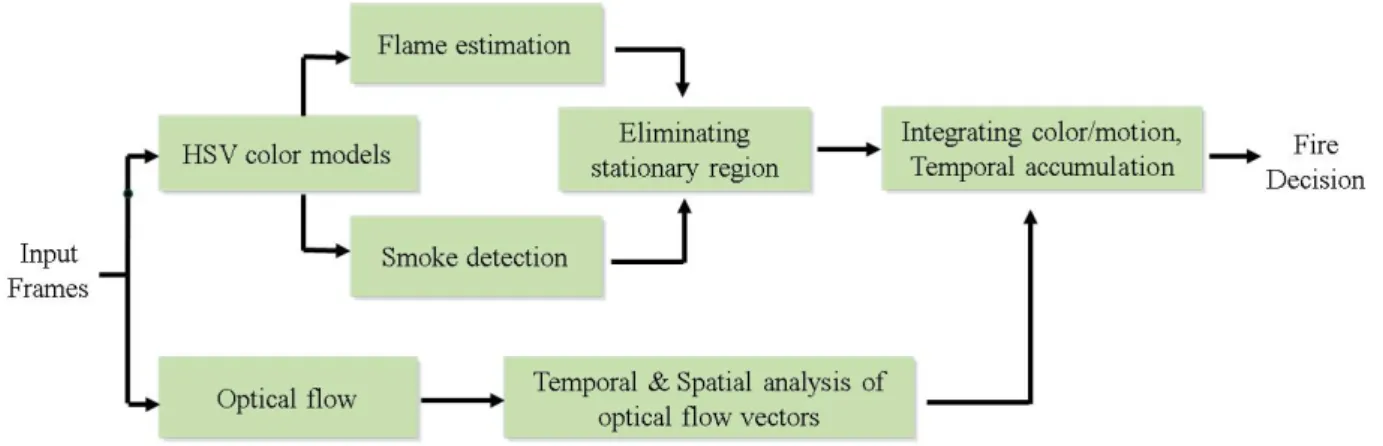
The overall structure of the proposed fire detection algorithm is shown in Fig. 1. The proposed algorithm can be divided into three parts. The first detects the flame and smoke regions using the hue-saturation-value (HSV) colormodel. The color space of video data is transformed to the HSV color space, and the candidate regions for fire are determined by trained HSV color models of flames and smoke. To reduce fire-like false alarms, stationary regions are removed by pixel-wise temporal analysis. The second part models the motion information by analyzing the temporal and spatial distributions of optical flow vectors. This is based on the observation that optical flow has randomness in fire regions, and we model the motion information of flames and smoke using data from many fire videos. The final part of the process combines color and motion models to determine the probability of fire, and accumulates the probability of fire in successive video frames. The final decision about the presence of fire is made when the accumulated probability of fire is greater than the pre-defined criterion. The accumulation process reduces false-positive alarms when fire-like moving objects appear in the video.
2.2 Color Models of Flame
Although combustible materials affect flame colors, most flame colors are reddish or yellowish. We use the HSV color space model instead of RGB, because it is difficult to filter out flame colors in the RGB space where channels are highly correlated to each other. The HSV color space is more efficient than RGB in estimating flame regions. The spectrum of flame colors is located in a local band in the hue spectrum. As the hue component is circular angle data, the hue is modeled as a von Mises distribution [16]:
{
}
0 1 ( ( , )) exp cos( ( , ) ) 2 ( ) H H H H p i x y i x y I κ μ π κ = − (1)where i x yH( , ) is the hue value at position ( , )x y , I0( )κ is
a modified Bessel function of the first kind and zero-th order, and κ is a measure of concentration. The parameter
H
μ is a circular mean of the hue component in a fire region, given by
Fig. 1. The overall structure of the proposed fire detection algorithm. HSV color models and motion models of flames and smoke are predefined in the offline learning phase. The pixels or blocks that have a high probability, according to integrated models, are determined to be fire. The probability is accumulated for a few seconds to reduce false-positive errors caused by fire-like color objects.
(
)
(
2)
2 ( , ) 1 ( , ) exp 2 2 S S S S S S i x y p i x y μ σ πσ ⎧ − ⎫ ⎪ ⎪ = ⎨− ⎬ ⎪ ⎪ ⎩ ⎭ (3) and(
)
(
2)
2 ( , ) 1 ( , ) exp 2 2 V V V V V V i x y p i x y μ σ πσ ⎧ − ⎫ ⎪ ⎪ = ⎨− ⎬ ⎪ ⎪ ⎩ ⎭ (4)where the subscript S means the saturation component, and V denotes value. The random variables , i iS V are
saturation and value components, μ μ are means, and S, V
,
S V
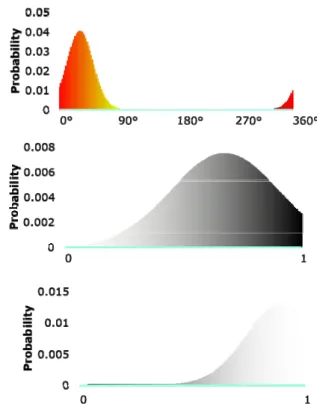
σ σ are standard deviations of saturation and value components. Fig. 2 shows the HSV color distributions of flames learned from vast amounts of data. An example of the proposed color models in Eqs. (2)-(4) are shown in Fig. 3. Parts (b) to (d) in Fig. 3 are the grayscale images of HSV components, and parts (f) to (h) in Fig. 3 are the grayscale images of HSV from Eqs. (2)-(4). As shown in the figures, the proposed color models make more distinctive scales, which improve separation of the flame region.
In addition, we devised another algorithm to reduce false detection of flame-colored blinking regions by eliminating stationary regions, as shown in Fig. 1. The HSV color space has a cone structure, where the hue and value planes are not perpendicular to the saturation component. Also the HSV color space yields a greater dynamic range in saturation. Using these properties, the saturation components to determine flame regions should be separated from hue and value. Assuming that hue and value components are independent, the candidate flame region is represented as a binary map given by
(
) (
)
(
)
1 1 2 if ( , ) ( , ) , 1, ( , ) and ( , ) , 0, otherwise, H H V V S S p i x y p i x y F x y p i x y τ τ ⎧ > ⎪ =⎨ > ⎪ ⎩ (5)where τ1 and τ are thresholds obtained empirically over 2
30 sets of video data. After F1 is obtained, it is followed
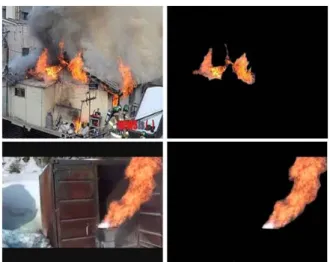
by an additional morphological operation to reduce noisy regions. Two examples of flame region detection are shown in Fig. 4.
2.3 Color Models of Smoke
Generally, smoke appears earlier than flame in fire situations, and thus, it is important to recognize smoke for early detection of fire. The visual color information from smoke varies according to the types of combustible materials. In addition, it is a challenge to distinguish between smoke and smoke-like things, such as cloud and vapor. Fig. 5 shows the wide variation of smoke colors, which makes it difficult to acquire the regulated and typical color information of smoke.
This paper considers general smoke colors, and excludes some special cases to reduce false positive smoke Fig. 2. Color models of flames in the HSV space (Top) probability density function (pdf) of the hue component, (middle) pdf of the saturation component, (bottom) pdf of the value component.
(a) (b) (c) (d)
(e) (f) (g) (h)
Fig. 3. An example of HSV distribution under the proposed color models (a) the original image, (b)-(d) grayscales of HSV components of (a), (e) final binary fire region of (a), (f)-(h) grayscales of HSV components using the proposed color probability models in Eqs. (2)-(4).
detection. Smoke is usually generated by burning carbon compounds, and it has grayish colors. Thus, smoke colors are mainly dependent on the saturation component. Because of the achromatic property of smoke colors, the saturation component from smoke is generally low, and the hue component has no effect on detecting a smoke region. The range of the value component is chosen from empirical data, excluding dark and bright values. The smoke region is defined as a binary map, F x y2( , ), by
3 2 4 5 if ( , ) , 1, ( , ) and ( , ) , 0, otherwise, S V i x y F x y i x y τ τ τ < ⎧ ⎪ =⎨ < < ⎪ ⎩ (6)
where τ τ3, , 4 and τ are thresholds for smoke detection. 5
To reduce smoke-colored objects, the temporal variance of colors in a smoke region is examined, as depicted in Fig. 1. Since smoke regions move in a diffusion process, the value and saturation components change in the temporal domain. We exploit the temporal variances of value components in five successive video frames from the current to the fourth previous frame. If the temporal variance of the value component at the same position is less than a threshold, the
position is removed from F x y2( , ) . Fig. 5 shows an
example of smoke region detection using Eq. (6). As shown in Figs. 6(b) and (c), the stationary region of the smoke color is eliminated via the temporal variance of the value component. Even though the temporal variance of the value component reduces real smoke regions, it is more effective at eliminating false positive errors in smoke detection.
2.4 Motion Models of Flames and Smoke
The proposed color models of flames and smoke detect fire regions well. However, various fire-like objects cause false positive alarms in real applications. Red moving objects are subject to being considered flames, and gray moving objects can be detected as smoke. To reduce these false positive errors in fire detection, it is reasonable to introduce dynamic characteristics of flames and smoke. In this paper, we propose motion models for flames and smoke based on optical flow analysis. Among various methods for obtaining the optical flow, the Farnebäck algorithm was selected because it generates dense optical flow that is appropriate for the dynamic features of flame and smoke [17]. This method estimates the motion field using a signal transform called polynomial expansion.After finding the optical flow, the image is divided into 8x8 blocks. The representative optical flow of each block is chosen for computational efficiency, and it is applied to a local variance calculation. Since the fire usually has dynamic movement in the temporal and spatial domains, the local variance of optical flow vectors in the fire region is usually larger than that in a non-fire region. Let an optical flow vector at block position ( , )i j in the -tht
frame be represented as f ( , )t i j : ( , ) f ( , ) ( , ) X t Y f i j i j f i j ⎡ ⎤ = ⎢ ⎥ ⎣ ⎦ (7) Then, the local temporal variance in a frame is defined by
(
)
2 3 2 1 1 0 1 f , f f , f 4 t n t n t n t n t n σ − − − − − − = =∑
− (8)where .,. is the inner product operator, and .,. is the mean of four inner products. The inner product of optical flow vectors between successive frames is used to analyze the randomness of optical flow. When the optical flow vectors are similar, the inner products of optical flow Fig. 4. Examples of flame region detection. First row:
the original fire image, second row: detected flame regions from Eq. (5).
Fig. 5. Various colors of smoke. There is no typical color distribution for smoke, unlike for flames.
Fig. 6. An example of smoke detection (a) the original image with smoke, (b) a binary smoke region, (c) a binary smoke region with stationary region filtering.
in a fire region, a local spatial variance is proposed. In the spatial domain, the angle of optical flow is considered, unlike in the temporal domain, because other moving objects also have a high magnitude in the optical flow vector. Specifically, we use the angles of optical flow vectors that have large magnitudes. The blocks that have large magnitudes of optical flow vectors are grouped into a cluster via connected component scheme, and the spatial variance of angles in each cluster is calculated. As the angles of optical flow vectors are circular data, their spatial variance in a cluster, L, is represented by
2 2 2 1 s = − C +S (10) where 1 cos L L C N θ θ ∈ =
∑
, 1 sin L L S N θ θ ∈ =∑
(11) and NL is the number of blocks in cluster L. Finally, wedetermine the fire region with the spatial variances of optical flow directions in a moving cluster. The spatial binary fire region F x y4( , ) is defined by
2 7 4 1, if ( , ) ( , ) 0, otherwise. s x y F x y = ⎨⎧ >τ ⎩ (12) Fig. 7 shows examples of fire detection by optical flow analysis. The fire regions generated by temporal and spatial variances are shown in Figs. 7(b) and (c), respectively. Fig. 7 (d) is generated by averaging two variances and two thresholds in Eqs. (9) and (12).
2.5 Fire Detection
To determine the final fire region, the tentative fire regions previously mentioned in Eqs. (5), (6), (9) and (12) are combined with some weights. The binary map of the final fire region in the current frame at time t is defined by
4 1 1, if ( , ) 1, ( , ) 0, otherwise, i i i w F x y D x y = ⎨⎧⎪ = = ⎪⎩
∑
(13)where wi is the weight of positive values. If fire region F1
has very small measure, weight w1 for region F1 is set to 0.
In this case, the flame region is not detected in the frame. Weight w2, which detects a smoke region by color models,
is usually less than w1 because smoke detection suffers
from more false positive errors than flame detection. Finally, we accumulate the probability of detected fire regions for long frames. If a fire decision is made only from the current frame, false positive errors increase. The proposed method accumulates fire regions FD for successive frames in a few seconds. FD at the t-th frame is represented by 1 1 ( , ) 1, if ( , ) 1 ( , ) max( ( , ), 0), if ( , ) 0 t t t t t FD x y D x y FD x y FD x y D x y − − ⎧ + = = ⎨ = ⎩ (14) If a pixel satisfies ( , ) 8 t FD x y > , it is determined to be τ a fire in the current frame.
3. Experimental Results
We tested the algorithm on 100 videos in which there were 10 videos without fire (mainly to test for false positives) and 90 videos with fire, categorized into three grades. The 50 videos classed as grade A contain a fire that is likely to be easily detected in both indoor and outdoor environments. The 27 videos classed as grade B contain mostly smoke, which is detected at moderate accuracy. The 13 videos classed as grade C include fire or smoke that is unlikely to be detected. We considered fire detection to be successful when the algorithm detects the fire within seven seconds.
The experimental results with the 90 fire videos are summarized in Table 1. The proposed algorithm is compared with a benchmark algorithm from Habiboglu et al. [15]. In Table 1, true positive (TP) means successful fire detection, and true negative (TN) denotes a failure to detect fire. A false positive (FP) is an error where no fire is detected as a fire. As summarized in Table 1, the proposed algorithm shows better performance in terms of TP, TN, and FP. Consequently, the proposed algorithm not only Fig. 7. (a) Original images, (b) fire region using temporal local variance, (c) fire region using spatial local variance with a high magnitude, (d) combined fire region using temporal and spatial local variances.
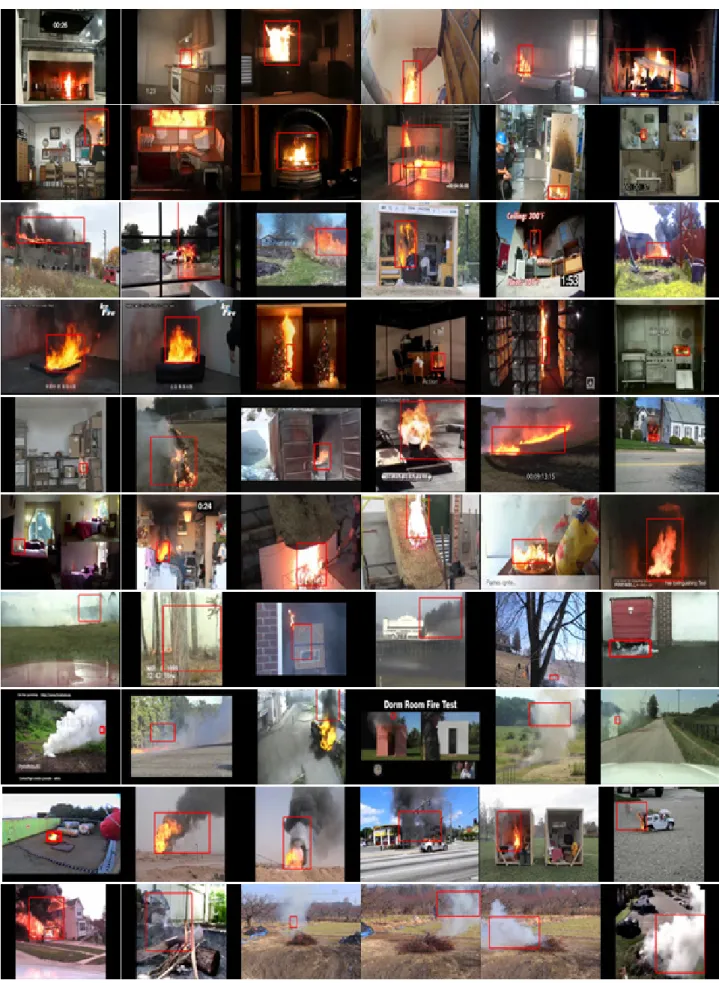
Fig. 8. Experimental results: Detection of various fire situations. A total of 60 fire video results are shown in the figures. Some fires are mainly detected by flame, and some are detected by smoke. The red boxes mean the fire regions that are determined by four binary maps (color models of flame and smoke, motion models of flame and smoke, respectively) and temporal accumulation described in Section 2.
detects fire situations well, but also reduces false positives. In real applications for fire detection, it is also important to reduce false positive errors for a reliable system.
Fig. 8 shows the experimental results of fire detection for the test videos. It shows as many captured frames as possible for objective evidence, since there are few reference products to compare the results objectively. According to Fig. 8, the experimental results show that the proposed algorithm detects the various fire situations very well.
Fig. 9 shows captured images from detection errors, including TN and FP. Five images are TN errors, and the bottom-left image is FN. The TN errors occur when there is slowly moving smoke or just a little bit of smoke that is similar to the background. If the thresholds are adjusted to detect this kind of smoke, false positive errors increase. The parameters were optimized for the set of 100 videos.
Table 2 summarizes the results of false positive errors. We chose 10 non-fire videos where flame- or smoke-like colored objects are moving, which can be confused as real fire and/or smoke. Fig. 10 shows the four captured images that frequently caused false positives. Fig. 10(a) shows flame-like images, and Fig. 10(b), smoke-like images. As shown in Table 2 and Fig. 10, the proposed algorithm reduces false positives. The results prove that the temporal and spatial variances of optical flow are appropriate measures for reducing confusion.
According to the various experiments, the proposed algorithm is shown to work well in detecting fire situations. Furthermore, the proposed algorithm reduces false positives by using temporal and spatial motion models and an accumulation scheme. From the aspect of time consumption, the proposed algorithm operates at most in 40 ms (25 frames per second) for 640x480 video. Thus, the proposed fire detection algorithm is suitable for general CCTV camera systems.
4. Conclusion
We have proposed a fire detection method using color and motion models in video data. The proposed method first finds candidate regions by using a color model in the HSV space and also by using a motion model based on the magnitude and angle of optical flow. The measurements Table 2. Results of false positive errors from 10 videos
comparing the proposed algorithm to an algorithm from Habiboglu et al. [15].
TP TN FP
Video
Grade Prop. Ref. [15] Prop. Ref. [15] Prop. Ref. [15] Flame-like 4 3 0 0 1 2 Smoke-like 5 5 0 0 0 0 Total 9 8 0 0 1 2
Fig. 9. Errors in fire detection (six videos). The first five images are failures, and the bottom-right image is a false positive (red box).
(c) (d)
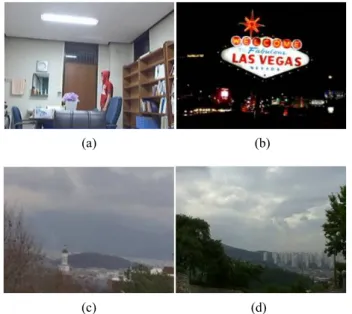
Fig. 10. Images from false positive errors (a) flame-like red moving objects (a person with a red shirt), (b) flame-like red flashing signs, (c)-(d) smoke-like gray moving cloud. These situations occur frequently in fire detection systems.
obtained by these models are accumulated over the temporal direction to reduce false positives. We tested the algorithm with 100 fire videos of various indoor and outdoor fire scenes and some scenes without fire that are prone to detection as false positives. According to the experiments, the proposed fire detection algorithm works well in various fire situations, and outperforms conventional algorithms. Since the proposed method does not use background subtraction, which was adopted in many existing methods, it can be applied to both fixed and PTZ cameras. In addition, the developed fire detection algorithm can be included in existing surveillance CCTV systems that are implemented for other security and safety purposes [18, 19]. As future work, since the proposed method sometimes confuses haze and cloud with smoke, and also because flames are sometimes unseen due to smoke, we will test whether dehazing algorithms can enhance outdoor detection performance, such as wild fire situations [20, 21].
Acknowledgement
This research was supported by the MSIP (Ministry of Science, ICT and Future Planning), Korea, under the ITRC (Information Technology Research Center) support program (IITP-2017-2016-0-00288) supervised by the IITP (Institute for Information & communications Technology Promotion).
References
[1] A. Enis Cetin, et al, “Video fire detection – review,” Digital Signal Processing, Vol. 23, pp. 1827-1843, 2013.
[2] Thou-ho Chen, Ping-Hsueh Wu, and Yung-Chuen Chiou, “An early fire-detection method based on image processing,” Proc. of International Conf. on
Image Processing (ICIP), pp.1707-1710, 2004.
[3] Che-Bin Liu and Narendra Ahuja, “Vision based fire detection,” Proc. of International Conf. on Pattern
Recognition (ICPR), 2004.
[4] B. U. Toreyin, Y. Dedeoglu, and A. Enis Cetin, “Wavelet based real-time smoke detection in video,”
Proc. of European Signal Proc. Conf. (EUSIPCO),
2005.
[5] B. U. Toreyin, Y. Dedeoglu, U. Gudukbay, and A. Enis Cetin, “Computer vision based method for real-time fire and flame detection,” Pattern Recognition
Letters, (27), pp. 49-58, 2007.
[6] B. U. Toreyin, R. G. Cinbis, Y. Dedeoglu, and A. Enis Cetin, “Fire detection in infrared video using wavelet analysis,” Optical Engineering, 46 (6), pp. 1-9, 2007.
[7] T. Celik, H. Demirel, H. Ozkaranmanli, and M. Uyguroglu, “Fire detection using statistical color model in video sequences,” Journal of Visual
Communication and Image Representation, 18,
pp.176-185, 2007.
[8] Feiniu Yuan, “A fast accumulative orientation model
based on integral image for video smoke detection,”
Pattern Recognition Letters, 29, pp.925-932, 2008.
[9] B. C. Ko, K.-H. Cheong, and J-Y. Nam, “Fire detection based on vision sensor and support vector machines,” Fire Safety Journal, 44, pp. 322-329, 2009.
[10] J. Gubbi, S. Marusic, M. Palaniswami, “Smoke detection in video using wavelets and support vector machines,” Fire Safety Journal, 44, pp. 1110-1115, 2009.
[11] Xiao-bai Li, Ying Hua, and Ning Xia, “Fire detection technology based on dynamic texture,” Procedia
Engineering, 52, pp. 186-195, 2013.
[12] M. Bugaric, T. Jakovevic, and D. Stipanicev, “Adaptive estimation of visual smoke detection parameters based on spatial data and fire risk index,”
Computer Vision and Image Computing, 118, pp.
184-196, 2014.
[13] D.-C. Wang, X. Cui, E. Park, C. Jin, and H. Kim, “Adaptive flame detection using randomness testing and robust features,” Fire Safety Journal, 55, pp. 116-125, 2013.
[14] T. Xuan and J.-M. Kim, “Fire flame detection in video sequence using multi-stage pattern recognition techniques,” Engineering Applications of Artificial
Inteligence, 25, pp. 1365-1372, 2012.
[15] Y. Habiboglu, O. Günay, and A. Çetin, “Covariance matrix-based fire and flame detection method in video,” Machine Vision and Applications, Vol. 23, no. 6, pp. 1–11, 2011.
[16] K. V. Mardia and P. E. Jupp, Directional Statistics, Wiley, 1999, pp. 83-92.
[17] G. Farneback, “Two-frame motion estimation based on polynomial expansion,” in Proc. Image Anal., pp. 363–370, 2003.
[18] D. T. Nghia, S. Kim, V. L. Cuong, and H.-J. Lee, “Anomalous Trajectory Detection in Surveillance Systems Using Pedestrian and Surrounding Information,” IEIE Transactions on Smart Processing and Computing, 5(4), pp. 256-266, Aug.
2016.
[19] H. Kim, J. Park, S. Park and J. Paik, “Motion Estimation–based Human Fall Detection for Visual Surveillance,” IEIE Transactions on Smart Processing and Computing, 5(5), pp. 327-330, Oct.
2016.
[20] T. H. Kil, S. H. Lee, and N. I. Cho, “A dehazing algorithm using dark channel prior and contrast enhancement,” Proc. of International Conf. on
Acoustics, Speech and Signal Processing (ICASSP),
pp. 2484-2487, 2013.
[21] T. H. Kil, S. H. Lee, and N. I. Cho, “Single image dehazing based on reliability map of dark channel prior,” Proc. of International Conf. on Image
Sang Hwa Lee received the B. S. and M. S. degrees in Electronics, and Ph. D. degree in Electrical Engineering from Seoul National University, Seoul, South Korea, in 1994, 1996, and 2000 respectively. He had been a researcher in NHK-ES, Tokyo, Japan from 2000 to 2002. He has joined Seoul National University as a research professor since 2005. His majors are image processing and computer vision. His main research topics include stereo camera system, MRF modeling, image restoration and enhan-cement, video/image compression, pattern recognition, and commercial applications of camera systems.
Convergence Technology. His research interests include sensor networks, IOT and convergence technology
Nam Ik Cho received the B.S., M.S., and Ph.D. degrees in Control and Instrumentation Engineering from Seoul National University, Seoul, Korea, in 1986, 1988, and 1992, respectively. From 1994 to 1998, he was with the University of Seoul, Seoul, Korea, as an Assistant Professor of Electrical Engineering. He joined the School of Electrical Engineering, Seoul National University, in 1999, where he is currently a Professor of Department of Electrical and computer Engineering. His research interests include speech, image/video signal processing, and adaptive filters, pattern recognition.