자동차 난방 시트의 구조에 따른 열응력 해석에 대한 융합 연구
최계광
1
, 조재웅2*
1공주대학교 금형설계공학과 교수, 2공주대학교 기계자동차공학부 교수
Convergence Study on the Thermal Stress According to the Structure of Automotive Heating Seat
Gye-Gwang Choi
1
, Jae-Ung Cho2*
1Professor, Department of Metal Mold Design Engineering, Kongju national University
2Professor, Division of Mechanical & Automotive Engineering, Kongju National University
요 약 자동차 운전석의 따뜻하고 쾌적한 요구가 증가하고 있기 때문에 난방 시트의 연구 개발이 활발히 이루어지고 있다. 본 연구에서는 세 가지의 난방 시트 모델 A, B, C를 가지고 열응력해석과 구조해석을 시행하였다. 똑같은 재질로 열해석을 함으로서, 연구 결과에서는 모델 A가 모델 B나 모델 C보다 더 좋은 열전달을 가짐을 보여주었다. 이로써 모델 들이 제품의 형상에 따라 같은 재질을 가졌다고 하더라도 열전달들이 서로 다른 것을 알 수 있었다. 더 안정적인 난방을 기대하기 위해 열선을 추가하는 것은 더 좋은 난방이 될 수 있지만 제품의 가격대비 성능을 고려한 측면에서 한계가 있다. 전반적으로 모든 면에서 모델 B가 모델 A나 모델 C보다 열적으로 가장 안전하다고 사료된다. 본 연구결과에 의하 여 취득한 내구성과 안정성 있는 자동차 난방 시트 제품의 설계데이터를 사용하여 자동차 운전석에 융합하여 그 예술적 인 분위기를 조성할 수 있다.
주제어 : 자동차 난방 시트, 열응력, 온도, 내구성, 구조해석, 융합
Abstract Because the warm and cozy demand of automotive driving seat increases, the research development of heating seat has been actively made. In this study, the thermal stress analysis and the structural analysis were carried out with three kinds of heating seats of A, B and C. By executing the thermal analysis with the same material, model A was shown to have the heat transfer better than model B or model C at the study result. So, it could be seen that the heat transfers became different each other though models had the same material according to the configuration of product. Adding the hot wire in order to expect the safer heating can be better heating, but there is the limit on the aspect considering the capability in contrast to the price of product. Generally, model B is thought to be safest thermally than model A or model C in every respect. As the design data of the automotive heating seat product with the durability and safety acquired by this study result are used, the artistic environment can be promoted by being grafted onto the automotive driving seat.
Key Words : Automotive heating seat, Thermal stress, Temperature, Durability, Structural analysis, Convergence
*Corresponding Author : Jae-Ung Cho([email protected]) Received April 30, 2019
Accepted July 20, 2019
Revised May 20, 2019
Published July 28, 2019
1. 서론
자동차 시트는 승객이 바로 차에 탑승하여 승차감을 느끼게 된다. 또한 시트는 안락성을 자아내기 위하여 인 체를 비롯한 여러 가지 기술이 포함되어야 한다. 시트는 크게 프레임(골격), 헤드, 쿠쉬 패드(Cush pad), 백 패드 (Back pad), 커버링 등으로 나뉘어진다. 그리고 시트는 자동차의 여러 부품과 같이 차량 사고 시 인체의 부상을 방지하거나 냉난방 통풍을 위한 기능들이 있다. 요즈음 탑승자들은 자동차 안에서 지내는 시간이 늘어나서 상쾌 하고 편안한 차량 내부의 환경이 요구되고 있는 추세이 다. 더불어 자동차의 탑승자들이 체험하는 여러 가지 요 소가 있지만 그 가운데 자동차 시트가 탑승자와 직접 닿 는 부분이므로 중요하다고 사료된다. 이러한 소비자들의 요구를 반영하기 위하여 자동차 시트의 개발은 탑승자들 의 편안감과 승차감을 조성시키려는 최근의 기술 개발이 주로 이루어지고 있다. 또한 경량성과 환경에 친화적인 자동차 시트의 개발도 병행되고 있다. 냉난방 시트의 적 용 또한 과거 고급차종 일부 옵션으로 장착되어오던 것 이 현재는 점차 다양한 차종에 확대 적용되고 있는 실정 이다. 본 연구를 통하여 안락하고 편안한 열선 난방 시트 의 설계 및 해석을 통하여 소비자들의 취향에 맞는 자동 차 난방 시트를 개발하고자 한다[1-18]. 본 연구결과를 토대로 얻은 내구성과 안정성 있는 자동차 난방 시트 제 품의 설계데이터를 활용함으로서 실생활에서의 기계나 구조물에 융합하여 그 미적 감각을 나타낼 수 있다. 또한 본 연구에서의 시뮬레이션 해석 결과를 통하여 설계에 적용하였을 때 실험을 않고도 해석 결과를 통하여 그 내 구성 있는 결과를 예측할 수가 있다.
2. 모델 및 해석 결과
2.1 모델의 구조
본 연구에서는 자동차 시트 등받이와 열선 시트를 3D 모델링 하였다. 열선 난방 시트의 구조는 Fig. 1과 같다.
Model A와 B, C 모두 고정 방식은 동일하며 Model A 는 열선의 모양이 가로 모양, B는 세로 모양, C는 바둑판 모양으로 설계하였다. 그리고 본 연구 Model A, B, C의 Mesh는 39236개, 40677개, 41808개이고 자동차 시트 재료는 폴리에틸렌, 열선은 구리이다.
(a) Modeling of A (b) Modeling of B
(c) Modeling of C
Fig. 1. Configurations with meshes of each model
2.2 온도 해석의 구속조건
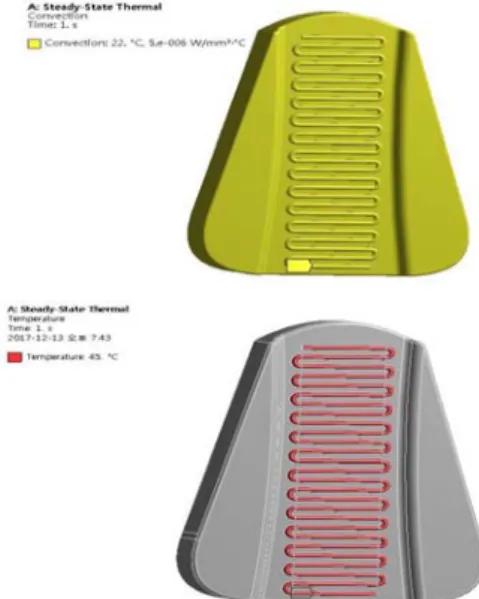
Fig. 2는 난방시트 3가지 모델들 중 Model A에 대한 구속조건을 나타낸다. Model B, C도 Model A와 같이 적용된다. 실제적인 조건으로서 그 주위의 온도를 22℃
로 하고, 열선에서의 온도는 45℃로 가정하였다.
Fig. 2. Constraint conditions of models
2.3 해석 결과
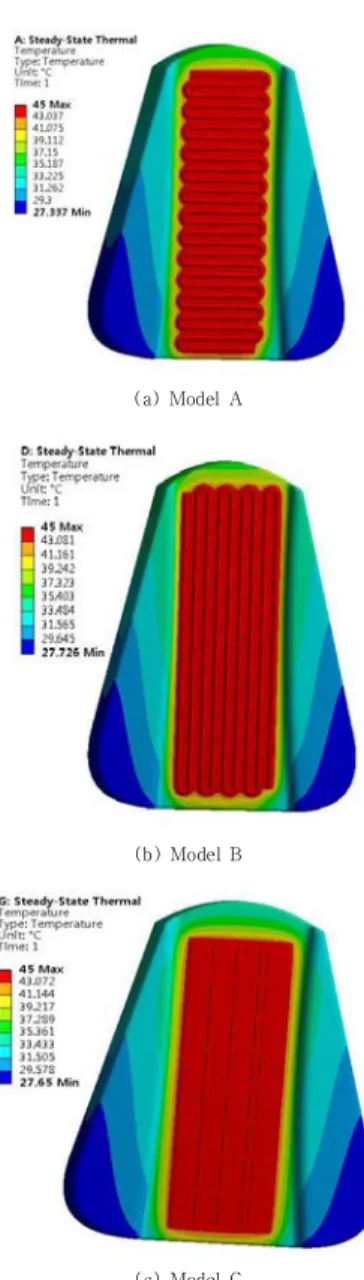
Fig. 3의 (A)는 난방 시트 Model A의 온도 분포를 나 타낸 그림이다. 최대 온도는 45℃ 이고 난방 시트 후면에 서 27.337℃로서 최소 온도가 됨을 보여 준다. (B)는 난
방 시트 Model B의 온도 분포를 나타낸 그림이다. 최대 온도는 45℃ 이고 난방 시트 후면에서 27.726℃로서 최 소 온도가 됨을 보여 준다. (C)는 난방 시트 Model C의 온도 분포를 나타낸 그림이다. 최대 온도는 45℃ 이고 난 방 시트 후면에서 27.65℃로서 최소 온도가 됨을 보여 준다. 공통적으로 Model A, B, C 모두 아주 열전달이 작 은 차이를 보였지만 Model B가 최소 온도가 세 모델들 중에서 크게 나타나서 그 열전달률이 가장 좋다고 판단 된다[19-20].
(a) Model A
(b) Model B
(c) Model C
Fig. 3. Temperature of models A ,B and C
그리고 초기 조건에서의 열응력을 해석시 그 경계조건 을 설정하였으며 자동차 시트에서 시트의 후면을 고정시 키고 등가 응력과 전변형량을 구하였다. Fig. 4에 세 가 지 모델들에서 똑같이 적용되는 열응력해석 시의 구속 조건들을 나타낸다.
Fig. 4. Constraint conditions of models A, B and C
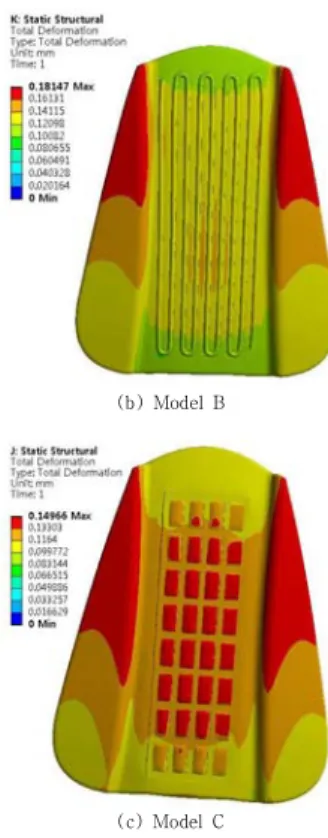
Fig. 5는 모델들의 등가 응력의 등고선들을 나타낸 것 이다. Fig. 5의 (A)의 그림은 난방 시트 Model A의 등가 응력을 나타낸 그림으로서 최대의 등가응력은 237.73Mpa 이고 최소의 등가응력은 0.026206Mpa이다. (B)의 그림 은 난방 시트 Model B의 등가응력을 나타낸 그림으로서 최대의 등가응력은 185.82Mpa이고 최소의 등가응력은 0.029799Mpa이다. (C)의 그림은 난방 시트 Model C 의 등가응력을 나타낸 그림으로서 최대의 등가응력은 307.26Mpa이고 최소의 등가응력은 0.035097Mpa이 다. 그리고 Fig. 6은 Model들의 전변형량의 등고선들을 나타낸 것이다. Fig. 6의 (A)의 그림은 난방 시트 Model A의 전변형량을 나타낸 그림으로서 최대의 변형량은 0.16517mm 인 것을 알 수 있다. Fig. 6의 (B)의 그림은 난방 시트 Model B의 전변형량을 나타낸 그림으로서 최 대의 변형량은 0.18417mm 인 것을 알 수 있다. (C)의 그림은 난방 시트 Model C의 전변형량을 나타낸 그림으 로서 최대의 변형량은 0.14966mm 인 것을 알 수 있다.
초기 조건에서의 변형량을 비교해 보았을 때 Model B의 변형량이 0.18417mm로 가장 크게 나타났다. 등가응력 해석 결과에서는 Model B가 가장 적은 응력을 받으며, 다음으로 Model A, Model C 순으로 나타나 Model B 가 강도가 좋은 것으로 보인다.
(a) Model A
(b) Model B
(c) Model C
Fig. 5. Equivalent Stresses of models A, B and C
(a) Model A
(b) Model B
(c) Model C
Fig. 6. Total deformations of models A, B and C
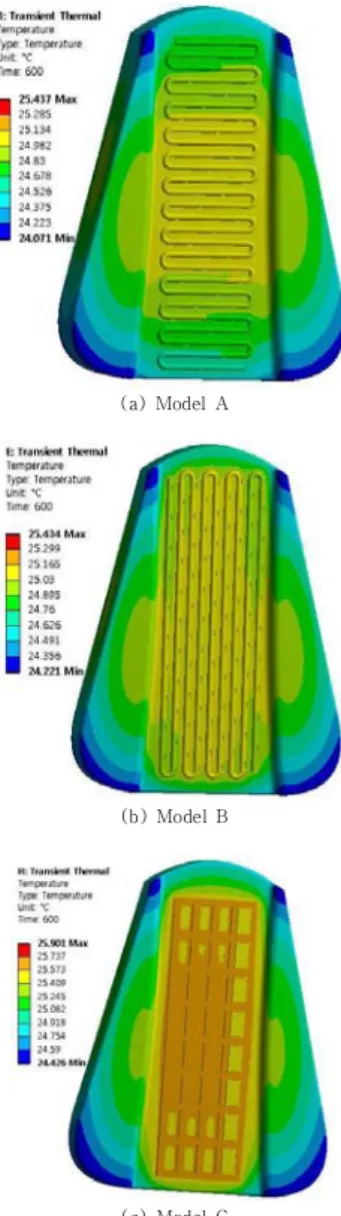
Fig. 7은 Model A, B 및 C가 600초 이후에 식은 온 도 분포의 등고선들을 나타낸 것들이다. Fig. 7의 (a)는 난방 시트 Model A의 식는 온도 분포를 나타낸 그림이 다. 최대 온도는 25.437℃ 이고 난방 시트 후면에서 24.071℃로서 최소 온도가 됨을 보여 준다. (b)는 난방 시트 Model B의 식는 온도 분포를 나타낸 그림이다. 최 대 온도는 25.434℃ 이고 난방 시트 후면에서 24.221℃
로서 최소 온도가 됨을 알 수 있다. (c)는 난방 시트 Model C의 식는 온도 분포를 나타낸 그림이다. 최대 온 도는 25.901℃ 이고 난방 시트 후면에서 24.426℃로서 최소 온도가 됨을 알 수 있다. 600초 동안 난방 시트가 식어가는 과정을 해석해 본 결과 Model A, B 및 C의 내 열성은 비슷하다고 판단된다.
(a) Model A
(b) Model B
(c) Model C
Fig. 7. Temperature of models A, B and C after elapsed time of 600 sec.
3. 결론
본 연구에서는 자동차 난방 시트의 구조에 따른 열응 력 해석을 진행하였다. 난방으로 인한 해석과정을 통하여 각 모델별 전변형량, 등가응력 데이터들을 통한 결과들을 얻을 수 있었다. 연구를 통한 결과들은 다음과 같다.
1) 자동차 난방 시트 모델들의 전변형량 해석 결과, Model B가 최대 변형량이 가장 작게 나타났고 다
음으로 Model A, Model C 순으로 나타났다. 변 형량을 확인한 결과, B의 강도가 좋은 것으로 사 료되었다.
2) 자동차 난방 시트 모델들의 등가응력 해석 결과에 서는 Model B가 가장 적은 응력을 받으며, 다음으 로 Model A, Model C 순으로 나타났다. 등가응력 도 변형량과 마찬가지로 확인한 결과 B의 강도가 좋은 것으로 보이나 600초 동안 난방 시트가 식어 가는 과정을 해석해 본 결과 Model A, B 및 C의 내열성은 비슷하다고 판단된다.
3) 본 연구결과를 토대로 얻은 내구성과 안정성 있는 자동차 난방 시트 제품의 설계데이터를 활용함으 로서 실생활에서의 기계나 구조물에 융합하여 그 미적 감각을 나타낼 수 있다.
REFERENCES
[1] J. H. Lee & J. U. Cho. (2015). Convergence Technique Study through Simulation Thermal Analysis due to the Shape of Electric Heater.
Journal of the Korea Convergence Society, 6(6),241-246.
[2] C. J. Choi, J. C. Gao, J. Y. Kim & Y. S. Jung. (2016).
Research on the Relationship between Thermoelectric Module with Defects and Thermal Performances.
Journal of the Korean Society of Manufacturing Process Engineers, 15(4),
125-133.
[3] Y. T. Cho. (2013). Heat Sink of LED Lights Using Engineering Plastics.
Journal of the Korean Society of Manufacturing Process Engineers, 12(4),61-68.
[4] J. U. Cho. (2015). Study on Convergence Technique through Strength Analysis of Stabilizer Link by Type.
J
ournal of the Korea Convergence Society, 6(1),57-63.
[5] J. H. Lee & J. U. Cho. (2015). Convergence Technique Study through CAE due to the Shape of Lift for Car.
Journal of the Korea Convergence Society, 6(5),
49-54.
[6] G. M. Ku, K. Kim, S. H. Park, S. D. Choi & J. W. Heo.
(2013). Cooling Performance Study of a Impinging Water Jet System with Heat Sink for High Power LEDs.
Journal of the Korean Society of Manufacturing Process Engineers, 12(6),
152-158.
[7] Z. H. Wang., C. K. Chun & Y. C. Kwon. (2018). Study on Exhaust Air Heat Transfer Characteristics of Heat Exchange System for White Smoke Reduction.
Journal of Korean Society of Mechanical Technology, 20(6),739-744.
[8] Y. S. Choi & Y. C. Kwon. (2019). An Experimental
Study of Air-side Heat Transfer and Pressure Drop of
Evaporator for Refrigerator Unit.
Journal of Korean Society of Mechanical Technology, 21(1),42-47.
[9] S. W. Hwang. (2019). A Comparison Study of Performance due to the Oil-cooler Fin Shape for Diesel Engine using Numerical Analysis.
Journal of Korean Society of Mechanical Technology, 21(1),1-7.
[10] B. M. Jang & D. H. Cho. (2019). A Study on the Flow Characteristics around Vertical Wall with Flap.
Journal of Korean Society of Mechanical Technology, 21(2).248-253.
[11] H. J. Kang & H. S. Lee. (2019). A Study on Heating and Cooling Performance Characteristics of Heat Meter for Water Source Heat Pump System.
Journal of Korean Society of Mechanical Technology, 21(2),321-326.
[12] M. S. Han & J. U. Cho. (2016). Durability Analysis through the Radiation of Heat of a Laptop.
Journal of the Korean Society of Manufacturing Process Engineers, 15(5),25-30.
[13] J. U. Cho & M. S. Han. (2013). Study on Analysis of Heat Dissipation due to Shape of Motorcycle Disc Brake. J
ournal of the Korean Society of Manufacturing Process Engineers, 12(4),100-107.
[14] J. U. Cho. (2014). A Flow Analysis on Wing Shape of Cooling Fan at Automobile”,
Journal of the Korea Convergence Society. 5(4),75-79. .
[15] S. Y. Oh. (2012). A Traffic Hazard Prediction Algorithm for Vehicle Safety Communications on a highway.
Journal of Digital Convergence, 10(9),319-324.
[16] K. H. Ko. (2018). An Estimating Algorithm of Vehicle Collision Speed Through Images of Blackbox.
Journal of Digital Convergence, 16(9),173-178.
[17] J. H. Hyeon, Y. H. Moon & S. W. Ha. (2018).
Development of Automation Software for Corner Radius Analysis of Composite Laminated Structure.
Journal of Convergence for Information Technology, 8(3),
107-114.
[18] J. H. Ku. (2017). A Study on the Platform for Big Data Analysis of Manufacturing Process.
Journal of Convergence for Information Technology, 7(5),177-182.
[19] M. S. Han & J. U. Cho. (2016). A Study on the Shape Design of a Radiator Panel for Effective Heat Release.
Journal of the Korean Society of Manufacturing Process Engineers, 15(5),
25-30.
[20] J. H. Lee & J. U. Cho. (2015). Study on Convergence Technique due to the Shape of Cruiser Board through Structural Analysis.
Journal of the Korea Convergence Society, 6(4),99-104.
최 계 광(Gye-Gwang Choi) [정회원]
․ 1993년 2월 : Pusan University of
Technology Metalmold
Engineering (공학사)
․ 1995년 8월 : 국민대학교 대학원 기계 설계학과 (공학석사)
․ 2005년 2월 : 국민대학교 대학원 기계 설계학과 (공학박사)
․ 2005년 8월 : (주) 현대배관 기술부장
․ 2006년 5월 ~ 현재 : 공주대학교 금형설계공학과 교수
․ 관심분야 : 3D CAD, CAM Programing
․ E-Mail : [email protected]
조 재 웅(Jae-Ung Cho) [종신회원]
․ 1980년 2월 : 인하대학교 기계공학과 (공학사)
․ 1982년 2월 : 인하대학교 기계공학과 (공학석사)
․ 1986년 8월 : 인하대학교 기계공학과 (공학박사)
․ 1988년 3월 ~ 현재 : 공주대학교 기 계·자동차공학부 교수
․ 관심분야 : 기계 및 자동차 부품 설계 및 내구성 평가, 피로 또는 충돌 시 동적 해석
․ E-Mail : [email protected]