Corresponding author: So Young Lee
Department of Nursing, Kkottongnae University, 133 Sangsam-gil, Hyeundo-myeon, Seowon-gu, Cheongju 28211, Korea.
Tel: +82-43-270-0135, Fax: +82-43-270-0614, E-mail: [email protected]
- This study was supported by Youth Mental Health Screening Program of Siheung Mental Health Center.
Received: Nov 8, 2016 / Revised: Dec 17, 2016 / Accepted: Dec 18, 2016
This is an open access article distributed under the terms of the Creative Commons Attribution Non-Commercial License (http://creativecommons.org/licenses/
by-nc/3.0), which permits unrestricted non-commercial use, distribution, and reproduction in any medium, provided the original work is properly cited.
Factors for Suicidal Ideation in Middle School Students by Gender
Seung-Kyo Chaung
1· Chun-Gill Kim
2· Soo Yang
3· So Young Lee
41Department of Nursing, Semyung University, 2Division of Nursing, Hallym University, 3College of Nursing, The Catholic University of Korea,
4Department of Nursing, Kkottongnae University
ABSTRACT
Purpose: This study was conducted to identify the factors of suicidal ideation in middle school students by gender, and to announce the necessity of gaining upon a socio-cultural comprehension-based approach. Methods: Three middle schools were randomly selected from a pool of 21 middle schools in S City, and were stratified by school and grade. A total of 878 students were included in the analysis. Multiple logistic regression analysis was con- ducted to identify the factors that affect suicidal ideation by gender. Results: Suicidal ideation and depression scores of the female students were over twofold higher than those of the male students. The factor that was found to affect suicidal ideation in the male students was depression while for the female students the factors were visiting suicide-related websites, having friends who attempted to commit suicide, depression, and poor communication with one’s parents. Conclusion: The findings in this study support gender differences in suicidal ideation, and sug- gest that building socio-cultural environments are needed to abate their negative emotions and to help youth find out their reasons to live.
Key Words: Suicidal Ideation, Depression, Comprehension, Youth
INTRODUCTION
Suicide has been reported to be the fourth highest cause of death in South Korea since 2005. In terms of age, from the teens to the thirties, suicide has been ranked as the first cause of death in both males and females. It has been the highest (29.1/100,000 persons) and was over twofold higher than the OECD average (12.1/100,000 persons) in a single year [1]. With almost one million people dying from suicide around the world each year, and with a dis- proportionate impact of such on the world’s youth, the global society owes it to the future generations to act now with regard to such matter [2].
Suicidal ideation is distinguished from suicidal attempt and suicide but is linked to them. Although not all cases of suicidal ideation would necessarily lead to suicidal at- tempt or suicide, suicidal ideation has been geared to-
wards suicide and could facilitate suicidal risk and the plausibility of committing suicide [1,3,4]. The ripple effect - that is, that suicide may impact on the lives and mental health of many families and communities, beyond the in- dividual who commits it - dictates the need for collective action to acknowledge and address the problem as well as for commitment to effective interventions supported by political will and resources [2].
Adolescence is a transitional stage of rapid develop- mental change in the physical, psychological, intellectual, and social realms, which exposes one to increasing self- consciousness and doubts about one’s identity. These rap- id changes can induce stressful conditions and may lead to emotional instability and impulsiveness [5-7]. Accor- ding to the 2013 Korean Youth Health Behavior Survey (9th), the level of stress cognition and depression of ado- lescents is higher than that of adults and is higher in girls
than in boys and in high school students than in middle school students [8]. Suicidal ideation was also found to be higher in high school students than in middle school stu- dents, but the suicidal attempt rate was found to be higher in middle school students than in high school students [8].
Adolescents who have suicidal ideation may commit suicide in adulthood tenfold more than those who do not have suicidal ideation [7]. Also, suicidal ideation has a dif- ferent elevation trend by gender, specially, suicidal idea- tion rate in girls has highly elevated from twelve to four- teen years old as that of boys [9]. Suicide is a concept re- sulting from suicidal ideation and suicidal attempt [4,10], and suicidal ideation among the youth needs to be given particular attention and public health concern [9].
In previous studies, the factors that affect the adoles- cent suicidal ideation rate were condensed into depression, stress [4,9-12], hopelessness [2,3,14], low self-esteem [15,16], absence of social support [2,3,5,11,15], bullying [4,18], con- flict with one’s parents [4,12,16,17], and poor peer rela- tionships [4,16-18].
Besides, unlike in many other countries, the educational and social structures in South Korea have a tendency to foster crooked college admission practices and emphasize earning a degree rather than learning and ability, which has resulted not only in biased education but also in an imbalanced educational culture, particularly examination- oriented education and early childhood education. Hence, adolescents have come to have stressful conditions that could worsen their anxiety and depression [4]. Specially, family environmental stress and academic stress that af- fect to suicidal ideation in adolescents have been reported in Korean researches [10,17].
Legislation for suicide prevention, including fostering a life-respecting culture, has been enacted in 2011. Con- currently, Korea Suicide Prevention Center has establi- shed and implemented various relevant programs. In school, the student health promotion program has come to emphasize mental health, and this trend has expanded generally, but the scope of the program is still limited, and it is focused on preventive and general education, except- ing specific strategies. To identify adolescents’ mental health status and to connect which can lay down their sui- cidal ideation, an approach based on socio-cultural com- prehension is needed. Although suicidal ideation rate was higher in high school students than in middle school stu- dents, this study focused on middle school students con- sidering their conditional differences; elevation of acade- mic stress in general, emotional instability, depression, and decreasing of self-esteem.
This study was conducted to identify the factors for sui-
cidal ideation in middle school students by gender, and to announce the necessity of gaining upon socio-cultural comprehension based approach.
METHODS 1. Study Design
This study used a cross-sectional survey research design, conducting secondary analysis of screening survey data from Siheung Mental Health Center in Gyeonggi Province, South Korea. The screening survey was conducted to ex- amine the youth’s mental health status and to gather basic data for use in coming up with a community-based mental health program. The study received ethical approval from the Institutional Review Board of J Oriental Hospital, which is affiliated with S University (SMJOH, 2010-4).
2. Setting and Sample
This study was conducted in three middle schools ran- domly selected from a pool of 21 middle schools in S City.
The sample was stratified by school and grade (3 classes per grade, 9 classes in one school). A total of 18 classes were selected, and a total of 906 students from the three schools agreed to participate in the study. During the data screening, the 28 participants who only partially com- pleted the survey questionnaire were dropped out of the study. As such, a total of 878 participants were included in the analysis. Based on the power calculation using the G*Power program, effect size f2=0.15, ⍺=.05, power (1- β)=.95, and Odds 1.5, and considering depression the main variable related to suicidal ideation, as in the previous re- search [19], 417 participants were needed for the multiple logistic regression model. The actual number of partic- ipants in this study was sufficient.
3. Procedure
Data collection was conducted from November 1 to December 10, 2010. Three middle schools were randomly picked from a pool of 21 middle schools in S City. Three classes were randomly assigned in each grade, and nine classes per school. A document reflecting the research purpose and a request for cooperation was sent to the principal of each school, but direct contact was establi- shed with the target participants to obtain their informed consent to participate in the study. After the explanation of the research purpose to them, the students signed the informed-consent form. The ethical-consideration infor-
mation that the students’ participation was not manda- tory and could be withdrawn at any time during the study was given to the students in advance.
4. Measures
1) Suicidal ideationSuicidal ideation was measured using the Korean Sui- cidal Ideation Questionnaire (KSIQ), which is a modified version [20] of the Reynolds Suicidal Ideation Question- naire (RSIQ) developed by Reynolds [21]. The 30 items of the RSIQ elicit data about a person’s thoughts about and views of suicidal ideation. Each item is scored based on a 7-point Likert scale ranging from 0 to 6. The means across all the items are summed up to obtain the total score (range: 0~180); a higher score indicates a higher level of suicidal ideation. The reliability was .96 for the males and .98 for the females in this study. The cut-off score for suici- dal ideation was 20, reported as having the optimal clini- cal utility based on the results of a clinical study involving adolescents aged 13~18[22]. In this study, the cut-off score for suicidal ideation was chosen by this clinical utility report.
2) Academic stress
Academic stress was measured using the Visual Ana- log Scale (VAS), a 10cm horizon bar ranging from 0 (left end) to 10 (right end). Each subject marked his/her own academic stress level on the instrument, and a higher mark represents a higher level of academic stress. Most of the other existing academic stress scales are included in gen- eral stress inventories or consist of many items, which might elevate the dropout rate or lessen the reliability of the results obtained. VAS is based on the intensity of the respondent’s conformity to each of the items, and can evaluate the evaluation object easily, but its validity is still being debated [23]. Hence, by targeting 119 middle school students, partial correlation analysis was conducted be- tween VAS and Adolescent Academic Stress Scale, which is used for the Korean Adolescent Panel Survey [17], to es- tablish concurrent validity (r=.736, p<.001).
3) Depression
Depression was measured using Beck Depression In- ventory II (BDI II)[24], which consists of 21 items. Each item is scored based on a 4-point Likert scale ranging from 0 (not at all) to 3 (severely). The means across all the items are summed up to obtain the total score (range: 0~63); a higher score indicates a higher level of depression. The re- liability was .90 in this study.
4) Self-esteem
Self-esteem was measured using VAS, which was de- scribed earlier. Each subject marked his/her own self-es- teem level on the instrument; a higher mark indicates a higher level of self-esteem. Although the validity of VAS is still being debated [23], the instrument is based on the in- tensity of the respondent’s conformity to each of the items, and can evaluate the evaluation object easily. To address VAS’s weakness in terms of validity, targeting 119 middle school students, partial correlation analysis was conduc- ted between VAS and Adolescent Self-Esteem Scale, which is used for the Korean Adolescent Panel Survey [17], to es- tablish concurrent validity (r=.779, p<.001).
5) Communication with one’s parents
To measure the respondent’s level of communication with his/her parents, a subscale (8 items related to com- munication with one’s parents) of Inventory of Parent and Peer Attachment (IPPA) developed by Armsden and Greenberg (1987)[25] was used. Each item is scored based on a 4-point Likert scale ranging from 1 (never) to 4 (al- most every day). The means across all the items are sum- med up to obtain the total score (range: 8~32); a higher score indicates frequent communication with one’s parents.
The reliability was .78 in this study.
5. Data Analysis
Descriptive statistics were used to evaluate the charac- teristics of the subjects by gender, and the x2 test was used to compare the differences in suicidal ideation according to the general characteristics and suicide-related variables of the subjects by gender. The independent t-test was used to compare the subjects’ academic stress, depression, self- esteem, and communication with their parents according to suicidal ideation by gender. To identify the factors that affect suicidal ideation by gender, multiple logistic regres- sion analysis was conducted. For data analysis, SPSS/WIN 16.0 was used.
RESULTS
1. Characteristics of the Subjects and Suicidal ideation relating variables
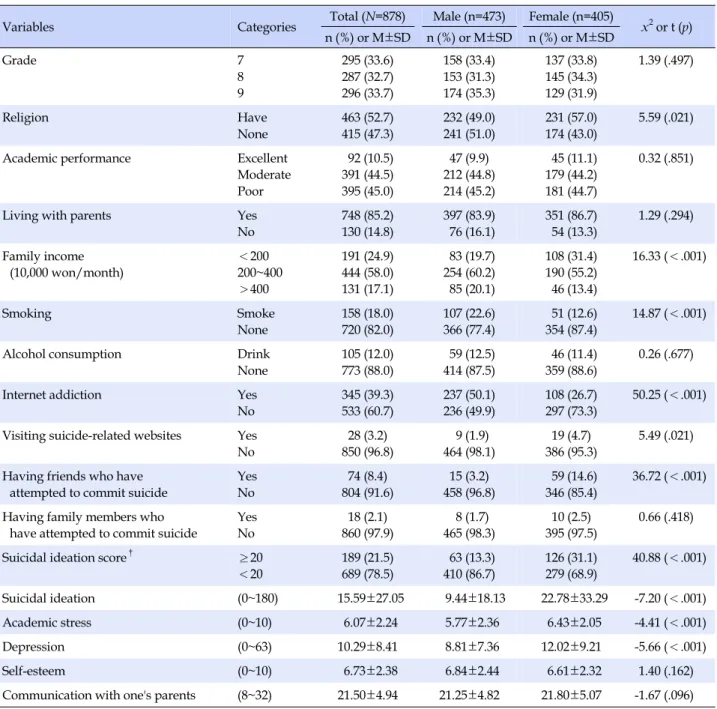
Except for 10.5% of the subjects, the subjects had mid- low school grades (boys: 90.0%; girls: 88.9%). Most of the subjects claimed that their family income was under 2 million Korean won per month. With regard to the sub- jects’ health behavior 39.3% of all the subjects were ad-
Table 1. General Characteristics and Suicidal Ideation Related Variables of the Subjects (N=878)
Variables Categories Total (N=878) Male (n=473) Female (n=405)
x2or t (p) n (%) or M±SD n (%) or M±SD n (%) or M±SD
Grade 7
8 9
295 (33.6) 287 (32.7) 296 (33.7)
158 (33.4) 153 (31.3) 174 (35.3)
137 (33.8) 145 (34.3) 129 (31.9)
1.39 (.497)
Religion Have
None
463 (52.7) 415 (47.3)
232 (49.0) 241 (51.0)
231 (57.0) 174 (43.0)
5.59 (.021)
Academic performance Excellent
Moderate Poor
92 (10.5) 391 (44.5) 395 (45.0)
47 (9.9) 212 (44.8) 214 (45.2)
45 (11.1) 179 (44.2) 181 (44.7)
0.32 (.851)
Living with parents Yes
No
748 (85.2) 130 (14.8)
397 (83.9) 76 (16.1)
351 (86.7) 54 (13.3)
1.29 (.294)
Family income (10,000 won/month)
<200 200~400
>400
191 (24.9) 444 (58.0) 131 (17.1)
83 (19.7) 254 (60.2) 85 (20.1)
108 (31.4) 190 (55.2) 46 (13.4)
16.33 (<.001)
Smoking Smoke
None
158 (18.0) 720 (82.0)
107 (22.6) 366 (77.4)
51 (12.6) 354 (87.4)
14.87 (<.001)
Alcohol consumption Drink
None
105 (12.0) 773 (88.0)
59 (12.5) 414 (87.5)
46 (11.4) 359 (88.6)
0.26 (.677)
Internet addiction Yes
No
345 (39.3) 533 (60.7)
237 (50.1) 236 (49.9)
108 (26.7) 297 (73.3)
50.25 (<.001)
Visiting suicide-related websites Yes No
28 (3.2) 850 (96.8)
9 (1.9) 464 (98.1)
19 (4.7) 386 (95.3)
5.49 (.021)
Having friends who have attempted to commit suicide
Yes No
74 (8.4) 804 (91.6)
15 (3.2) 458 (96.8)
59 (14.6) 346 (85.4)
36.72 (<.001)
Having family members who have attempted to commit suicide
Yes No
18 (2.1) 860 (97.9)
8 (1.7) 465 (98.3)
10 (2.5) 395 (97.5)
0.66 (.418)
Suicidal ideation score† ≥20
<20
189 (21.5) 689 (78.5)
63 (13.3) 410 (86.7)
126 (31.1) 279 (68.9)
40.88 (<.001)
Suicidal ideation (0~180) 15.59±27.05 9.44±18.13 22.78±33.29 -7.20 (<.001)
Academic stress (0~10) 6.07±2.24 5.77±2.36 6.43±2.05 -4.41 (<.001)
Depression (0~63) 10.29±8.41 8.81±7.36 12.02±9.21 -5.66 (<.001)
Self-esteem (0~10) 6.73±2.38 6.84±2.44 6.61±2.32 1.40 (.162)
Communication with one's parents (8~32) 21.50±4.94 21.25±4.82 21.80±5.07 -1.67 (.096)
†Cut-off score for suicidal ideation: 20.
dicted to the Internet, and in particular. 8.4% had friends who had attempted to commit suicide while 2.1% had family members who had attempted to do the same. And there were gender differences in suicidal ideation, aca- demic stress, and depression. The subject female students had significantly higher scores in suicidal ideation, aca- demic stress, and depression compared to the subject male students (p<.001). Especially, the suicidal ideation in the subject female students was over twofold higher than that in the subject male students (boys: 13.3%; girls:
31.1%)(Table 1).
2. Suicidal Ideation according to the General Char- acteristics and Suicidal Ideation Relating Var- iables by Gender
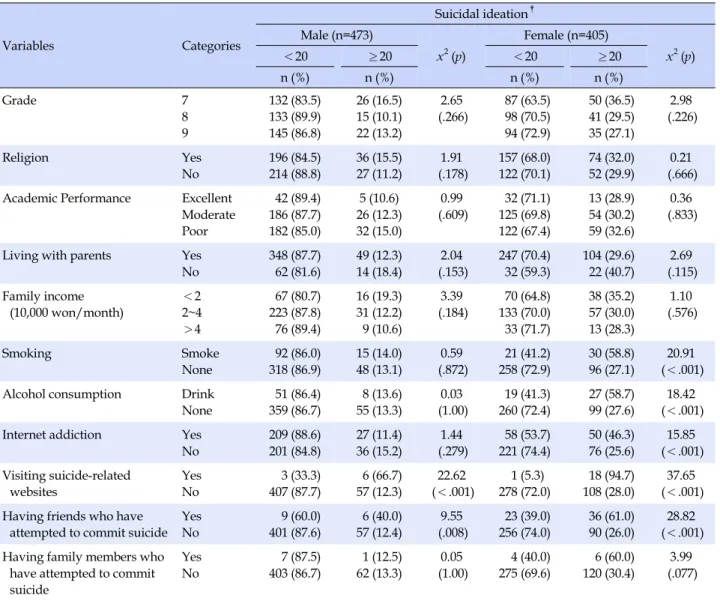
Among the subject male students, there were signifi- cant group differences in suicidal ideation according to whether or not they visited suicide-related websites (p<
.001) and whether or not they had friends who had at- tempted to commit suicide (p=.008). Among the subject female students, there were also significant group differ- ences in suicidal ideation according to whether or not
Table 2. Differences in Suicidal Ideation according to the General Characteristics and Suicidal Ideation Related Variables (N=878)
Variables Categories
Suicidal ideation† Male (n=473)
x2(p)
Female (n=405)
x2(p)
<20 ≥20 <20 ≥20
n (%) n (%) n (%) n (%)
Grade 7
8 9
132 (83.5) 133 (89.9) 145 (86.8)
26 (16.5) 15 (10.1) 22 (13.2)
2.65 (.266)
87 (63.5) 98 (70.5) 94 (72.9)
50 (36.5) 41 (29.5) 35 (27.1)
2.98 (.226)
Religion Yes
No
196 (84.5) 214 (88.8)
36 (15.5) 27 (11.2)
1.91 (.178)
157 (68.0) 122 (70.1)
74 (32.0) 52 (29.9)
0.21 (.666) Academic Performance Excellent
Moderate Poor
42 (89.4) 186 (87.7) 182 (85.0)
5 (10.6) 26 (12.3) 32 (15.0)
0.99 (.609)
32 (71.1) 125 (69.8) 122 (67.4)
13 (28.9) 54 (30.2) 59 (32.6)
0.36 (.833)
Living with parents Yes
No
348 (87.7) 62 (81.6)
49 (12.3) 14 (18.4)
2.04 (.153)
247 (70.4) 32 (59.3)
104 (29.6) 22 (40.7)
2.69 (.115) Family income
(10,000 won/month)
<2 2~4
>4
67 (80.7) 223 (87.8) 76 (89.4)
16 (19.3) 31 (12.2) 9 (10.6)
3.39 (.184)
70 (64.8) 133 (70.0) 33 (71.7)
38 (35.2) 57 (30.0) 13 (28.3)
1.10 (.576)
Smoking Smoke
None
92 (86.0) 318 (86.9)
15 (14.0) 48 (13.1)
0.59 (.872)
21 (41.2) 258 (72.9)
30 (58.8) 96 (27.1)
20.91 (<.001) Alcohol consumption Drink
None
51 (86.4) 359 (86.7)
8 (13.6) 55 (13.3)
0.03 (1.00)
19 (41.3) 260 (72.4)
27 (58.7) 99 (27.6)
18.42 (<.001)
Internet addiction Yes
No
209 (88.6) 201 (84.8)
27 (11.4) 36 (15.2)
1.44 (.279)
58 (53.7) 221 (74.4)
50 (46.3) 76 (25.6)
15.85 (<.001) Visiting suicide-related
websites
Yes No
3 (33.3) 407 (87.7)
6 (66.7) 57 (12.3)
22.62 (<.001)
1 (5.3) 278 (72.0)
18 (94.7) 108 (28.0)
37.65 (<.001) Having friends who have
attempted to commit suicide Yes No
9 (60.0) 401 (87.6)
6 (40.0) 57 (12.4)
9.55 (.008)
23 (39.0) 256 (74.0)
36 (61.0) 90 (26.0)
28.82 (<.001) Having family members who
have attempted to commit suicide
Yes No
7 (87.5) 403 (86.7)
1 (12.5) 62 (13.3)
0.05 (1.00)
4 (40.0) 275 (69.6)
6 (60.0) 120 (30.4)
3.99 (.077)
†Cut-off score for suicidal ideation: 20.
they were smokers, whether or not they drank alcohol, and whether or not they were addicted to the Internet (p<
.001). That is, among both the subject male and female stu- dents, those who visited suicide-related websites and who had friends who had attempted to commit suicide were found to have significantly higher suicidal-ideation scores than those who did not visit suicide-related web- sites and did not have friends who had attempted to com- mit suicide (Table 2).
3. Differences in Academic Stress, Depression, Self-esteem, and Communication with Parents according to Suicidal Ideation by Gender
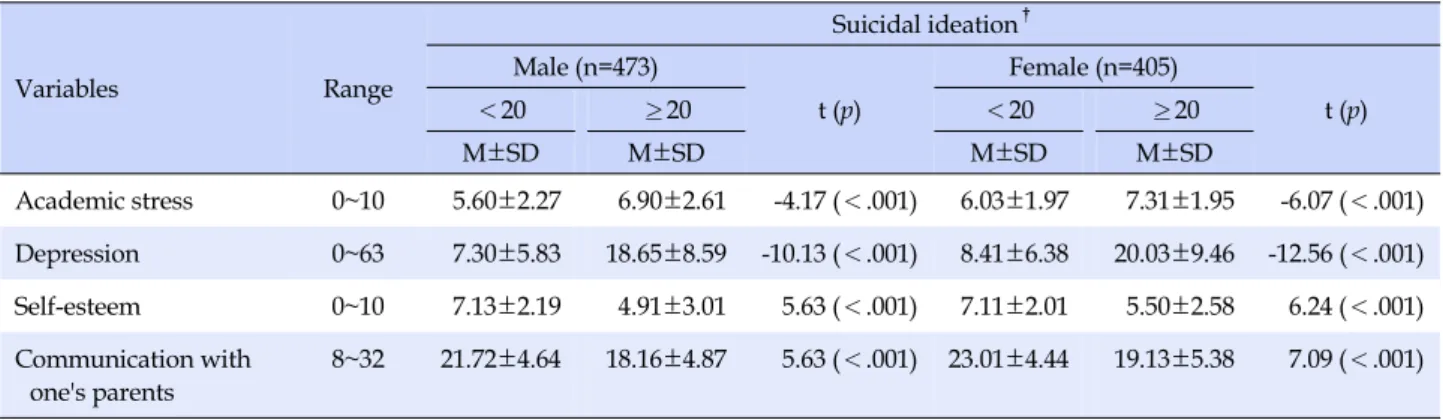
Based on the cut-off score for suicidal ideation (20), in both the subject male and female students, the academicstress and depression were significantly higher in the sui- cidal-ideation group than in the non-suicidal-ideation group while the self-esteem and communication with pa- rents were significantly lower in the suicidal-ideation group than in the non-suicidal-ideation group, whose sui- cidal-ideation score was under 20 (p<.001)(Table 3).
4. Factors affecting Suicidal Ideation by Gender
To identify the factors that affect suicidal ideation in middle school students, multiple logistic analysis was conducted. For independent variables, significant varia- bles both male and female students which were analyzed in descriptive analysis were included. Among suicidal ideation relating variables, visiting suicide related web- sites and having friends who have attempted suicideTable 3. Differences in Academic Stress, Depression, Self-esteem, and Communication with Parents according to Suicidal Ideation (N=878)
Variables Range
Suicidal ideation† Male (n=473)
t (p)
Female (n=405)
t (p)
<20 ≥20 <20 ≥20
M±SD M±SD M±SD M±SD
Academic stress 0~10 5.60±2.27 6.90±2.61 -4.17 (<.001) 6.03±1.97 7.31±1.95 -6.07 (<.001) Depression 0~63 7.30±5.83 18.65±8.59 -10.13 (<.001) 8.41±6.38 20.03±9.46 -12.56 (<.001) Self-esteem 0~10 7.13±2.19 4.91±3.01 5.63 (<.001) 7.11±2.01 5.50±2.58 6.24 (<.001) Communication with
one's parents
8~32 21.72±4.64 18.16±4.87 5.63 (<.001) 23.01±4.44 19.13±5.38 7.09 (<.001)
†Cut-off score for suicidal ideation: 20.
Table 4. Factors Influencing Suicidal Ideation by Gender (N=878)
Variables Male (n=473) Female (n=405)
β SE OR 95% CI p β SE OR 95% CI p
Visiting suicide-related websites
(1: yes; 0: no) 1.76 0.95 5.83 0.90~37.77 .064 3.32 1.19 28.00 2.74~285.74 .005
Having friends who have attempted suicide
(1: yes; 0: no) 0.25 0.94 1.29 0.20~8.17 .789 1.23 0.40 3.40 1.57~7.38 .002
Academic stress 0.00 0.08 1.00 0.86~1.17 .981 0.14 0.08 1.15 0.99~1.34 .071
Depression 0.18 0.03 1.19 1.13~1.26 .000 0.15 0.02 1.17 1.12~1.22 .000
Self-esteem -0.12 0.08 0.89 0.76~1.03 .105 -0.05 0.07 0.95 0.82~1.10 .510
Communication with one's parents
-0.06 0.04 0.94 0.87~1.01 .104 -0.09 0.03 0.91 0.86~0.97 .004
Constant -2.118 -1.875
Degree of freedom 1 1
which were examined nominal variables changed to dum- my variables.
For the subject male students, the factor that was found to affect suicidal ideation was depression; a 1 point in- crease in the depression score led to 1.2-fold higher odds of suicidal ideation (95%CI: 1.13~1.26). For the subject fe- male students, those who visited suicide-related websites had 28-fold higher suicidal-ideation scores than those who did not (95%CI: 2.74~285.74), and those who had fri- ends who had attempted to commit suicide got 3.40-fold higher suicidal-ideation scores than those who did not (95% CI: 1.57~7.38). Also, a 1 point increase in the depres- sion score led to 1.165-fold higher odds of suicidal idea- tion (95% CI: 1.12~1.22), and a 1 point increase in the com- munication with parents score led to 0.91-fold lower odds of suicidal ideation (95% CI: 0.86~0.97)(Table 4).
DISCUSSION
Social interests for suicide have been increased as the highest suicide mortality rate, and many studies on suici- dal ideation have been conducted in Korea. This study was conducted not only to identify the factors for suicidal ideation in middle school students by gender, but also to announce the necessity of gaining upon socio-cultural comprehension based approach which offset suicidal ide- ation in middle school students.
There were differences in the suicidal-ideation scores by gender according to the general characteristics of the subjects. Jeon and colleagues [18] reported that conflicts and stress with one’s peer group and conflicts with one’s parents were the common predictable variables related to suicidal ideation. Conflicts with one’s parents were ranked
as the factor with the greatest effect in both the subject male and female students, followed by bullying and fami- lial economic status in the subject male students and by conflicts with one’s peer group and familial economic sta- tus in the subject female students. Other studies reported that familial economic status could adversely affect ado- lescent mental health, smoking, and alcohol consumption [11]. Also, Internet suicide site accessibility was added to the factors affecting suicidal ideation, as well as conflicts with familial members or friends [2].
Based on the cut-off score for suicidal ideation (20), the academic stress and depression were higher and the self- esteem and communication with one’s parents were low- er in the suicidal-ideation group than in the non-suicidal- ideation group. In previous studies, self-esteem [15,16], familial alliance [12,16,18], and social support [2,3,5,15]
were found to lessen the danger of suicidal ideation. In this study, self-esteem and communication with one’s pa- rents presented a similar effect of abating suicidal idea- tion. Depression was cited as a critical factor in suicidal ideation psychologically [4,10-13], and life events preceded suicidal ideation [2,4,14,26]. As discussed earlier, the sui- cidal ideation in the subject female students in this study was twofold higher than in the subject male students, and the smoking and alcohol consumption rates were higher in the suicidal-ideation group than in the non-suicidal- ideation group among the subject female students. It is presumed that smoking and alcohol consumption need to be more carefully observed or monitored in female stu- dents than in male students.
Suicide impacts the most vulnerable of the world’s populations, and places a larger burden on the low- and middle-income countries [2], and this economic vulner- ability could be linked to other poor conditions, not only to the factors impacting suicidal ideation among adoles- cent [5,11,18]. In this study, the characteristics and envi- ronment of the subjects regarded that they were socio- economically disadvantaged: 82.9% of the students lived in a family that their family income were under 4,000,000 won per month (family median income was 4,220,000 won per month in Korea), especially 24.9% were under 2,000,000 won; and Internet-addicted, 39.3%; and low school grades, 45.0%. These socio-economically disadvantaged conditions have resulted in adolescents’ depression and suicidal ide- ation [12].
Also, in suicidal ideation relating variables, gender dif- ferences were found in terms of visiting suicide-related websites, having friends who have attempted to commit suicide, academic stress, and depression; more female stu- dents visited suicide-related websites and had friends
who have attempted to commit suicide, and the academic stress and depression in the female students were signifi- cantly higher than those in the male students. It is not ir- relevant that in previous studies, the depression level of the female students was higher than that of the male stu- dents [4,12,14], and the female students could be more sensitive in terms of stress [12,26]. Phillips et al., [15] re- ported that negative emotions strongly associated with current and future self-harm in both male and female ado- lescents, while self-esteem strongly moderated current and future self-harm. It is suggested that negative emo- tions and response to neutral life events should be attenu- ated and should hold gender differentiated approach.
Shim and Kim [19] revealed that the suicidal ideation relating factors differ by phase; in early youth, stress and depression are the most powerful factors, and in mid- and late youth, the social support and impact of one’s relation- ship with a significant key person determined the level of one’s suicidal ideation. On the contrary, Kim [27] found that self-efficacy, which has a protective effect on early- youth suicidal ideation, decreases in mid- and late youth while the impact of depression is maintained. Another study presented participation in sports teams in and out- side of school protected against suicidal ideation [13]. Con- sidering gender and youth phase, suicidal ideation rate in boys showed indifferences, while the rate in girls showed peak elevation in age twelve to fourteen years old and re- lieved after age fifteen years old [9]. Although the differ- ences depending on the youth phase and gender have not been verified, it may be appropriate to approach the cli- ents considering the youth phase they are in for the suici- dal ideation prevention program’s effectiveness.
The multiple logistic regression analysis revealed that in the male students, depression was the sole factor that influenced suicidal ideation, while in the female students, visiting suicide-related websites, having friends who have attempted to commit suicide, depression, and communi- cation with one’s parents influenced suicidal ideation.
Especially, among the female students, those who visited suicide-related websites showed a 28-fold higher suicidal- ideation risk than those who did not, which is more than quadruple that among the male students. Although Shim and Kim [19] showed that the suicidal ideation relating factors are indifferent by gender, Jeon and colleagues [18]
reported that academic performance, family economic state, conflicts with one’s parents, bullying, and conflicts with one’s friend related with suicidal ideation, and these are prominent in girls than those of boys. And family en- vironmental stress and academic stress that affect to suici- dal ideation in adolescents have been reported [10,17]. In
this study, academic stress had related in suicidal ideation but didn’t affect to suicidal ideation in logistic analysis both male and female students. Further study is needed to identify various stress inducing variables to confirm suici- dal ideation affecting factors.
In Smahel and colleagues’[28] research, digital media including internet use and technology impacted physical and mental health problems to children. It is presumed that female students who have a negative mental state and strong emotional stress due to their personal conditions, including their familial environment, have a great risk to suicidal ideation. Further research should investigate whe- ther internet addiction and visiting suicide-related web- site are correlated.
In the Guidelines for the Prevention of Suicide, the United Nations cites the following key components of na- tional suicide prevention strategies: clear objectives, rele- vant risk and protective factors, and effective interven- tions. Further, the intervention targets should be divided into the general population, the vulnerable subpopula- tions at risk, and individuals [29]. Also, gatekeeper train- ing, crisis care, scaling up human resources, and access to and management of persons at risk should be considered, as well as restricting access to means of inflicting self-harm and development of policies aimed at reducing the risk [2]. In South Korea, rapid growth and development may induce a work-oriented society and an inordinately edu- cation-oriented culture, particularly examination-oriented education and early childhood education. These tight and rigid atmospheres can worsen adolescents’ stress; espe- cially, they can aggravate adolescents’ depression and provoke negative thinking [4,11]. Also, negative emotions and low self-esteem strongly associated with current and future self-harm in adolescents [15].
Not a few adolescents have faced the danger of suicide;
in fact, the leading cause of death among teens at present is suicide in Korea, and the level of stress cognition and depression of adolescents is higher than that of adults [8].
To combat suicide and to prevent suicidal ideation in mid- dle school students, we have to try to take socio-cultural comprehension based approach, and to build an environ- ment which can abate negative emotion and draw out rea- son for living including making meaningful relations.
Limitations
The limitations of this study should be presented before planning the later study. First, this study was based on the respondents’ self-report in response to each item. And academic stress and self-esteem were assessed through
VAS instead of based on a scale with documented reli- ability, although concurrent validity was applied to address VAS’s weakness in validity. If researchers considered an- other approach in depth, such as focus group interview, we could find more diverse and copious factors which affect to negative conditions of adolescents and intimate conditions that draw in their suicidal ideation. Further research should be conducted to bring more reliable re- sult and evidence to this concern.
CONCLUSION
Most research on suicidal ideation of adolescents in Korea has focused on analyzing risk factors, and the fac- tors contributing to suicidal ideation by gender have re- ported inconsistently in each study. This study was con- ducted to identify the factors for suicidal ideation in mid- dle school students by gender, and to suggest the needs for socio-cultural comprehension based approach which put down their suicidal ideation. Suicidal ideation scores of the female students were over twofold higher than those of the male students. The factor that was found to affect suicidal ideation in the male students was depres- sion while for the female students the factors were visiting suicide-related websites, having friends who attempted to commit suicide, depression, and poor communication with one’s parents.
Definitely, we should take responsibility in combating suicide by building a socio-cultural environment as well as preventing and managing the suicide risk of adoles- cents: diminution of negative emotion, making school cul- ture which generate encouraging and consolation, and drawing out the reason for living. It would be possible when family, school, community including policymakers strives to develop diverse socio-cultural environment.
Conflict of Interest
The authors declared no conflict of interest.
Acknowledgement
This work was conducted secondary analysis of screen- ing data from Siheung Mental Health Center in Gyeonggi Province, South Korea, which was pursued to examine the youth’s mental health status and to gather basic data for use in coming up with a community-based mental health program. We thank the school staff who coordinated and supported the Youth’s Mental Health Status Survey, and the students who participated in the research.
REFERENCES
1. The Organization for Economic Co-operation and Development.
OECD health data: Health statistics [Internet]. Paris: Author;
2014 [Cited 2015 April 15]. Available from:
http://www.oecd-ilibrary.org/social-issues-migration-health /suicides-2014-1_suicide-table-2014-1-en.
2. World Health Organization. Public health action for the pre- vention of suicide [Internet. Geneva: Author; 2012 [Cited 2015 April 10]. Available from:
http://www.who.int/mental_health/publications/prevention _suicide_2012/en/
3. Kuo WH, Gallo JJ, Eaton WW. Hopelessness, depression, sub- stance disorder, and suicidality. Social Psychiatry and Psychi- atric Epidemiology. 2004;39:497-501.
http://dx.doi.org/10.1007/s00127-004-0775-z
4. Wang RH, Lai HJ, Hsu HY, Hsu MT. Risk and protective fac- tors for suicidal ideation among Taiwanese adolescents. Nurs- ing Research. 2011;60(6):413-421.
http://dx.doi.org/10.1097/NNR.0b013e3182337d83
5. Cheng Y, Li X, Lou C, Sonenstein FL, Kalamar A, Jejeebhoy S, et al. The association between social support and mental health among vulnerable adolescents in five cities: findings from the study of the well-being of adolescents in vulnerable environ- ments. Journal of Adolescent Health. 2014;55(6):31-38.
http://dx.doi.org/10.1016/j.jadohealth.2014.08.020
6. Langille DB, Asbridge M, Kisely S, Rasic D. Suicidal behav- iours in adolescents in Nova Scotia, Canada: Protective associ- ations with measures of social capital. Social Psychiatry Psy- chiatric Epidemiology. 2011;47(10):1549-1555.
http://dx.doi.org/10.1007/s00127-011-0461-x
7. Reinherz HZ, Tanner JL, Berger SR, Beardslee WR, Fitzmaurice GM. Adolescent suicidal ideation as predictive of psychopa- thology, suicidal behaviour, and compromised functioning at age 30. The American Journal of Psychiatry. 2006;163(7):1226- 1232. https://doi.org/10.1176/appi.ajp.163.7.1226
8. Korea Centers for Disease Control and Prevention. 2013 Korean Youth Health Behaviour Survey (9th) [Internet]. Chongwon:
Author; 2013 [Cited 2015 April 16]. Available from:
http://yhs.cdc.go.kr/
9. Boeninger DK, Masyn KE, Feldman BJ, Conger RD. Sex differ- ences in developmental trends of suicide ideation, plans, and attempts among European American adolescents. Suicide and Life-Threatening Behavior. 2010;40:451-464.
http://dx.doi.org/10.1521/suli.2010.40.5.451
10. Kim BY, Lee CS. A meta-analysis of the variables related to sui- cidal ideation in adolescents. Journal of Korean Academy of Nursing. 2009;39(5):651-661.
http://dx.doi.org/10.4040/jkan.2009.39.5.651
11. Gong Y, Zhang L, Wang Z, Liang Y. Pathway analysis of risk
factors for severe suicidal ideation: A survey in rural China.
Canadian Journal of Public Health. 2011;102(6):472-475.
http://dx.doi.org/10.17269/cjph.102.2504
12. Ng LC, Kirk CM, Kanyanganzi F, Smith Fawzi MC, Sezibera V, Shema E, et al. Risk and protective factors for suicidal ideation and behaviour in Rwandan children. The British Journal of Psychiatry. 2015;207(3):262-268.
http://dx.doi.org/10.1192/bjp.bp.114.154591
13. Dugas E, Low NCP, Rodriguez D, Burrows S, Contreras G, Chation M, et al. Early predictors of suicidal ideation in young adults. Canadian Journal of Psychiatry.2012;57(7):429-436.
http://dx.doi.org/10.1177/070674371205700706
14. Stewart SM, Kennard BD, Lee PWH, Mayers T, Hughes C, Emslie G. Hopeless and suicidal ideation among adolescents in two cultures. Journal of Child Psychology and Psychiatry.
2005;46(4):364-372.
http://dx.doi.org/10.1111/j.1469-7610.2004.00364
15. Phillips R, Spears M, Montgomery AA, Millings A, Sayal K, Stallared P. Could a brief assessment of negative emotions and self-esteem identify adolescents at current and future risk of self-harm in the community? A prospective cohort analysis.
BioMed Central Public Health. 2013;13:604-614.
http://dx.doi.org/10.1186/1471-2458-13-604
16. Lee SY. Reasons for living and their moderating effects on Ko- rean adolescents' suicidal ideation. Death Studies. 2011;35:711- 728. http://dx.doi.org/10.1080/07481187.2011.553316 17. Park JY, Chung IJ. The effects of high school students' acade-
mic problems on suicidal ideation: Focusing on the media- tional effects of individual-level risk and protective factors.
The Journal of Korean Society of Child Welfare. 2010;32:69-97.
18. Jeon GS, Park SY, Cho S. Gender differences in correlates of de- pression and suicidal ideation among Korean adolescents. The Korean Journal of Health Service Management. 2012;6(4):295- 308. http://dx.doi.org/10.12811/kshsm.2012.6.4.295
19. Shim MY, Kim KH. Risk and protective factors for suicidal ide- ations of Korean adolescents: Moderating effect of sex and de- velopmental period. The Korean Journal of Health Psycholo- gy. 2005;10(3):313-325.
20. Shin MS. An empirical study of the mechanism of suicide: Vali- dation of the scale for escape from the self [dissertation]. Seoul:
Yonsei University; 1992. p. 1-139.
21. Reynolds WM. (1988). Suicidal Ideation Questionnaire: Profes- sional manual. Odessa FL: Psychological Assessment Resour- ces; 1988. p. 1-50.
22. Pinto A, Whisman MA, McCoy KJM. Suicidal ideation in ado- lescents: Psychometric properties of the suicidal ideation ques- tionnaire in a clinical sample. Psychological Assessment. 1997;
9(1):63-66. https://doi.org/10.1037/1040-3590.9.1.63 23. Torrance GW, Feeny D, Furlong W. Visual analog scales: Do
they have a role in the measurement of preferences for health
states?. Medical Decision Making. 2001;21:329-334.
http://dx.doi.org/10.1177/0272989X0102100408
24. Beck AT, Steer RA, Ball R, Ranieri WF. Comparison of Beck Depression Inventories -IA and -II in psychiatric outpatients.
Journal of Personality Assessment. 1996;67:588-597.
http://dx.doi.org/10.1207/s15327752jpa6703_13
25. Armsden GC, Greenberg MT. The inventory of parent and peer attachment: Individual differences and their relationship to psychological well-being in adolescence. Journal of Youth and Adolescence. 1987;16(5):427-454.
http://dx.doi.org/10.1007/BF02202939
26. Gunnell D, Harbord R, Singleton N, Jenkins R, Lewis G. Fac- tors influencing the development and amelioration of suicidal thoughts in the general population. The British Journal of Psy-
chiatry. 2004;185:385-393.
http://dx.doi.org/101192/bjp.185.5.385
27. Kim W. The effects of psychological factors in suicidal ideation among Korean youth. Studies on Korean Youth. 2014;25(3):
199-231. http://dx.doi.org/ 1014816/sky.2014.08.74.199 28. Smahel D, Wright MF, Cernikova M. The impact of digital me-
dia on health: children's perspectives. International Journal of Public Health. 2014;60:131-137.
http://dx.doi.org/10.1007/s00038-015-0649-z
29. United Nations. Prevention of suicide: Guidelines for the for- mulation and implementation of national strategies. New York:
U.N. Department of Policy Coordination and Sustainable De- velopment; 1996. P. 1-34.