교감단이 우울행동과 면역기능에 미치는 효과
원광대학교 한의과대학 한방부인과학교실 정현철, 김송백, 서윤정, 조한백, 최창민
ABSTRACT
The Effect of Gyogam-dan on Depression and Immunity on Repeated Stress in Ovariectomized Rats
Hyun-Cheol Cheong, Song-Baek Kim, Yun-Jung Seo Han-Baek Cho, Chang-Min Choi
Dept. of Korean Gynecology and Obstetrics, College of Korean Medicine, Won-Kwang University
Objectives: In this research, the effect of Gyogam-dan (GGD) on depression and immunity were assessed in ovariectomized rats subjected to repetitive stress.
GGD is the prescription consisting of Poria cocos and Cyperi Rhizoma.
Methods: Ovariectomized rats were repeatedly stressed over a 2-week period.
After GGD (100 or 400 mg/kg) were orally administered, Elevated Plus Maze (EPM) and forced swimming test (FST) were performed to evaluate depressive and anxiety response. As well, the change of corticosterone (CORT) and the change of interleukin-1
β(IL-1β) and interleukin-4 (IL-4) in blood serum and in brain were mesured.
Results:
1. In the EPM, there were no statistically significant differences among the groups.
2. In the FST, immobility time significantly decreased in rats of each experiment group compared with the control group (p<0.01).
3. Serum CORT level were decreased in 400 mg GGD group (p<0.05).
4. On IL-1β and IL-4 measurement in the serum and brain, there were not significant increase or decrease compared with the control group.
Conclusions: These results suggest that GGD is effective to reduce depression- behavior in ovariectomized rats. However, GGD do not has significant efficacy to reduce anxiety-behavior in EPM test. Measurement of serum CORT level reveals significant decrease and it shows anti-depressant like effect. Results on immunity are not significant.
Key Words: Menopausal depression, Gyogam-dan, Bebavior test, Corticosterone, Cytokine
2)
Corresponding author(Chang-Min Choi) : Won-Kwang Univ. Gwangju Korean Medical Hospital, 543-8, Juwol 1-dong, Nam-gu, Gwangju, Korea
Tel : 062-670-6437 Fax : 062-670-6767 E-mail : [email protected]
Ⅰ. Introduction
Menopausal depression is a major one of menopausal symptoms, which midlife women aged 40-50 years in depressed mood have. Twenty percent of outpatient have menopausal depression 1) . Women in menopausal period have one or more of menopausal symptoms 2) , and primary factor includes depressant episode, vasomotor symptom and pessimism about life 3) , and change of hormone related menopausal depression 4) .
According to recent longitudinal cohort studies, the probability of depressed mood in the menopausal transition is approximately 30% to three times greater compared with that of premenopausal period. Women with a history of depression are nearly five times more likely to have a diagnosis of major depression in the menopausal transition, whereas women with no history of depression are two to four times more likely to report depressed mood 5) .
Gyogam-dan (交感丹:GGD) is the prescription consisting of Cyperi Rhizoma and Poria cocos. GGD was recorded in
≪Hongssijibheombang (洪氏集驗方)≫ 6) for the first time. GGD has been used for the treatment of psychiatry symptoms of depression, anger or anxiety 7) .
According to recent study on menopausal depression, there was study of documatary records about a Gamisoyo-san (加味逍 遙散) 8) and laboratory studies of Samul- tanggahyangbuja (四物湯加香附子) 9) .
On GGD, there were some kinds of studies like documentary and laboratory research of hormonal and immune effect 10-14) . However, there has not yet been examination about efficacy of GGD on depression and immunity.
This study was designed to assess the anti-depressant and immune effects of GGD in the experimental animal models. It was tested via EPM and FST. In addition, the serum levels of Corticosterone (CORT), IL-1β and IL-4, and immunohistochemical changes of IL-1β and IL-4 in brain were measured.
Ⅱ. Materials and methods
1. Experimental procedure
Sprague Dawley female rats (about 200 g) at the age of 2-3 months (Orient, Inc., Gyeonggi-do, Korea) were used for the study. The rats were housed under a controlled temperature (22-24℃) with a 12 hours light/dark cycle. The lights were on from 8:00 to 20:00. Food and water were made available ad libitum.
They were allowed at least 1 week to adapt to their environment before the experiments. The animal experiments were carried out in accordance with the Prevention of Cruelty to Animals Act 1986 and NIH guidance for the care and use of laboratory animals for experimental procedures, and were approved by local committee review.
The female rats were randomly divided
into four groups (n=10 per group): the nonoperated and nonstressed group (Normal), the ovariectomized and stressed group (Control), the ovariectomized, stressed and GGD 100 mg/kg/day treated group (GGD 100), the ovariectomized, stressed and GGD 400 mg/kg/day treated group (GGD 400).
Using aseptic conditions, bilateral ovariectomy was performed under general anesthesia with pentobarbital sodium (50 mg/kg, i.p.). After postoperative recovery
for 7 days, the ovariectomized rats were stressed daily. Stress was produced by forcing the animals into an immobilizer device (a disposable rodent restraint cone, Harvard Instrument, U.S.A.) for 2 hours (10:00-12:00 a.m.) for 14 days.
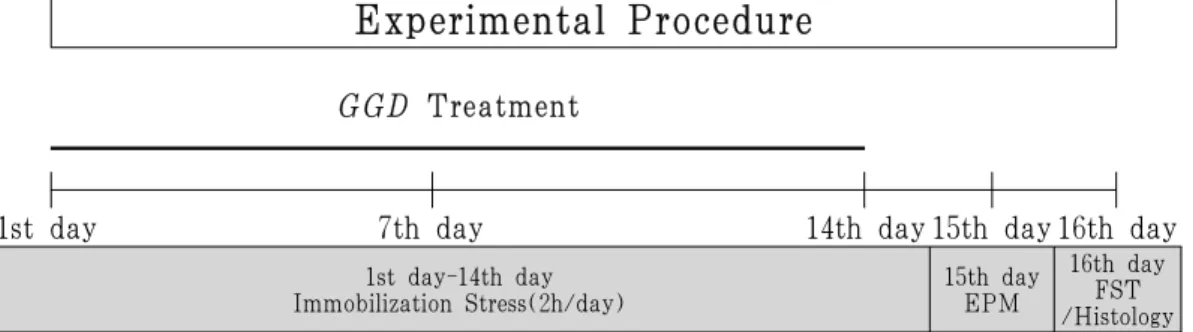
From the day of the first immobilization, the GGD group was daily treated with GGD extract (100 and 400 mg/kg, p.o.) for 2 weeks, and other groups were given sterile saline. Immobilization began 30 minutes after the treatments.
Experimental Procedure
GGD Treatment
1st day 7th day 14th day 15th day 16th day
1st day-14th day Immobilization Stress(2h/day)
15th day EPM
16th day FST /Histology
Fig. 1. Experimental Procedure.
2. Preparation of herbal extracts GGD was purchased from an oriental drug store (Omniherb, Inc., Gyeongsangbuk-do, Korea), as prescribed in Table 1. The voucher specimens are deposited at the herbarium located in the College of Oriental Medicine, Wonkwang University.
The dried GGD samples (500 g) were immersed in a 10 fold volume of distilled water, boiled at 80℃ for 1hour, and then the water extract was collected. The process was repeated once, and the extracts were combined and concentrated with a rotary evaporator and vacuum-dried to yield
about 8.0% (w/w) of the extract.
Pharmaceutical name Dose (g) Root of Cyperi Rhizoma 400
Spawn of Poria cocos 100
Total amount 500
Table 1. The Prescription of Gyogam -dan(GGD)
3. Elevated Plus Maze (EPM)
The construction and the testing procedure
of EPM were based on a method described
by Pellow et al. (1985) 15) . The EPM is
a rodent model of anxiety that is used
as a screening test for putative anxiolytic
compounds and as a general research tool in neurobiological anxiety research.
It consisted of two open arms (the arms extended from a central 50×10 cm space) and two enclosed arms (50×10×40 cm).
The apparatus was elevated 50 cm above the floor. Two behavioral measures were recorded for each rat; (1) the duration of time spent on the open arms and (2) the number of entry points to the two compartments of the maze. The frequency of entries into the open arms and the closed arms and the time spent on the respective arms were recorded for a 5 minutes period.
4. The Forced swimming test (FST) FST was originally described by Porsolt et al. (1977) 16) and is the most widely used pharmacological model for assessing anti-depressant activity 17) . The development of immobility when the rodents are placed in an inescapable cylinder of water reflects the cessation of persistent escape-directed behavior 18) . The apparatus consisted of a transparent Plexiglas cylinder (50 cm high×20 cm wide) filled to a 30 cm depth with water at room temperature. In the pre-test, rats were placed in the cylinder for 15min, 24 h prior to the 5-min swimming test.
GGD extract (100, 400 mg/kg) or saline was administrated p.o. three times : immediately after the initial 15min pre-test, 5-min test and 1h prior to the swimming test. During the 5-min swimming test, the following behavioral responses were
recorded by a trained observer : Climbing behavior, which is defined as upward -directed movements of the forepaws along the side of the swim chamber.
Swimming behavior, defined as movement throughout the swim chamber, which included crossing into another quadrant.
Immobility was considered when the rat made no further attempts to escape except the movement necessary to keep its head above the water. Increases in active responses, such as climbing or swimming, and reduction in immobility, are considered as behavioral profiles consistent with an anti-depressant like action 17) .
5. Corticosterone (CORT) measurements After the behavior test, blood samples were collected from the rats. The total concentration of CORT was measured by an ELISA kit (DuoSet ELISA development system, R&D Systems, Inc., Minneapolis, MN., USA). Cardiac blood was collected just prior to sacrificing the rats. The blood was centrifuged for 15 minutes at 1000×g within 30 minutes of collection.
The samples were immediately assayed
or stored at ≤-60℃. All reagents,
working standards and samples were
prepared. The excess microplate strips
were removed from the plate frame,
returned to the foil pouch containing
the desiccant pack and sealed. All of
the samples or standards (100 μl) were
added into the appropriately labeled
wells and 50
μl of conjugated serum
was placed into all of the wells except for the nonspecific binding wells and total count wells. CORT (50
μl) wasadded into all of the wells. All of the wells were incubated for two hours at room temperature on a horizontal orbital microplate shaker (0.12
〃orbit) set at 500±50 rpm. Each well was washed three times with wash buffer. After the last washing, any remaining Wash Buffer was removed by aspirating or decanting.
5 μl of CORT conjugate and 200 μl of p-nitrophenyl phosphate-substrate was added to all of the wells. The well was incubated for 1 hour at room temperature (without shaking). Next, 50
μl of Stop Solution was added to each well. Using a microplate reader, the optical density of each well was immediately determined.
The absorbance was read at 450 nm and 550 nm, and the sample values were calculated from a standard curve.
6. Cytokine measurements
After the behavior test, plasma separated from the blood was used to estimate the cytokine levels. Enzyme -linked immunosorbent assay (ELISA) was performed using DuoSet ELISA development system according to the manufacturer's instructions (R & D Systems, Minneapolis, MN, USA). Briefly, polystyrene microtiter plates (NUNC, U16 Maxisorp type, Roskilde, Denmark) were coated with monoclonal capture antibody (antirat IL4) obtained from mouse (R & D Systems) and incubated at 4℃ overnight. The
following day, the plates were blocked and then incubated for two hours with plasma. This was followed by the addition of corresponding biotinylated detection antibody obtained from goat (R & D Systems) and incubated for two hours.
Streptavidin horseradish peroxidase (R &
D Systems) and, then, tetramethylbenzidine substrate (Bangalore Genei, Bangalore, India) treatment followed this incubation.
The reaction was stopped using 2N sulfuric acid, and optical density reading was taken at 450 nm. All the experiments were conducted in duplicate. A standard curve was obtained based on the standards provided by the manufacturer.
7. IL-1β and IL-4 immunohistochemistry All of the animals were deeply anesthetized with sodium pentobarbital (80 mg/kg, ip) and they were perfused through the ascending aorta with normal saline (0.9%), followed by 800 ml of 4%
paraformaldehyde in 0.1 M phosphate buffer saline (PBS). The brains were removed, postfixed overnight and cryoprotected in 20% sucrose in 0.1 M PBS at 4℃.
The brains were cut by cryostat sectioning into 30 μm coronal sections, and these slices were processed histochemically as free-floating sections.
The brain sections were washed in
PBS containing 0.3% Triton X-100. The
primary goat polyclonal antibodies against
the following specific antigen were used :
IL-1β and IL-4 (concentration 1:100 ;
Santacruz biotechnology, Delaware Avenue
Santa Cruz, CA, USA). The primary antibodies were diluted with blocking solution (10% fetal bovine serum in PBS, pH=7.4) and the tissues were incubated for 72 hours at 4℃ with constant agitation. Following rinsing in PBS, the sections were incubated for 2 hours at room temperature in biotinylated goat anti-serum (Vector Laboratories, Burlingame, CA, USA) that was diluted 100:1 in PBS with tween-20 containing 2% normal rabbit serum. The sections were placed in Vectastain Elite ABC reagent (Vector Laboratories, Burlingame, CA, USA) for 2 hours at room temperature.
Following a further rinsing in PBS, the tissue was developed using diaminobenzidine chromogen with nickel intensification.
The sections were mounted on gelatine- coated slides, air-dried and coverslipped for microscopic observation. The number of stained nuclei of hippocampal cells were counted at 100× magnification using a microscope rectangle grid that measured 100×100
μm.
8. Data analysis
Statistical comparisons were done for the behavioral and immunological studies using the one-way ANOVA, respectively, and Scheffe post-hoc test was done. All of the results were presented as means
±S.E.M., and SPSS 15.0 for Windows was used for analysis of the statistics.
The significance level was set at p<0.05.
Ⅲ. Results
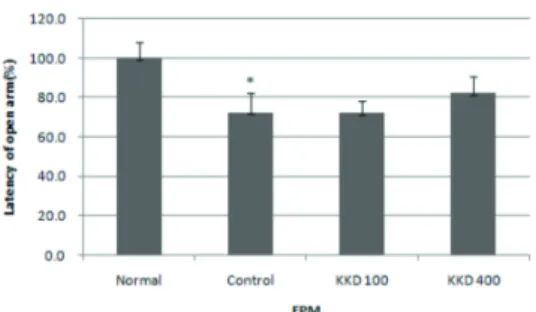
1. Latency in the Open Arms of EPM The number of open arms entries for 5 min was counted. The time spent on the open arms shows the percentage (100×time spent on the open arms/total time in EPM, normal group=100%).
Total time in the open arms was significantly decreased in the control group, compared with the normal group (p<0.05). GGD groups tended to increase the time spent in the open arms of the elevated plus maze. However, it did not reach statistical significance.
Fig. 2. The Time Spent on the Open Arms in the EPM.
Normal : the nonoperated and nonstressed group Control : after ovariectomized, exposed to immobilization stress group
GGD 100 : after ovariectomized, exposed to immobilization stress, GGD 100 mg/kg treated group
GGD 400 : after ovariectomized, exposed to immobilization stress, GGD 400 mg/kg treated group.
* : p<0.05 in comparison with the Normal group
2. Numbers of crossing the open and close arms in the EPM
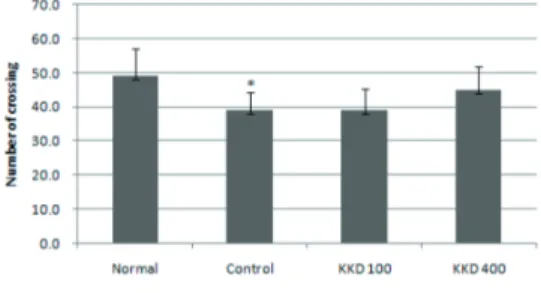
Locomotor activity was decreased in
the control group compared with the
normal group (p<0.05). There were no statistically significant differences in the numbers of crossing of the elevated plus maze among the groups.
Fig. 3. The Number of Crossings the Open and Closed Arms in the EPM.
Normal : the nonoperated and nonstressed group Control : after ovariectomized, exposed to immobilization stress group
GGD 100 : after ovariectomized, exposed to immobilization stress, GGD 100 mg/kg treated group
GGD 400 : after ovariectomized, exposed to immobilization stress, GGD 400 mg/kg treated group.
* : p<0.05 in comparison with the Normal group
3. Forced swimming test
Immobilization stress increased immobility time in the FST (p<0.01) and GGD groups treatment significantly shortened the immobility time in comparison with control values (p<0.01).
Fig. 4. Forced Swimming Test (Immobility Time).
Normal : the nonoperated and nonstressed group
Control : after ovariectomized, exposed to immobilization stress group
GGD 100 : after ovariectomized, exposed to immobilization stress, GGD 100 mg/kg treated group
GGD 400 : after ovariectomized, exposed to immobilization stress, GGD 400 mg/kg treated group.
** : p<0.01 in comparison with the Normal group
## : p<0.01 in comparison with the Control group
4. ELISA
1) Corticosterone (CORT)
The serum levels of CORT were significantly increased in the control group compared with the normal group (p<0.05). However, administration with GGD 400 group significantly reduced the serum levels of CORT (p<0.05).
Fig. 5. The Serum Levels of CORT.
Normal : the nonoperated and nonstressed group Control : after ovariectomized, exposed to immobilization stress group
GGD 100 : after ovariectomized, exposed to immobilization stress, GGD 100 mg/kg treated group
GGD 400 : after ovariectomized, exposed to immobilization stress, GGD 400 mg/kg treated group.
* : p<0.05 in comparison with the Normal group
# : p<0.05 in comparison with the Control group
2) The serum levels of IL-1β
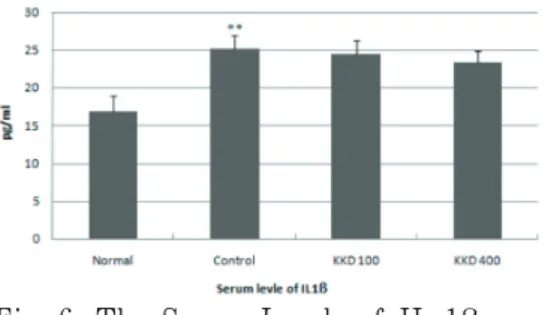
The post-hoc test results indicated a significantly increased serum levels of IL-1β in the control group compared with the normal group (p<0.01).
GGD groups decreased the serum levels
of IL-1
βbut did not show statistically significant difference.
Fig. 6. The Serum Levels of IL-1
β.
Normal : the nonoperated and nonstressed group Control : after ovariectomized, exposed to immobilization stress groupGGD 100 : after ovariectomized, exposed to immobilization stress, GGD 100 mg/kg treated group
GGD 400 : after ovariectomized, exposed to immobilization stress, GGD 400 mg/kg treated group.
** : p<0.01 in comparison with the Normal group
3) The serum levels of IL-4
The post-hoc test results indicated a significantly decreased serum levels of IL-4 in the control group compared with the normal group (p<0.05).
GGD groups increased the serum levels of IL-4 but did not show statistically significant difference.
Fig. 7. The Serum Levels of IL-4.
Normal : the nonoperated and nonstressed group Control : after ovariectomized, exposed to
immobilization stress group
GGD 100 : after ovariectomized, exposed to immobilization stress, GGD 100 mg/kg treated group
GGD 400 : after ovariectomized, exposed to immobilization stress, GGD 400 mg/kg treated group.
* : p<0.05 in comparison with the Normal group
4) IL-1
βimmunohistochemistry in the hippocampus
IL-1
βimmuoreactivity was increased in the control group compared with the normal group (p<0.05).
GGD groups decreased the level of IL-1
βin the hippocampus but did not show statistically significant difference.
Fig. 8. IL-1
βImmunohistochemistry in the Hippocampus.
Normal : the nonoperated and nonstressed group Control : after ovariectomized, exposed to immobilization stress group
GGD 100 : after ovariectomized, exposed to immobilization stress, GGD 100 mg/kg treated group
GGD 400 : after ovariectomized, exposed to immobilization stress, GGD 400 mg/kg treated group.
* : p<0.05 in comparison with the Normal group
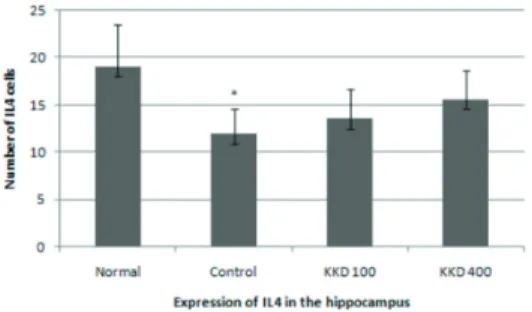
5) IL-4 immunohistochemistry in the hippocampus
IL-4 immuoreactivity was reduced in
the control group compared with the
normal group (p<0.05).
GGD groups increased the level of IL-4 in the hippocampus but did not show statistically significant difference.
Fig. 9. IL-4 Immunohistochemistry in the Hippocampus.
Normal : the nonoperated and nonstressed group Control : after ovariectomized, exposed to immobilization stress group
GGD 100 : after ovariectomized, exposed to immobilization stress, GGD 100 mg/kg treated group
GGD 400 : after ovariectomized, exposed to immobilization stress, GGD 400 mg/kg treated group.
* : p<0.05 in comparison with the Normal group
Ⅳ. Discussion
Main symptoms of menopause-related depression include as anxiousness, strong emotions, hypochondria, repentance, feelings of guilt and helplessness, behavior changes, and depressive delusion, as well as major depressive disorder symptom 19) .
There are several theories about perimenopause and the causes of memopausal depression is estimated to have close correlation with the endocrine system such as estrogen and psychosocial factors 1,20,21) . Some studies suggest that memopausal depression is related to decrease of the ability to recognize 23-25) ,
however, there is opposite study 22) . GGD is a prescription consisting of Poria cocos and Cyperi Rhizoma. GGD was first recorded in ≪Hongssijibheombang (洪氏集驗方)≫ by Jun Hong(洪遵) 6) . It has been used to treat the syndrome of ‘qi(氣)' stagnation such as symptoms of palpitation with fear, anxiety, feeling heavy and insomnia 26) . Poria cocos is dried mass of spawn of Poria cocos Wolf. Poria cocos is effective in promoting diuresis and tranquilizing the mind 27) . Cyperi Rhizoma is dried root of Cyperus rotundus L. and belongs to Cyperaceae.
Cyperi Rhizoma has efficacy to regulate
‘qi(氣)', relieve depression, regulate menstruation and relieve pain and has been used to treat gynecologic diseases and neurological diseases 27) .
There were some studies regarding treatment of menopausal depression using herbal medication as Soyo-san (逍遙散) 28) , Gammaegdaejo-tang (甘麥大棗湯) 29) , Samul -tanggahyangbuja (四物湯加香附子) 9) , Gwibi -tang (歸脾湯) 30,31) , Gwibiondam-tang (歸 脾溫膽湯) 32) , Bunsimgi-eum (分心氣飮) 33) , Wonjiseogchangpo-san (遠志石菖蒲散) 34) , Cheonghwabosim-tang (淸火補心湯) 35) , Hwanglyeonhaedog-tang (黃連解毒湯) 36) , Sihosogan-san (柴胡疎肝散) 37) and Cheonwangbosim-dan (天王補心丹) 38) .
GGD has been studied in several ways.
There are studies refered to documentary
records 11) , about effect of GGD on
hormone 12) , immunity of macrophage 13)
and clinic research 14) . However, there is
no experimetal study about effect of
GGD on depression and immunity.
In this study, we designed to demonstrate its anti-depressant like effects of GGD in menopausal depression.
Ovariectomized rats were repeatedly stressed for 2 weeks and orally medicated with GGD. The EMP test was executed to reveal the anxiety response. And depression response was tested with FST. Also measurements of CORT and cytokine of blood serum and brain proceeded.
The EPM test is designed to estimate drugs with anxiolytic-like action 39) . Increased time spent in open arms means anxiolytic efficacy by withdrawal of fear in the animals. On the contrary, increased time spent in the closed arms is considered to produce fear or anxiety 40) . So the result of EPM test forecast validity for screening anxiolytic drugs 39,41,42) .
In the present study, GGD did not significantly prolong the time spent in the open arms and did not increase the number of entries into the open arms compared with the control group in the EPM. These results of behavioral study suggest that GGD did not have the anxiolytic effects on the ovariectomized rats.
The FST which Porsolt develops is the useful test coverage that it confirms an effect and neurobiology mechanism of the various anti-depressants 43) . Animals in the water show three pattern of behavior as immobility behavior, swimming behavior and climbing behavior. The
rat's immobility behavior in the FST has been interpreted as behavioral despair and has been suggested as an animal model of human depression 44,45) .
GGD produced decrease in the immobility time in FST compared with control group. Therefore it demonstrates the anti-depressant like effects.
Stress makes hypothalamus-pituitary -thyroid axis to be active. Secretion of corticotropin-releasing hormone, adrenocortico -trophic hormone and glucocorticoids is increased 46) . Therefore acute and chronic stress induce scretion of CORT and in opposite direction, chronic scretion CORT induce anxiety and impatience 47) . Because CORT level in plasma depend on the anxiety or depression, CORT was measured 48) .
In 100 mg of GGD, there is no significant result. However, in 400 mg of GGD experiment group, there is remarkable decrease in comparison with the control group. These results show that GGD induces decrease in CORT, therefore it has anti-depressive effect on HPA (Hypothalamic-Pituitary-Adrenal) axis.
Cytokines are watersoluble protein
controlling activation and growth of
immune cell. They combine with special
receptor and mediate inflammatory and
immune reaction 49) . IL-1β is a pro-
inflammatory cytokine as a mediator of
inflammatory reaction and stimulation 50)
and it is secreted in stressful condition 51) .
IL-4 is an anti-inflammatory cytokine,
which called differentiation factor of B
cell 50,52,53) . The pro-inflammatory cytokines (IL-2, IL-12, and TNF-α) and MCP-1 were significantly higher, whereas anti-inflammatory cytokines IL-4 and Transforming TGF-β1 were significantly lower in patients with major depression than those of healthy controls 54) . Considering above, anti-depressant medicine maybe decrease pro-inflammatory cytokines as IL-1
βand increase anti-inflammatory cytokines as IL-4.
IL-1β and IL-4 of blood serum and brain were measured. GGD did not significantly produce the change of increase or decrease. Therefore, GGD did not have statistically significant effects on immune activity.
In conclusion, GGD is effective to reduce depression-behavior. However, GGD do not show significant efficacy to reduce anxiety-behavior in EPM test.
According to results of CORT level and cytokine measure, GGD is more effective on HPA axis than on cytokine.
Ⅴ. Conclusion
In order to research the effects of GGD on repetitive stressed ovariectomized rats, present study was performed the measure of EPM, FST, the measure of CORT, IL-1
βand IL-4 of serum and
the measure of IL-1
βand IL-4 in the brain, and investigated the following results.
1. In the EPM, there were no statistically significant differences among the groups.
GGD is not effecitve to reduce axiety -behavior.
2. Immobility time in the FST was significantly decreased in rats of each experiment group compared with the control group(p<0.01).
3. Serum CORT level was decreased in 400 mg GGD group(p<0.05).
4. On IL-1β and IL-4 measurement in the serum and brain, there were not significant increase or decrease compared with the control group.
In conclusion, decrease of immobility time and serum CORT level in the present study shows that GGD is effecive to reduce stress and depression-behavior.
Therefore, GGD could be effective for depression treatment in menopausal women.
And further study on anti-depressant like effect of GGD would be necessary in chronic mild stress(CMS) model.
□ 투 고 일 : 2013년 7월 15일
□ 심 사 일 : 2013년 8월 7일
□ 게재확정일 : 2013년 8월 19일
국문초록