A STUDY ON PIEZOELECTRIC PROPERTIES OF PVDF AND ITS COPOLYMERS
Mohd. Zahid Ansari *
1and Cho Chongdu
11Department of Mechanical Engineering, Inha University 253 Yonghyun-dong, Nam-gu, Incheon, 402-751, Korea
Abstract
Polyvinylidene fluoride (PVDF) is a type of electroactive polymer which shows significant shape change when exposed to electric field. PVDF is generally used as a film sensor in non- destructive evaluation (NDE) of materials. In this study, however, its properties relevant to film actuator are considered. Since most of the electromechanical applications that use PVDF and its copolymers as actuators use their piezoelectric properties, only the piezoelectric properties of PVDF are discussed here. These properties depend mainly on the degree of crystallinity of PVDF. Available data from recent research publications are used to simulate the response of a PVDF bimorph beam on the application of electric field, by a commercial finite element analysis package ANSYS. Finally, the factors that affect mechanical behavior of PVDF bimorph beam are discussed.
Key Words:
Polyvinylidene fluoride (PVDF), Electroactive polymers, Ferroelectricity, Piezoelectricity, Electromechanics.INTRODUCTION
Discovered in early 1990s electroactive polymers (EAPs) are polymers that exhibit
significant shape or size change during electrical stimulation. EAPs have emerged as
one of the most promising smart material that can be used to imitate movements of
animals and insects, and hence biologically- inspired robots. EAP materials are
superior to other smart materials. For example, they can induce strains that are as high
as two orders of magnitude greater than the striction-induced, rigid, and fragile
electroactive ceramics (EAC) such as lead zirconate titanate (PZT). Further, EAP
materials are superior to shape memory alloys (SMA) in higher response speed, lower density, and greater resilience.
Generally, EAPs are divided into two major categories based on their actuation mechanism: electronic and ionic. The electronic polymers such as piezoelectric and electrostrictive require higher activation fields (>150MV/m) close to the breakdown level. However, they can be made to hold the induced displacement under activation of a dc voltage, making them attractive for robotic applications. Also, these materials are faster and can be operated in air with no major constraint. In contrast, ionic EAP materials such as gel, polymer-metal composites, conductive polymers, and carbon nanotubes require drive voltage as low as 1-5 V. However, there is a need to maintain their wetness, and except for conductive polymers it is difficult to sustain dc-induced displacements. The induced displacement for both electronic and ionic EAPs can be designed geometrically to bend, stretch, or contract.
In this study, first the piezoelectric properties of PVDF are discussed and then a commercial finite element analysis software ANSYS is used to analyze the deflection of a PVDF bimorph beam due to electric field. The bimorph beam is made of two piezoelectric PVDF film layers joined together with opposite polarities. In our case, the top layer expands and the bottom layer contracts on the application of electric field across it. The applied field is 150MV/m.
THEORY
Polyvinylidene fluoride (PVDF) is a ferroelectric polymer (electric EAP) which
shows spontaneous polarization that can be reoriented between possible equilibrium
directions by a realizable electric field. It is a long chain semicrystalline polymer of
the repeat unit CH
2-CF
2. This unit has extremely high net dipole moment, which is
responsible for PDVF developing substantially greater piezoelectric characteristics
than any other organic material. PVDF is flexible, lightweight, and transparent
material. Most of the electromechanical applications that use PVDF and its
copolymers exploit their piezoelectric properties. To make a PVDF piezoelectric it is
poled by either corona discharge or elctroding followed by application of strong
electric field. PVDF is a dynamic material that does not operate under static
conditions because of the rapid decay of the induced charges. Therefore, its
piezoelectric electric properties depend on the frequency of applied field. PVDF has
wide-band frequency dependent characteristics from near DC to frequencies in GHz range depending upon its film thickness [1]. The piezoelectric effect is a linear electromechanical effect where the mechanical strain(S) and stress (T) are linearly coupled to the electric field (E) and displacement (or charge density D). The full tensor form of the piezoelectric constitutive equations is,
+
+
E
ij ijkl k l kij k
T
i ik l k l ik k
S s T d E D d T
ε
E=
=
where d
kijis the piezoelectric coefficient, S
Eijklis the elastic compliance, ε
Tikis the dielectric permittivity, and i, j, k, l=1-3. First equation is often known as the converse piezoelectric effect and second equation as direct piezoelectric effect.
Almost all of the ferroelectric polymers are semicrystalline form. Since the piezoelectric response is mainly from crystalline region, piezoelectric properties can be improved by raising the degree of crystallinity. For PVDF homopolymer the crystallinity is at about 50% [2]. However, by increasing trifluoroethylene (TrFE) content to 75/25 mol% the degree crystallinity in P(VDF-TrFE) copolymer can be increased up to 90%. The relatively large-sized single crystal P(VDF-TrFE) 75/25 mol% copolymer has d
33= -38 pm/V and electromechanical coupling factor k
33=0.33, values which up to now represent the best piezoelectric performance of known piezoelectric and ferroelectric polymers [3].
Another way to increase the electromechanical coupling is by increasing the electrostriction that can be achieved by increasing the dielectric constant of P(VDF- TrFE). Zhang et al [4] reported that in high-energy electron-irradiated P(VDF-TrFE) copolymers, the dielectric constant of almost 60 can be achieved at room temperature and, as a consequence, a high electrostrictive strain of about 5% under 150 MV/m field can be induced. Compared with the piezoelectric materials where there is a linear relation between induced strain and applied electric field, the electrostrictive effect has quadratic dependence between induced strain (S) and applied electric field (E), i.e.,
S = -Qεo2(εr -1)2E2.
Here, S is strain in the thickness direction, Q is electrostrictive coefficient, ε
oand ε
ris the free space and the relative permittivity.
SIMULATION
Figure 1 shows the schematic diagram of a piezoelectric bimorph. The bimorph beam
is composed of two piezoelectric layers joined together with opposite polarities.
Piezoelectric bimorphs are widely used for actuation and sensing. In the actuation mode, on the application of an electric field across the beam thickness, one layer contracts while the other expands. This results in the bending of the entire structure and tip deflection. In our case, the top layer expands and the bottom layer contracts on the application of electric field across it. Although, the electrode material and its thickness plays a critical role in actuation it is omitted in this simulation. Moreover, only the static analysis is performed. Finite element analysis software ANSYS 10 is used to simulate the deflection behavior of PVDF bimorph beam. The applied field is 150MV/m. A total of 1605 8-node Plane-223 piezoelectric elements are used in this simulation. The mechanical and piezoelectric properties of PVDF are:
Young’s modulus= 2.0 GPa, Poisson ratio= 0. 29, shear modulus= 775MPa,d
31=28 pC/N, d
32=4 pC/N, d
33=-35 pC/N, and
ε33=15.1
11 12X Y Z
APR 9 2007
01:14:16 DISPLACEMENT
SUB =1 TIME=1 DMX =.006277
Figure 1 – Schematic diagram of a bimorph beam. Thickness of each PVDF layer is 0.5 mm and length of beam is 10 cm. Applied electric field is 150MV/m.
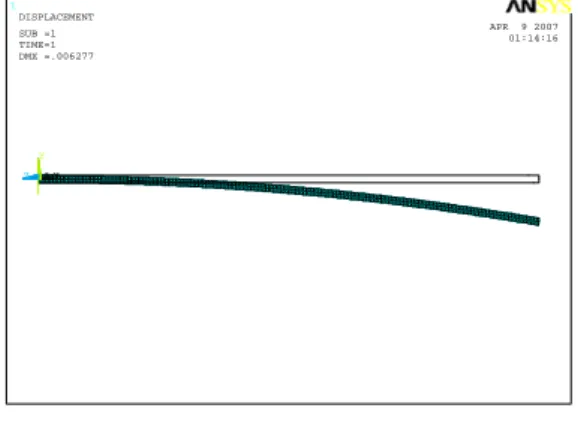
Figure 2 – Deflection of PVDF bimorph beam on application of 150 MV/m field.
The beam deflection is 6.277%.
RESULTS
Fig. 2 shows the simulation results for deflection behavior of PVDF bimorph beam
on application of 150MV/m field. During this bending actuation 6.277% strain is
observed. The beam bends downwards because the d
33coefficient of the piezoelectric
matrix is always negative. Due to this negative coefficient, PVDF layer always
contracts. However, by using appropriate poling direction of PVDF layers the
direction of contraction, and hence bending can be controlled.
DISCUSSION
Flexural Strength of PVDF Bimorph BeamThe PVDF bimorph beam consisted of two layers of PVDF joined. Therefore, the deflection behavior of the beam depends highly on behavior of the interface. During bending actuation, as the voltage field is applied the upper layer expands and the lower layer contracts, and hence shear forces are generated in the interface region.
This shear coupling weakens the interface. This weakening may lead to crack generation and propagation, which can cause delamination of the PVDF layers.
Further, during cyclic bending actuation frictional heating between layers can occur, which can seriously affects actuation force and life of the beam. Therefore, design of PVDF bimorph beam should consider the fatigue criteria. Moreover, the electrode material and its thickness seriously affect the actuation strain. The electrode materials are metals and have higher stiffnesses than PVDF film. Thus, the flexural strength of the beam will be high. Therefore, the actuation strain and force not only depends on the applied field but also on characteristics of electrode material.
Properties and Applications of PVDF
PVDF materials are about one-third lighter than piezoelectric ceramics such as PZT.
They are available in thin films, are flexible and transparent. PVDF materials are
extremely robust against diverse chemical environments like humidity, solvents,
acids, and UV radiation. However, it is quite sensitive to electromagnetic radiation
and requires shielding from it. In addition, they are temperature sensitive, resulting in
decreasing piezoelectric performance with increasing temperature. A typical limit is
100
oC. PVDF materials are manufactured in thin sheets, which can be readily cut
into a wide variety of different shape and sizes. PVDF and PZT can be used as
electro-mechanical transducers for microphones, relays, strain gauges, and
thermistor-based devices. PVDF elements are more sensitive to mechanical loads
over a wide range of loading than piezoceramics. Hence, they are more suitable for
sensor applications. PVDF can be used to measure the impact of micron-sized
particles in space, and also the stresses developed in ballistic tests by armor-piercing
shells. The pressure sensitivity of these polymeric materials ranges from micro-torr to
mega-bar.
CONCLUSIONS
In this study, the piezoelectric properties of PVDF and its copolymers are studied.
PVDF and its copolymers are attractive candidates for applications in smart materials and structures. They are flexible, lightweight, and easy to shape. Since they are available into thin films, they can be embedded into structures. PVDF is used as both sensor and actuator. Finite element analysis software ANSYS is used to analyze the actuation behavior of a PVDF bimorph beam subjected to 150MV/m electric field.
Results show that this field caused 6.277% strain. Such a bimorph structure can be used to make actuators that are lightweight, flexible and easy to embed. Recent researches have been successful in improving PVDF actuation properties, and hence widening the role of PVDF and its copolymers for future intelligent structures and material applications.
REFERENCES
[1] Gandhi, M.V., Thompson, B.S., Smart Materials and Structures, 1st Edition, Chapman &
Hall, London, pp. 175~191 (1992).
[2] Scheinbeim, J., Nakafuku, C., Newman, B.A., Pae, K.D., “High-pressure crystallization of poly(vinylidene fluoride),” J Appl. Phys., 50, 4300 (1979).
[3] Omote, K., Ohigashi, H., OKoga, K., “Temperature dependence of elastic, dielectric, and piezoelectric properties of “single crystalline” films of vinylidene fluoride trifluroethylene copolymer,” J Appl. Phys. 81(6), 2760 (1997).
[4] Zhang, Q.M., Bharti, V., Zhao, X., “Giant electrostriction and relaxor ferroelectric behavior in electron-irradiated PVDF copolymer,” Science, 280, pp. 2101~2104 (1998).
[5] Bar-Cohen, Y., Electroactive Polymers (EAP) Actuators as artificial muscles reality, potential, and challenges, 2nd Edition, SPIE Press, pp. 95~126 (2004).