• 검색 결과가 없습니다.

Inorganic As Concentration in Rice Grown Around the Abandoned Mining Areas and its Health Risk Assessment

N/A
N/A
Protected

Academic year: 2021

Share "Inorganic As Concentration in Rice Grown Around the Abandoned Mining Areas and its Health Risk Assessment"

Copied!
5
0
0

로드 중.... (전체 텍스트 보기)

전체 글

(1)

Inorganic As Concentration in Rice Grown Around the Abandoned Mining Areas and its Health Risk Assessment

Hyuck-Soo Kim, Dae-Won Kang, Da-In Kim, Seul Lee, Sang-Won Park, Ji-Hyock Yoo, and Won-Il Kim*

Chemical Safety Division, National Institute of Agricultural Sciences, RDA, Wanju 55365, Korea (Received: October 20 2016, Revised: October 27 2016, Accepted: October 28 2016)

The current study was carried out to investigate total and inorganic arsenic (As) concentrations in 112 rice samples (husked rice and polished rice) grown around the abandoned mining areas and to estimate the potential health risk through dietary intake of rice in Korea. Mean concentrations of total As in husked rice and polished rice were 0.23 and 0.13 mg kg -1 , respectively. Also, average inorganic As concentrations in husked rice and polished rice were 0.09 and 0.05 mg kg -1 , respectively. These levels are lower than the standard guideline value (0.2 mg kg -1 ) for inorganic As in polished rice recommended by Korea Ministry of Food and Drug Safety and Codex. For health risk assessment, the average values of cancer risk probability was 5.7×10 -5 which was less than the acceptable cancer risk of 10 -6 ~10 -4 for regulatory purpose. Also, hazard quotient values were lower than 1.0. Therefore, these results demonstrated that human exposure to inorganic As through dietary intake of rice collected from abandoned mining areas might not cause adverse health effects.

Key words: Total arsenic, Inorganic arsenic, Rice, Risk assessment, Abandoned mining area

Inorganic arsenic (As) concentrations in 112 rice samples collected from abandoned mining areas.

1)

*Corresponding author: Phone: +82632383245, Fax: +82632383837, E-mail: [email protected]

§
Acknowledgement: This study was financially supported by “Research Program for Agricultural Science & Technology Development

(Project No. PJ 011161)” National Institute of Agricultural Sciences, Rural Development Administration, Korea.

(2)

Introduction

폐광산 인근 농경지는 광업활동으로 발생한 광물 부산물 의 비산, 유실 그리고 산성 광산배수 유입 등으로 중금속과 비소와 같은 오염물질에 오염되고, 결국 농경지 내 중금속과 비소는 작물로 전이되어 이들 작물을 섭취 시 인체에 악영향 을 미칠 수 있다 (Razo et al., 2004; Liu et al., 2005; Liu et al., 2010). 폐광산에서 발생하는 다양한 오염물질 중 비소 (As)는 인체에 매우 유독한 발암물질로 환경 중에 유기비소 와 무기비소 형태로 존재하는데, 무기형태가 유기형태보다 더 독성을 띄는 것으로 알려져 있다 (Smith et al., 1998). 이 에 따라 국제식품규격위원회 (Codex Alimentarius)에서는 2014년 백미 중 무기비소 함량 기준을 0.2 mg kg

-1

으로 설정 하였고, 최근 (2016년 9월) 식품의약품안전처에서 국내 백미 의 무기 As 기준을 Codex와 동일하게 설정한다는 행정예고 를 하였다. 이 외에도 미국 EPA는 무기 As에 대해 발암위해 성 관련 발암잠재력 인자 (Slope factor)와 비발암위해성 관 련 1일 참고 섭취량 (Oral reference dose value)을 설정하여 환경에 존재하는 무기 As가 인체에 미치는 위해성을 평가하 고 있다 (US EPA, 2016). 우리나라에서도 다양한 연구를 통 해 농산물 섭취에 따른 비소 위해성을 평가하였는데 (Lee and Chon, 2005; Lee et al., 2011; Kim et al., 2015; Lim et al., 2015), 한 예로 3개 지역 폐금속 광산 인근 (2 km 이내) 농경 지에서 벼를 채취하여 위해성을 평가한 결과 이들 지역에서 재배한 쌀을 지속적으로 섭취 시 발암위해확률이 천명 중 1 명 이상 (3×10

-3

-7×10

-3

)으로 높게 나타났다 (Lee et al., 2007). 하지만 선행연구를 살펴보면 위해성 평가에 필요한 백 미 중 무기 As 함량 대신 총 As 함량을 그대로 계산식에 이용 하거나, 총 As 함량 대비 무기 As 함량을 예측하여 위해성을 평가하는 경우가 많았다. 따라서 본 연구는 폐광산 인근 농경 지에서 재배한 쌀의 무기비소 함량을 분석하고, 이를 기반으 로 쌀 섭취에 따른 위해성을 평가하여 무기비소로부터 안전 한 벼 생산을 위한 과학적 근거 자료를 제공하고자 한다.

Materials and Methods

전국 22개 폐광산 인근 농경지에서 112개 벼 시료를 채취 하였고, 풍건 후 왕겨를 벗긴 현미 시료와 7분 도정한 백미 시료를 식품공전 분석법 (Ministry of Food and Drug Safety, 2016)에 따라 총 As 함량과 무기 As 함량을 분석하였다. 총 As 함량은 시료를 곱게 빻은 후 0.5 g을 고압 폴리테트라플로로 에틸렌 용기에 옮긴 후, 70% HNO

3

8 mL와 H

2

O

2

1 mL를 각각 주 입하여 microwave digestion system (ETHOS, Milestone, Italy) 을 이용해 분해한 후 0.45 ㎛ 여과지로 여과하여 여과액을 유 도결합플라즈마 질량분석기 (ICP-MS, Agilent Technologies, 7500a)로 분석하였다. 무기 As는 분말 시료 1 g을 50 mL

conical tube에 담고 5 mM malonic acid (pH 5.6) 10 mL를 넣 은 후 5분간 충분히 흔들어 혼합하였다. 이후 85°C water bath 에서 30분간 가열한 후 sonicator (Hanil Science Industrial, Inchon, Korea)를 이용하여 1분간 초음파 추출을 하였다. 동 일한 가열 및 초음파 추출 과정을 총 3회 실시한 후 다시 water bath에서 30분간 가열하였고, 마지막으로 5분간 초음 파 추출하였다. 이를 4°C 이하 냉장고에서 2시간 동안 냉각 후 3000×g의 중력가속도로 원심분리하여 시료의 상등액을 0.45 ㎛ 여과지로 여과하여 여과액을 고성능 액체 크로마토 그래피 (HPLC, Agilent Technologies, 1260series)와 커플링 한 ICP-MS로 분석하였다. 위와 같이 분석한 백미의 무기 As 함량 결과를 바탕으로 쌀 (백미) 섭취에 따른 위해성을 평가 하였는데, 평가방법은 Eq. 1에 따라 일일평균노출량 (Average daily dose, ADD)을 산출하고 이를 이용하여 Eq. 2와 3과 같 이 발암위해확률 (Cancer risk probability, CR)과 비발암위 해지수 (Hazard quotient, HQ)를 각각 평가하였다 (Kim et al., 2015).

ADDmgkgday   ×  ×  ×  ×  (Eq. 1) C (Concentration of inorganic arsenic) = 백미 중 무기

비소 함량 (mg/kg)

IR (Intake rate) = 벼 섭취율 (kg/day, 0.168) EF (Exposure frequency) = 노출빈도 (day/year, 350) ED (Exposure duration) = 노출기간 (years, 30) BW (Body weight) = 평균체중 (kg, 72.3) AT (Averaging time) = 평균수명 (days, 28,831)

CR    expADD × SF (Eq. 2)

ADD = 일일평균노출량 (mg/kg/day)

SF (Slope factor) = 발암잠재력 (mg/kg/day, 1.5)

HQ    (Eq. 3)

ADD = 일일평균노출량 (mg/kg/day) RfD (Oral reference dose value)

= 참고섭취량 (mg/kg/day, 0.0003)

일일평균노출량 산정 시 필요한 벼 섭취율은 통계청 국가

통계포털 (Statistics Korea, 2016)에 제시된 1인 1일당 양곡

소비량 자료를 이용하였고, 노출빈도와 노출기간은 EPA 자

료를 활용하였으며 (US EPA, 1997), 평균체중 및 평균수명은

KOSIS에 제시된 성인 (19-65세) 남자 평균 체중 및 2016년

기준 남자 기대수명 자료를 이용하여 적용하였다 (Statistics

Korea, 2016). 발암위해확률 산정에 필요한 발암잠재력 (SF)

(3)

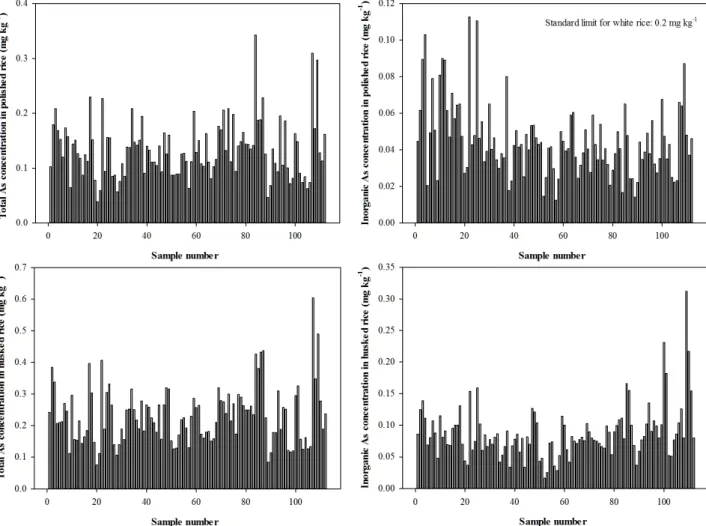
Fig. 1. Total and inorganic arsenic concentrations in polished and husked rice samples.

과 비발암위해지수 산정에 필요한 참고섭취량 (RfD)은 EPA 자료를 인용하였다 (US EPA, 2016).

Results and Discussion

전국 22개 폐광산 인근에서 채취한 112개 현미 시료와 백 미 시료의 총 As 평균 함량은 각각 0.23 mg kg

-1

(0.08-0.60 mg kg

-1

), 0.13 mg kg

-1

(0.04-0.34 mg kg

-1

)으로 나타났고, 무기 As의 평균 함량은 각각 0.09 mg kg

-1

(0.02-0.31 mg kg

-1

), 0.05 mg kg

-1

(0.01-0.11 mg kg

-1

)으로 나타났다 (Fig.

1). 결과에서 볼 수 있듯이 현미 시료의 총 As 함량과 무기 As 함량은 백미 시료보다 높게 나타났는데, 이는 현미의 겨층 (bran layer)에 다량의 비소가 축적되어 있기 때문이다 (Meharg et al., 2008). 분석 대상 백미의 총 비소 함량 중 무기비소 함 량 비율은 평균 36%로 조사되었다. Paik et al. (2010)은 우리 나라 폐광산 인근에서 재배한 백미 시료 11점에 대해 총 As 함량과 무기 As 함량을 분석하였는데, 총 As 함량은 0.01-0.15 mg kg

-1

, 무기 As 함량은 0.01-0.06 mg kg

-1

으로 나타났으 며, 총 비소 함량 중 무기비소 함량 비율은 평균 57% (35-73%) 로 본 연구 결과보다 높은 평균값을 나타냈다. 또한 방글라데

시에서 재배한 현미의 총 As 함량과 무기 As 함량의 비율은 100% 를 나타내기도 했다 (Ohno et al., 2007). 하지만 미국 에서 재배한 백미의 무기 As 함량은 0.02-0.11 mg kg

-1

으로 (Williams et al., 2005) 본 연구에서 조사한 백미의 무기 As 함량과 비슷한 함량을 나타냈으나, 총 As 함량 대비 무기 As 함량은 평균 27% (10-39%)로 본 연구 결과보다 낮은 수준을 나타냈다. 이와 같이 재배환경에 따라 총 As 함량 중 무기 As 함량 비율은 다른 경향을 보이므로 총 As 함량만으로는 정확 한 비소 위해성 평가가 어려울 것으로 판단된다. 따라서 비소 위해성을 정확히 평가하기 위해서는 무기 As 함량 분석이 동 반되어야 한다.

백미의 무기 비소 함량을 바탕으로 일일평균노출량 (Average daily dose)을 계산한 후 비소 발암잠재력 인자 (Slope factor:

1.5)를 이용해 쌀 섭취에 따른 발암위해확률 (Cancer risk

probability)을 구해보면 평균 확률이 10만명 당 5.7명 (5.7×10

-5

)

으로 전체 1.6×10

-5

-1.0×10

-4

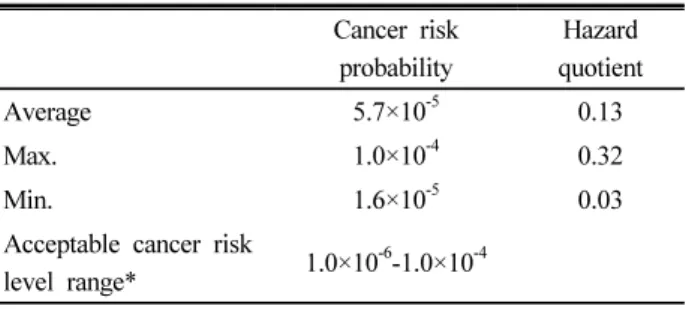
의 범위를 나타냈고 (Table 1),

이는 EPA에서 제시한 허용범위 1.0×10

-6

-1.0×10

-4

를 만족

하였다 (US EPA, 2001). 비발암위해지수 (Hazard quotient)

평가 결과에서는 대상시료 평가지수가 모두 1.0 이하로 나타

나, 연구 대상 쌀 섭취로 인한 비소 비발암위해 가능성은 매

(4)

Table 1. Cancer risk probability and hazard quotient of As in collected polished rice samples.

Cancer risk probability

Hazard quotient

Average 5.7×10

-5

0.13

Max. 1.0×10

-4

0.32

Min. 1.6×10

-5

0.03

Acceptable cancer risk

level range* 1.0×10

-6

-1.0×10

-4

* US EPA, 2001.

우 낮은 것으로 나타났다 (Table 1). 쌀을 주식으로 하는 다른 나라에서도 본 연구와 같은 쌀 섭취에 의한 무기 As 인체 위 해성을 평가하였는데, 그 예로 Li et al. (2011)은 중국에서 생 산된 농수산물의 무기 As 함량 데이터를 수집하여 인체 위해 성을 평가한 결과 발암위해확률이 성인 기준 1천명 당 1명 이 상으로 나타났고, 농수산물을 통한 무기 As 섭취량 중 60%는 쌀에 의한 것으로 나타났다. 또한 인도 서벵골 (West Bengal) 에서는 쌀밥 (cooked rice) 내 비소 섭취에 의해 인구 1만명 당 7.6명이 발암 위해 가능성이 있는 것으로 나타났고 (Mondal and Polya, 2008), 방글라데시에서는 쌀 섭취에 의한 발암위 해확률이 인구 1만명 당 9명인 것으로 나타나 (Meharg et al., 2009) 두 나라 모두 EPA 허용 기준 (1.0×10

-6

-1.0×10

-4

) 보다 높은 발암 위해 가능성을 보였다. 이와 같은 결과를 볼 때 우리나라 폐광산 주변 농경지에서 재배 생산된 백미 중 무 기 As는 허용기준을 만족할 뿐만 아니라 다른 나라에 비해 인 체 위해성이 낮으므로 이들 백미를 장기간 섭취하더라도 무 기 As에 의한 인체 독성이 나타날 가능성은 낮은 것으로 판단 된다.

Conclusions

전국 22개 폐광산 인근에서 재배한 112개 백미 시료의 무 기 As 함량은 0.01-0.11 mg kg

-1

으로 모두 오염기준 (0.2 mg kg

-1

)보다 낮았으며, 백미의 무기비소 함량이 인체에 미치는 위해성은 미미한 것으로 나타났다. 하지만 취약 농경지에서 재배되는 벼 (백미)에 대해서는 지속적인 무기비소 함량 모 니터링을 통해 인체 위해 가능성을 항시 점검해야 할 것이다.

References

Kim, H.S., K.R. Kim, C.O. Hong, W.R. Go, S.H. Jeong, J.H.

Yoo, N.J. Cho, J.H. Hong, and W.I. Kim. 2015. Monitoring of Cd, Hg, Pb, and As and risk assessment for commercial medicinal plants. Korean J. Environ. Agric. 34:282-287.

Lee, J.S. and H.T. Chon. 2005. Risk assessment of arsenic by human exposure of contaminated soil, groundwater and rice

grain. Econ. Environ. Geol. 38:535-545.

Lee, J.H., W.I. Kim, E.J. Jeong, J.H. Yoo, J.Y. Kim, M.K. Paik, B.J. Park, G.J. Im, and M.K. Hong. 2011. Arsenic contamination of polished rice produced in abandoned mine areas and its potential human risk assessment using probabilistic techniques.

Korean J. Environ. Agric. 30:43-51.

Lee, J.S., H.H. Kwon, Y.S. Shim, and T.H. Kim. 2007. Risk assessment of heavy metals in the vicinity of the abandoned metal mine areas. J. KoSSGE. 12:97-102.

Li, G., G.X. Sun, P.N. Williams, L. Nunes, and Y.G. Zhu. 2011.

Inorganic arsenic in Chinese food and its cancer risk. Environ.

Int. 37:1219-1225.

Lim, T.Y., S.W. Lee, M.J. Park, S.H. Lee, and S.O. Kim. 2015.

Comparative study on the human risk assessment of heavy metal contamination between two abandoned metal mines in Korea. J. Korean Soc. Environ. Eng. 37:619-630.

Liu, C.P., C.L. Luo, Y. Gao, F.B. Li, L.W. Lin, C.A. Wu, and X.D. Li. 2010. Arsenic contamination and potential health risk implications at an abandoned tungsten mine, southern China.

Environ. Pollut. 158:820-826.

Liu, H., A. Probst, and B. Liao. 2005. Metal contamination of soils and crops affected by the Chenzhou lead/zinc mine spill (Hunan, China). Sci. Total Environ. 339:153-166.

Meharg, A.A., E. Lombi, P.N. Williams, K.G. Scheckel, J.

Feldmann, A. Raab, Y. Zhu, and R. Islam. 2008. Speciation and localization of arsenic in white and brown rice grains. Environ.

Sci. Technol. 42:1051-1057.

Meharg, A.A., P.N. Williams, E. Adomako, Y.Y. Lawgali, C.

Deacon, A. Villada, R.C.J. Cambell, G. Sun, Y.G. Zhu, J.

Feldmann, A. Raab, F.J. Zhao, R. Islam, S. Hossain, and J.

Yanai. 2009. Geographical variation in total and inorganic arsenic content of polished (white) rice. Environ. Sci. Technol.

43:1612-1617.

Ministry of Food and Drug Safety. 2016. Korean Food Standards Codex. Cheongju, Korea.

Mondal, D. and D.A. Polya. 2008. Rice is a major exposure route for arsenic in Chakdaha block, Nadia district, West Bengal, India: A probabilistic risk assessment. Appl. Geochem. 23:

2987-2998.

Ohno, K., T. Yanase, Y. Matsuo, T. Kimura, M.H. Rahman, T.

Magara, and Y. Matsui. Arsenic intake via water and food by a population living in an arsenic-affected area of Bangladesh. Sci.

Total Environ. 381:68-76.

Paik, M.K., M.J. Kim, W.I. Kim, J.H. Yoo, B.J. Park, G.J. Im, J.E. Park, and M.K. Hong. 2010. Determination of arsenic species in polished rice using a methanol-water digestion method. J. Korean Soc. Appl. Biol. Chem. 53:634-638.

Razo, I., L. Carrizales, J. Castro, F. Díaz-Barriga, and M. Monroy.

2004. Arsenic and heavy metal pollution of soil, water and sediments in a semi-arid climate mining area in Mexico. Water Air Soil Pollut. 152:129-152.

Smith, E., Naidu, R,, and A.M. Alston. 1998. Arsenic in the soil

(5)

environment. Adv. Agron. 64: 149-195.

Statistics Korea. 2016. Korea Statistical Information Service (KOSIS). http://kosis.kr/.

US EPA. 1997. Exposure Factors Handbook. Environmental Protection Agency. Office of Research and Development, Washington, DC.

US EPA. 2001. Risk Assessment Guidance for Superfund:

volume III — part A, process for conducting probabilistic risk

assessment. Washington, DC.

US EPA. 2016. Integrated risk information system (IRIS).

https://www.epa.gov/iris.

Williams, P.N., Price, A.H., Raab, A., Hossain, S.A., Feldmann, J., and A.A. Meharg. 2005. Variation in arsenic speciation and concentration in paddy rice related to dietary exposure. Environ.

Sci. Technol. 38:5531-5540.

수치

Fig. 1. Total and inorganic arsenic concentrations in polished and husked rice samples
Table 1. Cancer risk probability and hazard quotient of As in  collected polished rice samples.

참조

관련 문서

Distribution of Cd in stream sediments, paddy soils, rice stalks and grains from the Kubong

As the results, the preparations of financial and customer/marketing perspectives have significant relationships between operational performances in total

The Study on the Changes of Bacterial Inorganic Phosphate Metabolism in Interactions between Nitric Oxide and Salmonlla enterica serovar Typhimurium..

Human risk assessment around some abandoned metal mine sites some abandoned metal mine sites.

In the current study, I investigated the association between vascular risk factors as chronic ischemia of the prostate and BPH by conducting experiments to elucidate

In this study, the usage of most common cement for the ground material was highly reduced, and developed a solidifying agent for organic and inorganic

Objectives: The purpose of this study was to investigate the relationship between mental health and experience of falling in some local elderly people using the 2013

The first theory was that the phosphate from rice husk-derived biochar reacted with lead in the contaminated sample, which resulted in the formation of