http://www.medicinalcrop.org http://dx.doi.org/10.7783/KJMCS.2013.21.5.394
종자 전처리 및 환경조절이 삽주 종자 발아에 미치는 영향
전권석*·송기선*†·윤준혁*·김창환*·김종진**
*국립산림과학원 남부산림자원연구소, **건국대학교 녹지환경계획학과
Effects of Seed Pretreatment and Environment Controls on Germination of Atractylodes japonica Seeds
Kwon Seok Jeon*, Ki Seon Song*†, Jun Hyuck Yoon*, Chang Hwan Kim*and Jong Jin Kim**
*Southern Forest Resources Research Center, Korea Forest Research Institute, Jinju 660-300, Korea.
**Department of Environmental Design, Konkuk University, Seoul 143-701, Korea.
ABSTRACT : This study was carried out in order to examine the germination characteristics of Atractylodes japonica seeds, and it was to develop the more efficient pre-treatment and production system of the seeds. Experiment was performed by two ways-temperature control (10, 15, 20, 25℃) and shading treatment (full sunlight, 35, 50, 75, 95% of full sunlight). Seed pre-treatment before the each experiment was carried out by temperature (with low temperature and wetting treatment (LTW) for 0, 15, 30, 45 and 60 days) and shading treatment (with drying at room temperature (DRT), drying at low temper- ature (DLT) and water soaking (WS) for 48 hours). Seeds of A. japonica were germinated well under temperature control (overall 85.3~ 100%), especially high temperature. And, the seeds pre-treated with LTW for 45 days germinated with a 100% success rate. Under the surveying shading treatment, the highest germination rate was 95.8% with DRT and overall 63.2 ~ 95.8%. Germination rate under seeds with WS was 63.2~ 7.8%. As a result of surveying the whole experiment, A.
japonica seeds don't need to pre-treat cause of high germination, but if it is performed with LTW for a certain period of time, it would be more productive.
Key Words : Atractylodes japonica, Pre-Treatment, Temperature Control, Shading Control, Seed Germination
서 언
삽주 (Atractylodes japonica Koidz.)는 국화과에 속하는 다년 생초본으로 한국, 일본, 중국의 동북지방 산지에 자생하는데, 초 장이 30 ~ 100 ㎝에 달하고 뿌리가 굵으며 마디가 있다. 우리 나라에서는 주로 산야에서 자생하고 있으며 농가에서 약용으 로 재배하기도 한다. 뿌리는 약용으로 쓰이며 잎은 채소로서 식용되는데 가정에서는 이 삽주의 부드러운 싹을 삽주국, 삽 주쌈, 나물 등으로 만들어 먹는다. 천생출, 동출, 산출, 백출, 창출, 선출, 산연이라고 부르기도 한다 (Kwak et al., 2011;
Park and Seong, 2007).
한편, 한방에서는 삽주가 다른 약재의 효능을 증가시키는 보 조재로서 주로 처방되고 있는데 자연상태에서 종자결실율이
매우 낮을 뿐만 아니라 종자번식을 통한 생장이 아주 느리기 때문에 주로 근경을 이용하여 재배가 이루어지고 있다. 또한, 주로 수입품에 의존하고 있기 때문에 시급히 재배가 이루어져 야만 하는데 과거에 삽주 종자의 증식기술 개발을 위한 연구 는 많지 않았으나 근래 많은 연구가 진행되고 있다.
여러 식물 종자를 이용한 발아연구는 발아력을 향상시키기 위해 상대적으로 큰 종자 (Wright, 1976)를 사용하거나 층적 저장 (저온습윤) (Jeoung, 1991; Kwon et al., 1993; Yang and Kim, 1993), 온도 처리 (Jeon et al., 2010; Hwang et al., 2012; Yoo et al., 2012a, 2012b), 호르몬 처리 (Kim, 1999), priming 처리 (Kang et al., 2001)를 하는 등의 다양 한 연구가 진행되고 있다.
따라서 본 연구에서는 온도와 광도가 삽주 종자의 발아에
†Corresponding author: (Phone) +82-55-760-5034 (E-mail) [email protected]
Received 2013 January 24 / 1st Revised 2013 Srptember 11 / 2nd Revised 2013October 15 /3th Revised October 17 / Accepted 2013 Revised October 17
This is an open access article distributed under the terms of the Creative Commons Attribution Non-Commercial License (http://creativecom- mons.org/licenses/by-nc/3.0/) which permits unrestricted non-commercial use, distribution, and reproduction in any medium, provided the original work is properly cited.
미치는 영향을 구명하여 삽주의 종자 증식기술 개발에 활용하 고자 한다.
재료 및 방법
1. 시험재료
본 연구의 시험재료는 삽주 (Atractylodes japonica Koidz.) 이다. 종자는 2012년 10월에 국립산림과학원 남부산림자원연 구소의 월아시험림 임간재배지에서 직접 채취하였으며 본 시 험에 사용된 종자의 길이와 폭은 각각 10.02 ㎜ 와 3.96 ㎜ 로 품질은 Table 1과 같다. 종자의 발아능력은 현장에서의 파종 량을 결정하는 중요한 요인 (Thompson, 1979)이 되기 때문에 상대적으로 발아율이 높은 큰 종자 (Kim, 1999; Clair and Adams, 1991)를 선별하여 사용하였다. 실험은 국립산림과학원 남부산림자원연구소 내 소득임산물연구실과 가좌묘포장에서 각각 실시하였다.
2. 항온기 발아실험 및 전처리
온도 처리별 발아 실험은 전 처리된 종자를 사용하여 10℃, 15℃, 20℃ 그리고 25℃로 조절된 항온기에서 각각 실시하였 다. 종자의 전처리 과정은, 2013년 3월 11일에 정선된 종자를 흡습지에 싸서 지퍼백에 넣은 후 지퍼백 내부의 흡습지가 충 분히 젖도록 증류수로 습윤 처리하여 4℃의 저온저장고에 각 각 15일, 30일, 45일, 60일 동안 저장하였다. 대조구 (저온습 윤 저장 0일) 종자는 2013년 3월 11일에 상기 온도로 조절된 항온기에서 발아실험이 진행되었으며, 15일, 30일, 45일, 60일 동안 저온습윤 처리를 받은 종자는 전처리 기간이 끝난 3월 26일, 4월 10일, 4월 25일 그리고 5월 10일에 각각 발아실험 이 실시되었다.
항온기 발아실험은 각 온도별로 filter paper를 2장씩 깐 petri dish (Ø90× H15 ㎜)에 증류수를 흐르지 않을 정도로 넣 은 후 종자를 50립씩 3반복으로 실시하였다. 이 실험은 암조 건 (Kwon et al., 1993)으로 실시되었으며, 종자를 치상한 petri dish를 넣은 후 습도를 유지(Ahn et. al., 2008; Jin and Ahn, 2010)하기 위하여 수시로 분무처리 하였다.
한편, 대조구, 15일 및 30일 동안의 저온습윤 처리구에는 각각 온도별로 50립씩 3반복 총 150립의 종자로 실험을 실시 하였으며, 45일 동안의 저온습윤 처리구는 처리 중 약 20.2%
가 발아되어 나머지 미발아 종자를 온도별로 총 120립의 종
자를 배치하여 실험을 실시하였다. 또한, 60일 동안의 저온습 윤 처리구는 전처리 중 종자의 63.1%가 이미 발아하여 따로 발아실험을 실시하지 않았다.
3. 용기파종 발아실험을 위한 전처리 및 광조절
광 처리 실험은 용기에 파종 후 비닐온실 내 전광 및 35%, 50%, 75%, 95% 차광망을 이용하여 설치된 차광시설에서 2013년 3월 6일부터 50일간 진행되었다. 파종 전 충실한 종자 를 선별하여 48시간 동안 각각 상온건조 (실온), 저온건조 (4℃
저온저장) 및 수침처리 조건으로 전처리를 하였다. 이렇게 처 리된 종자를 시중에서 판매되며 유기물질이 포함되지 않은 원 예용 상토를 담은 플라스틱 트레이 용기 (72 cavities, L27.5× W54.0 × H4.5 ㎝)에 각 구마다 종자 1립씩 파종하였으 며, 차광조건별로 파종용기 2개씩 배치하였다 (Table 2). 그리 고 습도유지를 위하여 모든 차광 처리구에 비닐을 씌웠으며 고온으로 인한 피해를 방지하기 위하여 내부 온도가 높은 오 후 1 ~ 2시에는 비닐을 개방해 주었다.
광수준은 2013년 3월 6일에 ANA-F10 Illuminance meter (Tokyo Photoelectric Co., Japan)를 이용하여 각 차광 내 3곳 을 측정하였으며 차광처리구별로 각각 전광은 30,667 lux, 35% 차광은 18,520 lux, 50% 차광은 16,013 lux, 75% 차광 은 7,897 lux, 그리고 95% 차광은 1,948 lux로 조사되었다. 각 차광처리별 상대광도는 전광대비 각각 약 60% (35% 차광), 50% (50% 차광), 25% (75% 차광) 및 10% (95% 차광)로 조 사되었다. 본 실험에 사용된 차광망은 비교적 균일한 차광력을 가지고 있어 유사한 실험에 많이 쓰이는 재료를 사용하였다.
4. 실험결과 조사
저온습윤 전처리 후 종자의 형태 변화조사는 발아가 되지 않은 30일 동안 처리한 종자를 대상으로 실시하였으며 처리 전·후의 종자 길이 (L), 폭 (W) 그리고 종자지수 (L/W)를 각각 구하였다.
발아실험 실시 후, 매일 발아 종자 개수를 조사하여 발아율 (Germination rate, GR), 발아기 (Days to 50% of germination of final germination rates, T50; Coolbear et al., 1984), 평균발아일수 (Mean germination time, MGT; Edwards, 1934), 발아균일도 (Germination uniformity, GU; Gordon, 1971), 발아세 (Germination speed, GS)를 아래의 식을 이용하 여 구하였다.
ㆍGR = (N / S) × 100
ㆍT50= Ti + (Tj− Ti) × (N/2 − Ni) / (Nj − Ni) ㆍMGT =Σ (TxㆍNx) / N
ㆍGU =Σ [(MGT − Tx)2·Nx] / N − 1 ㆍGS =Σ (Nx / Tx)
Table 1. Seed quality of Atractylodes japonica used for this experiment.
1000 seeds weight (g)
1 liter
weight (g) Seed no./Kg Seed no./L
17.75 403.96 56,338 22,758
(N :총 발아수, S : 총 공시 종자수, Ni: N에 대한 50% 발 아 직전까지의 총 발아수, Nj : N에 대한 50% 발아 직후까지 의 총 발아수, Ti : Ni 시점까지 소요된 발아기간, Tj : Nj 시점 까지 소요된 발아기간, Nx : 조사 당일의 발아수, Tx : 치상 후 조사일수)
결과 및 고찰
1. 종자 형태 변화
본 실험에서 30일간 저온습윤 처리된 삽주 종자의 길이와 폭은 각각 11.28 ㎜와 5.17 ㎜로 조사되어 처리 전보다 각각 약 1.1배와 1.3배 커진 것으로 나타났다 (Table 2). 길이보다 폭의 증가가 더 컸으며 종자지수 또한 전처리 전 (2.57) 보다 전처리 후 (2.21)에 낮게 변화하였다. 이러한 종자의 외부 형 태 변화는 식물종자 발아과정의 첫 단계인 종자의 수분흡수 (Bewley and Black, 1985) 후 건조한 종자 내 원형질의 수화 작용이 진행되어 여러 가지 세포 소기관이 수분을 흡수 (Ching, 1972)하여 팽창하였기 때문으로 판단된다.
2. 저온습윤 처리 후 발아력 1) 발아율 및 발아기
발아는 종자가 수분을 흡수하여 배가 휴면으로부터 벗어나, 낮은 상태의 대사작용이 최적상태로 변하여 생장이 재개되어 종피를 뚫고 유근이 나오는 과정 (Come and Tissaoui, 1973) 을 의미한다.
본 실험에서 저온습윤 처리를 하지 않은 삽주 종자의 발아 율은 20℃에서 96.7%로 가장 높았으며 15일 저온습윤 처리구 에서는 15℃와 20℃에서 100%로 가장 높은 발아율을 보였다.
전체에서 대조구의 25℃에서 가장 낮은 85.3%의 발아율을 보 인 처리구를 제외하고 91.3 ~ 100% 발아율로 조사되어 전체적 으로 삽주의 발아율은 높은 것으로 나타났다 (Fig. 1). 한편, 45일 저온습윤 처리구는 모든 온도에서 100%의 발아율로 조 사되어 저온습윤 처리 기간이 길어질수록 발아율이 높아지는 경향을 보였다. 이러한 결과는 발아억제물질이 제거되었기 때 문으로 판단되며 독활 (Kim and Chae, 1993) 종자를 저온습 층 처리를 하였을 때 발아율이 높은 것과 동일한 결과로 사료 된다. 또한, 약재로 쓰이는 백초향 (Choi et al., 1993)과 선학
초 (Lee et al., 2000)가 온도별 실험에서 20℃에서 가장 높 은 발아율을 보인 것과 유사한 경향을 보였다. 한편, Kim 등 (2012)은 삽주와 마찬가지로 어린 순은 식용하고, 뿌리나 열매 등은 약용으로 사용이 가능하다고 알려진 어수리 종자의 온도 별 발아시험결과 저온인 5℃에서 가장 높은 82%의 발아율로 보고하여 본 실험과는 다른 경향을 보였다.
총 발아율의 50%가 발아된 일수를 나타내는 발아기 (T50)는 전체적으로 1.0 ~ 9.7일의 범위를 보였으며, 저온습윤 처리 기간 이 길어질수록, 온도가 높아질수록 낮아지는 경향을 보였다. 이 것은 저온습윤 처리 기간과 온도가 증가할수록 발아가 빨리 이루어졌기 때문으로 판단된다. 섬쑥부쟁이의 발아기는 25℃
Fig. 1. Effects of temperature on germination rate of Atractylodes japonica seeds pre-treated with low temperature and wetting (LTW). Bars indicate SD.
Fig. 2. Effects of temperature on T50 (days to 50% of germination of final germination rates) of Atractylodes japonica seeds pre-treated with low temperature and wetting (LTW). Bars indicate SD.
Table 2. Morphological change of Atractylodes japonica seeds after wetting with low temperature treatment.
Before treatment After wetting with
low temperature treatment Seed length
(㎜) Seed width
(㎜) Seed index
(L/W)
Seed length
(㎜) Seed width
(㎜) Seed index
(L/W) 10.02± 0.91 3.96± 0.54 2.57± 0.43 11.28± 0.89 5.17± 0.70 2.21± 0.26*
*Means± SD were presented and obtained from the seeds pre-treated with wetting and low temperature condition for 30 days.
의 암 조건에서 가장 낮게 (Choi et al., 2003) 나타났으며 방풍, 갯방풍, 구릿대, 참당귀 종자의 온도별 발아실험과 저온 흡습처리 기간별 실험에서 발아기는 처리 온도가 높아질수록, 저온흡습 처리기간이 길어질수록 낮아(Yoon et al., 1999)져 본 실험과 동일한 결과를 보였다.
2) 평균발아일수, 발아균일도 및 발아세
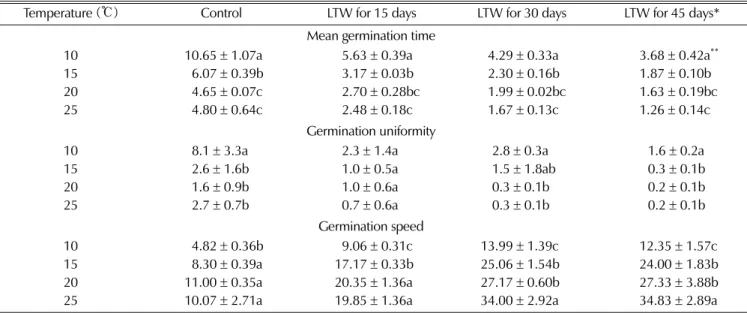
평균발아일수 (MGT)는 대조구의 10℃에서 10.65일로 가장 길게, 45일 저온습윤 처리구의 25℃에서는 가장 짧게 조사되 어 전체적으로 저온습윤 처리기간이 길어질수록, 온도가 높아 질수록 평균발아일수는 짧아지는 경향을 보였다 (Table 3). 온 도별로는 45일 저온습윤 처리구 보다 대조구에서 2.9 ~ 3.8배 긴 평균발아일수를 보인 것으로 나타났다. 발아균일도 (GU) 또한 대조구에서 가장 높게 조사되었으며 가장 낮은 값으로 조사된 45일 저온습윤 처리구보다 온도별로 5.1 ~ 13.5배 더 높게 나타났으며 저온습윤 처리기간이 길어질수록, 온도가 높 아질수록 발아균일도가 낮아지는 경향을 보였다. 발아세(GS) 는 대조구의 10℃에서 4.82로 가장 느린 것으로 조사되었으며 온도가 높아질수록, 저온습윤 처리 기간이 길어질수록 빨라지 는 경향을 보였다. 이것은 Fig. 2와 부합되는 결과이며, 저온 습윤 처리를 하였을 때 발아가 빨라져 전체적인 평균발아일수 가 짧아지고 발아세가 빨라졌으며 이로 인해 발아균일도가 낮 아져 보다 효율적인 생산관리가 가능할 것으로 판단된다.
또한, 대조구에서는 치상 후 2 ~ 4일차에 첫 발아가 시작되 었으며 30일과 45일 저온습윤 처리구에서는 모두 치상 후 1 일차에 첫 발아가 시작된 것으로 조사되었다. 이것은 일정기
Fig. 3. Effects of shading rate on germination rate of Atractylodes japonica seeds pre-treated with drying at room temperature (DRT), drying at low temperature (DLT), and water soaking (WS). Bars indicate SD.
Fig. 4. Effects of shading rate on T50 (days to 50% of germination of final germination rates) of Atractylodes japonica seeds pre-treated with drying at room temperature (DRT), drying at low temperature (DLT) and water soaking (WS). Bars indicate SD.
Table 3. Effects of temperature on mean germination time, germination uniformity and germination speed of Atractylodes japonica seeds pre-treated with low temperature and wetting (LTW).
Temperature (℃) Control LTW for 15 days LTW for 30 days LTW for 45 days*
Mean germination time
10 10.65± 1.07a 05.63± 0.39a 04.29± 0.33a 3.68± 0.42a**
15 06.07± 0.39b 03.17± 0.03b 02.30± 0.16b 1.87± 0.10b
20 04.65± 0.07c 02.70± 0.28bc 01.99± 0.02bc 1.63± 0.19bc
25 04.80± 0.64c 02.48± 0.18c 01.67± 0.13c 1.26± 0.14c
Germination uniformity
10 08.1± 3.3a 02.3± 1.4a 02.8± 0.3a 1.6± 0.2a
15 02.6± 1.6b 01.0± 0.5a 01.5± 1.8ab 0.3± 0.1b
20 01.6± 0.9b 01.0± 0.6a 00.3± 0.1b 0.2± 0.1b
25 02.7± 0.7b 00.7± 0.6a 00.3± 0.1b 0.2± 0.1b
Germination speed
10 04.82± 0.36b 09.06± 0.31c 13.99± 1.39c 12.35± 1.57c
15 08.30± 0.39a 17.17± 0.33b 25.06± 1.54b 24.00± 1.83b
20 11.00± 0.35a 20.35± 1.36a 27.17± 0.60b 27.33± 3.88b
25 10.07± 2.71a 19.85± 1.36a 34.00± 2.92a 34.83± 2.89a
*LTW; Low temperature with wetting.
**Different letters in each column indicate significant differences according to Duncan's multiple range test (p = 0.05).
간의 저온습윤 저장 (Schopmeyer, 1974)을 함으로써 종자의 휴면과 발아 억제물질이 타파되어 발아가 빨리 이루어진 것으 로 판단된다. 이러한 결과는 선학초의 종자를 저온층적 처리 하였을 때 발아기간 단축과 발아율이 보다 높아 (Lee et al., 2000)지는 것과 동일한 경향을 보였다. 또한, 방풍, 갯방풍, 구 릿대, 참당귀 (Yoon et al., 1999) 종자의 저온흡습 처리 시 발아율 향상뿐만 아니라 발아일수가 짧아져 본 실험과 동일한 결과를 보였으며 이러한 처리는 약용작물 재배에 보다 효율적
일 것으로 사료된다.
3. 전처리 및 차광처리 후 발아력 1) 발아율 및 발아기
광 등의 환경요인 (Bonner, 1988; Cho and Kim, 1993;
Kang et al., 1997; Yu et al., 1995; Amen, 1967)은 종자의 발아에 영향을 미친다.
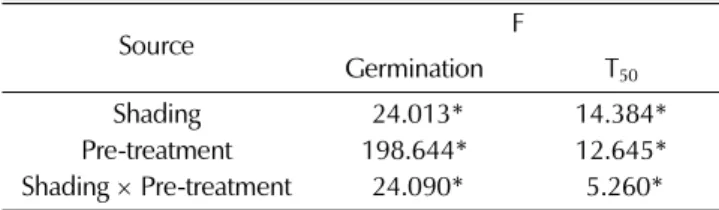
전처리와 광수준을 달리하여 삽주 종자의 발아 실험을 한 결과, 전체에서 63.2 ~ 95.8%의 발아율을 보인 것으로 조사되 었으며, 가장 높은 발아율은 전광 내 상온건조 처리구에서 95.8%로 조사되었다 (Fig. 3). 상온건조 처리 종자는 35% 차 광처리구를 제외하고 91.0 ~ 95.8%의 높은 발아율을 보였으며, 저온건조 처리 종자는 50% 차광을 제외하고 84.0 ~ 93.8%의 발아율로 차광률이 높아질수록 발아율이 낮아지는 경향을 보 였다. 수침 처리 종자는 63.2 ~ 77.8%의 발아율로 차광률이 높 아질수록 발아율이 낮아지는 경향을 보였다. 종자의 전처리가 이루어진 세 처리구 중 수침 처리구에서 상대적으로 낮은 발 Table 4. F-value of germination rate and T50 of Atractylodes
japonica seeds with different shading rates and pre- treatment.
Source F
Germination T50
Shading 24.013* 14.384*
Pre-treatment 198.644* 12.645*
Shading× Pre-treatment 24.090* 5.260*
*p<0.01.
Table 5. Effects of shading on mean germination time, germination uniformity and germination speed of Atractylodes japonica seeds pre- treated with drying at room temperature (DRT), drying at low temperature (DLT) and water soaking (WS).
Shading (%) Pre-Treatment
DRTz DLTy WSx
Mean germination time
Full sunlight 22.79± 0.13d 23.19± 0.04d 22.65± 0.70c*
35 26.13± 0.06a 24.67± 0.66c 23.91± 0.25b
50 22.93± 0.44d 27.03± 1.32a 23.83± 0.44b
75 23.79± 0.23c 25.64± 0.26bc 25.29± 0.38a
95 24.30± 0.23b 26.06± 0.73ab 25.64± 0.36a
Germination uniformity
Full sunlight 10.6± 0.7ab 09.6± 0.8a 10.4± 0.1c
35 14.0± 2.2a 13.5± 6.6a 21.6± 0.2a
50 05.2± 0.8c 14.1± 3.4a 14.1± 7.2bc
75 10.7± 4.7ab 14.7± 0.2a 13.3± 7.5c
95 09.8± 2.9b 15.0± 5.4a 20.3± 4.2ab
Germination speed
Full sunlight 3.08± 0.08a 2.96± 0.10a 2.49± 0.11a
35 2.13± 0.08c 2.63± 0.08b 2.41± 0.03a
50 2.88± 0.09b 1.91± 0.13d 2.08± 0.13b
75 2.84± 0.16b 2.44± 0.23bc 1.83± 0.04c
95 2.84± 0.16b 2.37± 0.25c 1.84± 0.04c
Source F
Mean germination time Germination uniformity Germination speed
Shading 58.130* 7.265* 46.784*
Pre-treatment 53.060* 15.949* 144.477*
Shading -Pre-treatment 28.942* 3.265* 34.307*
zDrying at room temperature, yDrying at low temperature, xWater soaking
*Different letters in each column indicate significant differences according to Duncan's multiple range test (p = 0.05). * p<0.01.
아율을 보였는데 이것은 수침처리에 의한 과습의 피해를 입었 기 때문으로 사료된다.
발아기 (T50)는 전체적으로 21.6 ~ 26.8일의 범위로 조사되어 종자의 전처리에 따른 발아기는 큰 차이를 보이지는 않았으 나, 상대적으로 전광에서 낮은 값을 보였다. 한편, 저온층적 처 리한 선학초 종자를 파종하였을 때 더 많은 엽수가 발생 (Lee et al., 2000)되어 종자 전처리가 중요한 것으로 보고하였지만, 삽 주 종자의 발아기에는 큰 영향을 미치지 않는 것으로 사료된다.
2) 평균발아일수, 발아균일도 및 발아세
전처리 종자의 평균발아일수 (MGT)는 22.65 ~ 27.03일의 범 위로, 차광별로는 대부분 저온건조 처리 종자가 높게 조사되 었으나 처리구간 큰 차이는 없는 것으로 나타났다. 발아균일 도 (GU)는 저온건조 처리 종자와 35% 차광을 제외한 수침 처리 종자의 경우 차광률이 높아질수록 높은 값을 보였으며, 차광별로는 대부분 상온건조 처리 종자가 보다 낮은 발아균일 도를 보였다. 발아세 (GS) 또한 35% 차광을 제외하고 상온건 조 처리 종자가 가장 높은 것으로 조사되었으며 전체적으로는 수침 처리 종자가 가장 낮은 발아세를 보였다. 이러한 결과는 삽 주 종자의 경우 특별한 전처리가 필요하지 않는 것으로 판단된다.
LITERATURE CITED
Ahn YH, Choi CY and Kim YH. (2008). Study of ecotype on difference luminosity intensity and latitude in native Cacalia firma Kom. Korean Journal of Environment and Ecology Symposium. 2:157-158.
Amen RD. (1967). The effect of gibberellic acid and stratification on the seed dormancy and germination in Luzula Spicata.
Physiology Plant. 20:6-12.
Bewley JD and Black M. (1985). Seeds : Physiology of development and germination. Plenum press. New York, USA.
p.1-367.
Bonner FT. (1988). Seeds of woody plants. Advances in Research and Technology of Seeds. 11:81-112.
Ching TM. (1972). Metabolism of germinating seeds. In Kozlowski TT. (ed.). Seed biology(Vol. 2). Academic Press.
New York, USA. p.103-218.
Cho SH and Kim KJ. (1993). Studies on the increase of germination percent of Angelica gigas Nakai Ⅰ. Germination characteristics and cause of lower germination perecent. Korean Journal of Medicinal Crop Science. 1:3-9.
Choi GS, Park KW and Kang HM. (2003). Effect of temperature, light condition, and priming treatement on the germination of Aster glehhi FR. seed. Journal of Bio- Environment Control. 12:132-138.
Choi SK, Lee JI, Seo YN and Choi KJ. (1993). Studies on the germination physiology, growth and component analysis of Agastache rugosa KUNTZE. Journal of Oriental Botany Research. 6:147-154.
Come D and Tissaoui T. (1973). Interrelated effects of inhibition,
temperature and oxygen on seed germination. InHeydecker W.
(ed.). Seed ecology. Butterworths. London, England. p.157-168.
Coolbear P, Francis A and Grierson D. (1984). The effect of low temperature pre-sowing treatment on the germination performance and membrane integrity of artificially aged tomato seeds. Journal of Experimental Botany. 35:1609-1617.
Edwards TI. (1934). Relations of germinating soybeans to temperature and length of incubation time. Journal of Plant Physiology. 9:1-30.
Gordon AG. (1971). The germination resistance test-a new test for measuring germination quality of cereals. Canadian Journal of Plant Science. 51:181-183.
Hwang IS, Yoo JH, Seong ES, Lee JG, Kim HY, Kim NJ, Lee JD, Ham JK, Ahn YS, Kim NY and Yu CY. (2012). The effect of temperature and seed soaking on germination in Cynanchum wilfordii (Maxim.) Hemsl. Korean Journal of Medicinal Crop Science. 20:136-139.
Jeon SH, Son D, Ryu YS, Kim SH, Chung JI, Kim MC and Shim SI. (2010). Effect of presowing seed treatments on germination and seedling emergence in taraxacum platycarpum.
Korean Journal of Medicinal Crop Science. 18:9-14.
Jeoung HW. (1991). Studies on the propagation on Korea native aralia(Aralia elata Seemann). Master Thesis. Konkuk University p.4-21.
Jin YH and Ahn YH. (2010). Comparison of ecological characteristics of Parasenecio firmus population in Korea and China. Journal of Environmental Science International. 19:197-207.
Kang JH, Kim DI, Yu OK, Kim US and Kim YK. (1997).
Effect of seed pretreatment with chilling, GA3 and light on Bupleurum falcatum germination. Korean Journal of Crop Science. 42:384-391.
Kang JH, Shim YD and Jeong JI. (2001). Effects of seed treatments for promoting seedling emergence of Codonopsis lanceolata Trautv. Korean Journal of Medicinal Crop Science.
9:68-75.
Kim CJ. (1999). Studies on seed production and germination of Ligularia fischeri. Master Thesis. Kangwon University. p.1-39.
Kim ES, Kim HJ, Ahn JH, Kim DG, Lee KC and Seo KW.
(2012). Effect of temperature on seed germination of Heracleum moellendorffii Hance. Conference of The Plant Resources Society of Korea. p.131-131.
Kim KS and Chae YA. (1993). Analysis of substances related to germination in Aralia continentalis Kitagawa. Korean Journal of Medicinal Crop Science. 1:49-57.
Kwak JS, Seong HG and Chang KJ. (2011). Medicinal plant cultivation. Blue Happy Press. Seoul, Korea. p.1-423.
Kwon TR, Jo JH, Kwon YS, Lee SP and Choi BS. (1993).
Study on seed treatments to facilitate germination of some wild edible greens. Korean Journal of Soil Science and Fertilizer.
35:416-421.
Lee YH, Park JM, Lee ST, Chung DS and Kim HK. (2000).
Effect of seed treatments on germination and growth of Agrimonia pilosa Ledeb. Korean Journal of Medicinal Crop Science. 8:129-133.
Park JH and Seong SH. (2007). Medicinal plant. Shinilbooks.
Seoul, Korea. p.1-568.
Schopmeyer CS. (1974). Seeds of woody plants in the United
States. United States Department of Agriculture(USDA) Handbook. No. 450. Forest Service. USDA. Washington D.C., USA. p.53-74.
St. Clair JB and Adams WT. (1991). Effects of seed weight and rate of emergence on early growth of open-pollinated Douglas- fir families. Forest Science. 37:987-997.
Thompson JR. (1979). An introduction to seed technology. John Wiley and Sons. New York, USA. p.1-252.
Wright LN. (1976). Germination and growth response of seed weight genotype of Panicum antidotale Retz. Crop Science.
17:176-178.
Yang YJ and Kim YS. (1993). Seed germination of Korean wild medicinal plants : Capsella bursapastoris, Persicaria perfoliata and Commelina communis. Journal of the Korean Society for Horticultural Science. 34:315-319.
Yoo JH, Hwang IS, Seong ES, Lee JG, Kim HY, Kim NJ, Lim
JD, Ham JK, Ahn YS and Yu CY. (2012a). The germination characteristics of Rheum undulatum L. seeds in treatment conditions. Korean Journal of Medicinal Crop Science. 20:393- 397.
Yoo JH, Hwang IS, Seong ES, Lee JG, Kim NJ, Kim MJ, Lee JD, Ham JK, Ahn YS, An TJ and Yu CY. (2012b).
Establishing optimal germination for stored Rheum palmatum L. seeds. Korean Journal of Medicinal Crop Science. 20:85-88.
Yoon ST, Lee DJ and Kim YH. (1999). The technology for increasing seed viability by priming treatment and plant growth regulators in medicinal plants. The Journal of the Korean Society of International Agriculture. 11:85-95.
Yu HS, Kang BH, Im DJ, Kim CG, Kim YG, Lee ST and Chang YH. (1995). Effects of temperature, light, GA3 and storage method on germination of Angelica gigas NAKAI.
Korean Journal of Medicinal Crop Science. 3:30-34.