운동 피로와 시각정보 차단이 직립서기 자세제어에 미치는 영향
오현진
1․염창홍
2․김태현
31동아대학교 교육대학원 체육교육과 ․2동아대학교 스포츠과학대학 스포츠지도학과․3동아대학교 대학원 태권도학과
Effects of Exercise-Induced Fatigue and Blocked Vision on Postural Control during Upright Stance
Hyun-Jin Oh
1․Chang-Hong Youm
2․Tae-Hyeon Kim
31Department of Physical Education, Graduate School of Education, Dong-A University, Busan, Korea
2Department of Coaching, College of Sport Sciences, Dong-A University, Busan, Korea
3Department of Taekwondo, Graduate School, Dong-A University, Busan, Korea
Received 14 July 2011; Received in revised form 25 July 2011; Accepted 26 September 2011
ABSTRACT
The purpose of this study was to investigate the effects of exercise-induced fatigue and blocked vision on postural control during upright stance in elderly women. The study population included 22 women who were aged over 65 years, had no sustained orthopedic damage within the last 6 months, and had been randomly recruited. The results were analyzed with respect to the mediolateral and anteroposterior factors for the center of pressure. The exercise-induced fatigue and the absence of visual information increased the anteroposterior and mediolateral velocity for center of pressure. This means that the elderly women could control their posture through many sways. In conclusion, the exercise-induced fatigue and the blocked vision decreased ability of the postural control in elderly women. Further research on the change of postural control in relation to the types of exercise-induced fatigue and the levels of muscular fatigue is expected.
Keywords : Postural Control, Exercise-Induced Fatigue, Vision, Center of Pressure
Ⅰ. 서 론
노화란 나이가 증가함에 따라 생식력의 감퇴와 사망률의 증가 가 동반되는 진행성 기능상실로 정의될 수 있다 (Hayflick, 2000).
노화는 근육 내 지방 및 콜라겐의 증가와 근육의 부피 감소가 동반되며 , 나아가 근력의 감소가 초래된다(Frontera, Hughes, Lutz
& Evans, 1991; Goodpaster et al., 2001; Kent-Braun, Ng & Young, 2000; Overend, Cunningham, Paterson & Lefcoe, 1992). 이러한 근
이 논문은 2010한국운동역학회 추계학술대회에서 발표된 논문임.
이 논문은 동아대학교 교내연구비 지원에 의하여 연구되었음.
Corresponding Author : Chang-Hong Youm
Department of Coaching, College of Sports Sciences, Dong-A University, 840 Hadan-dong, Saha-gu, Busan, Korea
Tel : +82-51-200-7830 / Fax : +82-51-200-7805 E-mail : [email protected]
러한 근 골격계의 변화로 인해 하지 수행력은 감소하게 되고 (Visser et al., 2002), 그 결과 고령자들은 전반적 신체 활동에 제약을 받게 된다 (Evans, 1999). 또한 노화는 균형에 영향을 미 치는 자세제어계의 조절과 통합 능력을 감소시키며 (Maki &
Mcllroy, 1996), 감각기능 저하로 인해 자세제어에 영향을 미치 는 시각 , 전정감각, 고유감각, 근력, 반응시간의 능력을 감소시 킨다 (Sturnieks, St George & Lord, 2008). 이러한 자세제어 능력 의 감소로 인해 고령자들의 낙상 위험은 증가된다 .
낙상이란 급성 마비나 외적 힘의 작용에 의해 넘어지는 경 우를 제외한 본인의 의사와 상관없이 최초의 위치보다 낮은 위 치 혹은 바닥으로 떨어지는 것을 말한다 (Fuller, 2000; Lord, Kaplan & Ward, 1993; Stalenhoef, Diederik & Knottnerus, 2002).
낙상은 고령자들의 건강과 관련된 주요한 문제 중 하나이며 ,
고령자의 약 30%가 해마다 한 번의 낙상을 경험한다(Bath &
Morgan, 1999; Bueno & Padilla, 2000). 낙상으로 인한 사망자의 75% 중 고령자 인구의 비율은 12.5%에 이르며, 연령과 인종에 관계없이 그 추세가 증가되고 있다 (Fuller, 2000). 또한 낙상은 국내 사고사 중에서 자살과 운수사고에 이어 3위를 차지하는 고령자들의 흔한 사망 원인 중의 하나이다 (Statistics Korea, 2010b). 특히 낙상은 고령여성일수록 그 위험이 증가하는 것으 로 보고되고 있다 (Fuller, 2000).
자세제어계는 인체의 본질적인 불안정으로 인해 다소 안정 된 두 발로 서 있는 동안에도 안정을 위해 노력이 요구된다 (Loram, Maganaris & Lakie, 2005; Masani, Popovic, Nakazawa, Kouzaki & Nozaki, 2003; Masani et al., 2007; Peterka, 2002). 이 러한 자세제어는 감각정보 통합 , 신경계 처리, 생체 역학적 요 인을 포함하며 , 시각, 전정감각, 체성감각 통합과 함께 근골격 계의 조화로운 조절에 의해 이루어진다 (Hall & Brody, 1999;
Shumway-Cook & Woollacott, 2000). 시각은 자세제어에 중요한 역할을 하며 일반적으로 시각 부재 시 동요는 증가한다 (Schmit, Regis & Riley, 2005). 시각 이용 시 나타나는 동요 감소는 고유 감각이나 전정감각보다 크게 영향을 미치며 (Easton, Greene, DiZio & Lackner, 1998), 시력이 약한 노인은 그렇지 않은 노인 보다 낙상 발생률이 약 3배 이상 높다(Lord & Dayhew, 2001).
자세제어 시 충분한 힘이 지속적으로 발휘 되지 않는다면 , 자세의 불안정은 불가피하게 되며 (Yaggie & McGregor, 2002), 이러한 지속적인 힘의 발휘를 저해하는 근피로는 근 수축 효율 성과 고유 감각기의 변화를 가져와 움직임과 자세제어에 영향 을 미치게 된다 (Chabran, Maton & Forrment, 2002). 근피로 원인 은 운동피질 (motor cortex)에서 부적절한 운동 명령에 따른 근섬 유 내 대사산물 축적 , 힘을 생산하는 수축성 단백질을 이용하 는 생리학적 처리과정 손상 등과 같은 다양한 기전에 의해 발생 되며 , 근피로에 대한 총체적인 기전에 대하여 알려진 바는 없는 실정이다 (Allen & Westerblad, 2001; Asmussen, 1979; Bigland-Ritchie, Rice, Garland & Walsh, 1995; Giannesini, Cozzone & Bendahan, 2003; Enoka & Stuart, 1992).
Vuillerme, Forestier와 Nougier(2002)는 건강한 대학생 9명을 대상으로 종아리근 피로가 두발서기 시 자세제어에 미치는 영 향에 대하여 연구한 결과 , 종아리 근 피로는 두발서기 시 자세 제어 능력의 감소를 일으킨다고 보고하였다 . 또한 Yaggie와 McGregor(2002)는 건강한 남자 24명을 대상으로 저측굴곡근과 배측굴곡근 피로가 외발서기 시 자세제어에 미치는 영향에 대 하여 연구한 결과 , 압력중심점(center of pressure, COP)의 좌우 변수에서 유의한 증가가 나타나 저측굴곡근과 배측굴곡근 피로 는 자세제어 능력의 감소를 일으킨다고 보고하였다 . 그러나 Adlerton과 Moritz(2003)는 건강한 여성 23명을 대상으로 종아리 근 피로가 외발서기 자세제어에 미치는 영향에 대하여 연구한
결과 , 종아리 근 피로 후 자세제어 능력의 감소가 나타나지 않 았다고 보고하였다 . 이와 같이 선행연구들은 피로 유발이 자세 제어 능력을 감소시킨다는 보고와 유의한 감소를 보이지 않는 다는 보고가 상충하고 있는 실정이다 .
국외의 경우 , 근피로와 자세제어 능력 간의 관계에 대한 연 구가 다소 이루어지고 있으나 국내에서는 이와 관련된 연구는 거의 없는 실정이다 . 또한 고령자를 대상으로 운동 피로와 시 각정보 차단과 관련된 변인으로 자세제어 능력을 비교한 연구 는 국내뿐 아니라 국외에서도 거의 없는 실정이다 .
따라서 이 연구의 목적은 고령여성을 대상으로 운동 피로와 시각정보 차단이 직립서기 자세제어에 어떠한 영향을 미치는가 를 알아보고자 하는 것이다 .
Ⅱ. 연구방법
1. 연구 대상 및 실험 장비
이 연구의 피험자는 최근 6개월 내에 정형 외과적 신체장애 가 없는 65세 이상 고령여성 22명(나이: 69.7±5.3 years, 신장:
153.4±5.1 cm, 체중: 57.4±5.3 kg, BMI: 24.4±2.9 kg/m
2)을 무작위 로 선정하였다 . 피험자들에게는 연구에 대한 충분한 설명과 서 면을 통한 동의를 구했으며 , 모든 실험은 자발적으로 참여하였 다 . 사용된 실험 장비는 <Table 1>과 같다.
Equipment Model Manufacturer
Analysis S/W Nexus Vicon(UK)
Force platform OR6-7 AMTI(US)
Force platform amplifier MSA-6 AMTI(US) Table 1. Experimental equipment
2. 실험 절차
이 연구는 운동 피로와 시각정보 차단이 직립서기 자세제어 에 미치는 영향을 알아보기 위하여 반복측정 연구를 이용하였 다 . 실험 순서는 1차 실험과 2차 실험으로 나누어 진행되었으 며 , 1차 실험은 눈뜨고 두발 직립서기를 Bicycle 운동 전과 후 로 나누어 실시하였다 . 그리고 1차 실험으로 인한 피로 회복을 위해 약 1주일 후 2차 실험이 진행되었으며, 2차 실험은 눈감고 두발 직립서기를 Bicycle 운동 전과 후로 나누어 실시하였다.
피험자들은 실험이 진행되는 일주일 동안 일상생활 이외에 다 른 신체활동 프로그램에 참여하지 않도록 하였다 .
실내 체육관에서 두발 직립서기를 수행하는 위치에 힘판
(AMTI OR6-7, Watertown, MA, US)을 설치하고, 미끄럼 방지용 테이프를 부착하여 미끄럼이 억제되도록 하였으며 , 신발은 착 용하지 않았다 . 지면반력 측정 시 실시하는 절차에 따라 지면 반력 장비를 가동시킨 후 , 전자적 드리프트(drift)를 제거하기 위 하여 약 45분 이상 예열하였으며(Lafond, Corriveau, Hebert &
Prince, 2004), 앰프(AMTI MSA-6 MiniAmp, Watertown, MA, US) 게인은 4,000 N, 샘플링 주파수 120 Hz로 설정 하였다.
자세제어 능력 실험은 Bicycle 운동 전․후, 시각정보 유․무 에 따라 70초 이상 두발 직립서기 자세를 유지하게 하였으며, 두발의 위치는 두 발을 나란하게 모아 앞꿈치와 뒷꿈치를 붙이 도록 하였다 . 데이터는 실험 환경에서 발생할 수 있는 초기 동 요를 제거하기 위하여 시작 신호로부터 5초 후 총 60초의 자료 를 분석하였다 (Jonsson, Seiger & Hirschfeld, 2004; Le Clair &
Riach, 1996; Perrin, Deviterne, Hugel & Perrot, 2002; Youm, Park,
& Seo, 2007).
실험이 준비된 피험자는 실험 진행자의 지시에 따라 힘판에 올라가 양발을 나란히 붙인 다음 양손을 자연스럽게 내리고 시 선은 15° 상향의 표적을 주시하게 한 후, 눈뜨고․눈감고 두발 직립서기를 유지하게 하였다 .
3. Bicycle 운동 피로 프로토콜
Bicycle 운동 피로는 Bicycle Ergometer(Bicycle ergometer, Computromic 232CXL, Japan)로 Modified Åstrand의 점증부하법 을 이용하여 페달회전 속도 50 rpm, 파워 20 watts부터 2분 간 격으로 10 watts씩 점증 부하하여 실시하였다. 운동 피로 수준 은 80% HRR과 자각적 운동 강도(RPE) 17 이상으로 판정하였 으며 (ACSM, 2006), 피험자별 운동 강도를 알아보기 위하여 Polar 무선심박측정기(Polar Electro OY, Finland)를 이용하여 심 박수를 측정하였다 . 측정 결과, Bicycle 운동 피로 후 심박수는 1차 실험 91.1±15.2 %HRR, 2차 실험 91.5±10.9 %HRR로 나타났 으며 , 자각적 운동 강도는 1차 실험 17.6±1.0, 2차 실험 17.7±1.3 으로 나타났다 .
Bicycle 운동에 따른 생리학적 피로 수준을 알아보기 위하여 운동 전과 후 전완 주정맥에서 NaF(Sodium Fluride) 용기를 이 용하여 채혈하였으며 , 운동 후 채혈까지 소요된 시간은 약 2분 내외로 제어하였다 . 채혈된 혈액은 생화학 장치(Cobas Intergra, Roche, Germany)를 이용하여 효소적 측색법(LOX/PAP with lactate oxidase and 4-aminoantipyrine)으로 젖산농도(mmol/L)를 측정하였으며 , 혈액 검사는 눈뜨고 두발 직립서기 측정 시 Bicycle 운동 전 1회, Bicycle 운동 후 1회, 눈감고 두발 직립서 기 측정 시 Bicycle 운동 전 1회, Bicycle 운동 후 1회로 총 4회 를 실시하였다 . 측정 결과, Bicycle 운동 피로 후 젖산 농도는 1 차 실험 4.1±2.2 mmol/L, 2차 실험 4.3±1.9 mmol/L로 나타났다.
4. 자료 분석
데이터는 시작 신호로부터 5초 이후 60초의 자료 대상으로 분석하였으며 (Jonsson et al., 2004; Le Clair & Riach, 1996; Perrin et al., 2002; Youm et al., 2007), Butterworth의 저역통과 필터를 이용하여 차단주파수 10 Hz로 필터링하였다(Doyle, Ragan, Rajendran, Rosengren & Hsiao-Wecksler, 2008; Raymakers, Samson & Verhaar, 2005).
분석에 사용된 변수는 COP 궤적의 전후 요인과 좌우 요인으 로 나누어 사용하였으며 , COP 전후 요인은 전후 범위, 전후 속 도 , 전후 RMS(root mean square) 거리, COP 좌우 요인은 좌우 범위 , 좌우 속도, 좌우 RMS 거리로 설정하였다.
5. 통계 처리
통계처리는 SPSS 19.0을 이용하여 각 변수들의 평균과 표준 편차를 산출하였다 . 각 변수들의 정규성 검정을 위해 Shapiro- Wilk 테스트를 실시하였으며 그 결과는 정규성을 만족하는 것 으로 나타났다 . Bicycle 운동 전․후와 시각정보 유․무 간의 상호작용 효과는 반복측정에 의한
two-way ANOVA를 실시하였 으며 , 통계적 유의수준은 .05로 설정하였다.
Ⅲ. 결 과
1. COP 전후 요인
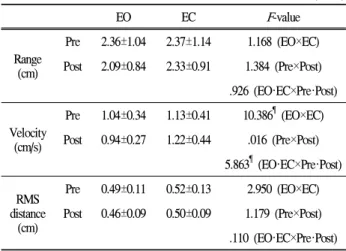
COP 전후 요인에 대한 분석 결과는 <Table 2>와 같다.
EO EC F -value
Range (cm)
Pre 2.36±1.04 2.37±1.14 1.168 (EO×EC) Post 2.09±0.84 2.33±0.91 1.384 (Pre×Post)
.926 (EO·EC×Pre·Post) Velocity
(cm/s)
Pre 1.04±0.34 1.13±0.41 10.386
¶(EO×EC) Post 0.94±0.27 1.22±0.44 .016 (Pre×Post)
5.863
¶(EO·EC×Pre·Post)
distance RMS (cm)
Pre 0.49±0.11 0.52±0.13 2.950 (EO×EC) Post 0.46±0.09 0.50±0.09 1.179 (Pre×Post)
.110 (EO·EC×Pre·Post) EO means eyes open; EC means eyes closed; Pre indicates before exercise-induced fatigue; Post indicates after exercise-induced fatigue;
¶is result of two-way ANOVA with repeated measures between EO and EC × between Pre and Post at p<.05
Table 2. The anteroposterior variables of the COP trajectories (N=22)
COP 전후 범위와 전후 RMS 거리는 눈뜨고․눈감고 실험 간과 운동 전 ․후 간 상호작용 효과, 눈뜨고․눈감고 실험 간 과 운동 전 ․후 간 주효과 모두에서 통계적으로 유의한 차이가 나타나지 않았다 .
COP 전후 속도는 눈뜨고․눈감고 실험 간과 운동 전․후 간 (
F1,21=5.863, p=.025)에서 통계적으로 유의한 상호작용 효과가 나타났다 . 눈뜨고․눈감고 실험 간(
F1,21=10.386,
p=.004)에서 통 계적으로 유의한 주효과가 나타났으나 , 운동 전․후 간에서는 통계적으로 유의한 주효과가 나타나지 않았다 .
2. COP 좌우 요인
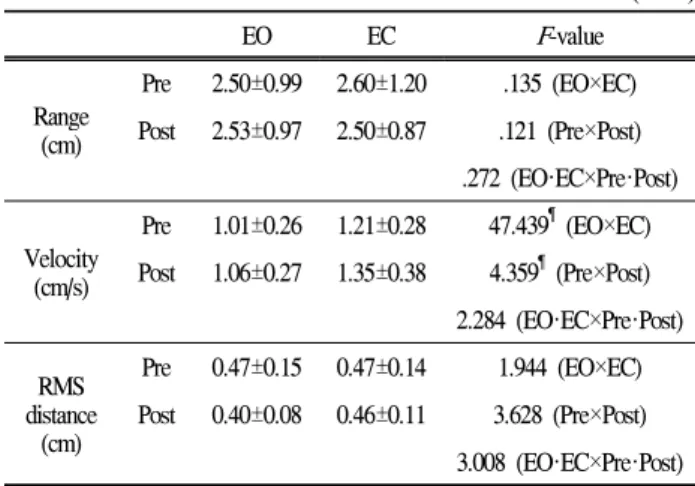
COP 좌우 요인에 대한 분석 결과는 <Table 3>과 같다.
EO EC F -value
Range (cm)
Pre 2.50±0.99 2.60±1.20 .135 (EO×EC) Post 2.53±0.97 2.50±0.87 .121 (Pre×Post)
.272 (EO·EC×Pre·Post) Velocity
(cm/s)
Pre 1.01±0.26 1.21±0.28 47.439
¶(EO×EC) Post 1.06±0.27 1.35±0.38 4.359
¶(Pre×Post)
2.284 (EO·EC×Pre·Post)
distance RMS (cm)
Pre 0.47±0.15 0.47±0.14 1.944 (EO×EC) Post 0.40±0.08 0.46±0.11 3.628 (Pre×Post)
3.008 (EO·EC×Pre·Post) EO means eyes open; EC means eyes closed; Pre indicates before exercise-induced fatigue; Post indicates after exercise-induced fatigue;
¶is result of two-way ANOVA with repeated measures between EO and EC × between Pre and Post at p<.05
Table 3. The mediolateral variables of the COP trajectories (N=22)
COP 좌우 범위와 좌우 RMS 거리는 눈뜨고․눈감고 실험 간과 운동 전 ․후 간 상호작용 효과, 눈뜨고․눈감고 실험 간 과 운동 전 ․후 간 주효과 모두에서 통계적으로 유의한 차이가 나타나지 않았다 .
COP 좌우 속도는 눈뜨고․눈감고 실험 간과 운동 전․후 간 에서 통계적으로 유의한 상호작용 효과가 나타나지 않았다 . 그 러나 눈뜨고 ․눈감고 실험 간(
F1,21=47.439
, p=.000)과 운동 전․
후 간 (
F1,21=4.359
, p=.049)에서 통계적으로 유의한 주효과가 나 타났다 .
Ⅳ. 논 의
이 연구는 고령여성을 대상으로 운동 피로와 시각정보 차단
이 직립서기 자세제어에 미치는 영향을 알아보는 것이다 . 정적서기 시 자세제어의 정량적 분석에는 지면반력 시스템을 통한 COP 변수들을 사용하고 있다(Ferdjallah, Harris & Wertsch, 1999; Harris, Riedel, Matesi & Smith, 1993). ISPGR(International Society for Posture & Gait Research)은 지면반력 시스템을 이용 한 자세제어 능력 평가 시 시간영역 변수로 COP 속도와 RMS 거리 사용을 권고하고 있다 (Kapteyn et al., 1983). COP 속도의 증가는 안정성 감소나 자세제어 능력의 감소로 해석되며 , 안정 성에 대한 지각은 자세를 제어하는 동작의 진폭보다는 동작의 속도와 더 밀접한 관련이 있다 (Adlerton & Moritz, 2003; Cobeil, Blouin, Begin, Nougier & Teasdale, 2003). 그리고 RMS 거리는 안정성이 확보된 상태에서 자세 제어계의 효과성에 관련된 변 수이며 , 속도는 안정성의 수준에 따라 자세를 제어하는 활동의 양과 관련된 변수이다 (Prieto, Myklebust, Hoffmann, Lovett &
Myklebust, 1996).
이 연구 결과 , COP 전후 요인과 좌우 요인 모두에서 동작의 진폭을 의미하는 COP 범위와 RMS 거리는 눈뜨고․눈감고 실 험 간과 운동 전 ․후 간 상호작용 효과와 눈뜨고․눈감고 실험 간 주효과와 운동 전 ․후 간 주효과에 통계적으로 유의한 차이 가 나타나지 않았다 . 그러나 동작의 속도를 의미하는 COP 전후 속도는 눈뜨고 ․눈감고 실험 간과 운동 전․후 간 상호작용 효 과와 눈뜨고 ․눈감고 실험 간 주효과에서 통계적으로 유의한 차이가 나타났으며 , COP 좌우 속도는 눈뜨고․눈감고 실험 간 주효과와 운동 전 ․후 간 주효과에서 통계적으로 유의한 차이 가 나타났다 . 따라서 COP 속도 변수는 운동 피로 혹은 시각정 보 유 ․무와 같은 안정성에 영향을 미치는 조건에서의 자세제 어 능력 평가 시 사용할 수 있는 변수인 것으로 판단된다 .
COP 전후 요인 중, 전후 범위와 전후 RMS 거리는 상호작용 효과와 주효과 모두 통계적으로 유의한 차이가 나타나지 않았 다 . 그러나 COP 전후 속도는 눈뜨고․눈감고 실험 간과 운동 전 ․후 간 상호작용 효과와 눈뜨고․눈감고 실험 간 주효과는 통계적으로 유의한 차이가 나타났으나 , 운동 전․후 간 주효과 에서는 통계적으로 유의한 차이가 나타나지 않았다 . COP 전후 속도에서의 이러한 결과는 운동 피로와 시각정보 차단이 자세 제어 능력 감소를 초래한다는 것이다 .
Vuillerme et al.(2002)은 건강한 대학생 9명을 대상으로 종아
리 근 피로가 두발서기 시 자세동요에 미치는 영향에 대해 연
구한 결과 , 종아리 근 피로 후 COP 범위와 평균 속도의 증가를
보고하면서 , 종아리 근육의 피로는 두발서기 자세제어 능력을
감소시킨다고 하였다 . 그리고 Shin과 Youm(2011)은 건강한 남
자 대학생 20명을 대상으로 뒤꿈치 들기와 하버드 스텝을 통한
운동 피로 후 외발서기 자세제어에 미치는 영향에 대하여 연구
한 결과 , 뒤꿈치 들기 운동 피로 시 COP 전후 속도와 RMS 거
리는 통계적으로 유의한 감소가 나타났으나 , 하버드 스텝 운동
피로 시 COP 전후 속도와 RMS 거리는 유의한 차이가 나타나 지 않았다고 보고하였다 . 또한 Adlerton과 Moritz(2003)는 건강 한 여성 23명을 대상으로 종아리 근 피로가 외발서기 자세제어 에 미치는 영향에 대하여 연구한 결과 , 종아리 근 피로 후 자세 제어 능력 감소는 나타나지 않았다고 보고하였다 . 위에서 살펴 본 바와 같이 , 두발서기와 외발서기, 즉 서기 형태 간의 차이와 피로 유발 운동 형태 , 즉 근육의 피로 부위 간의 차이에 따라 자세제어 능력은 다르게 나타남을 알 수 있다 .
이 연구 결과 , 눈뜨고 두발서기 시 COP 전후 속도와 전후 RMS 거리는 운동 피로 전 보다 운동 피로 후 다소 감소하는 경향이 나타났다 . 이러한 결과는 Adlerton과 Moritz(2003)의 연 구 보고에서 그 원인을 살펴볼 수 있다 . Adlerton과 Moritz(2003) 는 피험자 중 14명에서 피로 운동 후 즉시 자세동요가 감소한 것으로 보고하였으며 , 이러한 결과는 피로에 대한 보충적인 자 세제어로 인해 발생된 자세제어 전략의 변화라고 하였다 . 그리 고 이러한 자세제어 전략의 변화는 실제적인 자세의 불안정을 나타내기보다 안정적인 자세를 유지하기 위한 목적으로 적응하 는 운동 전략의 변화를 말하는 것이 아닌가라고 제안하였다 . 이 연구 결과에서도 마찬가지로 고령여성들의 운동 피로 후 눈 뜨고 두발서기는 평소 적절하게 적응된 신체 움직임을 통해 자 세를 제어하고 있는 것 (Adlerton & Moritz, 2003)으로 판단되며, 자세제어 전략의 변화와 관련된 이러한 부분의 해석은 추가의 연구를 통해 살펴볼 필요가 있는 것으로 생각된다 .
일반적으로 시각은 자세제어에 중요한 역할을 하며 시각 부 재 시 동요는 증가하는데 (Schmit et al., 2005), COP 전후 요인 결과에서도 마찬가지로 시각정보 차단 시에는 자세제어 능력의 감소가 나타나며 , 나아가 이러한 자세제어 능력 감소는 낙상 발생률을 높이게 될 것이다 .
COP 좌우 요인 중, 좌우 범위와 좌우 RMS 거리는 상호작용 효과와 주효과 모두 통계적으로 유의한 차이가 나타나지 않았 다 . 그러나 COP 좌우 속도는 눈뜨고․눈감고 실험 간과 운동 전 ․후 간 상호작용 효과는 통계적으로 유의한 차이가 나타나 지 않았으나 , 눈뜨고․눈감고 실험 간 주효과와 운동 전․후 간 주효과에서는 통계적으로 유의한 차이가 나타났다 . COP 좌 우 속도에서의 이러한 결과는 운동 피로와 시각정보 차단이 자 세제어 능력 감소를 초래한다는 것이다 .
Yaggie와 McGregor(2002)는 건강한 남자 24명을 대상으로 저 측굴곡근과 배측굴곡근 피로 후 외발서기 자세제어 변화를 연 구한 결과 , 좌우 요인에서 피로 후 유의한 증가가 나타났다고 보고하였다 . 또한 Vuillerme et al.(2002)은 건강한 대학생 9명을 대상으로 종아리 근 피로 후 두발서기 자세제어에 미치는 영향 에 대해 연구한 결과 , 피로 후 COP 데이터에서 관찰된 변화는 개인의 안정성 한계에 도달되어 자세제어 능력의 저하로 낙상 이나 상해 가능성을 높일 수 있다고 보고하였다 . 이러한 결과는
건강한 남자와 고령여성이라는 대상자의 차이와 외발서기와 두 발서기라는 차이가 있지만 , COP 좌우 요인에서, 운동 피로와 시 각정보 차단은 직립서기 자세제어 능력의 감소를 초래하는 것으 로 생각된다 (Vuillerme et al., 2002; Yaggie & McGregor, 2002).
COP 좌우 속도에서 눈뜨고․눈감고 간 주효과에서 통계적 으로 유의한 증가가 나타났다 . 이는 앞에서 언급한 바와 같이 시각정보 차단은 동요를 증가시키며 (Schmit et al., 2005), 이는 운동 피로 효과와 상관없이 유의한 차이가 나타남을 알 수 있 다 . 그리고 Lord와 Dayhew(2001)은 시력이 약한 노인은 그렇지 않은 노인보다 낙상을 경험할 확률이 3배 이상인 것으로 보고 하였으며 , 가령에 따라 시력저하가 동반되는 경우에도 낙상 발 생률은 높아진다고 하였다 .
Mcllroy와 Maki(1996)는 자세제어 능력에 있어 좌우 동요에 대한 반응 손상이 전후 동요에 대한 반응 손상보다 낙상과 크게 관련되어 있다고 하였다 . 따라서 운동 피로와 시각정보 차단으 로 인한 자세제어 능력 감소는 낙상 발생률을 높이는데 기여하 는 것으로 판단된다 . 종합해보면, 운동 피로와 시각정보 차단은 고령여성들의 자세제어 능력을 감소시키며 , 고령여성들은 많은 움직임을 통해 자세를 제어하고 있는 것으로 나타났다 . 이러한 결과에 비추어 운동 피로 , 시각정보 차단 및 시력저하, 나아가 시력에 영향을 미칠 수 있는 낮은 조도의 환경은 고령여성의 낙 상 발생률 증가에 영향을 미칠 수 있을 것이다 . 따라서 그에 따 른 치료 및 운동 프로그램 개발은 물론 고령자를 위한 시설의 조도를 조절하여 환경을 개선할 필요가 있는 것으로 판단된다 .
Ⅴ. 결 론
이 연구는 고령여성을 대상으로 운동 피로와 시각정보 차단 이 직립서기 자세제어에 미치는 효과를 분석한 결과 , 다음과 같은 결론을 얻었다 .
운동 피로와 시각정보 차단은 COP 전후 속도와 좌우 속도의 증가를 초래하였으며 , 이는 고령여성들이 많은 움직임을 통해 자세를 제어하고 있다는 것을 의미한다 .
결론적으로 운동 피로와 시각정보 차단은 고령여성들의 자 세제어 능력을 감소시킨다 . 차후 피로 유발 운동 형태와 피로 수준에 따른 자세제어 변화를 구명할 수 있는 연구가 기대된다 .
참고문헌
ACSM(2006).
Guideline for Exercise Testing and Prescription(6th ed). Baltimore: Williams & Wilkins.
Adlerton, A. K., & Moritz, U.(2003). Forceplate and accelerometer measures for evaluating the effect of muscle fatigue on postural control during on-legged stance.
Physiotherapy Research International,8(4), 187-199.
Allen, D. G., & Westerblad, H.(2001). Role of phosphate and calcium stores in muscle fatigue.
Journal of Physiology,536, 657-665.
Asmussen, E.(1979). Muscle Fatigue.
Medicine and Science in Sports and Exercise, 11, 313-321.
Bath, S. P. A., & Morgan, K.(1999). Differential risk factor profiles for indoor and outdoor falls in older people living at home in Nottingham UK.
European Journal of Epidemiology,15, 65-73.
Bigland-Ritchie, B., Rice, C. L., Garland, S. J., & Walsh, M.
L.(1995). Task-dependent factors in fatigue of human voluntary contractions.
Advances in Experimental Medicine and Biology, 384, 361-380.
Bueno, C. A., & Padilla, R. F.(2000). Risk factors in falls among the elderly according to extrinsic and intrinsic precipitating causes.
European Journal of Epidemiology, 16, 849-859.
Chabran, E., Maton, B., & Fourment, A.(2002). Effects of postural muscle fatigue on the relation between segmental posture and movement.
Journal of Electromyography and Kinesiology, 12(1), 67-79.
Cobeil, P., Blouin, J. S., Bégin, F., Nougier, V., & Teasdale, N.(2003). Pertubation of the postural control system induced by muscular fatigue.
Gait and Posture, 18, 92-100.
Doyle, R. J., Raganc, B., Rajendran, K., Rosengren, K. S., &
Hsiao-Wecksler, E. T.(2008). Generalizability of stabilogram diffusion analysis of center of pressure measures.
Gait and Posture, 27, 223-230.
Easton, R. D., Greene, A. J., DiZio, P., & Lackner, J.(1998).
Auditory cues for orientation and postural control in sighted and congenitally blind people.
Experimental Brain Research, 118, 541-550.
Enoka, R. M., & Stuart, D. G.(1992). Neurobiology of muscle fatigue.
Journal of Applied Physiology, 72, 1631-1648.
Evans, W. J.(1999). Exercise training guidelines for the elderly.
Medicine and Science in Sports and Exercise
, 31(1), 12-17.
Ferdjallah, M., Harris, G. F., & Wertsch, J. J.(1999). Instantaneous postural stability characterization using time-ferquency analysis.
Gait and Posture, 10, 129-134.
Frontera, W. R., Hughes, V. A., Lutz, K. J., & Evans, W.
J.(1991). A cross-sectional study of muscle strength and mass in 45 - to 78-yr-old men and women.
Journal of Applied Physiology, 71(2), 644-650.
Fuller, G. F.(2000). Falls in the elderly.
American Academy of Family Physician,61(7), 2159-2168.
Giannesini, B., Cozzone, P. J., & Bendahan, D.(2003). Non-invasive investigations of muscular fatigue: metabolic and electromyo graphic components,
Biochimie, 85, 873-883.
Goodpaster, B. H., Carlson, C. L., Visser, M., Kelley, D. E., Scherzinger, A., Harris, T. B., Stamm, E., & Newman, A. B.(2001). Attenuation of skeletal muscle and strength in the elderly; The Health ABC Study.
Journal of Applied Physiology,90(6), 2157-2165.
Hall, C. M., & Brody, L. T.(1999).
Therapeutic Exercise: Moving Toward Function. Baltimore: Lippincott Williams &
Wilkins.
Hayflick, L.(2000). The illusion of cell immortality.
British Journal of Cancer, 83(7), 841-846.
Harris, G. F., Riedel, S. A., Matesi, D., & Smith, P.(1993). Standing postural stability assessment and signal stationarity in children with cerebral palsy.
IEEE Transactions on Rehabilitation Engineering, 1(1), 35-42.
Jonsson, E., Seiger, A., & Hirschfeld, H.(2004). One-leg stance in healthy young and elderly adults: a measure of postural steadiness.
Clinical Biomechanics, 19, 688-694.
Kapteyn, T. S., Bles, W., Njiokiktjien, C. J., Kodde, L., Massen, C. H., & Mol, J. M. F.(1983). Standardization in platform stabilometry being part of posturography.
Agressologie, 24, 321-326.
Kent-Braun, J. A., Ng, A. V., & Young, K.(2000). Skeletal muscle contractile and noncontractile components in young and older women and men.
Journal of Applied Physiology, 88(2), 662-668.
Lafond, D., Corriveau, H., Hebert, R., & Prince, F.(2004).
Intrasession reliability of center of pressure measures of postural steadiness in healthy elderly people.
Archives of Physical Medicine and Rehabilitation, 85, 896-901.
Le Clair, K., & Riach, C.(1996). Postural stability measures: what to measure and for how long.
Clinical Biomechanics, 11, 176-178.
Loram, I. D., Maganaris, C. N., & Lakie, M.(2005). Human
postural sway results from frequent, ballistic bias
impulses by soleus and gastronemius.
The Journal of Physiology, 56(4), 295-311.
Lord, S. R., Kaplan, G. A., & Ward, J. A.(1993). Balance, reaction time, and muscle strength in exercising and non-exercising older women.
Archives of Physical Medicine and Rehabilitation, 74(8), 837-839.
Lord, S. R., & Dayhew, J.(2001). Visual risk factors for falls in older people.
Journal of the American Geriatrics Society, 49(5), 508-515.
Maki, B. E., & Mcllroy, W. E.(1996). Postural control in the older adult.
Clinics in Geriatric Medicine, 12(4), 635-658.
Masani, K., Popovic, M. R., Nakazawa, K., Kouzaki, M., &
Nozaki, D.(2003). Importance of body sway velocity information controlling ankle extensor activities during quiet stance.
Journal of Neurophysiology, 90, 3774-3782.
Masani, K., Vette, A. H., Kouzaki, M., Kanehisa, H., Fukunaga, T., & Popovic, M. R.(2007). Larger center of pressure minus center of gravity in the elderly induces larger body acceleration during quiet standing.
Neuroscience Letters, 422, 202-206.
Mcllroy, W. E., & Maki, B. E.(1997). Preferred placement of the feet during quiet stance: development of a standardized foot placement for balance testing.
Clinical Biomechanics, 12, 66-70.
Overend, T. J., Cunningham, D. A., Paterson, D. H., & Lefcoe, M. S.(1992). Thigh composition in young and elderly men determined by computed tomography.
Clinical Physiology Oxford England, 12(6), 629-640.
Perrin, P., Deviterne, D., Hugel, F., & Perrot, C.(2002). Judo, better than dance, develops sensorimotor adaptabilities involved in balance control.
Gait and Posture, 15, 187-194.
Peterka, R. J.(2002). Sensorimotor integration in human postural control.
Journal of Neurophysiology, 88, 1097-1118.
Prieto, T. E., Myklebust, J. B., Hoffmann, R. G., Lovett, E. G.,
& Myklebust, B. M.(1996). Measures of postural steadiness: differences between healthy young and elderly adults.
IEEE Transactions on Biomedical Engineering, 43(9), 956-966.
Raymakers, J. A., Samson, M. M., & Verhaar, H. J. J.,(2005).
The assessment of body sway and the choice of the stability parameter(s).
Gait and Posture, 21, 48-58.
Rocchi, L., Chiari, L., & Cappello, A.(2004). Feature selection of stabilometric parameters based on principal component analysis.
Medical and Biological Engineering and Computing, 42, 71-79.
Schmit, J. M., Regis, D. I., & Riley, M. A.(2005). Dynamic
patterns of postural sway in ballet dancers and track athletes.
Experimental Brain Research, 163, 370-378.
Shin, J. D., & Youm, C. H.(2011). Effects of Heel Raise and Harvard Step Exercise-Induced Fatigue on Single-Leg Stance Postural Control .
The Korean Journal of Physical Education,50(3), 581-591.
Shumway-Cook, A., & Woollacott, M. H.(2000).
Motor control:Theory and Practical Applications(2nd ed)