© Copyright
Keimyung University School of Medicine 2016
계명의대학술지 제35권 1호
30
Keimyung Med J
Vol. 35, No. 1, June, 2016
Percutaneous device closure of secundum atrial septal defect (ASD) has become a definite therapy in selected patients. However the more transcatheter device was implanted, the more complication was developed. Especially, the device embolization remains a major complication requiring immediate intervention. We report a case of a displaced ASD occluder in the ascending aorta. We were successfully removed the device through a total circulatory arrest and closed the ASD.
Key Words: Atrial septal defect, Device embolization, Percutaneous septal occlusion
Introduction
Secundum atrial septal defect (ASD) form 6% to 10% of all cardiovascular malformations. The incidence of early device embolization after transcatheter ASD closure with Amplatzer septal occluder is approximately 0.5% [1]. The more transcatheter device was implanted, the more complications were developed.
Case Report
A four-year-old girl was admitted with known ASD that was diagnosed 2 years ago.
Transthoracic echocardiography demonstrated a 8 mm-sized secundum ASD with a large left-to-right shunt (Qp/Qs = 2.2) seen by color flow doppler. Percutaneous transcatheter septal closure was then scheduled. In the cardiac catheterization laboratory, the ASD was measured to be 8 mm in diameter with a balloon under fluoroscopic
Received: March 16, 2016
Revised: May 23, 2016
Accepted: June 02, 2016
Corresponding Author: Jae Bum Kim, M.D.,
Department of Thoracic & Cardiovascular Surgery,
Keimyung University School of Medicine,
56 Dalseong-ro, Jung-gu, Daegu 41931, Korea
Tel: +82-53-250-8049
E-mail: [email protected]
• The authors report no conflict of interest in this
work.
Department of Thoracic & Cardiovascular Surgery, Keimyung University School of Medicine, Daegu, Korea
Jae Bum Kim, M.D., Jae Hyun Kim, M.D., Woo Sung Jang, M.D.
The Operative Management of Embolized Septal Occluder at
Ascending Aorta
31
The Operative Management of Embolized Septal Occluder at Ascending Aorta
guidance after induction of general anesthesia. A 9 mm Amplatzer septal occluder (AGA Medical, Golden Valley, MN, USA) was delivered through delivery sheath to the left atrium, and deployed. During the implantation of the device, it detached from its screw and embolized into the left atrium. The patient was emergently taken to the operating room.
Cardiopulmonary bypass was initiated with aortic and bi-caval cannulation. Aorta was cross-clamped and the heart was arrested with antegrade cardioplegia.
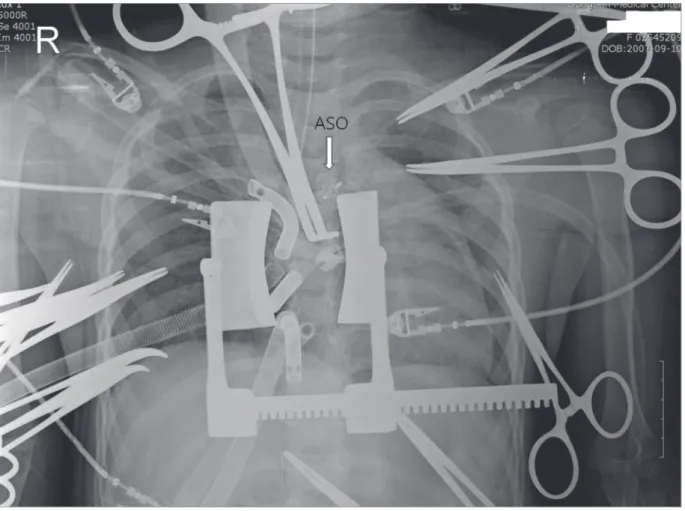
Right atriotomy was performed and the secundum ASD was found to be 7 × 8 mm in size. The rim of the ASD was well marginated. The Amplatzer septal occluder device was not located in left atrium and ventricle. After portable chest X-ray, we found the
Amplatzer septal occlude at ascending aorta between aortic cross clamp and aortic cannula (Fig. 1). After total circulatory arrest, the device was successfully retrieved through aortotomy and the retrieved specimen showed structural integrity of the device (Fig. 2). The ASD was closed with direct. The patient was weaned from cardiopulmonary bypass without difficulty. The patient was then discharged in good condition.
Discussion
Surgical repair was the primary treatment of ASD until 1976, when King and Mills reported the first
Fig. 1. The ASO embolized at ascending aorta between aortic cross clamp and aortic cannula. ASO: amplatzer
septal occlude.
33
The Operative Management of Embolized Septal Occluder at Ascending Aorta
devices should be retrieved by percutaneously [6].
However most of authors believe that an embolized device should always be retrieved surgically because it allows inspection of intracardiac structures that may have become damaged [7]. Also, the device of our case was retrieved surgically as soon as we knew the device dislocation. At operation field, we did inspect an intracardiac structure which was not damaged.
Short-term and mid-term studies have shown the device to be safe and effective. But, information on long-term complications is being collected now [8].
The more transcatheter device was implanted, the more complications were developed. Our experience suggests that this device should only be inserted in hospitals, where cardiac surgical support is immediately available.
References
1. Amin Z, Hijazi ZM, Bass JL, Cheatham JP, Hellenbrand WE, Kleinman CS. Erosion of Amplatzer septal occluder device after closure of secundum atrial septal defects:
review of registry of complications and recommendations to minimize future risk. Catheter Cardiovasc Interv 2004;63:496-502.
2. King TD, Thompson SL, Steiner C, Mills NL. Secundum
atrial septal defect. Nonoperative closure during cardiac catheterization. JAMA 1976;235:2506-9.
3. Mashman WE, King SB, Jacobs WC, Ballard WL. Two cases of late embolization of Amplatzer septal occluder devices to the pulmonary artery following closure of secundum atrial septal defects. Catheter Cardiovasc Interv 2005;65:588-92.
4. Kim YH, Kim H, Kim SJ, Kang JH, Chung WS, Shin JH, et al. Emergent surgical intervention for embolization of atrial septal defect closure device. Korean J Thorac Cardiovasc Surg 2012;45:320-2.
5. Berdat PA, Chatterjee T, Pfammatter JP, Windecker S, Meier B, Carrel T. Surgical management of complications after transcatheter closure of an atrial septal defect or patent foramen ovale. J Thorac Cardiovasc Surg 2000;120:1034-9.
6. Shirodkar S, Patil S, Pinto R, Dalvi B. Successful retrieval of migrated Amplatzer septal occluder. Ann Pediatr Cardiol 2010;3:83-6.
7. Kim JJ, Hijazi ZM. Clinical outcomes and costs of Amplatzer transcatheter closure as compared with surgical closure of ostium secundum atrial septal defects.
Med Sci Monit 2002;8:CR787-91.
8. Knepp MD, Rocchini AP, Lloyd TR, Aiyagari RM.
Long-term follow up of secundum atrial septal defect
closure with the amplatzer septal occluder. Congenit
Heart Dis 2010;5:32-7.