Copyright ⓒ 2013 by the Korean Society of Breeding Science
This is an Open-Access article distributed under the terms of the Creative Commons Attribution Non-Commercial License (http://creativecommons.org/licenses/by-nc/3.0) which permits unrestricted non-commercial use, distribution, and reproduction in any medium, provided the original work is properly cited.
http://dx.doi.org/10.9787/KJBS.2013.45.1.055 Print ISSN: 0250-3360
검정콩 녹색자엽 소립 신품종 ‘소청2호’
백인열1* ・ 한원영1・ 고종민1・ 김현태1・ 전명기1・ 박금룡1・ 이병원1・ 이영훈1・ 하태정1・ 신상욱1・ 심하식1・ 문중경1・ 오기원1・ 강성택1・ 조상균1・ 윤홍태1・ 이승수2・ 손창기3
1농촌진흥청 국립식량과학원, 2충청남도농업기술원, 3경상북도농업기술원
A New Black Seed Coat Soybean Cultivar, ‘Socheong 2’ with Green Cotyledon and Small Seed Size
In Youl Baek
1*, Won Young Han
1, Jong Min Ko
1, Hyun Tae Kim
1, Myeong Gi Jeon
1, Keum Yong Park
1, Byung Won Lee
1, Young Hoon Lee
1, Tae Jung Ha
1, Sang Ouk Shin
1, Ha Sik Shim
1, Joong Kyung Moon
1, Ki Won Oh
1, Sung Taek Kang
1, Sang Kyun Cho
1, Hong Tai Yun
1, Seung Soo Lee
2, and Chang Ki Son
31
National Institute of Crop Science, RDA, Suwon 441-857, Korea
2
Chungnam Agricultural Research & Extension Service, Yesan 340-861, Korea
3
Gyeongbuk Agricultural Research & Extension Service, Daegu 702-708, Korea
Abstract : A new black seed coat soybean variety, ‘Socheong 2’ was developed at the National Institute of Crop Science (NICS) in 2006. ‘Socheong 2’ was selected from the cross between ‘Milyang78’ and ‘Peking’. The preliminary, advanced and regional yield trials for evaluation and selection of this variety were carried out from 2005 to 2009. It has determinate growth habit, white flower, brown pubescence, black pod color, black seed coat, green cotyledon, elongated flattened seed shape, oval leaf shape and small seed size (12.2 grams per 100 seeds). And it has the same maturity as the check cultivar Cheongjakong. ‘Socheong 2’
has better seed quality than that of the check cultivar in isoflavone contents (2,031 ㎍/g), and it has good adaptability for
‘Cheongkugjiang’ and soybean malt. It also has been identified to have resistance to soybean mosaic virus symptom (SMV) which was the troublesome soybean diseases. The average yield of ‘Socheong 2’ was 2.00 ton per hectare in the regional yield trials carried out in five locations of Korea among seven from 2007 to 2009, which was 7 percent higher than that of the check cultivar ‘Cheongjakong’.
Keywords : Soybean, Variety, Socheong 2, Black seed coat, Isoflavone
*Corresponding author (E-mail: [email protected], Tel: +82-55- 350-1210, Fax: +82-55-353-3050)
(Received on July 30, 2012. Revised on March 19, 2013.
Accepted on March 20, 2013.)
서 언
콩의 원산지는 한반도와 만주지역으로 추정되고 있다. 일 반적으로 원산지에는 종의 분화도와 특성 변이 폭이 크며 식 품으로 이용도가 높은데 우리나라에서 검정콩을 대표로 하는 유색콩은 쌀, 맥류, 잡곡 등과 혼합하여 주식으로 이용되거나 자반용으로 주로 이용되어 왔으며, 일부는 떡소, 제과용 및 약 용으로 소비되고 있다. 따라서 새로운 소비 창출을 위해서는
다양한 용도에 적합한 가공적성이 높은 품종 개발이 요구되 고 있다.
콩은 오랜 재배 역사를 통하여 장류, 두부, 콩나물 등의 전 통식품으로 많이 이용되고 있으며, 밥밑용, 떡소 및 떡고물용 등 용도에 알맞은 품종 개발이 필요한 실정이다. 일반적으로 밥밑콩으로 이용되는 콩은 대립이고 당도가 높고 잘 무르는 특성이 중요한데, 밥밑콩은 종피색이 흑색이거나 적갈색인 것 또는 아주까리 콩 등의 유색 품종이 적합하다. 검정콩은 종피 색깔 및 구조, 종실 형태에 따라 선비잡이콩, 아주까리콩, 쥐 눈이콩(서목태), 및 서리태(속청) 등으로 불리며 예로부터 널 리 재배되어 왔고, 지금도 많은 지역 재래종이 존재하고 있다.
특히 혼반용은 종실이 굵고 연질이며 알카리 붕괴도가 높고
Year 1996 1997 1998 1999 2000 2001 2002 2003 2004 2005 2006 2007 2008 2009 Genera-
tion - F
1F
2F
3F
4F
5F
6F
7F
8F
9F
10F
11F
12F
13Milyang 78
× Peking
YS
1262 → Bulk →Bulk → 1 2 3
④
․ 37
→
① 2 3
→
① 2
․ 5
→ 1
․
③
․ 5
→ 1
․
④
․ 10
→ 1
②
․ 3
→ ①
․ 5
→ ①
․ 20
→
Milyang 182
Socheong 2
Remark Cross Pedigee PYT
zAYT RYT
z
PYT: Preliminary yield trial, AYT: Advanced yield trial, RYT: Regional yield trial
Fig. 1. Pedigree diagram of a new black seed coated soybean variety, ‘Socheong 2’.
et al. 1992). 최근 콩의 기능성 성분인 안토시아닌 색소, 아이 소플라본, 올리고당, 사포닌 등은 항암 효과와 골다공증, 심장 질환, 신부전증 등 각종 성인병 예방에 효과가 큰 것으로 보 고되고 있다(Tomomatsu 1994, Barnes 1998, Choung et al.
2001).
최근 건강 기능성 식품으로 검정콩에 대한 소비자의 수요 와 선호도가 증가하고 있으며, 고유 재래종의 만숙성, 쓰러짐, 병해 저항성 등 불리한 재배적 특성을 개선하고 가공적성이 우수한 품종 개발과 농가 보급이 시급한 실정이다. 국립식량 과학원 콩 육종연구팀은 밥밑용 및 제과용 등 용도로 고품질 콩 신품종 육성을 위하여 노력한 결과, 녹색 자엽의 소립 검 정콩으로 숙기 빠른 양질 내재해 다수성 ‘소청2호’를 육성하 였기에 본 품종의 육성 경위와 주요 특성 등 시험한 결과를 보고하고자 한다.
재료 및 방법
본 품종의 생산력검정시험은 2005년부터 2006년까지 2개 년간 국립식량과학원 두류유지작물과 전작포장에서 6월 중순 에 휴폭 60 cm, 주간 10 cm, 1주 2본으로 실시하였다. 지역 적응시험은 2007년부터 2009년까지 3년간 전국의 5개 지역 에서 수행하였고, 검정콩 대비 품종인 ‘청자콩’(Baek et al.
리는 단작 60 × 15 cm, 이모작 60 × 10 cm이다. 입모 후 1 주 2본으로 주수를 조정하였다. 시비관리는 토양을 검정하여 시비하거나, 콩의 표준시비량인 1000 m2당 질소-인산-가리를 3.0-3.0-3.4 kg을 기비로 주었다. 작물학적 주요특성은 성숙 기 등을 조사하였다. 또한, 내병성(콩모자익바이러스, 불마름 병과 검은뿌리썩음병), 내재해성(내습성, 내탈립, 콩나방), 품 질특성(조단백질, 조지방, 경실종자, 수분흡수율, 이소플라본 및 안토시아닌색소 함량과 두부가공적성)의 조사는 농촌진흥 청 신품종개발공동연구사업 계획서의 기준에 의하여 실시하 였다(RDA 2009).
결과 및 고찰
육성경위
‘소청2호’는 기능성분이 우수하고 녹색 자엽의 소립으로 가공적성 우수한 검정콩 품종육성을 목표로, 재래 수집종이며 숙기 매우 늦고 녹색 자엽의 대립 검정콩인 ‘밀양78호’와 조 숙 소립 내병 내도복 도입종인 Peking을 1996년 인공교배하 여 1997년 F1을 양성하였고, 1998부터 2004년도에 포장에서 F2 - F8 세대를 계통육종법으로 선발한 YS1262-2B-4-1-1-3-4-2 -1-1 계통이다. 2005과 2006년도에 실시한 생산력검정시험에 서 내도복 소립 검정콩으로 아이소플라본 함량이 높은 계통
Table 1. Inherent characteristics of ‘Socheong 2’ determined by the regional adaptation yield trial.
Cultivar Growth habit
Flower color
Leaf shape
Pubescence color
Pod color
Seed coat color
Cotyledon color
Seed shape
Socheong 2 Determinate White Oval Brown Black Black Green Elongated flattened
Cheongjakong Determinate Purple Oval Brown Brown Black Green Spherical flattened
Table 2. Agronomic characteristics of ‘Socheong 2’ determined by the regional adaptation yield trial from 2007 to 2009.
Cultivar Flowering date
Maturity date
Stem
Height (cm) No. of nodes Lodging
(0-9)
zNo. of pods Wt. of 100 seeds (g)
Socheong 2 July 31 Oct. 2 56 13 1 39 12.2
Cheongjakong July 28 Oct. 2 66 13 4 26 26.7
z
0: Resistant, 9: Susceptible
Socheong 2 Cheongjakong
Fig. 2. Pictures of the cultivation in the field (left) and comparison of see size (right), ‘Socheong 2’.
으로 유망시 되어 ‘밀양182호’의 계통명을 부여한 후, 2007 년부터 2009년까지 3년간의 지역적응시험을 실시한 결과, 녹 색 자엽의 내도복 소립 검정콩 품종으로 인정되어, 2009년 12월 농작물직무육성 신품종선정위원회에서 신규 품종으로 결정하고 ‘소청2호’로 명명하였다(RDA 2010). 인공교배부터 계통선발, 생산력검정시험과 지역적응시험을 거치는 일련의 육종과정은 Fig. 1과 같다.
주요특성
‘소청2호’는 Table 1에서와 같이 유한신육형 품종으로 꽃 은 백색이고 잎은 난형이며, 모용은 갈색, 성숙기의 협은 흑색 이고 종피색과 제색은 흑색이며, 자엽색은 녹색이고, 입형은 장타원형으로 수확기 협의 자연개열은 잘 되지 않는다(Fig.
2). 개화기는 7월 31일로 대비품종 ‘청자콩’보다 2일 늦고, 성
숙기는 10월 2일로서 ‘청자콩’과 같으며, 경장은 56 cm로
‘청자콩’보다 10 cm 짧고 협수는 39개로 ‘청자콩’ 보다 13개 많았다(Table 2). 100립의 무게는 12.2 g으로 소립종이다.
바이러스 저항성은 콩 모자익바이러스(SMV) 유묘접종 (G7H, G6H, G5) 반응시 국부반응을 나타내었고, 콩 포장에서 모자이크 증상은 경미하였고 괴저반응은 없었다(Table 3). 불 마름병에 대한 유묘 접종 및 포장반응은 ‘청자콩’과 비슷하였 으며, 검은뿌리썩음병 발병정도도 비슷하였다(Table 4).
내습성 인위적 검정에서 ‘청자콩’보다 내습성이 높았고, 협 개열은 약하고 콩나방 피해립율은 ‘청자콩’과 비슷하였다 (Table 5).
‘소청2호’의 조단백 함량은 38.8%로 ‘청자콩’보다 다소 낮 고, 조지방은 18.9%로 ‘청자콩’과 비슷하였다. 경실 종자는 0.5%로 낮고, 수분흡수율은 ‘청자콩’보다 높았다(Table 6).
Table 3. The reaction of ‘Socheong 2’ to the SMV of soybean determined by the regional adaptation yield trial from 2007 to 2009.
Cultivar SMV artificial inoculation
zNatural infection
G7H G6H G5 Mosaic (0-9)
yNecrosis (%)
Socheong 2 L/- L/- -/- 1 0
Cheongjakong -/M -/M -/- 1 0
z
Reaction of inoculated leaf/upper leaves, -: No symptom, L: Local, M: Mosaic
y
0: resistant, 9: susceptible
Table 4. The reaction of ‘Socheong 2’ to the other diseases of soybean determined by the regional adaptation yield trial from 2007 to 2009.
Cultivar
Bacterial pustule
Stem root rot (0-9)
yArtificial inoculation
(0-9)
zNatural infection (0-9)
ySocheong 2 4 1 3
Cheongjakong 4 1 3
z
8ra strain
y
0: resistant, 9: susceptible (2008-2009)
Table 5. The reaction of ‘Socheong 2’ to the water stress and pod borer test determined by the regional yield trial from 2007 to 2009.
Cultivar
Water stress Excess water
(0-9)
zPod shattering (0-9)
zPod borer test (damaged seed, %) Field
test
Oven dry for 72hr at 40℃
ySocheong 2 3 3 3 6.5
Cheongjakong 6 9 5 4.9
z
0: tolerant, 9: susceptible
y
2009
Table 6. Seed component analysis and water absorption of ‘Socheong 2’ determined by the regional yield trial from 2008 to 2009.
Cultivar Chemical components (%) Seed hardness (%)
Water absorption rate (%)
Crude protein Crude oil 2 hr. 6 hr. 12 hr.
Socheong 2 38.8 18.9 0.5 44.9 89.3 127.9
Cheongjakong 40.9 18.4 0.0 46.6 85.8 125.2
Table 7. Comparison of isoflavone contents of ‘Socheong 2’ determined by the regional yield trial from 2007 to 2009.
Cultivar Isoflavon (㎍/g)
Daidzein Glycitein Genistein Total
Socheong 2 652 551 898 2,031
Cheongjakong 375 205 614 1,194
높았다(Table 7). 종피의 안토시아닌 색소함량은 12,847 ㎍/g 낮으나, 청국장 수율 및 풍취에서 좋았다. 메주 가공수율은 다
Table 8. Comparison of anthocyanin contents of ‘Socheong 2’ determined by the regional yield trial from 2008 to 2009.
Cultivar Anthocyanin (㎍/ seed coat g)
zDp3glc Cy3gal Cy3glc Pt3glc Pn3glc Total
Socheong 2 - 144.0 12,435 - 268 12,847
Cheongjakong 5,173 - 10,799 996 - 17,041
z
Dp3glc: Delphinidin-3-glucoside, Cy3gal: Cyanidin-3-galactose, Cy3glc: Cyanidin-3-glucoside, Pt3glc : Petunidin-3-glucoside, Pn3-glc;
Peonidin-3-glucose
Table 9. Cheongkugjiang processabilty and soybean malt of ‘Socheong 2’ determined by the regional yield trial in 2009.
Cultivar
Cheongkugjiang processabilty Soybean Moeju
Degree of fermentation
(1-5)
zYield
(%) Smell (1-5) Degree of
fermentation (1-5)
Yield
(%) Smell (1-5)
Socheong 2 3.2 208 3.6 4.2 55 4.6
Ilpumgeomjeong-kong 3.9 177 3.3 3.8 59 4.1
Taekwangkong 3.3 195 3.3 3.8 77 4.1
z
1: very bad, 2: bad, 3: middle, 4: good, 5: very good
Table 10. Yield of ‘Socheong 2’ on the regional yield trials determined by the regional yield trial.
Location
Socheong 2 (ton/ha, A) Index (A/B 100)
zCheongjakong (ton/ha, B)
2007 2008 2009 Mean 2007 2008 2009 Mean
Daegu 2.12 2.62 - 2.37 121 1.88 2.03 - 1.96
Iksan 2.21 1.66 - 1.94 102 2.16 1.63 - 1.90
Yesan 1.23 2.13 2.14 1.83 110 0.97 1.78 2.24 1.66
Miryang - - 2.41 2.41 107 - - 2.26 2.26
Chilgok 2.12 2.47 - 2.30 92 2.38 2.62 - 2.50
Mean 1.73 2.15 2.28 2.00 107 1.69 1.91 2.25 1.87
z
no significant at the t-test
소 낮으나, 발효 정도 및 풍취에서 ‘일품검정콩’보다 우수하 였다(Table 9).
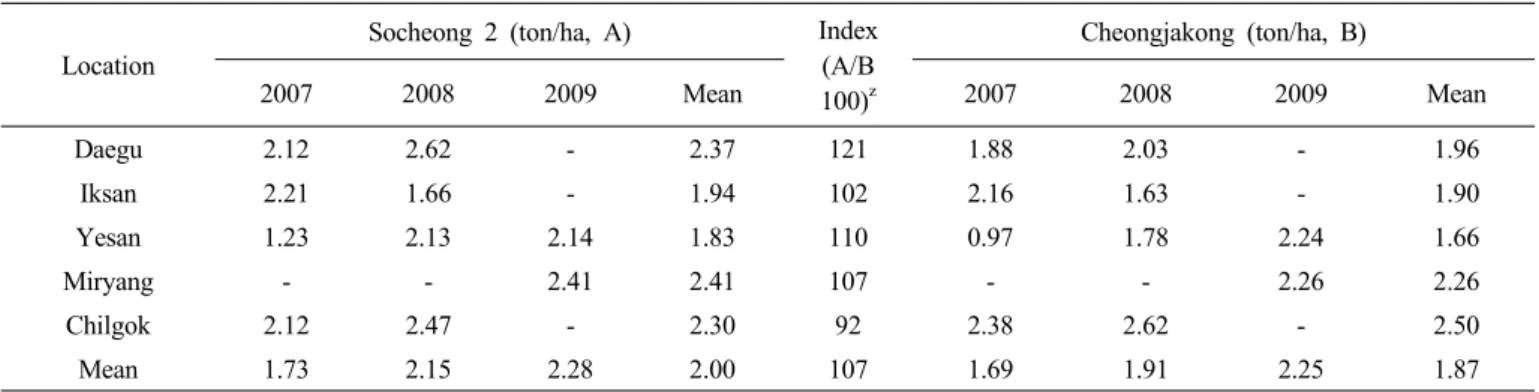
‘소청2호’는 2007년부터 2009년까지 3년간 실시한 지역적 응시험 결과(RDA 2010), 중남부 5개 적응지역의 평균 수량 성은 ha당 2.00톤으로 ‘청자콩’ 1.87톤보다 7% 증수하였다 (Table 10).
‘소청2호’는 콩 모자이크 증상 및 괴저병(SMV-N)에 비교 적 강하고, 적정 파종기는 단작지대는 5월 하순 이후, 2모작 지대는 6월 중하순경으로 조기 파종시 바이러스병이 다소 발 생하며, 도복에는 강하므로 표준재배보다 다소 많이 파종하는 것이 수량 확보면에서 유리하다. 불마름병에는 다소 약하므로 병 발생이 심한 지역은 재배에 유의하여야 한다.
적 요
‘소청2호’는 녹색 자엽의 검정콩으로 내재해성이 우수하고 가공용에 적합한 신품종육성을 목표로 숙기가 매우 늦은 대 립 검정콩인 ‘밀양78호’와 소립 내재해 도입종인 ‘Peking’을 1996년 인공교배한 YS1262 조합으로 계통육종법으로 선발 하였고 계통명은 ‘밀양182호’이다. 꽃은 백색이고 자엽색은 녹색이며, 입형은 장타원형이며 성숙기가 지나면 협의 개열에 는 약하다. 성숙기는 10월 2일로 ‘청자콩’과 같이 다소 빠른 품종이며, 경장은 56 cm로 ‘청자콩’보다 10 cm 짧고 100립 의 무게는 12.2 g인 소립인 품종이다. 도복에 강하며 포장 재 배시험에서 콩모자이크 바이러스병은 다소 발생하였고, 불마
보다 다소 낮았고, 종실의 아이소플라본 함량은 2,031㎍/g으 로 ‘청자콩’보다 높았다. 청국장 가공적성에서 ‘일품검정콩’
보다 발효 정도는 다소 낮으나, 청국장 수율 및 풍취에서 우 수하였다. ‘소청2호’의 중남부지역 5개소의 평균 수량성은 ha 당 2.00톤으로 ‘청자콩’ 대비 7% 증수하였다.
인 용 문 헌