Print ISSN: 2288-4637 / Online ISSN 2288-4645 doi:10.13106/jafeb.2021.vol8.no5.0151
Corporate Governance Mechanisms in Saudi Arabia:
The Case of Family Ownership with Audit Committee Activity*
Sami WAKED 1 , Khaled ALJAAIDI 2
Received: January 15, 2021 Revised: March 21, 2021 Accepted: April 01, 2021
Abstract
This paper empirically examines the relationship between one of the major corporate governance attributes; family ownership and the audit committee activity across a sample of 430 publicly traded firms on the Saudi Stock Exchange (Tadawul) for the period 2012–2019. Using the Pooled OLS regression, this study finds that family ownership is negatively associated with audit committee activity. This study reported that family ownership is negatively associated with audit committee activity, giving support to the convergence-of-interest hypothesis. Therefore, the existence of family ownership as a monitoring corporate governance mechanism substitutes the audit committee activity as another monitoring mechanism. This study provides empirical evidence on the associations of two internal corporate governance mechanisms, namely; family ownership and audit committee activity in the Saudi context where there is a paucity of research in this area. The findings of this study provide a new understanding regarding the extent to which family ownership impacts the activity of audit committees in manufacturing companies. Similarly, the companies’ management, external auditors, bankers, and companies would also benefit from understanding the influential factors of the audit committee activities.
Keywords: Audit Committee Activity, Family Ownership, Saudi Arabia JEL Classification Code: M40, M42
governance and regulating financial reporting; its activities play an important part in the effective governance and risk and control framework (Klein, 2002). The audit committee is also critical in enhancing risk management, external reporting, and internal control procedures of organizations. Similarly, an audit committee acts as an important communication channel facilitating communication between internal auditors, external auditors, and the board (Chau & Leung, 2006). Dey (2008) cited that an active audit committee plays a vital role in sending a positive signal about the quality of an organization’s accounting and financial information, especially when agency costs are high. The committee should assist the board in carrying out its functions relating to the safeguarding of assets, the operation of adequate risk management and control processes and the preparation of financial statements in compliance with all applicable legislation and regulations, and the oversight of the external and external and internal audit appointments and function. Additionally, an active audit committee improves transparency in security markets, which is essential in bettering the protection of shareholders’ interests and enhancing an organization’s book value (Yin et al., 2012; McMullen & Raghunandan, 1996; DeZoort et al., 2002; Bagais & Aljaaidi, 2020; Habtoor et al., 2019; Hassan et al., 2018; Aljaaidi & Bagais, 2021). DeZoort et al. (2002)
*Acknowledgements:
1
This publication was supported by the Deanship of Scientific Research at Prince Sattam bin Abdulaziz University, Alkharj, Saudi Arabia.
1
First Author. Assistant Professor, Accounting Department, College of Business Administration, Northern Border University, Saudi Arabia.
Email: [email protected]
2
Corresponding Author. Assistant Professor, Accounting Department, College of Business Administration, Prince Sattam bin Abdulaziz University, Saudi Arabia [Postal Address: Zayed bin Haretha Street, Al-Salam District, Al-Kharj, Al-Rayadh, 16244, Saudi Arabia]
Email: [email protected]
© Copyright: The Author(s)
This is an Open Access article distributed under the terms of the Creative Commons Attribution Non-Commercial License (https://creativecommons.org/licenses/by-nc/4.0/) which permits unrestricted non-commercial use, distribution, and reproduction in any medium, provided the original work is properly cited.
1. Introduction
The objective of this paper is to examine the association
between family ownership and audit committee activity. The
primary purpose of a company’s audit committee is to provide
oversight of the financial reporting process, the audit process,
the company’s system of internal controls, and compliance
with laws and regulations. The role of the audit committee
forms the cornerstone for effective corporate governance. The
concept of auditing has been central in the debate on corporate
asserted that the frequency of the members’ meeting is primarily implemented as a proxy for the proficiency of the audit committee and to observe certain benefits of the financial reporting for companies with a well-structured audit committee.
The connection between the audit committee and the family ownership can be illustrated by using the convergence- of-interest theory, which indicates that agency Cost decreases in firms that have a significant proportion of insider ownership.
External investors sometimes consider the owner-manager’s behavior as a way of maximizing company value when the owner-manager’s holding is huge. Under such circumstances, there is an occurrence of convergence-of-interest between outside investors and the owner-manager (Feldmann &
Schwarzkopf, 2003; Menon & Williams, 1994; Abbott et al., 2004; Fan & Wong, 2002). Findings revealed that most firms based in Arab still practice concentrated ownership. As such, family involvement and generational ties often impact governance relations as well as agreements, and they form an integral part of economic and political influence. Ownership structure in various Saudi organizations is infiltrated with the dominance of one primary owner. The dominant owner, who is often the founder or an immediate family member, has a huge share (family ownership). The dominant owner is always in the center of the company management. They actively participate in important decision-making procedures directly or indirectly, thereby influencing most of the management decisions. Family control and ownership are common in GCC companies. Due to their success, family firms are considered the backbone of the Gulf region’s economy, accounting for about 80 percent of the non-oil GDP (El-Agamy & Schreibe, 2014; Kolsi & Grassa, 2017).
Empirically, the relationship between the audit committee and family ownership was extensively explored. For example, Chau and Leung (2006) investigated empirically the relationship between three major corporate governance attributes (family shareholding, non-executive directors, and independent chairman) and the existence of audit committees across a sample of 397 publicly traded firms in Hong Kong. The results showed that at a medium level of family shareholding (between 5% and 25%), the convergence-of-interest effect is dominant and the existence of audit committees decreases.
At a high level of family shareholding (more than 25%), the entrenchment effect is dominant and as a result, the existence of audit committees’ increases. Besides, we show that the response of investors to audit committee existence is not dependent upon family shareholding when there is an independent chairman. Al-Musali et al. (2019) reported on the level of audit committee (AC) effectiveness on the top capitalized firms in GCC countries and empirically investigated the hypothesized influence of ownership types on the level of AC effectiveness.
The findings revealed that family, government, and institutional ownership, in addition to board independence, all have a significant positive association with AC effectiveness, and
they serve as a complement to AC effectiveness. On the other hand, Omer et al. (2020) theoretically and empirically provided evidence on the association of the royal family board members, the number of board of directors, and the board of director meetings with the choice of auditor for non-financial listed companies in the Saudi Stock Exchange. This study identified two types of audit firms: (1) Big-4 and (2) Non-Big-4 auditors.
The outcomes of this study have significant implications on the issues surrounding auditor independence in the Saudi Arabian setup. Similarly, Braswell et al. (2012) examination showed a negative association between audit committee meetings and board meetings frequency (Menon & Williams, 1994; Mendez & Garcia, 2007; Raghunandan & Rama, 2007;
Sharma et al., 2009; Greco, 2011; Al-Najjar, 2011; Thiruvadi, 2012; Yin et al., 2012; Maraghni & Nekhili, 2014; Braswell et al., 2012; Aljaaidi et al., 2021a, 2021b; Aljaaidi & Hassan, 2020). The current research studies focus on the developed and developing markets. Moreover, the findings reveal that there is limited evidence from the GCC countries. Also, a number of previous findings have either conflicting results or are documented inconclusively; hence the need to conduct a more empirical investigation regarding the audit committee’s activities. As such, this study aims to expound on the results of the current research studies on the audit committee meeting frequency by adding new pragmatic evidence to the literature of corporate governance using the current data.
The paper is organized as follows. Section two highlights the sample, data, and model of the study. The third section displays the results, tests, and analysis. The final section concludes the study.
2. Sample and Data
This study is based on Saudi manufacturing firms listed on the Saudi Stock Exchange (Tadawul) for the period ranging from 2012 to 2019. This is the most recent period for which data was available at the time of the study. Our final sample comprises 430 firm-year observations. The number of the audit committee meetings, the board size, board meetings, total assets, debts, performance, and age was hand-collected from annual reports available on the website of the Saudi Stock Exchange (Tadawul). The samples selected are depicted in Table 1.
We control for several variables that are evidenced by prior studies to have associations with audit committee Table 1: Sample Selection
Total Observations
Total observations 465
Observations discarded (outliers,
missing and incomplete data) (35)
Final sample 430
meeting activity as a monitoring mechanism, varying based on the level of the agency costs. As for the association of board size and audit committee activity, Al-Najjar (2011) and Maraghni and Nekhili (2014) reported a positive relationship between board size and audit committee meeting frequency.
Regarding the association of board meeting with audit committee activity, Maraghni and Nekhili (2014), Thiruvadi (2012), Raghunandan and Rama (2007) reported a positive association relationship between board meetings and audit committee frequency.
Research studies showed that there is a likelihood of companies with poor performance to experience financial fraud and errors, necessitating the need for effective internal auditing. Other studies considered profitability as a control variable impacting the audit committee meeting frequency (Raghunandan & Rama, 2007; Sharma et al., 2009; Yin et al., 2012). Regarding the association between a company’s age and the audit committee meeting frequency, Evans (1987) postulated that an organization’s age is considered an important factor in its stability and growth in the contemporary business world. Geroski (1995) added that an organization’s age has been largely utilized as a proxy for its experience over a long period in the economic world, which positively impacts its performance. Corporate management has been acquiring significant information regarding skills and capability over the past years (Evans, 1987).
3. Methods
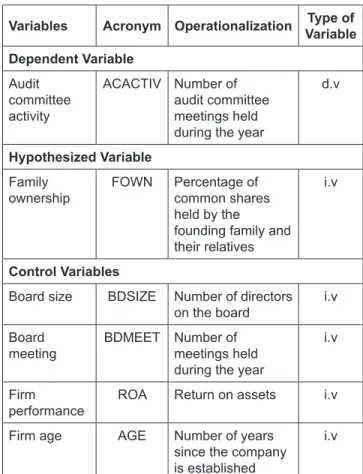
Due to the continuous nature of the dependent variable, Pooled Ordinary Least Square OLS was utilized as the method of analysis to test the hypothesis. The OLS model can be written as follows:
ACACTIV BDSIZE FOWN BDSIZE BDMEET ROA AGE
0 1 2
3 4
5 6