Print ISSN: 2288-4637 / Online ISSN 2288-4645 doi:10.13106/jafeb.2021.vol8.no4.0433
The Effect of Word-of-Mouth on Purchase Intention:
A Case Study of Low-Cost Carriers in Indonesia
Yasintha SOELASIH
1, Sumani SUMANI
2Received: November 30, 2020 Revised: February 20, 2021 Accepted: March 02, 2021
Abstract
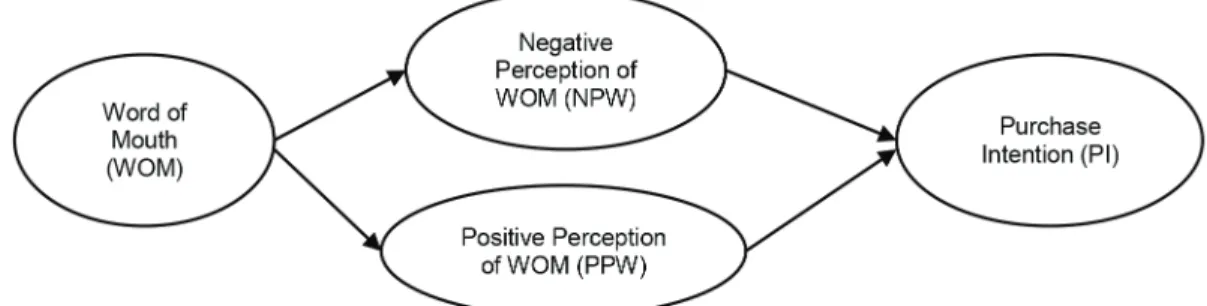
This study aims at testing word-of-mouth (WOM) by mediating positive and negative perceptions of purchase intention on low-cost carriers (LCC) flights in Indonesia. One of the communications mixes that airlines can carry out is WOM. WOM is a form of communication between passengers after using a flight. The formation of a positive perception of WOM is expected by airlines. If a positive perception of WOM has formed, a purchase intention will arise. The study population included LCC flight passengers in Indonesia, involving 387 respondents. For indicators and variables, validity and reliability tests were conducted using CFA, CR, and AVE tools. Sampling locations were Soekarno-Hatta and Kualanamu airports. Sample collection was obtained through purposive sampling, and the analytical tool used was structural equation modeling (SEM) with Lisrel. The results showed that WOM influenced purchase intention through positive and negative perceptions of WOM. It can be seen that a positive perception of WOM has a direct effect, while a negative perception of WOM has the opposite effect. In conclusion, the mediation of perceptions influences purchase intention, whether it in the same direction or the opposite ones. To conclude, WOM is an antecedent for it influences purchase intention.
Keywords: Airlines, LCC, Negative Perception, Positive Perception, Purchase Intention, Word-of-Mouth (WOM) JEL Classification Code: C30, L93, M30, M31
on service quality: full service, medium service, and no-frills service. This research focuses on aviation with the concept of no-frills service in Indonesia or low-cost carriers (LCC).
The flight process, starting from looking for flight information, purchasing tickets, check-in, on-time performance, in-flight and post-flight, these concepts are the same, but what differentiates them at in-flight. The low-cost carrier concept emphasizes simple operations to minimize costs and increase efficiency (Doganis, 2010). These simple operations cause lower operating costs. Lower costs lead to cheap airfare. Apart from simple procedures, there have also been changes to the LCC concept of physical appearance, especially the seats’ distance.
Companies emphasize that the LCC concept needs to pay attention to the value for passengers so that consumers are satisfied and want to reuse. One of the values that need to be considered is on-time performance because this is required for passengers who use air transportation services.
The impact of fair value for passengers can lead to positive word-of-mouth (WOM) and vice versa; if the perceived value is less, it will cause a negative WOM. Companies can design WOM as an antecedent by informing positive values for passengers.
1
First Author and Corresponding Author. Assistant Professor, Management Department, Faculty of Economics and Business, Atma Jaya Catholic University of Indonesia, Indonesia [Postal Address: Jln Jenderal Sudirman No 51 Jakarta, 12930, Indonesia]
Email: [email protected]
2
Assistant Professor, Management Department, Faculty of Economics and Business, Atma Jaya Catholic University of Indonesia, Indonesia. Email: [email protected]
© Copyright: The Author(s)
This is an Open Access article distributed under the terms of the Creative Commons Attribution Non-Commercial License (https://creativecommons.org/licenses/by-nc/4.0/) which permits unrestricted non-commercial use, distribution, and reproduction in any medium, provided the original work is properly cited.