INTRODUCTION
The Chinese bleak, Aphyocypris chinensis (Cy- prinidae), is common in small streams, agricul- tural waterways and ponds in Korea. The Chinese bleak has been selected as a possible test species among the 145 freshwater fishes of Korea becau- se of some advantages of distribution, abundance, adult size and easiness of culturing (Yeom et al., 1999). Only two studies have dealt with the bio- logical characteristics of A. chinensis: Park et al.
(1998) describe the development of egg and larva and Yeom et al. (2000) describe the annual repro- ductive cycle.
In order to develop a new test organism, infor- mation on the reproductive conditions, such as water temperature and photoperiod, for a f ish is needed to develop a culturing method in the laboratory. Most of the studies published on re- productive biology of a f ish were concentrated on determining reproductive cycle, breeding season,
seasonal change of fecundity, ovarian cycling, and length of intervals between spawning events (Taylor and Burr, 1977; Fernández-Delgado and Herrera, 1995; Gale and Buynak, 1982).
In this study, to determine the optimum water temperature of spawning for Chinese bleak, A.
chinensis, we examined the effects of various water temperatures on the spawning, egg pro- ductivity, spawning interval, and hatching rate of Chinese bleak by inducing natural spawning in the laboratory for two months.
MATERIALS AND METHODS
Chinese bleak used in the experiment were ob- tained from the laboratory (Korea Research Ins- titute of Chemical Technology, KRICT)-reared F1 and F2 males and females and were the same age groups (about 6 month old). Before the fish begun breeding, Identification of the sex of fish was nearly impossible using external morpholo-
* Corresponding Author: Tel: 042) 860-7347, Fax: 042) 860-7399, E-mail: [email protected]
─
─ 337 ──
Influence of Water Temperature on Spawning of Chinese Bleak, Aphyocypris chinensis
Yeom, Dong--Hyuk*, Sung--Kyu Lee and Shin--Sok Choi1 (Toxicology Research Center, Korea Research Institute of Chemical Technology,
Daejeon, 305-600 Korea,
1Department of Biology, College of Natural Sciences, Chungnam National University, Daejeon, 305-764 Korea)
Studies were conducted to determine the effects of water temperature on the number of spawning, egg production, spawning intervals and hatching success of Chinese bleak, Aphyocypris chinensis. Adult fish were exposed to water tempera- tures of 19, 22, 25 and 28�C for two months in the laboratory. The spawning number, egg productivity, and hatching rate increased as water temperature increased between 19�C and 25�C. Maximum egg production and hatching rate occurred at 25�C, whereas the spawning intervals decreased as water temperature increased except for the treatment of 28�C. The shortest spawning interval observed at 25�C.
Key words : Chinese bleak, Aphyocypris chinensis, Optimum water temperature, Spawning, Egg productivity
gical characteristics. For this study, the sex of the Chinese bleak was determined by visually abdo- men. At the end of the experiment, sex of the fish was confirmed by observation of gonads. Chinese bleak discharged the eggs in the water regard- less of spawning substrates. Since eggs sank to the bottom of the tank and weakly adhesive, all the spawning tanks had to be covered with a black and transparent acrylic plate substrates (25×16 cm) for easier collection of eggs.
Four groups of fish, each containing five pairs, were bred daily at various temperature ranges.
One group was bred at 19�C. Other groups were bred at 22, 25, and 28�C, respectively. The tem- perature of experimental room was maintained at 19�C and water temperature was controlled by heating the filtered ground water. Each pair of fish was put in a separate spawning tank (25×
32×35 H cm) and was observed through the two months study. Each spawning tank was aerated and filtered using tetra brillant filter (Tetra®, Germany). The fish were maintained on 15 : 9 h light : dark cycle. Fish were fed brine shrimp and tetramine flakes ad libitum 2 times daily.
During the experimental periods, the spawning tanks were checked daily between 9 : 00 and 10 : 30 a.m. Any eggs were removed from the acrylic plates using a soft brush, and then we counted the number of eggs. Then the substrates were placed back to the spawning tanks. The spawned eggs were placed in crystallizing dish (150×75 mm) and incubated at 23~26�C. All dishes were examined for dead eggs and hatched larvae, and the water was aerated weakly using air stone during the incubation period. The spawning inter- vals were recorded as the number of days from the day of one spawning to the day of the next.
The tank with dead fish and same sex were re- moved from group of test water temperature and were not included in our data. Statistical analyses were performed using SYSTAT statistical soft- ware (SYSTAT, 1997).
RESULTS
During the experimental period, fish bred at 25�C showed maximum numbers in spawning.
However, there were no significant differences (ANOVA, p⁄0.05) in the average numbers of spawning among test water temperature groups of 19, 22, 25 and 28�C. The number of spawning increased as the water temperature increased between 19�C and 25�C, although Chinese bleak showed big individual difference in spawning numbers at 19�C and 22�C. Further increase of the water temperature from 25�C to 28�C re- sulted in a decline in number of pair spawning (Table 1).
The number of eggs spawned each time varied considerably among fish of same replicates for all breeding water temperatures. While it is uncom- mon to have 1,182 fertilized eggs deposited at one spawning from a single female, some fish laid only less than 10 eggs at a time. In our study, batch fecundity, number of eggs per spawning, was estimated from naturally spawned eggs. The usual range of batch fecundity was between 110 and 160 eggs regardless of numbers of spawning and water temperatures (Table 1). To test for an effect of number of spawning, and water tem- perature on batch fecundity, Pearson correlation coefficients were calculated. Batch fecundity was not significantly associated with number of spawning act (r =-0.442, df = 14) and water tem- perature of breeding (r =-0.391, df = 14). When the egg productivity of Chinese bleak was esti- mated from naturally spawned eggs, the total yield of eggs laid per pair varied considerably according to water temperature. Based on the to- tal number of eggs released per pair for 60 days, the egg productivity of fish bred at four different water temperatures followed the order: 25�C¤
22�C¤19�C¤28�C (Table 1).
Although the outlier was present, frequency
Table 1. The inf luence of different water temperatures on spawning characteristics of the Aphyocypris chinensis kept under 15 hr light condition for 60 days.
Water temperature No. of pairs No. of spawning/pair Batch fecundity Total No. of eggs/pair
(±1�C) tested Mean Range Mean Range Mean Range
19 4 5.4 2~11 160 4~665 932 508~1,022
22 4 9.3 2~20 135 2~702 1,248 228~2,990
25 3 14.3 12~16 129 12~1,182 1,803 1,262~2,102
28 3 4.3 5~7 110 2~357 587 371~810
distribution of spawning intervals showed a dis- tinct difference in response of fish to various wa- ter temperatures. At 19�C, the frequency distri- bution of spawning intervals ranged predomi- nantly between 4 and 7-day (mean: 8.3 day, Fig.
1A). The distribution of spawning intervals has a strong peak at 2~3 days at 22�C. The spawning intervals were mainly found between 2 and 7 day
and the spawning interval was far shorter than that obtained at 19�C (mean: 4.6 day, Fig. 1B).
Spawning on consecutive days was observed 7 times of 39 spawning at 25�C. The frequency distribution of intervals was consisted predomi- nantly 1, 2, 4, 5, and 7-day intervals, respecti- vely (mean: 4.0 day, Fig. 1C). At 28�C, the fre- quency did not show any particular peak, and was evenly distributed ranging from 1 day to 42 day (mean: 9.7 day, Fig. 1D). The spawning in- tervals of the fish bred at 22�C and 25�C were far shorter than those fish bred at 19�C and 28�C.
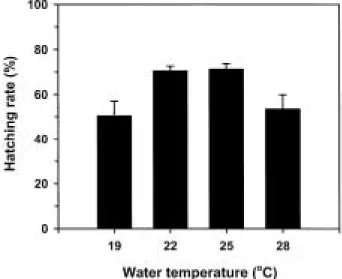
Hatching usually occurred about two days after incubation of eggs at 23~26�C. 100% of the egg mortality occurred 5 times, but average 50% of the eggs succeeded in hatching when the fish were bred at 19�C. The hatching rate of fish bred at 22�C was 70.4% and fish bred at 25�C showed maximum hatching rate (71.2%). The average 47% of the eggs failed to hatch when the fish were bred at 28�C (Fig. 2).
DISCUSSION
Generally, the water temperature for spawning of fish has been determined by investigating monthly changes of goandosomatic index (GSI) and water temperature of sampling site (Taylor and Burr, 1997; Weddle and Burr, 1991; Heins
Fig. 1. Effects of various water temperatures on the spawning interval of Chinese bleak, A. chinensis.
Fig. 2. Effects of various water temperatures on the hat- ching rate of eggs spawned under a 15 hr light: 9 hr dark photoperiod. Columns and bars indicate the means and standard errors.
and Baker, 1989). This method has a limitation in the determination of optimum water tempera- ture for spawning of fish because ranges of opti- mal water temperatures vary highly. Our results also showed that the Chinese bleak, when kept between 19�C and 28�C, is capable of laying eggs.
However, the results of this study demonstrate that the number of spawning, spawning interval, and hatching rate were very different depending on the water temperature of breeding.
The spawning number, egg productivity, and hatching rate increased as water temperature increased between 19�C and 25�C. Maximum egg production and hatching rate occurred at 25�C (Table 1, Fig. 2), whereas the spawning intervals decreased as water temperature increased except for the treatment of 28�C. The shortest spawning interval observed at 25�C (mean: 4.0 day, Fig. 1).
Based on the results, we believe that the opti- mum water temperature for spawning is around 25�C for Chinese bleak.
Sexual development and spawning in cyprinids is modulated both by temperature and photope- riod although temperature is the predominant influence in most species (Potts and Wootton, 1984). In Chinese bleak, we found that the matu- ration of the gonad was initiated by the combina- tion of water temperature of ¤19�C and photo- period of ¤13 hr light condition. The highest spawning number, egg productivity, and egg hat- ching rates are observed under 15 hr light condi- tion (unpublished data). In the zebrafish, Bra- chydanio rerio, it is also demonstrated that the length of the ovarian cycle varies with tempera- ture, and the optimum water temperature for spawning is 25.3~25.7�C (Hisaoka and Firlit, 1962; Eaton and Farley, 1974).
If the Chinese bleak are bred in accordance with its precisely controlled reproductive conditions, viable eggs can be obtained in large numbers throughout the year. Thus, further studies are needed to assure the other reproductive condi- tions and ovarian cycle of the Chinese bleak.
ACKNOWLEDGMENTS
This experiment was funded by Ministry of En-
vironment. We also greatly appreciate valuable suggestions by Dr. Young-Pyo, Hong in the National Science Museum, Daejeon.
REFERENCES
Eaton, R. and R.D. Farley. 1974. Spawning cycle and egg production of zebrafish, Brachydanio rerio, in the laboratory. Copeia. 1: 195-204.
Fernández-Delgado, C. and M. Herrera. 1995. Age structure, growth and reproduction of Rutilus lemmingii in an intermittent stream of the Gua- dalquivir river basin, southern Spain. Hydrobiolo- gia. 299: 207-213.
Gale, W.F. and G.L. Buynak. 1982. Fecundity and spawning frequency of the fathead minnow- A fractional spawner. Transaction of the American Fishery Society. 111: 35-49.
Heins, D.C. and J.A. Baker. 1989. Growth, popula- tion structure, and reproduction of the percid fish Percina vigil. Copeia. 1989: 727-736.
Hisaoka, K.K. and C.F. Firlit. 1962. Ovarian cycle and egg production in the zebrafish, Brachydanio rerio. Copeia. 1962: 788-792.
Park, D.S., D.H. Yeom and S.S. Choi. 1998: Develop- ment of eggs and larvae of Aphyocypris chinensis GüNTHER (Cyprinidae:Leuciscinae) Reared in the laboratory. Korean Journal of Environmental Biology. 16(3): 245-251.
Potts, G.W. and R.J. Wootton. 1984. Fish reproduc- tion: strategies and tactics. Academic Press, London, pp 410.
SYSTAT, 1997: New statistics, Version 7.0 edn. SPSS Inc. Chicago, IL, pp. 303.
Taylor, C.A. and B.M. Burr. 1977. Reproductive bio- logy of the northern starhead topminnow, Fundu- lus dispar (Osteichthyes: Fundulidae), with a review of data for freshwater members of the genus. Am. Midl. Nat. 137: 151-164.
Weddle, G.K. and B.M. Burr. 1991. Fecundity and dynamics of multiple spawning in percids: an in- stream study of Etheostoma rafinesquei. Copeia.
1991: 419-433.
Yeom, D.H., S.K. Lee and S.S. Choi. 2000. Reproduc- tive cycle of the Chinese bleak, Aphyocypris chi- nensis. Korean J. Limmol. 33(4): 395-404.
Yeom, D.H., Y.P. Hong, S.K. Lee and S.S. Choi. 1999.
Selection of candidate fish for developing indi- genous toxicity testing fish. Korean J. Limmol. 32 (2): 162-171.
(Received 3 Nov. 2001, Manuscript accepted 1 Dec. 2001)
⁄ ¤
왜몰개( Aphyocypris chinensis )의 산란에 미치는 수온의 영향
염 동 혁*∙이 성 규∙최 신 석1
(한국화학연구원 안전성연구센터, 1충남대학교 자연과학대학 생물학과)
왜몰개, Aphyocypris chinensis의 산란에 미치는 수온의 영향을 알아보기 위하여, 19, 22, 25, 28�C 수온에서 2개월 동안 사육을 하면서 산란횟수, 생산된 총 수정란 수, 산란간격 및 부화율 등을 조 사하였다. 19�C와 25�C 사이에서는 수온이 증가하면 할수록 산란횟수, 생산된 총 수정란 수 및 수 정란의 부화율이 증가하여 25�C에 노출된 암컷과 수컷에서 가장 많은 산란횟수, 난 생산 및 부화 성공률과 가장 짧은 산란간격을 나타냈다. 그러나 28�C에서는25�C 보다 수온이 증가했음에도 오 히려 4개의 실험수온 중에서 가장 적은 산란횟수, 난 생산 및 부화율과 가장 긴 산란간격을 나타 냈다.