A Comparative Study on the Efficacy of Zea mays L. Extracts as a Natural Ingredient in Cosmetics
Hye-Jin Kwon
Professor, Dept. of Chemical Engineering, Soongsil University
화장품 천연원료로서 옥수수잎 추출물의 효능 비교연구
권혜진
숭실대학교 화학공학과 교수
Abstract In this study, Zea mays L., which were discarded after harvesting in Korea, were collected and used for experiment. The Zea mays L. were dried in the shade and ground before being extracted using two solvents.
Subsequently, DPPH, ABTS, the total flavonoid content and the total polyphenol content were measured to analyze antioxidant activity. The diameter of clear zone was measured by using the paper disc diffusion method. The results showed that the ethanol extract had a slightly higher antioxidant and antibacterial activity. The total polyphenol content was measured using gallic acid as standard, and CE(ethanol extract) was found to contain 31.2±5.2 ㎎ GAE/g of polyphenols, indicating a considerably high activity. When DPPH radical scavenging ability was measured, CE was found to have 4.6±0.9%, 6.4±0.5%, 22.9±0.6% and 83.2±0.2% at different concentrations of 1 ㎍/mL, 10 ㎍/mL, 100 ㎍/mL, and 1,000 ㎍/mL, respectively, with a dependent tendency at the concentration of 1,000 ㎍/mL and a considerably high activity at the concentration of 1,000 ㎍/mL. This study is expected to be used as preliminary data to develop new natural antioxidant, antibacteria raw materials, as only little research has been undertaken on Zea mays L., which are mostly discarded after harvesting, while many studies have been so far conducted on corn and corn silks.
Key Words : Zea mays L, Corn, Corn leaf, Antioxidant, Antibacteria
요 약 국내에서 재배되는 옥수수의 수확 후 버려지는 잎을 수거하여 음건하고 분쇄 한 후 실험에 사용하였다. 두 가지 용매로 추출 후 DPPH, ABTS, 총 플라보노이드 함량, 총 폴리페놀 함량을 측정하여 항산화 활성을 분석하고, Paper disc diffusion method 로 clear zone의 직경을 측정 하였다. 그 결과 에탄올 추출물이 모든 항산화활성과 항균활성에서 다소 높은 결과를 나타내었다. Gallic acid를 표준물질로 하여 총 polyphenol 함량을 측정한 결과 CE는 31.2±5.2 ㎎ GAE/g로 높은 활성 을 보였고, DPPH radical 소거능 측정 결과 CE는 1, 10, 100, 1,000 (㎍/mL) 농도에서 각각 4.6±0.9%, 6.4±0.5%, 22.9±0.6%, 83.2±0.2%로 나타나 농도 의존적 경향을 보였으며 1,000 (㎍/mL)에서는 매우 높은 활성을 보였다. 지금까지 옥수수와 옥수 수 수염에 대한 연구는 많지만 페기 되는 잎에 대한 연구는 없어 본 연구가 새로운 천연 항산화, 항균 효능을 가진 원료 개발의 기초 자료가 될 것으로 판단된다.
주제어 : 옥수수학명, 옥수수, 옥수수잎, 항산화, 항균
*This research was supported by 2018 Basic Science Research Program through the National Research Foundation of Korea funded by the Education, Science and Technology. (No.2018008274)
*Corresponding Author : Hyel-Jin Kwon([email protected]) Received July 26, 2018
Accepted September 20, 2018
Revised August 20, 2018 Published September 28, 2018
1. INTRODUCTION
A huge number of cosmetics with functional materials have been released in the market, with only a few of them satisfying consumers [1]. The demand for natural ingredients is still high after a series of recent incidents related to synthetic compounds and artificial bleach. Although research on various natural materials has been performed to develop new cosmetics materials, only a few materials can be commercialized because many requirements should be met for the commercialization. Even natural materials already developed require further research, given the formulation and percutaneous absorption [2].
Developing natural functional materials, which are differentiated and advanced, requires securing a variety of related technologies. Also important are the methods to discover such materials and mass production technologies. In this sense, utilizing discarded produce or crop can be one way [3].
Corn (Zea mays L.) is among the world's three major food crops along with rice and wheat. Corn farming area is about 159 million hectares in the world, and the world’s corn production amounts to 819 million tons a year and continues to increase. All parts of corn, from the stalk to the silk, are used as energy, industrial materials, pharmaceutical raw materials and the like in various fields [4]. Corn silk is known to have diuretic effect, circulation effect, hypoglycemic effect and cholagogue/hemostatic effect, and thus is used to treat nephritis, hypertension, diabetes, ascites due to cirrhosis, icteric hepatitis, cholecystitis, cholelithiasis, ulorrhagia and purpura hemorrhagica. Corn silk has a strong diuretic effect and treats urinary infections, such as bladder infection and urethritis. Corn silk also has been reported to help maintain and regain normal urination, thus lowering blood pressure [5]. In addition, it has a good efficacy for symptoms (cholecystitis, cholelith, icteric hepatitis, cholecystitis) of body swelling due to liver diseases [6]. In the reality, only some parts of corn crops are used as raw materials or stockfeed after harvesting, and other parts are
incinerated. Various studies on corn silk and stalk have been conducted, however, only little research on corn leaf has been carried out. In this regard this study intended to evaluate the possibility that corn leaf, which is discarded in bulk every year, can be used as natural cosmetic materials by analyzing its antioxidant and antibacterial activity.
2. MATERIALS AND METHODS
2.1 Sample Extraction and Experiment Materials
The corn leaves used in this experiment were obtained after harvesting corn in Jecheon, Korea. They were ground and dried to contain less than or equal to 40% moisture to produce the corn leaf distilled water extract (CD) and the corn leaf ethanol extract (CE).
Hot water extraction was performed at 60℃ for 24 hours, by placing 50 g of corn leaf power and 1 L of sterile distilled water into a 2 L Erlenmeyer flask and wrapping the flask with aluminum. And 80% ethanol extraction was performed at 60℃ for 24 hours, by placing 50 g of corn leaf power and 1 L of sterile distilled water into a 2 L Erlenmeyer flask and wrapping the flask with aluminum. The extraction yield is 28.7% for CD and 29.3% for CE.
2.2 Measurement of the Total Polyphenol Content
CD and CE of 1 mL each at a concentration of 1 ㎎ /mL were added with 0.5 mL of 50% Foiln-Ciocalteu's phenol reagent, and the resulting mixtures were allowed to react at room temperature for 3 minutes.
The reacting solutions were mixed with 1 mL of
Na
2CO
3saturated solution and 7.5 mL of distilled water
in sequence. The resulting mixtures were left to stand
for 30 minutes, followed by 10 minutes of
centrifugation at 14,000 g. Then the supernatants were
taken to measure the absorbance at the wavelength of
760 nm. The total phenol content was measured
according to the calibration curve plotted by using gallic acid as standard.
2.3 Measurement of the Total Flavonoid Content
CD and CE of 1 mL each at a concentration of 1 ㎎ /mL were mixed with 0.9 mL of 80% ethanol. And the resulting mixtures of 0.5 mL were added with 10%
aluminium nitrate, 0.1 ㎖ of 1M potassium acetate and 4.3 mL of 80% ethanol to be left at room temperature for 40 minutes. The absorbance was measured at the wavelength of 415 nm and the content was measured through the standard curve plotted by using quercetin as standard.
2.4 Measurement of DPPH Radical Scavenging Ability
The extracts were diluted to concentrations of 1㎍
/mL, 10 ㎍/mL, 100 ㎍/mL and 1,000 ㎍/mL. And 150 µL of 0.2 mM DPPH solution dissolved in ethanol was mixed with 100 µL extracts diluted at each concentration. The resulting mixtures were allowed to react at 37℃ for 30 minutes. The absorbance was measured at the wavelength of 517 nm. To obtain the correction value, the control group of the sample was added with distilled water while ethanol was added in the control group for DPPH solution.
2.5 Measurement of ABTS Radical Scavenging Ability
The extracts were diluted to concentrations of 1㎍
/mL, 10 ㎍/mL, 100 ㎍/mL and 1,000 ㎍/mL. The ABTS radical cation (ABTS·+) was produced by reaction of 7.4 mM ABTS (2,2–azino–
bis-(3-ethylbenzothiazoline-6-sulfonic acid)) with 2.6 mM potassium persulfate and allowing the mixture to stand in dark for a day before use. The ABTS·+
solution was diluted to have an absorbance of up to 1.5 at 732 nm The 150 µL of diluted ABTS·+ solution was mixed with 5 µL of each extract. The mixtures were
allowed to react at room temperature for 10 minutes and the absorbance was measured at the wavelength of 732 nm. As for the antioxidant capacity, ABTS radical scavenging ability was represented in percentage against the control group of distilled water.
2.6 Measurement of Antibacterial Activity The four strains released from Korea Research Institute of Bioscience & Biotechnology Propionibacterium acnes (P. acnes 3314), Staphylococcus aureus(S.
aureus) gram-positive bacteria and Pseudomonas aeruginosa(P .aeruginosa), Escherichia coli(E. coli) gram-negative bacteria. The antimicrobial activity was measured as a. Paper disc diffusion method of clear zone size.
2.7 Statistical Processing
The results of the experiment were processed statistically using unpaired student's T-test in SPSS 18.0 and ANOVA. Statistical significance was tested at p<0.05, p<0.01 and p<0.001.
3. RESULTS AND DISCUSSION
3.1 Total Polyphenol Content
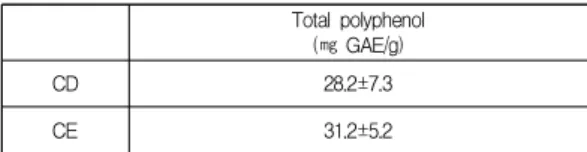
Gallic acid was used as a standard. The total polyphenol contents of CD and CE were measured as 28.2 ± 7.3 mg GAE/g and 31.2 ± 5.2 mg GAE/g, respectively. Polyphenol content was higher in CE than in CD (see Table 1).
Total polyphenol (㎎ GAE/g)
CD 28.2±7.3
CE 31.2±5.2
Table 1. Total Polyphenol Contents of CD and CE
3.2 Total Flavonoid Content
Quercetin was used as a standard. Total flavonoid
contents in CD and CE were measured to be 8.8 ± 0.4
㎎ / g for CD and 16.0 ± 1.3 ㎎ / g for CE. flavonoid content was higher in CE than in CD (see Table 2).
Polyphenols are one of the secondary metabolites widely distributed throughout the plant kingdom.
Polyphenols, aromatic compounds containing phenolic hydroxyl functionalities, are biologically active and known to have antioxidant and anticancer effects when combined with protein and other macromolecules.
Flavonoids, a generic term for phenolic compounds, are phenyl benzo-γ-pyrone derivatives. Flavonoids have excellent antioxidant effects and stress preventive effects and are found mainly in flowers, fruits, stems and roots of plants [7,8].
It has been reported that in general, corn silks contain a large amount of various antioxidant substances [9]. According to the study by Ju Jong-chan (2006) [10] on antioxidant activity of hot water extracts from medicinal plants, corn silks contain 2.81±0.05 mg/100 g of polyphenols and 1.93±0.02 mg/100 g of flavonoids. It can be seen that corn silks contain a slightly larger amount of antioxidant substances than corn leaves. Lee Hee-bong (2006) [11], in his study on the antioxidant activity of colored corn, confirmed that yellow, purple and black corn show higher antioxidant activity than colorless corn, in the same way as green and yellow vegetables contain a lot of antioxidants.
As the consumption of corn grows rapidly along with the increase in the consumption of green and yellow vegetables, colored corn and produce, various research on corn has been conducted in Korea and abroad [12]. In recent years, more studies are carried out on the use of corn silk, after several studies confirmed that corn silks can be used as functional cosmetic materials [13]. However, few studies have been undertaken on the use of corn leaves, which are mostly discarded after harvesting. The results of this study suggest the possibility that corn leaf extract may be used as cosmetic materials with antioxidant activity.
Total flavonoid (㎎/g)
CD 8.8±0.4
CE 16.0±1.3
Table 2. Total Flavonoid Contents of CD and CE
3.3 DPPH Radical Scavenging Ability
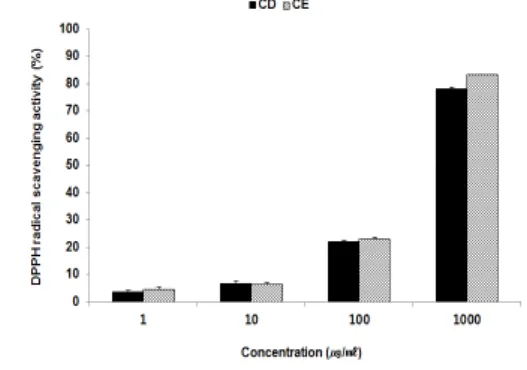
The DPPH radical scavenging activity of CD and CE was measured as 3.6 ± 0.6%, 6.7 ± 0.8%, 21.9 ± 0.4%
and 78.2 ± 0.5% at the concentrations of 1, 10, 100 and 1,000 ㎍ /mL , And CE was 4.6 ± 0.9%, 6.4 ± 0.5%, 22.9
± 0.6%, and 83.2 ± 0.2% at concentrations of 1, 10, 100, and 1,000 μg / mL, respectively. Both CD and CE showed a concentration dependent DPPH radical There was an increase in curl scavenging ability (see Fig. 1).
Fig. 1. DPPH radical scavenging activity of CD and CE. CD and CE were incubated at 1, 10, 100, and 1,000 ㎍/mL with DPPH solution for 30 mins. Activities were determined by measurement of absorbance at 517 ㎚. The results were expressed as mean ± S.D from three independent experiments.
3.4 ABTS Radical Scavenging Ability
Antioxidant activity was measured using ABTS radical cation. This method is based on the ability of antioxidants to decolorize ABTS radical cation, a blue/green chromophore, which is created through the reaction with potassium persulfate [14]. It has been known that the phenolic compound content is proportionally correlated with ABTS free radical scavenging activity.
Antioxidant activity can be measured in both
hydrophilic and hydrophobic materials [15].
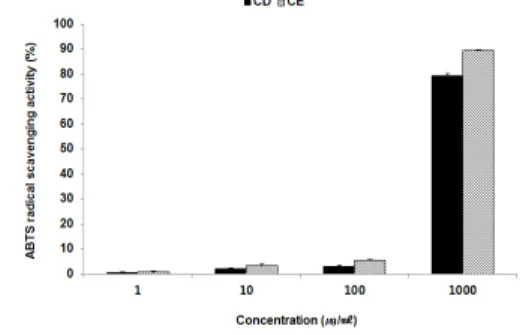
The ABTS radical scavenging activity of CD and CE was 0.5 ± 0.1%, 2.2 ± 0.2%, 3.0 ± 0.6%, and 79.3 ± 0.8% at 1, 10, 100 and 1,000 ㎍/mL respectively The concentration of CE was 0.7 ± 0.2%, 3.1 ± 0.9%, 5.4 ± 0.5%, and 89.4 ± 0.4% at concentrations of 1, 10, 100 and 1,000 μg/mL Curl scavenging ability increased (see Fig. 2).
Fig. 2. ABTS radical scavenging activity of CD and CE. CD and CE were incubated at 1, 10, 100, and 1,000 ㎍/mL with ABTS solution for 10 mins. Activities were determined by measurement of absorbance at 732 nm. The results were expressed as mean ± S.D from three independent experiments.
3.5 Measurement of Antibacterial Activity A total of 4 strains consisting of P. acnes 3314, S.
aureus, (gram-positive bacteria) and P. aeruginosa, E.
coli (gram-negative bacteria) were extracted, and the MIC of each extract at a 0.1% concentration is shown in Table 3. Both CD and CE displayed the highest antibacterial activity against E. coli among the four strains. But the antibacterial activity of corn leaf was found to be relatively low against other strains.
Consequently, further studies may need to experiment with different concentrations and extraction methods.
Sample P. acnes 3314
S.
aureus
P.
aeruginosa E. coli
CD + + + +
CE + + + ++
- : not detected, + : less than 1.5 mm ++ : 1.5~3 mm, +++: more than 3 mm