840
Copyright © 2014 The Korean Society of Fisheries and Aquatic Science pISSN:0374-8111, eISSN:2287-8815
서 론
총암모니아성질소
(TAN, total ammonia nitrogen)
는양식생물에의해배설되는주요질소대사산물이며
(Colt and Arm-
strong, 1981; Foss et al., 2004),
수중용존산소가충분할경 우어류의생존과생산성에영향을주는첫번째제한요인이다(Park, 2005).
암모니아는어체에축적되어유독성을나타내는데
(Randall and Wright, 1987; Paust et al., 2011),
단기증상으 로는아가미호흡의증가,
불규칙한움직임,
평형감상실,
먹이 섭취의감소(Meade, 1985; Russo and Thurston, 1991)
등이나 타날수있으며,
만성적으로노출될시에는성장감소(Lang et al., 1987),
중추신경계의손상(McKenzie et al., 1993)
및폐사 에이르게된다(Ip et al., 2001).
돌돔은남해안에서해상가두리와육상수조식으로주로양식
하고있는온수성어류로
,
적정수온이20℃
이상이라서(Kim,
2011),
동절기저수온에서는생존율이낮은문제가있기때문에
(Kang et al., 1998; Oh et al., 2006),
동절기에돌돔의생산 성을높이기위해서육상양식장에서는가온을실시하여사육 하기도한다.
이럴경우에는에너지비용이경영상부담이될수 가있으므로,
에너지절약형사육시스템의도입이필요한데,
순 환여과시스템은다양한수처리시설을이용하여물을지속적으 로재사용하는생산시스템으로외부로빠져나가는열에너지를 최소화하여난방효율을극대화시킬수있어(Suh et al., 2001),
돌돔의육상수조식양성에서는매우적합한시스템이다(Kim,
2011).
또한환수를최소한으로조절하므로써외부환경에대한간섭을적게받을수있고유입되는질병의원인을사전에차 단할수있다는장점이있어세계적으로도관심을모으고있다
(Van Rijn, 1996).
사육수의 암모니아 농도가 돌돔(Oplegnathus fasciatus)의 성장과 혈액성분에 미치는 영향
박성덕ㆍ김병기
1ㆍ전중균*
강릉원주대학교 해양생물공학과, 1강원도립대학 해양생명과학과
Effect of Ammonia Concentration in Rearing Water on Growth and Blood Components of the Parrotfish Oplegnathus fasciatus
Seongdeok Park, Pyong Kih Kim
1
and Joong-Kyun Jeon*Department of Marine Biotechnology, Gangneung-Wonju National University, Gangneung 210-702, Korea
1
Department of Marine Bio-Science, Gangwon Provincial College, Gangneung 210-804, Korea
This study investigated growth and hematological changes in parrotfish Oplegnathus fasciatus (~200 g/fish) reared under different total ammonia nitrogen (TAN) concentrations (0, 4, or 8 mg/L) for 6 weeks. Survival rates of par- rotfish in all experimental groups did not significantly differ, as they were all ~100%. Although specific growth rate (SGR), weight gain, and daily feed intake in the high TAN concentration group (TAN8) were significantly lower than in the other two groups, there was no significant difference between the TAN4 group and the control group, (TAN0), indicating that parrotfish have a strong resistance to ammonia toxicity. As for temporal changes of the major blood components, cortisol increased as a result of stress caused by the high ammonia concentration in the TAN8 group. For this reason, the concentrations of energy sources such as glucose and total cholesterol were reduced. However, there was little difference among all experimental groups in concentrations of liver function glutamic oxaloacetic trans- aminase (GOT) and glutamic pyruvic transaminase (GPT), and nutrient factors, such as total protein and albumin.
Key words: Oplegnathus fasciatus , Parrotfish, Total ammonia nitrogen, Growth, Blood chemistry
This is an Open Access article distributed under the terms of the Creative Commons Attribution Non-Commercial Licens (http://creativecommons.org/licenses/by-nc/3.0/)which permits unrestricted non-commercial use, distribution, and reproduction in any medium, provided the original work is properly cited.
http://dx.doi.org/10.5657/KFAS.2014.0840 Kor J Fish Aquat Sci 47(6) 840-846, December 2014
Received 28 November 2014; Revised 8 December 2014; Accepted 8 December 2014
*Corresponding author: Tel: +82. 33. 640. 2412 Fax: +82. 33. 640. 2955
E-mail address: [email protected]
다만
,
순환여과시스템은양식생물의최적성장을위한적절 한수질관리가필요하므로, TAN
과같은대사산물은수중으로 부터신속하고효과적으로제거되어야한다.
따라서본연구에 서는돌돔을순환여과시스템에 적용하여 생산하는데 필요한TAN
농도기준을제시하고자TAN
농도에따른돌돔의성장 과혈액학적특성을조사하였다.
재료 및 방법
사육시스템 및 수질
실험에는
Park et al. (2013)
과동일한규격(
총수량4,500 L)
의독립된3
개의순환사육시스템을활용하였고,
실험기간중의 수온,
용존산소(DO, dissolved oxygen),
염분및pH
측정은하 루두차례(09:00, 17:00)
의사료공급30
분후에다항목수질측 정기(YSI 556MPS, USA)
로측정하였으며, TAN
는분광광도 계(HACH DR 4000U, USA)
로매일1
회측정하였다.
어류에 게유독한비이온화암모니아(NH
3, UIA)
의농도는Johansson and Wedborg (1980)
에따라계산하였으며,
실험기간동안의 수질은Table 1
과같다.
실험 어류 및 암모니아 주입
경상남도통영의가두리에서사육중인약
200 g
의돌돔을구 입하여실험에이용하였다.
수조(1.0 m×1.0 m×1.0 m)
별로100
마리씩(
사육밀도33 kg/m
3) 3
반복으로수용하였고, 6
주간 해산어류용상품사료(
우성사료,
조단백43.5±0.6%,
조지질11.8±0.1%)
를일간2
회(09:00, 17:00)
만복공급하였다.
용존 산소(DO)
의공급은산소발생기(OXUS Aqua-7L, Korea)
를이용하여포화도
80%
이상으로유지하였고,
산소포화도는휴대용
OxyGuard (OxyGuard A/S, Birkerød, Denmark)
로매일아 침마다측정하여확인하였다.
실험
TAN
농도는사전예비실험을통하여사료섭취량이평상시의
70%
이하로떨어지는약8 mg/L
를기준으로하여, 0 mg/L (
대조구), 4 mg/L (TAN4)
및8 mg/L (TAN8)
의3
구간 을설정하였다.
그리고시스템내암모니아의 주입은별도의
150 L
암모니 아탱크에NH
4Cl
수용액(TAN4
는10%, TAN8
는20%)
을넣 고,
정량펌프(AX1-32-PFC-HWS-K, Korea)
를이용하여시스템의
sump
에90 mL/min
속도로주입하였다.
암모니아용액은 매일새로만들어20:00
에탱크청소후재주입하였으며, sump
에공급된암모니아는포말분리기와여과조를거쳐사육수와 충분히혼합된후사육수조로들어가도록설계하였다.
환수량 은7 L/min
으로설정하여,
시스템별일간약2.2
회의환수가되 도록하였다.
성장 및 혈액성분 조사
TAN
농도에따른돌돔의성장을조사하기위해실험시작전,
2
주, 4
주및6
주후에돌돔을계측하였고,
이때실험구마다15
마리씩(
수조별5
마리)
총45
마리를무작위로선택하여미부동 맥에서채혈하여실험에사용하였다.
혈액은냉장고에서3
시 간방치하고응고시킨뒤원심분리(3,000 rpm, 10 min)
하여상 등부의혈청(serum)
을분석에이용하였다.
코티졸(cortisol)
분 석은Jeon et al. (2000)
의방법으로하였으며,
총단백질(total protein),
알부민(albumin),
포도당(glucose),
총 콜레스테롤(total cholesterol), glutamic oxaloacetic transaminase (GOT), glutamic pyruvic transaminase (GPT)
는Cobas Integra 800 analyzer (Roche Diagnostics, USA)
로측정하였다.
통계처리
본실험에대한결과는
mean±S.D.
로나타내었고, SPSS ver.
10.0
프로그램을사용해ANOVA
로검증한후, P<0.05
수준에 서Duncan’s multiple range test
로유의성비교를하였다.
결 과
TAN 농도에 따른 돌돔의 성장
TAN
농도에따른돌돔의성장결과를Table 2
에나타내었다
.
실험기간 동안TAN
농도에따른 생존율차이는없었다(P>0.05).
최초200 g
내외의돌돔이실험종료시점인6
주후 에는 대조구, TAN4
및TAN8
실험구에서 각각245.4±1.6, 242.4±6.7
및238.5±5.3 g
으로 성장하여 증중량은TAN8
실험구가 대조구보다유의하게낮았다(P<0.05).
그리고돌돔 의일간성장률은TAN8
실험구가대조구와TAN4
실험구보다 유의하게낮았고(P<0.05),
일간사료섭취율은TAN4
및TAN8
실험구가 대조구보다 유의하게 낮았으나(P<0.05), TAN4
와Table 1. Water environment for the experiment Water temp.
(℃) Dissolved oxygen
(DO; mg/L) Salinity(psu) pH Total ammonia
nitrogen (TAN; mg/L)
Un-ionized ammonia (UIA; mg/L)
Control 22.17±2.34 7.57±0.45 32.37±0.61 8.09±0.61 0.08±0.06 0.004±0.003
TAN4 22.12±2.28 7.26±0.22 32.38±0.61 7.92±0.18 3.61±1.50 0.129±0.054
TAN8 22.07±2.15 7.39±0.31 32.44±0.64 7.82±0.19 8.07±2.85 0.231±0.081
TAN, total ammonia nitrogen; TAN4, TAN concentration of 4 mg/L; TAN8, TAN concentration of 8 mg/L.
TAN8
실험구사이에는차이가없었다(P>0.05).
TAN 노출에 따른 돌돔의 주요 혈액성분 변화
돌돔의사육중주요혈액성분의변화는
Fig. 1
과같다.
우선,
스트레스지표인혈중코티졸의농도는실험시작시
5.6 μg/dL
였으나
,
대조구와TAN4
실험구는2
주후에각각1.8 μg/dL
과2.5 μg/dL
로차이가없었고,
이런경향은4
주와6
주후에도변 함이없었다.
그러나TAN8
실험구에서는2
주후에10.2 μg/dL
로다른두실험구와유의적인차이를보이면서급상승했다가,
4
주후에도비록낮아지긴했지만여전히두실험구와유의적인차이를보였고
, 6
주후에는1.2-1.5 μg/dL
로실험구간에차 이가없었다.
주요영양성분인알부민의농도는실험시작시
1.0 g/dL
에서2
주후0.8 g/dL
수준으로모든실험구에서낮아졌다가,
이후에 는증가경향을보였다.
그리고4
주후에는0.9 g/dL
수준으로 증가하긴했으나실험구간에유의적인차이를보이진않았고, 6
주후에는TAN8
실험구에서1.1 g/dL
로상승하여대조구와TAN4
실험구(0.9 g/dL)
에비해유의적으로높았다(P<0.05).
그리고총단백질의변화패턴도이와유사하였다
.
또다른에너지원인포도당농도는대조구에서는실험기간 동안
42-43 mg/dL
로큰변화폭을보이지않았으나, TAN4
실험구는
23-36 mg/dL, TAN8
실험구에서는10-32 mg/dL
로대 조구에비해유의하게낮았다.
총콜레스테롤농도에서는두암 모니아실험구에서는4
주후까지는대조구에비해낮은농도였 으나, 6
주후에는대조구와차이를보이지않았다.
GPT
활성은실험시작시2.2 IU/L
에서2
주차에는실험구 별로2.2-3.0 IU/L
수준이었고, 4
주차에는전반적으로세실험 구모두약간증가한후6
주차에는다시낮아지는공통된경향 을보였으며,
실험기간중실험구간에유의적인차이는없었 다(P>0.05).
그러나GOT
활성은6
주차에고암모니아실험구(TAN8)
가다른두실험구에비해유의적으로높았다(P<0.05).
고 찰
순환여과시스템은주로담수어류를중심으로발전되어왔으 며
(Park, 2005),
특히북유럽에서는순환여과양식을뱀장어양 식에도입하여유럽에서의뱀장어총생산량의절반이상을담 당하고있다(FFI, 1996).
하지만해수의경우염분으로인한질 산화효율의감소로(Son et al., 2000)
대사산물인TAN
을제거 하기위한장비의규모가커야하기때문에경제성이떨어진다(Kim, 2011).
따라서해수어류를순환여과시스템을이용하여사육하려면대상어종의
TAN
에대한내성수준을고려하여수 처리장치의규모를설정하는작업이먼저이루어져야만한다.
먹이를통해아미노산형태로공급되는질소는아미노산과단 백질의합성에필수적인성분이지만(Chin et al., 1998),
어류 는체내흡수되고남은단백질과체내조직단백질의이화과정 을통해최종적인질소대사산물로암모니아를배설하게된다(Forster and Glodstein, 1969).
이렇게배설된암모니아는독성 이있어,
조직의구조와기능,
혈액성상,
삼투압조절,
내병성,
성장,
번식에심각한영향을미치기도하여생산성을크게감소 시키는주된원인이되며(Russo, 1985; Jeney et al., 1992),
특 히산소포화도가낮으면독성은더욱크게발현되는것이보고 되고있다(Thurston et al., 1981; Wajsbrot et al., 1991).
그래 서본실험은산소포화도를80%
이상으로유지시키면서고농 도암모니아가어류의성장에미치는영향을보고자한것이다.
수중 암모니아(TAN)
에는 이온화되지 않은 암모니아(NH
3, UIA)
와 암모늄 이온(NH
4+)
의 두 가지 형태가 존재하는데(Bower and Bidwell, 1978),
이중에서어류에게해로운것은 이온화되지않은암모니아이다.
본연구에서TAN4
및TAN8
실험구의UIA
농도는각각0.13
및0.23 mg/L
인데(Table 1
참 조),
이농도는여러어류의성장이나건강에부정적인영향을 나타낼정도로높은수준이며,
이와같은고암모니아농도에노 출시켜어류성장에미치는영향을조사한연구는매우부족하 다(Foss et al., 2009).
그러나환경내성은종이나성장단계에 따라다르기때문에확인할필요가있을것이라여겨진다.
본실험에서는
200 g
내외의돌돔을6
주간사육하였더니, TAN8
실험구는대조구와비교하여평균증중량,
증중률,
일간 성장률및일간사료섭취율등전반적인성장지표가모두유의 Table 2. Growth performance of parrotfish Oplegnathus fasciatusreared with 3 different total ammonia nitrogen TAN concentrations for 6 weeks
TAN concentrations
Control TAN44 TAN85
Initial mean
weight (g) 203.8±3.7 202.4±1.6 205.7±2.8
Survival (%) 100 99.7±0.6 100
Mean weight
gain (g/fish) 41.56±2.10a 40.02±5.09ab 32.86±2.54b Weight gain
(%)1 20.41±1.40a 19.77±2.36ab 15.97±1.02b Specific growth
rate (%/day) 2 0.53±0.03a 0.50±0.01a 0.46±0.06b Daily feed
intake (%/day) 3 2.51±0.02a 2.27±0.04b 2.27±0.03b Values in each row with the different superscripts are significantly different (P<0.05).
1100×(final mean weight– initial mean weight)/initial mean weight.
2(loge final weight - loge initial weight) ×100/days.
3Feed intake (day matter)×100/[(initial fish weight+final fish weight+dead fish weight)×days fed/2].
4 Total ammonia nitrogen concentration of 4 mg/L.
5 Total ammonia nitrogen concentration of 8 mg/L.
Fig. 1. Fluctuations of some serum components of parrotfish Oplegnathus fasciatus according to total ammonia nitrogen (TAN) concentra- tions. TAN4, TAN concentration of 4 mg/L; TAN8, TAN concentration of 8 mg/L (1P<0.05). GOT, glutamic oxaloacetic transaminase; GPT, glutamic pyruvic transaminase.
Cortisol ( μg/dL)
0 5 10 15
20 Control
TAN4TAN8
★
★
Albumin (g/dL)
0.0 0.5 1.0 1.5 2.0
Control TAN4TAN8
★
Total protein (g/dL)
0 5 10
Control TAN4TAN8
★
Glucose (mg/dL)
0 50 100 150 200
Control TAN4TAN8
★ ★ ★
Total cholesterol (mg/dL)
0 50 100 150
Control TAN4TAN8
★
★
Time (weeks) Time (Weeks)
0 2 4 6 0 2 4 6
GOT (IU/L)
0 20 40 60 80
Control TAN4TAN8
GPT (IU/L)
0 5 10 15 20
Control TAN4TAN8
★
Time (weeks)
0 2 4 6
Specific growth rate (%/day)
0.0 0.2 0.4 0.6
Control TAN4TAN8
★
★
박성덕
ㆍ
김병기ㆍ
전중균844
적으로낮았지만
(P<0.05), TAN4
에서는일간사료섭취율을제외하고는대조구와 유의적인차이를보이지않았다
(P<0.05).
이와관련해서
, Paust et al. (2011)
는약52 g
의Atlantic halibut (Hippoglossus hippiglossus)
을대상으로UIA
농도0.06, 0.12
및0.17 mg/L
에서100
일간사육하였더니,
일간성장률이0.06 mg/L
에서는대조구와차이가없었지만, 0.12 mg/L
에서는6
주 차까지대조구보다성장률이낮았으나7
주차이후에는대조 구와유사한성장률을보였고, 0.17 mg/L
에서는10
주차이후 대조구와유사한수준의성장률을보고하였다.
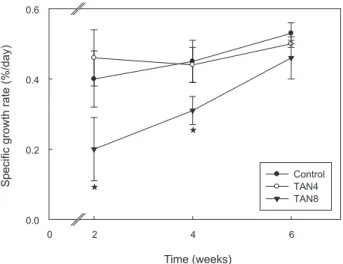
본연구(Fig. 2)
에서도실험초기인
2
주차에는대조구와TAN4
의일간성장률이
0.40-0.46%/day
로유사하였고,
이후6
주차에도두실험구 는유사한성장패턴을보였던것에비해, TAN8
실험구는실험 초기부터종료하기까지다른두실험구와는유의적인차이를 보이며일간성장율이낮았다.
다만,
일간성장율의차이는실험 기간이길어지면서점차작아지는경향을보였다(Fig. 2).
이들 결과는고농도암모니아에서는성장에미치는영향이크다는 것을보여주는데,
이와관련하여,
본연구에서TAN4
실험구의UIA
농도와유사한수준인0.12 mg/L
정도에서도성장감소가 일어난다는것은dover sole (Solea solea), turbot (Scophthal- mus maximus) (Alderson, 1979), spotted wolfish (Anarhichas minor) (Foss et al., 2003), Atlantic cod (Gadus morhua) (Foss et al., 2004), European sea bass (Dicentrarchus labrax) (Le- marié et al., 2004), gilthead sea bream (Sparus aurata) (Wajs- brot et al., 1993), Senegalese sole (Solea senegalensis) (Pinto et al., 2007)
등여러해산어류에서도확인되고 있다.
그런데 본연구에서는고농도의암모니아는돌돔의성장에직접적으로영향을미쳤지만
, TAN4
실험구의성장지표가대조구와비교하여유의적인차이가없었던것은암모니아독성에대해돌
돔이다른어류들에비해내성이강하다는것을보여주는것이 라여겨진다
.
한편
,
다른동물(Selye, 1973)
과마찬가지로,
어류도스트레스 를받으면강도나지속시간에따라신경계및내분비계가자극 되어코티졸등이과다분비되고,
이로인해삼투질농도(Avella et al., 1991)
나포도당및콜레스테롤과같은에너지원성분도 영향을받는다는것이잘알려져있다(Schreck, 1981; Waring et al., 1992).
본실험에서는급작스런스트레스환경에노출된돌돔이순
간적으로혈중코티졸의농도가
11 μg/dL
까지상승하다가시간이흐르면서
2 μg/dL
수준으로하강하여안정되었는데,
이런결과는
Biswas et al. (2008)
의보고와도잘일치한다.
그리 고이결과는고암모니아농도가초기에는돌돔에게큰스트레 스로작용하지만,
돌돔은고암모니아환경에잘적응하고있음 을보여준다.
한편,
에너지원으로사용되는포도당과총콜레스 테롤의혈중농도가모두감소하는경향을보였고,
특히포도당 농도에서감소가높은것은,
호흡을위한아가미운동등으로 많은에너지를사용하면서고갈된것이아닐까여겨진다(Lang et al., 1987).
이와관련하여, Remen et al. (2008)
도고농도암 모니아(0.115-0.120 UIA mg/L)
에노출시킨juvenile Atalnatic cod (Gadus morhua)
에서포도당농도가감소했다고보고하였 고,
본실험과유사한결과를보였다.
이들결과를정리하면
,
고농도(TAN8)
의암모니아환경은어류의성장에영향을미칠뿐아니라
,
혈액성분의농도에도영향 을미치는등,
전반적으로돌돔에게부정적인영향을미치지만 시간경과에따라다소적응하는것으로사료된다.
사 사
본연구는해양수산부가지원하는강원씨그랜트사업에의해 수행되었으며
,
이에감사드립니다.
References
Alderson R. 1979. The effect of ammonia on the growth of juve- nile Dover sole, Solea solea (L.) and turbot, Scophthalmus
maximus (L.). Aquaculture 17, 291-309.
Avella M, Schreck CB and Prunet P. 1991. Plasma prolactin and cortisol concentrations of stressed coho salmon (Oncorhyn-
chus kisutch) in freshwater. Gen Comp Endocrinol 81, 21-
27.Biswas AK, Seoka M, Ueno K, Yong ASK, Biswas BK, Kim YS, Takii K and Kumai H. 2008. Growth performance and physiological responses in striped knifejaw, Oplegna-
thus fasciatus, held under different photoperiods. Aqua-
culture 279, 42-46. http://dx.doi. org/10.1016/j.aquacul- ture.2008.04.007.Bower CE and Bidwell JP. 1978. Ionization of ammonia in sea- water effects of temperature, pH and salinity. J Fish Res Bd
Cortisol ( μg/dL)
0 5 10
★
Albumin (g/dL)
0.0 0.5 1.0 1.5 2.0
Control TAN4TAN8
★
Total protein (g/dL)
0 5 10
Control TAN4TAN8
★
Glucose (mg/dL)
0 50 100 150 200
Control TAN4TAN8
★ ★ ★
Total cholesterol (mg/dL)
0 50 100 150
Control TAN4TAN8
★
★
Time (weeks) Time (Weeks)
0 2 4 6 0 2 4 6
GOT (IU/L)
0 20 40 60 80
Control TAN4TAN8
GPT (IU/L)
0 5 10 15 20
Control TAN4TAN8
★
Time (weeks)
0 2 4 6
Specific growth rate (%/day)
0.0 0.2 0.4 0.6
Control TAN4TAN8
★
★
Fig. 2. Fluctuations of specific growth rate of parrotfish Opleg- nathus fasciatus according to total ammonia nitrogen (TAN) con- centrations. TAN4, TAN concentration of 4 mg/L; TAN8, TAN concentration of 8 mg/L (1P<0.05).
Can 35, 1012-1016.
Chin P, Shin YK, Kim HG, Lee JS and Kim HS. 1998. Biologi- cal study on the increment of survival rate during early life cycle in the rockfish, Sebastes schlegeli (Telostei: Scorpae- nidae) Ⅰ. Effects of ammonia on survival and growth of the larvae and juveniles stage. Kor J Ichthyol 10, 98-105.
Colt J and Armstrong. 1981. Nitrogen toxicity to crustacean, fish and Mollusca. In: Proceeding of the Bio-engineering Symposium for Fish Culture. Allen LJ and Kinney EC, eds.
America Fisheries Society, Bethesda, MD, U.S.A., 34-37.
Forster RP and Goldstein L. 1969. Formation of excretory prod- uct. In: Fish Physiology. Hoar WE and Randall DJ, eds.
Academic Press, New York, U.S.A., 313-345.
Foss A, Evensen TH, Vollen T and Øiestad V. 2003. Effects of chronic ammonia exposure on growth and food conversion efficiency in juvenile spotted wolffish. Aquaculture 228, 215-224. http://dx.doi.org/10.1016/S0044-8486(03)00276- Foss A, Siikavuopio TH, Sæther BS and Evensen TH. 2004. X.
Effect of chronic ammonia exposure on growth in juve- nile Atlantic cod. Aquaculture 237, 179-189. http://dx.doi.
org/10.1016/j.aquaculture.2004.03.013.
Foss A, Imsland AK, Roth B, Schram E and Stefansson SO.
2009. Effects of chronic and periodic exposure to ammonia on growth and blood physiology in juvenile turbot (Scoph-
thalmus maximus). Aquaculture 296, 45-50. http://dx.doi.
org/10.1016/j. aquaculture. 2009.07.013.
FFI. 1996. Inter Eascann eel farm is the first in Ireland. Fish Farming International 23, 3.
Ip YK, Lim CB, Chew SF, Wilson JM and Randall DJ. 2001.
Partial amino acid catabolism leading to the formation of alanine in Periophthalmadon schlosseri (mudskipper): a strategy that facilitates the use of amino acids as an energy source during locomotory on land. J Exp Biol 204, 1615- 1624.
Jeney G, Nemesok J, Jeney Z and Olah J. 1992. Acute effect of sublethal ammonia concentrations on common carp (Cypri-
nus carpio L.) II. Effect of ammonia on blood plasma trans-
aminases (GOT, GPT), GIDH enzyme activity and ATP value. Aquaculture 104, 149-156.Jeon JK, Kim PK, Park YJ, Myoung JG and Kim JM. 2000.
Changes of serum cortisol concentration and stress respons- es in coho salmon (corhynchus kisutch) to netting. J Kor Fish Soc 33, 115-118.
Johansson O and Wedborg MG. 1980. The ammonia-ammoni- um equilibrium in seawater at temperatures between 5 and 25 degrees C. J Chem Soc 9, 37-44.
Kang YJ, Lee SM, Hwang HK and Bai SC. 1998. Optimum di- etary protein and lipid levels on growth in parrot Fish (Ople-
gnathus fasciatus). J Aquacult 11, 1-10.
Kim PK. 2011. Effects of stocking density and dissolved oxygen concentration on the growth and hematology of the parrot-
fish Oplegnathus fasciatus in a recirculationg aquaculture stsrem (RAS). Kor J Fish Aquat Sci 44, 747-752. http://
dx.doi.org/10. 5657/KFAS.2011.0747.
Lang T, Peters G, Hoffmann R and Meyer E. 1987. Experimen- tal investigations on the toxicity of ammonia-effects on ven- tilation frequency, growth, epidermal mucous cells, and gill structure of rainbow-trout Salmo gairdneri. Dis Aquat Ogr 3, 159-165.
Lemarié G, Dosdat A, Covès D, Dutto G, Gasset G and P.-Le Ruyet, J. 2004. Effect of chronic ammonia exposure on growth of European seabass (Dicentrarchus labrax) juve- niles. Aquaculture 229, 479-491. http://dx.doi.org/10.1016/
S0044-8486(03)00392-2.
McKenzie DJ, Randall DJ, Lin H and Aota S. 1993. Effects of changes in plasma pH, CO2 and ammonia on ventilation in trout. Fish Physiol Biochem 10, 507-515.
Meade JW. 1985. Allowable ammonia for fish culture. Prog Fish Cult 3, 135-145.
Oh SY, Noh CH, Kang RS and Myoung JG. 2006. Effects of water temperature and photoperiod on the oxygen consump- tion rate of fasted juvenile parrot fish, Oplegnathus fascia-
tus. Ocean and Polar Res 28, 407-413.
Park J. 2005. Design and performance of pilot recirculating aquaculture system for abalone Haliotis discus hannai.
Ph.D. Thesis, Pukyong National University, Busan, Korea.
Park J, Kim PK, Lim T and Daniels HV. 2013. Ozonation seawa- ter recirculating system for black seabream Acanthopagrus
schlegelii (Bleeker): Effects on solids, bacteria, water clarity,
and color. Aquacult Eng 55, 1-8. http://dx.doi.org/10.1016/j.aquaeng.2013.01. 002.
Paust LO, Foss A and Imsland AK. 2011. Effects of chronic and periodic exposure to ammonia on growth, food conversion efficiency and blood physiology in juvenile Atlantic halibut (Hippoglossus hippoglossus L.). Aquaculture 315, 400-406.
http://dx.doi.org/ 10.1016/j.aquaculture.2011.03.008.
Pinto W, Arago C, Soares F, Dinis MT and Conceicao LEC.
2007. Growth, stress response and free amino acid levels in Senegalese sole (Solea senegalensis Kaup 1858) chronically exposed to exogenous ammonia. Aquac Res 38, 1198-1204.
http://dx.doi.org/10.1111 /j.1365-2109.2007.01788.x.
Randall DJ and Wright PA. 1987. Ammonia distribution and ex- cretion in fish. Fish Physiol Biochem 3, 107-120.
Russo RC. 1985. Ammonia, nitrite and nitrate. In: Fundamentals of Aquatic Toxicology. Hemisphere Publishing. Rand GM and Petrocelli SR, eds. Washington DC, U.S.A., 455-471.
Russo RC and Turston RV. 1991. Toxicity of ammonia, nitrite and nitrate to fishes. Aquaculture and water quality. Brune E and Tomasso JR. eds. Advances in World Aquaculture.
Vol. 3. The World Aquaculture Society. Louisiana, U.S.A., 58-89.
Remen M, Imsland AK, Stefansson SO, Jonassen TM and Foss A. 2008. Interactive effects of ammonia and oxygen
on growth and physiological status of juvenile Atlantic cod (Gadus morhua). Aquaculture 274, 292-299. http://dx.doi.
org/10.1016/j.aquacuture. 2007.11.032.
Schreck CB. 1981. Stress and compensation in teleotean fishes : responses to social and physical factors. In Stress in Fish.
Pickering AS, ed. Academic Press, London, U.K., 295-321.
Selye H. 1973. The evolution of the stress concepts. American Scientist 61, 692-699.
Son MH, Jeon IG, Cho KC and Kim KS. 2000. Ammonia re- moval rate on ammonia loading rates in seawater filtering system using rotating biological contactor (RBC). J Kor Fish Soc 33, 367-372.
Suh KH, Kim BJ and Jeon IG. 2001. Design and Development of Integrated Recirculating Aquaculture System. J Kor Fish Soc 34, 70-76.
Thurston R, Russo RC and Vinogradov GA. 1981. Ammonia toxicity to fishes - effect of pH on the toxicity of the un- ionized ammonia species. Environ Sci Technol 15, 837-840.
Van Rijn J. 1996. The potential for integrated biological treat- ment systems in recirculating fish culture - A review. Aqua- culture 139, 181-201.
Wajsbrot N, Gasith A, Krom MD and Popper DM. 1991. Acute toxicity of ammonia to juvenile gilthead seabream Sparus
aurata under reduced oxygen levels. Aquaculture 92, 277-
Wajsbrot N, Gasith A, Diamant A and Popper DM. 1993. 288.Chronic toxicity of ammonia to juvenile gilthead seabream
Sparus aurata and related histopathological effects. J Fish
Biol 42, 321-328.Waring CP, Stagg RM and Poxton MG. 1992. The effects of handling on flounder (Platichthys flesus L.) and Atlantic salmon (Salmo salar L.). J Fish Biol 41, 131-144.