Effects of Turine and Vitamin E on Sperm Viability, Membrane Integrity and Mitochondrial Activity damaged by Bromopropane in Fresh Boar Semen
Seunghyung Lee
1,*, Hee-Woo Park
1,*, Hee-Tae Cheong
2, Choon-Keun Park
1and Boo-Keun Yang
1,†1
College of Animal Life Sciences, Kangwon National University, Chuncheon 24341, Republic of Korea
2
School of Veterinary Medicine, Kangwon National University, Chuncheon 24341, Republic of Korea
ABSTRACT
The purpose of this study was to examine the effects of taurine and vitamin E on sperm characteristics damaged by bromopropane (BP) in pig. We evaluated toxicity of BP on viability, membrane integrity and mitochondrial activity of spermatozoa. 1-BP (0, 2.5, 5.0, 10, and 50 μM), 2-BP (0, 2.5, 5.0, 10, and 50 μM), taurine (0, 5.0, 10, and 25 μM) and vitamin E (0, 50, 100, and 200 μM) were treated in fresh boar semen for 6 h. 10 and 50 μM of 1-BP and 2-BP inhibited sperm viability, membrane integrity and mitochondrial activity in fresh boar semen (P<0.05). 25 μM of taurine increased sperm viability and membrane integrity (P<0.05), 100 μM of vitamin E enhanced viability and mitochondrial activity of sperm (P<0.05). Finally, 10 μM of 1-BP and 2-BP was co-treated with taurine (25 μM) and vitamin E (100 μM) in the fresh boar semen. The co-treated samples did affected viability, membrane integrity and mitochondrial activity of sperm. In conclusion, taurine and vitamin E can improve and maintain sperm quality in fresh boar semen.
(Key words: bromopropane, taurine, vitamin E, viability, membrane integrity, mitochondrial activity)
This research was supported by 2015 Research Grant from Kangwon National University, Republic of Korea (No. 520150149).
*
Both authors contributed equally to this study.
†Correspondence : [email protected]
INTRODUCTION
Bromopropane (BP) has 1-bromopropane (n-propyl bromide, 1-BP) and 2-bromopropane (isopropyl bromide, 2-BP), is a solvent and the halogenated hydrocarbon, respectively (Ichihara, 2005). BP can disturb the system of immune, nervous and reproduction, and damages reproductive function in humans and animals. Recently studies of exposure to BP reported that 1-BP and 2-BP have a neurotoxic in humans and rats (Ichihara et al., 2002; Honma et al., 2003; Raymond et al., 2007; Mohideen et al., 2011). 1-BP regulates the production of cytokine and nitric oxide in macrophages (Han et al., 2008). Also, 2-BP induced damage of reproductive system in animals, spermato- gonia and spermatocytes were decreased by exposure to 2-BP in rats (Kamijima et al., 1997; Nakajima et al., 1997; Yu et al., 1999). In the studies of ovary and testis, 2-BP has a specific toxicity in spermatogonia and oocyte (Omura et al., 1999; Yu et al., 1999). These results indicate that BP induces production of reactive oxygen species, and the cells have damaged by oxidative stress and cytotoxic function.
Reactive oxygen species (ROS) stimulates cellular oxidative
stress, and induces cell death signaling pathway, such as apop- tosis. Over-produced oxidants include superoxide, hydrogen peroxide, and hydroxyl radicals. These oxidants contribute to cellular damage and diseases such as cancer, immune-system decline, cardiovascular disease and aging. In mitochondrial function, increased mitochondrial ROS and superoxide cause DNA damage and aging processing in human endothelial cells (Shigenaga et al., 1994; Du et al., 2003). Also, oxidative stress is a main factor for regulating the functionality of sperm in human and animal (Aitken and Curry, 2011). Thus a damage of sperm DNA and a loss of sperm viability are increased by ROS generation in the cells. Generally, antioxidant enzymes are activated for scavenging free radical in cells. Therefore, the sperm are protected from ROS by free radical scavengers and antioxidant enzymes (Rhemrev et al., 2000; Vernet et al., 2004). However, the ejaculated semen is exposed to in vitro environment, thus the spermatozoa is more damaged from oxi- dative stress. Therefore, antioxidants are a necessary condition for protecting sperm quality in vitro.
In this study, we used taurine and vitamin E antioxidants.
Taurine has many biological functions, as antioxidation, mem-
brane stabilization, and cardiovascular function. Vitamin E is the main lipid-soluble antioxidant in the body, and it can stop the production of reactive oxygen species in cell membranes (Herrera et al., 2001). We designed experiments, first, 1-bromo- propane (n-propyl bromide, 1-BP) and 2-bromopropane (isopropyl bromide, 2-BP) were treated in the semen. Secondly, antioxidants, taurine and vitamin E, were treated. And finally, bromopropa- nes and antioxidants were treated in the fresh boar semen. Then we evaluated sperm viability, membrane integrity, and mitochon- drial activity in fresh boar semen.
MATERIALS AND METHODS
1. Reagents and Sperm Preparation
1-Bromopropane (1-BP), 2-bromopropane (2-BP), taurine and vitamin E were purchased from Sigma-Aldrich (St. Louis, Missouri, USA). Bore semen was collected from the local AI center (Wonju, Kangwon, Korea), diluted to concentration of 3.0×10
6sperm in 1 ml Beltsville thawing solution (BTS) ex- tender, and transported to the laboratory at 17 ℃ within 2 h.
The semen was incubated 1-BP and 2-BP (2.5, 5, 10, and 50 μM), taurine (5, 10, and 25 mM), and vitamin E (50, 100, and 200) for 6 h at 37 ℃. The viability, motility, mitochondria activity and membrane integrity of sperm were evaluated. All procedures that involved the use of animals were approved by the Kangwon National University Institutional Animal Care and Use Committee (KIACUC-09-0139).
2. Sperm Viability
Viability of spermatozoa was evaluated after treatment with bromopropanes (1-BP and 2-BP) and/or taurine and vitamin E for 6 h. After treatment, 100 μl of sample was stained with 10 μl propidium iodide (0.5 mg/ml in PBS), and incubated at 3 7 ℃ for 5 min. Then 10 μl of Hoechst 33342 (0.5 mg/ml) was added in the sample, and the mixed samples incubated for 10 min at 37 ℃ in the dark. After incubation, 20 μl of sperm sample was placed on slide glass, and observed under an epi- fluorescence microscope at 400× magnification (Zeiss, Axioskop, Germany). The detected fluorescence spectra were 460/500 nm. For sperm motility, 20 μl of sample was placed on pre- warmed slide glass, and then sperm viability was examined using a fluorescence microscope (Zeiss, Axioskop, Germany).
3. Membrane Integrity
The plasma membrane integrity was evaluated using hypo- osmotic swelling test (HOST). 100 μl sperm sample was mixed with 1 ml hypo-osmotic solution (150 mOsm, 7.35g Na-citrate and 13.51 g fructose in 1 l water), and incubated for 30 min at 37 ℃. Finally, 20 μl of sample was placed on a glass slide, and covered with a pre-warmed-cover glass. The sperm tails and heads were observed under a phase contrast microscope at 400× magnification (Nikon, Eclipse TE300, Japan).
4. Mitochondrial Activity
Mitochondrial activity was measured by Rhodamin123 (R123) and propidium iodide (PI) staining. 1 ml sample was treated with 3 μl R123 (2.0 mg/ml), and stained at 37 ℃ for 15 min in dark room. After the sample was centrifuged at 1,500× g for 5 min, supernatant was removed and diluted in 1 ml PBS.
Finally, R123-treated sample was mixed with 10 μl PI for 10 min in dark room. For observing mitochondrial activity of sperm, 20 μl of sperm sample was moved to a slide glass, and covered with a cover glass. Slide glass and cover glass were pre-heated at 37 ℃. Samples were evaluated by fluorescence microscope on 400× magnification (Zeiss, Axioskop, Germany).
R123 and PI were measured in 490/515 and 545/590 nm fil- ters, respectively.
5. Statistical Analysis
Data were compared for differences using of Duncan’s mo- dified multiple range tests using Statistical Analysis System software version 9.2 (SAS Institute Inc. USA). All values were presented as mean±the standard effort of the mean (SEM). A 5% probability was considered significant.
RESULTS
1. Bromopropane, 1-BP and 2-BP, Inhibits Sperm Characteristics in Fresh Boar Semen
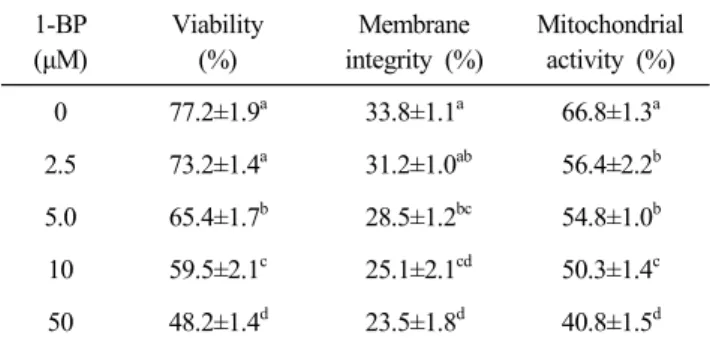
1-BP and 2-BP decreased viability, membrane integrity and mitochondrial activity of spermatozoa in a dose-dependent manner (Table 1 and 2). 10 and 50 μM of 1-BP (Table 1) and 2-BP (Table 2) significantly inhibited sperm viability and membrane integrity (P<0.05), but did not affect the sperm cha- racteristics on low concentration of bromopropane (2.5 μM).
We also determined sperm mitochondrial activity in 1-BP- and
2-BP-treated boar semen. Mitochondrial activity was decreased
on 5, 10, and 50 μM of bromopropanes (Table 1 and 2, P<
Table 1. Effects of 1-BP on sperm viability, membrane integrity and mitochondrial activity in fresh boar semen 1-BP
(μM)
Viability (%)
Membrane integrity (%)
Mitochondrial activity (%)
0 77.2±1.9
a33.8±1.1
a66.8±1.3
a2.5 73.2±1.4
a31.2±1.0
ab56.4±2.2
b5.0 65.4±1.7
b28.5±1.2
bc54.8±1.0
b10 59.5±2.1
c25.1±2.1
cd50.3±1.4
c50 48.2±1.4
d23.5±1.8
d40.8±1.5
da~d
Different superscripts within same column are significantly differ, P<0.05.
Values are the mean±S.E.M of three experiments.
Table 2. Effects of 2-BP on sperm viability, membrane integrity and mitochondrial activity in fresh boar semen 2-BP
(μM)
Viability (%)
Membrane integrity (%)
Mitochondrial activity (%)
0 65.1±1.4
a33.6±1.3
a62.1±2.2
a2.5 61.7±1.3
b30.5±1.2
a59.8±1.6
a5.0 61.4±2.0
b24.6±2.1
b57.3±2.3
a10 52.3±2.4
b21.7±1.3
bc49.8±1.2
b50 34.0±1.3
c19.8±1.3
c36.6±2.0
ca~c
Different superscripts within same column are significantly differ, P<0.05.
Values are the mean±S.E.M of three experiments.
0.05). Thus 10 μM of 1-BP and 2-BP was used to examine the effects of antioxidant (taurine and vitamin E) on sperm cha- racteristics.
2. Taurine Enhances Sperm Viability and Membrane Integrity Taurine regulated the viability and membrane integrity of sperm in fresh boar semen. Sperm viability and membrane integrity were significantly increased in 25 μM taurine-treated sample than control and low concentrations (5 and 10 μM, Table 3, P<0.05). The mitochondrial activity of sperm was not stimulated by taurine.
3. Vitamin E Increases Viability and Mitochondrial Activity of Sperm Vitamin E enhanced sperm viability and mitochondrial acti- vity in fresh boar semen. 100 μM vitamin E increased sperm
Table 3. Effects of taurine on sperm viability, membrane integrity and mitochondrial activity in fresh boar semen Taurine
(mM)
Viability (%)
Membrane integrity (%)
Mitochondrial activity (%)
0 74.3±1.2
a21.9±1.4
a76.4±1.9
5 77.2±1.3
a23.7±1.0
a77.3±1.6
10 78.1±1.2
a24.4±1.1
a77.5±1.6
25 81.0±1.8
b26.6±1.3
b77.2±1.8
a,b
Different superscripts within same column are significantly differ, P<0.05.
Values are the mean±S.E.M of three experiments.
viability, but not low (50 μM) and high (200 μM) concen- trations (Table 4, P<0.05). On the other hand, the membrane integrity of sperm was not regulated in all treatments. Mito- chondrial activity was significantly stimulated in 100 and 200 μM vitamin E-treated semen (Table 4, P<0.05).
4. Taurine and Vitamin E can protect Spermatozoa from Bromopro- pane Damage
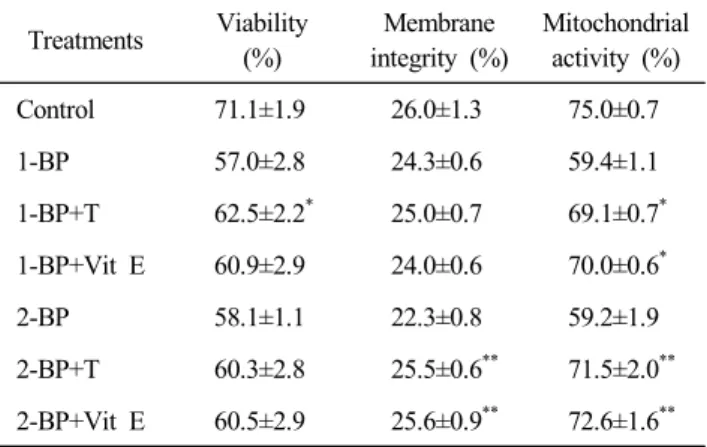
25 μM taurine and 100 μM vitamin E were treated with 1-BP (10 μM) and 2-BP (10 μM) in fresh boar semen for 6 h. Sperm viability in 1-BP samples was increased by taurine, and membrane integrity in 2-BP samples was increased by tau- rine and vitamin E (Table 5, P<0.05). Mitochondrial activity in bromopropane-treated fresh boar semen was not changed by taurine and vitamin E.
DISCUSSION
Table 4. Effects of vitamin E on sperm viability, membrane integrity and mitochondrial activity in fresh boar semen Vitamin E
(μM)
Viability (%)
Membrane integrity (%)
Mitochondrial activity (%)
0 55.0±1.2
a26.2±0.9 66.1±2.9
a50 55.1±1.7
a27.6±0.9 70.2±1.3
a100 60.4±1.5
b28.4±1.3 72.1±1.3
b200 57.6±2.0
a29.0±1.6 72.1±0.7
ba,b
Different superscripts within same column are significantly differ, P<0.05.
Values are the mean±S.E.M of three experiments.
Table 5. Effects of taurine and vitamin E on sperm viability, mem- brane integrity and mitochondrial activity in bromopropane- treated fresh boar semen
Treatments Viability (%)
Membrane integrity (%)
Mitochondrial activity (%)
Control 71.1±1.9 26.0±1.3 75.0±0.7
1-BP 57.0±2.8 24.3±0.6 59.4±1.1
1-BP+T 62.5±2.2
*25.0±0.7 69.1±0.7
*1-BP+Vit E 60.9±2.9 24.0±0.6 70.0±0.6
*2-BP 58.1±1.1 22.3±0.8 59.2±1.9
2-BP+T 60.3±2.8 25.5±0.6
**71.5±2.0
**2-BP+Vit E 60.5±2.9 25.6±0.9
**72.6±1.6
**1-BP, 10 μM 1-bromopropane; 2-BP, 10 μM 2-bromopropane;
T, 25 mM taurine; Vit E, 100 μM vitamin E.
*
Asterisk shows a significant difference between 1-BP- and an- tioxidants-treated groups (P<0.05).
**