≫ 연구논문 ≪
수산화나트륨 침출용액으로부터 과산화수소에 의한 침전으로 알루미나 회수
Thi Thuy Nhi Nguyen·
§이만승
목포대학교 신소재공학과Recovery of Alumina from Sodium Hydroxide Leaching Solution by Precipitation with Hydrogen Peroxide
Thi Thuy Nhi Nguyen and
§Man Seung Lee
Department of Advanced Materials Science & Engineering, Institute of Rare Metal, Mokpo National University, Chonnam 58554, Korea
요 약
블랙드로스로부터 순수한 알루미나를 회수하기 위해 기계적 처리한 블랙드로스의 수산화나트륨 침출용액을 대상으로 침전실험을 수행했다. 본 연구에서는 합성용액에 과산화수소를 침전제로 첨가했다. 실험변수중 과산화수소의 농도와 과산화수소와 용액의 부피 비가 수산화알루미늄의 침전에 큰 영향을 미쳤다. 최적 조건에서 용액중 알루미네이트이온이 대부분 침전되었다. 수산화알루미늄을 1200
oC에서 하소시켜 θ와 α상을 지닌 알루미나를 얻었고 제조한 알루미나의 특성은 XRD와 EDS로 측정했다. 알루미나 입자의 평 균 입경은 3.73 μm 이었다.
주제어 :
블랙드로스, 알루미나, 수산화알루미늄, 침전, 과산화수소
Abstract
In order to recover pure alumina from balck dross, precipiatation experiments were done to the NaOH leaching solution of mechanically activated black dross. In this work, hydrogen peroxide was added to the synthic solution as a precipitating agent.
Among some variables, the concentration of H2O2 and the volume ratio of H2O2 to solution showed a remarkable effect on the precipitation of aluminum hydroxide. At the optimum conditions, most of the aluminate was precipitated. Calcination of the alu- minum hydroxide at 1200oC led to the formation of θ and α-alumina. The charactistics of the synthesized activated alumina was measured by XRD and EDS. The average particles size of the alumina was 3.73 μm.
Key words : Black dross, Alumina, Aluminum Hydroxide, Precipitation, Hydrogen peroxide
1. Introduction
Aluminum dross contains alumina, metal oxides and nitrides and some salts
1). Black dross results from the
treatment to recover aluminum metal. Hydrometallurgical processes have been developed to recover alumina from black dross. Although alumina is amphoteric, alkaline leaching has a selectivity for the leaching of alumina
· Received : May 27, 2019 · Revised : July 1, 2019 · Accepted : July 5, 2019
§
Corresponding Author : Man-Seung Lee (E-mail : [email protected])
Department of Advanced Materials Science & Engineering, Mokpo National University, 1666 Yeongsan-ro, Cheonggye-myeon, Muan-gun, Chonnam 58554, Korea
ⓒThe Korean Institute of Resources Recycling. All rights reserved. This is an open-access article distributed under the terms of the
Creative Commons Attribution Non-Commercial License (http://creativecommons.org/licenses/by-nc/3.0/), which permits unrestricted
non-commercial use, distribution and reproduction in any medium, provided the original work is properly cited.
and results in pure aluminate solution with a small amount of silicate
2,3).
In previous studies, a process consisting of ball milling followed by NaOH leaching was performed to selectively dissolve alumina from black dross
3). The leaching behavior of the mechanically activated black dross was investigated as a function of NaOH concentration, leaching temperature, time and pulp density. Pulp density was found to have a remarkable effect on the dissolution of silica. As pulp density increased to higher than 100 g/L, only alumina and a small amount of silica were dissolved from the mechanically activated dross, leaving the other oxides in the residues. The purity of Al(III) in leaching solution was higher than 98% at the optimum conditions (5 M NaOH, 50 °C, 2 h, pulp density of 100 g/L). Although the purity is relatively high, around 150 ppm of silicate were still present in the solution
3). Therefore, the removal of silicate by coagulation with PAM was investigated. In our previous work on the recovery of alumina from black dross, aluminate solution with purity higher than 99.9% was obtained from the synthetic leaching solution of mechanically activated black dross by removing most of the silicate with coagulation with PAM
4). An important step in the production of alumina and compound from black dross by NaOH leaching is the crystallization of aluminum hydroxide from sodium aluminate solutions (leaching liquor). Aluminum hydroxide can be precipitated from sodium aluminate solution for the production of alumina
5). This hydrate is then calcined to alumina for further processing. The conversion of hydrates to the oxide is complex and provides several low-temperature alumina such as ρ, χ, η, and γ
6). These can in turn be converted to one or more of the following high-temperature transition alumina: δ, κ, and θ. The last stage in these transformations is α-Al
2O
3, which is thermodynamically the most stable
7).
Hydrogen peroxide has been utilized for the regeneration of sodium hydroxide from aluminum washed solution
8)and the synthesis of alumina particles with high surface area by precipitating boehmite from sodium aluminate solution
9). The properties of the synthesized alumina depend on the initial conditions of solution (the concent-
ration of NaOH and aluminate, temperature) and the method of addition of precipitating agents. The concent- ration of NaOH and aluminate in our previous work was 5 M NaOH and 13000 mg/L, respectively. Few works have been reported on the synthesis of alumina from this strong alkaline solution with high aluminate content. In this work, hydrogen peroxide was employed as an additive to synthesize aluminum hydroxide. Para- meters affecting the crystallization from the solution such as H
2O
2concentration, the volume ratio of H
2O
2to leaching liquor, temperature and reaction time were investigated. Moreover, the effect of calcination condi- tions on the properties of activated alumina was also reported.
2. Experimental
The leaching liquor was prepared by dissolving extra pure sodium hydroxide (NaOH) (Duksan Co.) in doubly distilled water. And then, the alkaline solution was used to dissolve AlCl
3(Daejung Chemicals and Metals Co., 95%). The concentration of Al(III) in the synthetic solution was fixed at 13000 mg/L in 5 M NaOH. The synthetic solution was prepared on the basis of the concentration of Al(III) and Si(IV) present in the real leaching solution.
Hydrogen peroxide (Daejung Chemicals and Metals Co., 30%) solutions were prepared at varying concentrations by dilution (using deionized water).
For the aluminum hydroxide precipitation reactions, varying dosage of hydrogen peroxide (H
2O
2) was added to 20 mL of the synthetic solution in covered 100 mL beakers equipped with a magnetic stirrer bar in a heating mantle. The mixture was stirred at 400 rpm and at 20
oC except for the effect of temperature. The slurry samples at desired time intervals were taken and filtered by using vacuum filtration. In each case, the aluminum hydroxide was separated by vacuum filtration, washed several times with warm deionized water, till the filtrate became neutral to litmus paper. The concentration of Al(III) in the solution was measured by inductively coupled plasma optical emission spectrometers ICP-OES (Spectro Arcos).
Precipitation yield of Al(OH)
3of the synthetic solutions
was calculated as follows
(1)
where m
0and m represent the concentration of Al(III) (mg/L) in the solution before and after precipitation, respectively.
For the production of activated alumina, precipitates were calcinated at 1200
oC for 5 hours in an SX-GD7123 muffle furnace. The structure and morphology of activated alumina was characterized by X-ray diffraction (XRD) (D8 Advance (Bruker AXS, Karlsruhe, Germany)) with Cu Ka (40 kV/40 mA, γ = 0.15406 nm) radiation and by Field Emission scanning electron microscopy (FE- SEM) (S-4800, Hitachi, Tokyo, Japan). Image analysis is one of the best methods for measuring powder size distribution. Therefore, ImageJ software, which is freeware Java-based Image Processing software, was employed in this work for particle size distribution analysis of alumina for each specimen using the collected FE-SEM images. The chemical composition of the alumina powder was analyzed using EDS.
3. Results and Discussion
3.1. Precipitation of aluminum hydroxide from sodium aluminate solution by using hydrogen peroxide
3.1.1. Effect of H
2O
2concentration
The effect of hydrogen peroxide concentration on the precipitation of aluminum hydroxide was investigated by varying H
2O
2concentration from 5 to 30 wt%, the volume ratio of H
2O
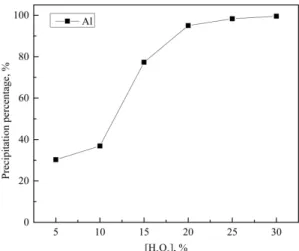
2to leaching liquor: 1, at 400 rpm for 3 hrs. The precipitation percentage of aluminum hydroxide increased to 99% as H
2O
2concentration increased to 30% (see Fig. 1). In order to precipitate aluminum hydroxide, it is necessary to remove the hydroxide ion coordinated to aluminum ion. In most cases, the removal of coordinated hydroxide ions can occur by condensation reaction which releases water molecules. Therefore, it is necessary to provide hydrogen ions to react with the coordinated hydroxide ions. A possible mechanism for the precipitation of aluminum hydroxide can be explained as follows. In strong alkaline
solution, metal ions may be entirely coordinated by hydroxide ligands, which can be represented as [M(OH)
x]
n. When H
2O
2is added to concentrated NaOH solution, H
2O
2is decomposed to hydroperoxide ion (HO
2−) and hydrogen ion (H
+) as Eq. (1)
10). The hydro- peroxide ion (HO
2−) can disproportionate to hydroxide ion and oxygen gas as Eq. (2).
H
2O
2= HO
2−+ H
+(1)
HO
2−= OH
−+ 1/2O
2(2)
This hydrogen ion can react with aluminate to preci- pitate either AlO(OH) or Al(OH)
3, depending on the concentration of NaOH in the solution. The precipitation reaction of aluminum hydroxide by H
2O
2can be repre- sented as Eq. (3)
11).
NaAlO
2+ H
2O
2= AlO(OH) + N aOH + 1/2O
2(pH = 14) (3)
Instead of adding acids as a hydrogen ion source, the addition of H
2O
2can regulate the production rate of hydrogen ion and thus control the size of the precipitates.
This method is a kind of homogenous precipitation.
3.1.2. Effect of H
2O
2volume
The effect of the volume ratio of H
2O
2to aluminate solution on the precipitation of aluminum hydroxide was Y = m
0– m
m
0--- × 100%
Fig. 1. Effect of H2O2 concentration on the precipitation of aluminum hydroxide from synthetic solution.
investigated at 10%, 15%, 20%, 30%. In this work, the volume ratio of H
2O
2to leaching liquor (V
1:V
2) was in the range from 0.5 to 2.5 and the corresponding results are shown in Fig. 2. Precipitation percentage of aluminum hydroxide was increasing with the increase in the volume ratio of H
2O
2. When the volume of ratio of H
2O
2to the aluminate solution was less than 1.5, only a small amount of aluminum hydroxide precipitates was formed in these conditions. In contrast, as the volume ratio increased from 1.5 to 2.5, precipitation percentage of aluminum hydroxide rapidly increased, even in low hydrogen peroxide concentrations like 10%, 15%. Based on the stoichiometry of the precipitation equations (Eq.
(3)), H
2O
2ratio has a great influence on the precipitation of aluminum hydroxide. For a complete reaction to occur, the ratio of hydrogen peroxide and sodium aluminate must be greater than 1. This is consistent with the experimental results.
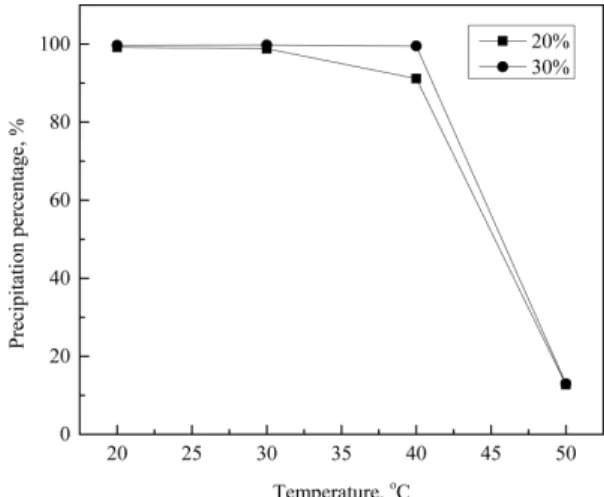
3.1.3. Effect of reaction temperature and time The effect of reaction temperature was investigated at H
2O
2concentrations of 20% and 30%. Most of aluminate ions were precipitated at both concentrations of H
2O
2as long as reaction temperature was lower than 30
oC. The precipitation efficiency with H
2O
2decreased when the temperature was raised above 40 °C (see Fig. 3).
The standard enthalpy change of Eq. (3) is approximately
1032 kJ mol
1, indicating that Eq. (3) is exothermic
12). Therefore, the reaction degree of Eq. (3) should decrease as reaction temperature increases. Our results agree well with this trend.
The effect of reaction time was investigated at both conditions of H
2O
2concentration (20% and 30%). Within our experimental range, reaction time did not show any significant effect on the precipitation of aluminum hydroxide in both concentrations of H
2O
2(see Fig. 4).
An optimum condition for the precipitation of aluminum hydroxide was obtained as follows: 20% H
2O
2, the volume ratio of H
2O
2to solution: 1.5, 20
oC, 400 rpm,
Fig. 2. Effect of the volume ratio of H2O2 to the leachingliquor on the precipitation of aluminum hydroxide from synthetic solution.
Fig. 3. Effect of temperature on the precipitation of aluminum hydroxide from synthetic solution.
Fig. 4. Effect of reaction time on the precipitation of aluminum hydroxide from synthetic solution.
and 3 hrs. At this condition, the precipitation percentage of aluminum hydroxide was 99%.
3.2. Production of activated alumina from aluminum hydroxide
The precipitated Al(OH)
3was calcined at 1200 °C for 5 h and Al
2O
3powders were obtained. The chemical reactions occurring during temperature increase are listed in Table 1. After calcination treatment, the α-Al
2O
3and θ-Al
2O
3powders were obtained. Their characteristics was measured by chemical analysis, XRD and SEM. From the XRD pattern in Fig. 5, the diffraction peaks of the powders agreed well with the standard diffraction peaks of α-Al
2O
3and θ-Al
2O
3, indicating that the powders consist of α-Al
2O
3and θ-Al
2O
3. EDS spectra of powders calcined at 1200
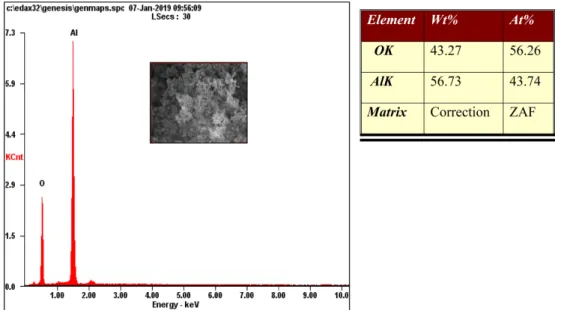
oC for 5 hrs is shown in Fig. 6. It is obvious from EDS results that the powders prepared at
this condition are alumina particle (56.73% aluminum and 43.27% oxygen). Moreover, there are no trace of other impurities like sodium and chloride in the powder samples.
Fig. 7 depicts the FE-SEM micrograph of the alumina powders. The powders have a rounded-corner shape. A lot of tiny grains were attached on large ones and non- uniformly distributed. Moreover, well-structured meso- porous alumina with high surface area and narrow pore size distribution was obtained by calcination at 1200
oC
Table 1. Chemical reaction occurred at different temperatureTemperature/
oC Reaction 100 ~ 120
200 ~ 250 700 900 1150 ~ 1200
2Al(OH)
3= Al
2O
3·3H
2O Al
2O
3·3H
2O = Al
2O
3·H
2O + 2H
2O
Al
2O
3·H
2O = γ-Al
2O
3+ H
2O γ-Al
2O
3= θ-Al
2O
3θ-Al
2O
3= α-Al
2O
3Fig. 5. The XRD pattern of the precipitates after calcined at 1200oC for 5 hrs.
Fig. 6. Energy dispersive spectra of the activated alumina.
for 5 hours. The particles size was found to be in the range of 0.5 μm to 15 μm (see Fig. 8). The particle size distribution of the powders were analyzed by using an ImageJ
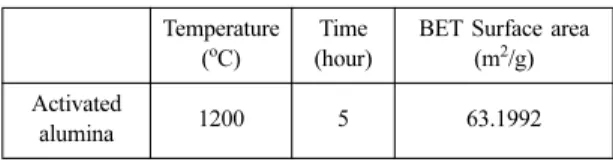
13)and Origin Pro 9.0 software (Origin lab corporation, Northampton, MA, USA, 2012) based on the SEM morphology (Fig. 7). The surface area of the synthesized alumina powders calcined at 1200 °C for 5
hrs was found to be nearly 63.2 m
2/g (Table 2), which is equivalent to a median particle size of 3.73 μm.
4. Conclusions
Black dross results from the re-melting of used aluminum cans and is a valuable resource containing alumina.
NaOH leaching of mechanically activated aluminum black dross followed by the removal of dissolved silicate results in an aluminate solution with 99.9% purity. In order to recover activated alumina from the leaching solution, precipitation of aluminum hydroxide and sub- sequent calcination was investigated. In this work, H
2O
2was selected as a precipitating agent and precipitation efficiency of aluminum hydroxide was investigated by varying conditions. Among the precipitation conditions, the concentration of H
2O
2and the volume ratio of H
2O
2to aluminate solution showed a remarkable effect on the precipitation of aluminum hydroxide. The precipitation of aluminum hydroxide increased as the concentration of H
2O
2and the volume ratio of H
2O
2to leaching liquor increased. At the optimum conditions (20% H
2O
2, the volume ratio of H
2O
2to leaching liquor: 1.5, 20
oC, 3 hrs, 400 rpm), the precipitation percentage of aluminum hydroxide was higher than 99%. This hydrate was then calcined to activated alumina at 1200
oC. XRD and EDS analysis indicated that the product consisted of α-phase and θ-phase alumina (α-Al
2O
3, θ-Al
2O
3) with high surface area (63.2 m
2/g). The synthesized alumina powder had a median particle size of 3.73 μm. In this study, alumina with high purity was obtained from the synthetic leaching solution of mechanically activated black dross by preci- pitation of aluminum hydroxide with H
2O
2. Further work is necessary to verify the obtained results with the real leaching solution of mechanically activated black dross.
Acknowledgments
This work was supported by the Global Excellent Technology Innovation of the Korea Institute of Energy Technology Evaluation and Planning (KETEP), granted financial resource from the Ministry of Trade, Industry
& Energy, Republic of Korea (No. 20165010100880).
Fig. 7. SEM micrograph of alumina calcinated at 1200oC for 5 hrs.
Fig. 8. Particle size distributions of the synthesized alumina powders.
Table 2. The surface area of activated alumina at 1200oC for 5 hours
Temperature (
oC) Time
(hour) BET Surface area (m
2/g) Activated
alumina 1200 5 63.1992
References
1. Manfredi, O., Wuth, W., and Bohlinger, I., 1997 : Char- acterizing the physical and chemical properties of alu- minum dross, pp.48-51.
2. Seyed Ghasemi, S. M. and A zizi, A ., 2017 : A lkaline leaching of lead and zinc by sodium hydroxide: Kinetics modeling, Journal of Materials Research and Technol- ogy, pp.1-8.
3. Nguyen, T. T. N., Lee, M. S., and Nguyen, T. H., 2019 : Ball milling treatment of black dross for selective disso- lution of alumina in sodium hydroxide leaching - sub- mitted, 6(4), pp.29-29.
4. Nguyen, T. T. N. and Lee, M. S., 2018 : Purification of the sodium hydroxide leaching solution of black dross by removal of silicate(iv) with polyacrylamide (PAM). Sub- mitted
5. Zhi, W., Liu, Y., and Juan, Z., 2010 : Adjustment on gibbsite and boehmite co-precipitation from supersatu- rated sodium aluminate solutions, Transactions of Non- ferrous Metals Society of China, 20(3), pp.521-527.
6. Technical, A., Wefers, K., and Laboratories, A.: Oxides and hydroxides of aluminum.
7. Matori, K. A., Wah, L. C., Hashim, M., and Ismail, I., 2012 : Phase transformations of α-alumina made from waste aluminum via a precipitation technique, 2, pp.16812-16821.
8. Barakat, M. A. and Farghly, F. E., 2005 : Removing al and regenerating caustic soda from the spent washing liquor of al etching, pp.35-38.
9. El-katatn, E. A., Halaw, S. A., Mohamed, M. A., and Zaki, M. I., 1998: A novel s y nthesis of high-area alu- mina via H2O2-precipitated boehmite from sodium alu- minate solutions, pp.320-328.
10. Sahu, N. K., Sarangi, C. K., Dash, B., Tripathy, B. C., and Satpathy, B. K., 2015 : Role of hydrazine and hydro- gen peroxide in aluminium hydroxide precipitation from sodium aluminate solution, 25, pp.615-621.
11. Barakat, M. A. and Farghly, F. E., 2005 : Removing al and regenerating caustic soda from the spent washing liquor of al etching, pp.35-38.
12. Kubaschewski, O. and Alcock, C. B., 1979 : Metallur- gical Thermochemistry, 5th Ed.
13. Abràmoff, M. D., Hospitals, I., Magalhães, P. J., and Abràmoff, M.: Image processing with imageJ.