https://doi.org/10.9724/kfcs.2016.32.6.677
Quality Characteristics of Tarts Made with Molecular Press Dehydrated Purple Sweet Potatoes during Storage
Man Jae Cho · Hyun Jung Kim
†Department of Food Bioengineering, Jeju National University, Jeju 63243, Korea
Abstract
Purpose: Molecular press dehydration is one of the dehydration methods. The purpose of this study was to investigate the quality characteristics of tarts made with dehydrated purple sweet potatoes during the storage period. Methods: Quality characteristics of purple sweet potato tarts were evaluated by analyzing moisture content, water activity, total phenolics, anthocyanins, 2,2-diphenyl-1- picrylhydrazyl (DPPH) free radical scavenging activity, color, and sensory evaluation for 45 days of storage. Results: Moisture content of tart crust made with molecular press dehydration treated purple sweet potatoes with concentrations of 20%, 40%, 60%, and 80%
maltodextrin as a dehydrating agent for 45 days was 8.47%, 7.95%, 6.96%, and 6.24% respectively; however, the moisture content of non-treated tart crust was 11.99% ( p<0.05). Total phenolics, anthocyanins, and DPPH free radical scavenging activity of dehydrated purple sweet potato tarts were lowered than those of non-treated tart ( p<0.05). Conclusion: These results indicated that tarts made with molecular press dehydrated purple sweet potatoes had effectively controlled moisture content and water activity during storage although total phenolics, anthocyanins, DPPH free radical scavenging activity, color, and sensory evaluation were decreased.
Key words: purple sweet potato, tart, maltodextrin, molecular press dehydration, anthocyanin
분자압축탈수된 자색고구마로 제조한 타르트의 저장 중 품질특성
조만재 ․ 김현정
†제주대학교 식품생명공학과
초 록
목적: 본 연구에서는 탈수방법 중 분자압축탈수법을 이용하여 탈수한 자색고구마로 제조한 타르트의 저장 중 품질특성을 조사하였다. 연 구방법: 자색고구마타르트의 수분함량, 수분활성도, 총페놀함량, 안토시아닌함량, DPPH 자유라디칼 소거능, 색도 및 관능평가를 45일 동안 실시하였다. 결과: 탈수제인 말토덱스트린 20%, 40%, 60%, 80%로 분자압축탈수 후 제조한 자색고구마타르트 크러스트의 수분함 량은 45일 저장 후 8.47%, 7.95%, 6.96%, 6.24%로 분자압축탈수하지 않은 자색고구마로 제조한 타르트 크러스트의 수분함량인 11.99% 에 비하여 낮았다 (p<0.05). 하지만 총페놀함량, 안토시아닌 함량과 DPPH 자유라디칼 소거능이 분자압축탈수한 자색고구마타 르트가 그렇지 않은 타르트에 비해 낮게 나타났다(p<0.05). 결론: 분자압축탈수 후 제조한 자색고구마타르트는 수분함량을 효율적으로 낮춰주어 저장 동안 타르트 크러스트의 바삭함을 유지할 수 있었으나 총페놀 및 안토시아닌 함량, DPPH 자유라디칼 소거능, 색도 및 관 능평가 결과가 감소하였다.
주제어: 자색고구마, 타르트, 말토덱스트린, 분자압축탈수, 안토시아닌
†
Corresponding author: Hyun Jung Kim, Department of Food Bioengineering, Jeju National University, 102, Jejudaehak-ro, Jeju 63243, Korea ORCID: http://orcid.org/0000-0002-1438-7125
Tel: +82-64-754-3614, Fax: +82-64-755-3601, E-mail: [email protected]
© 2016 Korean Society of Food and Cookery Science
This is an Open Access article distributed under the terms of the Creative Commons Attribution Non-Commercial License (http://creative-commons.org/lice
Ⅰ. Introduction
Baking products are not suitable for main cooking but they are perfect for refreshments and have emerged as rapidly expanding market items over the past years (Sloan AE 1998, McWatters S et al. 2005, Mondal A & Datta
AK 2008). In particular, tart, a baked product consisting
of a filling over a pastry base with an open top, has been
consumed by many people whilst enjoying their brunch
and dessert (Boyle J & Kolbe AL 2002). Not only
bakeries but also food manufacturers have produced tarts
with the expansion of brunch and dessert markets (Worosz
MR 2006, Thornsbury S & Martinez L 2012). As a filling material in tarts, purple sweet potatoes have been increasingly used because of their taste and health benefits imparted by the presence of phenolic compounds and anthocyanins (Konczak-Ilsam I et al. 2003, Kano M et al.
2005, Yang HS 2012). However, sometimes, the purple sweet potatoes as a filling in tarts caused the degradation of tart quality because of high moisture content (Sanguinetti AM et al. 2009). Because of the movement of moisture from the filling to a tart crust during storage, the crust loses its crunchy texture. Henceforth, it is necessary to control moisture contents of purple sweet potato tarts during storage.
Molecular press dehydration is one of the dehydration methods, which is based on the cytorrhysis phenomenon occurring outside of the plant cell walls using a dehydrating agent with large molecular size (Yoo MS &
Seo HC 2003). Because solute molecule is greater than pore size of cell wall, solute molecule is pressed which leads to collapse of the cell wall (Choi DW & Shin HH 1999, Choi DW et al. 2006). This dehydration method has been continuously employed to dehydrate raw materials for food preparation. Kim MH et al. (2008) reported effective dehydration of green peppers employing maltodextrin as a dehydrating agent in high concentrations. Lee HS et al.
(2010) reported that molecular press dehydrated ginger indicated great dehydration rate, high recovery rate, stable color, and sensory characteristics. To control moisture content of purple sweet potatoes prior to baking tarts, they were dehydrated by molecular press dehydration with a dehydrating agent, maltodextrin, and the effect of treatment on the quality characteristics of purple sweet potato tarts during storage was investigated.
Ⅱ. Materials and Methods
1. Materials
Purple sweet potatoes were provided by Jeju Purple Sweet Potato Farming Association (Jeju, Korea). The malto- dextrin (Samyang Genex Co., Seoul, Korea) was used as dehydrating agent. Folin-Ciocalteu reagent and a,a-diphenyl- 2-picryl-hydrazyl (DPPH) were purchased from Sigma- Aldrich (St. Louis, MO, USA) to measure total phenolic content and DPPH free radical scavenging activity.
2. Molecular press dehydration of purple sweet potatoes
Purple sweet potatoes were molecular press dehydrated
as following. Washed purple sweet potatoes were peeled and ground using a blender (SMX-8000EMT, Hanil, Seoul, Korea). They were mixed with maltodextrin at concen- trations of 0%, 20%, 40%, 60%, and 80% (w/w) and dehydrated at 25°C for 12 h in a shaking incubator (JSSI- 100T, JS Research Co., Gongju, Korea). Dehydrated purple sweet potatoes were separated from the dehydrated solution by filtering and used for the preparation of tart filling.
3. Preparation of purple sweet potato tarts Tart filling was prepared by mixing dehydrated purple sweet potato, butter, sugar, treha (Hayashibara Co., Okayama, Japan), eggs, and salt. Tart crust dough was made with 48% wheat flour (soft flour, Samyang Co., Seoul, Korea), 22% margarine (Ottogi Co., Ahnyang, Korea), 15% butter (Seoul Dairy Co., Seoul, Korea), 9.6% sugar (CJ Cheil- Jedang Co., Seoul, Korea), 5.4% eggs (Hanaro mart, Jeju, Korea), and salt (purified salt, Hanju Co., Ulsan, Korea).
The entire mixture of purple sweet potato filling and dough were put into a tart molding machine (System one SO-2A, Masdac Co., Saitama, Japan) to form the shape of a tart. Molded tarts were then baked in a baking oven (FDO-7102, Daeyung Bakery Machinery Ind. Co., Seoul, Korea) for 30 min at 190-200°C. After cooling down the baked tarts, they were individually packaged in plastic bags.
All experiments were performed for storage period of 0, 3, 7, 10, 15, 20, 30, and 45 days at room temperature.
4. Moisture content and water activity of tarts Tarts were separated into purple sweet potato filling and tart crust. The moisture content of tart filling and crust was determined by the method of AOAC (2005).
Water activities of tart filling were measured by water activity meter (HP23-AW-A, Rotronic AG, Zurich, Switzerland).
Water activity was measured 20 times and expressed as the average value.
5. Determination of total phenolic content
Total phenolic content of tart filling was measured following the modified method of Rumbaoa RGO et al.
(2009) using Folin–Ciocalteau reagent. The absorbance was
measured at 765 nm using a UV-Vis spectrophotometer
(Optizen 2120UV, Mecasys Co., Daejeon, Korea). As a
standard, gallic acid (Sigma-Aldrich Co.) solutions were
prepared in varying concentrations (50-150 mg/L) in a
similar manner to construct a calibration curve. Total phenolic
acid content was expressed as milligram of gallic acid
equivalents per 100 g of sample (mg GAE/100 g).
6. Determination of total anthocyanin content Total anthocyanin content of purple sweet potato in the tart filling was measured according to the pH-differential method as described by Park HM et al. (2012). The absorbance was measured at pH 1.0 and pH 4.5 with a UV-Vis spectrophotometer (Mecasys Co.). Total anthocyanin concentration (TAC, mg/100 g) was then calculated using the following equation and expressed as cyanidin-3-glucoside equivalents:
TAC (mg/100 g) =
×
× × × ×
Where,
A = (absorbance at 520 nm – absorbance at 700 nm) at pH 1.0 – (absorbance at 520 nm – absorbance at 700 nm) at pH 4.5
MW = cyanidin-3-glucoside molecular weight (449.2 g) DF = dilution factor
20 = volume of the final concentrated sample (20 mL) 100 = divided value by 10 g of the sample weight of
the extract solution for the change per 100 g of sample
ε = cyanidin-3-glucoside molar absorptivity (26,900 L/cm·mol)
1 = path length in cm.
7. DPPH free radical scavenging activity
To compare the antioxidant capacity of tart during storage, hydrogen electron donating abilities of tart filling were determined by DPPH method (Liu YN et al. 2013).
Subsequently, the absorbance was measured at 517 nm using a UV-Vis spectrophotometer (Mecasys Co.). Ethanol (Daejung Chemicals & Metals Co., Shiheung, Korea) was used as a control in the same way. Butylated hydroxyanisole (BHA, Sigma-Aldrich Co.) and ascorbic acid (Sigma-Aldrich Co.) levels were measured for comparison. DPPH free radical scavenging activities (%) were calculated by the difference in absorbance between the control and the tart filling sample.
DPPH free radical scavenging activity (%)
=
×
Where, A
0: absorbance of the control and A: absorbance of
the sample.
8. Color measurement
The color of tart filling was measured by a colorimeter (UltraScan VIS Spectrophotometer, Hunter Lab Inc., Reston, VA, USA) after correcting the color with a white and black standard plate. L (lightness), a (redness), and b (yellowness) values were measured and expressed as the average value. The total color difference (ΔE) was defined using the following equation:
ΔE = [(L - L
0)
2+ (a - a
0)
2+ (b - b
0)
2]
1/2Where, L, a, and b values were of tarts made with dehydrated purple sweet potatoes treated with maltodextrin and L
0, a
0, and b
0values were of tarts made with purple sweet potatoes non-treated with maltodextrin.
9. Sensory evaluation
Sensory evaluation was conducted with 10 panelists at Department of Food Bioengineering in Jeju National University, who were explained about the objective of the study and valuation basis. When the sensory evaluation was performed, panelist rinsed their mouth with water after evaluating each sample. Samples given with random number were conducted to ensure the objectivity of the study and to increase the accuracy. Evaluation details included characteristic of appearance, color, flavor, texture, and overall acceptability. Nine points evaluation was conducted with a range from very poor (1 point) to excellent (9 points) and a high preference gave a high score.
10. Statistical analysis
All experiments were performed in triplicate except water activity. Data were determined by one-way ANOVA followed by Duncan’s multiple range test using SPSS Statistics (ver. 18.0, SPSS Inc., Chicago, IL, USA).
Significant differences were considered at p<0.05.
Ⅲ. Results and Discussion
1. Moisture content and water activity
Changes in moisture contents of tart filling and a tart
crust made with purple sweet potato dehydrated with 0%,
20%, 40%, 60%, and 80% maltodextrin as a dehydrating
agent are shown in Fig. 1. Purple sweet potatoes dehydrated
Tart Storage (days)
0 3 7 10 15 20 30 45
Non-treated 0.869±0.015
1)b2)D3)0.881±0.013
aC0.885±0.012
aC0.886±0.012
aBC0.890±0.013
aBC0.895±0.013
aB0.890±0.017
aBC0.915±0.013
aA20% MD 0.890±0.010
aA0.855±0.019
bB0.830±0.012
bC0.793±0.015
bD0.787±0.012
bD0.772±0.020
bE0.757±0.016
bF0.753±0.013
bF40% MD 0.847±0.014
cA0.788±0.013
cB0.759±0.014
cC0.744±0.014
cD0.741±0.016
cD0.742±0.015
cD0.740±0.014
cD0.744±0.012
cD60% MD 0.833±0.011
dA0.737±0.013
dB0.729±0.014
dBC0.732±0.015
dBC0.727±0.017
dCD0.722±0.013
dCD0.719±0.015
dDE0.713±0.014
dE80% MD 0.752±0.020
eA0.686±0.013
eC0.663±0.020
eE0.673±0.013
eD0.689±0.012
eC0.686±0.012
eC0.718±0.015
dB0.715±0.015
dB1)
Values are mean±SD.
2)
Means with different small letters within a column indicate significant difference at p<0.05.
3)
Means with different capital letters within a row indicate significant difference at p<0.05.
Table 1. Water activities of tart made with molecular press dehydrated purple sweet potatoes with different concentrations of maltodextrin (MD) as a dehydrating agent during storage
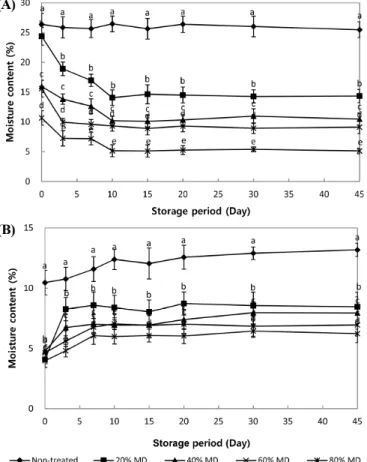
Fig. 1. Moisture content of tart filling (A) and tart crust (B) made with molecular press dehydrated purple sweet potatoes with different concentrations of maltodextrin as a dehydrating agent for 45 days. Mean±SD. Means with different small letters on the bar indicate significant difference within storage days at p<0.05.
using more than 20% maltodextrin controlled the moisture content of tart filling and tart crust low during storage of 45 days. No major changes in moisture content of purple sweet potato in the tart filling without maltodextrin was
observed from 0 days (26.39%) to 45 days (25.48%), which signifies maintenance of high moisture content. Furthermore, moisture content of tart crust non- treated by maltodextrin increased gradually from 0 days (10.47%) to 45 days (13.18%). As the concentration of maltodextrin used in the molecular press dehydration increased to 20%, 40%, 60%, and 80%, moisture content of purple sweet potato tart filling on 0 days exhibited a decreasing pattern as 24.39%, 15.96%, 15.59%, and 10.67%, respectively. Under similar conditions, moisture content of tart crust exhibited a decreasing trend as 4.10%, 4.77%, 4.64%, and 3.98%, respectively. Moisture content of tart filling made with molecular press dehydrated purple sweet potatoes in the presence of 20%, 40%, 60%, and 80% maltodextrin gradually decreased to 14.34%, 10.48%, 9.11%, and 5.12%
after 45 days, respectively. Under similar condi- tions, moisture content of tart crust gradually increased to 8.47%, 7.95%, 6.96%, and 6.24% after 45 days, respectively. The higher concentration of maltodextrin used in molecular press dehydration led to lower moisture contents of tart filling and tart crust. Tarts made with molecular press dehydrated purple sweet potatoes helped keep moisture contents low during storage. Previously, the green peppers, gingers, and carrots were effectively dehydrated by malto- dextrin and the moisture contents were kept low (Kim MH et al. 2008, Kim MH et al. 2009, Kim MK et al. 2009).
Therefore, these results suggested that merchandise made with molecular press dehydration efficiently maintained low moisture contents during storage.
Water activity of tart fillings made with purple sweet potato dehydrated with 0%, 20%, 40%, 60%, and 80%
maltodextrin as a dehydrating agent was changed during
storage for 45 days as shown in Table 1. Water activity
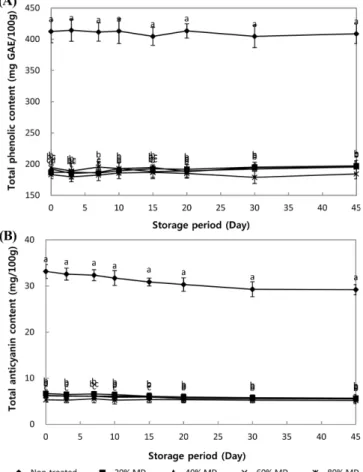
Fig. 2. Total phenolic content (A) and anthocyanin content (B) of tarts made with molecular press dehydrated purple sweet potatoes with different concentrations of maltodextrin as a dehydrating agent for 45 days. Mean±SD. Means with different small letters on the bar indicate significant difference within storage day at p<0.05.
of tart fillings made with molecular press dehydrated purple sweet potato were lower as compared to the water activity of tart filling made without dehydration during storage for 45 days. As the concentration of maltodextrin used in the molecular press dehydration increased to 20%, 40%, 60%, and 80%, water activity of tart fillings of purple sweet potato for 0 days decreased to 0.890, 0.847, 0.833, and 0.752, respectively. After 45 days of storage, the water activity gradually decreased to 0.753, 0.744, 0.713, and 0.715, respectively. These results indicated that tart made with molecular dehydrated purple sweet potatoes was possibly stored for a long time with expected crusty texture.
2. Total phenolic and anthocyanin contents Total phenolic content in tarts made with purple sweet potato dehydrated with 0%, 20%, 40%, 60%, and 80%
maltodextrin as a dehydrating agent is shown in Fig. 2(A).
Total phenolic content of tart made with non-treated purple sweet potato was 412.46 mg GAE/100 g on 0 days and no significant change in total phenolic content (408.74 mg GAE/100 g) for 45 days of storage was observed. However, total phenolic content of tarts made with molecular press dehydrated purple sweet potatoes exhibited a decreasing range of 183.22 to 194.43 mg GAE/100 g on 0 days.
These results exhibited similar trends as reported by Wang SM et al. (2011), which stated the occurrence of total phenolic content in purple sweet potatoes during molecular press dehydration.
Total anthocyanin content in tarts made with purple sweet potato dehydrated with 0%, 20%, 40%, 60%, and 80% maltodextrin as a dehydrating agent is shown in Fig.
2(B). Purple sweet potato tart prepared without dehydration of purple sweet potato by maltodextrin contained 33.16 mg/100 g of anthocyanin on 0 days and the content decreased significantly to 29.20 mg/100 g after 45 days of storage.
These results were in concordance with the reports of Brownmille C et al. (2008) and Hager A et al. (2008), which stated that over half of total anthocyanins in blue berry purees and black raspberry juice was lost after 6 months of storage.
Total anthocyanin contents of purple sweet potato tarts made with molecular press dehydration with 20%, 40%, 60%, and 80% maltodextrin were 6.68, 6.29, 6.20, and 5.31 mg/100 g on 0 days, respectively. In addition, these values decreased to 5.68, 5.61, 5.47, and 5.17 mg/100 g after 45 days of storage (p>0.05). Anthocyanins in purple sweet
potatoes were discharged into molecular press dehydrated solution during molecular press dehydration (Chun HH et al. 2012). Because of low stability of anthocyanins, marked loss was noted during the process of dehydration.
3. DPPH free radical scavenging activity
Changes in DPPH free radical scavenging activity of tarts made with purple sweet potato dehydrated with 0%, 20%, 40%, 60%, and 80% maltodextrin as a dehydrating agent are shown in Fig. 3. The DPPH free radical scaveng- ing activity of tarts made with non-treated purple sweet potatoes was 88.45% on 0 days and 83.61% after 45 days of storage. The antioxidant capacities of BHA (10%) and ascorbic acid (10%) were in the range of 86.61-90.90%
and 94.23-95.24% from 0 days to 45 days, respectively.
The antioxidant capacity of non-treated purple sweet potato
tart was similar to the activities of BHA. However, the
Fig. 3. DPPH radical scavenging activity of tarts made with molecular press dehydrated purple sweet potatoes with different concentration of maltodextrin as a dehydrating agent for 45 days. Mean±SD. Means with different small letters on the bar indicate a significant difference within storage day at p<0.05.
Tart Storage (days)
0 3 7 10 15 20 30 45
L
Non-treated 21.54±1.33
1)a2)A3)22.15±1.05
a21.62±1.47
a22.28±1.08
a21.77±1.26
a21.93±1.85
a22.11±1.08
a22.32±1.11
a20% MD 17.69±1.90
cA17.41±1.16
b16.67±1.65
d16.56±0.83
d17.10±1.27
c17.12±1.96
c16.53±1.33
d17.27±1.67
d40% MD 19.67±2.52
bA18.29±1.75
bB18.86±1.45
cAB18.57±1.10
cAB19.74±1.46
bA19.64±1.41
bA18.41±2.14
cB18.98±1.02
cAB60% MD 21.24±1.14
aAB21.68±1.56
a20.27±2.73
b21.16±1.24
b21.24±1.13
a21.42±1.05
a20.37±2.45
b20.85±1.16
b80% MD 21.33±2.25
aA20.99±2.82
a21.79±1.48
a21.04±1.61
b21.24±1.50
a21.18±1.74
a21.08±0.87
ab21.46±1.12
ba
Non-treated 8.18±0.81
bC8.13±0.76
bC8.27±1.19
aC8.18±1.07
bC8.44±0.85
aBC8.97±0.81
aAB9.21±1.00
aA9.15±0.54
aA20% MD 4.60±0.78
dAB4.62±0.41
dAB4.83±0.91
cA4.68±0.58
dAB4.51±0.74
cAB4.94±1.22
cA4.64±0.57
dAB4.16±0.55
cB40% MD 5.67±0.74
cA5.82±0.46
c5.82±1.58
b5.72±0.47
c5.53±0.53
b5.67±0.39
b5.52±0.75
c5.91±0.50
b60% MD 8.93±0.70
aA8.71±1.25
aAB8.87±0.70
aAB8.96±0.58
aA8.54±0.67
aAB9.03±0.83
aA8.28±1.51
bB8.93±0.45
aA80% MD 5.17±1.09
cA5.10±1.07
c5.85±0.91
b5.68±0.84
c5.74±0.89
b5.75±0.41
b5.84±1.48
c5.88±1.64
bb
Non-treated -3.73±0.87
dA-3.49±0.65
a-3.46±0.97
d-3.57±0.74
d-3.27±0.77
d-3.36±0.73
d-3.47±0.62
d-3.49±0.68
d20% MD 4.03±0.99
bcAB4.07±0.75
cAB3.80±1.70
cAB3.59±0.30
cAB3.49±0.84
cB4.23±0.62
bA4.12±0.42
bAB4.05±0.75
bcAB40% MD 4.61±1.24
bA4.57±0.75
b4.86±1.72
b4.54±0.69
b4.42±0.69
b4.45±0.62
b4.49±0.60
b4.81±0.53
b60% MD 5.67±1.55
aAB5.69±1.08
aAB5.93±1.22
aA5.39±0.89
aAB5.40±1.27
aAB5.10±0.89
aB5.77±1.10
aAB5.38±0.80
aAB80% MD 3.57±0.42
cAB3.80±0.48
cAB3.68±0.62
cAB3.37±0.80
cB3.52±0.48
cB3.63±0.50
cAB3.97±0.84
cA3.68±0.65
cABΔE
Non-treated 1.79 ±1.01
cB1.97±0.75
c2.30±0.83
c2.09±0.92
c2.11±0.78
c2.48±0.77
d2.18±0.51
d2.02±0.84
d20% MD 10.41±1.02
aAB10.49±0.76
aAB10.54±1.42
aAB10.32±0.49
aAB10.13±0.84
aB10.70±0.90
aAB10.82±0.65
aA10.71±0.70
aAB40% MD 10.20±1.12
aAB10.26±0.52
aAB10.45±1.59
aA10.09±0.58
aAB9.83±0.64
aAB9.83±0.53
bB10.32±0.58
bAB10.18±0.53
bAB60% MD 10.43±1.56
aAB10.57±1.02
aAB10.97±1.58
aA10.16±0.91
aAB10.16±1.27
aAB9.88±0.87
bB10.86±1.03
aA10.14±0.80
bAB80% MD 9.23±0.87
bAB9.60±0.97
bA8.98±0.69
bB8.75±0.59
bB8.84±0.61
bB8.95±0.42
cB9.24±0.71
cAB9.02±0.54
cB1)
Values are mean±SD.
2)
Means with different small letters within a column indicate significant difference at p<0.05.
3)
Means with different capital letters within a row indicate significant difference at p<0.05.
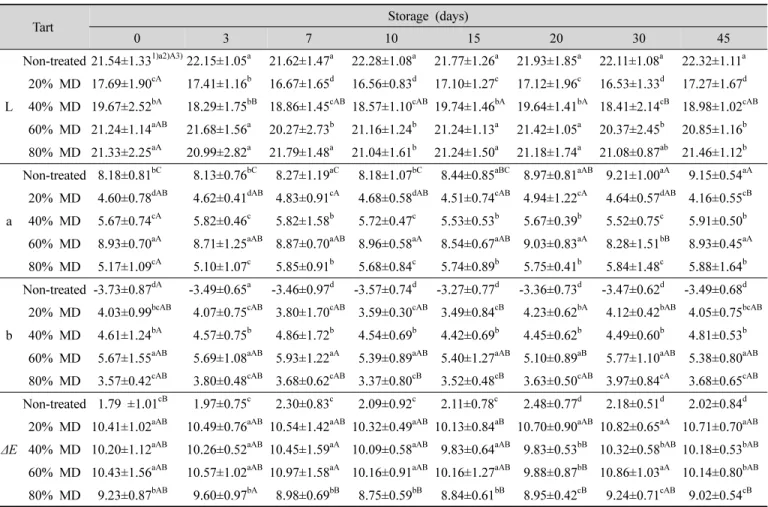
Table 2. Color of cross section of tarts made with molecular press dehydrated purple sweet potatoes with different concentrations of maltodextrin (MD) as a dehydrating agent during storage
DPPH free radical scavenging activity of purple sweet
potato tarts made with molecular press dehydration with
20%, 40%, and 60% maltodextrin was 77.44%, 74.36%,
and, 73.58%, respectively, on 0 days and 75.33%, 73.58%,
and 71.71%, respectively, after 45 days of storage. The
tart made with the purple sweet potato dehydrated with
80% maltodextrin showed no change in the DPPH free
radical scavenging activity during storage. There were no
significant differences in the antioxidant activities of purple
sweet potato tarts during storage. The DPPH free radical
scavenging activity of tarts made with molecular press
dehydrated purple sweet potatoes significantly decreased
with increasing the concentration of maltodextrin from
20%, 40%, and 60% to 80%. Although the total phenolic
and anthocyanin contents were significantly low in tarts
made with maltodextrin dehydrated purple sweet potatoes,
no major difference in the DPPH free radical scavenging
Sensory
evaluation Tart Storage (days)
0 45
Appearance
Non-treated 7.2±0.9
1)a2)6.7±1.1
a20% MD 3.2±1.2
b3.9±1.6
b40% MD 4.1±1.5
b4.5±0.8
b60% MD 4.1±1.3
b3.8±1.1
b80% MD 3.9±0.9
b3.2±1.2
bColor
Non-treated 7.2±0.9
a6.8±0.9
a20% MD 2.9±1.0
c3.5±1.7
b40% MD 4.2±1.5
b3.3±0.9
b60% MD 4.3±1.5
b4.0±1.2
b80% MD 4.2±1.5
b3.7±1.3
bFlavor
Non-treated 7.5±1.0
aA3)6.0±1.7
aB20% MD 3.8±1.3
b4.0±1.2
b40% MD 4.5±2.0
b4.8±1.0
ab60% MD 4.7±1.8
b4.7±1.6
ab80% MD 4.4±1.5
b4.5±1.6
bATexture
Non-treated 7.0±0.9
a6.3±1.8
a20% MD 4.1±1.6
b3.9±1.0
b40% MD 4.1±1.5
b3.0±1.4
b60% MD 4.3±1.5
b4.0±1.4
b80% MD 3.3±1.5
b2.8±1.5
bOverall acceptability
Non-treated 7.2±1.1
a6.9±1.4
a20% MD 3.4±1.4
b3.4±1.2
b40% MD 3.4±1.3
b3.2±1.1
b60% MD 4.0±0.9
b3.6±1.3
b80% MD 3.2±1.4
b2.6±1.1
b1)
Values are mean±SD.
2)
Means with different small letters within a column indicate significant difference at p<0.05.
3)