논문 2015-52-4-24
에지 검출을 이용한 동영상 잡음 예측
( Noise Estimation using Edge Detection in Moving Pictures )
김 영 로*, 오 태 명**
( Young-Ro Kim and Tae-Myung Oh
ⓒ)
요 약
움직임 영상에서 에지 검출을 이용하여 잡음을 예측하는 방법을 제안한다. 에지 검출은 잡음 예측에 영향을 주는 구조와 세 밀함을 제거하는 역할을 한다. 에지를 검출하기 위하여 잡음에 강한 소벨과 형상학 닫힘 연산자를 사용한다. 제안하는 잡음 예 측 방법은 다양한 종류의 동영상에 효율적으로 적용될 수 있으며 기존 잡음 예측 방법들 보다 향상된 결과를 가진다. 또한, 제 안하는 알고리즘은 영상과 비디오 응용에서 효율적으로 적용할 수 있다.
Abstract
We propose a noise estimation method using edge detection in moving pictures. Edge detection is to exclude structures and details which have an effect on the noise estimation. To detect edge, we use Sobel and morphological closing operators which are robust to details of images. The proposed noise estimation method is more efficiently applied to noise estimation in various types of moving images and has better results than those of existing noise estimation methods. Also, proposed algorithm can be efficiently applied to image and video applications.
Keywords : Noise estimation, Edge detection, Sobel, Morphological closing operation.
Ⅰ. Introduction
For high quality of various image and video applications, noise reduction is very important. Thus, many methods are proposed to reduce noise[1~4]. These methods need a priori noise information such as kinds and amount of noise. Thus, noise estimation is required to apply these methods successfully. The
* 평생회원, 명지전문대학 컴퓨터정보과
(Dept. of Computer Science and Information, Myongji College)
** 평생회원, 명지전문대학 컴퓨터전자과
(Dept. of Computer and Electronic Engineering, Myongji College)
ⓒ Corresponding Author(E-mail: [email protected]) Received ; February 2, 2015 Revised ; February 25, 2015 Accepted ; March 23, 2015
noise estimation methods are proposed[5~8]. Generally, noisy images are assumed to be contaminated by Gaussian noise as follows
(1)
where is noisy image pixel, is original image pixel, and is additive noise.Various noise estimations can be classified into filter-based and block-based methods. In filter-based case, a noisy image is filtered on the pixel unit by a lowpass filter[5~6]. These methods have a high operation number and can overestimate the noise in many detailed images. In block-based case, the standard deviation of the difference image between the filtered and noisy images within the selected blocks[7~8] are used to estimate the amount of noise.
However, these methods have difficulties that their estimation is depending on noise level and selection of blocks. Wavelet transform based approaches are also proposed[9~12]. The amount of noise is usually estimated through MAD(Median Absolute Deviation).
Also, Motion-compensated methods are proposed[13~
14]. However, estimation results of these methods depend on the type of images and need a lot of operations.
The paper is arranged as follows. In Section Ⅱ, existing noise estimation method is briefly reviewed.
Section Ⅲ describes the proposed noise estimation algorithm using edge detection in moving pictures.
Experimental and comparison results of the existing methods and proposed method are shown in Section
Ⅳ. Finally, Section V has the conclusion.
Ⅱ. Existing noise estimation method
In many proposed methods, a fast noise estimator using edge detection and Laplacian operator is proposed[5]. For highly detailed images, it excludes thin lines and structures and performs well for a large range of noise levels.
First, the edge map is obtained as follows
. (2)
where is noisy image pixel and is used to detect edge. The threshold is selected to be the
value when the accumulated histogram reaches
. Then, the edge map is obtained by the threshold value . After finding the edge map, they follow the same approach as “the Fast Estimation”[6], but exclude the edge pixels in the edge map. The standard deviation of the noise ′ is
estimated as follows
′
(3)
where , , and are the width, height, and Laplacian operator, respectively. The Laplacian operator is given by
. (4)
III. Proposed noise estimation of moving pictures
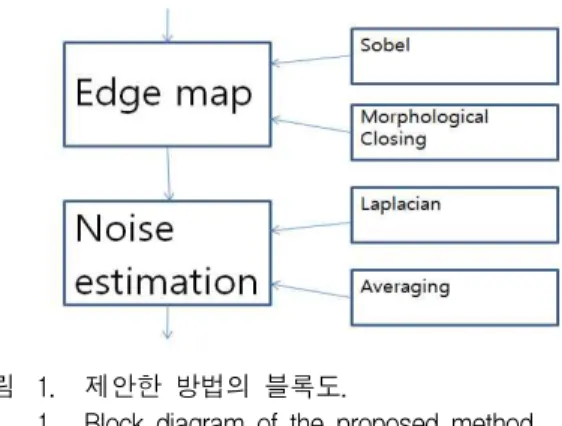
The proposed noise estimation method in moving pictures is based on filter-based approach. It has two stages. The proposed algorithm makes edge map with Sobel and morphological closing operations. It excludes detail structures and performs well for various noise levels. Obtained edge map efficiently excludes the details. Also, we estimates noise with averaging using a Laplacian operator. Fig. 1 shows the flowchart of the proposed noise estimation method.
In the first step in our method, the proposed algorithm detects the edge with Sobel operator. We filtered to make edge map which is used to exclude the edge pixels for estimation operations. We use Sobel operator which detect horizontal and vertical edges and isolate noisy pixels. In the Sobel operation, edge strength of input pixels are according to the
그림 1. 제안한 방법의 블록도.
Fig. 1. Block diagram of the proposed method.
value, as shown (2). Conventional methods [5∼6]
use the accumulated histogram of edge values.
However, they struggled to find the best choice of the threshold value and have different performances according to different types of images. In Sobel operations, means the threshold value for edge definition in histogram. The value is used to separate the image pixels into the edge region and the flat regions. Our proposed method has good results of edge detection according to local gradient values. To make robust edge map in spite of noise levels, we use morphological closing operator. It is used to separate and filter isolated pixels, efficiently.
The closing operation of the morphology filter is given by
′
●
(5)
where is a pixel in edge map image. ′
is a pixel in edge map image after closing operation.
is × structure element which is for dilation and erosion in closing operation. The operation includes dilation and erosion operations as follows
●
= (
⊕
) ⊖
(6)
where ⊕ is a dilation operator and ⊖ is an erosion operator, respectively. Morphological closing operation excludes more detail structures such as edges to estimate noise in flat regions. Thus, our proposed method has better results in estimation for selecting flat regions and estimation. However, if our method excludes too much regions, it cause to wrong estimation results. Thus, we use the edge map of morphological closing operation to estimate noise according to conditions as followsi f ′ min
′
′
and ′
(7)
where is a pixel-count of flat region according tothe edge map using Sobel operation and ′ is a pixel-count of flat region according to the edge map
′ using Sobel and morphological closing operation.
Thresholds min and are adopted experimentally as and which have good results.
Finally, we simply follow the same averaging method using a Laplacian operator[5] which excludes edge pixels. We estimated the standard deviation of the noise as follows
∈
(8)
where , , and are the width, height, and Laplacian operator, respectively. is a map image excluding detected edge pixels using Sobel and morphological closing operations.
Ⅳ. Experimental results
In this section, the proposed algorithm and existing motion estimation algorithm[5∼6] are simulated on several test video sequences, and the results are compared. Each sequence has 60 frames. We set the
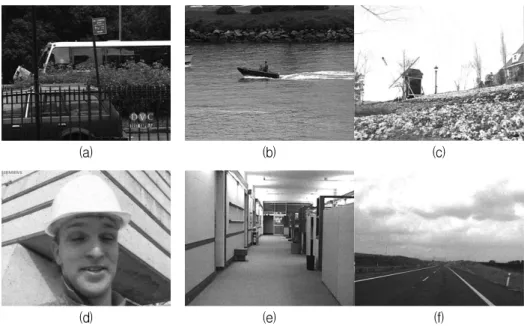
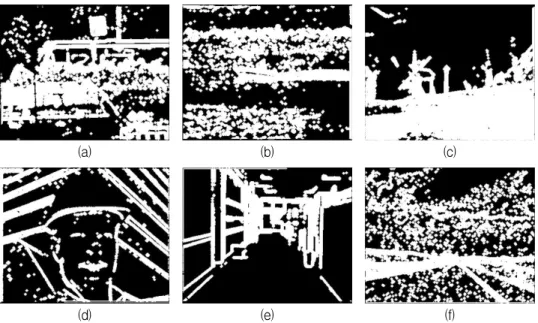
value in our method as , experimentally. Fig. 2 and Fig. 3 show test noisy video sequences which are corrupted by Gaussian noise and , respectively. Fig. 4 and Fig. 5 show edge maps of test video sequences which are derived from our method using Sobel and morphological closing operations. White pixel means a pixel of edge region.
Table 1, and 2 show the averages of absolute noise estimation errors in 60 frames of each test video sequences. The absolute noise estimation errors is
. are amounts of original and estimated noises, respectively. Table 1 and 2 show that the proposed algorithm has better performances than the existing method for noise level and
cases. The proposed method is simple and fast by Sobel and morphological closing operations.
(a) (b) (c)
(d) (e) (f)
그림 2. 테스트 잡음 동영상( ). (a) bus, (b) coastguard, (c) flower, (d) foreman, (e) hall, (f) highway.
Fig. 2. Test noisy video sequences( ). (a) bus, (b) coastguard, (c) flower, (d) foreman, (e) hall, (f) highway.
(a) (b) (c)
(d) (e) (f)
그림 3. 테스트 잡음 동영상( ). (a) bus, (b) coastguard, (c) flower, (d) foreman, (e) hall, (f) highway.
Fig. 3. Test noisy video sequences( ). (a) bus, (b) coastguard, (c) flower, (d) foreman, (e) hall, (f) highway.
Existing method [5]
Existing method [6]
Proposed method
bus 0.72 1.02 0.62
coastguard 0.48 0.54 0.34
flower 2.17 3.77 1.23
foreman 0.37 0.73 0.20
hall 0.11 0.30 0.01
highway 0.19 0.43 0.02
Average 0.67 1.13 0.40
표 1. 평균 잡음 추정 에러.( ).
Table 1. The average of the absolute noise estimation errors.( ).
Existing method [5]
Existing method [6]
Proposed method
bus 0.37 0.57 0.35
coastguard 0.25 0.28 0.16
flower 0.95 2.27 0.80
foreman 0.21 0.44 0.08
hall 0.10 0.03 0.13
highway 0.28 0.08 0.28
Average 0.36 0.61 0.30
표 2. 평균 잡음 추정 에러.( ).
Table 2. The average of the absolute noise estimation errors.( ).
(a) (b) (c)
(d) (e) (f)
그림 4. 제안한 방법의 에지 맵 이미지( ). (a) bus, (b) coastguard, (c) flower, (d) foreman, (e) hall, (f) highway.
Fig. 4. Edge map images of proposed method( ).
(a) bus, (b) coastguard, (c) flower, (d) foreman, (e) hall, (f) highway.
(a) (b) (c)
(d) (e) (f)
그림 5. 제안한 방법의 에지 맵 이미지( ). (a) bus, (b) coastguard, (c) flower, (d) foreman, (e) hall, (f) highway.
Fig. 5. Edge map images of proposed method( ).
(a) bus, (b) coastguard, (c) flower, (d) foreman, (e) hall, (f) highway.
V. Conclusions
We proposed an efficient noise estimation method in moving pictures based on edge detection. It detects the edge map using Sobel and morphological closing operations. Noise estimation is performed on the flat region without edge pixels which have detail
structures. Thus, the proposed algorithm performs well for different type images by selecting flat regions. Further improved noise estimation in moving pictures can be developed by enhanced segmentation methods of noisy and non-noisy regions.
Experimental results show that the proposed method has better noise estimation performance in
저 자 소 개 김 영 로(평생회원)
1993년 고려대학교 전자공학과 학사
1996년 고려대학교 전자공학과 컴퓨터공학 석사 2001년 고려대학교 전자공학과
컴퓨터공학 박사
2001년~2003년 삼성전자 시스템LSI 책임연구원 2003년~현재 명지전문대학 컴퓨터정보과 교수
<주관심분야 : 신호 및 영상처리, 멀티미디어 통 신>
오 태 명(평생회원)
1985년 광운대학교 전자공학과 학사
1997년 고려대학교 전자공학과 컴퓨터공학 석사 2002년 고려대학교 전자공학과
컴퓨터공학 박사 1986년~1998년 삼성 SDI 선임연구원
1998년~현재 명지전문대학 컴퓨터전자과 교수
<주관심분야: 영상부호화, 멀티미디어 통신 및 영 상 압축>
video sequences than those of the conventional noise estimation methods.
References
[1] M. K. Ozkan, M. I Sezan, and A. M. Tekalp,
“Adaptive motion-compensated filtering of noisy image sequences,” IEEE Trans. Circuits Sys.
Video Technol., vol. 3, pp. 277-290, Aug. 1993.
[2] J. Kim and J. W. Woods, “3-D Kalman filter image motion estimation,” IEEE Trans. Image Processing, vol. 7, pp. 42-52, Jan. 1998.
[3] L. Sendur and I. W. Selesnick, “Bivariate shrinkage functions for wavelet-based denoising exploiting interscale dependency,” IEEE Trans.
Signal Processing, vol. 50, pp. 2744-2756, Nov.
2002.
[4] B. Tang, G. Sapiro, and V. Caselles, “Color image enhancement via chromaticity diffusion,”
IEEE Trans. Image Processing, vol. 10, pp.
701-707, 2001.
[5] S. -C. Tai and S. -M. Yang, “A fast method for image noise estimation using laplacian operator and adaptive edge detection,” In Proc.
ISCCSP 2008, Malta, pp. 12-14, Mar. 2008.
[6] J. Immerkaer, “Fast noise variance estimation,”
Computer Vision and Image Understanding, Vol.
64, No. 2, pp. 300-302, Sep. 1996.
[7] J. S. Lee and K. Hoppel, “Noise modeling and estimation of remotely sensed images,” in Proc.
1989 Int. Geoscience and Remote Sensing,
Vancouver, Canada, vol. 2, pp.1005-1008, Jun.
1989.
[8] A. Amer, A. Mitiche, and E. Dubois, “Reliable and fast structure oriented video noise estimation,” in Proc. IEEE Int. Conf. Image Processing, Montreal, Quebec, Canada, vol. 1, pp.840-843, Jul. 2002.
[9] S. G. Chang, B. Yu, and M. Vetterli, “Adaptive wavelet thresholding for image denoising and compression,” IEEE Trans. Image Process., vol.
9, no. 9, pp. 1532-1546, Sep. 2000.
[10] S. G. Chang, B. Yu, and M. Vetterli, “Spatially adaptive wavelet thresholding with context modeling for image denoising,” IEEE Trans.
Image Process., vol. 9, no. 9, pp. 1522-1531, Sep.
2000.
[11] D. L. Donoho and I. M. Johnstone, “Ideal spatial adaption via wavelet shrinkage,” Biometrika, vol.
81, pp. 425-455, 1994.
[12] A. Hashemi and S. Beheshti, “Adaptive noise variance estimation in BayesShrink,” IEEE Signal Processing Letters, vol. 17, no. 1, Jan.
2010.
[13] S. -D. Kim and K. -W. Lim, “Motion Adaptive Temporal-Spatial Noise Reduction Scheme with Separated Pre- and Post-Spatial Filter,” IEIE 46SP-5-14, pp. 40-47, Sep. 2009.
[14] B. -C. Song, “Motion-compensated noise estimation for effective video processing,” IEIE 46SP-5-14, pp. 120-125, Sep. 2009.