실내 환경 개선을 위한 광도, 이산화탄소 농도 및 배지 종류에 따른 실내 관엽식물들의 광합성 반응
박신애1·김민지1·류명화1·오명민2·손기철1*
1건국대 환경과학과, 2충북대 원예과학과
Photosynthetic Response of Foliage Plants Related to Light Intensity, CO
2Concentration, and Growing Medium for the Improvement
of Indoor Environment
Sin-Ae Park1, Min-Gi Kim1, Mung-Hwa Yoo1, Myung-Min Oh2, and Ki-Cheol Son1*
1Department of Environmental Science, Kon-Kuk University, Seoul 143-701, Korea
2Department of Horticultural Science, Chung-Buk National University, Cheong-Ju 361-763, Korea
Abstract. This study was performed to investigate photosynthetic responses of 4 foliage plants in relation to light intensity, carbon dioxide concentration, and media, and to select efficient plants for the indoor environ- ment control based on the results. Four foliage plants used in this study included Syngonium podophyllum, Schefflera arboricola cv. Hong Kong, Dieffenbachia amoena, and Dracaena deremensis cv. Warneckii Com- pacta. The plants cultivated in two different growth media, peatmoss and hydroball, and subjected to various light intensities (0, 30, 50, 80, 100, 200, 400, and 600µmol · m−2· s−1 PPFD) and CO2 levels (0, 50, 100, 200, 400, 700, 1000, and 1500µmolCO2· mol−1). As a result of the photosynthetic rate of foliage plants according to change of light intensity and CO2 levels, Schefflera arboricola and Dieffenbachia amoena showed high apparent quantum yield, which stands for the photosynthetic rate under low light intensity, and both plants also recorded higher photosynthetic rate under high CO2 concentration compared to the other two indoor plants. Dracaena deremensis showed the lowest photosynthetic rate under the low light intensity or high CO2 concentration. There were inconsistent results in photosynthetic rate of foliage plants grown in peatmoss or hydroball. Higher photosynthetic rate was observed in Schefflera arboricola with peatmoss rather than hydroball as light and CO2 concentration increased. However, hydroball had a positive effect on Dieffenba- chia amoena in terms of photosynthetic rate. In case of Syngonium podophyllum, peatmoss induced higher photosynthetic rate according to increased light intensity, but there was no effect of media on the rate under various CO2 treatements. In contrast, media did not affect to photosynthetic efficiency of Dracaena deremen- sis subjected to various light intensities and the rate of Dracaena deremensis with peatmoss was a little high when CO2 concentration increased. In conclusion, potential plants for the indoor air pulification and environ- mental control were Schefflera arboricola and Dieffenbachia amoena because they showed high photosyn- thetic rate under typical indoor conditions, low light intensity and high CO2 concentration.
Key words : A-Ci curve, apparent quantum yield, CO2 fixation efficiency, photosynthetic rate, respiration rate
서 론
현대인들은 실내에서 하루의 80% 이상의 시간을 보 내고 있으며, 이로 인해 깨끗한 공기를 함유한 쾌적한
실내 환경은 인간의 건강과 삶의 질에 큰 영향을 미 치는 매우 중요한 요소로 부각되고 있다(Jenkins 등, 1992; Shin 등, 1993; Zhang과 Smith, 2003). 실내 에서 사용되는 연소기구, 건축자재, 각종 생활용품 등 에서 발생되는 분진, 담배연기, 이산화탄소, 일산화탄소, 포름알데히드, 라돈, 휘발성 유기화학물질 등이 실내 공기 오염(Yoon과 Spengler, 1995)과 빌딩증후군(sick
*Corresponding author: [email protected]
*Received July 7, 2010; Revised August 20, 2010;
*Accepted September 8, 2010
building syndrome)을 일으키는 원인으로 보고되었다 (Burge et al., 1987; Carpenter, 1998; Mendell and Smith, 1990). 이러한 물질들은 복합적으로 고농도를 이루어 점막 자극, 두통, 구역질 및 현기증과 같은 증 상을 일으키는 등 거주자의 건강에 악영향을 미치게 된다(Kim 등, 1997).
한편 식물은 광합성이나 호흡과 같은 생리 작용에서 일어나는 가스 교환시 잎의 기공을 통해 오염물질을 흡수함으로써 대기환경을 정화시킬 수 있는 잠재적 효 과가 보고됨에 따라(Sehemel, 1980), 식물을 이용하여 실내에서 발생하는 다양한 오염물질들을 제거하는 연 구들이 진행되고 있다(Han과 Lee, 2002; Kim 등, 2008; Park 등, 1998; Son 등, 2000; Woleverton 등, 1989). 또한, 실내공간에 식물을 도입함으로써, 쾌 적한 공간의 연출을 통한 심리적 안정과 스트레스 경 감 효과를 얻을 수 있으며(Bales, 1995; Relf와 Dorn, 1995), 광합성 작용과 증산 작용을 통한 실내공 기의 온습도 조절 효과(Son과 Kim, 1998; Snyder, 1990)와 음이온 발생 효과(Park 등, 1998) 등을 얻을 수 있다.
실내 식물을 유지 및 관리하는데 중요한 요소중 하 나는 배지이다. 대부분 실내식물의 분토양은 피트모스 (peatmoss)를 기본으로 한 배지를 사용하고 있지만, 최 근들어 식물의 수분 관리를 용이하게 하기 위한 하이 드로볼(hydroball) 배지를 이용한 수경재배 용기의 사 용이 증가하고 있다(Son, 2004). 하이드로볼 배지는 일반 배양토 대신에 황토를 구워 둥근 입자모양으로 만든 것이므로 토양의 입자가 매우 크기 때문에 토양 공극 내에 항상 많은 공기를 함유할 수 있다(Korean Floricultural Research Society, 2002). 따라서, 하이 드로볼 배지를 이용하면 뿌리의 일부는 물 속에 잠기 더라도 일부는 공기 중에 노출되어 식물이 생육하는데 지장이 없게 되며, 배수공이 없는 다양한 디자인의 화 분 용기들은 실내 장식품으로도 이용될 수 있다(Son, 2004). 하지만, 수분 관리에 편리한 하이드로볼을 사용 한 실내 식물의 공기 정화 능력 검정에 대한 자료는 많이 부족한 실정이다.
따라서 본 연구에서는 실내에서 많이 재배되는 관엽 식물 4종을 선정하여 피트모스를 기본으로 한 혼합배 지와 다공성배지인 하이드로볼 배지에 각각 재배 함으 로써 배지에 따른 실내 식물들의 실내 공기정화 능력
과 연관된 생리적 반응들을 검정하고, 또한 배지별로 식물의 광합성에 영향을 주는 광도와 이산화탄소 농도 변화량에 대한 생리적 반응에 관한 기본적인 자료를 수집하고자 수행하였다.
재료 및 방법
1. 식물재료 및 재배환경
실내환경에서 많이 이용되는 4종의 관엽식물인, 싱 고니움(Syngonium podophyllum), 쉐프렐라 홍콩 (Schefflera arboricola cv. Hong Kong), 디펜바키아 (Dieffenbachia amoena), 드라세나 와네키(Dracaena deremensis cv. Warneckii Compacta)를 실험재료로 사용 하였다. 경기도에 위치한 농가에서 재배된 식물을 구입한 후 직경 12 또는 18cm 화분에 피트모스 배지 (Sunshine mixed No.1, SunGro Inc., USA)와 하이 드로볼 배지(Luwasa hydroculture, Switzerland)를 사 용하여 옮겨 심었다. 모든 공시식물은 건국대학교 유리 온실에서 2개월 동안 순화시켰으며(200 ± 50µmol · m−2· s−1 광도, 25 ± 5oC 온도, 40 ± 10% 습도), 토양의 충 분한 수분 유지를 위하여서 피트모스 배지에 이식된 식물은 5일마다 한번씩, 하이드로볼 배지에 이식된 식 물은 1~2일마다 한번씩 상면관수 하였다. 또한 액비 Technigro(N : P : K = 24 : 7 : 5, SunGro Inc., USA) 20ppm을 1주마다 엽면시비하였다.
2. 광합성 측정
광도 및 엽육내 이산화탄소 농도변화에 따른 광합성 반응(light response curve, A-Ci curve)을 조사하기 위하여 휴대용 광합성 측정기를 사용하였으며(Li-6400, Li-Cor, USA), 측정은 오전 8시부터 오후 1시 사이에 수행하였다. 잎에 조사되는 빛의 광도와 leaf chamber 에 공급되는 이산화탄소 농도를 임의로 조절하기 위하 여 광합성 측정기에 LED light source와 CO2 injector system을 부착하였다. 광도 변화에 따른 광합성 반응 조사는 광합성 측정기의 leaf chamber에 유입되는 공 기의 유량을 250µmol · s−1, 온도를 23oC, 이산화탄소 농도를 400µmolCO2· mol−1 조건으로 설정한 후 측정 하였다. 이 때 광도는 0, 30, 50, 80, 100, 200, 400, 600µmol · m−2· s−1의 8가지 수준으로 처리하였다 . 광도 변화에 따른 광합성 속도를 측정한 후, 광-광합
성 곡선(light response curve)을 작성하고, 이 곡선에 서 광보상점, 광포화점, 호흡율, 광합성 능력, 순양자수 율(apparent quantum yield)을 산출하였다(Kim 등, 2001; Kim과 Lee, 2001). 순양자수율은 Kok효과 (Kok, 1948)의 영향이 적은 PPFD 0~100µmol · m−2· s−1 영역에서 광과 광합성의 직선회귀선 y = a + bx의 기울기 b로 하였다. 직선회귀선의 x절편(Lcomp=−a/b) 을 광보상점(Lcomp)으로, 광포화점(Lsat)은 직선회귀의 연장선과 광도에 따른 광합성 속도의 증가가 매우 완 만하게 나타나는 PPFD 200µmol · m−2· s−1 이상에서 의 광합성 속도가 서로 만나는 접점 Lsat= (Asat− a)/
b을 산출하였다. 광합성 능력은 광포화점보다 높은 광 도에서의 광합성 속도를 평균하였다(Kim 등, 2001;
Kim과 Lee, 2001).
엽육내 CO2농도 변화에 의한 광합성 반응은 광도 700µmol · m−2· s−1에서 측정하였으며, leaf chamber에 유입되는 공기의 유량과 온도는 광도 변화에 대한 광 합성 반응 측정과 동일한 조건으로 하였다. Leaf chamber에 공급되는 이산화탄소 농도는 0, 50, 100, 200, 400, 700, 1000, 1500µmolCO2· mol−1 8가지 수준으로 처리하였다. 광합성 측정기의 leaf chamber 에 공급되는 CO2농도를 달리 하면서 측정된 광합성 속도의 결과를 사용하여 광합성 반응(A-Ci curve)을 작성하고, 이산화탄소 보상점, 광호흡속도, 최대 광합성 속도, 이산화탄소 고정효율(CO2 fixation efficiency)값 을 산출하였다(Kim 등, 2001; Kim과 Lee, 2001).
광합성에서 이산화탄소 고정계의 활성을 반영한 탄소 고정효율은 Ci에 따른 광합성의 증가가 직선적으로 이 루어지는 Ci 150µmolCO2· mol−1 이하에서의 회귀직 선 y = a + bx의 기울기 b로 하였다(Farquhar 등, 1980). 한편, 이 회귀직선에서 y절편인 a, 즉 Ci의 값 이 0µmolCO2· mol−1일 때의 CO2 교환 속도를 광호 흡속도로 하였다. 이산화탄소 보상점(Ccomp)을 직선회귀 의 x절편인 Ccomp=−a/b로 산출하였다(Kim 등, 2001;
Kim과 Lee, 2001). 처리별 6개체씩 반복 측정하였다.
3. 통계분석
품종과 배지 차이에 의한 광보상점, 광포화점, 호흡 률, 광합성 능력, 순양자수율, 이산화탄소 보상점, 광호 흡 속도, 최대 광합성 속도, 이산화탄소고정 효율값은 SAS(Statistical Analysis System, version 9 for
Windows, SAS Institute Inc, Cary, NC)를 이용하여 분산분석(ANOVA)을 실시 하였으며, p = 0.05 수준에 서 유의성을 검증하였다. Duncan의 다중 범위 검증 (Duncan’s multiple range test)을 실시하여 각 항목들 의 평균값을 비교하였다.
결과 및 고찰
1. 광-광합성 곡선(Light response curve)
다른 두개의 배지에서 재배된 4종류의 관엽식물에서 광 강도에 따른 광합성률의 변화를 알아보고자 잎에
Fig. 1. Photosynthetic rate of Syngonium podophyllum, Schefflera arboricola, Dieffenbachia amoena, and Dra- caena deremensis grown under hydroball and peatmoss according to increased PPFD.
조사되는 광 강도를 달리하면서 측정한 광합성률을 토 대로 하여 광-광합성 곡선(light response curve)을 작 성하였다(Fig. 1). 모든 관엽식물에서 저광도영역(PPFD 0~100µmol · m−2· s−1)에서는 광도가 증가함에 따라 광 합성 속도도 급격히 상승하였으며, 광도가 더욱 증가함 에 따라 광합성 속도의 증가율은 점점 감소하는 양상 을 보였다. 사용된 배지와 관엽식물의 종류에 따라 광 합성률의 변화 양상은 달랐다. 쉐프렐라 홍콩과 싱고니 움의 광합성 속도는 피트모스 배지에 재배한 경우가 하이드로볼에 재배한 것 보다 높았으나, 디펜바키아는 하이드로볼에서 재배한 경우가 다소 높은 광합성율을 보였다. 드라세나 와네키는 배지간에 별다른 차이를 보 이지 않았다(Fig. 1).
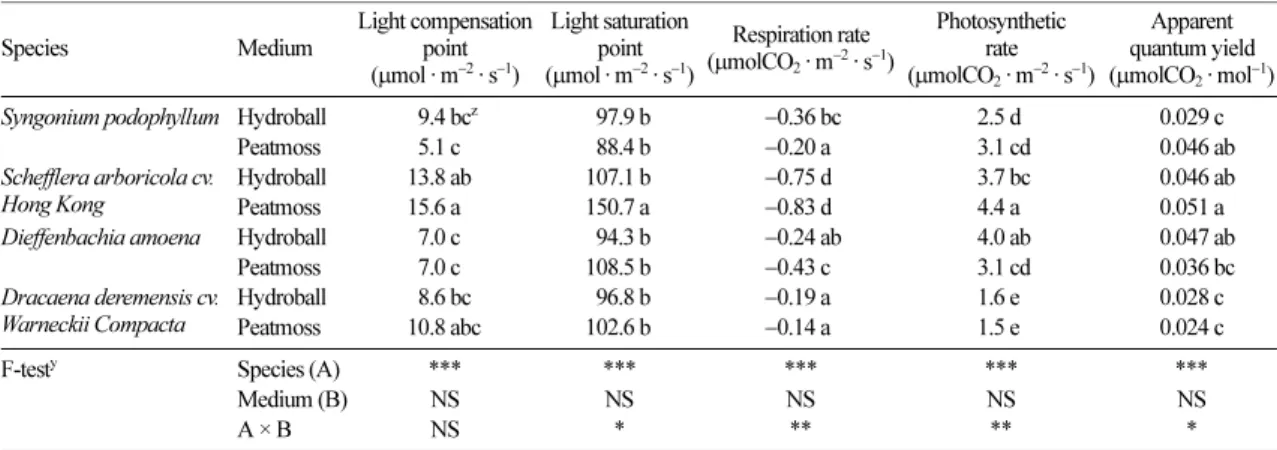
광-광합성 곡선을 토대로하여 광보상점, 광포화점, 호흡율, 광합성 능력, 순양자수율(apparent quantum yield)을 산출하였다(Table 1). 전체적으로 관엽식물의 종류는 모든 항목에 직접적인 영향을 미쳤지만 배지 처리는 영향을 미치지 못했으며, 종류와 배지간의 상호 작용에 의한 영향은 광보상점을 제외한 모든 항목에서 검증되었다. 광보상점은 관엽식물의 종류에 따라 유의 적 차이를 보였다. 쉐프렐라 홍콩과 드라세나 와네키가 비교적 높은 광보상점을 보였다. 광포화점은 피트모스 에서 자란 쉐프렐라 홍콩을 제외하고 관엽식물 종류간 배지처리간 유의적 차이를 보이지 않았다. 호흡율 또한 종류에 따라 차이가 있었으며, 싱고니움과 디펜바키아 에서 배지 처리에 따라 차이를 보였지만 상반된 결과
를 보였다. 광합성 속도와 순양자수율은 쉐프렐라 홍콩 과 디펜바키아가 비교적 높았으며, 드라세나 와네키는 다른 세가지 관엽식물에 비해 유의적으로 낮은 값을 기록하였다. 따라서 위의 결과를 종합하면 피트모스와 하이드로볼 처리에 의한 광합성 효율의 변화는 크지 않 았으며, 광도 증가에 의해서 쉐프렐라 홍콩이나 디펜바 키아가 효율적으로 광합성을 하였고, 드라세나 와네키는 가장 저조한 광합성 효율을 보여 실내 환경 개선을 위 한 실내식물로는 적합하지 않을 것으로 판단되었다. 이 는 Asaumi 등(1993)이 보고한 결과와 일치하였다.
2. 엽육내 이산화탄소 농도에 따른 광합성 곡선(A- Ci curve)
이산화탄소 농도에 따른 광합성의 정도 또한 관엽식 물의 종류에 따라 달랐다. 쉐프렐라 홍콩은 조사식물 중 가장 높은 광합성 효율을 보였다. 디펜바키아와 싱 고니움이 중간 정도의 효율을 보였으며 드라세나 와네 키는 광에 따른 광합성 반응 효율과 마찬가지로 가장 낮은 저조한 광합성율을 보였다(Fig. 2). 배지종류에 따라서도 이산화탄소의 농도가 증가할수록 싱고니움을 제외한 사용된 모든 관엽식물에서 광합성 속도에 차이 가 생겼다. 쉐프렐라 홍콩과 드라세나 와네키에서는 피 트모스 배지가 광합성 속도를 증가시켰지만 디펜바키 아의 경우는 그 반대였다. A-Ci curve에서 이산화탄소 농도가 상승하면 광호흡이 억제되면서 광합성 속도가 상승하게 되지만 이산화탄소 농도가 더욱 상승하게 되
Table 1. Light compensation point, light saturation point, respiration rate, photosynthetic rate, and apparent quantum yield of 4 foliage plants according to two different media.
Species Medium
Light compensation point (µmol · m−2· s−1)
Light saturation point (µmol · m−2· s−1)
Respiration rate (µmolCO2· m−2· s−1)
Photosynthetic rate (µmolCO2· m−2· s−1)
Apparent quantum yield (µmolCO2· mol−1)
Syngonium podophyllum Hydroball 09.4 bcz 097.9 b −0.36 bc 2.5 d 0.029 c
Peatmoss 05.1 c 088.4 b −0.20 a 3.1 cd 0.046 ab
Schefflera arboricola cv.
Hong Kong
Hydroball 13.8 ab 107.1 b −0.75 d 3.7 bc 0.046 ab
Peatmoss 15.6 a 150.7 a −0.83 d 4.4 a 0.051 a
Dieffenbachia amoena Hydroball 07.0 c 094.3 b −0.24 ab 4.0 ab 0.047 ab
Peatmoss 07.0 c 108.5 b −0.43 c 3.1 cd 0.036 bc
Dracaena deremensis cv.
Warneckii Compacta
Hydroball 08.6 bc 096.8 b −0.19 a 1.6 e 0.028 c
Peatmoss 10.8 abc 102.6 b −0.14 a 1.5 e 0.024 c
F-testy Species (A) *** *** *** *** ***
Medium (B) NS NS NS NS NS
A × B NS * ** ** *
zMean separation within colum by Duncan’s multiple range test at P = 0.05.
yNS,*,**,***Nonsignificant or significant at P = 0.05, 0.01, or 0.001, respectively.
면 광합성 속도가 더 이상 증가하지 않는다는 보고 (Farquhar 등, 1980; Kim과 Lee, 2001)와 같이 본 실험에서도 동일하게 나타났다.
A-Ci curve를 토대로 이산화탄소 보상점, 광호흡율, 최대광합성율, 이산화탄소 고정효율을 계산하였다(Table 2). 이산화탄소 보상점은 작물별, 배지별 유의적 차이 가 없었으며, 광호흡은 쉐프렐라 홍콩에서 가장 크게 나타났으며, 특히 피트모스에서 재배시 하이드로볼에 비해 유의적으로 큰 광호흡을 나타냈다. 이 결과는 광 도 및 광합성 속도가 높을수록 광호흡이 크게 나타난 다는 이전 실험의 결과와 일치하는 것이다(Jackson and Volk, 1970). 최대광합성율과 이산화탄소 고정효
율은 앞에서 언급한 A-Ci curve의 결과와 일치하였다.
쉐프렐라 홍콩이 배지에 관계없이 가장 활발한 광합성 을 보였으며, 드라세나 와네키는 가장 저조한 광합성율 을 보였다.
실내 관엽식물들의 환경에 따른 광합성 결과들을 종 합하여 볼 때 저광조건에서 광합성율을 나타내는 순양 자수율이 높은 쉐프렐라 홍콩과 디펜바키아가 실내환 경에서 공기정화에 효과적이라고 판단돠었다. 또한 이 두 실내식물은 실내 환경에서 자주 발생되는 고농도의 이산화탄소 환경에서도 높은 광합성율을 나타냈다. 특 히 쉐프렐라 홍콩은 높은 광합성율과 더불어 높은 증 산율을 기록(데이터 미제시)하여 봄·가을과 같은 건 조한 시기에 실내 상대습도 조절에도 유용할 것이라고 생각된다(Asaumi 등, 1995). 두개의 다른 배지에 처 리 시 식물의 종류에 따라서 엇갈린 반응을 보였다.
쉐프렐라 홍콩은 피트모스 배지에서 광과 이산화탄소 농도가 증가됨에 따라 하이드로볼 배지에 비해 높은 광합성 속도를 보였으며, 디펜바키아는 정 반대로 하이 드로볼 배지에서 더욱 높은 광합성율을 기록했다. 싱고 니움의 경우는 광처리에 의해서는 피트모스 배지에서 높은 광합성율을 보였지만 이산화탄소 처리에서는 배 지간 차이가 없었다. 최근 Jang 등(2010)의 연구에서 도 싱고니움의 재배시 하이드로볼은 피트모스를 포함 한 대조구처리에 비해 지하부의 생육을 제외한 모든 생육측정 항목에서 유의적 차이가 나타나지 않았다. 따 라서 앞으로 이 부분에 대해 추가적인 연구가 필요한 것으로 사료되었다. 하이드로볼 배지 사용시 확연한 생 육감소가 나타나지 않은 점과 건조시에도 분진발생율 도 낮다는 점을 감안했을 때 다공성인 하이드로볼 배 지를 이용하여 실내식물을 무배수공 용기에 수경재배 가능하다고 판단된다. 광합성 효율이 가장 높았던 쉐프 렐라 홍콩이나 하이드로볼 배지에서 높은 효율을 보인 디펜바키아가 실내 공기 정화 및 실내 환경 조절에 적합할 것으로 판단된다.
적 요
본 연구는 관엽식물 4종을 배지종류, 광도 및 이산 화탄소 농도를 달리하여 식물의 광합성 반응을 조사하 고, 그 결과에 기초하여 실내환경 조절에 효율적인 식 물을 선정하고자 실시하였다. 식물재료로는 싱고니움, Fig. 2. A-Ci curves of Syngonium podophyllum, Schefflera
arboricola, Dieffenbachia amoena, and Dracaena dere- mensis grown under hydroball and peatmoss.
디펜바키아, 쉐프렐라 홍콩, 드라세나를 사용하였으며, 성분과 성질이 다른 두 배지(peatmoss, hydroball)에 각각 재배하였다. 광도는 PPFD 0, 30, 50, 80, 100, 200, 400, 600µmol · m−2· s−1의 수준으로 조절하고, 이산화탄소 농도는 0, 50, 100, 200, 400, 700, 1000, 1500µmolCO2· mol−1의 수준으로 처리하였다.
광도 및 엽육내 CO2농도변화에 따른 관엽식물의 광 합성 반응을 조사한 결과, 약광에서의 광합성 능력을 나타내는 순양자수율은 쉐프렐라 홍콩과 디펜바키아에 서 높게 나타났으며, 두 실내식물은 고농도의 이산화탄 소 환경에서도 다른 두 식물에 비해 높은 광합성율을 기록했다. 드라세나 와네키는 두 조건 모두에서 가장 낮은 광합성 효율을 보였다. 두 배지 처리에 따라서는 각각의 관엽식물에서 엇갈린 광합성 반응이 관찰되었 다. 쉐프렐라 홍콩은 피트모스 배지에서 광과 이산화탄 소 증가에 따라 하이드로볼 배지에 비해 높은 광합성 속도를 보였지만, 디펜바키아는 그와는 정반대로 하이 드로볼 배지에서 더욱 높은 광합성율을 기록했다. 싱고 니움의 경우는 광처리에 의해서는 피트모스 배지에서 높은 광합성율을 보였지만 이산화탄소 처리에서는 배 지간 차이가 없었다. 가장 낮은 광합성 효율을 보인 드라세나 와네키는 광에 의한 배지간 차이가 없었으며, 이산화탄소 증가시에는 피트모스에서 다소 높은 광합 성율을 보였다. 따라서 실험한 4가지 관엽식물 중 광 합성 효율이 가장 높았던 쉐프렐라 홍콩이나 하이드로
볼 배지에서 높은 효율을 보인 디펜바키아가 실내 공 기정화 및 실내 환경조절에 적합할 것으로 판단된다.
주제어 : 광합성율, 순양자수율호흡율, 이산화탄소 고정 효율, A-Ci 곡선
사 사
본 연구는 환경부에서 시행한 환경기술개발사업의 과제임.
인 용 문 헌
1. Asaumi, H., H. Nishina, H. Nakamura, Y. Masui, and Y. Hashimoto. 1995. Effect of ornamental foliage plants on visual fatigue caused by visual display termi- nal operation. J. SHITAI 7:138-143.
2. Asaumi, H., H. Nishina, N. Masui, and Y. Hasimoto.
1993. Measurement of transpiration rate, stomatal resistance and shading ratio of ‘amenity plants’. J.
SHITAI 4:131-138.
3. Balse, S.F. 1995. The kitchen garden. Raised beds and electric chairs. Horticulture 73:34-39.
4. Burge, S., A. Hedge, S. Wilson, B.J. Harris, and A.
Robertson. 1987. Sick building syndrome: A study of 4373 office workers. Annals of Occupational Hygiene 31:493-504.
5. Carpenter, D.O. 1998. Human health effects of envi- ronmental pollutants: New insights. Env. Monitoring Table 2. CO2 compensation point, photo-respiration rate, maximum photosynthetic rate, and CO2 fixation efficiency of 4 foli-
age plants according to two different media.
Species
Medium
CO2 compensation point (µmolCO2· mol−1)
Photorespiration rate (µmolCO2· m−2· s−1)
Maximum photosynthetic rate (µmolCO2· m−2· s−1)
CO2 fixation efficiency (µmolCO2· mol−1) Syngonium podophyllum Hydroball 69.4 bcz 1.10 de 09.0 b 0.015 d
Peatmoss 61.3 bc 1.14 cde 07.9 bc 0.019 cd Schefflera arboricola cv.
Hong Kong
Hydroball 73.1 bc 1.85 b 10.0 b 0.027 b
Peatmoss 62.3 bc 2.59 a 14.3 a 0.042 a
Dieffenbachia amoena Hydroball 60.0 c 1.32 cd 10.7 b 0.022 bc Peatmoss 82.5 ab 1.23 cde 07.4 bcd 0.015 d Dracaena deremensis cv.
Warneckii Compacta
Hydroball 93.6 a 0.89 e 04.7 cd 0.012 d
Peatmoss 67.5 bc 1.48 c 04.3 d 0.017 cd
F-testy Species (A) NS *** *** ***
Medium (B) NS *** NS *
A × B ** ** * ***
zMean separation within colum by Duncan’s multiple range test at P = 0.05.
yNS,*,**,***Nonsignificant or significant at P = 0.05, 0.01, or 0.001, respectively.
and Assessment 53:245-258.
6. Farquhar, G.D., von S. Caemmerer, and J.A. Berry.
1980. A biochemical model of photosynthetic CO2 assimilation in leaves of C3 species. Planta 149:78-90.
7. Han, S.W. and J.S. Lee. 2002. Purification efficiency of O3 and SO2 by some oriental orchids. J. Kor. Soc.
Hort. Sci. 43:487-491 (In Korean).
8. Jackson, W.A. and R.J. Volk. 1970. Photorespiration.
Annual Review Plant Physiology 21:385-432.
9. Jang, H.S., S.G. Lee, J.H. Moon, and C.H. Park. 2010.
Growth of Syngonium podophyllum in drainless con- tainers fitted with drainage layers. Kor. J. Hort. Sci.
Technol. 28:192-199 (In Korean).
10. Jenkins, P.L., T.J. Phillips, E.J. Mulberg, and S.P. Hui.
1992. Activity patterns of Californians: Use of and proximity to indoor pollutant sources. Atmospheric Env. 26A:2141-2148.
11. Kim, K.J., M.J. Kil, J.S. Song, E.H. Yoo, K.C. Son, and S.J. Kays. 2008. Efficiency of volatile formalde- hyde removal by indoor plants: Contribution of aerial plant parts versus the root zone. J. Amer. Soc. Hort.
Sci. 133:521-526.
12. Kim, M.G., C.O. Park, Y.J. Kwon, Y.K. Lee, and D.W.
Lee. 1997. Variations of concentration levels of vola- tile organic compounds in the indoor air due to floor waxing. J. KAPPA 13(3):221-229.
13. Kim, P.G. and E.J. Lee. 2001. Ecophysiology of photo- synthesis 1: Effects of light intensity and intercellular CO2 pressure on photosynthesis. Kor. J. Agr. Forest Meteorology 3:126-133 (In Korean).
14. Kim, P.G., Y.S. Yi, D.J. Chung, and S.Y. Woo. 2001.
Effects of light intensity on photosynthetic activity of shade tolerant and intolerant tree species. J. Kor. For.
Soc. 90:476-487 (In Korean).
15. Kok, B. 1948. A critical consideration of the quantum yield of chlorella-photosynthesis. Enzymologia 13:1- 16.
16. Korean Floricultural Research Society. 2002. Floricul- tural and Horticultural Treatises. Moon Woon Dang Press. Seoul. p. 264.
17. Mendell, M.J. and A.H. Smith. 1990. Consistant pat- tern of elevated symptoms in air-conditioned office buildings: A re-analysis of epidemiological studies.
Amer. J. Public Health 80:1193-1199.
18. Park, S.H., Y.B. Lee, G.Y. Bea, and M. Kondo. 1998.
Anion Evolution in plants and its involved factors. J.
Kor. Soc. Hort. Sci. 39:115-118 (In Korean).
19. Relf, D. and S. Dorn. 1995. Horticulture: Meeting the needs of special population. HortTechnology 5:94-103.
20. Sehemel, G.A. 1980. Particle and gas deposition.
Atmos. Env. 14:983-1011.
21. Shin, H.S., Y.S. Kim, and G.S. Heo. 1993. Measure- ments of indoor and outdoor volatile organic com- pounds (VOCs) concentrations in ambient air. J.
KAPPA 9(4):310-319.
22. Snyder, S.D. 1990. Building interiors, plants and auto- mation. Prentice Hall, Englewood Cliffs, NJ, USA. p.
5-29.
23. Son, K.C. 2004. Indoor plants for human well-being.
Joongang Life Publishing Co., Seoul, Korea. p.125- 127.
24. Son, K.C. and M.K. Kim. 1998. Influences of indoor light, temperature, absolute humidity, and CO2 concen- tration on the changes of transpiration and photosyn- thesis rate of Pachira aquatica and their statistical modeling. J. Kor. Soc. Hort. Sci. 39:605-609 (In Korean).
25. Son, K.C., S.H. Lee, S.G. Seo, and J.E. Song. 2000.
Effects of foliage plants and potting soil on the absorp- tion and adsorption of indoor air pollutants. J. Kor.
Soc. Hort. Sci. 41:305-310 (In Korean).
26. Woleverton, B.C., A. Johnson, and K. Bounds. 1989.
Interior landscape plant for indoor air pollution abate- ment. NASA Report. p. 1-2.
27. Yoon, D.W. and J.D. Spengler. 1995. Standards for indoor air pollutant levels and ventilation rates. Archi- tectural Institute of Korea 39(6):12-18 (In Korean).
28. Zhang, J.J. and K. R. Smith. 2003. Indoor air pollu- tion: A global problem. British Medical Bul. 68:209- 225.