189
ABBREVIATIONS: [Ca2+]i, cytosolic Ca2+ level; PSS, physiologic salt solution; cAMP, 3’5’-cyclic monophosphate; fura-2/AM, fura-2 acethoxy- methyl ester; FCCP, carbonylcyanide p-(trifluoro-methoxy)phenylhy- drazone.
Received April 28, 2009, Revised May 15, 2009, Accepted June 2, 2009
Corresponding to: Seong Chun Kwon, Department of Physiology, College of Medicine, Kwandong University, 522, Naegok-dong, Gangnung 210-751, Korea. (Tel) 82-33-649-7463, (Fax) 82-33-641- 1074, (E-mail) [email protected]
Forskolin Changes the Relationship between Cytosolic Ca
2+and Contraction in Guinea Pig Ileum
Koon Hee Han1,2, Gap Jin Cheon1,2, Dong Soo Yeon2, and Seong Chun Kwon2
1Department of Internal Medicine, Gangnung Asan Hospital, Gangnung 210-711, 2Department of Physiology, College of Medicine, Kwandong University, Gangneung 210-751, Korea
This study was designed to clarify the mechanism of the inhibitory effect of forskolin on contraction, cytosolic Ca2+ level ([Ca2+]i), and Ca2+ sensitivity in guinea pig ileum. Forskolin (0.1 nM∼ 10 μM) inhibited high K+ (25 mM and 40 mM)- or histamine (3 μM)-evoked contractions in a concentration- dependent manner. Histamine-evoked contractions were more sensitive to forskolin than high K+- evoked contractions. Spontaneous changes in [Ca2+]i and contractions were inhibited by forskolin (1 μM) without changing the resting [Ca2+]i. Forskoln (10 μ M) inhibited muscle tension more strongly than [Ca2+]i stimulated by high K+, and thus shifted the [Ca2+]i-tension relationship to the lower-right.
In histamine-stimulated contractions, forskolin (1 μ M) inhibited both [Ca2+]i and muscle tension without changing the [Ca2+]i-tension relationship. In α-toxin-permeabilized tissues, forskolin (10 μ M) inhibited the 0.3 μ M Ca2+-evoked contractions in the presence of 0.1 mM GTP, but showed no effect on the Ca2+-tension relationship. W e conclude that forskolin inhibits smooth muscle contractions by the following two mechanisms: a decrease in Ca2+ sensitivity of contractile elements in high K+- stimulated muscle and a decrease in [Ca2+]i in histamine-stimulated muscle.
Key Words: Fosrkolin, Cytosolic Ca2+, Ca2+ sensitivity, Guinea pig ileum
INTRODUCTION
It is generally accepted that adenosine 3',5'-cyclic mono- phosphate (cAMP) is the intracellular messenger by which many smooth muscle relaxants inhibit the generation or maintenance of muscle tension (Murray, 1990; Lincoln and Cornwell, 1991; Ozaki et al., 1992; Murthy, 2006; Porter et al., 2006). Smooth muscle relaxation induced by cAMP occurs after activation of cAMP-dependent protein kinase (Eckly-Michel et al., 1997; Porter et al., 2006). In smooth muscle, cAMP decreases resting tone and inhibits contrac- tion induced by various agonists, although the mechanism of the inhibitory effect is not fully understood. One of the possibilities is that cAMP decreases [Ca2+]i by inhibiting Ca2+ influx or by activating Ca2+ sequestration (Abe and Karaki, 1988; Cooper, 2003). Another possibility is that cAMP-dependent protein kinase phosphorylates myosin light chain kinase and inhibits the activity of this kinase, thus inhibiting contractile elements (Adelstein et al., 1986;
Woodrum et al., 1999). Forskolin, a diterpene isolated from the roots of Coleus forskohli, is known to stimulate adenylate cyclase directly, resulting in an increase of intracellular cAMP levels, and to relax vascular smooth muscles (Seamon and Daly, 1986; Rembold and Chen, 1998). This provides
a good pharmacologic tool to investigate the role of cAMP.
Although the rise in [Ca2+]i initiates contractions in smooth muscle, there is not a simple relationship between [Ca2+]i and tension. Several agonists have been shown to alter the sensitivity of the contractile apparatus to Ca2+. For example, high K+ induces less contractile tension for a given increase in [Ca2+]i than agonists, such as norepine- phrine in ferret portal veins, norepinephrine, prostaglsndins, and endothelin-1 in rat aortas, thromboxane analogues and phenylephrine in rabbit pulmonary arteries, carbachol in canine tracheas, and pilocarpine in ileum (Karaki, 1989).
Furthermore, several reports have suggested that re- ceptor-agonists induce greater myosin light chain phosphor- ylation than high K+ at a given [Ca2+]i (Ratz, 1999; Porter et al., 2006). A decrease in Ca2+ sensitivity due to cAMP has also been reported (Rembold and Chen, 1998; Rembold et al., 2001). Therefore, it is possible that modulation of smooth muscle contraction by cAMP is due to the decrease in [Ca2+]i and Ca2+ sensitivity.
Based on these findings, we now assume that cAMP in- duces relaxation by suppressing cytosolic Ca2+ concen- tration and by decreasing Ca2+ sensitivity in intestinal smooth muscle. In order to clarify the precise mechanism of the relaxant effect of forskolin on intestinal smooth mus- cle, we examined its effect on [Ca2+]i and muscle tension, as well as an α-toxin-permeabilized preparation.
Fig. 1. Concentration-response relationship for the inhibitory effect of forskolin on contractions induced by 25 mM KCl, 40 mM KCl, and 3 μM histamine. Forskolin (0.1 nM∼10 μM) was cumulatively added after the contractions reached a steady state.
METHODS Tissue preparation
Male guinea pigs (250∼300 g) were killed by a sharp blow to the neck and exsanguination. A section of the ileum was isolated and placed in a physiologic salt solution (PSS).
The lumen of the ileum was cleaned gently with PSS. A glass pipette, 7 mm in diameter, was inserted in the lumen of the ileum and the longitudinal muscle layer was sepa- rated from the underlying circular muscle layer. Segments of the longitudinal muscle layer (approximately 10 mm), were used for experiments.
Measurements of muscle tension
A muscle strip was attached to a holder under a resting tension of 0.5 g. After equilibration for 60∼90 min in PSS, each strip was repeatedly exposed to 40 mM KCl solution until the responses became stable. The high K+ solution was prepared by replacing NaCl with equimolar KCl.
Muscle contraction was recorded isometrically with a force- displacement transducer and recorded with a pen recorder.
The PSS contained the following compositions (in mM):
136.9 NaCl, 5.4 KCl, 1.5 CaCl2, 1.0 MgCl2, 23.8 NaHCO3, 0.01 ethylenediamine tetraacetic acid (EDTA), and 5.5 glucose. These solutions were saturated with a 95% O2 and 5% CO2 mixture at 37oC to maintain the pH at 7.4.
Fura-2 loading and simultaneous measurements of tension and [Ca2+]i
[Ca2+]i was measured according to the method described by Kwon et al. (2000b) using the fluorescent Ca2+ indicator, fura-2. Muscle strips were exposed to the acethoxymethyl ester of fura-2 (fura-2/AM [5 μM]) in the presence of 0.02%
cremophor EL for 3∼4 hr at room temperature. After load- ing, the muscle strip was washed with PSS at 37oC for 20 min to remove uncleaved fura-2/AM and was held horizon- tally in a temperature-controlled, 7 ml organ bath. One end of the muscle strip was connected to a force-displacement transducer to monitor the muscle contraction. The muscle strips were illuminated alternately (48 Hz) at two ex- citation wavelengths (340 and 380 nm). The intensity of the 500 nm fluorescence (F340 and F380) was measured using a fluorimeter (CAF-100; Jasco, Tokyo). The ratio of F340 to F380 (F340/F380) was calculated as an indicator of [Ca2+]i. The absolute Ca2+ concentration was not calcu- lated in this experiment because the dissociation constant of the fluorescence indicator for Ca2+ in the cytosol may be different from that obtained in vitro (Karaki, 1989).
Therefore, the ratio obtained in resting and 40 mM KCl-stimulated muscle was taken as 0% and 100%, respectively.
Permeabilized preparation
Permeabilized smooth muscle was prepared, as described by Kwon et al. (2000a). A thin bundle of ileum (120∼150 μm in diameter and 2∼3 mm in length) was dissected parallel to the longitudinal muscle fiber under a binocular micro- scope. The muscle strip was soaked for 5∼10 min at room temperature (22∼24oC) in a relaxing solution containing Staphylococcus aureus α-toxin (10 μM protein/ml). One end of the muscle strip was fixed to the chamber, and the other
end was attached to a force transducer under a resting ten- sion of 50 mg and equilibrated for 60∼90 min. During this period, 10 μM Ca2+ was repeatedly applied until the peak force became reproducible. The contractile force of the per- meabilized muscle was recorded isometrically. The Ca2+
concentration was changed by adding an appropriate amount of CaCl2. The apparent binding constant of EGTA was considered to be 1 μM at pH 6.8 and 20oC. The relax- ing solution used for the permeabilized tissue contained the following compositions (in mM): 130 potassium proprionate, 4 MgCl2, 5 Na2-ATP, 2 creatine phosphate, 10 creatine phosphokinase, 20 Tris-maleate (pH 6.8), and 2 EGTA.
Added to the relaxing solution were the mitochondrial in- hibitor, 1 μM carbonyl cyanide p-(trifluoro-methoxy)phen- ylhydrazone (FCCP), and the protease inhibitors, 1 μM E-64 and 1 μM leupeptin.
Statistics
The results of the experiments were expressed as the mean±SE mean. An unpaired Student’s t-test was used for statistical analysis of the results and the number of prepa- rations taken from separate animals was indicated by n.
p values<0.05 were considered to be significantly different.
RESULTS
The effect of forskolin on high K+- and histamine- evoked contractions
Fig. 1 shows the concentration-response relationship of the inhibitory effects of forskolin on high K+ (25 and 40 mM)- and histamine (3 μM)-evoked sustained contrac- tions. Forskolin inhibited histamine-evoked contractions more strongly than high K+-evoked contractions from 25 mM to 40 mM. The inhibitory effect of forskolin was re- duced by increasing the K+ concentration.
Fig. 3. Effects of forskolin on 40 mM KCl (A)- and 3 μM histamine (B)-stimulated [Ca2+]i (upper trace) and muscle tension (lower trace). 100% represents the 40 mM KCl- or histamine-induced increases in [Ca2+]i before addition of forskolin. In panel A, after 40 mM KCl-stimulated [Ca2+]i and muscle tension reached a steady state level, 10 μM forskolin and verapamil were sequentially added. Forskolin partially inhibited contraction without changing [Ca2+]i. Verapamil (10 μM), on the other hand, inhibited [Ca2+]i
and tension to the resting level. In panel B, when the [Ca2+]i and muscle tension induced by histamine (3 μM) reached a steady state level, 1 μM forskolin and 10 μM verapamil were sequentially added. Forskolin (1 μM) significantly inhibited [Ca2+]i and contrac- tions. Verapamil (10 μM) inhibited [Ca2+]i and tension to the resting level.
Fig. 2. The effect of forskolin (1 μM) on [Ca2+]i (upper trace) and muscle tension (lower trace) in spontaneously active ileum. 100%
represents the steady state [Ca2+]i in the presence of 40 mM KCl.
Forskolin (1 μM) inhibited rhythmic increases in [Ca2+]i and tension without changing the basal [Ca2+]i. EGTA (4 mM) decreased basal [Ca2+]i below the resting level with no further decrease in muscle tension.
Fig. 4. Effect of forskolin (10 μM, open circles) on the relationship between [Ca2+]i (abscissa) and muscle tension (ordinate) in the presence various concentrations of KCl (10, 15, 20, 30, and 40 mM) or histamine (0.03, 0.1, 0.3, 1, and 3 μM). 100% represents 40 mM KCl-induced increases in [Ca2+]i and muscle tension measured before cumulative addition of the stimuli. Each point represents the mean of 7∼10 experiments, and the SR mean is shown by vertical and horizontal bars.
The effect of forskolin on spontaneous activities Fig. 2 shows the inhibitory effect of 1 μM forskolin on the spontaneous rhythmic changes in [Ca2+]i and muscle tension. Forskolin inhibited the rhythmic changes in [Ca2+]i
and contractions without changing the basal [Ca2+]i. The addition of EGTA decreased the basal [Ca2+]i below the res- ting level and inhibited spontaneous rhythmic contractions.
The effect of forskolin on high K+- and histamine- evoked changes in [Ca2+]i and contractions
Fig. 3A shows the effect of forskolin on high K+ (40 mM)-evoked responses in the ileum. The addition of 10 μM forskolin inhibited muscle tension by 44.1±9.7% (n=6), with a small decrease in [Ca2+]i (3.8±0.8; n=6). Addition of vera- pamil (10 μM) decreased the remaining [Ca2+]i and con- tractions to the resting level.
Fig. 3B shows the inhibitory effect of forskolin on the his- tamine-evoked changes in [Ca2+]i and contractions. Forsko- lin (1 μM) inhibited the histamine-induced contractions by 68.4±7.7%, with a decrease in [Ca2+]i by 32.3±7.7% (n=6).
The effect of forskolin on the [Ca2+]i-tension relationship Fig. 4A shows that K+ (10, 15, 20, 30, and 40 mM) evoked concentration-dependent increases in [Ca2+]i and muscle
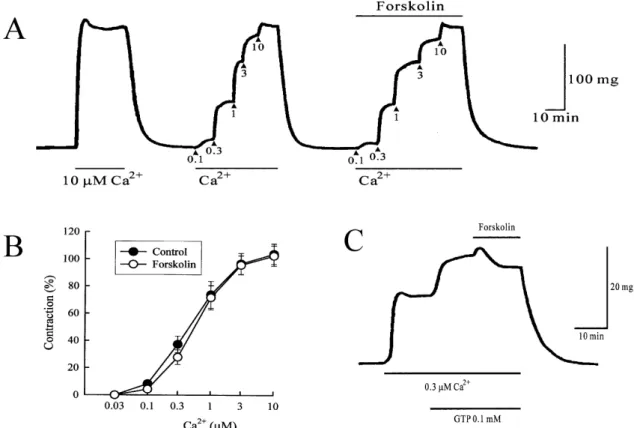
Fig. 5. (A) Effect of 10 μM forskolin on the contraction evoked by Ca2+ in α-toxin-permeabilized ileum. Ca2+ was cumulatively applied.
The experiments were repeated after application of 10 μM forskolin. As a control, 10 μM Ca2+ was applied. (B) The pCa2+-tension relationship observed before (●) and after application of 10 μM forskolin (○). The amplitude of 10 μM Ca2+ was taken as 100%. Each point represents the mean of 6 experiments and the SE mean is shown by a vertical bar. (C) Effects of 10 μM forskolin treated with 0.1 mM GTP. After permebilizing the tissues, 0.3 μM Ca2+ was applied. After the contraction induced by 0.3 μM Ca2+ had reached a steady level, 0.1 mM GTP and forskolin were sequentially applied.
tension. The relationship between [Ca ]i and muscle ten- sion suggests that there is a threshold [Ca2+]i for con- tractions (approximately 20% [Ca2+]i). When the [Ca2+]i in- creased above this level, there was a positive correlation between [Ca2+]i and muscle tension. Forskolin inhibited the high K+ (30 and 40 mM)-induced contractions without changing [Ca2+]i, whereas [Ca2+]i stimulated by 10, 15, and 20 mM of K+ was decreased. Thus, forskolin shifted the [Ca2+]i-tension curve to the lower-right and increased the threshold for contractions, suggesting that forskolin de- creased the Ca2+ sensitivity of contractile elements.
Fig. 4B shows the effect of 1 μM forskolin on histamine- evoked changes in [Ca2+]i and muscle tension. There is a positive correlation between [Ca2+]i and muscle tension in the presence of histamine (0.03, 0.1, 0.3, 1, and 3 μM) in a concentration-dependent manner. In the presence of for- skolin, the effects of histamine to increase [Ca2+]i and mus- cle tension were inhibited. Since forskolin inhibited both [Ca2+]i and muscle tension proportionally, the slope of the [Ca2+]i-tension relationship did not change. These results suggest that forskolin inhibits histamine-induced con- traction primarily by decreasing [Ca2+]i.
The effect of forskolin on Ca2+-evoked contractions in permeabilized muscle
Fig. 5A shows the pCa2+-tension relationship in the pres-
ence and absence of 10 μM of forskolin. In permeabilized ileum treated with α-toxin, the cumulative addition of 0.01
∼10 μM Ca2+ induced graded contractions in a concen- tration-dependent manner. The contractile responses were minimally affected by pretreatment of muscle fibers with 10 μM forskolin (Fig. 5B).
As shown in Fig. 5C, treatment of muscle with 0.1 mM GTP potentiated the contractions induced by 0.3 μM Ca2+. Forskolin (10 μM) inhibited the 0.3 μM Ca2+-evoked con- tractions in the presence of 0.1 mM GTP.
DISCUSSION
In the present study, we compared the inhibitory effects of forskolin on the contractions induced by high K+ and histamine in guinea-pig ileum. The results indicate that forskolin inhibited the increase in [Ca2+]i and muscle tension induced spontaneously or by stimulation with histamine.
Forskolin inhibited high K+-evoked contractions without or with only a small inhibition in [Ca2+]i. The [Ca2+]i, which was not inhibited by forskolin, was reduced by verapamil to the basal level, suggesting that this [Ca2+]i is due to Ca2+
entry from voltage-dependent Ca2+ channels. Furthermore, the inhibitory effect of forskolin was attenuated when the K+ concentration was increased. Histamine-induced con- tractions were more sensitive to forskolin than that induced
by high K+-induced contractions. The effects of forskolin on the [Ca2+]i-tension relationship in the presence of hista- mine showed that the inhibitory effect is mainly due to the decrease in [Ca2+]i, although this was not the case with the high K+-evoked contractions.
The decrease in [Ca2+]i may be due to the following: 1) inhibition of Ca2+ influx, 2) inhibition of Ca2+ release from sarcoplasmic reticulum, and 3) activation of Ca2+ seques- tration into intracellular stores. In smooth muscles, for- skolin may decrease [Ca2+]i by the following two mecha- nisms: 1) direct inhibition of voltage-dependent Ca2+ chan- nels and 2) indirect inhibition of Ca2+ channels following the activation of voltage- or Ca2+-dependent K+ channels.
The first possibility may be less likely since forskolin did not reduce high K+-induced increases in [Ca2+]i, which is readily inhibited by L-type Ca2+ channel blockers (Karaki and Weiss, 1984). A probable site of action is K+ channels;
indeed, an increase in K+ current hyperpolarizes the membrane. Higher concentrations of K+ may attenuate the membrane hyperpolarization due to opening K+ channels, and also by decreasing the transmembrane K+ gradient.
This may be the reason why the inhibitory effects of for- skolin on [Ca2+]i were less in the presence of high K+. Forskolin inhibited the increases in [Ca2+]i and muscle ten- sion induced spontaneously or by stimulation with hista- mine and this may be due to the inhibition of pacemaker activity by membrane hyperpolarization and/or the in- hibition of Ca2+ influx by the indirect inhibition of volt- age-dependent Ca2+ channels. Rembold and Chen (1998) reported that membrane hyperpolarization is involved in the inhibitory effect of forskolin. Forskolin significantly in- creased the cyclic AMP content, suggesting that the in- hibitory effect of forskolin is mainly mediated by cyclic AMP (Lincoln and Cornwell, 1991; Kwon et al., 1993). It has also been reported that Ca2+-activated K+ channels may be modulated by cAMP in various tissues, including vascular and visceral smooth muscle (Wellman et al., 2001; Ise et al., 2003). It is therefore possible that the increase in cAMP production in response to forskolin might activate K+ chan- nels via protein kinase A-mediated protein phosphorylation.
The second possibility for the forskolin-induced decrease in histamine-stimulated [Ca2+]i is the cAMP-mediated in- hibition of Ca2+ release from intracellular stores. It is known that cAMP can regulate [Ca2+]i mobilization from sarcoplasmic reticulum in a number of ways, including phosphorylation of IP3 and ryanodine receptors, and modu- lating the accumulation of Ca2+ in the sarcoplasmic reticulum. The inhibition by forskolin and dibutyryl cyclic AMP of phosphatidyl-inositol hydrolysis has been demon- strated in tracheal and vascular smooth muscles (Hall et al., 1989; Ahn et al., 1992). Previous reports have also sug- gested that elevation of cAMP leads to an increase in sarco- plasmic reticulum Ca2+ content and/or the probability of open ryanodine receptor channels (Wellman et al., 2001;
Morales et al., 2004).
It is also possible that the reduction in [Ca2+]i caused by forskolin could be related to an enhancement in Ca2+
uptake into sarcoplasmic reticulum (Bulbring and Tomita, 1987). cAMP has been reported to increase Ca2+ uptake or binding by microsomal fractions from intestinal smooth muscle (Andersson and Nilson, 1977), blood vessels (Bhalla et al., 1978), and uterine tissue (Nishikori and Maeno, 1979).
However, this mechanism may not play a major role be- cause forskolin showed little effect on muscles depolarized with high K+. In support of this hypothesis, forskolin does
not change the membrane Ca2+ pump activity in cultured vascular smooth muscle (Fukukawa et al., 1988).
Smooth muscle tone is regulated not only by levels of [Ca2+]i, but also by the Ca2+ sensitivity of the contractile elements (Somlyo et al., 1999). Therefore, the inhibitory effects of for- skolin do not appear to be limited to a decrease in [Ca2+]i. Forskolin inhibited high K+-induced contractions with little decrease in [Ca2+]i, suggesting that forskolin decreased the Ca2+ sensitivity of contractile elements to Ca2+. In premea- bilized ileum, forskolin did not affect the pCa2+-tension re- lationship in the absence of GTP, although it decreased Ca2+
sensitivity in the presence of GTP, indicating that GTP is required for this action, likely so as to serve as the sub- strate of adenylate cyclase. In vascular and tracheal smooth muscles, elevation of cAMP inhibits Ca2+-induced con- traction by the decrease in Ca2+ sensitivity of contractile elements (Pfitzer et al., 1984; Nishimura and van Breemen, 1989; Rembold and Chen, 1989). On the other hand, the [Ca2+]i-tension relationship in the presence of histamine showed that the inhibitory effect of forskolin was mainly due to the decrease in [Ca2+]i. Ozaki et al. (2002) reported that inhibitors of voltage-dependent Ca2+ channels, such as verapamil and nifedipine, completely inhibit agonist-in- duced contraction in the guinea-pig ileum, suggesting that histamine-induced contraction is mediated by Ca2+ influx through voltage-dependent Ca2+ channels. This result sug- gests that inhibition of L-type Ca2+ channels by forskolin in histamine-induced contractions could be a mechanism to induce relaxation.
In summary, we demonstrated that forskolin, through cy- clic AMP-dependent signaling pathways, inhibits smooth muscle contraction by decreasing [Ca2+]i, resulting from, in- hibition of Ca2+ influx and Ca2+ sensitivity in guinea pig ileum.
REFERENCES
Adelstein RS, Conti MA, Hathaway DR, Klee CB. Phosphorylation of smooth muscle myosin light chain kinase by the catalytic subunit of adenosine 3’:5’-monophosphate-dependent protein kinase. J Biol Chem 253: 8347−8350, 1978.
Ahn HY, Kang SE, Chang KC, Karaki H. Dibutyryl cyclic AMP and forskolin inhibit phosphatidyl-inositol hydrolysis, Ca2+
influx and contraction in vascular smooth muscle. Jpn J Phar- macol 59: 263−265, 1992.
Andersson R, Nilsson K. Role of cyclic nucleotides: metabolism and mechanical activity in smooth muscle. In Biochemistry of Smooth Muscle (edited by Stephens NL), 263−291, 1977.
Bhalla RC, Webb RC, Singh D, Brock T. Role of cyclic AMP in rat aortic microsomal phosphorylation and calcium uptake. Am J Physiol 234: H508−H514, 1978.
Bulbring E, Tomita T. Catecholamine action on smooth muscle.
Pharmacol Rev 39: 49−96, 1987.
Cooper DM. Molecular and cellular requirements for the regulation adenylate cyclases by calcium. Biochem Soc Trans 31: 912−915, 2003.
Eckly-Michel A, Martin V, Lugnier C. Involvement of cyclic nucleotide-dependent protein kinases in cyclic AMP-mediated vasorelaxation. Br J Pharmacol 122: 158−164, 1997.
Hall IP, Donaldson J, Hill SJ. Inhibition od histamine-stimulated inositol phospholipids hydrolysis by agents which increase cyclic AMP levels in bovine tracheal smooth muscle. Br J Pharmacol 97: 603−613, 1989.
Ise S, Nishimura J, Hirano K, Hara N, Kanaide H. Theophylline attenuates Ca2+ sensitivity and modulates BK channels in porcine tracheal smooth muscle. Br J Pharmacol 140: 939−947, 2003.
Trends Pharmacol Sci 10: 320−325, 1989.
Karaki H, Weiss GB. Calcium channels in smooth muscle.
Gastroenterology 87: 960−970, 1984.
Kwon SC, Ozaki H, Hori M, Karaki H. Isoproterenol changes the relationship between cytosolic Ca2+ and contraction in guinea- pig taneia caecum. Jpn J Pharmacol 61: 57−64, 1993.
Kwon SC, Ozaki H, Karaki H. NO donor sodium nitroprusside inhibits excitation-contraction coupling in guinea pig taenia coli.
Am J Physiol 279: G1235−G1241, 2000a.
Kwon SC, Park KY, Ahn, DS, Lee HY, Kang BS. The effect of NO donor on contraction, cytosolic Ca2+ level and ionic currents in guinea-pig ileal smooth muscle. Korean J Physiol Pharmacol 4:
33−40, 2000b.
Kushida M, Takeuchi T, Fujita A, Hata F. Dependence of Ca2+- induced contraction in a-toxin-permeabilized preparations of rat femoral artery. J Pharmacol Sci 93: 171−179, 2003.
Lincoln TM, Cornwell TL. Towards an understanding of the mechanism of action of cyclic AMP and cyclic GMP in smooth muscle relaxation. Blood Vessels 28: 129−137, 1991.
Morales S, Camello PJ, Mawe GM, Pozo MJ. Cyclic AMP-mediated inhibition of gallbladder contractility: role of K+ channel activation and Ca2+ handling. Br J Pharmacol 143: 994−1005, 2004.
Murray KJ. Cyclic AMP and mechanism of vasodilation. Pharmacol Ther 47: 329−354, 1990.
Murthy KS. Signaling for contraction and relaxation in smooth muscle of the gut. Annu Rev Physiol 68: 345−374, 2006.
Nishikori K, Maeno H. Close relationship between adenosine3’:
5’-monophosphate-dependent endogenous phosphorylation of a specific protein and stimulation of calcium uptake in rat uterine microsomes. J Biol Chem 254: 6099−6106, 1979.
Nishimura J, van Breemen C. Direct regulation of smooth muscle contractile elements by second messengers. Biochem Biophys Res Commun 163: 929−935, 1989.
Cyclic AMP-mediated regulation of excitation-contraction coupling in canine gastric smooth muscle. J Physiol 447: 351−372, 1992.
Ozaki H, Hori M, Kim YS, Kwon SC, Ahn DS, Nakazawa H, Kobaysahi M, Karaki H. Inhibitory mechanism of xesto- spongin-C on contraction and ion channels in the intestinal smooth muscle. Br J Pharmacol 137: 1207−1212, 2002.
Pfitzer G, Hofmann F, DiSalvo J, Ruegg JC. cGMP and cAMP inhibit tension development in skinned coronary arteries.
Pflugers Arch 401: 277−280, 1984.
Porter M, Evans MC, Miner AS, Berg KM, Ward KR, Ratz PH.
Convergence of Ca2+-desensitizing mechanisms activated by forskolin and phenylephrine, but not 8-bromo-cGMP. Am J Physiol 290: C1552−C1559, 2006.
Ratz PH. Receptor activation induces short-term modulation of arterial sontractions: memory in vascular smooth muscle. Am J Physiol 269: C417−C423, 1999.
Rembold CM, Chen XL. Mechanisms responsible for forskolin- induced relaxation of rat tail artery. Hypertension 31: 872−877, 1998.
Rembold CM, O’Connor MJ, Clarkson M, Wardle RL, Murphy RA.
HSP20 phosphorylation in nitroglycerin- and forskolin-induced sustained reductions in swine carotid artery. J Appl Physiol 91:
1460−1466, 2001.
Seamon KB, Daly JW. Forskolin: its biological and chemical properties. Adv Cyclic Nucleotide Protein Phosphoryl Res 20: 1−
150, 1986.
Wellman GC, Santana LF, Bonev AD, Nelson MT. Role of phospholamban in the modulation of arterial Ca2+ sparks and Ca2+-activated K+ channels by cAMP. Am J Physiol 281: C1029−
C1037, 2001.
Woodrum DA, Brophy CM, Wingard CJ, Beall A, Rasmussen H.
Phosphorylation events associated with cyclic nucleotide- dependent inhibition of smooth muscle contraction. Am J Physiol 277: H931−H939, 1999.

![Fig. 4. Effect of forskolin (10 μM, open circles) on the relationship between [Ca 2+ ] i (abscissa) and muscle tension (ordinate) in the presence various concentrations of KCl (10, 15, 20, 30, and 40 mM) or histamine (0.03, 0.1, 0.3, 1, and 3 μM)](https://thumb-ap.123doks.com/thumbv2/123dokinfo/5471706.660293/3.892.463.803.612.1013/effect-forskolin-relationship-abscissa-ordinate-presence-concentrations-histamine.webp)