
Correction of Class III malocclusion with alternate rapid maxillary expansions and constrictions using a hybrid hyrax–mandibular miniplate combination and simultaneous orthodontic treatment: A case report
9
0
0
전체 글
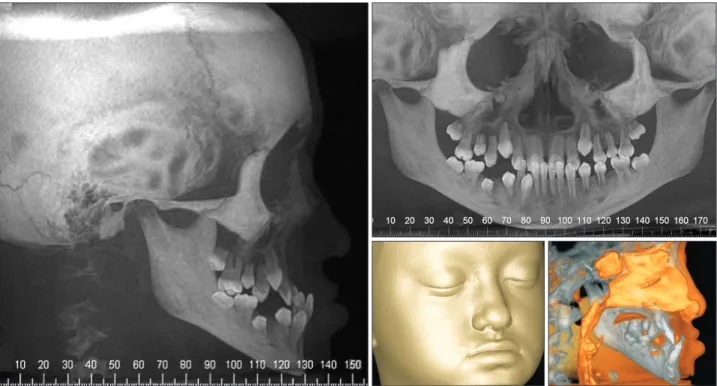
(2) Martínez-Smit et al • Alt-RAMEC hybrid-hyrax and mandibular miniplates. INTRODUCTION. DIAGNOSIS AND ETIOLOGY. A Class III skeletal pattern can be caused by maxillary hypoplasia, mandibular prognathism, or a combination of both.1 In cases of midface deficiency requiring maxillary protraction, orthopedic treatment has been shown to yield favorable results.2 The facemask is an effective device for the treatment of mild to moderate Class III skeletal malocclusion with maxillary retrusion; however, it can result in undesired effects such as molar mesialization and maxillary incisor proclination.3,4 Previous studies have reported the use of attachments with skeletal anchorage for maxillary protraction; these include ankylosed deciduous canines,5,6 onplants,7 miniplates,8 miniscrews,9 hybrid hyrax (HH)–mentoplate combination, 10,11 and even osseointegrated titanium implants.12 These provided skeletal outcomes similar to those obtained with the facemask, with the added advantage of no undesired dentoalveolar movements. Generally, rapid palatal expansion (RPE) is used as an adjunct to maxillary protraction.4 Loosening of the circummaxillary sutures by alternate rapid maxillary expansions and constrictions (Alt-RAMEC) has also been reported to improve the mechanics of orthopedic treatment for Class III malocclusion.13-15 Here we report the first case, to the best of our knowledge, involving the use of Alt-RAMEC with an HH– mandibular miniplate combination and simultaneous orthodontic treatment for the management of severe Class III malocclusion caused by maxillary hypoplasia in an 11-year-old girl.. An 11-year-old girl presented with Class III malocclusion and facial and psycho-affective involvement. On examination, she exhibited skeletal Class III malocclusion, a concave profile, levognatism, and a severe anterior crossbite (Figure 1, Table 1). Panoramic radiograph, lateral cephalometry, and cone beam computed tomography confirmed the presence of Class III malocclusion (Figure 2, Table 1).. TREATMENT OBJECTIVES The following treatment goals were established: correction of the Class III skeletal pattern, improvement of the facial profile, an increase in the overjet, correction of the posterior crossbite, and an improvement in facial esthetics.. TREATMENT ALTERNATIVES Different treatment alternatives were considered for the correction of Class III malocclusion. The first option was maxillofacial surgery after skeletal growth completion. However, this would result in further deterioration of her facial appearance. The second option was orthopedic treatment involving RPE with a hyrax appliance and protraction with a facemask; this was ruled out because of the possible effects of dentoalveolar compensation and the severity of malocclusion. Considering the severity of the Class III malocclusion and the need to correct the maxillary sagittal position without undesired. Figure 1. Pretreatment extraand intra-oral photographs of a young girl with severe Class III malocclusion due to maxillary hypoplasia.. www.e-kjo.org. https://doi.org/10.4041/kjod.2019.49.5.338. 339.
(3) Martínez-Smit et al • Alt-RAMEC hybrid-hyrax and mandibular miniplates. Table 1. Measurements from lateral cephalograms acquired before treatment (T0), after a 20-month treatment period (T1), and after a 24-month retention period (T2) for a young girl with severe Class III malocclusion due to maxillary hypoplasia Measurement o. T0. T1. T2. T1–T0. T2–T1. T0–T2. SNA ( ). 77. 84. 84. 7. 0. 7. SNB (o). 83.5. 85. 85.5. 1.5. 1. 2. ANB (o). −6.5. −1. −1.5. 5.5. −1. 5. CoA (mm) CoPog (mm) o. Mandibular plane–FH ( ) Lower anterior facial height (mm). 79. 80. 80. 2. 0. 1. 112. 113. 114. 1. 1. 2. 20. 23. 22. 3. −1. 2. 52. 56. 55. 4. −1. 3. −12. −5. −5.5. 7. −0.5. 6.5. o. 124. 123. 123. −1. 0. −1. o. 89. 84. 86. −5. 2. −3. Wits (mm) U1–PP ( ) L1–MP ( ). The patient underwent alternate rapid maxillary expansions and constrictions with a hybrid hyrax–mandibular miniplate combination and simultaneous orthodontic treatment for 20 months, followed by the retention phase. T0, Taken at the initial visit (11 years old); T1, taken after 20 months of treatment (12 years 10 months); T2, taken after 24 months in retention (14 years 10 months); SNA, sella-nasion-A point; SNB, sella-nasion-B point; ANB, A point-nasion-B point; CoA, Condileon to A point; CoPog, condileon to pogonion; FH, Frankfort plane; Lower anterior facial height, anterior nasal spine to menton; Wits, distance between perpendiculars from A point and B point onto the occlusal plane; U1–PP, maxillary lateral incisor to Palatal plane angle; L1–MP, mandibular incisor to mandibular plane angle.. Figure 2. Pretreatment lateral cephalogram, panoramic radiograph, and cone-beam computed tomography images for a young girl with severe Class III malocclusion due to maxillary hypoplasia.. 340. https://doi.org/10.4041/kjod.2019.49.5.338. www.e-kjo.org.
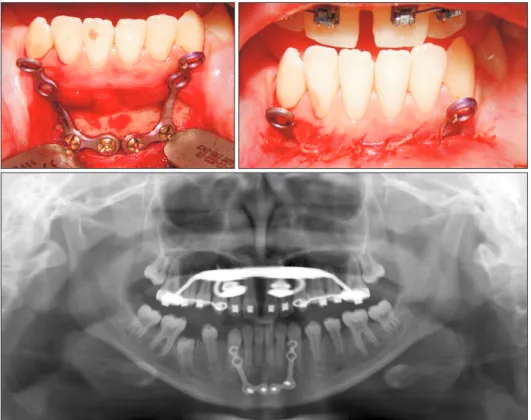
(4) Martínez-Smit et al • Alt-RAMEC hybrid-hyrax and mandibular miniplates. dental effects, we decided to use Alt-RAMEC with an HH–mandibular miniplate combination and simultaneous orthodontic treatment with passive self-ligation.. TREATMENT PROGRESS After the patient’s family approved the treatment plan, an 8-week ALT-RAMEC protocol13 involving expansion and constriction every alternate week was established. An HH appliance was used as proposed by Wilmes et al.10 As the first step of treatment, a silicone impression. was recorded (Figure 3) and the appliance was fabricated using the Ortho-Easy Forestadent® system (Bernhard Foerster GmbH, Pforzheim, Germany) for skeletal anchorage (Figure 4). The HH appliance was cemented with Band-Lok (Reliance Orthodontic Products, Itasca, IL, USA), and passive self-ligating brackets (Damon Q; Ormco®, Orange, CA, USA) were placed on the maxillary teeth for the initiation of simultaneous orthodontic treatment with a fixed appliance. The maxillary archwire was sectioned in the midline to facilitate transverse orthopedic movement. After the 8-week Alt-RAMEC protocol, a diastema between the maxillary incisors and a mild improvement in the overjet were observed (Figure 5). Subsequently, mandibular miniplates were placed (Figure 6), following which passive self-ligating brackets (Damon Q) were bonded to the mandibular teeth. Intermaxillary elastics (2 oz; size, 3/16-inch; Ormco®) were used as part of the mechanics recommended with this type of bracket. In addition, 5/16-inch intermaxillary elastics (8 oz; Ormco®) were extended from the mandibular miniplates to the HH appliance (Figure 7).. RESULTS After 20 months of treatment, the devices were re-. Figure 3. Silicone impression for the fabrication of a hybrid hyrax appliance for alternate rapid maxillary expansions and constrictions in a young girl with severe Class III malocclusion due to maxillary hypoplasia.. Figure 4. A fabricated hybrid hyrax appliance for alternate rapid maxillary expansions and constrictions in a young girl with severe Class III malocclusion due to maxillary hypoplasia. www.e-kjo.org. https://doi.org/10.4041/kjod.2019.49.5.338. Figure 5. Intraoral photographs after an 8-week alternate rapid maxillary expansions and constrictions protocol with simultaneous orthodontic treatment in a young girl with severe Class III malocclusion due to maxillary hypoplasia. 341.
(5) Martínez-Smit et al • Alt-RAMEC hybrid-hyrax and mandibular miniplates. Figure 6. Fixation of mandibular miniplates after an 8-week alternate rapid maxillary expansions and constrictions protocol with simultaneous orthodontic treatment in a young girl with severe Class III malocclusion due to maxillary hypoplasia. moved and the family was instructed about a control and retention program that should be carefully followed in accordance with the patient’s growth. The final result included the correction of Class III malocclusion with adequate function and excellent esthetics, which helped the patient in recovering her self-esteem and provided personal motivation (Figures 8 and 9). Maxillary protraction was observed, with an improvement in sella-nasion-A point from 77 o to 84o. Sellanasion-B point was controlled, with a minor increase of 1.5o, and A point-nasion-B point and the Wits appraisal value improved from −6.5o and −12 to −1o and −5 (Table 1), respectively. The maxillary incisor inclination was maintained, although the mandibular incisors were retroclined by 5o (Table 1). Superimposition of pre- (T0) and post-treatment (T1) lateral cephalograms revealed an improvement in the soft tissue profile, upper lip projection, maxillary advancement, and sagittal control of mandibular growth (Figure 9). After 24 months of retention, the outcomes appeared stable, as confirmed by superimposition of post-treatment (T1) and post-retention (T2) lateral cephalograms (Figures 10 and 11, Table 1).. DISCUSSION The use of an HH–mandibular miniplate combination. 342. Figure 7. Fixation of intermaxillary elastics extending from the mandibular miniplates to the hybrid hyrax appliance and from the mandibular to the maxillary brackets in a young girl with severe Class III malocclusion due to maxillary hypoplasia.. has been shown to be effective for the correction of Class III malocclusion in growing patients.10,11 Nevertheless, to the best of our knowledge, this is the first case report on the use of Alt-RAMEC with an HH–mandibular miniplate combination and simultaneous orthodontic treatment for the management of severe Class III malocclusion in a young girl in the growth phase. Conventionally, the facemask is used for the treatment of patients with Class III malocclusion due to maxillary hypoplasia.4 A systematic review and metaanalysis evaluated skeletal and dental changes after facemask treatment and found that SNA improved by. https://doi.org/10.4041/kjod.2019.49.5.338. www.e-kjo.org.
(6) Martínez-Smit et al • Alt-RAMEC hybrid-hyrax and mandibular miniplates. Figure 8. Final intra- and extra-oral photographs after 20-month treatment involving alternate rapid maxillary expansions and constrictions with a hybrid hyrax–mandibular miniplate combination and simultaneous orthodontic treatment for a young girl with severe Class III malocclusion due to maxillary hypoplasia. 2.1o.16 On the other hand, another study reported that RPE with an HH–mentoplate combination resulted in an improvement of 3.2o.11 Both values were considerably smaller than that observed for the present patient, who exhibited an improvement in SNA of 7o (Table 1). This finding is in agreement with that in a previous study,15 where maxillary advancement was greater with AltRAMEC and facemask treatment than with conventional RPE and facemask treatment or no treatment (control). We also observed an improvement in ANB (5.5o) and the Wits appraisal value (7 mm) in our patient. With regard to dental measurements, we observed stability in the inclination of the maxillary incisors (U1–PP, −1o) and retroinclination of the mandibular incisors (L1–PM, −5o) between T0 and T1; the retroclination probably occurred because of the use of Class III intermaxillary elastics extending from the brackets (Table 1). Although the use of an HH appliance and mandibular miniplates is more invasive than conventional treatment, it may benefit patients who prefer to use intraoral devices.11 De Clerck et al.8 previously reported the use of skeletal anchorage in both the maxilla and mandible for the correction of Class III malocclusion, with excellent skeletal results without dental compensation, including two miniplates in the maxilla and two in the mandible. Our patient received miniplates only in the mandible in accordance with previous reports.10,11. www.e-kjo.org. https://doi.org/10.4041/kjod.2019.49.5.338. The duration of conventional facemask treatment can vary from 12 to 15 months,16 and it can be decreased to 6 to 9 months with RPE using an HH–mentoplate combination.10 In previous reports, however, a second phase of orthodontic treatment was required after the first phase of orthopedic treatment. This second phase can last for an average of 20 months (range, 14–33 months), as reported in a recent systematic review.17 For the present case, the overall treatment duration was 20 months; this indicates that our protocol involving the simultaneous use of orthopedic and orthodontic treatment was more efficient than previously reported ones. We used elastics extending from the miniplates to the HH appliance and from the maxillary to the mandibular brackets with a Class III vector. The use of passive self-ligation brackets minimized friction, facilitated physiological sliding of the teeth in their bony bases for the correction of malposition, and corrected the sagittal position of the jaws. The decrease in the duration of active treatment is the most important finding from the present case. Considering that facial esthetics in adolescence is a determining factor for the development of a personality and interpersonal relationships, we recommend the use of this protocol for growing patients, who will exhibit not only an improved physical appearance but also a better quality of life. After 24 months of retention, our patient showed adequately stable dental and skeletal outcomes (Figures. 343.
(7) Martínez-Smit et al • Alt-RAMEC hybrid-hyrax and mandibular miniplates. A. T0 T1. B. C. 10 and 11, Table 1). In addition, she experienced no complications or failure during or after treatment with the HH appliance and miniplates and showed excellent compliance with the treatment. At the time of writing this manuscript, she was still in the retention phase and regularly visited our clinic every 6 months for review of her growth. In case of significant relapse, we planned to prescribe intermaxillary elastics with a Class III vector to the retainers. Although both the patient and her parents were very satisfied with the treatment outcomes, we did not rule out the possibility of orthognathic surgery in case the patient requested further improvement in her facial esthetics in the future.. CONCLUSION In conclusion, the findings from this case suggest that Alt-RAMEC with an HH–mandibular miniplate combination and simultaneous orthodontic treatment offers several advantages over other approaches, including direct application of forces to the skeletal structures, increased loosening of circummaxillary sutures, no requirement. 344. Figure 9. Final radiographs after a 20-month treatment period involving alternate rapid maxillary expansions and constrictions with a hybrid hyrax–mandibular miniplate combination and simultaneous orthodontic treatment for a young girl with severe Class III malocclusion due to maxillary hypoplasia. A, Lateral cephalogram; B, superimposition of pre- (T0) and post-treatment (T1) lateral cephalograms; C, panoramic radiograph.. of extraoral devices, lesser invasiveness, and decreased treatment duration. Future studies should compare the effects of this treatment protocol with those in a matched control group and evaluate its long-term stability.. CONFLICTS OF INTEREST No potential conflict of interest relevant to this article was reported.. REFERENCES 1. Alexander AE, McNamara JA Jr, Franchi L, Baccetti T. Semilongitudinal cephalometric study of craniofacial growth in untreated Class III malocclusion. Am J Orthod Dentofacial Orthop 2009;135:700.e1-14. 2. Cevidanes L, Baccetti T, Franchi L, McNamara JA Jr, De Clerck H. Comparison of two protocols for maxillary protraction: bone anchors versus face mask with rapid maxillary expansion. Angle Orthod 2010;80:799-806.. https://doi.org/10.4041/kjod.2019.49.5.338. www.e-kjo.org.
(8) Martínez-Smit et al • Alt-RAMEC hybrid-hyrax and mandibular miniplates. Figure 10. Extra- and intraoral photographs obtained after 24 months of retention following treatment involving alternate rapid maxillary expansions and constrictions with a hybrid hyrax–mandibular miniplate combination and simultaneous orthodontic treatment for a young girl with severe Class III malocclusion due to maxillary hypoplasia. 3. Shanker S, Ngan P, Wade D, Beck M, Yiu C, Hägg U, et al. Cephalometric A point changes during and after maxillary protraction and expansion. Am J Orthod Dentofacial Orthop 1996;110:423-30. 4. Baccetti T, Franchi L, McNamara JA Jr. Treatment and posttreatment craniofacial changes after rapid maxillary expansion and facemask therapy. Am J Orthod Dentofacial Orthop 2000;118:404-13. 5. Da Silva Filho OG, Ozawa TO, Okada CH, Okada HY, Carvalho RM. Intentional ankylosis of deciduous canines to reinforce maxillary protraction. J Clin Orthod 2003;37:315-20. 6. Kokich VG, Shapiro PA, Oswald R, Koskinen-Moffett L, Clarren SK. Ankylosed teeth as abutments for maxillary protraction: a case report. Am J Orthod 1985;88:303-7. 7. Hong H, Ngan P, Han G, Qi LG, Wei SH. Use of onplants as stable anchorage for facemask treatment: a case report. Angle Orthod 2005;75:453-60. 8. De Clerck H, Cevidanes L, Baccetti T. Dentofacial effects of bone-anchored maxillary protraction: a controlled study of consecutively treated Class III patients. Am J Orthod Dentofacial Orthop 2010;138:577-81. 9. Amini F, Poosti M. A new approach to correct a Class III malocclusion with miniscrews: a case report. J Calif Dent Assoc 2013;41:197-200. 10. Wilmes B, Nienkemper M, Ludwig B, Kau CH,. www.e-kjo.org. https://doi.org/10.4041/kjod.2019.49.5.338. Drescher D. Early Class III treatment with a hybrid hyrax-mentoplate combination. J Clin Orthod 2011;45:15-21; quiz 39. 11. Katyal V, Wilmes B, Nienkemper M, Darendeliler MA, Sampson W, Drescher D. The efficacy of Hybrid Hyrax-Mentoplate combination in early Class III treatment: a novel approach and pilot study. Aust Orthod J 2016;32:88-96. 12. Smalley WM, Shapiro PA, Hohl TH, Kokich VG, Brånemark PI. Osseointegrated titanium implants for maxillofacial protraction in monkeys. Am J Orthod Dentofacial Orthop 1988;94:285-95. 13. Liou EJ, Tsai WC. A new protocol for maxillary protraction in cleft patients: repetitive weekly protocol of alternate rapid maxillary expansions and constrictions. Cleft Palate Craniofac J 2005;42:121-7. 14. Franchi L, Baccetti T, Masucci C, Defraia E. Early Alt-RAMEC and facial mask protocol in class III malocclusion. J Clin Orthod 2011;45:601-9. 15. Wilmes B, Ngan P, Liou EJ, Franchi L, Drescher D. Early class III facemask treatment with the hybrid hyrax and Alt-RAMEC protocol. J Clin Orthod 2014;48:84-93. 16. Cordasco G, Matarese G, Rustico L, Fastuca S, Caprioglio A, Lindauer SJ, et al. Efficacy of orthopedic treatment with protraction facemask on skeletal Class III malocclusion: a systematic review and meta-analysis. Orthod Craniofac Res 2014;17:133-. 345.
(9) Martínez-Smit et al • Alt-RAMEC hybrid-hyrax and mandibular miniplates. Figure 11. Radiographs obtained after 24 months of retention following treatment involving alternate rapid maxillary expansions and constrictions with a hybrid hyrax–mandibular miniplate combination and simultaneous orthodontic treatment for a young girl with severe Class III malocclusion due to maxillary hypoplasia. A, Lateral cephalogram; B, superimposition of post-treatment (T1) and post-retention (T2) lateral cephalograms; C, panoramic radiograph.. 43. 17. Tsichlaki A, Chin SY, Pandis N, Fleming PS. How long does treatment with fixed orthodontic appli-. 346. ances last? A systematic review. Am J Orthod Dentofacial Orthop 2016;149:308-18.. https://doi.org/10.4041/kjod.2019.49.5.338. www.e-kjo.org.
(10)
수치


+4


관련 문서
Laser cutting process is one of flexible rapid manufacturing technologies with various advantages including a high cutting speed, manufacturing of parts with
박 열 수 조선대학교 대학원 Review of human and animal studies on maxillary sinus grafting for implant placement
Methods to overcome insufficient bone due to poor bone quality, the pneumatization of a maxillary sinus and other anatomical limitations of implant placement
The OSFE (osteotome sinus floor elevation) technique has been used for maxillary sinus augmentation.. The implants were clinically and radiographically followed
When the long-chain molecules in a polymer are cross-linked in a three dimensional arrangement the structure in effect becomes three-dimensional arrangement, the structure
The average position of the posterior superior alveolar artery, the wall thickness of the lateral wall, and the average volume of the maxillary sinus will
According to the recent diversification of ship and the rapid growth of her size, a database which can cover various ships is requested for
Rapid turning and capsize accident of ro-ro ferry Sewol occurred due to the very poor stability small rapid turning, and its objective turning characteristics
• The PDEase2D evolution solver automatically and continuously adjusts its time step interval to reduce the time interval when PDEase2D encounters a region of rapid change
