• 검색 결과가 없습니다.

Graph representations of normal matrices

N/A
N/A
Protected

Academic year: 2022

Share "Graph representations of normal matrices"

Copied!
10
0
0

로드 중.... (전체 텍스트 보기)

전체 글

(1)

GRAPH REPRESENTATIONS OF NORMAL MATRICES

Sang-Gu Lee and Han-Guk Seol

Abstract. We call the bipartite graph G is normal provided the reduced adjacency matrix A of G is normal. In this paper we give graph representations of normal matrices. In addition we shall have the characterization of signed bipartite normal graphs.

1. Introduction

For an integer n ≥ 2, an n × n matrix A is said to be reducible if there is a permutation matrix P and some integer r with 1 ≤ r ≤ n − 1 such that

P T AP =

· A 11 A 12 O A 22

¸ ,

where A 11 is an r × r matrix. Otherwise A is called irreducible. In particular, if A 12 = O then A is separable. The matrix A is inseparable if A is not separable. A real matrix A is said to be normal if A commutes with its transpose A T . Clearly, any symmetric matrix is normal, and any reducible normal matrix is permutationally similar to a direct sum of irreducible normal matrices. So we start with nonsymmetric, irreducible normal matrices.

Results on graph representations of matrices can be found in detail from [1]. And a large number of characterizations of normal matrices were given by Grone et al. in [3]. The combinatorial structure of nonneg- ative normal matrices, in particular, (0, 1)-normal matrices, was investi- gated in [4] (also see [5]). Normal graphs can be considered as a closure of perfect graphs by means of co-normal products [6] and graph entropy [2]. In this paper, we define bipartite normal graphs and consider the properties of this bipartite normal graphs.

Received August 31, 2005. Revised October 18, 2005.

2000 Mathematics Subject Classification: Primary 05A15, 65F25.

Key words and phrases: normal matrix, bipartite graph, reduced adjacency ma- trix, co-degree.

This work was supported by the Com

2

Mac-SRC/ERC program of MOST/KOSEF

(Grant No. R11-1999-054).

(2)

Let G be a bipartite graph with a partite vertex sets X = {1, 2, . . . , n}

and X 0 = {1 0 , 2 0 , . . . , n 0 }. The neighborhood of a vertex x in G, denoted by N (x), is the set of vertices in G adjacent to x, and the co-degree of two vertices x and y in G, denoted by c(x, y), is the number of vertices in N (x) ∩ N (y). Consider the matrix product AA T (or A T A). In AA T , the (i, j)-entry of AA T is the inner product of ith row and jth row of A (respectively, (i, j)-entry of A T A is the inner product of ith column and jth column of A). Now we apply this fact to the combinatorial properties of its related graph. Since we know the inner product of rows of A are same as the cardinality on intersection of neighborhoods of vertices. We can have the following definition.

Definition 1.1. A bipartite graph G is said to be normal if c(i, j) = c(i 0 , j 0 ) for any two vertices i, j in X and corresponding i 0 , j 0 in X 0 of G.

Normal graphs and (0, 1)-normal matrices are closely related. Since any symmetric matrix is normal, so that we can concentrate on non- symmetric (0, 1)-normal matrices. It is easy to see that for n ≤ 2 there is no nonsymmetric (0, 1)-normal matrix of order n. If G is a bipartite graph with bipartition X = {1, 2, . . . , n} and X 0 = {1 0 , 2 0 , . . . , n 0 }, then G determines an n × n (0, 1)-matrix A = [a ij ], where a ij = 1 if and only if {i, j 0 } is an edge of G. We call A the reduced adjacency matrix of G.

Then we obtain the following.

Theorem 1.2. A bipartite graph G is normal if its reduced adjacency matrix A(G) is normal.

Theorem 1.3. [1, Theorem 4.2.7] Let A be a nonzero (0, 1)-matrix of order n with total support, and let G be the bipartite graph whose reduced adjacency matrix is A. Then A is fully indecomposable if and if only G is connected.

Any normal matrix is permutationally similar to a direct sum of ir- reducible normal matrices. And any irreducible matrix is fully inde- composable. So in this paper, in view of Theorem 1.3, we consider the properties of a connected bipartite normal graph.

2. Bipartite normal graphs

Throughout this paper, let G denote a bipartite graph with a partite

vertex sets X = {1, 2, . . . , n} and X 0 = {1 0 , 2 0 , . . . , n 0 }, and let E(G)

denote the set of edges in G. We can easily show that, if G is normal

then for each i = 1, . . . , n, the degrees of the vertices i and i 0 are equal

(3)

as deg(i) = deg(i 0 ). As usual, K n,n denotes the complete bipartite graph with bipartition X = {1, 2, . . . , n} and X 0 = {1 0 , 2 0 , . . . , n 0 }. We say that the complement of a graph G is K n,n \ G, and denote the complement of G by G c . We now have the following theorem.

Theorem 2.1. A bipartite graph G is normal if and only if G c is normal.

Proof. Let c(i, j) and c 0 (i, j) be the codegrees of the bipartite graphs G and G c . By normality of G, c(i, j) = c(i 0 , j 0 ) for each i, j ∈ X and its corresponding i 0 , j 0 ∈ X 0 . Since G c is K n,n \ G,

c 0 (i, j) = |N (i) c ∩ N (j) c |

= |[N (i) ∪ N (j)] c |

= n − |N (i) ∪ N (j)|

= n − [|N (i)| + |N (j)| − |N (i) ∩ N (j)|]

= n − {deg(i) + deg(j) − c(i, j)}

and

c 0 (i 0 , j 0 ) = n − {deg(i 0 ) + deg(j 0 ) − c(i 0 , j 0 )}.

So one can obtain

c 0 (i, j) = n − {deg(i) + deg(j) − c(i, j)}

= n − {deg(i 0 ) + deg(j 0 ) − c(i 0 , j 0 )}

= c 0 (i 0 , j 0 ).

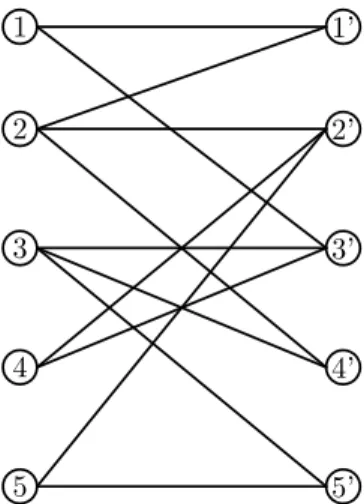
For example, let G be the bipartite graph with a partite vertex sets X = {1, 2, . . . , 5} and X 0 = {1 0 , 2 0 , . . . , 5 0 } in Figure 1.

Then G has reduced adjacency matrix

A(G) =

 

 

1 0 1 0 0 1 1 0 1 0 0 0 1 1 1 0 1 1 0 0 0 1 0 0 1

 

 

.

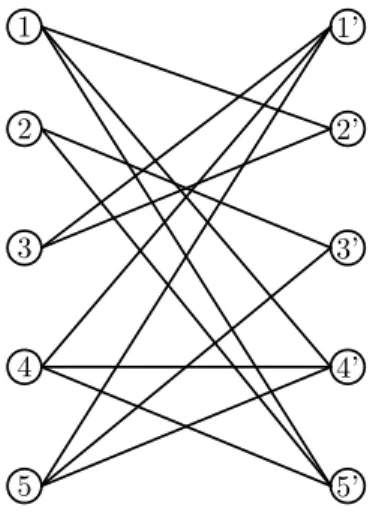
Since the complement graph G C of a graph G is as in Figure 2, the reduced adjacency matrix of G C is

A(G C ) = J − A(G) =

 

 

0 1 0 1 1 0 0 1 0 1 1 1 0 0 0 1 0 0 1 1 1 0 1 1 0

 

 

.

(4)

1

2

3

4

5

1’

2’

3’

4’

5’

Figure 1. The bipartite graph G with a partite vertex sets X = {1, 2, . . . , 5} and X 0 = {1 0 , 2 0 , . . . , 5 0 }

In fact,

A(G C )A(G C ) T =

 

 

3 1 1 2 1 1 2 0 1 1 1 0 2 1 1 2 1 1 3 2 1 1 1 2 3

 

 

= A(G C ) T A(G C ).

Hence the complement graph G C is a bipartite normal graph.

We know that the set of n × n nonsymmetric normal (0, 1)-matrices is closed under three operations which are permutation similarity, trans- position and complementation. Two (0, 1)-matrices A and B are called equivalent if B is obtained from A by finitely many these operations[7].

We note that if a (0, 1)-normal matrix A is equivalent to (0, 1)-matrix B, then B is also normal. Let G be a bipartite normal graph. If the number of edges in G is less than or equal to 2, then G is a symmetric graph. If G and G c have both irreducible reduced adjacency matrices, then N (i) and N (i) c are both nonempty for each i. Now we have the following proposition.

Proposition 2.2. Let G be a nonsymmetric bipartite normal graph of order 2n. Then the number of edges in G is between 3 and n 2 − 3.

If, further, G and G c both have irreducible normal reduced adjacency

(5)

1

2

3

4

5

1’

2’

3’

4’

5’

Figure 2. The complement graph G C of G

matrices, then the number |E(G)|of edges in G satisfies the following:

n ≤ |E(G)| ≤ n 2 − n.

We call that {i, j 0 } is a symmetric edge of G provided either both {i, j 0 } and {j, i 0 } are adjacent or both are not, otherwise {i, j 0 } is a nonsymmetric edge of G. In particular if N (i) = {i 0 1 , i 0 2 , . . . , i 0 k } and N (i 0 ) = {i 1 , i 2 , . . . , i k }, then we call N (i) a symmetric neighborhood of G. Clearly, the graph G is normal if it has symmetric neighborhood for each vertices in G.

Theorem 2.3. Let G be a connected bipartite normal graph such that N (i) and N (j) are symmetric neighborhoods of G for some i and j. If {i, j 0 } (thus {j, i 0 }) is not an edge of G, then the graph G 0 obtained by adding edges {i, j 0 } and {j, i 0 } to G is normal.

Proof. Let c 0 (s, t) be the co-degree of the vertices s and t in G 0 and N 0 (k) be the neighborhood of k in G 0 . Since c(s, t) = c(s 0 , t 0 ) for each s, t = 1, 2, . . . , n, and c 0 (s, t) = c 0 (s 0 , t 0 ) for each s, t 6= i, j, it is sufficient to show that c 0 (i, k) = c 0 (i 0 , k 0 ) and c 0 (j, k) = c 0 (j 0 , k 0 ) for each k = 1, 2, . . . , n and k 6= i, j. First we show that c 0 (i, k) = c 0 (i 0 , k 0 ) for each k = 1, 2, . . . , n. Let N (i) = {i 0 1 , i 0 2 , . . . , i 0 p }, N (j) = {j 1 0 , j 2 0 , . . . , j 0 q } and N (i 0 ) = {i 1 , i 2 , . . . , i p }, N (j 0 ) = {j 1 , j 2 , . . . , j q }. Then our condition implies that N 0 (i) = N (i) ∪ {j 0 }, N 0 (i 0 ) = N (i 0 ) ∪ {j}, N 0 (j) = N (j) ∪ {i 0 }, and N 0 (j 0 ) = N (j 0 ) ∪ {i}. Since N 0 (k) = N (k) and N 0 (k 0 ) = N (k 0 ), for any k = 1, 2, . . . , n, k 6= i, j. And for each k = 1, 2, . . . , n,

|{j 0 } ∩ N (k)| = |{j} ∩ N (k 0 )| by the symmetricity of the neighborhood

(6)

of j, we get

c 0 (i, k) = |N 0 (i) ∩ N 0 (k)|

= |N 0 (i) ∩ N (k)|

= |[N (i) ∪ {j 0 }] ∩ N (k)|

= |[N (i) ∩ N (k)] ∪ [{j 0 } ∩ N (k)]|

= c(i, k) + |{j 0 } ∩ N (k)|

= c(i 0 , k 0 ) + |{j} ∩ N (k 0 )|

= c 0 (i 0 , k 0 ).

Similarly, we can show that c 0 (j, k) = c 0 (j 0 , k 0 ) for each k = 1, 2, . . . , n.

Thus the proof is complete.

Corollary 2.4. Let G be a connected normal bipartite graph such that N (i) is a symmetric neighborhood of G for some i. If {i, i 0 } is not an edge of G then the graph G 0 obtained by adding the edge {i, i 0 } to G is normal.

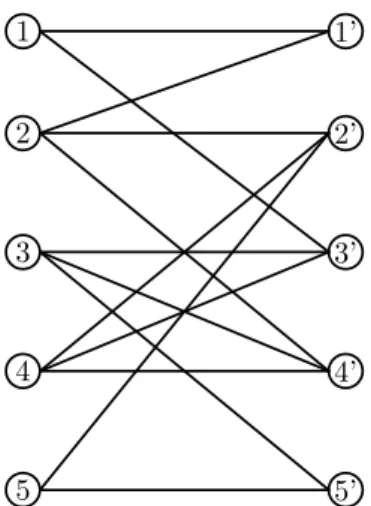
For example, let G be a bipartite graph defined in Figure 1. Then G is normal, and G 0 (Figure 3) obtained by adding the edge {4, 4 0 } to G is normal. In fact, the reduced adjacency matrix of G 0 is ;

A(G 0 ) =

 

 

1 0 1 0 0 1 1 0 1 0 0 0 1 1 1 0 1 1 1 0 0 1 0 0 1

 

 

.

This A(G 0 ) is a normal matrix.

Theorem 2.5. Let G be a connected normal graph, and let G 0 be the graph obtained by deleting every symmetric edges in G. Then G 0 is normal.

Proof. Let E α be the set of symmetric edges of G and let α 1 = {i 1 , i 2 , . . . , i k }, α 2 = {i 0 1 , i 0 2 , . . . , i 0 k } be the subsets of vertex sets X and X 0 with corresponding to E α , respectively. Let c 0 (i, j), c 0 (i 0 , j 0 ) be the co-degrees of G 0 . Since G is normal,

c(i, j) = |N (i) ∩ N (j)| = |N (i 0 ) ∩ N (j 0 )| = c(i 0 , j 0 ).

So

c 0 (i, j) = |N (i) ∩ N (j) − α 2 | = |N (i 0 ) ∩ N (j 0 ) − α 1 | = c 0 (i 0 , j 0 ).

(7)

1

2

3

4

5

1’

2’

3’

4’

5’

Figure 3. The graph G 0 obtained by adding the edge {4, 4 0 } to G

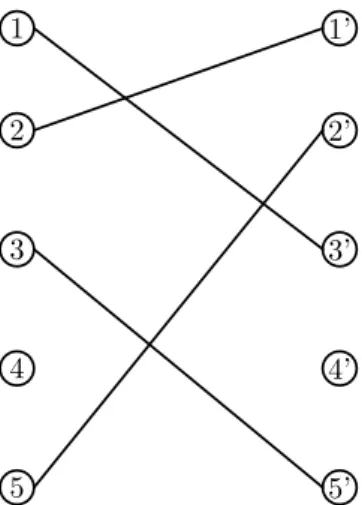
For example, let G 00 (Figure 4) be a bipartite graph with deleted all symmetric edges from above example graph G. Then the reduced adja- cency matrix of G 00 is

A(G 00 ) =

 

 

0 0 1 0 0 1 0 0 0 0 0 0 0 0 1 0 0 0 0 0 0 1 0 0 0

 

 

.

This A(G 00 ) is a normal matrix.

A matching of a graph G is a set of pairwise vertex disjoint edges, and a perfect matching is a matching in which each vertex is adjacent to an edge. Now we characterize the normal bipartite graph by matching of a graph G.

Theorem 2.6. Let G be a connected normal graph which has at least one nonsymmetric edge, and let G 0 be the graph obtained by deleting every symmetric edges in G. Then for some k ≥ 1, there exist pairwise disjoint matchings M 1 , . . . , M k in G 0 such that E(G 0 ) = M 1 ∪ · · · ∪ M k and |M i | ≥ 3 for each i = 1, . . . , k.

Proof. Let (i, j 0 ) be an edge of the graph G 0 . Since by the normality

of G, deg(i) = deg(i 0 ) and deg(j) = deg(j 0 ) in G 0 . So there is an edge

(j, k 0 ) ∈ G 0 and (k, j 0 ) is not in G 0 . If k = i, then (i, j 0 ) and (j, i 0 ) are

(8)

1

2

3

4

5

1’

2’

3’

4’

5’

Figure 4. The graph G 00 obtained by deleting every symmetric edges in G

symmetric edge which is not in G 0 . So k 6= i. Since deg(k) = deg(k 0 ) in G 0 , there is an edge (k, l 0 ) ∈ G 0 . If l = i, then M 1 = {(i, j 0 ), (j, k 0 ), (k, i 0 )}

is a matching in G 0 with |M 1 | = 3. If l 6= i, then there is an edge (l, m 0 ) ∈ G 0 , and m = i we can obtain a matching M 1 in G 0 with

|M 1 | = 4. In this process, we can obtain a matching M 1 in G 0 with

|M 1 | ≥ 3. Let G 00 = G 0 − M 1 . We can construct a matching M 2 with

|M 2 | ≥ 3 in a similar manner. So we can obtain a disjoint matchings M 1 , M 2 , . . . , M k in G 0 such that E(G 0 ) = M 1 ∪ · · · ∪ M k and |M i | ≥ 3.

The proof is complete.

3. Signed bipartite normal graphs

In [8], a signed graph is a graph in which every edge is labelled with

a ‘+1’ or a ‘−1’. An edge (u, v) labelled with a ‘+1’ (respectively, ‘−1’)

is called a positive edge (respectively, negative edge). Let G be a signed

bipartite graph. We define the positive neighborhood of a vertex x in G,

denoted N + (x) to be the set of vertices in G adjacent to x by labelling

+1. The positive co-degree of two vertices x and y in G, denoted c + (x, y),

is the number of vertices in (N + (x) ∩ N + (y)) ∪ (N (x) ∩ N (y)) and the

negative co-degree of two vertices x and y in G, denoted c (x, y), is the

number of vertices in (N + (x) ∩ N (y)) ∪ (N (x) ∩ N + (y)). Recall that if

G is an unsigned bipartite graph, simply the neighborhood of a vertex x

in G, denoted N (x) to be the set of vertices in G adjacent to x, and the

(9)

co-degree of two vertices x and y in G, denoted c(x, y), is the number of vertices in N (x) ∩ N (y). If G is a signed bipartite graph with bipartition X = {1, 2, . . . , n} and X 0 = {1 0 , 2 0 , . . . , n 0 }, then G determines an n × n (0, 1, −1)-matrix A = [a ij ], where

a ij =

 

1, {i, j 0 } with label + 1, 0, {i, j 0 } with no label ,

−1, {i, j 0 } with label − 1.

We call A the signed reduced adjacency matrix of G. Then we obtain the following.

Theorem 3.1. Let G be a connected signed bipartite graph with partitions X = {1, 2, . . . , n} and X 0 = {1 0 , 2 0 , . . . , n 0 }. Then G is normal if and only if for any two vertices i and j of G,

c + (i, j) − c (i, j) = c + (i 0 , j 0 ) − c (i 0 , j 0 ).

Proof. Let A(G) be the n × n (0, 1, −1)-matrix which is obtained by labelling each edge of G. Since G is normal if and only if A(G) is normal, the theorem is an immediate consequence from the conditions of normality.

From Theorem 3.1, we see that the normality of (−1, 0, 1)-matrices was interpreted as co-degrees of graph. Now we have the following the- orem from the normality of (−1, 1).

Theorem 3.2. Let G be a connected signed complete bipartite graph with partitions X = {1, 2, . . . , n} and X 0 = {1 0 , 2 0 , . . . , n 0 }. Then the followings are equivalent for any two vertices i and j of G;

(1) G is normal;

(2) c + (i, j) = c + (i 0 , j 0 );

(3) c (i, j) = c (i 0 , j 0 ).

Proof. Since G be a complete bipartite graph. So we know that the following; if we know c + (i, j) then c (i 0 , j 0 ) is determined by c + (i 0 , j 0 ) and vice versa. From Theorem 3.1, we complete this proof.

In this paper, we have seen that graph representations of normal

matrices with entries are in {−1, 0, 1}, {−1, 1} or {0, 1}. We may extend

these results to general normal matrices whose corresponding graph is a

weighted bipartite graph.

(10)

References

[1] R. A. Brualdi and H. J. Ryser, Combinatorial Matrix Theory, Encyclopedia of Mathematics and its Applications, Cambridge university Press, Cambridge, 1991.

[2] I. Csiszar, J. Korner, L. Lovasz, K. Marton, and G. Simonyi, Entropy splitting for antiblocking corners and perfect graphs, Combinatorica 10 (1990), no. 1, 27–40.

[3] R. Grone, C. R. Johnson, E. M. Sa, and H. Wolkowicz, Normal matrices, Linear Algebra Appl. 87 (1987), 213–225.

[4] Z. Li, F. Hall, and F. Zhang, Sign patterns of nonnegative normal matrices, Linear Algebra Appl. 254 (1997), 335–354

[5] F. Harary, On the notion of balance of a signed graph, Michigan Math. J. 2 (1953–

54), 143–146(1955).

[6] J. Korner and G. Longo, Two-step encoding of finite sources, IEEE Trans. Infor- mation Theory IT-19 (1973), 778–782.

[7] B. Y. Wang and F. Zhang, On normal matrices of zeros and ones with fixed row sum, Linear Algebra Appl. 275/276 (1998), 617–626.

[8] J. H. Yan, K. W. Lih, D. Kuo, and G. J. Chang, Signed degree sequences of signed graphs, J. Graph Theory 26 (1997), no. 2, 111–117.

Sang-Gu Lee

Department of Mathematics Sungkyunkwan University Suwon 440-746, Korea E-mail: [email protected] Han-Guk Seol

Department of Mathematics Daejin University

Pocheon 487-711, Korea

E-mail: [email protected]

수치

Figure 1. The bipartite graph G with a partite vertex sets X = {1, 2, . . . , 5} and X 0 = {1 0 , 2 0 ,
Figure 2. The complement graph G C of G
Figure 3. The graph G 0 obtained by adding the edge {4, 4 0 } to G
Figure 4. The graph G 00 obtained by deleting every symmetric edges in G

참조

관련 문서

Nail clipper CD player Vending machine Nail clipper, CD player, Vending machine Mechanical engineering is a field of making a g g g. useful mechanism or machine by using

 Gray and black vertices, therefore, have been discovered, but breadth-first search distinguishes between them to ensure that the search proceeds in a breadth-first manner..

• Solution 1: Break diffusion area by gaps (find a set of trails covering the graph). --> Minimize number of gaps (minimize

• Euler’s formula gives a relation among numbers of faces, vertices, and edges of a crossing-free drawing of a planar graph. n=9 vertices m=12 edges m=12

Calculate the magnitudes of the shear force, bending moment, and torsional moment acting g g on a transverse section through the frame at point O, located at some distance

Consider the motion of a particle of mass m which is constrained to move on the surface of a cone of half-angle α and which is subject to a gravitational force g. Let the

 How to tackle: large graphs, online setting, graph construction ….  One example: Online

 Discuss the machine learning background of auto-regressive model to obtain the