https://doi.org/10.5050/KSNVE.2019.29.2.199 ISSN 1598-2785(Print), ISSN 2287-5476(Online)
1)
1. 서 론
기어는 강력한 동력전달 수단으로 정확한 속도 비 를 가지고 효과적인 증속 및 증감을 수행하기 때문에 다양한 산업분야에 전반적으로 많이 사용되고 있다.
기어의 경우 과 부화에 의한 기어 절단, 장시간 사용에 의한 기어 이의 마모, 기어 접촉 시 발생하는 열에 의 한 변형 또는 제작 및 가공과정에서의 불량 등 다양한 원인으로 고장이 발생한다. 이는 기어의 동력손실과 결
함의 진전을 야기하고 더 나아가 설비의 고장을 발생 시키며, 막대한 유지보수비용 및 사용자의 안전까지 위 협하는 요소가 된다(1).
현재는 기어와 같은 회전체 결함진단을 위해 가동 시간 등을 기준으로 정비 계획을 세워 정기적으로 정 비하는 예방정비(preventive maintenance; PM)나 설비 의 고장 발생 후 정비하는 사후정비에 의존된 정비가 수행되고 있다. 이러한 정비방법은 과잉 정비와 같이 불 필요한 정비에 의해 이전에 없던 문제가 발생할 수 있 고, 갑작스러운 고장에 의한 대처가 힘들다. 또한 종래
† Corresponding Author ; Member, Department of Energy Mechanical Engineering of Marine Industry, Gyeongsang National University E-mail : [email protected]
* Department of Energy Mechanical Engineering, Gyeongsang University
# A part of this paper was presented at the KSNVE 2018 Annual Spring Conference.
‡ Recommended by Editor Gi-Woo Kim
© The Korean Society for Noise and Vibration Engineering
기어 이 파손 정도에 따른 진동신호의 특징기반 경향 감시
Feature-based Trend Monitoring of Vibration Signals According to Severity of Gear Tooth Breakage
정 덕 영*· 안 병 현*· 박 동 희*· 김 현 중*· 최 병 근†
Deok-Yeong Cheong
*, Byung-Hyeon Ahn
*, Dong-Hee Park
*,
Hyeon-Jung Kim
*and Byeong-Keun Choi
†(Received November 16, 2018 ; Revised January 18, 2019 ; Accepted February 11, 2019)
Key Words : Gear Tooth Breakage(기어 이 파손), Machine Learning(기계학습), Trend Monitoring(경향 감시), Feature Based(특징기반)
ABSTRACT
Gear systems are widely used in various industries. However, they fail due to different reasons such as poor manufacturing and assembly processes. Currently, preventive maintenance (PM) is periodically performed to ensure that a gearbox system is safely operating. However, unnecessary PM results in defects and maintenance cost. Therefore, a method to diagnose defects is developed using the features of machine learning. In this paper, lab-scaled gearbox is used as the experimental model, which can be simulated in four stages: normal and 10 %, 20 %, and 30 % of tooth breakage. The calculated fea- tures were selected using the genetic algorithm. Three features were used to diagnose the limitations of the gear system. Consequently, the severity of tooth breakage of the gearbox was classified for four stages by the three selected features. In addition, the increasing or decreasing trend of the value of features was identified according to the severity of the defect.
의 기술들은 설비의 안정적인 운행을 위해 진동 trend monitoring만 이루어지고 있다. 때문에 설비의 이상 발 생 시점을 예측하기 어렵고, 이상 발생 시 전문가의 상 세한 분석이 필요하다.
최근에는 언제, 어디서, 어떻게 사고가 발생할지 미 리 예측하고 사고 발생 전에 이를 대응할 수 있게 하는 예지정비(2) 수행을 위한 연구가 활발하게 진행되고 있 다. 그 중 4차 산업기술 machine learning(3,4)의 한 방 법인 유전알고리듬(genetic algorithm)을 이용한 특징 파라미터(feature parameter)(5)를 통해 결함진단을 실시 한 연구(6~8)가 진행 중이다.
이 논문은 앞서 설명한 예지정비의 수행을 위하여 lab scale 기어박스를 대상으로 기어 이 파손 정도를 모 사하여 실험을 진행했다. 또한 실험 모델인 기어박스에 대한 건전성 지표(health index)가 되는 특징값을 GA 를 활용한 특징선택 과정을 통해 최적의 특징을 선별 하였다. 선별된 특징을 대상으로 경향분석을 실시함으 로써 건전성 지표 개발을 위한 기초연구를 수행하였다.
2. 실 험
2.1 실험 모델
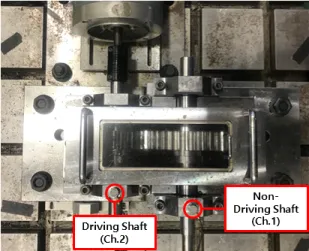
데이터 취득 장비로는 PULSE3560C(B&K)와 가속 도센서(B&K4371)를 사용하였으며, Table 1은 진동 신 호를 취득하기 위하여 사용된 장비의 상세사양 정보를 나타낸다. Fig. 1은 실험을 위해 제작된 lab-scale 기어 박스이며, 모터, 커플링, 축(구동 및 피구동), 구름요소 베어링, 기어(gear 및 pinion)로 구성되어 있으며, 신호 취득을 위해 구동축과 피 구동축의 non-drive-End 부 베어링 하우징에 수직으로 가속도센서를 부착하여 데 이터를 취득하였다. Fig. 2는 기어박스 내부를 나타내 었으며, 실험 모델인 lab-scale 기어박스는 2개의 평기 어로 구성되어 있고, 구동축 기어(pinion)는 이수가 25
개이고 구동축에 의해 회전하는 피 구동축 기어의 이 수는 38개로 구성되어 있다.
2.2 실험 방법
Table 2는 실험조건을 표로 나타낸 것이며, 기어 이 파손 정도를 표현하였다. 먼저, 정상상태인 0 %의 기어 이 높이(9 mm)를 기준으로 높이의 10 %인 0.9 mm씩 차이를 두어 기어 이 파손을 정도별로 모사하였으며, 그때 기어 작용 높이(working depth)와 피 구동축기어 (gear)의 맞물림 면적을 기입하였다. 기어는 맞물리는 위치와 면적에 따른 접촉응력(9)과 표면 마찰력(10)의 차 이가 발생하고, 그로 인한 동력손실의 차이가 나타나기
Type Properties
Pulse 3560C (B&K)
4/2-ch input/output module Operating freq. rang: 0 ~ 25.6 Hz Direct/CCLD/MIC. preamp 1 tacho
conditioning Accelerometer
(B&K 4371)
Operating freq. rang: 1 ~ 25.6 kHz Operating temp. -50 ℃ ~ 121 ℃
Sensitivity: 9.84 pC/g Table 1 Properties of data acquired system
Fig. 1 The measurement of experiment system
Fig. 2 The gearbox inside
Case Type Working
depth
Area of gear mesh
1 Normal 9 mm 246 mm2
2 Tooth breakage (10 %) 8.1 mm 225.3 mm2 3 Tooth breakage (20 %) 7.2 mm 210 mm2 4 Tooth breakage (30 %) 6.3 mm 198 mm2
Table 2 Case of experimental conditions
때문에 기어 작용 높이와 맞물림 면적에 대한 정보를 기재하였다.
Fig. 3은 기어 이 파손을 모사하기 위해 피 구동축 기 어(gear)의 이빨 상단 부를 와이어 커팅하여 이빨결함 상태를 모사한 사진이며, 이는 취성파괴 형태로 기어 자체의 결함 중 가장 심각한 단계이며, 대표적인 기어 결함인 이 파손(tooth breakage)을 모사하였다(11). 구동 축 기어(pinion)는 정상상태를 유지하였다.
진동 데이터 취득 시간은 각 case당 10분씩 취득하 였으며, 실험 구동속도는 300 r/min으로 선정하였다.
3. FFT Spectrum
Table 3은 FFT spectrum으로 확인한 overall value 와 GMF 성분의 진폭을 나타낸 표이며, Fig. 4는 normal 상태와 breakage 30 %의 FFT spectrum이다. Table 3 과 Fig. 4를 확인해보면 overall value 및 운전성분(1X, 3X)의 진폭 값의 차이는 확연하게 나타난다. 하지만 GMF성분의 경우 모든 case에서 1 um/s이하의 크기로 값이 아주 미세하게 확인된다. 이는 실험모델인 기어박 스의 구동속도가 저속이기 때문에 충격파의 영향이 적 게 나타난 것으로 판단된다(12). 이러한 미세한 GMF성
분과 운전성분의 차이만을 통해 결함의 진전도 평가 및 예측에는 기존 분석법으로는 한계가 있다고 판단된다.
Fig. 3 The tooth breakage of gear fault
Case Overall value GMF
Ch.1 Ch.2 Ch.1 Ch.2
1
(normal) 130 um/s 297 um/s 145 nm/s 454 nm/s 2
(breakage 10 %) 556 um/s 1.37 mm/s 184 nm/s 378 nm/s 3
(breakage 20 %) 612 um/s 1.48 mm/s 175 nm/s 681 nm/s 4
(breakage 30 %) 578 um/s 1.89 mm/s 343 nm/s 834 nm/s Table 3 Overall value and GMF
(a) Normal state
(b) Normal state GMF 1X
(c) Tooth breakage 30 %
(d) Tooth breakage 30 % GMF 1X Fig. 4 FFT spectrum
4. Machine Learning
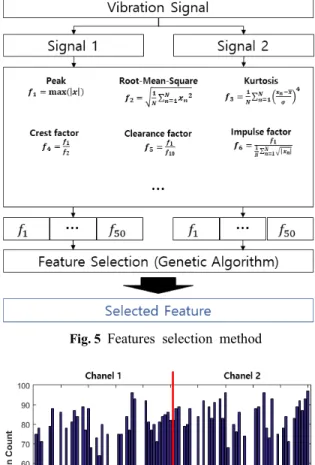
기어의 결함 검출을 위해 실제 물리량을 포함한 특 징 값을 이용하여 각 실험조건에 대한 특징기반(feature based) 분류를 실시하였다. 실험을 통해 취득한 데이터 를 time domain 특징 16가지, entropy domain 특징 4 가지, frequency domain 특징 16가지와 추가로 기어의 상태분석에 효과적인 cepstrum domain 특징(13) 14가지 등 총 50가지 특징을 사용하여 특징기반 분류를 수행 하였다.
Fig. 5는 취득된 신호에서 추출한 50가지 특징에 대 한 유전알고리즘(GA)기반 특징선택(14)과정을 나타내 었으며, 데이터는 각 신호의 샘플 개체의 밀집도와 개 체 간의 평균 거리를 목적함수로 설정하여 개체 간 거 리가 높은 특징을 선택하였다. 2개의 센서에서 각각 추 출된 특징 50가지, 총 100가지 특징 중 GA기반 특징 선택 과정에서 선택빈도가 높은 3가지 특징을 선별하 기 위해 분류기는 기계학습 알고리즘 중 하나인 support vector machine(SVM)(15)을 사용하였으며, 이를 통해 분류 성능을 평가하였다.
Fig. 6은 취득된 진동신호에 관한 데이터로 GA를 이 용하여 특징 선택 결과를 나타낸 histogram으로 X축 은 100가지 특징을 나타내고, Y축은 GA기반 특징선택 빈도를 나타낸다.
5. 결 과
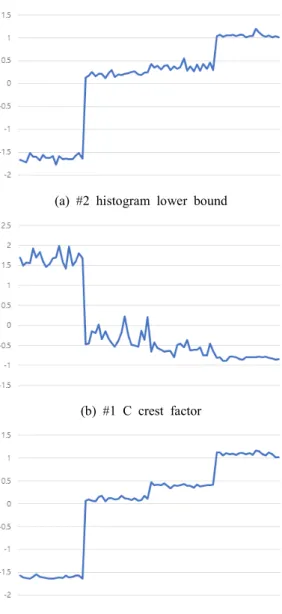
Fig. 7은 GA기반 특징선택 빈도가 높았던 특징 3가 지를 분석한 그래프이며, Table 4는 각 특징의 평균값 을 나타내었다. Table 4의 특징 값의 단위는 특징추출 단계에서 특징 값 차이가 각 특징의 단위에 따라 상이 하기 때문에 각 특징의 단위를 무차원화(정규화)하여 특징 선택의 변별성을 높였다. 각 특징 평균값이 결함의 진전에 따라 증가하거나 감소하는 경향을 가지는 것을 확인할 수 있다. 여기서 특징명칭 앞의 C는 cepstrum domain의 특징을 나타낸 것이다. (a)와 (b)의 경우는 클래스의 일관성이 낮음을 확인할 수 있고, 반면에 (c) 의 경우 각 클래스 내의 특징 값이 일관성을 보인다.
이는 해당 설비의 상태(결함정도)에 대한 정보를 잘 포함한 특징으로 판단된다. 또한, 결함의 진전에 따라 (a), (c)의 경우 증가하는 경향을 확인하였으며, (b)의 경우는 감소하는 경향을 보이는 것을 확인할 수 있다.
이 특징들은 GA의 목적함수인 각 샘플의 밀집성과 클 Fig. 5 Features selection method
Fig. 6 The histogram of feature selection
Case
Feature Histogram
lower bound C crest factor C root mean square Case 1 -1.627 22 1.668 182 -1.605 41 Case 2 0.207 104 -0.268 19 0.108 079
Case 3 0.365 08 -0.587 19 0.365 08
Case 4 1.055 033 -0.812 79 1.055 033 Table 4 Average of feature values
래스인 실험조건 간 거리를 고려하였을 때, 최적의 특 징조합으로 분류성이 높게 평가되어 선택 빈도가 높았 다고 판단된다.
Fig. 8은 GA기반으로 선택된 3가지 특징을 선택빈 도에 따라 각 X, Y, Z로 선정하여 3차원 그래프로 표 현한 그래프이며, 실험 조건(case)마다 선택된 특징에 대해 각 클래스의 특징 값이 일정 영역으로 군집되며 확연하게 층을 나누어 분류되는 것을 확인하였다. 또 한 support vector machine으로 분류성능을 평가한 결 과 분류성능은 100 %로 확인되었다.
6. 결 론
이 연구에서는 기어박스를 대상으로 기어 이 결함 정도를 모사하여 기존의 회전체 고장진단에 사용되는 특징과 기어 상태감시에 효과적인 cepsetrum domain 의 특징을 추가하여 총 50가지 특징으로 취득된 진동 신호에 대해 결함정도별 분류 가능성 확인과 특징의 경향분석을 실시하였다.
분류결과 사용한 50가지 특징 중 GA기반 특징 선택 빈도가 높은 특징인 histogram lower bound, C crest factor, C root-mean-square는 GA목적함수에 부합하는 특징으로 해당 설비와 실험조건에 대해 민감하게 반응 한 것으로 판단된다. 여기서 C crest factor의 경우 특징 값의 일관성이 낮아 클래스 간에 겹치는 부분이 존재 하는 것을 확인함으로 C crest factor의 특징만으로는 경 향분류가 어렵다고 판단되며, C root-mean-square는 특 징 값의 일관성이 높고 클래스 간에 겹치는 특징 값 또 한 존재하지 않기 때문에 경향분류에 가장 적합한 특징 이라고 판단된다.
또한, 선택된 특징 3가지를 사용하여 3차원으로 확인 한 결과, 모든 case가 영역을 가지며 결함 정도에 따라 분류되는 것을 확인하였고, 위 3가지 특징의 경향분석 을 통해 특징 값이 증가하거나 감소하는 것을 확인할 수 있었다. 이를 통해 특징기반(feature based) 결함진단 법으로 결함의 정도별 상태 감시가 가능함을 확인하였 으며, 선택된 특징별 상태에 대한 진동규격 확인과 추 가적인 실험을 통해 해당 설비와 설비의 상태에 대한 건전성 지표 개발이 가능할 것이라고 판단된다.
앞선 선행연구와 이 연구의 결과로 대상설비에 대한 특징, 결함, 신호, 정도별 분류 및 분석을 완료하였으 며 신호의 종류와 어떠한 특징이 선택되느냐에 따라 분 류결과 혹은 분류성능의 차이가 발생하는 것을 확인하 (a) #2 histogram lower bound
(b) #1 C crest factor
(c) #2 C root mean square Fig. 7 Trend analysis of selected features
Fig. 8 The result of machine learning
고, 결함의 정도에 따라 설비의 상태 분류와 특정 특징 에 대해 결함의 진전에 따라 경향성을 보이는 것을 확 인하였다. 이를 토대로 데이터에 대한 적응도 및 새로 운 특징 개발 등의 추가적인 연구를 토대로 특징기반 결함진단법의 성능 개선을 실시하고, 설비의 복합결함 정도에 따른 분석을 통해 machine learning 수행을 위 한 학습데이터 확립 및 health index 개발을 목표로 연 구를 진행할 예정이다.
후 기
이 연구는 “자동 예측 진단 기술 개발(한국수력원자 력중앙연구소)”의 지원으로 수행되었으며, 관계자 여 러분께 감사드립니다.
References
(1) Park, S. T., Gim, J. W. and Yang, J. K., 2002, The Detection of Gear Failures Using Wavelet Transform, Proceedings of the Korean Society of Automotive Engineers Annual Autumn Conference, pp. 74~79.
(2) Kim, U. S., 2015, Innovation of Safety Management System through Predictive Maintenance, Transactions of the Korean Society of Mechanical Engineers, Vol. 55, No. 10, pp. 58~60.
(3) Jeong, H. D. and Lee, S. C., 2017, Industrial Arti- ficial Intelligence, Transactions of the Korean Society for Noise and Vibration Engineering, Vol. 27, No. 6, pp. 3~7.
(4) Park, S. T. and Lee, S. C., 2017, Generative Adver- sarial Network and Noise/vibration Engineering, Transactions of the Korean Society for Noise and Vibration Engineering, Vol. 27, No. 6, pp. 14~19.
(5) Jeong, R. H., Chai, J. B., Lee, B. H., Lee, D. H.
and Lee, B. K., 2012, Feature Parameter Analysis for Rotor Fault Diagnosis, The KSFM Journal of Fluid Machinery, Vol. 15, No. 6, pp. 31~38.
(6) Kim, H. J., Ahn, B. H., Park, D. H. and Choi, B. K., 2017, Vibration Signal Analysis of Gearbox Fault According to Feature, Transactions of the Korean Society for Noise and Vibration Engineering, Vol. 27, No. 4, pp. 419~424.
(7) Kim, H. J., Ahn, B. H., Park, D. H. and Choi, B.
K., 2017, Feature Analysis for Fault Diagnosis According to Gearbox Failure, Transactions of the Korean Society for
Noise and Vibration Engineering, Vol. 27, No. 3, pp.
312~317.
(8) Kim, H. J., Ha, J. M., Ahn, B. H., Park, D. H.
and Choi, B. K., 2018, Failure Classification of Gearbox Using Ultrasonic Signal Characteristics, Transactions of the Korean Society for Noise and Vibration Engineering, Vol. 28, No. 1, pp. 57~63.
(9) Lee, J. H., Lee, D. H. and Lee, K. H., 2010, Contact Stress Analysis of a Pair of Mating Spur Gears, Journal of the Korean Society of Manufacturing Process Engineers, Vol. 9, No. 4, pp. 59~65.
(10) Park, C. I., 2013, Analysis of Sliding Friction in Spur Gears, Proceedings of the KSNVE Annual Autumn Conference, pp. 261~262.
(11) Lee, D. H., Lee, W. Y. and Moon, K. H., 2015, Characteristics of Vibration Condition Indicator with Gear Tooth Damage, Journal of the Korean Society for Precision Engineering, Vol. 32, No. 7, pp. 611~617.
(12) Lee, S. J., Yang, B. S., Lee, S. S., Park. S. T.
and Son, J. D., 2007, Vibration Characteristics of Worm Gear Faults for Elevators, Journal of the Korean Society for Power System Engineering, Vol. 11, No. 4, pp. 65~71.
(13) Lee, J. E., Yu, G. H., Han, J. Y. and Jang, H. S., 1997, A Study on the Fault Detection of Gears, Institute of Technology and Science, Vol. 27, pp. 95~109.
(14) Kim, Y. S., Kim, J. Y., Kang, M. S., Jun, H. S., Choi, B. K. and Kim, J. M., 2015, Reliable Fault Diagnosis of Induction Motor Failures Using a Genetic Algorithm-
Based Feature Analysis Methodology, Proceedings of the KSNVE Annual Autumn Conference, pp. 353~358.
(15) Ko, J. P., 2005, Solving Multi-class Problem Using Support Vector Machines, Journal of KIISE, Vol. 32, No.
12, pp. 1260~1271.
Deok-Yeong Cheong is unified Bachelor’s course degrees at the Department of Energy and Mecha- nical Engineering at Gyeongsang National University in Korea. Areas of research are dynamic analysis of the shaft through FEM analysis and measurement for diagnosis.
Byung-Hyun Ahn is unified doctor’s course degrees at the Department of Energy and Mechanical Engineering at Gyeongsang National University in Korea. Areas of research are dy- namic analysis of the shaft through FEM analysis and measurement for diagnosis.
Dong-Hee Park is unified master’s course degrees at the Department of Energy and Mechanical Engineering at Gyeongsang National University in Korea. Areas of research are dy- namic analysis of the shaft through FEM analysis and measurement for diagnosis.
Hyeon-Yung Kim is unified Bachelor’s course degrees at the Department of Energy and Mechanical Engineering at Gyeongsang National University in Korea. Areas of research are dy- namic analysis of the shaft through FEM analysis and measurement for diagnosis.
Byeong-Keun Choi is a Professor at the Department of Energy and Me- chanical Engineering at Gyeongsang National University in Korea. He re- ceived his Ph.D. degrees in Mechan- ical Engineering from Pukyong National University, Korea, in 1999.
Dr. Choi worked at Arizona State University as an Academic Professional from 1999 to 2002. Dr. Choi’s research interests include vibration analysis and optimum design of rotating machinery, machine diagnosis and prognosis and acoustic emission. He is listed in Who’s Who in the World, among others.