ABSTRACT
Background and Objectives: Discrepancy in blood pressure (BP) control rate may be owed to different risk factors associated with elevated systolic and diastolic BP (SBP and DBP).
Methods: In a nationally representative survey of Korean population with BP measurements, a total of 5,100 participants with hypertension was included in the analyses. Three
separate types of control rates were calculated: SBP, DBP, and (combined) S&DBP among all participants with hypertension and participants with treated hypertension, separately.
Control rates were compared across sex and age groups. Multivariable logistic regression was used to identify demographic factors associated with SBP, DBP, and S&DBP control rates, separately.
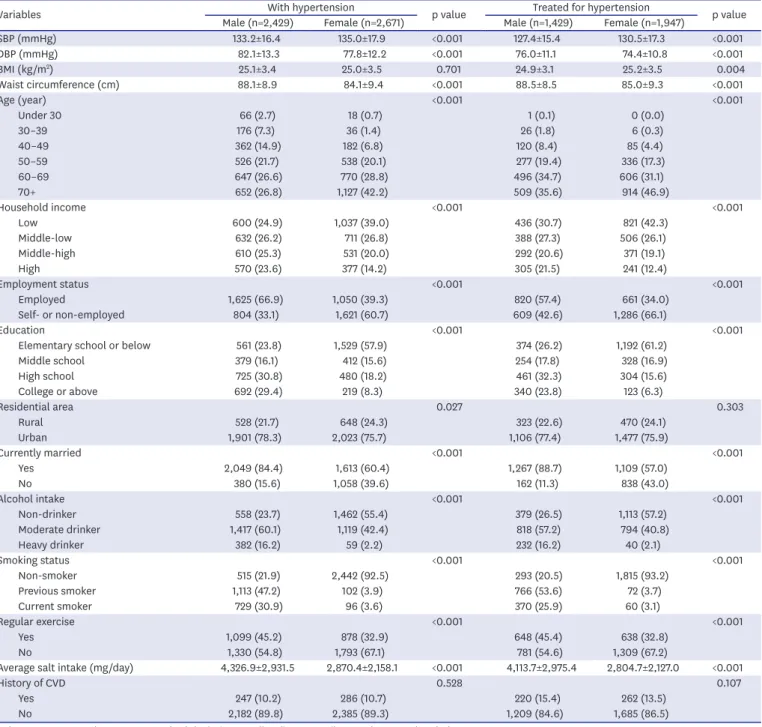
Results: In total, SBP, DBP, and S&DBP control rates were 63.0%, 63.7%, and 42.5% among all hypertension patients, and 77.5%, 87.4%, and 71.6% among treated hypertension patients.
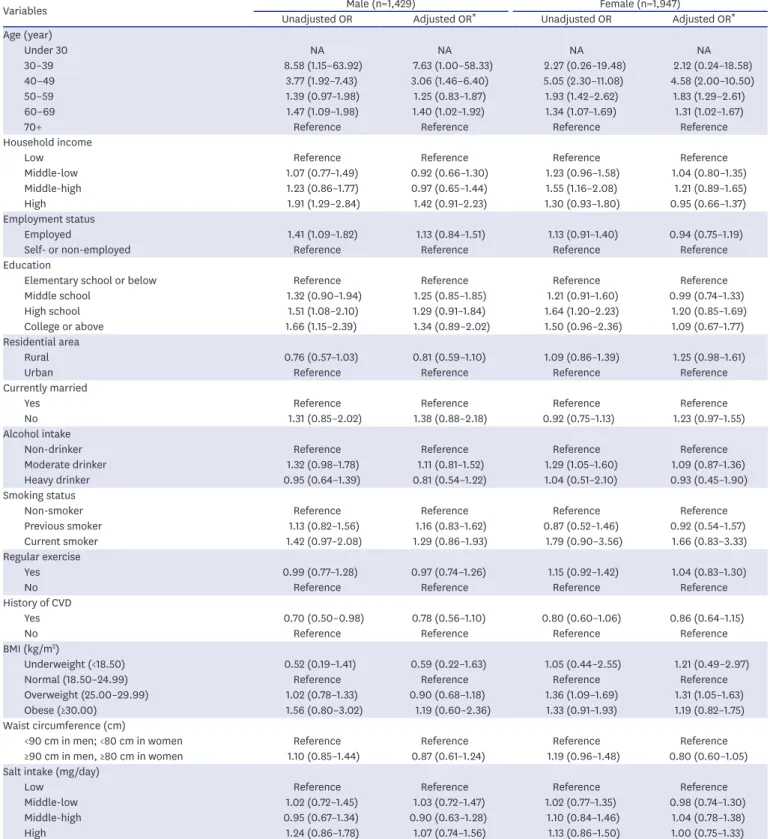
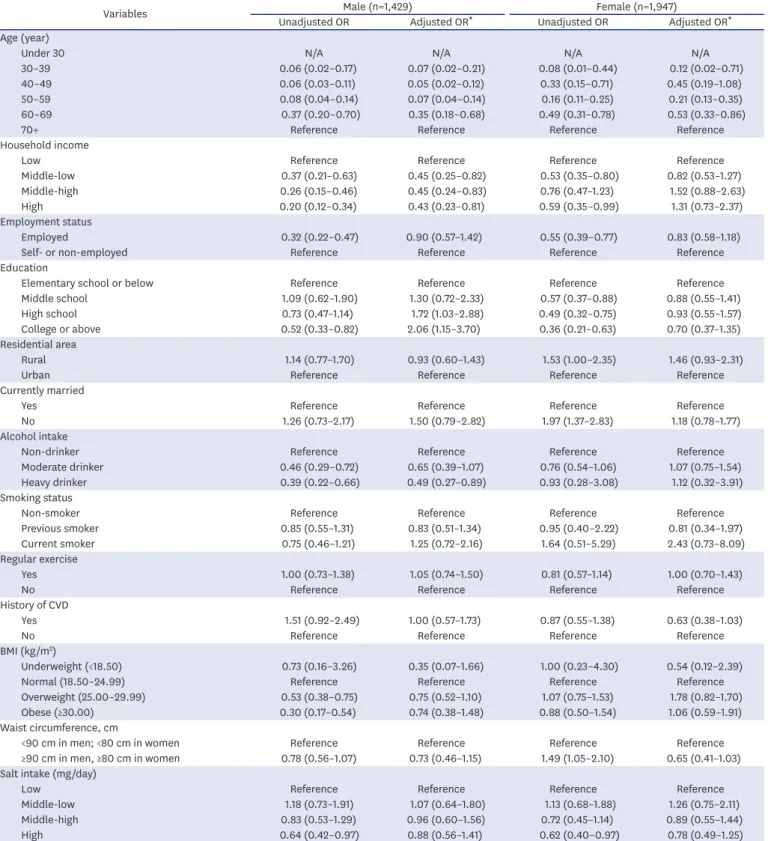
Men aged 40–49 years with hypertension and 30–39 years treated for hypertension had the highest SBP control rate (74.6% and 96.2%), which decreased by older age. Inversely, DBP control rate progressively increased with older age. SBP control rate among women with hypertension was the highest in 40–49 years (67.0%) but without linear trend by age group.
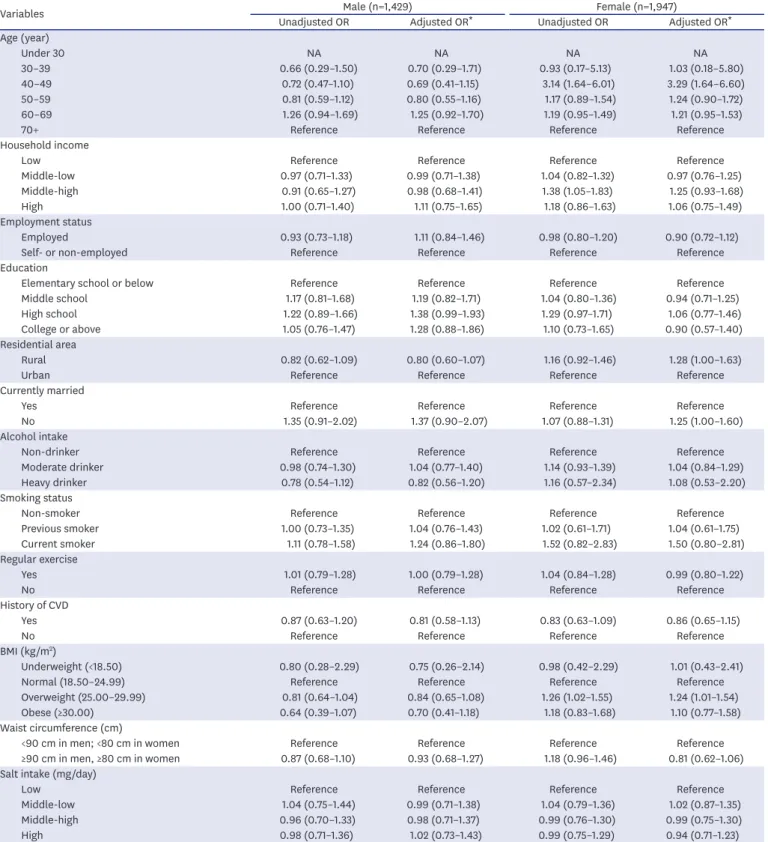
Interestingly, both combined and DBP control rates were noticeably low among women aged 50–59 years. Women with body mass index ≥25 were at higher odds of having controlled SBP.
Lower DBP control rate was observed in men with lower education level, higher household income, and heavy drinkers.
Conclusions: Separate examination of control rates demonstrated different sex- and age- differential trends, which would have been overlooked in combined control rates.
Keywords: Hypertension; Blood pressure; Chronic disease
Original Article
Received: Feb 7, 2019 Revised: Mar 27, 2019 Accepted: May 16, 2019 Correspondence to Hyeon Chang Kim, MD, PhD
Department of Preventive Medicine, Yonsei University College of Medicine, 50-1, Yonsei-ro, Seodaemun-gu, Seoul 03722, Korea.
E-mail: [email protected]
Copyright © 2019. The Korean Society of Cardiology
This is an Open Access article distributed under the terms of the Creative Commons Attribution Non-Commercial License (https://
creativecommons.org/licenses/by-nc/4.0) which permits unrestricted noncommercial use, distribution, and reproduction in any medium, provided the original work is properly cited.
ORCID iDs So Mi Jemma Cho
https://orcid.org/0000-0003-2460-3335 Hokyou Lee
https://orcid.org/0000-0002-5034-8422 Wook Bum Pyun
https://orcid.org/0000-0002-6377-0411 Hyeon Chang Kim
https://orcid.org/0000-0001-7867-1240
So Mi Jemma Cho , BA 1 , Hokyou Lee , MD 2,3 , Wook Bum Pyun , MD, PhD 4 , and Hyeon Chang Kim , MD, PhD 2,5
1
Department of Public Health, Yonsei University Graduate School, Seoul, Korea
2
Department of Preventive Medicine, Yonsei University College of Medicine, Seoul, Korea
3
Department of Internal Medicine, Yonsei University College of Medicine, Seoul, Korea
4
Division of Cardiology, Ewha Womans University Mokdong Hospital, Seoul, Korea
5