Veterinary Science
http://dx.doi.org/10.4142/jvs.2011.12.3.251 Received: 10 Jun. 2010, Accepted: 15 Sep. 2010
Original Article
*Corresponding author
Tel: +55-51-3308-6099; Fax: +55-51-3308-7305 E-mail: [email protected]
Relationship among blood indicators of lipomobilization and hepatic function during early lactation in high-yielding dairy cows
Felix Diaz González
1,*, Rodrigo Muiño
2, Víctor Pereira
3, Rómulo Campos
4, José Luis Benedito
31
Faculdade de Veterinária, Universidade Federal do Rio Grande do Sul, Porto Alegre, Brazil
2
Centro Veterinario de Meira, Galicia, Spain
3
Facultade de Veterinaria, Universidade de Santiago de Compostela, Lugo, Spain
4
Facultad de Ciencias Agropecuarias, Universidad Nacional de Colombia, Palmira, Colombia
Blood indicators are used as a tool to diagnose metabolic disorders. The present work was conducted to study the relationships among blood indicators of lipomobilization and hepatic function in high-yielding dairy cows. Two groups of Holstein cows were studied: 27 early lactation cows and 14 mid lactation cows from four different herds with similar husbandry characteristics in Galicia, Spain. Blood samples were obtained to measure beta-hydroxybutyrate (BHB), non-esterified fatty acids (NEFA), triglycerides (TG), and the activity of aspartate transaminase (AST) and gamma-glutamyl transferase. Cows in early lactation had higher levels of BHB and NEFA than mid lactation cows.
High lipomobilization (NEFA > 400 μmol/L) was detected in 67% and 7% of early lactation and mid lactation cows, respectively, while subclinical ketosis (BHB > 1.2 mmol/L) was detected in 41% and 28% of the early lactation and lactation cows, respectively. TG concentrations were low in all cows suffering subclinical ketosis and in 61% of the cows with high lipomobilization. During early lactation, 30% of cows suffered hepatic lipidosis as detected by levels of AST. Compromised hepatic function was observed in early lactation cows as shown by lower concentrations of glucose, total protein, and urea.
Keywords: blood biochemistry, hepatic lipidosis, high-yielding dairy cow, ketosis
Introduction
The productivity of high-yielding dairy cows has increased so that that milk yield has doubled over the past 40 years.
This has increased cow susceptibility to metabolic disea-
ses, mainly related to ketosis, fatty liver, and hypocalcemia [14]. Ketosis and fatty liver are closely linked and are responsible for severe economic losses in dairy farms due to drop in milk yield and increase in culling rates.
Clinical ketosis in dairy cows usually occurs between the second and seventh week of lactation [6]. Nevertheless, most of cows in this stage of lactation may suffer a subclinical form of ketosis defined as increased blood ketone bodies without any other symptoms but accom- panied by considerable decrease in milk yield and susceptibility other diseases [6]. The prevalence of subclinical ketosis in high-yielding dairy cows in The Netherlands was estimated in 12 to 47% of the herd [12].
Such prevalence is considered to be higher during the first month of lactation compared to the second month, with a peak of occurrence at the fourth week [3].
High-yielding dairy cows suffer from negative energy balance (NEB) during the first week of lactation because of energy expenditure due to milk production and limited feed intake [12]. NEB leads to lipomobilization with a high probability of fatty infiltration into the liver. It has been calculated that the amount of fat accumulated in the liver during the first 10 days of lactation is 60 to 125 g/day, leading to fatty infiltration in up to 25% of hepatic tissue [1].
Fatty liver or hepatic lipidosis in these cows occurs when lipid uptake by the liver exceeds the capacity of lipid oxidation or secretion by this organ, which is more common during the first 4 weeks of lactation [4]. Liver lesions caused by fatty infiltration as a consequence of lipomobilization are typically observed in high producing cows during the first stage of lactation. Development of these hepatic lesions leads to a high probability of suffering from other disorders, such as ketosis, mastitis, metritis, hypocalcemia, abomasum displacement and placenta retention, in a more severe and less responsive manner [2].
Diagnosing liver lipidosis and susceptibility of ketosis in
high-yielding dairy cows may include liver biopsy or
ecography, but a less invasive and more economical
Table 1. Number of dairy cows on the farms and composition (kg/cow) of the feed given as totally mixed rations
Composition of the diet Farm 1 Farm 2 Farm 3 Farm 4
Corn (silage) 22.0 25.0 25.0 27.0
Ryegrass (silage) 9.0 15.0 15.0 10.0
Concentrate 12.0 14.0 10.5 12.0
Straw / hay 1.0 1.0 0.6 0.5
Total (wet basis) 44.0 55.0 51.1 49.5
Number of dairy cows 120 92 110 163 Table 3. Characteristics of the high-yielding dairy cows in the present study
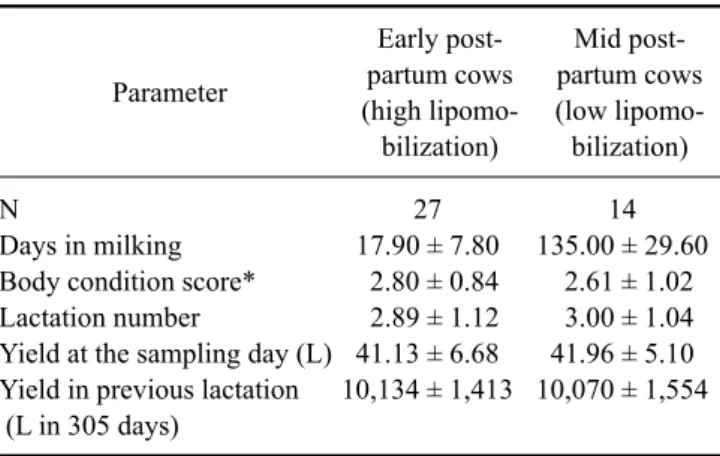
Parameter
Early post- partum cows (high lipomo- bilization)
Mid post- partum cows (low lipomo-
bilization)
N 27 14
Days in milking 17.90 ± 7.80 135.00 ± 29.60 Body condition score* 2.80 ± 0.84 2.61 ± 1.02 Lactation number 2.89 ± 1.12 3.00 ± 1.04 Yield at the sampling day (L) 41.13 ± 6.68 41.96 ± 5.10 Yield in previous lactation 10,134 ± 1,413 10,070 ± 1,554 (L in 305 days)
*Scale: 1 (thin) to 5 (fat). All data are presented means ± SD.
Table 2. Analysis of the totally mixed rations (%) given on the farms
Parameter Farm 1 Farm 2 Farm 3 Farm 4
Dry matter 47.4 40.4 41.9 43.3
Crude protein 15.6 15.7 15.0 16.4
Acid fiber 20.2 22.4 21.0 20.4
Neutral fiber 31.2 35.3 36.3 29.1
Ashes 5.1 6.7 6.6 7.7
Starch 28.3 22.2 22.9 27.7
Fat 5.5 4.2 4.1 5.0
analytical method may be the measurement of blood biochemical indicators [3]. The main blood indicators of lipomobilization in ruminants are beta-hydroxybutyrate (BHB), the most important and abundant ketone body, and non-esterified fatty acids (NEFA). The main indicators of hepatic lesions and function are enzymes aspartate transaminase (AST), gamma-glutamyl transferase (GGT), glutamate dehydrogenase (GLDH), and the metabolites glucose, cholesterol, and albumin [17]. The present study was conducted to determine the relationships between blood indicators of lipomobilization and hepatic function in high-yielding dairy cows in a region of Galicia (Spain).
The purpose was to obtain parameters to help diagnose the severity of metabolic disorders related to NEB during early lactation in dairy cows.
Materials and Methods
Our study was performed in the Galicia at four dairy farms under similar husbandry and feeding conditions (Table 1). The cows, all Holstein-Friesian, were high- yielding with a preceding lactation over 10,000 L of milk and also with a minimum yield of 40 L on the day of blood sampling. The cows were housed in free-stalls with sand beds, and only fed a mixed ration of similar composition (Tables 1 and 2). Clean water was available ad libitum in
automatic drinking troughs. The cows were milked twice a day and the number of cows at milking varied from 92 to 163 in the different herds.
Two groups of cows were chosen according to the lactation stage (Table 3). One group consisted of early post-partum cows in the first month of lactation (n = 27), and a second group included mid post-partum cows between 3 to 5 months of lactation (n = 14). Cows in early post-partum were designated as the high lipomobilization group (risk group), and cows in mid post-partum were classified as the low lipomobilization group (control group).
Blood samples were collected from the coccygeal vein in plain vacuum tubes after the first milking in the morning before feeding. Body condition scores were recorded by the same observer using the 1∼5 scale according to Ferguson et al. [8], meaning 1 = too thin and 5 = too fat. The blood samples were kept in ice boxes and carried to the laboratory within 1 h. The samples were then centrifuged (1,000 × g for 10 min) to obtain serum, which was immediately frozen in Eppendorf tubes at −20
oC until the biochemical measurements.
The following biochemical blood components were measured by different colorimetric techniques using a spectrophotometer (Genesys; Thermo, USA): BHB and NEFA levels were measured using a kit from Randox (Ireland), AST, GGT and triglycerides were measured using kits from Spinreact (Spain), glucose, total proteins and albumin were measured using kits from Human (Germany), and urea, creatinine, bilirubin, calcium, and phosphorus were measured using a kit from RAL (Spain).
Statistical analysis included performing a multivariate ANOVA of the blood metabolites using a general linear model and Pearson test for bipartial correlation. The principal effect was the stage of lactation (early vs.
mid-postpartum cows) in the analysis of blood metabolites.
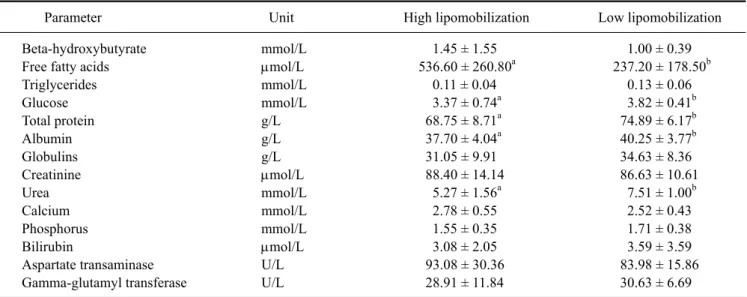
Table 4. Blood biochemistry of high-yielding dairy cows with high and low lipomobilization
Parameter Unit High lipomobilization Low lipomobilization
Beta-hydroxybutyrate mmol/L 1.45 ± 1.55 1.00 ± 0.39
Free fatty acids μmol/L 536.60 ± 260.80
a237.20 ± 178.50
bTriglycerides mmol/L 0.11 ± 0.04 0.13 ± 0.06
Glucose mmol/L 3.37 ± 0.74
a3.82 ± 0.41
bTotal protein g/L 68.75 ± 8.71
a74.89 ± 6.17
bAlbumin g/L 37.70 ± 4.04
a40.25 ± 3.77
bGlobulins g/L 31.05 ± 9.91 34.63 ± 8.36
Creatinine μmol/L 88.40 ± 14.14 86.63 ± 10.61
Urea mmol/L 5.27 ± 1.56
a7.51 ± 1.00
bCalcium mmol/L 2.78 ± 0.55 2.52 ± 0.43
Phosphorus mmol/L 1.55 ± 0.35 1.71 ± 0.38
Bilirubin μmol/L 3.08 ± 2.05 3.59 ± 3.59
Aspartate transaminase U/L 93.08 ± 30.36 83.98 ± 15.86
Gamma-glutamyl transferase U/L 28.91 ± 11.84 30.63 ± 6.69
a,b