고교시설 디자인 지표의 적용 분석 연구
- 경기도 고등학교를 중심으로 -
A Study on the Application of Design Indicators of the High School Facilities
- Focused on High School in Gyeonggi-do -
조 경 식*
아이게림**
Cho, Kyung-Sik Belyalova Aigerim
Abstract
The purpose of this study is to provide the fundamental data to improve a school building through comparing and analyzing facilities of high schools located in Gyeonggi–do Province on the basis of the Design Indicator for the Korean Educational Buildings. Two types of high schools were examined for this study. Some of them are high schools selected by Korean Ministry of Education as a school equipped with superior facilities and the others are high schools equipped with general facilities. 8 items such as safety, comfort, the function of education, utilization, the public, eco-friendliness, technology performance, economical efficiency were examined by 5 point Likert scale. Findings showed that all facilities of both types of high schools received high ratings in terms of safety, utilization, and technology performance. However, the evaluation index on 'various used outdoor space' and 'public buildings harmonized with surroundings' of the education function of both types of high schools was low, which implies that the facility related to the education function needs to be improved. It infers that facilities are simplified and harmony with surroundings disappears when altering the design of the school building due to the convenience of building and the problem of the budget. Therefore, these need to be primarily controlled. Additionally, in high schools with general facilities, the evaluation index on ‘aesthetic interior and exterior design of comfort’, ‘the responsive space to the demand for teaching and learning of the function of education’, and eco-friendless were so low that these factors need to be considered when designing the school building.
키워드:DQIS, 한국 학교시설 디자인 지표, 학교건축, 우수시설학교, 평가지표
Keywords:DQIS, Design quality indicator for the korean educational buildings, School design, Excellent facilities, Evaluation index
1. 서론
1)미래의 교육은 개방적이고, 창의적이며, 협력적인 인재를 양성하기 위한 방향으로 변모하고 있으며, 이러한 흐름에 따라 다양한 교육환경을 제공하여야 할 필요성이 대두되고 있다(맹준호 외 4. 2017). 교육시설과 학습 환경에 대한 지
* Dept. of Pedagogy, Graduate school, Dongguk Univ., Korea Corresponding Author,
E-mail: [email protected]
** Dept. of Pedagogy, Graduate school, Dongguk Univ., Korea Tel: 82-10-7938-1990, E-mail: [email protected]
속적인 관심과 기대수준의 향상은 교육환경의 디자인 품질 향상 및 사용자의 적극적인 참여가 요구되고 있으며 교육정 책은 획일적이고 일방향적인 학교운영에서 개별화되고 양 방향적으로 변화, 발전하고 있다. 교육의 효과를 높이기 위 해 학교시설 개선의 계획도 중요한 요인으로 여겨지며 최근 에는 학교시설 요인의 다양성에 대한 연구 결과도 보고되고 있다(Lyons, 2001; Picus et al., 2005; OECD, 2005). 이미 영국을 필두로 한 선진국에서는 급변하는 교육환경에 적극 적으로 대응하고 요구사항을 반영하기 위해 사용자 참여 디 자인(User Participatory Design)을 수행하고 있으며 체크
리스트 형식의 디자인품질지표(Design Quality Indicator)를 기반으로 사용자 의견을 적극적으로 수렴하고 더 나아가 다 양한 학교시설 디자인을 창출하고 있다. 그러나 우리나라의 학교시설 계획은 최소화된 법적 규제로 발주자와 설계자의 주도하에 공급자 위주로 진행되고 있어서 학교시설의 실제 사용자인 교사, 학생, 학부모, 지역주민의 만족도는 낮은 편이 다(박성철 외 6, 2011). 이에 따라 우리나라도 2011년 한국교 육개발원 KEDI(Korean Educational Development Institute) 에서 전문가를 활용하여 델파이 설문조사를 기반으로 국내 교육정책과 학교시설환경을 고려한 ‘한국 학교시설 디자인 지표’를 개발하였다. 이후 이화룡, 조창희(2012)도 델파이 설문조사와 AHP기법을 통해 학교시설의 디자인 품질지표 를 제시하였으며 두 연구가 동일한 지표를 제시함에 따라 학교시설 평가에 적합한 것으로 해석할 수 있다. 그러나 현 재까지 학교시설을 평가하는 도구로서 교육부의 ‘우수시설 학교 시상’1)과 건축법에 근거한 ‘친환경건축물인증제’2)가 활용되어지고 있다. 이미 개발되어진 ‘한국 학교시설 디자 인 지표’는 우수시설학교의 평가방법과 친환경건축인증 평 가방법의 내용을 모두 포함하고 있으며, 이 지표를 활용하 여 학교시설 설계 시 사용자의 의견수렴과 전문가의 의사결 정을 효과적으로 지원할 수 있는 도구3)이나, 개발된 지표가 수용단계에 진입하지 못하고 프로세스가 적용된 사례를 찾 기 드물다.
이에 따라 본 연구는 경기도에 위치한 교육부 우수시설 학교로 선정된 특수학교포함 고등학교와 일반시설 학교의 시설을 ‘한국 학교시설 디자인 지표’를 통해 비교 분석하 고 학교건축 개선방향과 ‘한국 학교시설 디자인 지표’의 활성화를 위한 기초자료를 제공하는 것을 목적으로 한다.
1) 초·중등학교 및 국립대학교 시설 중 설계·시공사례를 통합 발 굴하여 설계자 및 관계공무원을 시상함으로써 학교시설의 질 적 수준 향상
2) 건축법 제65조(친환경건축물의 인증) ① 국토해양부장관과 환 경부장관은 지속가능한 개발의 실현과 자원절약형이고 자연친 화적인 건축물의 건축을 유도하기 위하여 공동으로 친환경건 축물 인증제도를 실시한다.
친환경건축물 인증은 건축법 제65조 4항에 따라 친환경건축물 인증기준이 고시된 건축물을 대상으로 한다-공동주택, 복합건 축물(주거), 업무용 건축물, 학교시설, 판매시설, 숙박시설, 소 형주택
3) ‘한국 학교시설 디자인 지표’는 사용자 참여형 설계나 기존방 식의 각 설계별 제시되는 학교시설 대안들의 설계품질을 객관 적으로 진단·평가함에 따라 참여자간 의견충돌을 사전에 방지 하여 보다 효율적인 의견 수렴도구로 사용될 수 있다. 또한 단 계별 평가지표를 수립함으로서 학교 건축 전 단계에 걸친 종 합적인 품질관리 시스템 구축을 가능하게 한다(이화룡, 조창 희, 2012).
2. 이론적 고찰
2.1 고등학교 시설
학교시설과 관련하여 「학교시설사업 촉진법」, 「초중등교 육법」, 「시행령」, 「건축법」, 「도시계획법」, 「학교보건법」,
「소방법」, 「고등학교 이하 각 학교 설립·운영 규정」등의 법규가 있다. 그 중 1969년 학교시설 및 설비에 관한 「학 교시설·설비기준령」이 제정되고 16차례에 걸쳐 개정되었 으나 「고등학교 이하 각 학교 설립·운영 규정」이 1997년 개정되면서 폐지되었다(노란 외 2, 2011). 이 영은 학교에 많은 자율성을 부여한 7차 교육과정으로 들어서면서 고등 학교 설립기준을 최소화하여 일정기준만 충족하면 다양한 형태의 고등학교를 쉽게 설립·운영할 수 있도록 하고, 고 등학교이하 각급 학교의 설립·운영기준을 체계적으로 정 비하기 위해 새로이 개정되었다.4)
이와 관련하여 노란 외 2(2011)는 일반 초·중등학교의 교 육과정과 시설·설비에 대한 기준 또는 법령을 대상으로 교 육과정 변천에 대응할 수 있는 시설·설비 기준의 개정방향 을 연구하였고, 김창성(2013)은 국내 학교시설 친환경건축 물 인증기준GBCC: Green Building Certification Criteria) 의 평가항목을 연도별로 조사, 분석하고 친환경인증을 취 득한 학교건물의 사례분석을 통하여 국내 학교시설부문 친환경인증제도의 개선방향을 모색하였으며, 진재봉(2015) 은 충남교육청에서 시범운영하고 있는 학교시설민간위탁 에 대한 전·후의 경제성 비교, 위탁업체 근로자의 인력관 리운영과 전문성을 분석하였다.
2.2 우수시설학교
교육부에서는 1980년도부터 적용한 ‘학교시설 표준설계 도’를 폐지하고, 1995년부터 추진한 교육환경개선사업을 확대하여 1988년부터 3년간 전국에 75개 현대화 시범학교 를 신축하여 제7차 교육과정에 대응하는 학교시설을 신축 하게 되었다. 이에 다양한 교육과정을 반영한 학교시설 정 보교류와 사회여건 요구에 따라 아름다운 학교건축물을 발굴, 홍보할 목적으로 공개 응모하여, 초·중등학교, 특수 학교 및 국립대학교 시설 중 우수설계 및 시공사례를 발 굴·확산하여 학교시설의 질적 수준 향상 및 관련자를 시 상하기 위해 선정해왔다(하인철, 2013).
우수시설학교 선정기준은 2016년 공모부터 기준이 변경 되었다. 1998년부터 2015년까지 시설기획, 교수·학습방법 4) 교육과학기술부, 대통령령 제15484호 고등학교이하각급학교설
립·운영규정 제·개정문, 1977
대응, 건축계획, 공정 및 안전관리 등 크게 4가지 주요 평가 내용으로 심사하였다면 2016년 이후부터는 교육과정의 적 합성, 배치계획, 공간계획, 사회적 공공성, 친환경 설계, 구 조 및 시공성, 경제성 등 7가지 관점에서 심사하고 있으며 2015년 이전까지 한 차례 심사에 마쳤던데 반해 2016년 이 후부터는 2차례 심사 결과를 거치고 있다. 변경 전 평가기 준은 기본개념, 배치계획, 평면계획, 입면계획, 시공계획 등 5가지 항목으로 나뉘었고 변경 후 평가기준은 계획, 구조 (안전) 및 시공, 전기 및 기계, 교육으로 나뉘었으며 1차 서 류심사와 2차 현장심사에 맞게 세부평가기준은 그 내용이 달리한다. 시상은 총 7작품 내외로 하며 관련 공무원 및 건 축 관련자에게 교육과학기술부장관 표창을 하고 수상작 대 상 학교에는 우수시설학교 선정 패를 시상한다.
2.3 학교시설 점검진단도구 관련 국내외 사례연구 학교시설 디자인 품질 지표와 관련 활용되어 지고 있는 지표 및 관련 국내외 사례는 다음과 같다.
먼저 국내 사례를 살펴보면, 학교시설분야에서 이슈가 되고 있는 사용자 참여디자인(User Participatory Design) 이 매우 유용한 시스템으로 인식되고 있으나 사용자 참여 디자인 워크숍에 있어 사용자의 의견을 신속하고 효율적 으로 수렴할 수 있는 도구 개발이 미흡하다. 이러한 한계 점을 보완하고, 실질적인 이용자의 요구사항을 체계적으로 반영할 수 있는 한국형 디자인지표 개발을 목적으로 학교 시설의 디자인 품질 지표 개발 연구에서 ‘한국 학교시설디 자인지표(Korean Educational Building Design Indicator, KEBDI)’를 개발하였다. 또한 이화룡, 조창희(2012)는 국내 외 다양한 지표와 지침 등을 조사하여 국내 실정에 적합 한 학교 설계 디자인 품질 지표를 발굴하였고, 이지은 (2012)은 성공적인 디자인 품질 지표로 실행되고 있는 영 국의 DQI와 DQIfS에 대한 고찰과 이와 유사한 국내외 디 자인 품질 지표 현황의 분석을 통해 국내 실정에 맞는 품 질 지표 가이드라인을 제시하고자 하였다.
다음 국외 학교시설 지표 사례를 살펴보면, 영국은 2005 년부터 중고등학교를 위한 디자인 품질 표시기(DQIS:
Design Quality Indicator for Schools) 프로세스의 도입으 로 교사, 학부모, 학교 총재, 학생, 지역 사회 구성원, 지방 당국이 참여하여 학교디자인의 품질을 향상시키고, 사용자 가 학교 건물의 소유권과 정체성을 공유하며 학생들의 성 과에 긍정적인 영향을 미치도록 하고 있다. 미국 워싱턴 주 의 시애틀교육청은 2001년도에 학교설계팀(School Design Team)을 구성하여 설계프로세스를 개발하였고, 개별 학교
설계팀 구성방법 및 역할에 대한 가이드라인(School Design Team Guidelines)을 제시하여 얼마나 많은 학교설계의 주 제들이 시설에 반영되었는지 점검 가능한 체크리스트를 제시하였다(박성철 외 6, 2011), 일본에서는 다양한 주체가 학교건설의 모든 프로세스에 참여하는 ‘학교만들기’가 전 개되고 있다. 문부과학성, 국토교통성, 후생노동부는 지역 참가를 통한 열린 학교를 위해 관련 위원회를 설치하고, 지역참가형 학교만들기 프로세스와 방법론을 지방자치제 에 팜플렛 및 매뉴얼의 형태로 보급하였다(성은영 외 3, 2009).
3. 연구방법
본 연구는 경기도 소재 2010년 이후 신·증축 및 개축 고 등학교 중 교육부 우수시설학교로 선정된 특수학교포함 고 등학교 3곳과 일반시설 학교3곳의 시설비교를 통하여 학교 건축 시설 현황분석과 개선방향을 제시하고자 한다. 연구방 법은 문헌고찰, 현장조사의 방법을 이용하였으며 문헌고찰 을 통하여 학교시설을 평가하기 위한 분석의 틀을 정리하였 다. 현장조사를 통하여 각 공간을 관찰하고 사진촬영을 병 행하였으며 2011년 교육부에서 개발하였으나 활성화되지 않은 한국 학교시설 디자인 지표의 개념을 기반으로 기준으 로 학교시설을 분석 및 평가하였다. 평가는 5점 척도를 이 용하였고 평가에 적용된 척도의 기준은 다음과 같다.
1점은 모든 시설 미설치, 2점은 시설 불량, 3점은 일부시 설 설치는 되었으나 법적기준 미달, 4점은 일부시설이 설치 되고 법적기준에 적합, 5점은 모든 시설이 설치되고 법적기 준에 적합하며 시설이 매우 양호한 상태로 점수화 한다.
4. 시설분석
4.1 현황표 작성
본 지표는 한국교육개발원의 한국 학교시설 디자인 지 표, 이화룡, 조창희(2012)의 연구, 영국의 DQI, 행정중심복 합도시 좋은 건축물 지정제도 등을 참고로 하여 다음과 같이 정리하였다(Table 1).
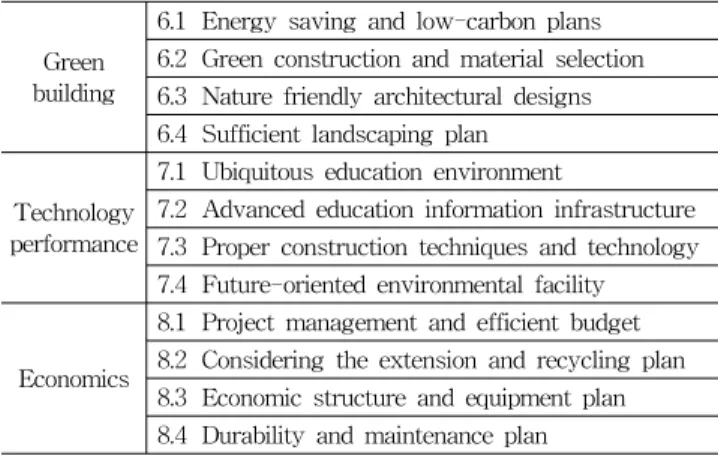
이 중 본 연구에서 적용할 학교시설 환경 평가는 박성 철 외 6(2011)가 연구한 한국교육개발원의 ‘한국 학교시설 디자인 지표’는 안전하고 쾌적한 교육환경, 교육적 기능과 가치를 실현하는 학습 환경, 친환경적인 공공시설로의 학 교, 미래지향적인 건물 성능을 포함한 기본 방향 4개, 안 전성, 쾌적성, 교육성능, 활용성, 공공성, 친환경성, 기술성
items
Development of Design
Quality Indicator
for the Korean Educational
Buildings
Developing the Standardized
Index of Evaluation
for Upgrading the School Facilities
DQI for British
Better building
Perfor- mance criteria
Safety
Safety
Comfort Access
Training
performance Training
activities Functionality Space Availability
Publicness complexation Impact Public &
Harmony Green
building
Green
building Build Quality
Form Technology
performance
Environ- mental Design Economics
Table 1. Analysis of Performance criteria
Items
Safety
1.1 Natural disaster and fire prevention design 1.2 Crime prevention through environmental design 1.3 Barrier free design
1.4 Life safety design
Comfort
2.1 Comfortable indoor environment 2.2 Interior proper illuminance & acoustice
environment
2.3 Aesthetic Exterior and interior design 2.4 Sanitary living environment
Training performance
3.1 Learning Space corresponding to needs 3.2 Space for smooth operation of the curriculum 3.3 Supporting facility for teachers and students 3.4 Multipurpose public outdoor space
Availability
4.1 Considering the characteristics and psychology student design
4.2 Variety of secure flexibility for use
4.3 Move a convenient and secure places to relax 4.4 Efficient space plan
Publicness
5.1 School facility utilization of community 5.2 Public building fit in with their environment 5.3 Community connection
5.4 Suitable separation with resident use space Table 2. Evaluation details of the rating scale
Green building
6.1 Energy saving and low-carbon plans 6.2 Green construction and material selection 6.3 Nature friendly architectural designs 6.4 Sufficient landscaping plan
Technology performance
7.1 Ubiquitous education environment
7.2 Advanced education information infrastructure 7.3 Proper construction techniques and technology 7.4 Future-oriented environmental facility
Economics
8.1 Project management and efficient budget 8.2 Considering the extension and recycling plan 8.3 Economic structure and equipment plan 8.4 Durability and maintenance plan
School Location Building
size
Num- ber of class
plot- tage (㎡)
Excellent facilities
school A
112, Wi city 4-ro, Ilsandong-gu, Goyang-si, Gyeonggi-do, Republic of Korea
five-floor and a basement
24 17,460
B
21, Bubaljungang-ro 46beon-gil, Bubal-eup, Icheon-si, Gyeonggi-do, Republic of Korea
four-floor and a basemen
30 15,104
C
64, Hi park 1-ro, Ilsanseo-gu, Goyang-si, Gyeonggi-do, Republic of Korea
five-floor and a basemen
36 14,937
General facilities school
D
267, Waseoksunhwan-ro, Paju-si, Gyeonggi-do, Republic of Korea
five-floor 45 13,969
E
100, Daehwa-ro, Ilsanseo-gu, Goyang-si, Gyeonggi-do, Republic of Korea
five-floor and a basemen
36 16,600
F
39, Seojeongmaeul 2-ro, Deogyang-gu, Goyang-si, Gyeonggi-do, Republic of Korea
five-floor and a basemen
36 14,816
A B C
D E F
A: Goyang global high school B: Dawon school C: Deogi high school D: Unjeong high school E: Deahwa high school F: Seojeong high school
Table 3. Overview of surveyed schools
능, 경제성을 포함한 8개의 요구 성능, 그리고 32개의 세 부요구성능, 각 세부요구성능에 대한 지표항목 168개의 문 항으로 구성되어 있다. 이에 본 논문에서는 32개의 세부요 구성능에 대한 지표항목을 평가 기준 및 체크리스트로 삼 아 평가하였다. 평가지수 척도는 1점에서 5점까지의 점수 로 평가하게 되어 있다(Table 2).
4.2 현황파악 및 분석 1) 관찰조사
경기도 소재 2010년 이후 신·증축 및 개축 고등학교 중
A
B1 parking lot, machine room
1F library, staff room, staff lounge, traditional culture room 2FAV room, staff room, language lab, club room, research lab,
computer lab
3F classroom, research lab, science lab
4F classroom, science lab, international cultural experience room 5F classroom, cooking room, tech room, music room
B
B1 parking lot, machine room
1Fkindergarten, administration, principal's office, elementary classroom, cafeteria
2Fstaff room, broadcasting booth, library, auditorium, elementary classroom
3F middle classroom, computer lab, art studio, science lab 4F high classroom, major, music room
C
B1 machine room
1Fcafeteria, principal's office, administration, special class, historical sociology class
2Flibrary, computer lab, auditorium, indoor garden, historical sociology class
3F home base, korean class, art studio, common room, staff lounge 4F science lab, math class. common room, staff lounge 5Flanguage lab, english class, chinese composition class, staff
lounge, roof garden
D
1F auditorium, staff room, principal's office 2F gym, classroom
3F multi hall, staff room, classroom 4F staff room, classroom
Table 4. Each floor mail room
5F classroom, music room
E
B1 parking lot, machine room
1FAV room, cafeteria, principal's office, administration, indoor garden
2Flibrary, home base, staff room, broadcasting booth, language lab, science lab
3F classroom, home base, art studio, cooking room, research lab 4F classroom, home base, gym, research lab
5F classroom, research lab
F
B1 machine room
1Fcafeteria, administration, principal's office, AV room, tech-cooking room
2F gym, library, art studio, classroom, staff room 3F classroom, computer lab, science lab, staff lounge 4F classroom, language lab, science lab, staff lounge 5F classroom, music room, home base
A D
2F 2F
B E
2F 2F
C F
2F 2F
Table 5. Plan of surveyed schools
우수시설학교인 고양국제고, 다원학교, 덕이고 등 3곳과 일반시설학교인 운정고, 대화고, 서정고 등 3곳을 선정하 여 총 6곳의 학교시설을 조사하였다.
고양국제고는 경기도 고양시에 위치하고 있으며 2011년 우수시설학교로 선정되었고 경기도 이천시에 위치한 다원 학교는 2016년 우수시설학교로 선정되었으며 유치원, 초등 학교, 중학교, 고등학교, 전공과 등 총 30학급으로 되어 있 는 특수학교이다. 덕이고는 경기도 고양시에 위치하고 있 으며 2012년 우수시설학교로 선정되었다. 일반시설학교인 경기도 파주시에 위치한 운정고는 2012년 개교했으며, 대 화고와 서정고는 경기도 고양시에 2012년 개교하였다. 대 체로 일반시설 고등학교의 학급수가 많은 편이며 각 학교 의 전경은 다음과 같다(Table 3).
2) 실측조사(평면)
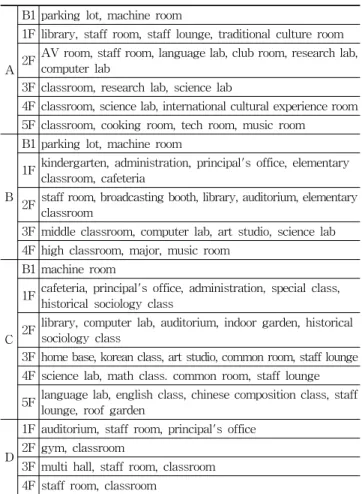
우수시설학교인 고양국제고, 다원학교, 덕이고는 일반시 설학교인 운정고, 대화고, 서정고에 비해 특별교과활동이 가능한 다양한 학습실로 구성되어 있다(Table 4). 이에 표 4의 가독성을 확보하기 위해 대체로 특별교과활동 학습실 이 많이 배치되어 있는 2층 평면도를 제시한다(Table. 5).
3) 조사대상시설 평가 분석
6곳 학교의 평가지수는 다음과 같다(Table 6).
안전성에서 6곳 학교 모두 세부항목의 높은 평가지수를 받았고 평균 평가지수가 4.92에 이르러 적정 기준 이상임 을 알 수 있다.
쾌적성 항목을 살펴보면 대부분의 세부항목에서 6곳 학 교 모두 높은 평가지수를 받았으나 ‘심미적 실내, 외 디자 인’ 항목에서 운정고, 대화고, 서정고가 낮은 지수를 받았 다. 지수가 낮은 학교는 모두 일반시설학교로서 우수시설 학교가 심미적 측면에서 뛰어난 것을 알 수 있었다.
교육성능을 살펴보면 ‘다양하게 활용되는 옥외공간’에 대해 다원학교를 제외한 5곳의 학교가 낮은 지수를 받아, 우수시설학교와 일반시설학교가 대체로 다양하게 활용되 는 옥외공간에 대한 개선이 필요한 것으로 사료되며, ‘교 수학습 요구에 대응하는 공간’에 대해 일반시설학교인 대 화고, 서정고가 낮은 지수를 받은 것으로 나타났다.
A B C D E F
Safety
- Handrails installed in the toilet, wall, the hallway
- Remove threshold - Ramp installed on
the entrance
- Handrails installed in the toilet, wall, the hallway
- Remove threshold - Ramp installed on
the entrance
- Handrails installed in the toilet, wall, the hallway
- Remove threshold - Ramp installed on
the entrance
- Handrails installed in the toilet, wall, the hallway
- Remove threshold - Ramp installed on
the entrance
- Handrails installed in the toilet, wall, the hallway
- Remove threshold - Ramp installed on
the entrance
- Handrails installed in the toilet, wall, the hallway
- Remove threshold - Ramp installed on
the entrance
Comfort - Sanitary conditions - Appropriate light
fixtures
- Design of Construction - Sanitary conditions - Appropriate light
fixtures
- Sanitary recycling bin in the building - Appropriate light
fixtures
- Sanitary conditions - Appropriate light
fixtures
- Sanitary conditions - Appropriate light
fixtures
- Sanitary recycling bin in the building - Sanitary conditions - Appropriate light
fixtures
Training perfor-
mance
- Multipurpose education room - Staff room - Special education
room
- Multipurpose auditorium - Special education
room
- Individual locker
- Multipurpose education room - Individual locker - Multipurpose
education room
- Multipurpose education room - Special education
room
- Staff room - Special education
room
- Special education room
Availa-
bility - That can read and lounge space the hall - Multipurpose hall
- That can read and lounge space the hallway - Multipurpose hall
- Service areas in the hall
- Exhibition space available in the hall
- Multipurpose room - Multipurpose room - Service areas in the
hall
Publi- cness
- Building with surrounding or not - Open the front gate for local community
- Usable physical fitness equipment for local resident - Separation of space
from students' space
- Building with surrounding or not
- Building with surrounding or not
- Sports Facilities open to community residents
- Building with surrounding or not
Green building
- Landscape space - Use Eco finish
materials
- Solar energy installation - Vegetable garden - Landscape space - Eco friendly
finishing materials
- Landscape space - Eco friendly
finishing materials
- Solar energy installation - Landscape space
- Rest space in the landscape
- Indoor garden
Tech- nology perfor- mance
- Built-in chiller and heater
- IT infrastructure Built in class room
- Built-in chiller and heater
- IT infrastructure Built in class room
- Built-in chiller and heater
- IT infrastructure Built in class room
- Built-in chiller and heater
- IT infrastructure Built in class room
- Elevator installation - Built-in chiller and
heater
- Built-in chiller and heater
- IT infrastructure Built in class room
Econo-
mics - Considering the extension and recycling plan
- Economic structure - Proper maintenance
- Economic structure - Proper maintenance
- Economic
equipment planning - Proper maintenance
- Economic
equipment planning - Proper maintenance
- Economic
equipment planning - Proper maintenance Figure 1. Each school's facilities
Items School
A B C D E F
Safety
1.1 Natural disaster and fire
prevention design 5 5 5 5 4 5
1.2 Crime Prevention Through
Environmental Design 5 5 5 5 5 4
1.3 Barrier free design 5 5 5 5 5 5
1.4 Life safety design 5 5 5 5 5 5
Com- fort
2.1 Comfortable indoor environment 5 4 4 4 4 4 2.2 Interior proper illuminance &
Acoustice Environment 4 5 4 4 4 3
2.3 Aesthetic Exterior and interior
Design 4 4 4 2 3 2
2.4 Sanitary living environment 5 5 5 4 4 4
Train- ing perfor-
mance
3.1 Learning Space corresponding to
needs 4 4 5 4 3 3
3.2 Space for smooth operation of the
curriculum 4 4 4 4 4 4
3.3 Supporting facility for teachers
and students 4 4 4 4 4 4
3.4 Multipurpose public outdoor space 3 4 3 3 3 3
Avai- lability
4.1 Considering the characteristics
and psychology student design 5 4 5 5 4 4 4.2 Variety of secure flexibility for use 4 4 4 4 4 4 4.3 Move a convenient and secure
places to relax 5 5 5 4 4 4
4.4 Efficient space plan 5 5 5 4 4 4
Publi- cness
5.1 School facility utilization of
community 4 3 4 4 4 3
5.2 Public building fit in with their
environment 3 3 3 2 3 2
5.3 Community connection 5 4 3 3 3 3
5.4 Suitable separation with resident
use space 5 5 5 5 5 4
Green buil-
ding
6.1 Energy saving and low-carbon
plans 4 4 4 3 3 2
6.2 Green construction and material
selection 4 4 5 2 4 2
6.3 Nature friendly architectural
designs 5 5 4 2 2 2
6.4 Sufficient landscaping plan 4 4 5 3 4 3
Tech- nology perfor- mance
7.1 Ubiquitous education environment 5 5 5 3 3 3 7.2 Advanced education information
infrastructure 5 5 5 4 3 3
7.3 Proper construction techniques
and technology 5 5 5 4 4 3
7.4 Future-oriented environmental
facility 5 5 5 4 4 3
Econo- mics
8.1 Project management and efficient
budget 5 5 4 3 4 3
8.2 Considering the extension and
recycling plan 4 4 4 4 3 3
8.3 Economic structure and equipment
plan 4 4 4 3 3 3
8.4 Durability and maintenance plan 4 5 5 3 3 2
Total 143 143 142 118 118 108
Average 4.47 4.47 4.44 3.69 3.72 3.31 Table 6. Assessment results in detail items
활용성을 살펴보면 6곳 학교 모두 세부항목의 높은 평 가지수를 받아, 설계 시 공간계획이 적절히 이루어진 것으 로 추측된다.
공공성을 살펴보면 ‘주민활용공간과의 적절한 분리’에 대해 6곳 학교 모두 높은 평가지수가 나타났으며 ‘주변 환 경과 조화되는 공공건축물’에 대해 6곳 학교 모두 낮은 평 가지수를 받았다. 이는 우수시설학교와 일반시설학교 모두 주변환경과 조화롭지 못한 건축디자인인 것으로 알 수 있 으며, 공사의 편리성, 예산문제 등으로 설계변경을 거치며 단순화되고 조화로움이 사라지는 것으로 사료된다.
친환경성을 살펴보면 ‘에너지 절약 및 저탄소 계획’에서 일반시설학교인 운정고, 대화고, 서정고가 낮은 평가지수 를 받았고, ‘친환경 공법 및 재료 선정’에서 운정고, 서정 고가 낮은 평가지수를 받았다. ‘자연친화적 건축 디자인’에 서 운정고, 대화고, 서정고가 낮은 지수를 받았으며, ‘충분 한 녹화 및 조경계획’에서 운정고, 서정고가 낮은 지수를 받았다. 대체로 일반시설학교인 운정고, 대화고, 서정고의 친환경성 평가 지수가 낮아, 개선이 필요한 사항으로 사료 된다.
기술성능을 살펴보면 ‘유비쿼터스 교육환경 조성’에서 우수시설학교인 고양국제고, 다원학교, 덕이고가 높은 평 가지수를 받았으며, ‘첨단 교육정보 인프라 구축’에서 대화 고, 서정고가 낮은 평가지수를 받았다. ‘적정 건축구법 및 기술 적용’과 ‘미래지향적 환경설비계획’에서는 서정고가 낮은 평가를 받았고, 기술성능의 평균지수는 일반시설학교 인 운정고, 대화고, 서정고가 낮게 나타났다. 기술성능에서 일반시설학교인 서정고가 가장 낮은 평가지수를 받은 것 으로 나타났다.
경제성을 살펴보면 ‘효율적인 예산 및 공사 관리’에서 운정고와 서정고가 낮은 평가지수를 받았고, ‘증축 및 재 활용을 고려한 계획’에서 대화고 서정고가 낮은 지수를 받 았다. ‘경제적인 구조 및 설비계획’과 ‘내구성과 유지관리 계획’에서는 우수시설학교인 고양국제고, 다원학교, 덕이고 가 높은 평가지수를 받았다. 경제성에 대해 대체로 일반시 설학교의 평가지수가 낮게 나타나, 최초 학교건축 계획단 계 시 참고해야 할 사항으로 판단된다.
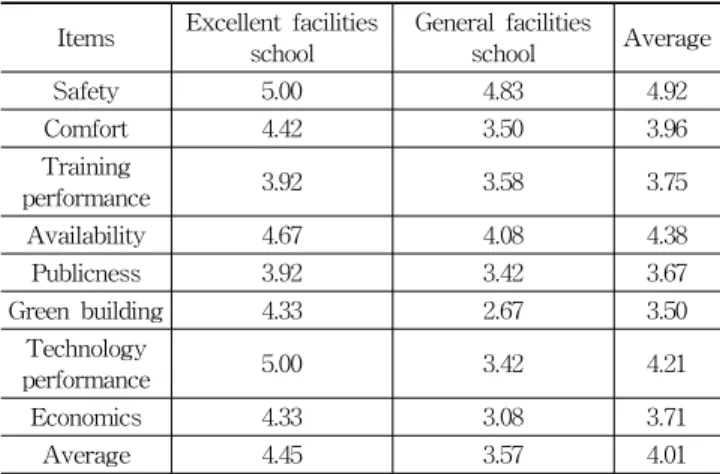
우수시설 고등학교와 일반시설 고등학교의 요구성능 항 목의 평균 평가지수를 살펴보면, 우수시설 고등학교는 8개 항목에 대해 대체로 높은 평가를 받았다. 일반시설 고등학 교는 친환경성과 경제성에서 낮은 평가지수를 받았으며, 그 외 항목에 대해서는 평균 이상의 평가를 받아 적정수 준에 이르고 있음을 알 수 있다(Table 7).
Items Excellent facilities school
General facilities
school Average
Safety 5.00 4.83 4.92
Comfort 4.42 3.50 3.96
Training
performance 3.92 3.58 3.75
Availability 4.67 4.08 4.38
Publicness 3.92 3.42 3.67
Green building 4.33 2.67 3.50
Technology
performance 5.00 3.42 4.21
Economics 4.33 3.08 3.71
Average 4.45 3.57 4.01
Table 7. Evaluation Index in performance criteria
5. 결론 및 제언
본 연구는 한국 학교시설 디자인 지표의 개념에 의해 우수시설 고등학교와 일반시설 고등학교의 시설을 비교 분석하였으며 그 결과는 다음과 같다.
첫째, 안전성, 활용성, 기술성능에서 우수시설 고등학교 와 일반시설 고등학교 모두 높은 평가지수를 받았다. 이는 우수시설 고등학교 뿐 만 아니라, 최근 신·증축 및 개축한 일반시설 고등학교도 무장애 설계, 학생 행동특성을 반영 한 적절한 공간배치. 첨단 교육설비의 활용 등이 적절히 이루어지고 있으며 한국 학교시설의 수준이 높아지고 있 음을 알 수 있다.
둘째, 쾌적성의 세부항목 중 ‘심미적 실내외 디자인’ 항 목에서 일반시설 고등학교의 평가 지수가 낮게 나타났다.
현재 재정투자사업의 경우 건축가와 교육청의 시설담당공 무원이 주축으로 설계를 추진하고, 민간투자방식인 BTL 사업의 경우 건설사의 비중이 상대적으로 커서 건축가는 간접적으로 참여하게 되는 구도로서, 설계의 질을 제고하 기 위해서는 설계안의 발전과정에 대해 사용자와 건축가가 주도하여 참여하는 구조 개선이 필요한 것으로 사료된다.
셋째, 우수시설 고등학교와 일반시설 고등학교가 대체로
‘다양하게 활용되는 옥외공간’에 대한 평가 지수가 낮아, 학생들의 행태와 요구분석이 필요한 것으로 사료되며, 교 육성능 중 ‘교수학습 요구에 대응하는 공간’에 대해 일반 시설학교의 지수가 낮아 개선해야 할 사항으로 사료된다.
넷째, ‘주변 환경과 조화되는 공공건축물’에 대해 우수시 설 고등학교와 일반시설 고등학교 모두 낮은 평가 지수를 받았다. 공사의 편리성, 예산문제 등으로 설계변경을 거치 며 단순화되고 조화로움이 사라지는 것으로 추측되며 중점 관리해야 할 사항으로 사료된다. 또한 앞서 지적한 설계
참여구조 개선이 동시에 이루어져야 할 것으로 판단된다.
다섯째, 친환경성과 경제성에 대해 대체로 일반시설 고 등학교의 평가 지수가 낮게 나타났다. 이는 우수시설 고등 학교가 다양한 교육과정과 친환경적 시설에 적합한 설계 가 이루어진 것으로 알 수 있으며, 유제용(2006)의 연구결 과에 따르면 우수시설학교가 고가의 재료로 미려하게 시 공하여 선정된 것이 아니라 선정기준에 적합하게 설계되 고 시공된 결과임으로 나타났다. 따라서 최초 학교건축 계 획 단계 시 효율적인 예산 관리로 보다 나은 교육환경을 계획해야 할 것으로 판단된다.
2011년 개발된 ‘한국 학교시설 디자인 지표’는 수용단계 에 진입하지 못하고 실제 프로세스가 적용된 사례가 드물 어 본 연구는 학교시설 평가지표를 적용하여 경기도 소재 우수시설학교와 일반시설학교를 평가하였다. 이는 학교시 설 평가지표의 검증을 가능하게 하며 학교건축이 나아가 야 할 방향을 제시함에 목적이 있다. 향후 타 지역 학교를 동일 조건에서 비교 연구하여 학교시설 평가지표의 적극 적인 활용과 영국의 DQI와 같은 체계적인 운영시스템이 자리 잡기 기대한다.
References
1. Ha, In-Cheol, Ministry of Education School Excellence Winner Selected Through a Change of the School Facilities, Journal of Korean Institute of Educational Facilities, 20(4), pp.59-62, 2013.
2. Jin, Jae-Bong, A Study on Efficient Management of School Facilities, Graduate School, Korea National University of Education, Doctorate Thesis, 2015.
3. Kim, Chang-Sung, The Analysis on the Assessment Categories of Korea Green Building Certification Criteria by the Case Studies of Educational Facilities, Journal of the Korean Institute of Educational Facilities, 20(2), pp.15-24, 2013.
4. Lee, Hwa-Ryong and Cho, Chang-Hee, A Study on Developing the Design Quality Indicators(DQI) for School Building -Using Delphi Survey Method and Analytical Hierarchical Process(AHP)-, Journal of the Architectural Institute of Korea Planning & Design, 28(5), pp.69-77, 2012.
5. Lee, Ji-eun, A Study on the User-participation Design Process for School, Graduate School, Kwangwoon University, Doctorate Thesis, 2012.
6. Lyons, J. B., Do school facilities really impact a child’s education issue track: a CEFPI brief on educational facility
issues, Council of Educational Facility Planners, Interna- tional, Scottsdale, AX. ED 458791, 2001.
7. Mang, Joon-Ho, Lee, Ho-Jin, Kim, Seong-Joong, Lee, Seung-min and Park, Young-Bin, A study on restruc- turing of new educational space, Korea institute of sustainable design and educational environment, 2017.
8. Noh, Ran, Yoon, Sung-hoon and Jung, Jin-ju, A Study on the Revisions of the School Facility and Equipment Standards with the Changes in Education Curriculum and Legislations of School Facilities and Equipment, Journal of the Korean Institute of Educational Facilities, 18(5), pp.23-33, 2011.
9. OECD, Building schools for the future in the united kindom, PEP Exchange, 54, 11-13, 2005.
10. Park, Sung-Cheol, Cho, Jin-il, Choi, Hyeong-ju, Ro Keun Chul, Jung, Tae-Hwan, Park, Hee-won and Koh, In-Lyong, Development of design quality indicator for the Korean educational buildings, Seoul:Korean Educational Development Institute, RR2011-28, 2011.
11. Picus, Lawrence O., Scoott F. Marion, Naomi Calvo, &
William J. Glenn, Understanding the relationship between student achievement and the quality of educational facilities: evidence from wyoming, Peabody Journal of Education, 80(3), pp.71-95, 2005.
12. Seong, Eun-Young, Cho, Sang-Kyu, Ko, Eun-Jeong and Lee, Jin Min, A Study on Strategy and System to Achieve a Well-designed School Building, 2009.
13. Yu, Chea-Yong, Study on the Improvement of the Design and Construction Evaluation Policy to Select the Quality Public School Facilities, Graduate School, Seoul National University of Technology, Doctorate Thesis, 2006.
접수 2017. 9. 24 1차심사완료 2017. 10. 30 2차심사완료 2017. 11. 8 2차재심완료 2017. 11. 17 게재확정 2017. 11. 17