http://www.ecevr.org/
119
CLINICAL
EXPERIMENTAL VACCINE
RESEARCH
Guideline
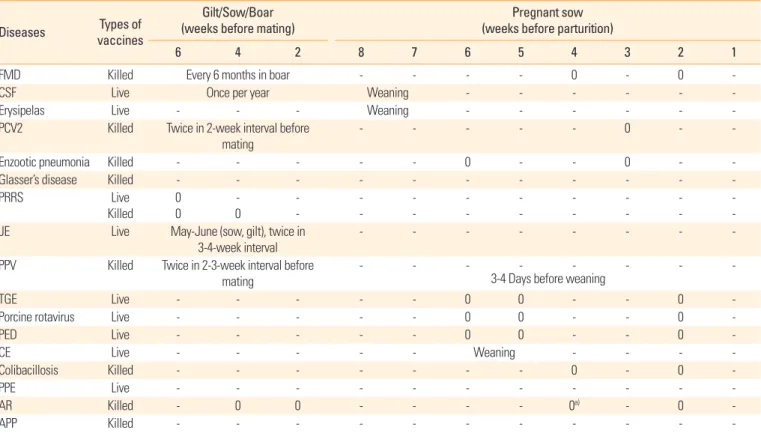
Pig industry have been increased during the last half century in Korea. About sixteen million pigs were slaughtered in 2013, which is indicating current situation of pig farm- ing in our country. Increase in the number of animals is closely related with the increase of outbreak in infectious diseases. After the antimicrobial agents had been banned as feed additives in July 2012, the importance of vaccines have been increased. To control the epidemics of the infectious diseases, several vaccination programs have been used in Korean pig farms based on the farm situation even though standard vaccine pro- grams were suggested. Therefore, needs to optimize pig vaccination program has been increased in our country. Based on the current situation of Korean pig industry, vacci- nation programs in pigs are suggesting (Tables 1, 2). However, this guideline is adjust- able to farm depending on the situation of farms such as current vaccination programs and immunological status in each farm.
© Korean Vaccine Society.
This is an Open Access article distributed under the terms of the Creative Commons Attribution Non-Com- mercial License (http://creativecommons.org/licenses/
by-nc/3.0) which permits unrestricted non-commercial use, distribution, and reproduction in any medium, pro- vided the original work is properly cited.
K O R E A N V A C C I N E S O C I E T Y
K O R E A N V A C C I N E S O C I E T Y
K O R E A NA C C I N E O C I E T Y V
S
Clin Exp Vaccine Res 2015;4:119-120 http://dx.doi.org/10.7774/cevr.2015.4.1.119 pISSN 2287-3651 • eISSN 2287-366X
Won Hyung Lee
1, Han Sang Yoo
21XP Bio Inc., Anseong, 2Department of Infectious Diseases, College of Veterinary Medicine, Seoul National University, Seoul, Korea
Received: August 13, 2014 Revised: October 21, 2014 Accepted: October 24, 2014
Corresponding author: Han Sang Yoo, DVM, PhD Department of Infectious Diseases, College of Veterinary Medicine, Seoul National University, 1 Gwanak-ro, Gwanak-gu, Seoul 151-742, Korea Tel: +82-2-880-1263, Fax: +82-2-874-2738 E-mail: [email protected]
No potential conflict of interest relevant to this article was reported.
There is no published guideline for the vaccination to pigs even though several vaccine com- panies suggested the program based on their products. It is very difficult to standardize the program because most of the veterinary vaccines are containing several multivalent antigens depending on the companies. Now, we are suggesting the vaccine programs based on the current situation.
Keywords: Vaccination program, Swine, Korea
Suggested guidelines for
vaccination of pigs in Korea
Won Hyung Lee et al • Suggested guidelines for vaccination of pigs in Korea
120
http://www.ecevr.org/ http://dx.doi.org/10.7774/cevr.2015.4.1.119Table 1. Recommended vaccination program in piglets and growing pigs
Diseases Types of
vaccines
Age of pigs (wk)
1 2 3 4 5 6 7 8 9 10 11
FMDa) Killed - - - 0 - - -
CSF Live - - - 0 - - 0 - -
Erysipelas Live - - - 0 - - 0
PCV2 Killed - - 0 - - - -
Enzootic pneumonia Killed - 0 - 0 - - - -
Glasser’s disease Killed - 0 - 0 - - - -
PRRS Live - - 0 Usually, 4 weeks before infection
Killed - - - 0 - - 0 - - - -
JE Live - - - -
PPV Killed - - - -
TGE Live - - - -
Rotavirus Live - - - -
PED Live - - - -
CE Live - - - - 0 0 - 0 0 - -
Colibacillosis Killed - - - -
PPE Live - - 0 - - - -
AR Killed - - - 0 - 0 - - - - -
APP Killed - - - - 0 - 0 - - - -
FMD, foot-and-mouth disease; CSF, classical swine fever; PCV2, porcine circovirus type 2; PRRS, porcine respiratory and reproductive syndrome; JE, Japanes encephalitis;
PPV, porcine parvovirus; TGE, transmissible gastroenteritis; PED, porcine epidemic diarrhea; CE, classical swine fever+erysipelas; PPE, porcine proliferative enteropathy;
AR, atrophic rhinitis; APP, Actinobacillus pleuropneumoniae.
a)2nd vaccination is strongly recommended at 12 weeks of age.
Table 2. Recommended vaccination program in sow and boars
Diseases Types of
vaccines
Gilt/Sow/Boar
(weeks before mating) Pregnant sow
(weeks before parturition)
6 4 2 8 7 6 5 4 3 2 1
FMD Killed Every 6 months in boar - - - - 0 - 0 -
CSF Live Once per year Weaning - - - -
Erysipelas Live - - - Weaning - - - -
PCV2 Killed Twice in 2-week interval before mating
- - - 0 - -
Enzootic pneumonia Killed - - - 0 - - 0 - -
Glasser’s disease Killed - - - -
PRRS Live
Killed 0
0 -
0 -
- -
- -
- -
- -
- -
- -
- -
- -
-
JE Live May-June (sow, gilt), twice in
3-4-week interval - - - -
PPV Killed Twice in 2-3-week interval before
mating - - - -
TGE Live - - - 0 0 - - 0 -
Porcine rotavirus Live - - - 0 0 - - 0 -
PED Live - - - 0 0 - - 0 -
CE Live - - - Weaning - - - -
Colibacillosis Killed - - - 0 - 0 -
PPE Live - - - -
AR Killed - 0 0 - - - - 0a) - 0 -
APP Killed - - - -
FMD, foot-and-mouth disease; CSF, classical swine fever; PCV2, porcine circovirus type 2; PRRS, porcine respiratory and reproductive syndrome; JE, Japanes encephalitis;
PPV, porcine parvovirus; TGE, transmissible gastroenteritis; PED, porcine epidemic diarrhea; HE, hog cholera and erysipelas; CE, classical swine fever + erysipelas; PPE, porcine proliferative enteropathy; AR, atrophic rhinitis; APP, Actinobacillus pleuropneumoniae.
a)One inoculation in the pregnant sows during 2-4 weeks before parturition.
3-4 Days before weaning