Chemotherapy
Infect Chemother 2018;50(1):21-28
ISSN 2093-2340 (Print) · ISSN 2092-6448 (Online)
Received: January 4, 2018 Accepted: February 17, 2018 Published online: March 16, 2018 Corresponding Author : Diamantis P. Kofteridis, MD, PhD
Department of Internal Medicine and Infectious Diseases, University Hospital of Heraklion, P.O. Box 1352, 71110 Heraklion, Crete, Greece
Tel: +30-2810-392688, Fax: +30-2810-392359 E-mail: [email protected]
This is an Open Access article distributed under the terms of the Creative Commons Attribution Non-Commercial License (http://creativecommons.org/licenses/by-nc/3.0) which permits unrestricted non-commercial use, distribution, and repro- duction in any medium, provided the original work is properly cited.
Copyrights © 2018 by The Korean Society of Infectious Diseases | Korean Society for Chemotherapy
www.icjournal.org
Epidemiology, Microbiological and Clinical Features, Treatment, and Outcomes of Infective Endocarditis in Crete, Greece
Panteleimon E. Papakonstantinou, George Samonis, Angeliki M. Andrianaki, Maria Christofaki, Dimitra Dimopoulou, John Papadakis, Achilleas Gikas, and Diamantis P. Kofteridis
Department of Internal Medicine and Infectious Diseases, University Hospital of Heraklion, School of Medicine, University of Crete, Heraklion, Crete, Greece
Background: This study aimed to evaluate the epidemiology, clinical and microbiological features, treatment, and outcomes of infective endocarditis (IE) on the island of Crete, a region with high levels of antimicrobial resistance.
Materials and Methods: Medical records of all hospitalized patients diagnosed with IE at the University Hospital of Heraklion, Crete, Greece, from 1995 to 2015, were retrospectively reviewed. Patients who met the modified Duke’s criteria for definite or possible IE were included.
Results: A total of 82 IE patients (median age 67 [range 21–86] years) were included. Most patients suffered from left-sided IE (94%), while most cases of infection occurred in native valves (53.6%). Systemic inflammatory response syndrome criteria were lacking in almost half of the patient population. The leading causative microorganism was Staphylococcus aureus, isolated in 24 cases (29%), followed by Streptococcus spp. in 15 (18%) and Enterococcus spp. in 12 (14.5%). A number of rare and difficult to treat microorgan- isms had been identified, such as Gemella morbillorum in four cases (4.5%), Streptococcus lugdunensis in two (2.5%) and Streptococ- cus pneumoniae in one (1%). One patient was serologically positive for Coxiella burnetii (1%). All patients received empirical antimi- crobial treatment, proven appropriate in 39 blood culture-positive patients (56.5%). Thirteen (16%) patients were classified as culture negative. Seven patients (8.5%) were surgically treated. In-hospital death occurred in 9 patients (11%).
Conclusion: Changes in IE profile requires continuous epidemiological updates. Staphylococcus and Streptococcus spp. remain the most common etiologic agents. However, the presence of uncommon and/or difficult to treat pathogens raise concerns on the appro- priate prophylaxis as well as empirical treatment.
Key Words: Endocarditis; Epidemiology; Staphylococcus; Treatment outcome; Prosthetic valve endocarditis
Papakonstantinou PE, et al. • Epidemiological features of infective endocarditis www.icjournal.org
22
Introduction
Infective endocarditis (IE) is a relatively uncommon infec- tion of the endothelial surface of the heart and is associated with severe complications and high mortality, despite improve- ments in its management and prophylaxis [1]. IE is an evolv- ing disease [2], and its epidemiology, microbiological causes, clinical presentation, treatment, and outcome have significant- ly changed over the past years, especially in developed coun- tries [3-5]. Changes in the disease’s microbiology have occurred worldwide due to changes in the predisposing conditions and age of the affected patients and may differ considerably from country to country and even within national borders [1, 4].
IE’s mortality rate has been estimated at approximately 25%
[4], and despite improvements in healthcare facilities in high-income countries, its incidence has not significantly de- creased [4, 5].Clinical factors such as the increasing percent- age of elderly people, reduction of rheumatic heart disease in developed countries, increasing the number of invasive pro- cedures, implantation of prosthetic valves and intracardiac de- vices, intravenous drug use, and the preventing human immu- nodeficiency virus, have significantly changed the epidemiology [3, 6-8]. Furthermore, a microbiological shift from streptococci to staphylococci and an increased rate of IE cases due to mul- tidrug-resistant pathogens, mainly in patients with implantable devices, have been described [5, 9].
The current epidemiological status of IE is sparse in the liter- ature, because well-conducted prospective studies were limit- ed [10], while the criteria for definite diagnosis have not been always clear [11, 12]. Regarding the epidemiology of IE in Greece, the primary recent data come from two registries con- ducted only in Athens [13, 14], while data from other Greek re- gions are limited and based on retrospective case series and/
or case reports [15, 16].
Moreover, in an era of increasing antimicrobial resistance, appropriate empirical antimicrobial treatment for IE with high mortality is of paramount importance.
This study aimed to present IE’s epidemiology, causative or- ganisms, clinical features, effective treatment, and positive out- come in a region with high levels of antimicrobial resistance.
Materials and Methods
The medical records of 82 adult patients (aged ≥18 years) who were definitely or possibly diagnosed with IE according to the modified Duke’s criteria [1] and who visited the University
Hospital of Heraklion, Crete, Greece, from January 1995 to Jan- uary 2015, were retrospectively examined.
The study was conducted in the Department of Internal Med- icine and Infectious Diseases of the hospital, a 650-bed tertiary care hospital, which is a referral center of patients with IE from southern Greece, as it is the only hospital in the region with car- diothoracic surgery department. The hospital covers approxi- mately one million inhabitants. Demographic data, clinical and imaging characteristics, microbiological data, and treatment and outcome data of each patient were recorded. IE cases have been divided into three groups: patients with prosthetic valve endocarditis (PVE), native valve endocarditis (NVE), and int- racardiac device-related disease. Early PVE was defined as IE occurring <12 months post-surgery, whereas late PVE was de- fined as the case occurring ≥12 months post-surgery [1]. Two patients had prosthetic valve along with permanent pacemak- er and were included as PVE in the analysis.
Causative microorganisms were identified using convention- al culture and serology [1]. The initial empirical antimicrobial therapy was considered appropriate if the causative pathogen was susceptible to the agent used [17].
Chronic kidney disease was classified according to pre-es- tablished criteria [18]. Glomerular filtration rate (GFR) was cal- culated using the Cockcroft-Gault formula [19].
The study has been conducted according to the Declaration of Helsinki for human medical studies and has been approved by the institutional medical ethics committee.
Statistical Methods
The statistical analysis was mainly descriptive. Data are pre- sented asmean ± standard deviation or median values or num- bers (percentages). Categorical variables were compared be- tween the two groups using the chi-square with Yates correction test. A two-tailed P-value of <0.05 was considered statistically significant. Data were analyzed using the SPSS 15.0 for Win- dows (SPSS Inc., Chicago,IL, USA).
Results
A total of 82 patients (50 males) with possible (15; 18%) or definite (67; 82%) IE were included in the study (Fig. 1). The pa- tients’ median age was 67 (range, 21–86) years. Table 1 lists the clinical and demographic characteristics of the study popula- tion. Twelve patients (15%) suffered from type 2 diabetes. The
https://doi.org/10.3947/ic.2018.50.1.21 • Infect Chemother 2018;50(1):21-28
www.icjournal.org 23
most common symptoms upon admission were fever and weak- ness, present in 84% and 61% of patients, respectively. The mean duration of fever before initiation of antimicrobial therapy was 25 + 33 days. Other symptoms were chills (45%), sweating (23%), weight loss (17%), headache (16%), arthralgia (16%), myalgia (11%), back pain (11%), and vomiting (6%). A total of 46 patients (56%) presented with systemic inflammatory response syn- drome (SIRS) on admission. Two patients presented with coma and one with delirium. Clinical signs such as Janeway lesions and Roth’s spots were observed in only five (6%) and two (2.5%) patients, respectively. Splenomegaly was recorded in nine (11%). In 20 patients (24.5%), a newly detected heart murmur was observed. A predisposing risk factor was present in most patients (70; 85%), while a history of rheumatic fever was pres- ent only in five (6%) (Table 1). Six patients had a history of pre- vious IE. Five (6%) suffered major arterial emboli, while septic pulmonary infarcts were observed in four (5%). Rheumatoid factor was elevated in seven (8.5%) patients. Thirty (36.5%) pa-
tients had microscopic hematuria, while glomerulonephritis as direct complication was recorded in 11 patients (13.5%) upon admission.
The vast majority of patients suffered left-sided IE (77; 94%).
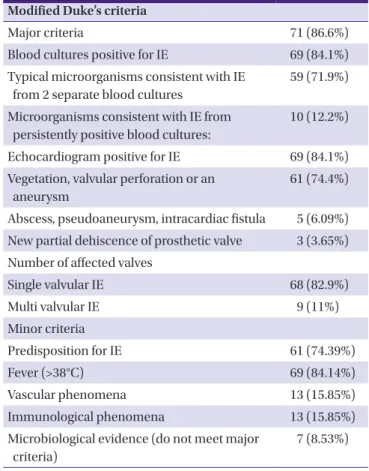
Right-sided IE was recorded in five (6%) patients: due to intra- venous drug use (3) and permanent pacemaker (2). Most IEs (86.5%) met at least one major criterion of the modified IE Duke’s criteria [20], (Check please)while echocardiography was characteristic for IE in 69 patients (84%) (Table 2). Most cases (44) occurred in native valves. However, a significant in- crease in the PVE percentage from the first (1995–2004) to the second decades of the study period (2005–2015) was observed (27% vs. 50%; P = 0.042). Seven cases (8.5%) were associated with implanted intracardiac devices. The most commonly af- fected valve in PVE IE was the aortic (69.7% vs. 27.3%; P <0.01), while in those with NVE was the mitral (36.3% vs. 63.6%; P = 0.02) (Fig. 1). Twelve patients (14.6%) presented with early PVE.
The most common microorganism isolated from the blood Figure 1. Summary of 82 cases with infective endocarditis.
IE, infective endocarditis; PVE, prosthetic valve endocarditis; NVE, native valve endocarditis.
aThree patients had two prosthetic valves affected.
bTwo patients had prosthetic valve along with permanent pacemaker.
17 337 Figure 1. Summary of 82 cases with infective endocarditis.
338
IE, Infective endocarditis; PVE,
prosthetic valve endocarditis; NVE, native valve endocarditis.
339
aTwo patients had prosthetic valve along with permanent pacemaker 340
bThree patients had two prosthetic valves affected.
341 342
n = 82
n = 33
n = 12
n = 23
n = 1 n = 4
n = 12 n = 28
n = 6
n = 1
n = 44 n = 7
a b
Papakonstantinou PE, et al. • Epidemiological features of infective endocarditis www.icjournal.org
24
was Staphylococcus aureus being the causative organism in al- most one-third of all cases (24; 29%). Seven of these 24 isolates were methicillin-resistant (MRSA) (Table 3). Twelve cases of Enterococcus spp. have been isolated; no vancomycin-resistant enterococci strains have been identified among them. Four cases of gram-negative bacterial IE (5%) and another four of the anaerobic pathogen Gemella morbillorum (with two resis- tant to β-lactams and aminoglycosides) (5%) were also ob- served. Thirteen cases (15%) were classified as culture-negative IE, and one of had Coxiella burnetii as the causative organism them based on serological results (Table 3). Culture-negative IE was significantly higher in PVE patients (29% vs. 4.5%; P <0.01).
Microorganisms (Staphylococcus spp., Streptococcus spp., and Enterococcus spp.) causing IE in the present population have been divided in two groups, with each group representing the organisms isolated in one decade. Comparison between the two decades of the study has not shown any significant dif- ference regarding the type of organisms.
The initial antimicrobial therapy has been found to be appro- priate in 39 out of 69 (56.5%) blood culture-positive cases. Three patients presented with reversible acute kidney failure and one
with leukopenia as direct complications of the antimicrobial therapy. Thirty patients (36%) had received antimicrobial treat- ment prior to hospital admission.
In-hospital death occurred in nine patients (11%). Seven (8.5%) had a IE relapse during the follow-up period. Ischemic stroke occurred in seven (8.5%), while one (1.22%) suffered from hem- orrhagic stroke as an IE complication. Nineteen patients (23%) met the criteria for surgical valve repair; however, only nine of them underwent valve surgery. The remaining 10 patients re- fused surgical treatment.
Discussion
The changing IE profile requires continuous epidemiological updates. This is the first retrospective study on IE in Crete and southern Aegean islands. The study showed that the frequen- cy of rheumatic heart disease-related IE was low, as compared to other developed countries [4], along with a significant in- crease in PVE cases in the recent years. The study also demon- strated prosthetic valves as the main predisposing factors and S. aureus as main causative pathogen, with a high percentage Table 1. Demographic and clinical characteristics of the study population
Patients’ characteristics N = 82 (100%)
Age 62.06 ± 16.79
Male 50 (61%)
Underlying diseases
Diabetes mellitus 12 (14.63%)
Degenerative heart disease 10 (12.2%)
COPD 7 (8.53%)
Moderate or severe chronic kidney disease 4 (4.87%)
Hepatic disorders 6 (7.32%)
Cancer 1 (1.22%)
HIV 1 (1.22%)
Alcohol abuse 1 (1.2.2%)
Risk factors for IE
Prosthetic valve/intracardiac device 40 (48.8)
Congenital heart disease 6 (7.31%)
Previous Episode of IE 6 (7.31%)
IVDU 3 (3.65%)
Rheumatic heart disease 5 (6.1%)
Bicuspid aortic valve 1 (1.22%)
Mitral valve prolapse 7 (8.53%)
Calcific aortic stenosis 2 (2.44%)
COPD, chronic obstructive pulmonary disease; HIV, human immunodeficiency virus; IE, infective endocarditis; IVDU, intravenous drug user.
Table 2. Modified Duke’s criteria of 82 cases with infective endocarditis Modified Duke’s criteria
Major criteria 71 (86.6%)
Blood cultures positive for IE 69 (84.1%) Typical microorganisms consistent with IE
from 2 separate blood cultures
59 (71.9%)
Microorganisms consistent with IE from persistently positive blood cultures:
10 (12.2%)
Echocardiogram positive for IE 69 (84.1%) Vegetation, valvular perforation or an
aneurysm
61 (74.4%)
Abscess, pseudoaneurysm, intracardiac fistula 5 (6.09%) New partial dehiscence of prosthetic valve 3 (3.65%) Number of affected valves
Single valvular IE 68 (82.9%)
Multi valvular IE 9 (11%)
Minor criteria
Predisposition for IE 61 (74.39%)
Fever (>38°C) 69 (84.14%)
Vascular phenomena 13 (15.85%)
Immunological phenomena 13 (15.85%)
Microbiological evidence (do not meet major criteria)
7 (8.53%) IE, infective endocarditis.
of MRSA (29%). Moreover, almost half of the patients were ad- mitted to the hospital without fulfilling the SIRS criteria for sepsis.
The median age of patients with definite or possible IE was 67 years (21–86), which is consistent with the most recent pub- lished information regarding IE in Greece [14] as well as in high-income countries [4, 9, 21]. In contrast, the median age of patients in developing countries is significantly lower [3, 4, 22].
IE is an uncommon, potentially deadly, disease, and depend- ing on the causative microorganism as well as the presence or absence of underlying heart disease, the initial clinical presen- tation may vary widely, although most physicians may expect a severely ill septic patient. It should be noted that in almost half of the present patients, SIRS criteria for sepsis were not ob- served upon admission.
Pathogens causing IE and the main risk factors vary accord-
ing to the continent, region, country, even in areas within a coun- try, and access to cardiovascular surgery [4]. Different micro- biological and risk factors have been observed between early and late PVEs. Furthermore, risk factors and causative micro- organisms are different between high- and low-income coun- tries [4]. In particular, in developed countries, degenerative heart disease, implantable intracardiac devices, and prosthet- ic valves have replaced rheumatic heart disease as the main risk factors [4]. In developing and low-income countries, such as regions in Asia, Latin America, and Africa, rheumatic dis- ease and streptococci remain the main risk factor and the most common causative agents, respectively [1, 4]. In contrast, in developed and high-income countries, staphylococci are the most common pathogens [1, 4, 23]. Indeed, in the present study, only five patients (6%) had a history of rheumatic heart disease, while the most common pathogen isolated was S. aureus, fol- Table 3. Microorganisms isolated from 82 patients with infective endocarditis
All N = 82 (100%)
Prosthetic valves or device related IE
N = 38 (100%)
Native valve IE
N = 44 (100%) P-value
Blood culture-positive IE 69 (84.14%) 27 (71%) 42 (95.5%) <0.01
Staphylococcus spp. 30 (36.5%) 10 (26.3%) 20 (45.4%) 0.1
Staphylococcus aureus 24 (29.2%) 7 (18.4%) 17 (38.6%) 0.054
MRSA 7 (29.16%) 3 (42.8%) 4 (23.5%) 0.37
Staphylococcus lugdunensis 2 (2.44%) 0 (0%) 2 (4.5%) 0.49
Other CNS 4 (4.9%) 3 (7.9%) 1 (2.3%) 0.33
Streptococcus spp. 15 (18.3%) 5 (13.1%) 10 (22.7%) 0.39
Viridans streptococci 6 (7.3%) 1 (2.6%) 5 (11.36%) 0.2
Streptococcus pneumoniae 1 (1.22%) 0 (0%) 1 (2.3%) 0.99
Streptococcus sanguis 1 (1.22%) 1 (2.6%) 0 (0%) 0.46
Streptococcus mitis 1 (1.22%) 0 (0%) 1 (2.3%) 0.99
Streptococcus bovis 4 (4.9%) 2 (5.2%) 2 (4.5%) 0.99
Streptococcus mutans 1 (1.22%) 0 (0%) 1 (2.3%) 0.99
Streptococcus milleri group 1 (1.22%) 1 (2.6%) 0 (0%) 0.46
Enterococcus spp. 12 (14.6%) 8 (21%) 4 (9.1%) 0.21
Enterococcus faecium 6 (7.3%) 3 (7.9%) 3 (6.8%) 0.99
Enterococcus faecalis 6 (7.3%) 5 (13.1%) 1 (2.3%) 0.09
Gram-negative bacterium IE 4 (4.9%) 1 (2.6%) 3 (6.8%) 0.62
Escherichia coli 2 (2.44%) 0 (0%) 2 (4.5%) 0.49
Pseudomonas aeruginosa 1 (1.22%) 0 (0%) 1 (2.3%) 0.99
Stenotrophomonas maltophilia 1 (1.22%) 1 (2.6%) 0 (0%) 0.46
Facultative anaerobic
Gemella morbillorum 4 (4.9%) 1 (2.6%) 3 (6.8%) 0.62
Polymicrobial IE 4 (4.9%) 2 (5.2%) 2 (4.5%) 0.99
IE, infective endocarditis; MRSA, methicillin-resistant S. aureus; CNS, coagulase negative staphylococci.
Papakonstantinou PE, et al. • Epidemiological features of infective endocarditis www.icjournal.org
26
lowed by Streptococcus spp. and Enterococcus spp. In a recent multicenter prospective cohort study in Greece from the met- ropolitan area of Athens [14], Enterococcus spp. were the lead- ing cause of nosocomial IE. In the present study, four cases of Gram-negative bacterial IE and another four rare cases of G.
morbillorum, a facultative anaerobic pathogen (two strains re- sistant to β-lactams and aminoglycosides) [15], were recorded.
Additionally, a rare case of C. burnetii IE, an endemic pathogen on the island of Crete, has also been identified [16], showing the importance of knowledge on local epidemiology.
The microbiological shift from streptococci to staphylococci is not only important for epidemiological reasons but also for the initiation of appropriate empirical antimicrobial treatment, especially in regions with high rate of antimicrobial resistance.
In the present study, the leading pathogen was S. aureus in both NVE and PVE. Greece is one of the leading European coun- tries in the prevalence of MRSA, with its percentage being 39.4% according to the antimicrobial resistance surveillance re- port of the European Centre for Disease Prevention and Con- trol in 2015 [24]. MRSA was detected in 29% of the S. aureus IE cases. Current European Society of Cardiology Guidelines [1]
proposed the combination of ampicillin and flucloxacillin or oxacillin and gentamicin as initial empiric antimicrobial ther- apy in severely ill patients with community-acquired native valve IE or late PVE. In penicillin-allergic patients and those with early PVE or nosocomial and healthcare-associated IE, the combination of vancomycin and gentamycin is the treat- ment of choice. This evidence reveals a gap between the cur- rent European guidelines for initial empirical treatment of IE in NVE or late PVE, and the need for the administration of vanco- mycin, instead of ampicillin and flucloxacillin/oxacillin as ini- tial antimicrobial treatment before the pathogen’s isolation in countries with high percentages of MRSA, such as Greece, might be associated with a better clinical outcome. In 43.5% of the present blood culture-positive cases, the initial antimicro- bial therapy was inappropriate. This can be explained, partly, due to the high levels of MRSA (29%), along with the special re- gional epidemiology of intracellular and anaerobic pathogens.
Blood culture-negative IE can occur in up to 31% of all IE cas- es [1], and its management is challenging. This type of infection commonly occurs as a consequence of previous antimicrobial administration. In the present study, 13 (16%) cases have been classified as culture-negative, which is consistent with the re- cently published data from developed countries in Europe and Greece [4, 9, 13, 14, 23, 25]. Interestingly in our study, cul- ture-negative IE was significantly higher in PVE (P <0.01), with previous antimicrobial use being considered the main cause,
encountered in 12 out of 13 patients.
The present study has some limitations since it was a sin- gle-center and retrospective with a relatively small number of patients. However, it highlights the local IE epidemiology and was conducted in a referral center.
In conclusion, in the present population, S. aureus was the leading pathogen that causes IE, whereas intracellular patho- gens such as C. burnetii and facultative anaerobic bacteria like G. morbillorum, with unusual antimicrobial resistance, raise concerns on the appropriate prophylaxis and empirical treat- ment of IE. Consequently, IE treatment may be a more com- plicated issue than previously believed, especially in an era and area with dramatically increasing microbial resistance.
Conflicts of Interest
No conflicts of interest.
References
1. Habib G, Lancellotti P, Antunes MJ, Bongiorni MG, Casalta JP, Del Zotti F, Dulgheru R, El Khoury G, Erba PA, Iung B, Miro JM, Mulder BJ, Plonska-Gosciniak E, Price S, Roos-Hes- selink J, Snygg-Martin U, Thuny F, Tornos Mas P, Vilacosta I, Zamorano JL; Document Reviewers, Erol Ç, Nihoyannopou- los P, Aboyans V, Agewall S, Athanassopoulos G, Aytekin S, Benzer W, Bueno H, Broekhuizen L, Carerj S, Cosyns B, De Backer J, De Bonis M, Dimopoulos K, Donal E, Drexel H, Flachskampf FA, Hall R, Halvorsen S, Hoen B, Kirchhof P, Lainscak M, Leite-Moreira AF, Lip GY, Mestres CA, Piepoli MF, Punjabi PP, Rapezzi C, Rosenhek R, Siebens K, Tamargo J, Walker DM. 2015 ESC Guidelines for the management of infective endocarditis: The Task Force for the Management of Infective Endocarditis of the European Society of Cardi- ology (ESC). Endorsed by: European Association for Car- dio-Thoracic Surgery (EACTS), the European Association of Nuclear Medicine (EANM). Eur Heart J 2015;36:3075- 128.
2. Toyoda N, Chikwe J, Itagaki S, Gelijns AC, Adams DH, Egorova NN. Trends in infective endocarditis in California and New York State, 1998-2013. JAMA 2017;317:1652-60.
3. Xu H, Cai S, Dai H. Characteristics of infective endocarditis in a tertiary hospital in East China. PLoS One 2016;11:e0166764.
4. Ambrosioni J, Hernandez-Meneses M, Téllez A, Pericàs J, Falces C, Tolosana JM, Vidal B, Almela M, Quintana E, Llo- pis J, Moreno A, Miro JM; Hospital clinic infective endocar-
ditis investigators. The changing epidemiology of infective endocarditis in the Twenty-First Century. Curr Infect Dis Rep 2017;19:21.
5. Moreillon P, Que YA. Infective endocarditis. Lancet 2004;363:139-49.
6. Durante-Mangoni E, Bradley S, Selton-Suty C, Tripodi MF, Barsic B, Bouza E, Cabell CH, Ramos AI, Fowler V Jr, Hoen B, Koneçny P, Moreno A, Murdoch D, Pappas P, Sexton DJ, Spelman D, Tattevin P, Miró JM, van der Meer JT, Utili R;
International Collaboration on Endocarditis Prospective Cohort Study Group. Current features of infective endo- carditis in elderly patients: results of the International Col- laboration on Endocarditis Prospective Cohort Study.
Arch Intern Med 2008;168:2095-103.
7. Darouiche RO. Treatment of infections associated with surgical implants. N Engl J Med 2004;350:1422-9.
8. Cabell CH, Heidenreich PA, Chu VH, Moore CM, Stryjew- ski ME, Corey GR, Fowler VG Jr. Increasing rates of cardiac device infections among Medicare beneficiaries: 1990- 1999. Am Heart J 2004;147:582-6.
9. Cresti A, Chiavarelli M, Scalese M, Nencioni C, Valentini S, Guerrini F, D’Aiello I, Picchi A, De Sensi F, Habib G. Epide- miological and mortality trends in infective endocarditis, a 17-year population-based prospective study. Cardiovasc Diagn Ther 2017;7:27-35.
10. Murdoch DR, Corey GR, Hoen B, Miró JM, Fowler VG Jr, Bayer AS, Karchmer AW, Olaison L, Pappas PA, Moreillon P, Chambers ST, Chu VH, Falcó V, Holland DJ, Jones P, Klein JL, Raymond NJ, Read KM, Tripodi MF, Utili R, Wang A, Woods CW, Cabell CH; International Collaboration on Endocarditis-Prospective Cohort Study (ICE-PCS) Investi- gators. Clinical presentation, etiology, and outcome of in- fective endocarditis in the 21st century: the International Collaboration on Endocarditis-Prospective Cohort Study.
Arch Intern Med 2009;169:463-73.
11. Tleyjeh IM, Abdel-Latif A, Rahbi H, Scott CG, Bailey KR, Steckelberg JM, Wilson WR, Baddour LM. A systematic re- view of population-based studies of infective endocarditis.
Chest 2007;132:1025-35.
12. Bin Abdulhak AA, Baddour LM, Erwin PJ, Hoen B, Chu VH, Mensah GA, Tleyjeh IM. Global and regional burden of in- fective endocarditis, 1990-2010: a systematic review of the literature. Glob Heart 2014;9:131-43.
13. Loupa C, Mavroidi N, Boutsikakis I, Paniara O, Deligarou O, Manoli H, Saroglou G. Infective endocarditis in Greece: a changing profile. Epidemiological, microbiological and therapeutic data. Clin Microbiol Infect 2004;10:556-61.
14. Giannitsioti E, Skiadas I, Antoniadou A, Tsiodras S, Kanavos K, Triantafyllidi H, Giamarellou H; Hellenic Endocarditis Study Group. Nosocomial vs. community-acquired infec- tive endocarditis in Greece: changing epidemiological profile and mortality risk. Clin Microbiol Infect 2007;13:763-9.
15. Kofteridis DP, Anastasopoulos T, Panagiotakis S, Kontopo- dis E, Samonis G. Endocarditis caused by Gemella morbil- lorum resistant to beta-lactams and aminoglycosides.
Scand J Infect Dis 2006;38:1125-7.
16. Kokkini S, Kofteridis D, Psaroulaki A, Sipsas N, Tsiodras S, Giannitsiotiand E, Gikas A. Q fever endocarditis in Greece:
report of five cases. Clin Microbiol Infect 2009;15 (Suppl 2):136-7.
17. Paul M, Kariv G, Goldberg E, Raskin M, Shaked H, Hazzan R, Samra Z, Paghis D, Bishara J, Leibovici L. Importance of appropriate empirical antibiotic therapy for methicil- lin-resistant Staphylococcus aureus bacteraemia. J Anti- microb Chemother 2010;65:2658-65.
18. Stevens PE, Levin A; Kidney Disease: Improving Global Outcomes Chronic Kidney Disease Guideline Develop- ment Work Group Members. Evaluation and management of chronic kidney disease: synopsis of the kidney disease:
improving global outcomes 2012 clinical practice guide- line. Ann Intern Med 2013;158:825-30.
19. Cockcroft DW, Gault MH. Prediction of creatinine clear- ance from serum creatinine. Nephron 1976;16:31-41.
20. Li JS, Sexton DJ, Mick N, Nettles R, Fowler VG Jr, Ryan T, Bashore T, Corey GR. Proposed modifications to the Duke criteria for the diagnosis of infective endocarditis. Clin In- fect Dis 2000;30:633-8.
21. Erichsen P, Gislason GH, Bruun NE. The increasing inci- dence of infective endocarditis in Denmark, 1994-2011.
Eur J Intern Med 2016;35:95-9.
22. Zhu W, Zhang Q, Zhang J. The changing epidemiology and clinical features of infective endocarditis: a retrospective study of 196 episodes in a teaching hospital in China.
BMC Cardiovasc Disord 2017;17:113.
23. Muñoz P, Kestler M, De Alarcon A, Miro JM, Bermejo J, Rodríguez-Abella H, Fariñas MC, Cobo Belaustegui M, Mestres C, Llinares P, Goenaga M, Navas E, Oteo JA, Tara- bini P, Bouza E; Spanish Collaboration on Endocardi- tis-Grupo de Apoyo al Manejo de la Endocarditis Infeccio- sa en España (GAMES). Current epidemiology and outcome of infective endocarditis: a multicenter, prospec- tive, cohort study. Medicine (Baltimore) 2015;94:e1816.
24. European Centre for Disease Prevention and Control (ECDC). Antimicrobial resistance surveillance in Europe
Papakonstantinou PE, et al. • Epidemiological features of infective endocarditis www.icjournal.org
28
2015: annual report of the European antimicrobial resis- tance surveillance network (EARS-Net). Stockholm:
ECDC; 2017.
25. Kanafani ZA, Kanj SS, Cabell CH, Cecchi E, de Oliveira Ra- mos A, Lejko-Zupanc T, Pappas PA, Giamerellou H, Gor-
don D, Michelet C, Muñoz P, Pachirat O, Peterson G, Tan RS, Tattevin P, Thomas V, Wang A, Wiesbauer F, Sexton DJ.
Revisiting the effect of referral bias on the clinical spec- trum of infective endocarditis in adults. Eur J Clin Micro- biol Infect Dis 2010;29:1203-10.