© 2017 Korean Breast Cancer Society. All rights reserved. http://ejbc.kr | pISSN 1738-6756
INTRODUCTION
Breast cancer is the most common cancer in women world- wide, with approximately 1.7 million cases a year, which ac- counts for 25.2% of female cancer patients. Breast cancer is also the most common cause of death among female cancer patients; approximately 520,000 patients died of breast cancer worldwide in 2012 [1,2]. Meanwhile, in Korea, breast cancer is the second most common cancer among women, next to
thyroid cancer, and its incidence and mortality rate are steadi- ly increasing. According to the statistics of the National Can- cer Registration, more than 20,000 new cases of breast cancer were diagnosed in Korea in 2013, which accounts for 15.4% of all cancer cases in female patients [3,4]. In addition, according to Statistics Korea, the mortality rate due to breast cancer was 4.8 women per 100,000 in 2000, which had nearly doubled to 8.8 women per 100,000 by 2013 [5].
The Korean Breast Cancer Society (KBCS) started collect- ing national data on patients with breast cancer since 1996.
Through this, KBCS conducted a large-scale epidemiological survey on breast cancer in Korea, highlighting different as- pects from breast cancer in Western countries, which laid the foundation for the development of prophylactic and ther- apeutic methods to treat breast cancer in Korea. The breast
Basic Facts of Breast Cancer in Korea in 2014: The 10-Year Overall Survival Progress
Eun Hwa Park, Sun Young Min1, Zisun Kim2, Chan Seok Yoon3, Kyu-Won Jung4, Seok Jin Nam5, Se Jeong Oh6, Seeyoun Lee7, Byeong-Woo Park8 , Woosung Lim9, Min Hee Hur10, Korean Breast Cancer Society
Department of Surgery, Gangneung Asan Hospital, University of Ulsan College of Medicine, Gangneung; 1Department of Surgery, Kyung Hee University Medical Center, Kyung Hee University School of Medicine, Seoul; 2Department of Surgery, Soonchunhyang University Bucheon Hospital, Soonchunhyang University College of Medicine, Bucheon; 3Department of Surgery, Cheil General Hospital and Women’s Healthcare Center, Dankook University College of Medicine, Seoul; 4The Korea Central Cancer Registry, Division of Cancer Registration and Surveillance, National Cancer Center, Goyang; 5Department of Surgery, Samsung Medical Center, Sungkyunkwan University School of Medicine, Seoul; 6Department of Surgery, Incheon St. Mary’s Hospital, The Catholic University of Korea College of Medicine, Incheon; 7Center for Breast Cancer, National Cancer Center, Goyang; 8Department of Surgery, Yonsei University College of Medicine, Seoul; 9Department of Surgery, Ewha Womans University Mokdong Hospital, Seoul; 10Department of Surgery, Inha University Hospital, Inha University School of Medicine, Incheon, Korea
SPECIAL ARTICLE
We, the Korean Breast Cancer Society (KBCS), present the facts and the trends of breast cancer in Korea in 2014. Data on the to- tal number of newly diagnosed patients was obtained from the Korea Central Cancer Registry database, other data were col- lected from the KBCS online registry database, and the overall survival data of patients were updated from Statistics Korea. A total of 21,484 female patients were newly diagnosed with breast cancer in 2014. The crude incidence rate and the age-standard- ized incidence rate (ASR) of breast cancer in female patients, in- cluding carcinoma in situ, were 83.4 cases and 63.9 cases per 100,000 women, respectively. The ASR showed an annual in- crease of 6.1% from 1999 to 2014; however, although the in- crease of the ASR had slowed since 2008, the incidence rate it- self continuously increased. The proportion of early breast can-
cer increased consistently, and the pathological features changed accordingly. While breast-conserving surgery was mainly performed, the proportion of total mastectomy was slightly increased. The total number of breast reconstruction sur- geries increased rapidly. The 5-year and 10-year overall survival rates for all stages of breast cancer patients were 91.2% and 84.8%, respectively. The overall survival rate of Korean patients with breast cancer was extremely high, compared with other de- veloped countries. Thus, we consider that the clinical character- istics of breast cancer have changed over the past decade. A nationwide registry data will contribute to a better understanding of the characteristics of breast cancer in Korea.
Key Words: Breast neoplasms, Korea, Online systems, Overall survival, Registries
Correspondence to: Min Hee Hur
Department of Surgery, Inha University Hospital, Inha University School of Medicine, 27 Inhang-ro, Jung-gu, Incheon 22332, Korea
Tel: +82-32-890-2560, Fax: +82-32-890-3549 E-mail: [email protected]
Received: February 12, 2017 Accepted: March 1, 2017
Cancer
cancer registration program, which started offline in 1996, was converted to an online registration project since 2001 [6- 9] and has actively collected large-scale epidemiological and clinical data, which has used for research on breast cancer in Korean patients.
The aim of the current study was to investigate the national status of breast cancer in Korea in 2014, and to examine the characteristics, the age of onset, surgical method, and changes in stages of breast cancer in Korean women over 10 years. In addition, we also aimed to report the 5-year and 10-year over- all survival rates of breast cancer patients in Korea.
DATA COLLECTION
Data sources
Data were collected on Korean women who were newly di- agnosed with primary breast cancer between January 1, 2014 and December 31, 2014. Data on the total number of newly diagnosed breast cancer patients (including invasive cancer and carcinoma in situ) and their ages were collected from Korea Central Cancer Registry (KCCR). The KCCR was estab- lished by the Ministry of Health and Welfare in 1980. Since 1999, the KCCR has collected data on cancer incidence na- tionwide by integrating a hospital-based KCCR database with data from regional cancer registry programs [4].
Data of patients characteristics such as the cancer stage, type of surgery, pathological information (histological type and biologic markers), and survival information were ob- tained from the KBCS online breast cancer registry (http://
registry.kbcs.or.kr/ecrf/login.php). Total overall survival data were updated from Statistics Korea until December 31, 2014 (http://kosis.kr) [5].
Statistical analysis
Incidence rates were expressed as crude rate (CR) and age- standard ized rates (ASR) per 100,000 individuals. The CR was calculated as the total number of newly diagnosed breast cancer cases from data of the KCCR divided by the mid-year population of 2014. The mid-year population of 2014 was acquired from Statistics Korea [5]. The ASR were obtained from the KCCR data. The Korea 2000 standard population was used when calculating ASR. Trends in incidence rates were summarized as the annual percent change (APC). With the APC approach, the rates of cancer were assumed to change at a constant percentage of the rate of the previous year. The average annual percent change (AAPC) is a summary measure of the trend over a prespecified fixed interval [10]. The AAPC is usually applied to use a single number to describe the average APCs over a period of many years. We used the join-
point regression model (version 4.2.0.2) developed by the U.S.
National Cancer Institute [11] to analyze in which years there was a significant change in ASR. This program is a Windows- based statistical software that analyzes joinpoint models [10].
Joinpoint regression method identifies changes in data trends by straight light segments joined at the “joinpoint.” At the
“joinpoint,” the incidence rate trend changes its slope statisti- cally significantly [12]. The APC and corresponding 95% con- fidence interval (CI) were calculated for each line segment, and the AAPC of total period (i.e., from 1999 to 2014) was es- timated. We also analyzed the trends in the proportion of stages, biological markers, and median age using linear regres- sion analysis. A p-value <0.05 was regarded as statistically significant (95% level of confidence). Data analysis was per- formed using SPSS Statistics version 18.0 (SPSS Inc., Chicago, USA). The life-table, Cutler-Ederer method was used to esti- mate survival rates. The stage-specific overall survival was compared using Gehan’s generalized Wilcoxon test.
BASIC FINDINGS OF KOREAN BREAST CANCER IN 2014
Total number of newly diagnosed breast cancer patients A total of 21,484 patients were newly diagnosed with breast cancer in 2014. Among these, 18,381 patients had invasive breast cancer and 3,103 had carcinoma in situ. There were 82 breast cancer cases in male patients, including carcinoma in situ, which accounted for 0.4% of the total number. The CR and ASR of breast cancer in female patients, including carci- noma in situ, in 2014, were 84.3 and 63.9 cases per 100,000 women, respectively.
Age distribution
Analysis of the KBCS registry data and the KCCR data gen- Table 1. Age distribution of newly diagnosed breast cancer patients in Korea
Age (yr) KBCS registry data
No. of patients (%) KCCR data No. of patients (%)
<20 2 (0.01) 6 (0.01)
20–29 114 (1.0) 202 (0.9)
30–39 1,233 (10.5) 2,264 (10.5)
40–49 4,166 (35.6) 7,602 (35.4)
50–59 3,653 (31.2) 6,550 (30.5)
60–69 1,641 (14.0) 2,967 (13.8)
70–79 692 (5.9) 1,495 (7.0)
≥80 113 (1.0) 398 (1.9)
Unknown 76 (0.7) 0
Total 11,690 (100.0) 21,484 (100.0)
KBCS=Korean Breast Cancer Society; KCCR=Korea Central Cancer Registry.
erated equivalent results in terms of the age distribution of newly diagnosed patients (Table 1). According to the KBCS registry data, the median age at diagnosis was 50 years; the youngest patient was 15 years old, and the oldest was 114 years old. The age group with the highest number of newly di- agnosed breast cancer cases was the 40 to 49 years old age group (7,602 cases, 35.4% of total cases), followed by the 50 to 59 years old age group (6,550 cases, 30.5% of total cases).
Surgery and staging
Data about surgical methods were obtained from the KBCS online registry. Among 11,653 patients, the most frequent surgical method was breast-conserving surgery (BCS; 7,573 cases, 65.0% of total cases), followed by total mastectomy (3,967 cases, 34.0% of total cases) (Table 2). Further, breast cancers were most frequently diagnosed at stage I (41.3% of total cases), followed by stage II (32.4%), stage 0 (12.0%), and stage III (8.8%). Stage IV only accounted for a small portion of total cases (133 cases, 1.1% of total cases) (Table 3).
Pathology and biological markers
Among 10,120 patients whose pathological results were re- ported in the online registry, invasive ductal carcinoma was the most common histological type, followed by ductal carci- noma in situ and invasive lobular carcinoma (Table 4). The proportions of patients with tumors that were positive for es- trogen receptor (ER) and progesterone receptor (PR) expres- sion were 74.1% and 62.4%, respectively. When c-erb B2 ex- pression was identified, 41.4% of all patents had negative im-
munohistochemical (IHC) staining in the tumor, and 18.9%, 20.4%, and 19.1% of all cases had an IHC stain rating of 1+, 2+, and 3+, respectively (Table 5).
CHANGING PATTERNS OF BREAST CANCER IN KOREA
Incidence
The number of newly diagnosed breast cancer patients in Korea has continuously increased over the last decade. In 2014, there were 21,402 newly diagnosed breast cancer cases in female patients, which was about 3.6 times higher than the 6,025 cases that were reported in 1999 (255.2% increase;
R2=0.995, p<0.001) (Figure 1). The CR of breast cancer in female patients in Korea in 2014, including cases of carcinoma in situ, was 84.3 cases per 100,000 women. Analysis of the in- dividual breast cancer types revealed that the CR in 2014 of invasive cancer was 72.1 cases per 100,000 women, which was
Table 2. Surgical management of newly diagnosed breast cancer pa- tients
Surgery No. of patients (%)
Mastectomy 3,967 (34.0)
BCS 7,573 (65.0)
Others 61 (0.5)
Unknown 52 (0.5)
Total 11,653 (100.0)
BCS=breast-conserving surgery.
Table 3. Stage distribution of newly diagnosed breast cancer patients
Stage No. of patients (%)
0 1,398 (12.0)
I 4,824 (41.3)
II 3,787 (32.4)
III 1,027 (8.8)
IV 133 (1.1)
Unknown 521 (4.5)
Total 11,690 (100.0)
Table 4. Histological types
Histologic type No. of patients (%) Ductal carcinoma in situ 1,302 (12.9) Invasive ductal carcinoma 7,893 (78.0) Lobular carcinoma in situ 67 (0.7) Invasive lobular carcinoma 429 (4.2) Paget’s disease (pure form) 8 (0.1) Malignant phyllodes tumor 29 (0.3)
Lymphoma 1 (0.01)
Sarcoma 2 (0.01)
Unknown 389 (3.8)
Total 10,120 (100.0)
Table 5. Biological markers
Biologic marker No. of patients (%) ER
Negative 2,538 (25.7)
Positive 7,326 (74.1)
Unknown 17 (0.2)
Total 9,881 (100.0)
PR
Negative 3,252 (37.5)
Positive 5,407 (62.4)
Unknown 10 (0.1)
Total 8,669 (100.0)
c-erb B2
Negative 3,957 (41.4)
Weak (1+) 1,803 (18.9)
Intermediate (2+) 1,954 (20.4)
Strong (3+) 1,830 (19.1)
Unknown 17 (0.2)
Total 9,561 (100.0)
ER=estrogen receptor; PR=progesterone receptor.
three times higher than the 24.3 cases reported in 1999 (196.7% increase; R2=0.992, p<0.001). The CR of carcinoma in situ showed a marked increase of 8.7 times, from 1.4 cases per 100,000 women in 1999 to 12.2 cases per 100,000 women in 2014 (771.4%; R2=0.984, p<0.001). The CR of invasive cancer increased from 1999 through 2014, with an AAPC of +7.1%, and the CR of carcinoma in situ significantly increased with an AAPC of +15.6%. The CR of all breast cancer cases (invasive and carcinoma in situ) increased with an AAPC of +8.2%. Moreover, the ASR for female breast cancer, including
carcinoma in situ, increased from 26.1 per 10,000 in 1999, to 63.9 per 10,000 in 2014 (AAPC was +6.1%) (Figure 2). The ASR of invasive breast cancer in particular increased from 1999 to 2014 with an AAPC of +5.5%, while the ASR of carci- noma in situ increased from 1999 to 2014 with an AAPC of +13.5% (Table 6).
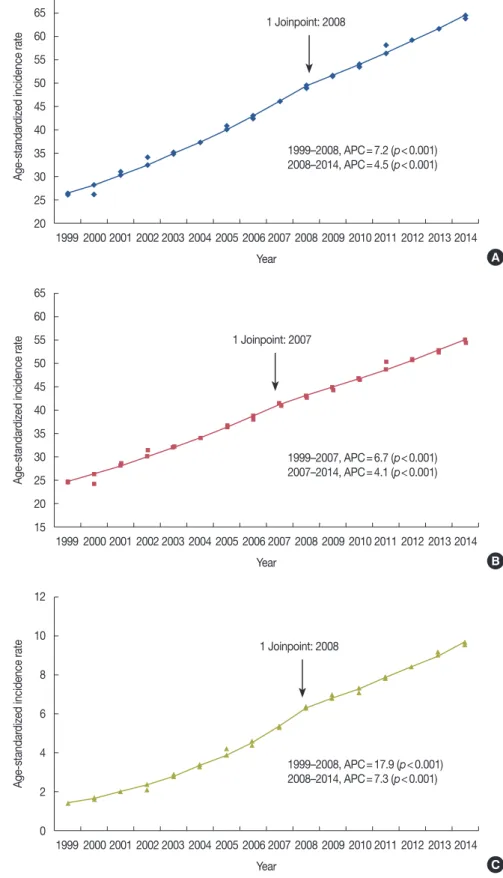
In all breast cancer cases that were analyzed there was 1 joinpoint in 2008. The ASR for all breast cancer cases until 2008 (APC, +7.2%; 95% CI, 6.3%–8.2%) had increased more rapidly than between 2008 and 2014 (APC, +4.5%; 95% CI, Figure 1. Number of newly diagnosed Korean female breast cancer patients.
25,000
20,000
15,000
10,000
5,000
0
1999 2000 2001 2002 2003 2004 2005 2006 2007 2008 2009 2010 2011 2012 2013 2014 Year
Number
322 5,703 6,025
389 5,848 6,237
486 7,116 7,602
536 8,033 8,569
766 8,469 9,235
892 9,160 10,052
1,143 10,196 11,339
1,226 10,880 12,106
1,525 11,964 13,489
1,876 12,761 14,637
2,138 13,586 15,724
2,170 14,569 16,739
2,486 16,054 18,540
2,698 16,615 19,313
2,928 17,231
20,159
3,098 18,304 21,402
All breast cancer Invasive cancer Carcinoma in situ
Figure 2. Trends in age-standardized incidence rates of Korean female breast cancer from 1999 to 2014.
80
60
40
20
0
1999 2000 2001 2002 2003 2004 2005 2006 2007 2008 2009 2010 2011 2012 2013 2014 Year
No. of patients per 100,000 women
1.4 24.5 26.1
1.6 24.3 26.2
2.0 28.6 31.0
2.1 31.5 34.1
2.9 32.3 35.1
3.4 34.1 37.3
4.2 36.8 40.8
4.4 38.2 42.5
5.3 41.1 46.2
6.3 42.7 48.9
7.0 44.4 51.4
7.1 46.6 53.6
7.9 50.4 58.2
8.4 51.1 59.4
9.2 52.5
61.5
9.6 54.4 63.9
All breast cancer Invasive cancer Carcinoma in situ
Figure 3. Joinpoint regression analysis in age-standardized incidence rates of Korean female breast cancer from 1999 to 2014. (A) All breast cancer (invasive cancer+carcinoma in situ). (B) Invasive breast cancer. (C) Ductal carcinoma in situ.
APC=annual percent change.
70 65 60 55 50 45 40 35 30 25 20
65 60 55 50 45 40 35 30 25 20 15
12
10
8
6
4
2
0
1999 2000 2001 2002 2003 2004 2005 2006 2007 2008 2009 2010 2011 2012 2013 2014
1999 2000 2001 2002 2003 2004 2005 2006 2007 2008 2009 2010 2011 2012 2013 2014
1999 2000 2001 2002 2003 2004 2005 2006 2007 2008 2009 2010 2011 2012 2013 2014 Year
2008–2014, APC=4.5 (p<0.001)
2007–2014, APC=4.1 (p<0.001)
2008–2014, APC=7.3 (p<0.001) 1999–2008, APC=7.2 (p<0.001)
1999–2007, APC=6.7 (p<0.001)
1999–2008, APC=17.9 (p<0.001) 1 Joinpoint: 2008
1 Joinpoint: 2007
1 Joinpoint: 2008 Year
Year
Age-standardized incidence rateAge-standardized incidence rateAge-standardized incidence rate
A
B
C
3.5%–5.5%). Table 6 and Figure 3 shows the trends in breast cancer incidence in Korea according to invasiveness. For inva- sive breast cancer, there was 1 joinpoint at 2007. An increase in the ASR, with an APC of +6.7% (95% CI, 5.5%–7.9%), was observed until 2007. Thereafter the increase in ASR had slowed down, with an APC of +4.1% (95% CI, 3.2%–5.1%).
For carcinoma in situ, there was 1 joinpoint at 2008. A contin- uous significant increase of the ASR of carcinoma in situ was observed with an APC of +17.9% (95% CI, 15.6%–20.2%) un- til 2008; thereafter the ASR increase had slowed with an APC of +7.3% (95% CI, 6.0%–8.6%) (Table 6, Figure 3).
Age distribution and median age at diagnosis
We analyzed the trends in the number of breast cancer cas- es by age from 2000 to 2014. In 2014, the largest number of newly diagnosed cases were in women aged 40 to 49 years (7,602 cases, 35.4%), followed by those aged 50 to 59 years (6,550 cases, 30.5%), which were followed by those in their 60s, 30s, and 70s, according to decreasing frequency (Table 1).
Despite the increased breast cancer incidence and age at diag- nosis, however, the age distribution pattern was similar to that
recorded in the past (Figure 4).
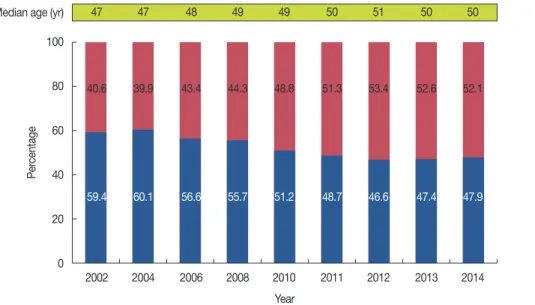
The median age at diagnosis was 47 years in 2002, which gradually increased to 50 years in 2011, and was maintained at 50 years in 2014. The proportion of postmenopausal wom- en with breast cancer rose from 40.6 % in 2002 to 52.1% in 2014 (28.3% increase; R2=0.921, p<0.001). Thus, postmeno- pausal women accounted for more than half of the total cases of breast cancer since 2011 (Figure 5).
Biologic markers and stage distributions
The proportions of both ER- and PR-positive breast cancer patients has consistently increased since 2002, from 58.2% to 74.1% in 2014 (27.3% increase; R2=0.975, p<0.001), and 50.7% to 62.4% in 2014 (23.1% increase; R2=0.840, p=0.001), respectively. In terms of the distribution of cancer stage, the proportion of patients with stage 0 and stage I breast cancer has steadily increased from 2002 and accounted for more than half of the total breast cancer cases since 2010. Specifically, the proportion of stage 0 cancer patients increased from 7.0% to 12.5% (78.6% increase; R2=0.812, p=0.002), while that of stage I cancer patients increased from 31.1% to 43.2% (38.9%
Table 6. Trends in age-standardized incidence rates for breast cancer according to joinpoint analysis (1999–2014)
AAPC 1999–2014
Trend 1 Trend 2
Period APC 95% CI
Period APC 95% CI
Lower Higher Lower Higher
All breast cancer +6.1* 1999–2008 +7.2* 6.3 8.2 2008–2014 +4.5* 3.5 5.5
Invasive breast cancer +5.5* 1999–2007 +6.7* 5.5 7.9 2007–2017 +4.1* 3.2 5.1
Carcinoma in situ +13.5* 1999–2008 +17.9* 15.6 20.2 2008–2014 +7.3* 6.0 8.6
AAPC=average annual percent change (%); APC=annual percent change (%); CI=confident interval.
*The APC or AAPC is significantly different from zero (p<0.05).
Figure 4. Trends in age distribution pattern of Korean female breast cancer from 2000 to 2014.
8,000
7,000
6,000
5,000
4,000
3,000
2,000
1,000
0
≤19 20–29 30–39 40–49 50–59 60–69 70–79 ≥80 Age (yr)
Number
2000 2002 2004 2006 2008 2010 2012 2014
increase; R2=0.915, p<0.001). On the contrary, the propor- tion of patients with stage II to IV cancers decreased from 61.9% to 44.2% over the same period (28.6% decrease; R2
=0.952, p<0.001) (Figure 6).
Surgical patterns
Patterns in the surgical treatment of breast cancer were ob- served between 2002 and 2014. Although total mastectomy was the most common breast cancer operation in 2002, the number of breast cancer patients undergoing BCS and total mastectomy has reversed since 2006. While the proportion of patients who underwent total mastectomy decreased from 61.3% in 2002 to 32.3% in 2012 (47.3% decrease; R2=0.984, p<0.001), the proportion of patients who was performed
BCS increased from 37.6% in 2002 to 67.2% in 2012 (78.2%
increase; R2=0.987, p<0.001). However, since 2013, the num- ber of patients undergoing total mastectomy gradually in- creased from 32.3% in 2012 to 34.0% in 2014 (5.2% increase;
R2=0.794, p=0.299) and those undergoing BCS slightly de- creased from 67.2% in 2012 to 64.9% in 2014 (3.4% decrease;
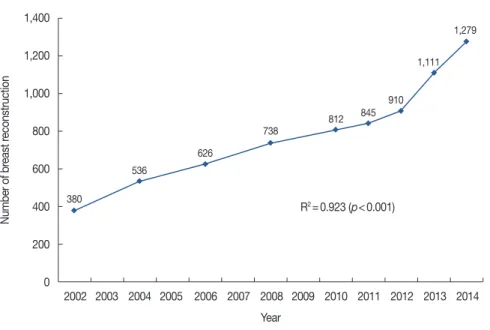
R2=0.783, p=0.309) (Figure 7). The number of breast recon- struction performed after total mastectomy markedly increase from 380 cases in 2002 to 1,279 cases in 2014 (236.6% in- crease; R2=0.923, p<0.001) (Figure 8).
Five-year and 10-year overall survival rates
The stage-specific overall survival rates were calculated uti- lizing the online registry data from 2001 to 2012. The median Figure 5. Trends in the median age at breast cancer diagnosis in Korea and the ratio of postmenopausal to premenopausal women at diagnosis.
100
80
60
40
20
0 Median age (yr)
2002 2004 2006 2008 2010 2011 2012 2013 2014 40.6 39.9 43.4 44.3 48.8 51.3 53.4 52.6 52.1
59.4 60.1 56.6 55.7 51.2 48.7 46.6 47.4 47.9 47 47 48 49 49 50 51 50 50
Year
Percentage
Postmenopause Premenopause
Figure 6. Changes in the stage distribution of Korean breast cancer.
100
80
60
40
20
0
2002 2004 2006 2008 2010 2011 2012 2013 2014 1.8 1.3 1.8 2.0 1.4 1.0 1.2 1.4 1.1 11.2 15.8 15.4 14.3 12.3 9.2 9.8 9.3 9.2
7.0 9.6 10.7 12.5 13.0 13.3 13.2 14.5 12.5 48.9 38.9 35.8 36.5 34.4 33.6 32.6 32.2 33.9
31.1 34.4 36.3 34.7 38.9 43.0 43.2 42.6 43.2
Year
Percentage
Stage IV Stage III Stage II Stage I Stage 0
Table 7. Stage-specific 5- and 10-year overall survival rates (2001–2012, Korean Breast Cancer Society registry data)
Stage No. of patients No. of events 5-Year survival rate (%) 10-Year survival rate (%)
0 12,285 266 98.3 95.4
I 39,284 1,557 96.6 92.7
II 40,024 3,951 91.8 84.8
III 13,774 6,544 75.8 63.4
IV 1,619 1,029 34.0 22.2
Unknown 2,998 343 - -
Total 109,988 10,690 91.2 84.8
Figure 8. Changing trends in breast reconstruction in patients with breast cancer surgery.
1,400
1,200
1,000
800
600
400
200
0
2002 2003 2004 2005 2006 2007 2008 2009 2010 2011 2012 2013 2014 Year
Number of breast reconstruction
R2=0.923 (p<0.001) 380
536
626
738 812 845
910 1,111
1,279
Figure 7. Changes in the surgical management of breast cancer.
BCS=breast-conserving surgery.
100
80
60
40
20
0
2002 2003 2004 2005 2006 2007 2008 2009 2010 2011 2012 2013 2014 Year
Percentage
1.1 37.6 61.3
0.8 40.2 59.0
1.3 49.6 49.1
1.0 56.8 42.2
0.6 61.9
37.5
0.5 65.7
33.8
0.5 67.2
32.3
0.5 67.1
32.4
0.9 64.9
34.0
Mastectomy BCS Others BCS:
2002–2012, R2=0.943 (p<0.001) 2012–2014, R2=0.783 (p=0.309)
Mastectomy:
2002–2012, R2=0.984 (p<0.001) 2012–2014, R2=0.794 (p=0.299)
follow-up period was 72.7 months. Survival information for 109,979 patients was obtained from Statistics Korea. Through all stages, the 5-year and 10-year overall survival rates of breast cancer were 91.2% and 84.8%, respectively. For stage 0 breast cancer, the 5-year and 10-year overall survival rates were 98.3% and 95.4%, respectively. For the rest of the breast cancer stages, the 5-year and 10-year overall survival rates were 96.6% and 92.7% for stage I, 91.8% and 84.8% for stage II, 75.8% and 63.4% for stage III, and 34.0% and 22.2% for stage IV, respectively (Table 7).
DISCUSSION
According to the 2014 World Cancer Report, the incidence of cancer was greater in high-income countries, such as Korea, and countries in North America and Western Europe. The incidence and mortality rate of breast cancer have increased worldwide; breast cancer incidence is the highest among cancers in female patients globally, and is the most common cause of death as it accounts for 14.7% of female patients who die from cancer [2]. The incidence of breast cancer in Korea has increased steeply, and the ASR in 2012 reached 52.1 per 100,000 people, which was higher than Japan (51.5 per 100,000 peoples), and ranked top among East Asian coun- tries. The global ASR is 43.3 per 100,000 people, and the aver- age breast cancer incidence in East Asian countries, including China, Mongolia and North Korea, is 27 per 100,000 [1].
The KBCS has regularly presented the incidence and the trends of the characteristics of breast cancer in Korea, combin- ing it with a nationwide survey, until 2016 [7,8]. From 2017, we substituted the KCCR database for the nationwide survey data about the incidence of breast cancer between 1999 and 2014. Thus, we investigated the incidence and basic data of Korean breast cancer in 2014 using KBCS registry and KCCR database, and analyzed the characteristics of breast cancer and changes in its treatment methods in recent years. While GLOBOCAN 2012 (an international report) [1] and the data from the Statistic Korea are based only on invasive breast can- cer, the current study is the only report on Korean breast can- cer including carcinoma in situ and invasive breast cancer.
In this study, the annual trends of patients with breast can- cer were quantified as APC and AAPC of the ASR. The ASR of breast cancer in Korea has increased from 26.1 per 100,000 people in 1999 to 63.9 per 100,000 people in 2014, with an AAPC of 6.1%. In the United States, breast cancer incidence has been maintained without a major change since 2003 with an AAPC of 0.2% [13]. Although the reasons for the rising trend of breast cancer incidence in Korea are not completely understood, it is likely to reflect birth-cohort effects, changes
in reproductive factors (early menarche, late child bearing, and having fewer children), diet (i.e., consumption of high calorie food), obesity, and the introduction of screening pro- grams. [6,9,14].
There was a fine change in the incidence of breast cancer in female patients in Korea between 1999 and 2014; there was one joinpoint in the ASR of breast cancer (i.e., all, invasive cancer and carcinoma in situ). The APC of the ASR of all breast cancer decreased during the latter period (from 7.5% in 1999–2008 to 4.5% in 2008–2014). In particular, the APC of ASR of invasive cancer had slightly declined since 2007 (from 6.7% in 1999–2007 to 4.1% in 2007–2014) and the APC of carcinoma in situ dropped during the second period (from 17.9% in 1999–2008 to 7.3% in 2008–2014). In Japanese stud- ies, the trend in breast cancer incidence was continuously in- creasing without any joinpoint between 1985 and 2010. The APC of the ASR for invasive breast cancer was 3.9% (95% CI, 3.7%–4.1%) without a joinpoint. Also, the APC of female breast cancer incidence including carcinoma in situ has in- creased since 2002 (3.8% in 1985–2002, 95% CI, 3.4%–4.2%;
and 5.9% in 2002–2010, 95% CI, 5.0%–6.8%) [8,15]. The APC of female breast cancer incidence rate remained stable in the United States (1.3% in 1992–1999, -2.2% in 1999–2004, and 0.2% in 2004–2010) [13]. Thus, the incidence of breast cancer in Korea was more steeply increasing than in Japan and the United States. The actual declining trend in breast cancer inci- dence in Korea will need to be followed.
The analysis of the age of Korean women with breast cancer in 2014 showed that patients in their 40s represented the highest population at 35% of all cases, followed by those in their 50s, 60s, 30s, and 70s. These results were similar to trends that were seen since 1999. According to the incidence curve by age, while breast cancer incidence in U.S. women in- creased with age, the highest incidence in Korean women was observed between the ages of 40 and 49 years which then de- creased for those aged over 50 years, showing an inverted V- shape peaking around 50 years of age. Although the incidence by age in Japan was similar to that in Korea, an intermediate form of the incidence curve between those of Korea and the U.S. was observed in Japan [1].
The consistent clinical facts derived from the current study were as follow. First, the number of patients with postmeno- pausal breast cancer has surpassed half of the total number since 2011, and accounted for 52.1% of all breast cancer pa- tients in 2014. Second, the ratio of early breast cancer (stage 0, I) increased gradually from 38.1% of total breast cancer in 2002 to 55.7% of cases in 2014. Third, neither the proportion of classifications according to histological type nor the propor- tion of patients who had cancer with +3 expression of c-erbB-2
had changed in 2014. Finally, although the proportion of pa- tients with ER- and PR-positive breast cancer had steadily in- creased until 2013, no further increase was observed in 2014.
Meanwhile, we found an interesting change in the surgical methods of breast cancer. Patients undergoing BCS increased steadily from approximately 5% in the late 1980s [16], to 56.8% in 2008, exceeding the number of patients undergoing mastectomy. These trends continued until 2012 as the propor- tion of BCS patients reached the twice that of mastectomy pa- tients (67.2% vs. 32.3%) [7]. The proportion of patients un- dergoing BCS in 2013 did not increase anymore, and showed a very slight reduction to 67.1%. In contrast, the proportion of patients undergoing mastectomy decreased steadily until 2012, and then increased slightly to 32.4% in 2013 [8]. The trends in surgical methods in 2014 showed a further decrease in the proportion of patients undergoing BCS to 67.1% and an increase in those undergoing mastectomy (i.e., 34%). Al- though these results were not statistically significant, the change in pattern of surgical methods should be followed in the future.
Such a reversal of surgical patterns was seen in the surgical trends of the U.S. as well. The Surveillance, Epidemiology and End Results (SEER) program showed that the rate of mastec- tomy dropped from 40% in 2000 to 36% in 2006, but then rose again to 38% by 2008 [17,18]. These changes were attrib- uted to a wider availability of breast magnetic resonance im- aging, increased genetic testing, shared decision making with patients, and the surgical choice like breast reconstruction [19-21]. In addition, studies on breast cancer in Japan be- tween 2004 and 2011 showed that although the annual rates of patients treated with BCS increased until 2006, this increase stopped in 2007 and plateaued at approximately 60% there- after. The proportion of modified radical mastectomy steadily decreased between 2004 and 2011 while that of simple mas- tectomy increased during the same period [22].
Cases of breast reconstruction following total mastectomy increased sharply over the last 12 years in Korea, and the number of reconstruction surgery in 2014 was 3.4 times that of 2002. In the United States, the performance of reconstruc- tion increased dramatically from 46% of patients in 1998 to 63% in 2007, while the proportion of bilateral mastectomy in- creased from 3% to 18%, between those respective years. A total of 76% of patients with bilateral mastectomy underwent reconstruction, which was significantly higher than the recon- struction rates of ipsilateral mastectomy cases [23]. This could be attributed to the fact that breast reconstruction in breast cancer patients has been partly covered by National Health Insurance since 2015 in Korea, and is likely to keep increasing in future.
The overall survival data for breast cancer patients enrolled in the KBCS registry between 2001 and 2012 had distinct differ- ences when compared to the international data (GLOBOCAN study) or KCCR survival data. First, the KBCS registry in- cluded all overall survival data of invasive breast cancer and in situ carcinomas, while the survival data of GLOBOCAN and the KCCR were only for invasive breast cancer. The 5-year total overall survival rate of our study was 91.2%, while the 10-year total overall survival was 84.8%. Second, we had data from a single population-based registry, in which information regarding stages was well documented, with almost no missing values. The stage-specific 5-year overall survival rates were 98.3% for stage 0 breast cancer, 96.6% for stage I, 91.8% for stage II, 75.8% for stage III, and 34.0% for stage IV. Thirdly, this report included the 10-year overall rate of breast cancers, which for early stages (i.e., Stage 0 and Stage I) was over 90%. The 5-year and 10-year overall survival rates of patients enrolled between 1993 and 2002 studied by the KBCS were 81.2% and 71.3%, respec- tively [24], indicating that the survival rate of breast cancer increased significantly over 10 years.
According to the SEER data from the U.S. National Cancer Institute, the 332,526 patients were diagnosed with breast can- cer between 2006 and 2012, and their 5-year relative survival rate was 89.7% [25]. Data from the National Cancer Center Japan showed that the 5-year relative survival rate of patients with breast cancer, who diagnosed between 2006 and 2008, in Japan was 91.1% [26]. Thus, our study was able to confirm the high overall survival of Korean breast cancer patients.
CONCLUSION
The fundamental characteristics of breast cancer in Korea have undergone several changes in recent years until 2014.
The clinical features of breast cancer have changed distinctive- ly and the survival rate has improved greatly. A continuous study of the nationwide registry data will provide better de- fined information that can be useful to understand the char- acteristics of breast cancer in Korea.
CONFLICT OF INTEREST
The authors declare that they have no competing interests.
ACKNOWLEDGMENTS
We thank all members of the KBCS who participated in KBCS online registry.
REFERENCES
1. Ferlay J, Soerjomataram I, Ervik M, Dikshit R, Eser S, Mathers C, et al.
GLOBOCAN 2012 v1.0, cancer incidence and mortality worldwide:
IARC CancerBase No. 11. International Agency for Research on Cancer.
http://globocan.iarc.fr. Accessed January 15th, 2017.
2. Stewart BW, Wild CP. World cancer report 2014. The Health Well.
http://www.thehealthwell.info/node/725845. Accessed January 17th, 2017.
3. Cancer statistics. National Cancer Information Center, Ministry of Health and Welfare. http://www.cancer.go.kr/mbs/cancer/. Accessed January 15th, 2017.
4. Oh CM, Won YJ, Jung KW, Kong HJ, Cho H, Lee JK, et al. Cancer statistics in Korea: incidence, mortality, survival, and prevalence in 2013. Cancer Res Treat 2016;48:436-50.
5. Statistics Korea 2015. Korean Statistical Information Service. http://
kosis.kr. Accessed January 15th, 2017.
6. Kim Z, Min SY, Yoon CS, Lee HJ, Lee JS, Youn HJ, et al. The basic facts of Korean breast cancer in 2011: results of a nationwide survey and breast cancer registry database. J Breast Cancer 2014;17:99-106.
7. Kim Z, Min SY, Yoon CS, Jung KW, Ko BS, Kang E, et al. The basic facts of Korean breast cancer in 2012: results from a nationwide survey and breast cancer registry database. J Breast Cancer 2015;18:103-11.
8. Min SY, Kim Z, Hur MH, Yoon CS, Park EH, Jung KW, et al. The basic facts of Korean breast cancer in 2013: results of a nationwide survey and breast cancer registry database. J Breast Cancer 2016;19:1-7.
9. Ko BS, Noh WC, Kang SS, Park BW, Kang EY, Paik NS, et al. Changing patterns in the clinical characteristics of Korean breast cancer from 1996-2010 using an online nationwide breast cancer database. J Breast Cancer 2012;15:393-400.
10. National Cancer Institute, Surveillance, Epidemiology, and End Results Program. National Cancer Institute Division of Cancer Control &
Population Sciences. https://surveillance.cancer.gov/help/joinpoint.
Accessed January 15th, 2017.
11. Kim HJ, Fay MP, Feuer EJ, Midthune DN. Permutation tests for join- point regression with applications to cancer rates. Stat Med 2000;19:
335-51.
12. Lim D, Ha M, Song I. Trends in major cancer mortality in Korea, 1983- 2012, with a joinpoint analysis. Cancer Epidemiol 2015;39:939-46.
13. Siegel R, Ma J, Zou Z, Jemal A. Cancer statistics, 2014. CA Cancer J Clin 2014;64:9-29.
14. Shin HR, Joubert C, Boniol M, Hery C, Ahn SH, Won YJ, et al. Recent trends and patterns in breast cancer incidence among Eastern and
Southeastern Asian women. Cancer Causes Control 2010;21:1777-85.
15. Katanoda K, Hori M, Matsuda T, Shibata A, Nishino Y, Hattori M, et al.
An updated report on the trends in cancer incidence and mortality in Japan, 1958-2013. Jpn J Clin Oncol 2015;45:390-401.
16. The Korean Breast Cancer Society. Korean breast cancer data of 1998. J Korean Breast Cancer Soc 1999;2:111-27.
17. Mahmood U, Hanlon AL, Koshy M, Buras R, Chumsri S, Tkaczuk KH, et al. Increasing national mastectomy rates for the treatment of early stage breast cancer. Ann Surg Oncol 2013;20:1436-43.
18. Kummerow KL, Du L, Penson DF, Shyr Y, Hooks MA. Nationwide trends in mastectomy for early-stage breast cancer. JAMA Surg 2015;
150:9-16.
19. Tracy MS, Rosenberg SM, Dominici L, Partridge AH. Contralateral prophylactic mastectomy in women with breast cancer: trends, predic- tors, and areas for future research. Breast Cancer Res Treat 2013;140:
447-52.
20. Balch CM, Jacobs LK. Mastectomies on the rise for breast cancer: “the tide is changing”. Ann Surg Oncol 2009;16:2669-72.
21. Vaz-Luis I, Hughes ME, Cronin A, Rugo HS, Edge SB, Moy B, et al.
Trends in the use of mastectomy in women with small node-negative breast cancer treated at US academic centers. Breast Cancer Res Treat 2016;155:569-78.
22. Kurebayashi J, Miyoshi Y, Ishikawa T, Saji S, Sugie T, Suzuki T, et al.
Clinicopathological characteristics of breast cancer and trends in the management of breast cancer patients in Japan: based on the Breast Cancer Registry of the Japanese Breast Cancer Society between 2004 and 2011. Breast Cancer 2015;22:235-44.
23. Jagsi R, Jiang J, Momoh AO, Alderman A, Giordano SH, Buchholz TA, et al. Trends and variation in use of breast reconstruction in patients with breast cancer undergoing mastectomy in the United States. J Clin Oncol 2014;32:919-26.
24. The Korean Breast Cancer Society. Survival analysis of Korean breast cancer patients diagnosed between 1993 and 2002 in Korea: a Nationwide study of the cancer registry. J Breast Cancer 2006;9:214-29.
25. Howlader N, Noone AM, Krapcho M, Miller D, Bishop K, Altekruse SF, et al. SEER cancer statistics review, 1975-2013. National Cancer Institute. http://seer.cancer.gov/csr/1975_2013. Accessed January 15th, 2017.
26. Monitoring of cancer incidence in Japan: survival 2006-2008 report.
Center for Cancer Control and Information Services, National Cancer Center. http://ganjoho.jp/en/professional/statistics/table_download.
html. Accessed January 18th, 2017.