© 2015 Korean Breast Cancer Society. All rights reserved. http://ejbc.kr | pISSN 1738-6756
INTRODUCTION
The Korean Breast Cancer Society (KBCS) publishes bien- nial reports on the characteristics of breast cancer in the coun- try, along with any evolving trends [1-4]. Data from the na- tionwide breast cancer registry program run by the Korean Breast Cancer Registry (KBCR) show that the overall survival
(OS) of Korean women with breast cancer has been improv- ing over time [5]. However, there is limited data to explain this increasing breast cancer survival in Korea.
Several hypotheses exist to explain this improved survival in breast cancer patients over time. These include improved early detection of breast cancer, increased rate of nonaggres- sive biologic phenotype breast cancer, and the use of novel ad- juvant hormonal or target therapy agents, such as aromatase inhibitors (AIs) and trastuzumab.
Genomic studies have established that breast cancer can be divided into four major intrinsic subtypes (hormone receptor [HR]+/human epidermal growth factor receptor 2 [HER2]–, HR+/HER2+, HR–/HER2+, and HR–/HER2–) that differ in terms of incidence, survival, and response to therapy [6,7].
Survival analysis according to these subtypes may provide some information in terms of the various hypotheses regard- ing the improved survival.
In this study, we have attempted to identify the clinicopath- ological and treatment factors that have exerted considerable
Survival Improvement in Korean Breast Cancer Patients Due to Increases in Early-Stage Cancers and Hormone Receptor Positive/HER2 Negative
Subtypes: A Nationwide Registry-Based Study
Jee Man You*, Yun Gyoung Kim1,*, Hyeong-Gon Moon1, Seok Jin Nam2, Jong Won Lee3, Woosung Lim4, Mi-Ri Lee5, Dong-Young Noh1, Wonshik Han1
Department of Surgery, Sun Medical Center, Daejeon; 1Department of Surgery, Seoul National University Hospital, Seoul; 2Department of Surgery, Samsung Medical Center, Seoul; 3Department of Surgery, Asan Medical Center, Seoul; 4Department of Surgery, Ewha Womans University Mokdong Hospital, Seoul;
5Department of Surgery, Dong-A University College of Medicine, Busan, Korea ORIGINAL ARTICLE
Purpose: The aim of this study was to investigate whether the observed changes over time in the survival rates vary according to the intrinsic subtypes of breast cancer diagnosed. Methods:
Data from 46,320 breast cancer patients in the Korean Breast Cancer Registry who underwent surgery between 1999 and 2006 were reviewed. Among them, results from 25,887 patients with available data about the status of estrogen receptor, pro- gesterone receptor, and human epidermal growth factor receptor 2 (HER2) were analyzed. Patients were classified into two co- horts according to the year in which they underwent surgery:
1999–2002 and 2003–2006. Results: The patients treated in the latter time period showed significantly better overall survival (OS) compared with those in the former period when adjusted for fol-
low-up duration. The proportion of hormone receptor+/HER2- subtype and stage I breast cancer were significantly higher in the latter period (47.4% vs. 54.6%, p<0.001; 31.0% vs. 39.6%, p<0.001, respectively). Improvement in OS between the former and latter periods was seen in all subtypes of breast cancer, in- cluding triple-negative cancers (all p-values <0.001 in univariate and multivariate analyses). Conclusion: Improvement in survival in Korean breast cancer patients over the study years is being observed in all subtypes of breast cancer, implying that increas- es in both early-stage detection and the proportion of less ag- gressive cancers contribute to this improvement.
Key Words: Breast neoplasms, Clinical characteristics, Korea, Registries
Correspondence to: Wonshik Han
Department of Surgery and Cancer Research Institute, Seoul National University Hospital, 101 Daehak-ro, Jongno-gu, Seoul 110-744, Korea Tel: +82-2-2072-2817, Fax: +82-2-766-3975
E-mail: [email protected]
*These authors contributed equally to this work.
This study was supported by a grant of the Korea Health Technology R&D Project, Ministry of Health and Welfare, Republic of Korea (A110961) and National Research Foundation of Korea (NRF) Grant funded by the Korean Government (20110005753).
Received: October 29, 2014 Accepted: January 31, 2015
Cancer
influence upon the observed improvement in breast cancer survival in Korea.
METHODS
Korean Breast Cancer Registry
The KBCR is a database that has been prospectively main- tained by the KBCS since 1996 [8]. Nationwide, 102 general hospitals with at least 400 beds, including 41 university hospi- tals and 61 surgical training hospitals, have voluntarily partici- pated in this program. In 2001, the Online Korean Breast Cancer Registration Program was launched, allowing physi- cians from each participating hospital could to input the data into the web-based database themselves. Retrospective collec- tion of data from as far back as 1992 was allowed when a par- ticipating hospital had a breast cancer database originating before 1996. Essential items for registration were the patient’s unique Korean resident’s registration number as an identifier;
the patient’s sex and age; the surgical method used; and the cancer stage based on the American Joint Committee on Can- cer classification. In 2004, this registry was estimated to in- clude more than 50% of all newly diagnosed breast cancer pa- tients in Korea.
Patient survival data, including dates and causes of death, were obtained from the Korea Central Cancer Registry, Min- istry of Health and Welfare, Korea. The Korean Central Can- cer Registry is linked to the Korean National Statistical Office, which maintains complete death statistics recorded by unique identification numbers assigned to all Korean residents [9].
The KBCR data do not include the type or date of tumor re- currence because the Korean Central Cancer Registry pro- vides mortality data only.
The KBCR data do not provide the patient’s name and unique Korean resident registration number in order to pro- tect the privacy of each patient.
Patients and follow-up
From the database, we identified 46,320 patients who un- derwent breast cancer surgery between January 1999 and De- cember 2006. Among them, 2,335 patients with pure carcino- ma in situ were excluded. Patients for whom immunohisto- chemistry (IHC) results for estrogen receptor (ER), progester- one receptor (PR), or HER2 status were not available, as well as patients who received neoadjuvant chemotherapy were also excluded. In addition, we excluded 6,125 patients who had a 2+ result for HER2 in IHC staining (Figure 1). The HER2 sta- tus in these patients should be analyzed by using fluorescence in situ hybridization (FISH); however, because we were not able to obtain FISH data in cases of equivocal IHC results, these
patients were excluded. Patients who had a 0, 1+ result for HER2 in IHC staining was considered HER2– , 3+ result for that was considered HER2+.
Patients were divided into two cohorts according to the year they received surgery: Cohort I (1999–2002) and Cohort II (2003–2006). In 2003, the use of the AIs was approved by the Korean Food and Drug Administration (FDA) for treatment of early breast cancer. To adjust for the effect of the duration of follow-up between the two cohorts, we took different fol- low-up end points for the study such as the last date of De- cember 2005 for Cohort I and the last day of December 2009 for Cohort II.
The study population was categorized into four breast can- cer subtypes according to the HR, and HER2 status of the tu- mors: HR–/HER2– (ER-negative, PR-negative, HER2-nega- tive), HR–/HER2+ (ER-negative, PR-negative, HER2-posi- tive), HR+/HER2+ (ER-positive and/or PR-positive, HER2- positive), and HR+/HER2– (ER-positive and/or PR-positive, HER2-negative).
Statistical analyses
The correlation between the two cohorts according to the date of surgery and clinicopathological parameters was ana- lyzed by using a chi-square test for trends. Overall survival (OS) was defined as the time from the date of surgery to the date of death or last follow-up.
Relative survival was defined as the observed survival rate divided by the expected survival rate. The observed survival rate was obtained from patient data by using the life-table method. Data from the general population matched for age, sex, and year of diagnosis were used to calculate the expected survival rate. Advice regarding estimation of relative survival Figure 1. Study enrollment scheme.
HER2=human epidermal growth factor receptor 2; ER=estrogen re- ceptor; PR =progesterone receptor; IHC =immunohistochemistry;
AJCC=American Joint Committee on Cancer.
46,320 Breast cancer (Jan 1999-Dec 2006)
34,445 Interpretable IHC
25,887 Interpretable IHC and 6th AJCC Stage I to IV
6,125 HER2 IHC 2+ 2,001 6th AJCC Stage 0
432 Neoadjuvant chemothrapy 4,093 Unknown HER2 7,782 Unknown ER, PR
was received from the Seoul National University Hospital Medical Research Collaborating Center.
The Kaplan-Meier method was used to estimate the surviv-
al outcomes of all patients by date of surgery and cancer sub- type. Groups were compared by using log-rank statistics. Cox proportional hazards models were used for both univariable Table 1. Patient, tumor and treatment characteristics according to Cohort I and Cohort II
Characteristic
Cohort I 1999–2002 (n=8,042)
No. (%)
Cohort II 2003–2006 (n=17,845)
No. (%)
Total (n=25,887)
No. (%) p-value
Age (yr)
≤50 5,146 (64.0) 11,214 (62.8) 16,360 (63.2)
>50 2,896 (36.0) 6,631 (37.2) 9,527 (36.8) 0.076
Tumor size (cm)
≤2 3,755 (46.7) 10,057 (56.4) 13,812 (53.4)
>2, ≤5 3,701 (46.0) 6,889 (38.6) 10,590 (40.9)
>5 586 (7.3) 899 (5.0) 1,485 (5.7) <0.001
Nodal status
N0 4,560 (56.7) 11,028 (61.8) 15,588 (60.2)
N1 1,949 (24.2) 4,045 (22.7) 5,994 (23.2)
N2 823 (10.2) 1,614 (9.0) 2,437 (9.4)
N3 709 (8.8) 1,148 (6.4) 1,857 (7.2) <0.001
Missing - - 11 (0.4)
Histological grade
G1 or G2 3,593 (57.1) 9,216 (60.7) 12,809 (49.5)
G3 2,695 (42.9) 5,960 (39.3) 8,655 (33.4) 0.001
Missing - - 4,423 (17.1)
Lymphovascular invasion
No 2,808 (61.4) 9,347 (63.7) 12,155 (47.0)
Yes 1,769 (38.6) 5,331 (36.3) 7,100 (27.4) <0.001
Missing - - 6,632 (25.6)
Estrogen receptor
Negative 3,457 (43.0) 7,280 (40.8) 10,737 (41.5)
Positive 4,579 (57.0) 10,550 (59.2) 15,129 (58.5) <0.001
Progesterone receptor
Negative 4,017 (50.1) 7,966 (44.7) 11,983 (46.4)
Positive 4,007 (49.9) 9,850 (55.3) 13,857 (53.6) <0.001
HER2*
0 or 1+ 5,641 (70.1) 13,604 (76.2) 19,245 (74.3)
3+ 2,401 (29.9) 4,241 (23.8) 6,642 (25.7) 0.004
Subtype
HR+/HER2– 3,808 (47.4) 9,749 (54.6) 13,557 (52.4)
HR+/HER2+ 1,340 (16.7) 2,014 (11.3) 3,354 (13.0)
HR–/HER2+ 1,061 (13.2) 2,227 (12.5) 3,288 (12.7)
HR–/HER2– 1,833 (22.8) 3,855 (21.6) 5,688 (22.0) <0.001
Chemotherapy
No 1,146 (15.6) 3,172 (19.4) 4,318 (16.9)
Yes 6,215 (84.4) 13,183 (80.6) 19,398 (74.9) <0.001
Missing - - 2,110 (8.2)
Hormone therapy
No 2,427 (35.1) 4,959 (34.1) 7,386 (28.5)
Yes 4,490 (64.9) 9,602 (65.9) 14,092 (54.4) 0.137
Missing - - 4,409 (17.0)
Hormone therapy
SERM 4,311 (96.0) 8,517 (88.7) 12,828 (49.6)
AIs±SERM 178 (4.0) 1,085 (11.3) 1,263 (4.9) <0.001
Missing - - 11,796 (45.6)
HER2=human epidermal growth factor receptor 2; HR=hormone receptor; HR+=estrogen receptor (ER)+ or progesterone receptor (PR)+; HR–=ER– and PR–;
SERM=selective estrogen receptor modulator; AIs=aromatase inhibitors.
*Patients who had 2+ result for HER2 was excluded in this data.
and multivariable analysis.
The hazard ratios (95% confidence interval [CI]) and p-val- ues are reported. A p-value of <0.05 was used to signify sta- tistical significance. We conducted our analyses by using the SPSS statistical software version 19.0 (SPSS Inc., Chicago, USA).
RESULTS
Patient characteristics
A total of 25,887 patients with invasive breast cancer with available IHC results were included in the final analysis. Pa- tient characteristics by date of surgery are listed in Table 1.
The median age of the patients at diagnosis was 47 years for both cohorts. The median duration of follow-up was 55 months for Cohort I and 48 months for Cohort II.
Cohort II had a higher proportion of older patients (>50 years), as well as patients with smaller tumor size (≤2 cm), negative node involvement, favorable histological grade (G1 or 2), negative lymphovascular invasion, positive HR status,
and negative HER2 status.
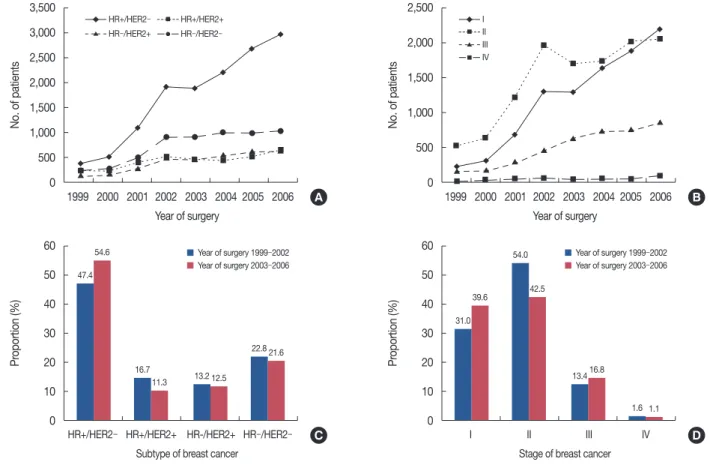
Figure 2 shows the increase of HR+/HER2– subtype breast cancer. There was a higher proportion of HR+/HER2– sub- type and stage I breast cancer in Cohort II as compared with Cohort I (HR+/HER2–, 54.6% vs. 47.4%, p<0.001; stage I, 39.6% vs. 31.0%, p<0.001).
Survival differences between the two cohorts
Five-year OS was 85.6% for Cohort I and 93.0% for Cohort II (p<0.001). Table 2 lists the results of univariate and multi- variate Cox regression analyses for clinicopathological factors influencing survival. Factors favorably affecting long-term OS rates were age <50 years, small tumor size, lymph node nega- tivity, HR-positive, HER2-negative, low histological grade, and negative lymphovascular invasion.
Analyses according to subtype
The OS rate was superior in Cohort II compared to Cohort I for all subtypes (Figure 3). The 5-year breast cancer-specific survival rate was also superior in Cohort II compared to in
3,500 3,000 2,500 2,000 1,500 1,000 500 0
60 50 40 30 20 10 0
60 50 40 30 20 10 0 2,500
2,000
1,500
1,000
500
0 1999 2000 2001 2002 2003 2004 2005 2006
Year of surgery
HR+/HER2– HR+/HER2+ HR-/HER2+ HR–/HER2–
Subtype of breast cancer
I II III IV
Stage of breast cancer
1999 2000 2001 2002 2003 2004 2005 2006 Year of surgery
No. of patientsProportion (%) Proportion (%)No. of patients
Figure 2. Chronological changes in Korean breast cancer during 1999 to 2006. The incidence of Korean breast cancer during 1999 to 2006 demon- strated by the subtype (A) and the stage (B). Proportional change of Korean breast cancer during 1999 to 2006 demonstrated by the subtype (C) and the stage (D).
HR=hormone receptor; HER2=human epidermal growth factor receptor 2.
HR+/HER2– HR+/HER2+ I
HR–/HER2+ II
III HR–/HER2–
IV
A
C D
B
54.6
39.6
11.3
42.5
12.5 16.8
21.6
1.1 47.4
31.0
16.7
54.0
13.2 13.4
22.8
1.6
Year of surgery 1999–2002 Year of surgery 1999–2002
Year of surgery 2003–2006 Year of surgery 2003–2006
Cohort I in each subtype: 94.7% vs. 98.0% in HR+/HER2−;
89.7% vs. 96.2% in HR+/HER2+; 82.9% vs. 94.6% in HR−/
HER2+; and 87.0% vs. 94.5% in HR-/HER2−, respectively.
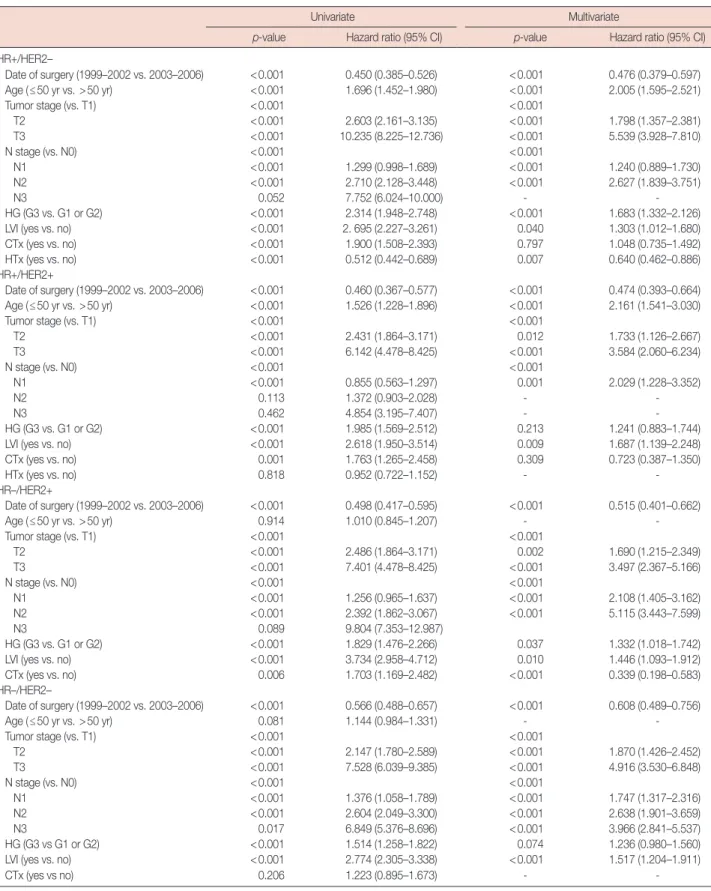
We also performed multivariate analysis to explore the as- sociated prognostic factors of breast cancer according to its subtypes (Table 3). The date of surgery (Cohort II vs. Cohort I)
1.1 1.0 0.9 0.8 0.7 0.6 0.5 0.4 0.3 0.2 0.1 0
1.1 1.0 0.9 0.8 0.7 0.6 0.5 0.4 0.3 0.2 0.1 0
1.1 1.0 0.9 0.8 0.7 0.6 0.5 0.4 0.3 0.2 0.1 0
1.1 1.0 0.9 0.8 0.7 0.6 0.5 0.4 0.3 0.2 0.1 0 0 1 2 3 4 5 6 7 8 9 10 11
0 1 2 3 4 5 6 7 8 9 10 11
0 1 2 3 4 5 6 7 8 9 10 11
0 1 2 3 4 5 6 7 8 9 10 11 Follow-up time in years
Follow-up time in years
Follow-up time in years
Follow-up time in years
SurvivalSurvival SurvivalSurvival
Figure 3. Relative survival plot of Korean breast cancer according to the subtype. (A) HR+/HER2–. (B) HR+/HER2+. (C) HR–/HER2+. (D) HR–/HER2–.
HR=hormone receptor; HER2=human epidermal growth factor receptor 2.
Relative survival in HR+/HER2–
Relative survival in HR–/HER2+
Relative survival in HR+/HER2+
Relative survival in HR–/HER2–
Year at diagnosis 1999–2002 2003–2006
Year at diagnosis 1999/2002 2003/2006
Year at diagnosis 1999–2002 2003–2006
Year at diagnosis 1999/2002 2003/2006
A
C
B
D Table 2. Univariate and multivariate analysis for prognostic factors associated with overall death among Korean breast cancer patients
Univariate Multivariate
p-value Hazard ratio (95% CI) p-value Hazard ratio (95% CI)
Date of surgery (1999–2002 vs. 2003–2006) <0.001 0.473 (0.434–0.515) <0.001 0.513 (0.452–0.583)
Age (≤50 yr vs. >50 yr) <0.001 1.374 (1.262–1.496) <0.001 1.428 (1.257–1.622)
Tumor stage (vs. T1) <0.001 <0.001
T2 <0.001 2.635 (2.373–2.927) <0.001 1.834 (1.559–2.158)
T3 <0.001 9.030 (7.992–10.203) <0.001 4.577 (3.751–5.584)
LN (positive vs. negative) <0.001 4.150 (3.770–4.569) <0.001 2.608 (2.209–3.079)
HG (G3 vs. G1 or G2) <0.001 2.505 (2.280–2.753) <0.001 1.380 (1.202–1.584)
LVI (yes vs. no) <0.001 2.917 (2.621–3.246) <0.001 1.532 (1.327–1.767)
Subtype (vs. HR+/HER2-) <0.001 <0.001
HR+/HER2+ <0.001 2.089 (1.831–2.383) <0.001 1.618 (1.323–1.981)
HR–/HER2+ <0.001 3.344 (2.973–3.762) <0.001 2.150 (1.726–2.677)
HR–/HER2– <0.001 2.753 (2.473–3.762) <0.001 2.014 (1.627–2.494)
CTx (yes vs. no) <0.001 2.078 (1.792–2.408) 0.003 0.695 (0.548–0.882)
HTx (yes vs. no) <0.001 0.509 (0.463–0.588) 0.003 0.756 (0.629–0.909)
CI=confidence interval; LN=lymph node involvement; HG=histological grade; LVI=lymphovascular invasion; HR=hormone receptor; HER2=human epidermal growth factor receptor 2; HR+=estrogen receptor (ER)+ or progesterone receptor (PR)+; HR–=ER– and PR–; CTx=chemotherapy; HTx=hormone therapy.
Table 3. Univariate and multivariate analysis for prognostic factors associated with overall death among Korean breast cancer patients according to molecular subtype
Univariate Multivariate
p-value Hazard ratio (95% CI) p-value Hazard ratio (95% CI)
HR+/HER2–
Date of surgery (1999–2002 vs. 2003–2006) <0.001 0.450 (0.385–0.526) <0.001 0.476 (0.379–0.597)
Age (≤50 yr vs. >50 yr) <0.001 1.696 (1.452–1.980) <0.001 2.005 (1.595–2.521)
Tumor stage (vs. T1) <0.001 <0.001
T2 <0.001 2.603 (2.161–3.135) <0.001 1.798 (1.357–2.381)
T3 <0.001 10.235 (8.225–12.736) <0.001 5.539 (3.928–7.810)
N stage (vs. N0) <0.001 <0.001
N1 <0.001 1.299 (0.998–1.689) <0.001 1.240 (0.889–1.730)
N2 <0.001 2.710 (2.128–3.448) <0.001 2.627 (1.839–3.751)
N3 0.052 7.752 (6.024–10.000) - -
HG (G3 vs. G1 or G2) <0.001 2.314 (1.948–2.748) <0.001 1.683 (1.332–2.126)
LVI (yes vs. no) <0.001 2. 695 (2.227–3.261) 0.040 1.303 (1.012–1.680)
CTx (yes vs. no) <0.001 1.900 (1.508–2.393) 0.797 1.048 (0.735–1.492)
HTx (yes vs. no) <0.001 0.512 (0.442–0.689) 0.007 0.640 (0.462–0.886)
HR+/HER2+
Date of surgery (1999–2002 vs. 2003–2006) <0.001 0.460 (0.367–0.577) <0.001 0.474 (0.393–0.664)
Age (≤50 yr vs. >50 yr) <0.001 1.526 (1.228–1.896) <0.001 2.161 (1.541–3.030)
Tumor stage (vs. T1) <0.001 <0.001
T2 <0.001 2.431 (1.864–3.171) 0.012 1.733 (1.126–2.667)
T3 <0.001 6.142 (4.478–8.425) <0.001 3.584 (2.060–6.234)
N stage (vs. N0) <0.001 <0.001
N1 <0.001 0.855 (0.563–1.297) 0.001 2.029 (1.228–3.352)
N2 0.113 1.372 (0.903–2.028) - -
N3 0.462 4.854 (3.195–7.407) - -
HG (G3 vs. G1 or G2) <0.001 1.985 (1.569–2.512) 0.213 1.241 (0.883–1.744)
LVI (yes vs. no) <0.001 2.618 (1.950–3.514) 0.009 1.687 (1.139–2.248)
CTx (yes vs. no) 0.001 1.763 (1.265–2.458) 0.309 0.723 (0.387–1.350)
HTx (yes vs. no) 0.818 0.952 (0.722–1.152) - -
HR–/HER2+
Date of surgery (1999–2002 vs. 2003–2006) <0.001 0.498 (0.417–0.595) <0.001 0.515 (0.401–0.662)
Age (≤50 yr vs. >50 yr) 0.914 1.010 (0.845–1.207) - -
Tumor stage (vs. T1) <0.001 <0.001
T2 <0.001 2.486 (1.864–3.171) 0.002 1.690 (1.215–2.349)
T3 <0.001 7.401 (4.478–8.425) <0.001 3.497 (2.367–5.166)
N stage (vs. N0) <0.001 <0.001
N1 <0.001 1.256 (0.965–1.637) <0.001 2.108 (1.405–3.162)
N2 <0.001 2.392 (1.862–3.067) <0.001 5.115 (3.443–7.599)
N3 0.089 9.804 (7.353–12.987)
HG (G3 vs. G1 or G2) <0.001 1.829 (1.476–2.266) 0.037 1.332 (1.018–1.742)
LVI (yes vs. no) <0.001 3.734 (2.958–4.712) 0.010 1.446 (1.093–1.912)
CTx (yes vs. no) 0.006 1.703 (1.169–2.482) <0.001 0.339 (0.198–0.583)
HR–/HER2–
Date of surgery (1999–2002 vs. 2003–2006) <0.001 0.566 (0.488–0.657) <0.001 0.608 (0.489–0.756)
Age (≤50 yr vs. >50 yr) 0.081 1.144 (0.984–1.331) - -
Tumor stage (vs. T1) <0.001 <0.001
T2 <0.001 2.147 (1.780–2.589) <0.001 1.870 (1.426–2.452)
T3 <0.001 7.528 (6.039–9.385) <0.001 4.916 (3.530–6.848)
N stage (vs. N0) <0.001 <0.001
N1 <0.001 1.376 (1.058–1.789) <0.001 1.747 (1.317–2.316)
N2 <0.001 2.604 (2.049–3.300) <0.001 2.638 (1.901–3.659)
N3 0.017 6.849 (5.376–8.696) <0.001 3.966 (2.841–5.537)
HG (G3 vs G1 or G2) <0.001 1.514 (1.258–1.822) 0.074 1.236 (0.980–1.560)
LVI (yes vs. no) <0.001 2.774 (2.305–3.338) <0.001 1.517 (1.204–1.911)
CTx (yes vs no) 0.206 1.223 (0.895–1.673) - -
CI=confidence interval; HR=hormone receptor; HER2=human epidermal growth factor receptor 2; HR+=estrogen receptor (ER)+ or progesterone receptor (PR)+; HR–=ER– and PR–; HG=histological grade; LVI=lymphovascular invasion; CTx=chemotherapy; HTx=hormone therapy.
was significantly associated with survival in all subtypes after adjustment for other prognostic factors (HR+/HER2-: hazard ratio, 0.467, 95% CI, 0.373–0.585, p<0.001; HR+/HER2+:
hazard ratio, 0.458, 95% CI, 0.323–0.633, p<0.001; HR-/
HER2+: hazard ratio, 0.449, 95% CI, 0.390–0.640, p<0.001;
HR-/HER2-: hazard ratio, 0.582, 95% CI, 0.481–0.738, p<0.001).
We analyzed the relative survival according to the stage. In Cohort II, especially in the advanced stage, most subtypes dis- played better survival than that of Cohort I. However, the HER2 subtype showed similar relative survival between Co- hort I and Cohort II.
DISCUSSION
In this study, we have demonstrated that the OS rate of breast cancer in Korea improved with respect to different chronological periods. We have also shown that survival im- provement was seen in all molecular subtypes. In addition, we found that the patients in Cohort II were more likely to have smaller tumors, negative lymph node involvement, and favor- able histological status. Interestingly, we found that the preva- lence of the HR+/HER2− subtype of breast cancer was signifi- cantly increased in Cohort II.
Remarkably, there was a significant survival improvement in patients with the HR−/HER2−subtype of breast cancer.
There has been little change in the treatment of the HR−/
HER2− subtype of breast cancer and there has emerged nei- ther any accepted targeted therapy nor any effective biologic agent for this type since the breast cancer community defined this disease entity in early 2000. The increase in survival might be explained by the increase in early-stage breast cancer in the HR-/HER2− subtype, and it might also be due to increasing use of aggressive chemotherapy even for early-stage HR−/
HER2− subtype of breast cancer.
One recent study from the Surveillance, Epidemiology, and End Results program demonstrated a significant decline of ER-positive breast cancer in Caucasian women in recent years [10]. However, the frequency of ER-positive breast cancer sig- nificantly increased in Japanese women [11]. In our study, we also found a similar trend among Japanese women.
A pooled analysis from the Breast Cancer Association Con- sortium Studies demonstrated that early age at menarche (≤12 years), nulliparity, increasing age at first birth, and obe- sity in older women (>50 years) were more frequently associ- ated with HR-positive breast cancer, especially HR+/HER2−
tumors [12,13]. Ko et al. [1] demonstrated that the increased incidence of breast cancer in Korea might be associated with increases in these generally accepted reproductive risk factors
[14,15]. Additionally, recent nationwide Korean breast cancer data have shown that increased reproductive risk factors may explain the recent increase in HR-positive tumors, especially the HR+/HER2− subtype [16].
AIs have been approved by the Korean FDA as a treatment for postmenopausal patients with HR-positive breast tumor since 2003. In our study, 178 of 4,489 patients (4.0%) in Co- hort I and 1,085 of 9,602 patients (11.3%) in Cohort II were prescribed AIs as adjuvant therapy. There was no survival dif- ference between the group that used selective ER modulator only and the group that used AIs (p=0.206) (Figure 4). It seems that increased use of AIs may not significantly contrib- ute to the improvement in survival rates seen over time. We could not identify the effect of trastuzumab in this study since it was not approved for use in Korea until after 2006.
Large-scale, multicenter data are one of the strengths of our study, but they are also one of the limitations. Because of the large amount of missing data, we had difficulty in investing the characteristics of all patients desired in our study. All pa- tients enrolled in the present study were breast cancer patients with result for ER, PR, and HER2 IHC result only. Thus, cau- tion is required when our results are interpreted as representa- tive for Korean breast cancer survival. Data on pathologic fea- tures and HR status were not standardized between institu- tions. Moreover, HER2 2+ patients had to be excluded unless FISH assay was performed, which could have resulted in a different proportion of subtypes.
Improvement in Korean breast cancer survival over the study period was observed in all subtypes of breast cancer, Figure 4. Kaplan-Meier survival plot of the HR+ (ER+ and/or PR+) sub- type tumor according to the use of aromatase inhibitors (AIs). There is nonsignificant survival difference between the selective estrogen recep- tor modulator (SERM)-only use group and AIs use group (p=0.206).
HR =hormone receptor; ER =estrogen receptor; PR =progesterone receptor; CI=confidence interval.
1.0
0.9
0.8
0.7
0.6
0.5
0 20 40 60 80 100 Month after surgery
Overall survival (proportion)
SERM Als+/–SERM
HR 0.792 (0.557-1.127) Log-rank p=0.206
which implies that an increase in early-stage detection and less aggressive cancers contributed to this improvement.
ACKNOWLEDGEMENTS
The Korean Breast Cancer Society thanks the following members who participated in the National Registry Program:
S.H. Ahn, J.W. Bae, Y.T. Bae, J.W. Baek, J.G. Bong, K.H. Cha, E.S. Chang, I.T. Chang, S.S. Chang, J.W. Cho, S.H. Cho, Y.U.
Cho, B.J. Chae, J.W. Choi, K.J. Choi, M.S. Choi, S.I. Choi, S.Y.
Choi, G.S. Goo, S.H. Han, W. Han, S.J. Hong, J.Y. Hwang, T.I.
Hyun, Y.J. Jegal, M.G. Im, Y.G. Joh, S.Y. Jun, B.W. Jung, J. Jung, J.H. Jung, K.H. Jung, M.S. Jung, P.J. Jung, S.H. Jung, S.S. Jung, Y.H. Jung, Y.S. Jung, D.H. Kang, H.J. Kang, H.S. Kang, S.H.
Kang, Y.I. Kang, Y.J. Kang, J.H. Keum, D.Y. Kim, E.K. Kim, H.A. Kim, H.J. Kim, J.G. Kim, J.H. Kim, J.S. Kim, J.S. Kim, K.C. Kim, M.S. Kim, S.C. Kim, S.H. Kim, S.I. Kim, S.J. Kim, S.K. Kim, S.W. Kim, S.W. Kim, S.Y. Kim, S.Y. Kim, T.H. Kim, Y.S. Kim, B.K. Ko, S.S. Ko, S.H. Koh, B.H. Koo, J.Y. Koo, B.S.
Kwak, H.S. Kwak, C.H. Lee, C.H. Lee, D.H. Lee, D.S. Lee, E.S.
Lee, G.S. Lee, H.D. Lee, H.S. Lee, J.C. Lee, J.E. Lee, J.H. Lee, J.K.
Lee, J.S. Lee, J.Y. Lee, K.M. Lee, K.P. Lee, K.S. Lee, K.Y. Lee, M.H. Lee, R.A. Lee, S.C. Lee, S.J. Lee, S.K. Lee, S.Y. Lee, W.
Lee, Y.H. Lee, J.W. Leu, C.H. Lim, C.W. Lim, W.S. Lim, B.I.
Moon, Y.S. Nam, S.J. Nam, D.Y. Noh, W.C. Noh, S.J. Oh, S.S.
Oh, W.K. Pae, I.W. Paik, N.S. Paik, B.G. Park, B.W. Park, C.H.
Park, E.H. Park, H.B. Park, H.K. Park, H.Y. Park, J.H. Park, K.H. Park, M.H. Park, S.H. Park, S.J. Park, S.T. Park, S.W. Park, W.C. Park, Y.K. Park, Y.L. Park, H.S. Seo, K.H. Seo, Y.J. Seo, Y.S. Sin, B.H. Son, G.S. Son, B.J. Song, K.H. Song, Y.J. Song, Y.J.
Suh, J.M. Won, D.H. Woo, D.H. Yang, J.H. Yang, K.Y. Yoo, S.Y.
Yoo, H.J. Yoon, H.S. Yoon, J.H. Yoon, and S.O. Yoon.
CONFLICT OF INTEREST
The authors declare that they have no competing interests.
REFERENCES
1. Ko BS, Noh WC, Kang SS, Park BW, Kang EY, Paik NS, et al. Changing patterns in the clinical characteristics of Korean breast cancer from 1996-2010 using an online nationwide breast cancer database. J Breast Cancer 2012;15:393-400.
2. Korean Breast Cancer Society. Clinical characteristics of breast cancer
patients in Korea in year 2000. J Korean Breast Cancer Soc 2002;5:217- 24.
3. The Korean Breast Cancer Society. Nationwide Korean breast cancer data of 2002 The Korean Breast Cancer Society. J Korean Breast Cancer Soc 2004;7:72-83.
4. Jung YS, Na KY, Kim KS, Ahn SH, Lee SJ, Park HK, et al. Nation-wide Korean breast cancer data from 2008 using the breast cancer registra- tion program. J Breast Cancer 2011;14:229-36.
5. The Korean Breast Cancer Society. Survival analysis of Korean breast cancer patients diagnosed between 1993 and 2002 in Korea: a nation- wide study of the cancer registry. J Breast Cancer 2006;9:214-29.
6. Perou CM, Sørlie T, Eisen MB, van de Rijn M, Jeffrey SS, Rees CA, et al.
Molecular portraits of human breast tumours. Nature 2000;406:747-52.
7. Sørlie T, Perou CM, Tibshirani R, Aas T, Geisler S, Johnsen H, et al.
Gene expression patterns of breast carcinomas distinguish tumor sub- classes with clinical implications. Proc Natl Acad Sci U S A 2001;98:
10869-74.
8. Ahn SH, Son BH, Kim SW, Kim SI, Jeong J, Ko SS, et al. Poor outcome of hormone receptor-positive breast cancer at very young age is due to tamoxifen resistance: nationwide survival data in Korea--a report from the Korean Breast Cancer Society. J Clin Oncol 2007;25:2360-8.
9. Shin HR, Won YJ, Jung KW, Kong HJ, Yim SH, Lee JK, et al. Nationwide cancer incidence in Korea, 1999–2001: first result using the national cancer incidence database. Cancer Res Treat 2005;37:325-31.
10. Hausauer AK, Keegan TH, Chang ET, Clarke CA. Recent breast cancer trends among Asian/Pacific Islander, Hispanic, and African-American women in the US: changes by tumor subtype. Breast Cancer Res 2007;
9:R90.
11. Yamashita H, Iwase H, Toyama T, Takahashi S, Sugiura H, Yoshimoto N, et al. Estrogen receptor-positive breast cancer in Japanese women:
trends in incidence, characteristics, and prognosis. Ann Oncol 2011;22:
1318-25.
12. Yang XR, Chang-Claude J, Goode EL, Couch FJ, Nevanlinna H, Milne RL, et al. Associations of breast cancer risk factors with tumor subtypes:
a pooled analysis from the Breast Cancer Association Consortium studies. J Natl Cancer Inst 2011;103:250-63.
13. Tamimi RM, Colditz GA, Hazra A, Baer HJ, Hankinson SE, Rosner B, et al. Traditional breast cancer risk factors in relation to molecular sub- types of breast cancer. Breast Cancer Res Treat 2012;131:159-67.
14. Yoo KY, Kim Y, Park SK, Kang D. Lifestyle, genetic susceptibility and fu- ture trends of breast cancer in Korea. Asian Pac J Cancer Prev 2006;7:
679-82.
15. Kim Y, Choi JY, Lee KM, Park SK, Ahn SH, Noh DY, et al. Dose-depen- dent protective effect of breast-feeding against breast cancer among ev- er-lactated women in Korea. Eur J Cancer Prev 2007;16:124-9.
16. Jung YS, Na KY, Kim KS, Ahn SH, Lee SJ, Park HK, et al. Nation-wide Korean breast cancer data from 2008 using the breast cancer registra- tion program. J Breast Cancer 2011;14:229-36.