hpm
Association between Introduction of the
Diagnosis-Related Groups System for Anal Operation and
Length of Stay: Higher Effectiveness at Hospitals
with Longer Length of Stay
Hye Ki Park1,2,3, Sung-Youn Chun1,2, Jae-Woo Choi1,2, Seung-Ju Kim1,2, Eun-Cheol Park2,4
1Department of Public Health, Yonsei University of College of Medicine; 2Institute of Health Services Research, Yonsei University College of Medicine, Seoul; 3Department of International Cooperation, Health Insurance Review & Assessment Service, Wonju; 4Department of Preventive Medicine, Yonsei University College of Medicine, Seoul, Korea
Background: We investigated association between introduction of the diagnosis-related groups (DRG) system for anal operation and length of stay. Also, we investigated how it is different among hospitals with longer length of stay and among hospitals with shorter length of stay before introduction of the DRG system.
Methods: We used data from Health Insurance Review and Assessment which were national health insurance claim data. Total 13,111 cases of anal surgery cases were included which were claimed by hospitals since July 2012 to June 2014. Two-level multivari-able regression was conducted to analysis the association between length of stay and characteristics of hospital and patient.
Results: Before introducing DRGs, the average length of stay was 5.41 days. After introducing DRGs, average length of stay was de-creased to 3.92 days. After introducing DRGs, length of stay has dede-creased (β=–1.0450, p< 0.0001) and it was statistically significant. Among hospitals which had short length of stay (shorter than mean of length of stay) before introducing DRGs, effect of introduc-ing DRGs was smaller (β=–0.4282, p< 0.0001). On contrary, among hospitals which had long length of stay (longer than mean of length of stay) before introducing DRGs, effect of introducing DRGs was bigger (β=–1.8280, p< 0.0001).
Conclusion: Introducing DRGs was more effective to hospitals which had long length of stay before introducing DRGs.
Keywords: Characteristics of hospital; Length of stay; Anal surgery; Diagnosis-related groups
INTRODUCTION
Organization for Economic Cooperation and Development (OECD) pointed out that Korea’s health spending growth was 8%, and it was almost double of the OECD average of 3.6%. Long hos-pital stay was cited for the reason of rapid growth of health spend-ing in Korea [1]. In addition, OECD recommended expandspend-ing di-agnosis-related groups (DRG) system as way of solution [1].
DRG presented as a containing method of constantly increased medical costs under fee-for service (FFS) system [2,3]. DRG is a payment system which pays the fixed amount of cost per DRG
from admission to discharge [4,5]. In contrast with FFS, paying per each medical performance, the characteristic of DRG, fixed sum of money per DRG, contains medical costs as inducing minimizing unnecessary length of stay (LOS) or performances [6,7]. European countries went further and considered hospital transparency, effi-ciency, and improving quality as expected effect of DRG [6,8].
The main expected effect of DRG was reducing excessive treat-ment, but people, who against DRG, insisted that in the process of reducing, scanty treatment was caused and patients could not re-ceive enough amount of treatment [9]. Representatively, as LOS in-crease, so do the expense per earning, because of that hospital
dis-https://doi.org/10.4332/KJHPA.2018.28.2.178
Correspondence to: Eun-Cheol Park
Department of Preventive Medicine and Institute of Health Services Research, Yonsei University College of Medicine, 50-1 Yonsei-ro, Seodaemun-gu, Seoul 03722, Korea
Tel: +82-2-2228-1862, Fax: +82-2-392-8133, E-mail: [email protected]
Received: May 14, 2018 / Revised: May 25, 2018 / Accepted after revision: June 1, 2018
© Korean Academy of Health Policy and Management This is an open-access article distributed under the terms of the Creative Commons Attribution Non-Commercial License (http://creativecommons.org/licenses/by-nc/4.0) which permits unrestricted non-commercial use,
charges patients too early, it is called bloody discharge [10]. In addi-tion, shifting to the ambulatory care sector also occur, so LOS is re-duced and visiting of ambulatory care sector is increasing [9,10].
As mentioned above, reduced hospital length was included in both DRG’s main advantages and side effects. LOS is typical index of measuring medical or hospital management, and reducing LOS is well known factor that increases hospital revenues as increasing operation efficiency and saving cost per case of operation [10]. LOS is due to personal characteristics or severity, but the characteristics of hospital, such as the number of doctors, beds, cases of operation, and the payment system were also known that impact on LOS [11-13]. So that, measuring changes of LOS, during assessment DRG, is important to understand positive and negative effect of DRG.
Since January 2002, after three times of demo business from 1997 to December 2001, Korea has implemented eight DRG tar-geted DRG to the hospitals which selected that system [14]. Since 2003, Korea had excluded vaginal delivery, so now Korean DRG included seven DRG: lens surgery, tonsillectomy and adenoidecto-my, appendectoadenoidecto-my, inguinal and femoral hernia surgery, anal sur-gery, uterus and uterus adnexa sursur-gery, and cesarean section.
The Ministry of Health and Welfare (MHW) business report in 2011 started the discussion of expanding DRG on inpatient sec-tion for sustainability of financial of nasec-tional health insurance. Since first of July 2012, MHW has conducted DRG to all hospital and clinic, and since first of July 2013, has conducted DRG to all general hospital and advanced general hospital.
Previous studies cited the LOS was reduced when DRG was con-ducted, and the reduced degree was different by the characteristics of hospitals [13,15,16]. In addition, previous studies suggested the characteristics of the LOS distribution in DRG target diseases, anal surgery had most plenty of operation cases, higher rate of extreme-ly shorter LOS, and big LOS distribution between hospitals [17].
Meantime previous studies, which researched the changed of LOS during introducing DRG in Korea, were limited to a hospital or only part of patient, so it was hard to represent all cases [17]. Es-pecially, general and advanced general hospital have not selected DRG mostly, typicality was treated [16]. However, since July 2013, DRG were conducted to all medical institution in Korea, finally could be verified the effect of DRG on general and advanced gen-eral hospitals.
In this study, we planned to analysis the changes of LOS of anal surgery patients during introducing DRG in FFS used institute. Es-pecially, through analyzing the characteristics of hospital, which
enlarge the change of LOS, we would imply propriety of the chang-es of LOS.
METHODS
1. Data collection and participants
We used Korean national health insurance claim data from July of 2012 to June of 2014. This data included all operation cases of DRG target diseases: lens surgery, tonsillectomy and adenoidecto-my, appendectoadenoidecto-my, inguinal and femoral hernia surgery, anal sur-gery, uterus and uterus adnexa sursur-gery, and cesarean section in Korea.
Among those, we selected anal surgery, which was classed as the International Classification of Diseases (ICD)-10 code G10200, G10201, G10400, G10401, G10402, G10500, G10501, G10502, G10600, G10601, and G10602. We selected the general and ad-vanced general hospital which claimed as FFS from July of 2012 to June of 2013 to exclude newly involved hospital after introducing DRGs in June of 2013 and used the cases from July of 2012 to June of 2014. Medical benefit patients were excluded and national hos-pital was excluded because there was only one national hoshos-pital in this study objects.
2. Study variables
We established from July 2012 to June 2013 as baseline, which be-fore introducing DRG durations, and from July 2013 to June 2014 as second year. To adjust difference characteristics of hospitals and each cases, variables are divided into hospital characteristics and individual characteristics, and hospital characteristic variables were as in the following: advanced general hospitals are general hospitals offering medical performances, had high level of difficulty for high risk patient, and appointed by the MHW. Based on claim date, we divided hospitals into general and advanced general hospital.
The number of beds was divided into 500 beds or above, 300 to 499 beds, and 300 beds below. The location of hospital was divid-ed into urban, locatdivid-ed in “si”, and rural, locatdivid-ed in under “gun”. Teaching and non-teaching hospital was divided. Divided the number of doctors by the number of beds and multiplied 100 to make the variable named doctors per 100 beds. We cumulated anal surgery cases by each hospital to make cumulated cases of operation. We included mean of LOS before introducing DRGs.
“Short” indicate shorter mean of LOS than mean of LOS among
than mean of LOS among same type of hospital.
Individual characteristics were as in the following. We divided sex into male and female, and divided ages into 20 to 39, 40 to 64, and 65 and above. We classified patient clinical complexity level (PCCL) into 0 and 1 or above groups. In order to classify the DRG groups, we divided ICD-10 codes as follow: G10200 and G10201 to G102 (multi-anal surgery); G10400, G10401, and G10402 to G104 (other anal surgery); G10500, G10501, and G10502 to G105 (circu-lar stapled hemorrhoidectomy); and G10600, G10601, and G10602 to G106 (main anal surgery).
In order to classify hospitals to “long LOS hospital” and “short LOS hospital,” we divided baseline’s cumulated LOS for each hos-pital and DRG by cumulated number of cases to obtain “average LOS by hospitals.” As same like average LOS by hospitals, we ob-tained “average LOS by classes of hospitals,” and compared with LOS by hospitals. The hospitals, which had longer average LOS by hospitals than average LOS by classes of hospitals, were classified into longer LOS hospital, and the hospitals, which had shorter av-erage LOS by hospitals than avav-erage LOS by classes of hospitals, were classified into shorter LOS hospital. Average LOS for each DRGs were as follow: G10200, 4.13 days; G10201, 5.33 days; G10400, 3.48 days; G10401, 4.44 days; G10402, 5.36 days; G10500, 3.85 days; G10501, 4.08 days; G10502, 5.10 days; G10600, 4.33 days; G10601, 4.73 days; and G10602, 5.73 days.
3. Statistical analysis
We proposed the distribution of hospitals and patients charac-teristics and average length of hospital stay complied with the characteristics. In addition, 2-level multivariable regression analy-sis with mixed model was used to compare the different adjusted LOS by characteristics of hospitals and patients. One-level was cases of claim, and 2-level was hospital. Sub-groups analysis was conducted by relative length of hospital stay and diagnosis-based groups. All statistical analyses were performed using SAS ver. 9.4 (SAS Institute Inc., Cary, NC, USA).
RESULTS
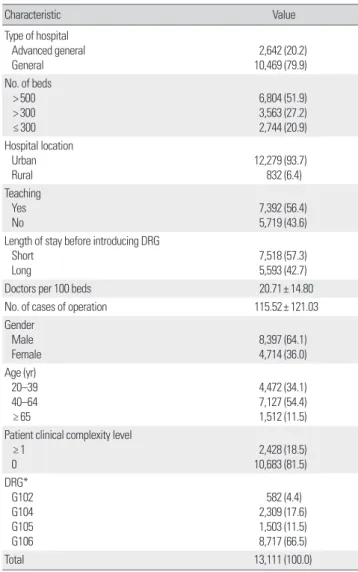
Table 1 indicates the distribution of hospital’ and patient’ char-acteristics at the baseline. Claimed anal surgery in advanced gener-al hospitgener-als were 2,642 cases, in genergener-al hospitgener-als were 10,469 cases, and total cases were 13,111. Urban-located hospital claimed 93.7% of the cases. The average number of doctors per 100 beds was 20.7,
and the average case of anal surgery was 115 cases. The distribution of DRG code, G102 (multi-anal surgery) was 582 cases, G104 (other anal surgery) was 2,309 cases, G105 (circular stapled hemorrhoidec-tomy) was 1,503 cases, and G106 (main anal surgery) was 8,717 cas-es. There were 7,518 cases of short LOS before introducing DRGs, and 5,598 cases of long LOS before introducing DRGs.
Table 2 shows the characteristics of hospitals. There were 44 ad-vanced general hospitals, and 184 general hospitals. Among total of 228 hospitals, 208 were located in urban region, and 20 were lo-cated in rural region.
Table 3 shows the average LOS by hospital’ and patient’ charac-teristics. From July 2012 to June 2013, the average LOS was 5.41 days. General hospital’s average LOS was 5.46 days, which was rela-Table 1. Distribution of cases at baseline (2012. 7.–2013. 6.)
Characteristic Value Type of hospital Advanced general General 2,642 (20.2) 10,469 (79.9) No. of beds > 500 > 300 ≤ 300 6,804 (51.9) 3,563 (27.2) 2,744 (20.9) Hospital location Urban Rural 12,279 (93.7) 832 (6.4) Teaching Yes No 7,392 (56.4) 5,719 (43.6) Length of stay before introducing DRG
Short Long
7,518 (57.3) 5,593 (42.7)
Doctors per 100 beds 20.71± 14.80
No. of cases of operation 115.52± 121.03 Gender Male Female 8,397 (64.1) 4,714 (36.0) Age (yr) 20–39 40–64 ≥ 65 4,472 (34.1) 7,127 (54.4) 1,512 (11.5) Patient clinical complexity level
≥ 1 0 2,428 (18.5) 10,683 (81.5) DRG* G102 G104 G105 G106 582 (4.4) 2,309 (17.6) 1,503 (11.5) 8,717 (66.5) Total 13,111 (100.0)
VValues are presented as number (%) or mean± standard deviation. DRG, diagnosis-related groups.
*G102: multi-anal surgery, G104: other anal surgery, G105: circular stapled hemorrhoid-ectomy, G106: main anal surgery.
tively longer than advanced general hospital’s average LOS, 5.24 days. Hospitals having small number of beds showed longer LOS,
and rural-located hospitals showed longer LOS. Teaching hospitals indicated longer LOS than non-teaching hospitals. From July 2013 to June 2014, the average LOS was 1.49 days shorter than baseline (3.92 days). In all categories of hospital and patient characteristics, shorter LOS was observed than baseline.
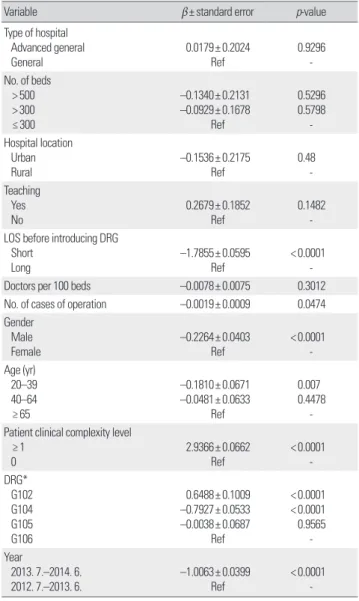
Table 4 shows the difference of average LOS by the characteristics of hospital and patient. Hospitals having above 300 beds indicated shorter LOS compared with the hospitals which had lower than 300 beds, but it was not statistically significant (above 500 beds, β= –0.3721; above 300 to 500 beds, β=–0.0266). Teaching hospital had statistically longer LOS than which did not (β= 0.5310, p= 0.0368).
The number of doctors per 100 beds (β=–0.0253, p= 0.0114) was
Table 2. Distribution of hospitals at baseline (2012. 7. –2013. 6.)
Variable No. (%) Type of hospital Advanced general General 44 (19.3) 184 (80.7) No. of beds > 500 > 300 ≤ 300 105 (46.1) 70 (30.7) 53 (23.3) Hospital location Urban Rural 208 (91.2) 20 (8.8) Teaching Yes No 121 (53.1) 107 (46.9)
Table 3. Average length of stay
Variable 2012. 7.– 2013. 6. 2013. 7.–2014. 6. Mean± SD p-value Mean± SD p-value Type of hospital Advanced general General 5.24± 4.86 5.46± 4.22 0.0247 3.93± 2.49 3.91± 1.99 0.6685 No. of beds > 500 > 300 ≤ 300 5.05± 4.18 5.65± 4.55 6.01± 4.43 < 0.0001 3.76± 2.11 3.83± 1.98 4.42± 2.15 < 0.0001 Hospital location Urban Rural 5.41± 4.36 5.48± 4.33 0.6395 3.92± 2.11 3.89± 1.94 0.7392 Teaching Yes No 5.24± 4.31 5.63± 4.40 < 0.0001 3.85± 2.15 4.00± 2.04 < 0.0001
Length of stay before introducing DRG Short Long 4.21± 2.45 7.03± 5.64 < 0.0001 3.53± 2.01 4.45± 2.11 < 0.0001 Gender Male Female 5.28± 4.23 5.65± 4.55 < 0.0001 3.86± 2.12 4.01± 2.06 0.0001 Age (yr) 20–39 40–64 ≥ 65 5.09± 3.99 5.49± 4.40 5.98± 5.03 < 0.0001 3.79± 2.15 3.99± 2.09 3.97± 1.96 < 0.0001
Patient clinical complexity level ≥ 1 0 7.84± 6.87 4.86± 3.30 < 0.0001 5.95± 4.15 3.86± 1.98 < 0.0001 DRG* G102 G104 G105 G106 6.75± 6.17 4.86± 3.97 5.70± 4.71 5.42± 4.22 < 0.0001 4.57± 2.77 3.32± 1.96 3.97± 1.78 4.05± 2.13 < 0.0001 Total† 5.41± 4.35 3.92± 2.10
SD, standard deviation; DRG, diagnosis-related groups.
*G102: multi-anal surgery, G104: other anal surgery, G105: circular stapled hemorrhoid-ectomy, G106: main anal surgery. †Difference of mean length of stay between before and after introducing DRGs was statistically significant.
Table 4. Association between characteristics of hospital and LOS
Variable β±standard error p-value
Type of hospital Advanced general General 0.0179± 0.2024 Ref 0.9296 -No. of beds > 500 > 300 ≤ 300 –0.1340± 0.2131 –0.0929± 0.1678 Ref 0.5296 0.5798 -Hospital location Urban Rural –0.1536± 0.2175 Ref 0.48 -Teaching Yes No 0.2679± 0.1852 Ref 0.1482 -LOS before introducing DRG
Short Long –1.7855± 0.0595 Ref < 0.0001 -Doctors per 100 beds –0.0078± 0.0075 0.3012 No. of cases of operation –0.0019± 0.0009 0.0474 Gender Male Female –0.2264± 0.0403 Ref < 0.0001 -Age (yr) 20–39 40–64 ≥ 65 –0.1810± 0.0671 –0.0481± 0.0633 Ref 0.007 0.4478 -Patient clinical complexity level
≥ 1 0 2.9366± 0.0662 Ref < 0.0001 -DRG* G102 G104 G105 G106 0.6488± 0.1009 –0.7927± 0.0533 –0.0038± 0.0687 Ref < 0.0001 < 0.0001 0.9565 -Year 2013. 7.–2014. 6. 2012. 7.–2013. 6. –1.0063± 0.0399 Ref < 0.0001 -LOS, length of stay; Ref, reference; DRG, diagnosis-related groups.
*G102: multi-anal surgery, G104: other anal surgery, G105: circular stapled hemorrhoid-ectomy, G106: main anal surgery.
plenty and the number of cases of operation (β=–0.0031, p= 0.0195)
was a lot, the LOS was significantly shorter. Compared with after DRG introducing, before DRG LOS was longer and it was statistical-ly significant (β=–1.0450, p<0.0001). Intraclass correlation
coeffi-cient (ICC) was 133,937.2.
Table 5 shows the association between characteristics of hospital and LOS by relative LOS. Among hospitals which had short LOS (shorter than mean of LOS) before introducing DRGs, effect of in-troducing DRGs was smaller (β=–0.4282, p<0.0001). On
con-trary, among hospitals which had long LOS (longer than mean of LOS) before introducing DRGs, effect of introducing DRGs was
bigger (β=–1.8280, p<0.0001). ICC was 65,631.9 for hospitals
with longer LOS, 61,911.0 for hospitals with shorter LOS.
Figure 1 shows the estimation of length of hospital stay in year of after introducing DRG-based payments compared with the baseline year by sub-groups: relative LOS hospitals and DRG. After introduc-ing DRG, hospitals, which demonstrated relatively longer LOS at baseline, had shorter LOS than baseline in all DRG and it was statis-tically significant (multi-anal surgery, β=–3.6746; other anal sur-gery, β=–1.7377; circular stapled hemorrhoidectomy, β=–2.1283; main anal surgery, β=–1.7091; and total DRG, β=–1.8280). Hospi-tals, which demonstrated relatively shorter LOS at baseline, also had shorter LOS than baseline and all the results were statistically signif-icant except multi-anal surgery, but the degree was tender than pre-vious hospital group, which had relatively longer LOS at baseline (multi-anal surgery, β=–0.1352; other anal surgery, β=–0.2836; cir-cular stapled hemorrhoidectomy, β=–0.5720; main anal surgery,
β=–0.4522; and total DRG, β=–0.4282).
DISCUSSION
This study aimed to analyze the changes of LOS and the factors had an effect on the changes of LOS after adopted DRG in FFS used hospitals. As the result, we found LOS were reduced when DRG was adopted in general and advanced general hospitals, which used to using FFS. In addition, the hospitals, which had relatively longer LOS at the baseline, had bigger reducing of LOS.
Length of hospital stay was the most important index, which Table 5. Association between characteristics of hospital and length
of stay by relative LOS
Variable
LOS of hospital before DRGs
Short Long
β±SE p-value β±SE p-value
Type of hospital Advanced general General 0.1677± 0.1973 Ref 0.3954 - 0.2155± 0.3215 Ref 0.5026 -No. of beds > 500 > 300 ≤ 300 –0.0284± 0.2016 0.0426± 0.1578 Ref 0.888 0.7873 - –0.4994± 0.2968 –0.2184± 0.2274 Ref 0.0925 0.3369 -Hospital location Urban Rural 0.0201± 0.2101 Ref 0.9239 - –0.1783± 0.3106 Ref 0.566 -Teaching Yes No –0.1212± 0.1841 0.5105 0.6919± 0.2448 0.0047 Doctors per 100 beds 0.0032± 0.0073 0.6599 –0.0151± 0.0105 0.149 No. of cases of operation –0.0004± 0.0009 0.6583 –0.0033± 0.0014 0.019 Gender Male Female –0.1331± 0.0360 Ref 0.0002 - –0.3637± 0.0790 Ref < 0.0001 -Age (yr) 20–39 40–64 ≥ 65 –0.1764± 0.0594 –0.0770± 0.0561 Ref 0.003 0.1696 - –0.1519± 0.1328 0.0385± 0.1253 Ref 0.2525 0.7588 -PCCL ≥ 1 0 1.5422± 0.0606 Ref < 0.0001 - 4.9818± 0.1371 Ref < 0.0001 -DRG* G102 G104 G105 G106 0.0065± 0.0934 –0.6973± 0.0510 –0.0872± 0.0621 Ref 0.9445 < 0.0001 0.1604 - 1.2993± 0.2135 –0.9218± 0.1131 0.0060± 0.1468 Ref < 0.0001 < 0.0001 0.9675 -Year 2013. 7.–2014. 6. 2012. 7.–2013. 6. –0.4282± 0.0358 Ref < 0.0001 - –1.8280± 0.0783 Ref < 0.0001 -LOS, length of stay; DRG, diagnosis-related groups; SE, standard error; Ref, reference. *G102: multi-anal surgery, G104: other anal surgery, G105: circular stapled hemorrhoid-ectomy, G106: main anal surgery.
Figure 1. Association between years and LOS by DRGs* and relative
LOS†. LOS, length of stay; DRG, diagnosis-related groups. *G102:
multi-anal surgery, G104: other anal surgery, G105: circular stapled
hemorrhoidectomy, G106: main anal surgery. †Relative LOS was
di-vided into < mean and ≥ mean by the average LOS of equivalent type hospitals. ‡Reference of estimations was baseline year (2012. 7.–
2013. 6.). G102 G104 G105 G106 Total Short –0.1352 –0.2836 –0.5720 –0.4522 –0.4282 Long –3.6746 –1.7377 –2.1283 –1.7091 –1.8280 0 –0.5 –1.0 –1.5 –2.0 –2.5 –3.0 –3.5 –4.0 β ‡
well indicated the status of hospitals [1]. First of all, LOS could be an index of measuring the quality of care [18]. Well-planned medi-cal care permit offers effective treatment and minimizes the LOS in the process of performances [19-21]. Second, LOS could be an index for measuring the management condition of hospital, and it was not independent with quality of care [21]. The hospitals, which examined a lot of patients, can attract high quality physicians us-ing the revenue, and can achieve excellent results under obtained learning effect over the process of examine [22]. On the other hand, patients are tended to converge on the hospitals, which achieved excellent results, that is the reason of the relation between the number of operation and the quality of care [22]. Provided that it is expected to admit new patients, who are known for create much higher daily cost, hospitals put effort into reducing existing patients’ unnecessary LOS [23]. Therefore, LOS could be impor-tant index to access hospital’s medical quality and effectiveness of management [23].
According to previous study, payment system strongly impact on LOS [24]. Under FFS, hospitals could receive all performances they offered, so they tend to offer medical performance as many as possible [25,26]. Increasing medical costs which were followed on FFS became a global issue, and DRG was suggested as a solution [1]. DRG arranged a mechanism that hospitals to minimize offer-ing medical performances through preservoffer-ing fixed price for a disease, so reducing net proceeds when they offering unnecessary performances or LOS [27]. In practice, we could identify substan-tially shorter LOS among the cases which were claimed as DRG than the cases which were claimed as FFS in our study.
According to previous study, above payment system, the aver-age length of hospital stay were well documented that closely con-nected with patient’s severities and some characteristics of hospi-tals [28]. As a result of our study, we could identify similar appear-ance among general and advappear-anced general hospital with clinic and hospital. Male and 20s to 30s showed shorter LOS than others. We assumed that it’s because male or 20s to 30s populations are com-paratively healthier than other population so they could quickly recover, or they usually carry on works or studies so they could want to discharge quickly. In addition, patients who had high PCCL, which indicates disease’ severities, spend long hospitaliza-tion period as previous studies.
Among characteristics of hospital, a large number of doctors and plenty of operation cases were related in LOS. We assumed that those variables reduced LOS by improved quality of care and
efficiency of management as we mentioned above [29]. A large number of beds and doctors increase medical supply and intensify the competition between hospitals [29,30]. In addition, under DRG, hospitals desire to preserve revenue as increasing the cases of operation because the cost per operation is fixed [26]. In this process, for achieving high number of operation, high turnover rate is needed and followed by reduced LOS [29].
Teaching hospitals had long LOS as previous study [28]. We as-sumed that this result caused by Korean teaching hospital’s struc-tural characteristics that residents primarily take care of patients and specialist coach and supervise the residents’ performances [28,31]. However, reduced LOS had not only advantages. Especial-ly, under DRG, the payment which fixed the cost per disease, “spill-over effect” and “blood discharge” became adverse effects [9,10].
In previous research, anal surgery was known as a disease has big deviation of LOS between hospitals [17]. According to previous study, anal surgery had high rates of patients who had remarkably shorter LOS than average LOS [17]. Nevertheless, as a result of our study, average LOS of anal surgery which claimed as FFS was lon-ger than average LOS, which was suggested by Health Insurance Review & Assessment Service. In our study, we identified signifi-cantly reduced LOS after introducing DRG.
We additionally analyzed to identify whether reduced LOS in anal surgery was a positive effect that was reducing of unnecessary LOS caused by efficiency of hospital, or a negative effect that was excessively reducing basically appropriated LOS. In our study re-sults, the hospital, which had relatively long LOS at FFS, reduced relatively long LOS, and the hospitals, which had relatively short LOS at FFS, reduced relatively short LOS. Therefore, we speculated the reduced LOS was unnecessarily long LOS, and deviations be-tween hospitals were reduced.
There are some limitations in our research. First, our study re-sults were confined in anal surgery and targeted general and ad-vanced general hospitals. However, it because we wanted to focus on the objective which was highly necessary to study or rarely studied for filling up unstudied blank in previous studies. Second, our study objects were hospitals, which did not choose DRG when the system was not an obligation duty. That kind of hospital could have own characteristics but we did not reflect in our study. How-ever, all of advanced general hospitals and most of general hospi-tals did not participated in DRG before it became a obligation duty, so it could not be a barrier for representative of our study.
Third, we found more reduced LOS in hospitals which had long LOS at FFS, but could not proof that there was no spill-over of blood discharge caused by reduced LOS. In addition, whether the effect of LOS reducing caused by improved hospitals’ manage-ment efficiency and quality of care during introducing DRG or not could not be certainly proved. Further studies about those will be necessary. Fourth, there was no control groups which did not par-ticipated in DRG, we could not certainly identify the effect of LOS reducing was only because of DRG. However, the reduced LOS at FFS every year was not as reduced LOS in this study, so it could be confined as an effect of DRG.
Despite of some limitations, our study had strong advantages. First, we filled up black of previous study about the effects of DRG, as analyzing general and advanced general hospitals. Second, we used all data of anal surgery claimed by hospitals, which newly participated in DRG, so it well represented national information. Third, we adjusted our study results with most of hospital charac-teristics that well known for impacting on LOS by previous stud-ies. Fourth, as suggesting the main source of reduced LOS was the hospitals which had relatively long LOS in FFS, we implied the possibility of hospital efficiency according to DRG.
In conclusion, introducing DRGs was more effective to hospitals which had long LOS before introducing DRGs. It could have pos-sibility of reducing unnecessary LOS among hospitals which had long LOS [1]. However, there are concerns of adverse effect [10]. Further studies are needed to ensure the positive and negative ef-fect of introducing DRGs. We expected that our study results could help decision makers of health policy, who consider effective payment systems in the world, by offering information of practical effectiveness of DRG.
ACKNOWLEDGMENTS
This study was conducted with the support of the Health Fel-lowship Foundation.
ORCID
Hye Ki Park: https://orcid.org/0000-0001-6553-7392; Sung-Youn Chun: https://orcid.org/0000-0003-4323-8724; Jae-Woo Choi: https://orcid.org/0000-0002-7428-8858; Seung-Ju Kim: https://orcid.org/0000-0003-3308-3802; Eun-Cheol Park: https:// orcid.org/0000-0002-2306-5398
REFERENCES
1. Organization for Economic Cooperation and Development. OECD re-views of health care quality: Korea 2012: raising standards. Paris: Organi-zation for Economic Cooperation and Development; 2012.
2. Gibbons GW, Marcaccio EJ Jr, Burgess AM, Pomposelli FB Jr, Freeman DV, Campbell DR, et al. Improved quality of diabetic foot care, 1984 vs 1990: reduced length of stay and costs, insufficient reimbursement. Arch Surg 1993;128(5):576-581. DOI: https://doi.org/10.1001/archsurg.1993. 01420170112017.
3. Busse R, Schreyogg J, Smith PC. Hospital case payment systems in Europe. Health Care Manag Sci 2006;9(3):211-213. DOI: https://doi.org/10.1007/ s10729-006-9039-7.
4. Wilensky GR. Reforming Medicare’s physician payment system. N Engl J Med 2009;360(7):653-655. DOI: https://doi.org/10.1056/NEJMp0808003. 5. Jencks SF, Dobson A. Strategies for reforming Medicare’s physician
pay-ments: physician diagnosis-related groups and other approaches. N Engl J Med 1985;312(23):1492-1499. DOI: https://doi.org/10.1056/nejm19850 6063122306.
6. Busse R, Geissler A, Quentin W. Diagnosis-related groups in Europe: moving towards transparency, efficiency and quality in hospitals. Maid-enhead: Open University Press; 2011.
7. Fetter RB, Shin Y, Freeman JL, Averill RF, Thompson JD. Case mix defi-nition by diagnosis-related groups. Med Care 1980;18(2 Suppl):1-53. 8. Polyzos N, Karanikas H, Thireos E, Kastanioti C, Kontodimopoulos N.
Re-forming reimbursement of public hospitals in Greece during the economic crisis: implementation of a DRG system. Health Policy 2013;109(1):14-22. DOI: https://doi.org/10.1016/j.healthpol.2012.09.011.
9. Zander B, Dobler L, Busse R. The introduction of DRG funding and hos-pital nurses’ changing perceptions of their practice environment, quality of care and satisfaction: comparison of cross-sectional surveys over a 10-year period. Int J Nurs Stud 2013;50(2):219-229. DOI: https://doi.org/10.1016/ j.ijnurstu.2012.07.008.
10. Rogers WH, Draper D, Kahn KL, Keeler EB, Rubenstein LV, Kosecoff J, et al. Quality of care before and after implementation of the DRG-based prospective payment system: a summary of effects. JAMA 1990;264(15): 1989-1994. DOI: https://doi.org/10.1001/jama.264.15.1989.
11. Yang J, Cui PJ, Han HZ, Tong DN. Meta-analysis of stapled hemorrhoid-opexy vs LigaSure hemorrhoidectomy. World J Gastroenterol 2013; 19(29):4799-4807. DOI: https://doi.org/10.3748/wjg.v19.i29.4799. 12. Qi-Ming X, Jue-Ying X, Ben-Hui C, Jing W, Ning L. Risk factors for
postop-erative retention after hemorrhoidectomy: a cohort study. Gastroenterol Nurs 2015;38(6):464-468. DOI: https://doi.org/10.1097/SGA.0000000000000121. 13. Schneider EB, Hyder O, Brooke BS, Efron J, Cameron JL, Edil BH, et al.
Patient readmission and mortality after colorectal surgery for colon can-cer: impact of length of stay relative to other clinical factors. J Am Coll Surg 2012;214(4):390-398. DOI: https://doi.org/10.1016/j.jamcollsurg. 2011.12.025.
14. Kwon S. Payment system reform for health care providers in Korea. Health Policy Plan 2003;18(1):84-92. DOI: https://doi.org/10.1093/ heapol/18.1.84.
15. Manton KG, Woodbury MA, Vertrees JC, Stallard E. Use of Medicare services before and after introduction of the prospective payment system. Health Serv Res 1993;28(3):269-292.
16. Kwak JM, Lee KS. Is the hospital caseload of diagnosis related groups re-lated to medical charges and length of stay? Korean J Health Serv Manag 2014;8(4):13-24. DOI: https://doi.org/10.12811/kshsm.2014.8.4.013. 17. Lee KS, Kang HC, Nam CM, Cho W, Kang HY. Variations in hospital length
of stay for diagnosis-related groups among health care institutions. Korean J Health Policy Adm 2006;16(2):77-95. DOI: https://doi.org/10.4332/kjh-pa.2006.16.2.077.
18. Thomas JW, Guire KE, Horvat GG. Is patient length of stay related to quality of care? Hosp Health Serv Adm 1997;42(4):489-507.
19. Rotter T, Kinsman L, James E, Machotta A, Willis J, Snow P, et al. The ef-fects of clinical pathways on professional practice, patient outcomes, length of stay, and hospital costs: Cochrane systematic review and meta-analysis. Eval Health Prof 2012;35(1):3-27. DOI: https://doi.org/10.1177/ 0163278711407313.
20. Archer SB, Burnett RJ, Flesch LV, Hobler SC, Bower RH, Nussbaum MS, et al. Implementation of a clinical pathway decreases length of stay and hospital charges for patients undergoing total colectomy and ileal pouch/ anal anastomosis. Surgery 1997;122(4):699-703. DOI: https://doi.org/ 10.1016/s0039-6060(97)90076-3.
21. Rotter T, Kinsman L, James E, Machotta A, Gothe H, Willis J, et al. Clini-cal pathways: effects on professional practice, patient outcomes, length of stay and hospital costs. Cochrane Database Syst Rev 2010;(3):CD006632. DOI: https://doi.org/10.1002/14651858.CD006632.pub2.
22. Coles JW, Hesterly WS. Transaction costs, quality, and economies of scale: examining contracting choices in the hospital industry. J Corp Financ 1998;4(4):321-345. DOI: https://doi.org/10.1016/s0929-1199(98)00011-x. 23. McPherson K. Length of stay and health outcome. Br Med J (Clin Res Ed)
1984;288(6434):1854-1855. DOI: https://doi.org/10.1136/bmj.288.6434.1854.
24. Bunker JP. Surgical manpower: a comparison of operations and surgeons in the United States and in England and Wales. N Engl J Med 1970;282(3): 135-144. DOI: https://doi.org/10.1056/nejm197001152820306.
25. Simoens S, Hurst J. The supply of physician services in OECD countries. Paris: Organization for Economic Cooperation and Development; 2006. 26. Cromwell J, Mitchell JB. Physician-induced demand for surgery. J Health
Econ 1986;5(4):293-313. DOI: https://doi.org/10.1016/0167-6296(86)90006-8.
27. Rosko MD, Broyles RW. Short-term responses of hospitals to the DRG prospective pricing mechanism in New Jersey. Med Care 1987;25(2):88-99. DOI: https://doi.org/10.1097/00005650-198702000-00002. 28. Cannoodt LJ, Knickman JR. The effect of hospital characteristics and
or-ganizational factors on pre- and postoperative lengths of hospital stay. Health Serv Res 1984;19(5):561-585.
29. Robinson JC, Luft HS. The impact of hospital market structure on pa-tient volume, average length of stay, and the cost of care. J Health Econ 1985;4(4):333-356. DOI: https://doi.org/10.1016/0167-6296(85)90012-8. 30. Robinson JC, Luft HS, McPhee SJ, Hunt SS. Hospital competition and
surgical length of stay. JAMA 1988;259(5):696-700. DOI: https://doi. org/10.1001/jama.259.5.696.
31. Rosenthal GE, Harper DL, Quinn LM, Cooper GS. Severity-adjusted mortality and length of stay in teaching and nonteaching hospitals: re-sults of a regional study. JAMA 1997;278(6):485-490. DOI: https://doi. org/10.1001/jama.1997.03550060061037.