Dicer Is Down-regulated and Correlated with Drosha in Idiopathic Sudden Sensorineural Hearing Loss
Previously, we reported the expression levels of specific microRNA machinery components, DGCR8 and AGO2, and their clinical association in patients with idiopathic sudden hearing loss (SSNHL). In the present study, we investigated the other important components of microRNA machinery and their association with clinical parameters in SSNHL patients.
Fifty-seven patients diagnosed with SSNHL and fifty healthy volunteers were included in this study. We evaluated mRNA expression levels of Dicer and Drosha in whole blood of patients with SSNHL and the control group, using RT & real-time PCR analysis. The Dicer mRNA expression level was down-regulated in patients with SSNHL. However, the Drosha mRNA expression level was not significantly altered in patients with SSNHL. Neither the Dicer nor Drosha mRNA expression level was not associated with any clinical parameters, including age, sex, duration of initial treatment from onset (days), initial Pure tone average, Siegel’s criteria, WBC, and Erythrocyte sedimentation rate. However, mRNA expression levels of Dicer and Drosha were positively correlated to each other in patients with SSNHL. In this study, we demonstrated for the first time that the Dicer mRNA expression level was down-regulated in patients with SSNHL, suggesting its important role in pathobiology of SSNHL development.
Keywords: MicroRNA Biogenesis; Idiopathic Sudden Sensorineural Hearing Loss; Dicer;
Drosha Shin Kim,1 Jae-ho Lee,2 and Sung-Il Nam3
Departments of 1Immunology, 2Anatomy, and
3Otorhinolaryngology, School of Medicine, Keimyung University, Daegu, Korea Received: 8 December 2014 Accepted: 30 April 2015 Address for Correspondence:
Sung-Il Nam, MD
Department of Otorhinolaryngology, Keimyung University School of Medicine, 56 Dalseong-ro, Jung-gu, Daegu 700-712, Korea
Tel: +82.53-250-7159, Fax: +82.53-256-0325 E-mail: [email protected]
http://dx.doi.org/10.3346/jkms.2015.30.8.1183 • J Korean Med Sci 2015; 30: 1183-1188
INTRODUCTION
Sudden sensorineural hearing loss (SSNHL) is a medical emer- gency. Therefore, searching for the mechanisms of SSNHL de- velopment is very important in establishment of the fundamen- tal therapeutic strategy of SSNHL. However, the exact patho- physiologic mechanism of the sudden sensorineural hearing loss (SSNHL) has remained elusive. It has been suggested that the following factors are causes of SSNHL: idiopathic (71.0%), infectious disease (12.8%), otologic disease (4.7%), trauma (4.2%), vascular or hematologic (2.8%), neoplastic (2.3%), and other causes (2.2%) (1). It is defined as hearing loss of 30 dB or more over at least three contiguous frequencies occurring within 3 days or less (2). Recently, some studies have reported an asso- ciation between genetic risk factors and SSNHL (3-5).
MicroRNAs (miRNAs) are small noncoding RNAs, which are 21-24 nucleotides (nt) in length and play an important role in the post-transcriptional gene regulation by translational inhibi- tion and/or inducing degradation of the target mRNA (6). Many studies reported that miRNAs are involved in a wide range of biological processes such as cellular development, differentia- tion, proliferation, metabolism, carcinogenesis, and cell death (7-9). The biogenesis of miRNA occurs in a well-organized pro-
cess, referred to as the ‘miRNA machinery’ (10), which is medi- ated by two important RNAse III endonucleases including Dic- er and Drosha (6, 11). Drosha is a part of a multiprotein com- plex, the DROSHA/DGCR8 miRNA microprocessor and cleaves primary miRNAs (pri-miRNA; a single-stranded RNA extensions consisting of a hairpin stem, a terminal loop, the capped 5’ end, and the polyadenylated 3’ end (12)) into precursor miRNAs (pre-miRNAs; approximately 70-90 nucleotide hairpin struc- ture (13)) in nucleus. The pre-miRNAs are transported to the cytoplasm and further processed by Dicer, into short double- stranded molecules, mature miRNAs (14). If any miRNA ma- chinery component is dysregulated, miRNA maturation is sig- nificantly altered, severely affecting the cells’ gene expression pattern. The altered expression of important individual miRNA machinery component has recently been suggested to play a role in various human diseases, including SSNHL (15), syncy- tial virus disease (16), neurological diseases (17), HIV-related li- podystrophy (18), and cancer (19, 20).
Previously, we evaluated the mRNA expression levels of im- portant miRNA machinery components such as the DiGeorge syndrome critical region gene 8 (DGCR8) and Argonaute 2 (AGO2), and the clinical implication in patients with SSNHL. In the pres- ent study, therefore, we investigated the altered regulations of
other miRNA-related components such as Dicer and Drosha, and their clinical associations in patients with SSNHL.
MATERIALS AND METHODS Patients
Altogether, fifty-seven patients diagnosed with SSNHL at De- partment of Otorhinolaryngology, Dongsan Medical Center between November 2011 and July 2012, were included in the study. Patients were included according to the following crite- ria: the presence of hearing loss when peripheral blood was collected, unilateral SSNHL of unknown origin, with or without tinnitus and/or vertigo, and no involvement of cranial nerves other than the eighth cranial nerve. SSHNL patients were clas- sified into several clinical characteristics (Table 1). Patients were excluded when having known causes of hearing loss (noise in- duced, drug induced, Ménière’s disease, otitis media, herpes zoster oticus) and familial deafness. Workup included pure-tome audiometry, tympanometry, stapedial reflexes, auditory brain- stem-evoked responses, and brain magnetic resonance imag- ing (in order to rule out acoustic neuroma). Fifty unrelated heal- thy volunteers, who underwent physical examinations and had
the same geographic and ethnic origin as the patient group, were randomly collected as controls.
Specimens and preparation
Peripheral blood was obtained from healthy volunteers and pa- tients with SSNHL. Blood specimens were collected into EDTA tubes to avoid clot. For leukocyte enrichment, an optimized hy- potonic lysis procedure with ACK lysing buffer (Gibco, Grand Island, NY, USA) was applied. The tubes were centrifuged and then Phosphate buffered saline (PBS) was added to wash. Final- ly, only leukocyte enriched-blood cells were collected.
RNA isolation and quantitative real-time RT-PCR
The mRNA expression of components of the miRNA biogenesis including Dicer and Drosha was detected by means of quanti- tative reverse transcription polymerase chain reaction (RT-PCR).
Total cellular RNA was extracted from blood cells using TRIzol (Molecular Research Center, Inc., Cincinnati, OH, USA) and treated with a DNAse to remove DNA. Each cDNA was synthe- sized form 2 μg of total RNA using M-MLV reverse transcriptase (Promega, Madison, WI, USA). By using the specific primer pairs described in Table 2 and SYBR GREEN Premix (TOYOBO, Ja- Table 1. Correlation of the clinicopathological characteristics with Dicer and Drosha expression levels in patients with SSNHL
Parameters Dicer
P value Drosha
P value
Low (%) High (%) Low (%) High (%)
Gender Male
Female 17 (65.4)
12 (44.4) 9 (34.6) 15 (55.6)
0.126
17( 58.6)
18 (64.3) 12 (41.4) 10 (35.7)
0.661
Age -39 40-49 50-59 60-69 70
5 (62.5) 7 (70.0) 6 (40.0) 4 (40.0) 7 (70.0)
3 (37.5) 3 (30.0) 9 (60.0) 6 (60.0) 3 (30.0)
0.371
4 (50.0) 7 (70.0) 12 (66.7) 6 (54.5) 6 (60.0)
4 (50.0) 3 (30.0) 6 (33.3) 5 (45.5) 4 (40.0)
0.880
Duration of initial treatment from onset (days) -3
4-6 7-
10 (55.6) 11 (52.4) 8 (57.1)
8 (44.4) 10 (47.6) 6 (42.9)
0.956
14 (70.0) 12 (54.5) 9 (60.0)
6 (30.0) 10 (45.5) 6 (40.0)
0.585
Initial PTA* (dB) -40 41-55 56-70 71-90 91-
1 (50.0) 4 (57.1) 7 (43.8) 8 (61.5) 9 (60.0)
1 (50.0) 3 (42.9) 9 (56.2) 5 (38.5) 6 (40.0)
0.874
1 (50.0) 6 (85.7) 10 (58.8) 9 (60.0) 9 (56.2)
1 (50.0) 1 (14.3) 7 (41.2) 6 (40.0) 7 (43.8)
0.718
Siegel’s criteria I
II III IV
5 (45.5) 4 (57.1) 7 (58.3) 13 (56.5)
6 (54.5) 3 (42.9) 5 (41.7) 10 (43.5)
0.921
8 (66.7) 7 (87.5) 9 (64.3) 11 (47.8)
4 (33.3) 1 (12.5) 5 (35.7) 12 (52.2)
0.233
WBC (/μL) -5,000 5,001-12,000 12,001-
4 (80.0) 20 (50.0) 4 (57.1)
1 (20.0) 20 (50.0) 3 (42.9)
0.439
4 (80.0) 25 (58.1) 5 (62.5)
1 (20.0) 18 (41.9) 3 (37.5)
0.634
ESR (mm/hr) -20 21-
12 (54.5) 7 (70.0)
10 (45.5) 3 (30.0)
0.409
15 (62.5) 8 (80.0)
9 (37.5) 2 (20.0)
0.320
PTA, pure tone average of 0.5, 1, 2, 3 kHz by four-dimension method. ESR, erythrocyte sedimentation rate.
Table 2. Primer sequences of miRNA machinery components used in quantitative PCR
Components Position Sequences
Dicer Forward
Reverse 5´-TTAACCTTTTGGTGTTTGATGAGTGT-3´
5´-AGGACATGATGGACAATT-3´
Drosha Forward Reverse
5´-CTGTCGATGCACCAGATT-3´
5´-TGCATAACTCAACTGTGCAGG-3´
β-actin Forward Reverse
5´-CAGCCATGTACGTTGCTATCCAGG-3´
5´-AGGTCCAGACGCAGGATGGCATG-3´
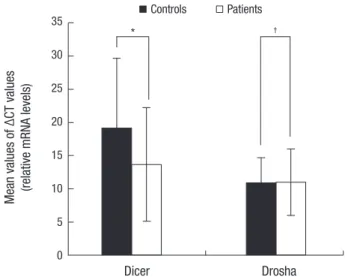
Fig. 1. Relative Dicer and Drosha mRNA expression in patients group with SSNHL and in the control group; *P < 0.001, †P = 0.788. All values are relative to β-actin gene expression (mean ± SD from triplicate readings). These values are representa- tive for two independent experiments with similar results.
Mean values of ∆CT values (relative mRNA levels)
Dicer Drosha
35 30 25 20 15 10 5 0
* †
Controls Patients
Fig. 2. Correlation between mRNA expression levels of Dicer and Drosha. (A) Patients group with SSNHL. (B) Control group. ΔCT, specific target gene CT–β-actin CT.
Relative mRNA levels (ΔCT) Drosha
Relative mRNA levels (ΔCT) Dicer 0 10 20 30 40 50 25
20
15
10
5
r = 0.149 P = 0.004
Relative mRNA levels (ΔCT) Drosha
Relative mRNA levels (ΔCT) Dicer 0 10 20 30 40 50 30
25 20 15 10 5 0
r = 0.010 P = 0.511
A B
pan). Quantitative real-time PCR was performed on the Light- Cycler® 480 real-time PCR system (Roche Diagnostics, Mann- heim, Germany).
Statistical analysis
Prior to statistical analysis, raw qPCR data of Dicer and Drosha mRNA levels were normalized to mRNA level of β-actin. β-Actin was used as a housekeeping gene, and a no template sample was used as a negative control. Then, relative gene expression was calculated by using the comparative CT (ΔCt) method (ΔCt
= specific target gene Ct–β-actin Ct) (21). Statistical analysis was performed with SPSS 18.0 (SPSS Inc., Chicago, IL, USA). To com- pare the mRNA expression levels of miRNA biogenesis-related components between patient groups and healthy volunteers, the data were analyzed using the Mann-Whitney U-test of vari- ance for continuous variables. Correlations between mRNA ex- pressions of interindividual miRNA biogenesis-related compo- nents were analyzed by the Pearson’s correlation coefficient analysis. The mean value was used as the cut-off value in the present study. Statistical analyses between each miRNA biogen- esis-related component and each clinical characteristic were performed by using the Kruskal-Wallis test for categorical vari- ables and the Pearson’s correlation coefficient analysis. Gener- ally, a P value of less than 0.05 was established to denote signifi- cance in all statistical analyses performed in the study.
Ethics statement
The study protocol was approved by the institutional review board of Keimyung University Dongsan Medical Center IRB (approval # 12-119). All samples derived from the patients with SSNHLs and healthy volunteers were obtained with informed consent under institutional review board-approved protocols.
RESULTS
Expression levels of Dicer and Drosha and mutual relation in patients with SSNHL and healthy volunteers.
To investigate the mRNA expression levels of major RNase components, Dicer and Drosha in the specimens of patients with SSNHL, we determined the expression levels of the select- ed two miRNA biogenesis-related components in the whole
blood cells of patients with SSNHL and healthy controls. Our study revealed that Dicer mRNA expression levels in the speci- mens of patients with SSNHL were significantly lower than the controls’ specimens (P < 0.001; Fig. 1). However, in the expres- sion levels of Drosha, there were no significant differences be- tween patients with SSNHL and the controls (P = 0.788; Fig. 1).
To investigate the significant correlation between mRNA ex- pression levels of Dicer and Drosha in with SSNHL and healthy volunteers, we evaluated the correlations of the two selected mRNA machinery components. As shown in Fig. 2A, there was a significant association between Dicer and Drosha with a Pear- son correlation coefficient value of 0.149 in only patients with SSNHL (P = 0.004; Fig. 2A), but not in healthy controls (Fig. 2B).
Relationship between mRNA expression levels of miRNA ma- chinery components and the clinical parameters in patients with SSNHL.
To elucidate the influence of the clinical characteristics on the mRNA expression levels of Dicer and Drosha, patients were grouped according to each clinical characteristic. The clinical characteristics of all 57 patients (mean age 54.43 ± 14.67 yr) with SSNHL were presented in Table 1. As shown in Table 1, there were no significant association between expression levels of specific miRNA machinery components and each clinical char- acteristic including age, sex, duration of initial treatment from onset (days), Initial PTA, Siegel’s criteria, WBC, and ESR.
DISCUSSION
miRNA plays an important role in a wide variety of biological processes in humans including development of human embry- onic stem cells (22), cancer (13), infectious disease (23), and heart development and function (24). The miRNA regulation is regulated by miRNA machinery components such as Dicer and Drosha. Dicer and Drosha are enzymes of the RNAse III endori- bonuclease family, which are crucial for RNA interference in eukaryotes. Drosha is a component of a multiprotein complex, the microprocessor, which cleaves pri-miRNAs into approxi- mately 60-70 nt hairpin pre-miRNAs in nucleus (25). Dicer is a component of the protein machinery (the RNA induced Silenc- ing Complex [RISC]) which is catalyzing the formation of ma- ture miRNAs from their precursors in the process of miRNA bio- genesis (26). Accumulating evidences revealed that dysregula- tions of the miRNA machinery components Dicer or Drosha are involved in various diseases in humans. For example, mRNA expression levels of Dicer and Drosha were down-regulated in ovarian cancer (19) and endometrial cancer (27). In addition, Dicer expression reduced in the cord blood of infants admitted with severe respiratory syncytial virus disease (16). Although the regulation of miRNA machinery components, DGCR8 and AGO2 has been evaluated in SSNHL, mRNA expression levels of Dicer and Drosha were not elucidated. Therefore, in this study,
we wanted to investigate the mRNA expression levels of Dicer and Drosha by RT-qPCR method and their clinical significanc- es in patients with SSNHL and healthy controls.
In the present study, we investigated the expressions and clin- ical relevance of the two miRNA machinery components in SS- NHL. Our data show that Dicer is significantly down-regulated in patients with SSNHL in comparison to healthy controls (Fig.
1). The up-regulated expression of two important RISC compo- nents, Dicer and AGO2, has recently been investigated in skin squamous cell carcinoma (20, 28). In that study, it was as ex- pected because Dicer and AGO2 are both part of the RISC and overexpression of only one RISC component would have been unlikely. On the other hand, a recent study suggested that Dicer and AGO2 are differentially expressed between estrogen recep- tor negative and estrogen receptor-positive breast cancer (29).
We reported that the mRNA expression level of AGO2 is up-reg- ulated in patients with SSNHL (15). Because subjects of each experiment were partially matched, we could not make a com- parison of each result. However, we found that Dicer was down- regulated and AGO2 was up-regulated in patients with SSNHLs, suggesting the aspects of gene regulation were similar to our re- sults. Therefore, more study is needed on the regulations of the two components and relationship between each other in many other diseases.
Recently, mRNA expression levels of DGCR8 and AGO2 have been revealed to be positively correlated to each other in pati- ents with SSNHL and controls, suggesting that Dicer and Dro- sha genes share, at least partly, common mechanisms that con- tribute to the deregulation of their expression in triple-negative breast cancer (30). So, in this study, the correlation between ex- pression levels of interindividual miRNA biogenesis-related components was evaluated by using the Pearson’s correlation coefficient analysis. In only SSNHL patients, a significant corre- lation between Dicer and Drosha was found (Fig. 2A). Based on the finding that there are significant correlations between Dicer and Drosha, obtained from statistical analyses between SSNHL patients and controls, it is possible to suppose that the changes of correlations from healthy volunteers to patients with SSNHL could be regarded as an epiphenomenon or a pathogenesis of SSNHL.
Although it is not easy to evaluate whether the dysregulated miRNA machinery components are a cause or outcome in the pathogenesis of the diseases, it has been revealed that there were significant correlations between the dysregulated compo- nents and clinical parameters (31). Recently, it has been report- ed that the RNA-induced silencing complex (RISC) component argonaute-2 (AGO-2) is significantly associated with WBC count in SSNHL patients (15). Because Dicer and Drosha are two main enzymes required for post-transcriptional miRNA processing, we therefore investigated whether the mRNA expression levels of Dicer and Drosha are associated with any clinical parameters
of SSNHL patients. There are many important factors, which are significantly associated with clinical characteristics of SSNHL.
Several known factors are initial hearing loss level, Pure Tone Average (PTA) pattern, age, presence or absence of vertigo and tinnitus, duration of initial treatment from onset, and underly- ing disease (32-35). Reported evidence revealed that good prog- nosis in the hearing recovery of SSNHL was associated with ab- sence of vertigo, early treatment (the first 7 days), and initial hearing loss less than 50dB (36). As shown in Table 1, the results indicated that there was no association between altered expres- sion levels of the two enzyme and clinical characteristics, includ- ing age, sex, duration of initial treatment from onset (days), ini- tial PTA, Siegel’s criteria, WBC, and ESR. Although, mRNA ex- pression levels of Dicer and Drosha were not associated with clinical parameters, as shown in Fig. 1, the cytosolic endonucle- ase, Dicer is significantly down-regulated in patients with SSNHL.
Therefore, the down-regulated Dicer could be correlated with an epiphenomenon or a pathogenesis of SSNHL. Considering the positive correlation between Dicer and Drosha in SSNHL patients, further study on relationship between these miRNA components is needed in SSNHL patients.
In conclusion, we examined the mRNA expression levels of the two critical miRNA machinery components, Dicer and Dro- sha, and their clinical signification in SSNHL patients’ whole blood cells for the first time. Our data demonstrated that Dicer is significantly down-regulated in SSNHL, suggesting that re- duced expression of Dicer may play an important role during the development of SSNHL. Considering the deep correlation between Dicer and Drosha in SSNHL patients, further study on relationship between these miRNA components is needed.
DISCLOSURE
The authors declare that there is no conflict of interest associat- ed with this manuscript.
AUTHOR CONTRIBUTION
Study design: Nam SI, Kim S. Acquisition of data: Lee J, Nam SI.
Interpretation of results and the writing of the manuscript: Nam SI, Kim S, Lee J. Approval of submission: all authors.
ORCID
Shin Kim http://orcid.org/0000-0002-1099-5027 Jae-ho Lee http://orcid.org/0000-0002-5562-0720 Sung-Il Nam http://orcid.org/0000-0002-4871-1755 REFERENCES
1. Chau JK, Lin JR, Atashband S, Irvine RA, Westerberg BD. Systematic re-
view of the evidence for the etiology of adult sudden sensorineural hear- ing loss. Laryngoscope 2010; 120: 1011-21.
2. Fusconi M, Chistolini A, Angelosanto N, Pignoloni P, Tombolini M, De Virgilio A, Pagliarella M, de Vincentiis M. Role of genetic and acquired prothrombotic risk factors in genesis of sudden sensorineural hearing loss. Audiol Neurootol 2011; 16: 185-90.
3. Nam SI, Yu GI, Kim HJ, Park KO, Chung JH, Ha E, Shin DH. A polymor- phism at -1607 2G in the matrix metalloproteinase-1 (MMP-1) increased risk of sudden deafness in Korean population but not at -519A/G in MMP- 1. Laryngoscope 2011; 121: 171-5.
4. Nam SI, Ha E, Jung KH, Baik HH, Yoon SH, Park HJ, Choe BK, Chung JH, Seo JC, Lee MY, et al. IL4 receptor polymorphism is associated with increased risk of sudden deafness in Korean population. Life Sci 2006;
78: 664-7.
5. Uchida Y, Sugiura S, Ando F, Shimokata H, Nakashima T. Association of the C677T polymorphism in the methylenetetrahydrofolate reductase gene with sudden sensorineural hearing loss. Laryngoscope 2010; 120:
791-5.
6. Bartel DP. MicroRNAs: genomics, biogenesis, mechanism, and function.
Cell 2004; 116: 281-97.
7. Shen J, Stass SA, Jiang F. MicroRNAs as potential biomarkers in human solid tumors. Cancer Lett 2013; 329: 125-36.
8. Li PY, He FC, Zhou GQ. Association of human microRNA related genetic variations with cancer. Yi Chuan 2011; 33: 870-8.
9. Schmittgen TD. Regulation of microRNA processing in development, dif- ferentiation and cancer. J Cell Mol Med 2008; 12: 1811-9.
10. Papachristou DJ, Korpetinou A, Giannopoulou E, Antonacopoulou AG, Papadaki H, Grivas P, Scopa CD, Kalofonos HP. Expression of the ribo- nucleases Drosha, Dicer, and Ago2 in colorectal carcinomas. Virchows Arch 2011; 459: 431-40.
11. Gregory RI, Yan KP, Amuthan G, Chendrimada T, Doratotaj B, Cooch N, Shiekhattar R. The Microprocessor complex mediates the genesis of mi- croRNAs. Nature 2004; 432: 235-40.
12. Lee Y, Ahn C, Han J, Choi H, Kim J, Yim J, Lee J, Provost P, Radmark O, Kim S, et al. The nuclear RNase III Drosha initiates microRNA process- ing. Nature 2003; 425: 415-9.
13. Dalmay T. MicroRNAs and cancer. J Intern Med 2008; 263: 366-75.
14. Tijsterman M, Plasterk RH. Dicers at RISC; the mechanism of RNAi. Cell 2004; 117: 1-3.
15. Han SY, Kim S, Shin DH, Cho JH, Nam SI. The Expression of AGO2 and DGCR8 in Idiopathic Sudden Sensorineural Hearing Loss. Clin Exp Oto- rhinolaryngol 2014; 7: 269-74.
16. Inchley CS, Sonerud T, Fjaerli HO, Nakstad B. Reduced Dicer expression in the cord blood of infants admitted with severe respiratory syncytial vi- rus disease. BMC Infect Dis 2011; 11: 59.
17. Tao J, Wu H, Lin Q, Wei W, Lu XH, Cantle JP, Ao Y, Olsen RW, Yang XW, Mody I, et al. Deletion of astroglial Dicer causes non-cell-autonomous neuronal dysfunction and degeneration. J Neurosci 2011; 31: 8306-19.
18. Mori MA, Thomou T, Boucher J, Lee KY, Lallukka S, Kim JK, Torriani M, Yki-Järvinen H, Grinspoon SK, Cypess AM, et al. Altered miRNA pro- cessing disrupts brown/white adipocyte determination and associates with lipodystrophy. J Clin Invest 2014; 124: 3339-51.
19. Merritt WM, Lin YG, Han LY, Kamat AA, Spannuth WA, Schmandt R, Urbauer D, Pennacchio LA, Cheng JF, Nick AM, et al. Dicer, Drosha, and outcomes in patients with ovarian cancer. N Engl J Med 2008; 359:
2641-50.
20. Sand M, Skrygan M, Georgas D, Arenz C, Gambichler T, Sand D, Altme- yer P, Bechara FG. Expression levels of the microRNA maturing micro- processor complex component DGCR8 and the RNA-induced silencing complex (RISC) components argonaute-1, argonaute-2, PACT, TARBP1, and TARBP2 in epithelial skin cancer. Mol Carcinog 2012; 51: 916-22.
21. Schmittgen TD, Livak KJ. Analyzing real-time PCR data by the compar- ative C(T) method. Nat Protoc 2008; 3: 1101-8.
22. Suh MR, Lee Y, Kim JY, Kim SK, Moon SH, Lee JY, Cha KY, Chung HM, Yoon HS, Moon SY, et al. Human embryonic stem cells express a unique set of microRNAs. Dev Biol 2004; 270: 488-98.
23. Cheng JC, Moore TB, Sakamoto KM. RNA interference and human dis- ease. Mol Genet Metab 2003; 80: 121-8.
24. Lin CC, Chang YM, Pan CT, Chen CC, Ling L, Tsao KC, Yang RB, Li WH.
Functional evolution of cardiac microRNAs in heart development and functions. Mol Biol Evol 2014; 31: 2722-34.
25. Lee Y, Han J, Yeom KH, Jin H, Kim VN. Drosha in primary microRNA processing. Cold Spring Harb Symp Quant Biol 2006; 71: 51-7.
26. Devasthanam AS, Tomasi TB. Dicer in immune cell development and function. Immunol Invest 2014; 43: 182-95.
27. Torres A, Torres K, Paszkowski T, Jodłowska-Jędrych B, Radomański T, Książek A, Maciejewski R. Major regulators of microRNAs biogenesis Dicer and Drosha are down-regulated in endometrial cancer. Tumour Biol 2011; 32: 769-76.
28. Sand M, Gambichler T, Skrygan M, Sand D, Scola N, Altmeyer P, Becha- ra FG. Expression levels of the microRNA processing enzymes Drosha and dicer in epithelial skin cancer. Cancer Invest 2010; 28: 649-53.
29. Cheng C, Fu X, Alves P, Gerstein M. mRNA expression profiles show dif- ferential regulatory effects of microRNAs between estrogen receptor-posi- tive and estrogen receptor-negative breast cancer. Genome Biol 2009; 10:
R90.
30. Passon N, Gerometta A, Puppin C, Lavarone E, Puglisi F, Tell G, Di Lo- reto C, Damante G. Expression of Dicer and Drosha in triple-negative breast cancer. J Clin Pathol 2012; 65: 320-6.
31. Mockenhaupt S, Schürmann N, Grimm D. When cellular networks run out of control: global dysregulation of the RNAi machinery in human pathology and therapy. Prog Mol Biol Transl Sci 2011; 102: 165-242.
32. Byl FM Jr. Sudden hearing loss: eight years’ experience and suggested prognostic table. Laryngoscope 1984; 94: 647-61.
33. Jaffe BF. Clinical studies in sudden deafness. Adv Otorhinolaryngol 1973;
20: 221-8.
34. Murai K, Tsuiki T, Kusano H, Shishido K. Clinical study of audiograms in the initial stage and fixed stage of sudden deafness. Acta Otolaryngol Suppl 1994; 514: 17-20.
35. Saeki N, Kitahara M. Assessment of prognosis in sudden deafness. Acta Otolaryngol Suppl 1994; 510: 56-61.
36. Enache R, Sarafoleanu C. Prognostic factors in sudden hearing loss. J Med Life 2008; 1: 343-7.