INTRODUCTION
Asthma is a chronic immunological disorder of the lung char- acterized by reversible airway obstruction, airway inflammation, and increased airway hyperresponsiveness in response to pro- vocative challenge. It is a complex disease that involves the in- terplay between multiple physiological processes.1 Physiological changes of the disease include accumulation of inflammatory cells, especially eosinophils, and goblet cell metaplasia of lung epithelium with a mucus-secreting phenotype.2 To reduce the disease burden of asthma, it is critical to understand its genetic and environmental risk factors. It is well known that the genetic background for asthma susceptibility is strong, with estimates of heritability up to 75%.3 Genome-wide linkage and genome-wide
association (GWA) studies have found that more than 100 genes are associated with the development of asthma and asthma-re- lated phenotypes.4 Several studies showed that variation in 17q12-21 locus harboring ORM1-like 3 (ORMDL3) and gasder- min B (GSDMB) is associated with asthma. ORMDL3 is a gene encoding ORM1-like 3, a transmembrane protein of the endo- plasmatic reticulum, and a member of the family of orosomu-
The Association of GSDMB and ORMDL3 Gene Polymorphisms With Asthma: A Meta-Analysis
Chun-Ni Zhao,
1Ye Fan,
2Jian-Jun Huang,
3Hai-Xia Zhang,
1Tao Gao,
4Cong Wang,
1Tong Wang,
1* Li-Fang Hou
1,4,51Department of Health Statistics, School of Public Health, Shanxi Medical University, China
2Department of Nutrition and Food Hygiene, School of Public Health, Shanxi Medical University, China
3Department of Surgery, General Hospital of Datong Coal Mining Group, China
4Department of Preventive Medicine, Feinberg School of Medicine, Northwestern University, Chicago, IL, USA
5Robert H. Lurie Comprehensive Cancer Center, Feinberg School of Medicine, Northwestern University, Chicago, IL, USA
This is an Open Access article distributed under the terms of the Creative Commons Attribution Non-Commercial License (http://creativecommons.org/licenses/by-nc/3.0/) which permits unrestricted non-commercial use, distribution, and reproduction in any medium, provided the original work is properly cited.
Purpose: ORM1-like 3 (ORMDL3) belongs to a highly conserved protein family which is anchored as transmembrane protein in the endoplasmic re- ticulum. Gasdermin B (GSDMB) is adjacent to ORMDL3 on chromosome 17q21.2 and belongs to the gasdermin-domain containing the protein family (GSDM family). Recent reports suggest that GSDMB and ORMDL3 are associated with asthma in several populations. However, genetic association studies that examined the association of GSDMB and ORMDL3 gene variants with asthma showed conflicting results. To assess whether combined evidence shows the association between GSDMB/ORMDL3 polymorphism and asthma. Methods: A bibliographic search from MEDLINE identified 13 original articles using the search keywords ‘GSDMB’, ‘ORMDL3’, and ‘asthma’. An updated literature-based meta-analysis involving 6,691 sub- jects with asthma, 9,281 control individuals, and 1,360 families were conducted. Meta-odds ratios (ORs) and 95% confidence intervals (CIs) based on the fixed effects model or the random effects model depended on Cochran’s Q-statistic and I2 values. Data from case-control and TDT studies were analyzed in an allelic model using the Catmap software. Results: We selected and identified 3 SNPs of ORMDL3 associated with asthma (rs8076131: OR=1.10; 95% CI, 1.02-1.20; P=0.012. rs12603332: OR=1.15; 95% CI, 1.05-1.25; P=0.002. rs3744246: OR=1.10; 95% CI, 1.02-1.17;
P=0.008) and 1 SNP of GSDMB associated with asthma (rs7216389: OR=1.37; 95% CI, 1.27-1.47; P<0.01). Publication bias was estimated using modified Egger’s linear regression test proposed by Harbordetal and revealed no evidence of biases. Furthermore, cumulative meta-analysis in chron- ological order showed the inclination toward significant association for rs7216389 and rs12603332 with continually adding studies, and the inclina- tion toward null-significant association for rs3744246 and rs8076131. Conclusions: Moderate evidence exists for associations of the ORMDL3 rs8076131, rs12603332, and rs3744246 and GSDMB rs7216389 variants with asthma. Large sample size and representative population-based stud- ies and TDT studies with homogeneous asthmatic patients and well-matched controls are warranted to confirm this finding.
Key Words: GSDMB; ORMDL3; polymorphism; asthma; meta-analysis
Correspondence to: Tong Wang, PhD, Department of Health Statistics, School of Public Health, Shanxi Medical University, 56 Xinjiannanlu Street, TaiYuan, Shanxi 030001, China.
Tel: +86-351-4135397; Fax: +86-351-4135998; E-mail: [email protected] Received: April 8, 2014; Revised: July 5, 2014; Accepted: August 18, 2014
•Chun-Ni Zhao and Ye Fan contributed equally on this work.
•There are no financial or other issues that might lead to conflict of interest.
Allergy Asthma Immunol Res. 2015 March;7(2):175-185.
http://dx.doi.org/10.4168/aair.2015.7.2.175 pISSN 2092-7355 • eISSN 2092-7363
coid-like proteins, which is produced in a number of cells, in- cluding lymphocytes and liver cells. ORM proteins regulate sphingolipid production, and altered expression of ORM genes or mutations affecting their phosphorylation sites can result in deregulation of sphingolipid production.5 ORMDL3 is also in- volved in the development of the unfolded protein response, a process that can initiate inflammation, which may explain the reported association between ORMDL3 with asthma.6 Multiple SNPs within the ORMDL3 gene, including rs8076131 and rs12603332, have been reported to be associated with asthma in different populations.7-10 In a study by Galanter et al.8 African Americans and Mexicans showed a positive association be- tween rs12603332 and asthma, and Puerto Ricans showed a negative association. Contradictory results had also been re- ported for rs3744246 polymorphism of ORMDL3.7,11 Moffatt et al.12 genotyped healthy children and patients with childhood- onset asthma from Germany and the UK. In their study, Ger- man subjects showed a positive association of rs3744246 and asthma while UK subjects showed a negative association.
GSDMB encodes gasdermin B, a member of the family of gas- dermin domain containing proteins. These proteins participate in numerous cell processes which are associated with tumor growth and progression, such as cell differentiation, cell cycle control, and apoptosis.13 The role of gasdermin B in bronchial asthma (BA) is still not clear, but it is known that gasdermin B participates in terminal differentiation of epithelial cells.14 GSD- MB may also have a role in stem cell proliferation.15 Studies showed both positive and negative associations between rs7216389 of GSDMB and asthma.7,12,16-21 In the study by Galanter et al.,8 Puerto Ricans showed a positive association of rs7216389 and asthma, while African Americans and Mexicans showed a negative association. The Costa Rican Hispanic subjects showed a positive association of rs7216389 and asthma and the Non-Hispanic White subjects from the Childhood Asthma Management Program (CAMP) showed a negative association in the study of Verlaan et al.22
These conflicting results about the association of GSDMB and ORMDL3 gene polymorphisms with asthma raised the question regarding the significance of these SNPs in asthma pathogenesis.
Obviously, the statistical power of an individual study could be very limited for the efficient assessment of these variants. Inte- gration of these datasets may provide improved statistical power to detect the significance. The transmission/disequilibrium test (TDT) based on family is particularly advantageous with less confounding caused by population admixture and has the same importance as case-control study in genetic association analy- sis.23 Therefore, we have electronically searched all genetic asso- ciation studies published in the field of asthma and GSDMB or ORMDL3 and conducted a meta-analysis of published studies to integrate the results from both case-control and TDT studies to provide more precise evaluation for the association of rs8076131, rs12603332, and rs3744246 of ORMDL3 and rs7216389 of GSD-
MB with susceptibility of asthma.
MATERIALS AND METHODS
Study identification and data extraction
We searched the PubMed biomedical database (US National Library of Medicine, Bethesda, Maryland) for all English-lan- guage articles related to asthma and GSDMB and ORMDL3 ge- netic polymorphisms that had been published through January 24, 2014.
We used the following search criterion: ‘GSDMB’ or ‘gasdermin B’, ‘ORMDL3’ or ‘ORM1-like 3’ in combination with ‘asthma’. Eli- gible studies fulfilled the following inclusion criteria: (1) either case-control or TDT study design; (2) data on either or both of GSDMB and ORMDL3 polymorphisms; (3) presentation of data necessary for calculating odds ratios (ORs); and (4) studies in- cluding either children or adult (>18-year-old) patients with clear definition of asthma. Case reports, editorials, nonepidemi- ologic studies (e.g. studies on animals or cell culture), treatment outcome studies and review articles were excluded. The full texts of the candidate articles were examined to determine whether they contained sufficient information on the GSDMB or ORMDL3 gene polymorphism and asthma. Furthermore, ref- erence lists were also reviewed to trace further relevant studies.
In total 17 studies (13 case-control studies and 4 TDT studies) with 6,691 asthma subjects and 9,281 healthy controls, and 1,360 nuclear families were included in this review.
The following data were extracted using a piloted data extrac- tion form: name of the first author, year of publication, ethnici- ty, type of study design, and diagnostic criteria for asthma. In- formation about the counts of alleles in case and control groups in case-control studies and numbers of transmitted alleles from heterozygous parents to affected offspring in family-based studies was also extracted.
Statistical analysis
We estimated unadjusted odds ratios (OR) for published gen- otype frequencies. The associations were indicated as pooled odds ratios with corresponding 95% confidence intervals. For meta-analysis, the overall or pooled estimate of risk was ob- tained by using the Mantel-Haenszel method in the fixed ef- fects model24 or by the DerSimonian and Laird method in the random effect model.25 In the absence of heterogeneity, the random-effects and fixed-effects models will provide similar re- sults. We assessed the within- and between-study variation or heterogeneity by testing Cochran’s Q-statistic.26 This heteroge- neity test assessed the null hypothesis that all studies were eval- uating the same effect. When a significant Q-statistic (P<0.10) indicated heterogeneity across studies, the random effect mod- el was used for meta-analysis to take into account the possibili- ty of heterogeneity between studies. Otherwise, the fixed effects model was used. Fixed effects model assumes all of the studies
are estimating the same underlying effect and considers only within-study variation. As studies in this review were from dif- ferent populations and heterogeneity was inherent, we chose to use random effect model first. However, in the meta-analyses of rs3744246 and rs8076131, the fixed effects model was used giv- en the fact that tau2 was less than or equal to 0 and no random effect estimates could be calculated.
We used funnel plot and Egger’s test to detect publication bias. A funnel plot is a useful graph designed to check the exis- tence of publication bias in meta-analyses. Publication bias can be visualized with a funnel plot which is a scatter plot of sample size and effect size. We also evaluated publication bias using Egger’s linear regression test,27 which measures funnel plot asymmetry on the natural logarithm scale of the odds ratio. The Chi-square goodness of fit test was used to test if observed fre- quencies of genotypes in controls conformed to Hardy-Wein- berg (HWE) expectations.
For the synthesis of case-control and TDT studies, the method described by Kazeem et al.28 was used. After obtaining the esti- mate of logarithm of the OR and its associated SE in each case- control or TDT study, the estimate of combined OR and its asso- ciated SE can be calculated by a weighted analysis method. The Catmap software implemented this method for the fix-effects model and extended this method for the random-effects model of DerSimonian and Laird to conduct case-control and TDT meta-analysis, which could be downloaded from the compre- hensive R network (http://www.r-project.org).29 Additionally, sensitivity analysis was performed to assess the influence of each study on the overall estimate. Cumulative meta-analysis was also conducted via the assortment of studies by publication time. All P values were 2-tailed with a significant level at 0.05. All statistical analyses were carried out in Catmap software V1.6.
RESULTS
Studies included in the meta-analysis
An initial screening of all abstracts produced 24 articles contain- ing information on either GSDMB or ORMDL3 polymorphisms and asthma. Eligible studies were genotype-based case-control studies and TDT studies that reported associations of rs8076131, rs12603332, and rs3744246 of ORMDL3 and rs7216389 of GSD- MB polymorphisms with asthma. Both hospital-based and pop- ulation-based studies were included in the analysis. Eleven stud- ies were excluded because they did not provide the data neces- sary for calculating odds ratios or they did not provide the data of the 4 SNPs of this review.30-40 According to the prespecified inclu- sion criteria, in total 13 reports7-12,16-22 were included in this re- view, including 17 studies (13 case-control studies and 4 TDT studies) with 6,691 subjects with asthma and 9,281 controls. Most of the studies were about childhood asthma (12 childhood asth- ma studies, 4 adult asthma studies, and 1 study with both child- hood and adult asthma subjects).
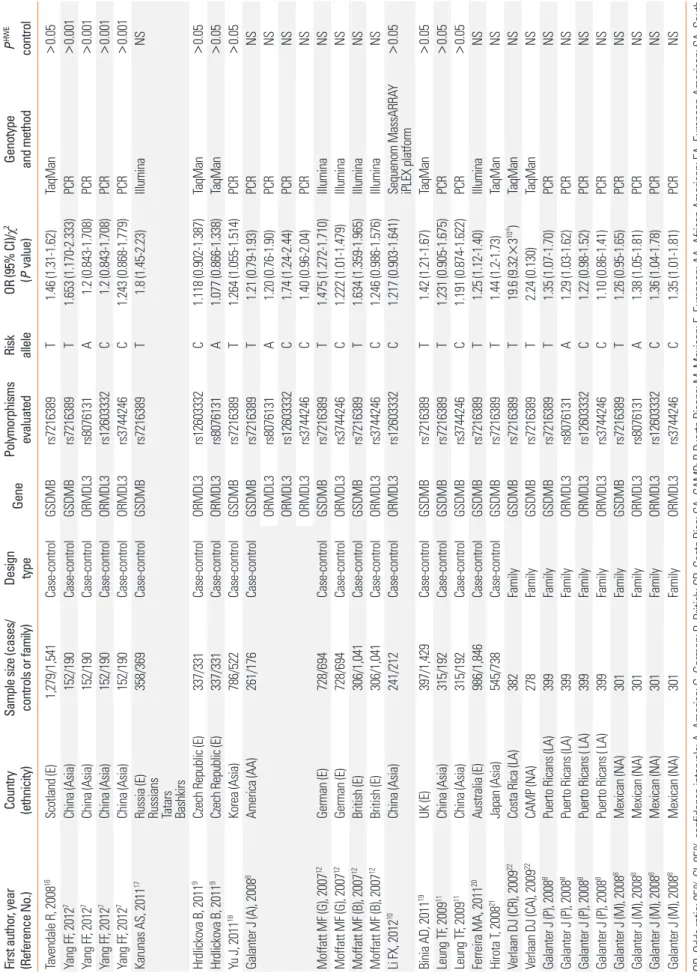
These 17 studies had been carried out in various countries, in- cluding China, Scotland, Russia, Korea, the United Kingdom, Germany, Australia, Canada, Costa Rica, Japan, the USA, Portu- gal, Hungary, Greece, Slovakia, and Czech Republic. A descrip- tion of these studies is given in Table 1. The selected papers as- sessed the association of GSDMB and ORMDL3 gene polymor- phisms with asthma. Of these papers, 37-9 evaluated the associ- ation of the rs8076131 polymorphism with asthma risk; 47-10 the association of the rs12603332 polymorphism with asthma,
47,8,11,12 the association of the rs3744246 polymorphism with
asthma, and 117,8,11,12,16-22 the association of the rs7216389 poly- morphism with asthma.
Combining results of case-control and TDT studies
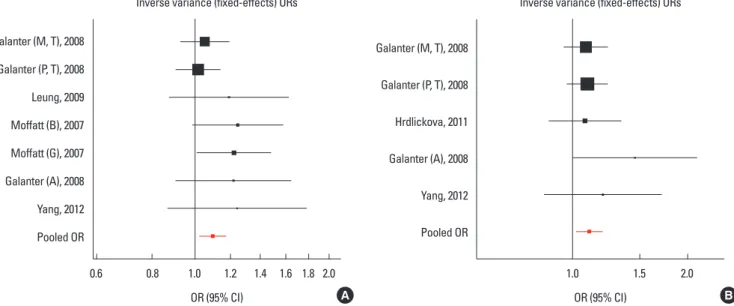
Meta-analyses for GSDMB and ORMDL3 were conducted us- ing 4 SNPs in 20,052 participants. Three SNPs (rs8076131, rs- 12603332, and rs3744246) of ORMDL3 and 1 SNP (rs7216389) of GSDMB were all associated with asthma at the P<0.05 level (Figs. 1, 2, Tables 2 and 3). For the most significant marker, rs7216389 of GSDMB, the T allele was consistently less com- mon in controls than in asthma cases. Random effects (DerSi- monian-Laird) pooled odds ratio was 1.37 (95% confidence in- tervals (CIs), 1.27-1.47), with evidence of heterogeneity (χ2= 40.04, P<0.01). We subsequently obtained results for associa- tions of rs8076131 and rs3744246 of ORMDL3 with asthma. The A allele of rs8076131 was significantly higher in asthma cases compared to controls (OR=1.10; 95% CIs, 1.02-1.20) by the fixed effects model. The random-effects model (DerSimonian- Laird) showed apparent evidence of association between the C allele of rs12603332 and asthma (OR=1.15; 95% CIs, 1.05-1.25).
The odds ratio of the C allele of rs3744246 for asthma was 1.10 (95% CIs, 1.02-1.17) by the fixed effects model.
Stratified analysis
Stratified analysis was performed by the type of study design for rs7216389 of GSDMB. In case-control studies, evidence of between-study heterogeneity was not found for rs7216389 of GSDMB (χ2=14.74, Pheterogeneity=0.14). The pooled allelic OR in the random-effects model was 1.44 (95% CI, 1.35-1.53, P<0.01).
In TDT studies, the heterogeneity test showed positive results (χ2=8.50, Pheterogeneity=0.04). In the random-effects model, this variant was associated with asthma risk (OR=1.20; 95% CIs, 1.05-1.37; P=0.007) (Table 2). In the stratified analysis by age at onset of the disease, 12 studies7,11,12,16-21 provided age at onset of the disease subgroup information, and significant associations between rs7216389 polymorphism and asthma risk were found for both the subgroup of adults (OR=1.50; 95% CIs, 1.38-1.63) and the subgroup of children (OR=1.38; 95% CIs, 1.02-1.87).
Because there were less than 3 studies of the subgroup of TDT or adults for rs8076131, rs12603332, and rs3744246 of ORMDL3 in this review, we did not perform stratified analysis.
Table 1. Characteristics of studies included in a meta-analysis of ORMDL3 and GSDMB polymorphisms, and asthma First author, year (Reference No.) Country (ethnicity) Sample size (cases/ controls or family) Design type
GenePolymorphisms evaluated
Risk allele
OR (95% CI)/χ2 (P value)
Genotype and method
PHWE control Tavendale R, 200816 Scotland (E)1,279/1,541Case-controlGSDMBrs7216389T1.46 (1.31-1.62)TaqMan>0.05 Yang FF, 20127China (Asia)152/190Case-controlGSDMBrs7216389T1.653 (1.170-2.333)PCR>0.001 Yang FF, 20127China (Asia)152/190Case-controlORMDL3rs8076131A1.2 (0.843-1.708)PCR>0.001 Yang FF, 20127China (Asia)152/190Case-controlORMDL3rs12603332C1.2 (0.843-1.708)PCR>0.001 Yang FF, 20127 China (Asia)152/190Case-controlORMDL3rs3744246C1.243 (0.868-1.779)PCR>0.001 Karunas AS, 201117
Russia (E) Russians Tatars Bashkirs
358/369Case-controlGSDMBrs7216389T1.8 (1.45-2.23)IlluminaNS Hrdlickova B, 20119 Czech Republic (E)337/331Case-controlORMDL3rs12603332C1.118 (0.902-1.387)TaqMan>0.05 Hrdlickova B, 20119Czech Republic (E)337/331Case-controlORMDL3rs8076131A1.077 (0.866-1.338)TaqMan>0.05 Yu J, 201118Korea (Asia)786/522Case-controlGSDMBrs7216389T1.264 (1.055-1.514)PCR>0.05 Galanter J (A), 20088America (AA)261/176Case-controlGSDMBrs7216389T1.21 (0.79-1.93)PCRNS ORMDL3rs8076131A1.20 (0.76-1.90)PCRNS ORMDL3rs12603332C1.74 (1.24-2.44)PCRNS ORMDL3rs3744246C1.40 (0.96-2.04)PCRNS Moffatt MF (G), 200712German (E)728/694Case-controlGSDMBrs7216389T1.475 (1.272-1.710)IlluminaNS Moffatt MF (G), 200712 German (E)728/694Case-controlORMDL3rs3744246C1.222 (1.01-1.479)IlluminaNS Moffatt MF (B), 200712British (E)306/1,041Case-controlGSDMBrs7216389T1.634 (1.359-1.965)IlluminaNS Moffatt MF (B), 200712British (E)306/1,041Case-controlORMDL3rs3744246C1.246 (0.986-1.576)IlluminaNS Li FX, 201210China (Asia)241/212Case-controlORMDL3rs12603332C1.217 (0.903-1.641)Sequenom MassARRAY iPLEX platform>0.05 Binia AD, 201119UK (E)397/1,429Case-controlGSDMBrs7216389T1.42 (1.21-1.67)TaqMan>0.05 Leung TF, 200911China (Asia)315/192Case-controlGSDMBrs7216389T1.231 (0.905-1.675)PCR>0.05 Leung TF, 200911 China (Asia)315/192Case-controlGSDMBrs3744246C1.191 (0.874-1.622)PCR>0.05 Ferreira MA, 201120Australia (E)986/1,846Case-controlGSDMBrs7216389T1.25 (1.12-1.40)IlluminaNS Hirota T, 200821Japan (Asia)545/738Case-controlGSDMBrs7216389T1.44 (1.2-1.73)TaqManNS Verlaan DJ (CR), 200922Costa Rica (LA)382FamilyGSDMBrs7216389T19.6 (9.32×310-6 )TaqManNS Verlaan DJ (CA), 200922 CAMP (NA)278FamilyGSDMBrs7216389T2.24 (0.130)TaqManNS Galanter J (P), 20088Puerto Ricans (LA)399FamilyGSDMBrs7216389T1.35 (1.07-1.70)PCRNS Galanter J (P), 20088Puerto Ricans (LA)399FamilyORMDL3rs8076131A1.29 (1.03-1.62)PCRNS Galanter J (P), 20088Puerto Ricans ( LA)399FamilyORMDL3rs12603332C1.22 (0.98-1.52)PCRNS Galanter J (P), 20088 Puerto Ricans ( LA)399FamilyORMDL3rs3744246C1.10 (0.86-1.41)PCRNS Galanter J (M), 20088Mexican (NA)301FamilyGSDMBrs7216389T1.26 (0.95-1.65)PCRNS Galanter J (M), 20088Mexican (NA)301FamilyORMDL3rs8076131A1.38 (1.05-1.81)PCRNS Galanter J (M), 20088Mexican (NA)301FamilyORMDL3rs12603332C1.36 (1.04-1.78)PCRNS Galanter J (M), 20088Mexican (NA)301FamilyORMDL3rs3744246C1.35 (1.01-1.81)PCRNS OR, Odds ratio; 95% CI, 95% confidence intervals; A, America; G, German; B, British; CR, Costa Rica; CA, CAMP; P, Puerto Ricans; M, Mexican; E, European; AA, African American; EA, European American; SA, South American; NA, North America; LA, Latin America; PHWE, P value for Hardy-Weinberg equilibrium test; NS, not stated.
Sensitivity analyses for combined studies of GSDMB and ORMDL3 polymorphism
Given the significant between-study heterogeneity for GSDMB rs7216389 polymorphism, we conducted a sensitive meta-anal- ysis to assess the effect of each individual study on the com- bined OR. A random-effects model was employed since hetero- geneity was indicated. A series of combined OR with 95% CIs produced repeatedly after the removal of each individual study was greater than 1.0, suggesting the stability of the outcome that rs7216389 was associated with asthma risk (Table 4). Addition- ally, sensitivity analyses indicated that all studies contributed to
the heterogeneity for rs7216389 equally. The P values for the Q test were all not less than 0.1 after deletion of each individual study, and the effect of rs7216389 was steadily significant.
Cumulative meta-analysis
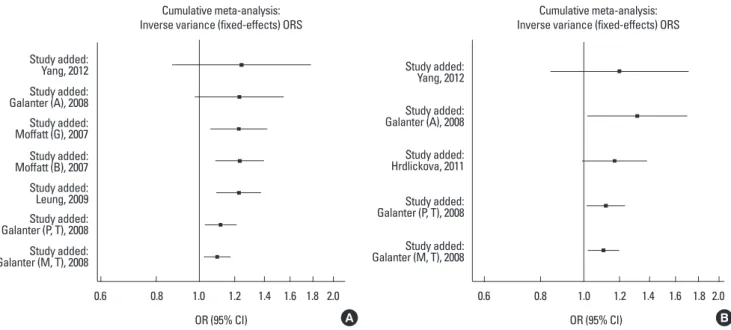
Cumulative meta-analyses of these 4 variants were also con- ducted via assortment of studies in chronological order. Figs. 3, 4 showed the results from the cumulative meta-analyses for rs7216389 and rs12603332 in the random-effects model and rs8076131 and rs3744246 in the fixed effects model. Rs3744246 and rs8076131 both tended to have no significant association Fig. 1. Results of meta-analysis of associations between ORMDL3 variants and asthma risk. (A) Forest plot for rs3744246 using the random-effects model. (B) Forest plot for rs8076131 using the fixed effects model.
Galanter (M, T), 2008 Galanter (P, T), 2008 Leung, 2009 Moffatt (B), 2007 Moffatt (G), 2007 Galanter (A), 2008 Yang, 2012 Pooled OR
Inverse variance (fixed-effects) ORs
0.6 0.8 1.0 1.2 1.4 1.6 1.8 2.0
OR (95% CI) A
Galanter (M, T), 2008
Galanter (P, T), 2008
Hrdlickova, 2011
Galanter (A), 2008
Yang, 2012
Pooled OR
Inverse variance (fixed-effects) ORs
1.0 1.5 2.0
OR (95% CI) B
Fig. 2. Results of meta-analysis of associations between GSDMB and ORMDL3 variants and asthma risk. (A) Forest plot for rs7216389 using the random-effects model. (B) Forest plot for rs12603332 using the fixed effects model.
Galanter (M, T), 2008 Galanter (P, T), 2008 Dominique (CA, T), 2009 Dominique (CR, T), 2009 Hirota, 2008 Ferreira, 2011 Leung, 2009 Binia, 2011 Moffatt (B), 2007 Moffatt (G), 2007 Galanter (A), 2008 Yu, 2011 Karunas, 2011 Yang, 2012 Tavendale, 2008 Pooled OR
DerSimonian & Laird (random-effects) ORs
1.0 1.5 2.0 2.5
OR (95% CI) A
Galanter (M, T), 2008
Galanter (P, T), 2008
LiFX, 2012
Hrdlickova, 2011
Galanter (A), 2008
Yang, 2012
Pooled OR
DerSimonian & Laird (random-effects) ORs
1.0 1.5 2.0
OR (95% CI) B
over time, and rs7216389 and rs12603332 tended to have signif- icant associations over time. Moreover, with increasing data the 95% CIs became increasingly narrower, suggesting that the pre- cision of the estimates was progressively enhanced by continu- ally adding more studies.
Publication bias
We assessed potential publication bias by examining funnel plots and using Egger’s test. Egger’s test detects whether the in- tercept deviates significantly from zero in a regression of the standardized effect estimates against their precision. The sensi- tivity of the regression method is generally low in meta-analysis based on less than 20 trials.41 There was no publication bias for rs8076131, rs7216389, and rs12603332 (P=0.106, 0.289, and 0.591, respectively). The result of Egger’s test of rs3744246 was significant (P=0.011). We neglected publication bias because the small number of studies was included in this review.
DISCUSSION
This current meta-analysis, to the best of our knowledge, is the first study to integrate the case-control and TDT studies to re- flect the precision effect of GSDMB and ORMDL3 variants in asthma risk. Our meta-analysis showed that moderate evidence existed for associations of the ORMDL3 rs8076131, rs12603332
and rs3744246 and GSDMB rs7216389 variants with asthma.
In the past few years, precise definition of asthma phenotypes has become increasingly important in the study of the genetic architecture and disease triggers of these phenotypes. Based on twin studies, estimates of the heritability of asthma ranged be- tween 75%42 and 92%.43 Advances in technology have allowed genome-wide association studies to replace candidate gene studies and the susceptibility locus for asthma was identified
12,22,44 as 17q12-21.1, which contained the GSDMB and ORM-
DL3 genes. 17q12-21 polymorphisms were found to be associ- ated with the presence and severity of asthma across different populations. The gasdermin gene was originally identified as a candidate gene responsible for the phenotype of a mouse skin mutant, namely recombination-induced mutation 3 (Rim3).45 GSDMB is expressed as an oncogene product in stem cell-resi- dent regions of normal epithelium.46 ORMDL3 is the third member of the gene family that encodes trans-membrane pro- teins that are anchored in the endoplasmic reticulum.47 ORM- DL3 binds and inhibits the sarcoendoplasmic reticulum Ca2+
pump, resulting in a reduced ER Ca2+ concentration and an in- creased unfolded-protein response, which is relevant in chronic inflammatory diseases, such as asthma.6 Although the present knowledge of the ORMDL3 function is limited, a study in yeast has shown that the gene product may be involved in protein folding.6 Studies of ORMDL3 in Puerto Rican asthmatics have Table 2. Random-effects odds ratios for asthma and heterogeneity test results for the risk allele of GSDMB (rs7216389) gene polymorphisms in relation to asthma
Study ID
Case-control TDT OR (95% CI)
Cases Controls
Transmitted T Untransmitted T Case-control TDT
T/C T/C
Tavendale R, 2008 1,429/1,129 1,431/1,651 1.46 (1.31-1.62)
Yang FF, 2012 237/67 259/121 1.65 (1.16-2.34)
Karunas AS, 2011 426/290 332/406 1.80 (1.46-2.21)
Yu J, 2011 1,216/356 762/282 1.26 (1.06-1.51)
Galanter J (A), 2008 437/85 276/76 1.42 (1.00-2.00)
Moffatt MF (G), 2007 830/626 657/731 1.48 (1.27-1.71)
Moffatt MF (B), 2007 378/234 1,035/1,047 1.63 (1.36-1.96)
Binia AD, 2011 432/338 1,352/1,506 1.42 (1.21-1.67)
Leung TF, 2009 506/124 295/89 1.23 (0.90-1.67)
Ferreira MA, 2011 1,045/927 1,735/1,957 1.27 (1.14-1.42)
Hirota T, 2008 852/238 1,052/424 1.44 (1.20-1.73)
Verlaan DJ (CR), 2009 299 200 1.50 (1.25-1.79)
Verlaan DJ (CA), 2009 202 173 1.17 (0.95-1.43)
Galanter J (P), 2008 533 474 1.12 (0.99-1.27)
Galanter J (M), 2008 441 403 1.09 (0.96-1.25)
Total 7,788/4,414 9,186/8,290 1,475 1,250 1.44 (1.35-1.53)* 1.20 (1.05-1.37)†
Total 1.37 (1.27-1.47)‡
*Random-effects pooled OR, P<0.01; χ2=119.58, Pheterogeneity=0.142; †Random-effects pooled OR, P<0.01; χ2=7.38, Pheterogeneity=0.037; ‡Random-effects pooled OR of case-control and TDT studies, P<0.01; χ2=119.58, Pheterogeneity=0.142.
A, America; G, German; B, British; CR, Costa Rica; CA, CAMP; P, Puerto Ricans; M, Mexican.
demonstrated a significant association between SNP rs12603332 and IgE levels,8 whereas subgroup analysis showed important associations between SNPs rs4378650 and rs12603332 in pa- tients with allergic asthma (IgE >100 IU/mL). Associations be- tween these SNPs and asthma became stronger in patients with IgE level >100 IU/mL.8 Although the function of GSDMB is not clear, the polymorphisms of GSDMB and ORMDL3 which are located in 17q gene were associated with early-onset asthma, smoking exposure,44 and several asthma-related phenotypes, including IgE11 and change in FEV1 in response to albuterol.8
Tavendale et al.16 confirmed that the rs7216389 C/T polymor- phism at locus 17q21 controlling ORMDL3 gene expression was strongly associated with the occurrence of childhood asthma, which showed that the effect was dose-dependent with each C to T substitution at the SNP site, and the odds of the occurrence of asthma was increased by about 50%, with the homozygous T allele being associated with doubled odds of the homozygous C
allele. In addition to its effects on asthma susceptibility, the study from Tavendale et al.16 also showed that the rs7216389 polymor- phism was associated with the risk of asthma exacerbations.
The rs12603332 (C allele) and rs8076131 (A allele) of ORM- DL3 are both in the intronic region. The rs12603332 SNP lies in a highly conserved element across species with a high correla- tion to the consensus target sequence for the transcription fac- tor E47.48,49 E47, a member of the “E protein” family, a subset of helix–loop–helix proteins, has been linked to T- and B-cell de- velopment,50,51 and the C allele substitution in the position of rs12603332 reduces the transcription factor score of this region.
Hrdlickova et al.9 reported that high-risk allele A of rs8076131 is significantly associated with hypersensitivity to pollen, and also reported a marginal significant relationship between polymor- phism rs8076131 and hypersensitivity to birch antigen. Genetic variant rs3744246 of ORMDL3 was also significantly associated with allergic rhinitis in the Japanese population.52 The expres- Table3. Odds ratios for asthma and heterogeneity test results for the risk allele of ORMDL3 (rs3744246, rs12603332, rs8076131) gene polymorphisms in relation to asthma
Study ID
Case-control TDT OR (95% CIs)
Cases Controls
Transmitted C/A Untransmitted C/A Case-control TDT
C/T (A/G) C/T (A/G)
rs3744246
Yang FF, 2012 239/65 284/96 1.24 (0.87-1.78)
Galanter J (A), 2008 383/139 244/108 1.22 (0.91-1.64)
Moffatt MF (G), 2007 1,213/243 1,115/273 1.22 (1.01-1.48)
Moffatt MF (B), 2007 506/106 1,651/431 1.25 (0.99-1.58)
Leung TF, 2009 502/126 291/87 1.19 (0.87-1.62)
Galanter J (P), 2008 592 583 1.02 (0.91-1.14)
Galanter J (M), 2008 494 470 1.05 (0.93-1.19)
Total 2,843/679 3,585/995 1,086 1,053 1.10 (1.02-1.17)*
rs12603332
Yang FF, 2012 235/69 281/99 1.22 (0.85-1.75)
Galanter J (A), 2008 239/283 125/227 1.53 (1.16-2.03)
Hrdlickova B, 2011 372/302 347/315 1.12 (0.90-1.39)
Li FX, 2012 350/116 295/119 1.22 (0.90-1.64)
Galanter J (P), 2008 428 394 1.09 (0.95-1.25)
Galanter J (M), 2008 430 391 1.10 (0.96-1.26)
Total 1.15 (1.05-1.25)†
rs8076131
Yang FF, 2012 235/69 281/99 1.20 (0.84-1.71)
Galanter J (A), 2008 176/454 68/289 1.46 (1.00-2.11)
Hrdlickova B, 2011 397/277 378/284 1.08 (0.87-1.34)
Galanter J (P), 2008 535 490 1.09 (0.97-1.23)
Galanter J (M), 2008 461 426 1.08 (0.95-1.23)
Total 1,616/800 727/672 996 916 1.10 (1.02-1.20)‡
*Fixed-effects pooled OR, P=0.008; χ2=6.85, Pheterogeneity=0.45; †Random -effects pooled OR, P=0.002;χ2=9.94, Pheterogeneity=0.36; ‡Fixed-effects pooled OR, P=0.012; χ2=6.22, Pheterogeneity=0.65.
A, America; G, German; B, British; P, Puerto Ricans; M, Mexican.
sion level of the ORMDL3 transcript was significantly correlat- ed with the genotype of rs3744246, and ORMDL3 mRNA was highly expressed in nasal epithelium.
ORMDL3 is expressed in multiple cell types important to the pathogenesis of asthma (i.e., epithelial cells, macrophages, eo- sinophils, and T cells),53,54 and increased expression of ORMDL3
Fig. 3. Results of cumulative meta-analysis of associations between ORMDL3 variants and asthma risk. (A) Cumulative forest plot for rs3744246 using the random- effects model. (B) Cumulative forest plot for rs8076131 using the fixed effects model.
Study added:
Yang, 2012 Study added:
Yang, 2012 Study added:
Galanter (A), 2008 Study added:
Galanter (A), 2008 Study added:
Moffatt (G), 2007 Study added:
Moffatt (B), 2007 Study added:
Leung, 2009
Study added:
Galanter (M, T), 2008
Study added:
Galanter (M, T), 2008 Study added:
Hrdlickova, 2011
Study added:
Galanter (P, T), 2008
Study added:
Galanter (P, T), 2008 Cumulative meta-analysis:
Inverse variance (fixed-effects) ORS Cumulative meta-analysis:
Inverse variance (fixed-effects) ORS
0.6 0.8 1.0 1.2 1.4 1.6 1.8 2.0
OR (95% CI) A
0.6 0.8 1.0 1.2 1.4 1.6 1.8 2.0
OR (95% CI) B
Table 4. Sensitivity analysis of pooled OR combining family-based and case- control studies for GSDMB rs7216389 polymorphism
Study omitted OR (95% CIs) χ2 P* P†heterogeneity
Tavendale R, 2008 1.36 (1.25-1.47) 54.72 <0.01 <0.01 Yang FF, 2012 1.36 (1.26-1.47) 61.83 <0.01 <0.01 Karunas AS, 2011 1.34 (1.25-1.44) 64.91 <0.01 <0.01 Yu J, 2011 1.38 (1.27-1.49) 61.36 <0.01 <0.01 Galanter J (A), 2008 1.37 (1.26-1.48) 62.04 <0.01 <0.01 Moffatt MF (G), 2007 1.36 (1.25-1.47) 56.69 <0.01 <0.01 Moffatt MF (B), 2007 1.35 (1.25-1.45) 60.29 <0.01 <0.01 Binia AD, 2011 1.36 (1.26-1.48) 57.07 <0.01 <0.01 Leung TF, 2009 1.37 (1.27-1.48) 64.06 <0.01 <0.01 Ferreira MA, 2011 1.38 (1.27-1.50) 57.84 <0.01 <0.01 Hirota T, 2008 1.36 (1.26-1.47) 57.97 <0.01 <0.01 Verlaan DJ (CR), 2009 1.36 (1.26-1.47) 57.92 <0.01 <0.01 Verlaan DJ (CA), 2009 1.38 (1.28-1.49) 66.35 <0.01 <0.01 Galanter J (P), 2008 1.39 (1.29-1.50) 78.57 <0.01 <0.01 Galanter J (M), 2008 1.39 (1.30-1.50) 82.63 <0.01 <0.01
*DerSimonian and Laird random-effects model used to determine the signifi- cance of the overall OR; †Cochran’s χ2-based Q statistic test used to assess the heterogeneity.
TDT, transmission/disequilibrium test; A, America; G, German; B, British; CR, Costa Rica; CA, CAMP; P, Puerto Ricans; M, Mexican.
in multiple cell types contributes to the pathogenesis of asthma.
Recent work has suggested that ORMDL3 may play a role in vi- ral respiratory infections.21 A study by Miller et al.55 showed that ORMDL3 plays an important role in the activation of the ATF6 UPR pathway in vivo and that expression of ORMDL3 in vivo regulates airway remodeling (smooth muscle, fibrosis, and mu- cus). In addition, the ORM protein is believed to be critical me- diators of sphingolipid homeostasis that may contribute to the development of childhood asthma.5 The human GSDM family consists of GSDMA, GSDMB, GSDMC, and GSDMD. The GSD- MA and GSDMB genes are located at 17q21.2, and the GSDMC and GSDMD genes are located at 8q24.13 GSDMB was revealed to have several polymorphisms associated with asthma suscep- tibility and asthma related phenotypes.8,11,12,16,21,31,37,40,44 Among the genes, GSDMB and ORMDL3 have received the most atten- tion, and their genotype-mediated expression is also affected by rhinovirus infection, one of the most common and powerful triggers for asthma exacerbations.56 Rs7216389 in GSDMB locat- ed in an intron was also strongly associated in cis with transcript levels of ORMDL3 in EBV-transformed lymphoblastoid cell lines from children with asthma.12 It has further been suggested that these 2 genes might be co-regulated, as their transcript lev- els seem connected.22 The study of Bouzigon et al.44 also showed an interaction between 17q21 variants and exposure to environ- mental tobacco smoke in early life. Among the offspring, an as- sociation between early-onset asthma and 11 SNPs (including rs7219923 of GSDML [or GSDMB] and rs8076131 of ORMDL3) was highly significant in the smoke-exposed families. Under the best-fitting recessive model, the overall risk of early-onset asth- ma when smoke exposure was not taken into account was in- creased for subjects who were homozygous for the risk alleles,
Fig. 4. Results of cumulative meta-analysis of associations between GSDMB and ORMDL3 variants and asthma risk. (A) Cumulative forest plot for rs7216389 using the random-effects model. (B) Cumulative forest plot for rs12603332 using the fixed effects model.
Study added:
Yang, 2012 Study added: Tavendale, 2008
Study added: Yang, 2012 Study added: Karunas, 2011 Study added: Yu, 2011 Study added: Galanter (A), 2008 Study added: Moffatt (G), 2007 Study added: Moffatt (B), 2007 Study added: Binia 2011 Study added: Leung, 2009 Study added: Ferreira, 2011 Study added: Hirota, 2008
Study added: Galanter (P, T), 2008 Study added: Galanter (M, T), 2008 Study added: Dominique (CR, T), 2009 Study added: Dominique (CA, T), 2009
Study added:
Galanter (A), 2008
Study added:
Galanter (M, T), 2008 Study added:
Hrdlickova, 2011 Study added:
LiFX, 2012 Study added:
Galanter (P, T), 2008 Cumulative meta-analysis:
DerSimonian & Laird (random-effects) ORs Cumulative meta-analysis:
DerSimonian & Laird (random-effects) ORs
1.0 1.2 1.4 1.6 1.8 2.0
OR (95% CI) A
0.6 0.8 1.0 1.2 1.4 1.6 1.8 2.0
OR (95% CI) B
as compared to those with other genotypes. However, exposure to environmental tobacco smoke in early life is associated with an even greater risk. Moreover, for SNPs showing significant heterogeneity, the SNP effect on early-onset asthma was signifi- cant in subjects with early exposure, as compared to those who did not have such exposure.
Our results confirm the role of the ORMDL3 and GSDMB ge- nomic area as a locus conferring susceptibility to asthma. In combination with the recent published studies in ethnically di- verse populations, it highlights the importance of ORMDL3 and GSDMB from the chromosome 17q21 region in the develop- ment of this complex disease. Despite the heterogeneity in bio- logical function, further studies to examine the functions of GS- DMB and ORMDL3 should focus on their role in asthma patho- genesis because of strong correlations observed between SNPs in these genes and asthma in many different ethnic groups.
Asthma is a complex condition with several contributing pathologic processes. Genetic variation in these processes and individual variation in response to pharmacologic therapies combine to form the range of phenotypes seen in the condi- tion. It is likely that deep resequencing of portions of ORMDL3 and GSDMB will be necessary to uncover untypical or novel variants that contribute to associations between these genes and asthma. Asthma has very variable clinical subphenotypes, and genetic differences may explain the high heterogeneity of disease manifestations. Therefore, we encourage larger studies being conducted in this area. Larger, more comprehensive studies would make meaningful stratification possible, and would also permit evaluation of gene-gene and gene-environ- ment interactions, and factors that are clearly important in complex diseases, such as asthma.
ACKNOWLEDGMENTS
We acknowledge financial support from the National Natural Science Foundation of China (NO. 81072385 and NO. 81402773).
REFERENCES
1. Lemanske RF Jr, Busse WW. Asthma: clinical expression and mo- lecular mechanisms. J Allergy Clin Immunol 2010;125:S95-102.
2. Laitinen LA, Heino M, Laitinen A, Kava T, Haahtela T. Damage of the airway epithelium and bronchial reactivity in patients with asthma. Am Rev Respir Dis 1985;131:599-606.
3. Koppelman GH, Los H, Postma DS. Genetic and environment in asthma: the answer of twin studies. Eur Respir J 1999;13:2-4.
4. Zhang G, Goldblatt J, LeSouëf P. The era of genome-wide associa- tion studies: opportunities and challenges for asthma genetics. J Hum Genet 2009;54:624-8.
5. Breslow DK, Collins SR, Bodenmiller B, Aebersold R, Simons K, Shevchenko A, et al. Orm family proteins mediate sphingolipid ho- meostasis. Nature 2010;463:1048-53.
6. Cantero-Recasens G, Fandos C, Rubio-Moscardo F, Valverde MA, Vicente R. The asthma-associated ORMDL3 gene product regu- lates endoplasmic reticulum-mediated calcium signaling and cel- lular stress. Hum Mol Genet 2010;19:111-21.
7. Yang FF, Huang Y, Li QB, Dai JH, Fu Z. Single nucleotide polymor- phisms in the ORM1-like 3 gene associated with childhood asthma in a Chinese population. Genet Mol Res 2012;11:4646-53.
8. Galanter J, Choudhry S, Eng C, Nazario S, Rodríguez-Santana JR, Casal J, et al. ORMDL3 gene is associated with asthma in three eth- nically diverse populations. Am J Respir Crit Care Med 2008;177:
1194-200.
9. Hrdlickova B, Holla LI. Relationship between the 17q21 locus and adult asthma in a Czech population. Hum Immunol 2011;72:921-5.
10. Li FX, Tan JY, Yang XX, Wu YS, Wu D, Li M. Genetic variants on
17q21 are associated with asthma in a Han Chinese population.
Genet Mol Res 2012;11:340-7.
11. Leung TF, Sy HY, Ng MC, Chan IH, Wong GW, Tang NL, et al. Asth- ma and atopy are associated with chromosome 17q21 markers in Chinese children. Allergy 2009;64:621-8.
12. Moffatt MF, Kabesch M, Liang L, Dixon AL, Strachan D, Heath S, et al. Genetic variants regulating ORMDL3 expression contribute to the risk of childhood asthma. Nature 2007;448:470-3.
13. Tamura M, Tanaka S, Fujii T, Aoki A, Komiyama H, Ezawa K, et al.
Members of a novel gene family, Gsdm, are expressed exclusively in the epithelium of the skin and gastrointestinal tract in a highly tissue-specific manner. Genomics 2007;89:618-29.
14. Carl-McGrath S, Schneider-Stock R, Ebert M, Röcken C. Differen- tial expression and localisation of gasdermin-like (GSDML), a nov- el member of the cancer-associated GSDMDC protein family, in neoplastic and non-neoplastic gastric, hepatic, and colon tissues.
Pathology 2008;40:13-24.
15. Zhang Y, Moffatt MF, Cookson WO. Genetic and genomic ap- proaches to asthma: new insights for the origins. Curr Opin Pulm Med 2012;18:6-13.
16. Tavendale R, Macgregor DF, Mukhopadhyay S, Palmer CN. A poly- morphism controlling ORMDL3 expression is associated with asthma that is poorly controlled by current medications. J Allergy Clin Immunol 2008;121:860-3.
17. Karunas AS, Iunusbaev BB, Fedorova I, Gimalova GF, Ramazanova NN, Gur’eva LL, et al. Genome-wide association study of bronchial asthma in the Volga-Ural region of Russia. Mol Biol (Mosk) 2011;45:
992-1003.
18. Yu J, Kang MJ, Kim BJ, Kwon JW, Song YH, Choi WA, et al. Polymor- phisms in GSDMA and GSDMB are associated with asthma sus- ceptibility, atopy and BHR. Pediatr Pulmonol 2011;46:701-8.
19. Binia A, Khorasani N, Bhavsar PK, Adcock I, Brightling CE, Chung KF, et al. Chromosome 17q21 SNP and severe asthma. J Hum Gen- et 2011;56:97-8.
20. Ferreira MA, McRae AF, Medland SE, Nyholt DR, Gordon SD, Wright MJ, et al. Association between ORMDL3, IL1RL1 and a de- letion on chromosome 17q21 with asthma risk in Australia. Eur J Hum Genet 2011;19:458-64.
21. Hirota T, Harada M, Sakashita M, Doi S, Miyatake A, Fujita K, et al.
Genetic polymorphism regulating ORM1-like 3 (Saccharomyces cerevisiae) expression is associated with childhood atopic asthma in a Japanese population. J Allergy Clin Immunol 2008;121:769-70.
22. Verlaan DJ, Berlivet S, Hunninghake GM, Madore AM, Larivière M, Moussette S, et al. Allele-specific chromatin remodeling in the ZPBP2/GSDMB/ORMDL3 locus associated with the risk of asthma and autoimmune disease. Am J Hum Genet 2009;85:377-93.
23. Lander ES, Schork NJ. Genetic dissection of complex traits. Science 1994;265:2037-48.
24. Mantel N, Haenszel W. Statistical aspects of the analysis of data from retrospective studies of disease. J Natl Cancer Inst 1959;22:
719-48.
25. DerSimonian R, Laird N. Meta-analysis in clinical trials. Control Clin Trials 1986;7:177-88.
26. Deeks JJ, Altman DG, Bradburn MJ. Chapter 15. Statistical methods for examining heterogeneity and combining results from several studies in meta-analysis. In: Egger M, Smith GD, Altman DG, edi- tors. Systematic reviews in health care: meta-analysis in context.
2nd ed. London: BMJ; 2001. 285-312.
27. Egger M, Davey Smith G, Schneider M, Minder C. Bias in meta-
analysis detected by a simple, graphical test. BMJ 1997;315:629-34.
28. Kazeem GR, Farrall M. Integrating case-control and TDT studies.
Ann Hum Genet 2005;69:329-35.
29. Nicodemus KK. Catmap: case-control and TDT meta-analysis package. BMC Bioinformatics 2008;9:130.
30. Rogers AJ, Raby BA, Lasky-Su JA, Murphy A, Lazarus R, Klander- man BJ, et al. Assessing the reproducibility of asthma candidate gene associations, using genome-wide data. Am J Respir Crit Care Med 2009;179:1084-90.
31. Wu H, Romieu I, Sienra-Monge JJ, Li H, del Rio-Navarro BE, Lon- don SJ. Genetic variation in ORM1-like 3 (ORMDL3) and gasder- min-like (GSDML) and childhood asthma. Allergy 2009;64:629-35.
32. Madore AM, Tremblay K, Hudson TJ, Laprise C. Replication of an association between 17q21 SNPs and asthma in a French-Canadi- an familial collection. Hum Genet 2008;123:93-5.
33. Marinho S, Custovic A, Marsden P, Smith JA, Simpson A. 17q12-21 variants are associated with asthma and interact with active smok- ing in an adult population from the United Kingdom. Ann Allergy Asthma Immunol 2012;108:402-411.e9.
34. Flory JH, Sleiman PM, Christie JD, Annaiah K, Bradfield J, Kim CE, et al. 17q12-21 variants interact with smoke exposure as a risk fac- tor for pediatric asthma but are equally associated with early-onset versus late-onset asthma in North Americans of European ances- try. J Allergy Clin Immunol 2009;124:605-7.
35. Smit LA, Bouzigon E, Pin I, Siroux V, Monier F, Aschard H, et al.
17q21 variants modify the association between early respiratory infections and asthma. Eur Respir J 2010;36:57-64.
36. Moffatt MF, Gut IG, Demenais F, Strachan DP, Bouzigon E, Heath S, et al. A large-scale, consortium-based genomewide association study of asthma. N Engl J Med 2010;363:1211-21.
37. Halapi E, Gudbjartsson DF, Jonsdottir GM, Bjornsdottir US, Thor- leifsson G, Helgadottir H, et al. A sequence variant on 17q21 is as- sociated with age at onset and severity of asthma. Eur J Hum Genet 2010;18:902-8.
38. Wan YI, Shrine NR, Soler Artigas M, Wain LV, Blakey JD, Moffatt MF, et al. Genome-wide association study to identify genetic deter- minants of severe asthma. Thorax 2012;67:762-8.
39. Kang MJ, Yu HS, Seo JH, Kim HY, Jung YH, Kim YJ, et al. GSDMB/
ORMDL3 variants contribute to asthma susceptibility and eosino- phil-mediated bronchial hyperresponsiveness. Hum Immunol 2012;73:954-9.
40. Sleiman PM, Annaiah K, Imielinski M, Bradfield JP, Kim CE, Frack- elton EC, et al. ORMDL3 variants associated with asthma suscepti- bility in North Americans of European ancestry. J Allergy Clin Im- munol 2008;122:1225-7.
41. Sterne JA, Gavaghan D, Egger M. Publication and related bias in meta-analysis: power of statistical tests and prevalence in the liter- ature. J Clin Epidemiol 2000;53:1119-29.
42. Willemsen G, van Beijsterveldt TC, van Baal CG, Postma D, Boomsma DI. Heritability of self-reported asthma and allergy: a study in adult Dutch twins, siblings and parents. Twin Res Hum Genet 2008;11:132-42.
43. Fagnani C, Annesi-Maesano I, Brescianini S, D’Ippolito C, Medda E, Nisticò L, et al. Heritability and shared genetic effects of asthma and hay fever: an Italian study of young twins. Twin Res Hum Gen- et 2008;11:121-31.
44. Bouzigon E, Corda E, Aschard H, Dizier MH, Boland A, Bousquet J, et al. Effect of 17q21 variants and smoking exposure in early-onset asthma. N Engl J Med 2008;359:1985-94.
45. Saeki N, Kuwahara Y, Sasaki H, Satoh H, Shiroishi T. Gasdermin (Gsdm) localizing to mouse Chromosome 11 is predominantly ex- pressed in upper gastrointestinal tract but significantly suppressed in human gastric cancer cells. Mamm Genome 2000;11:718-24.
46. Saeki N, Usui T, Aoyagi K, Kim DH, Sato M, Mabuchi T, et al. Dis- tinctive expression and function of four GSDM family genes (GSD- MA-D) in normal and malignant upper gastrointestinal epitheli- um. Genes Chromosomes Cancer 2009;48:261-71.
47. Hjelmqvist L, Tuson M, Marfany G, Herrero E, Balcells S, Gonzàlez- Duarte R. ORMDL proteins are a conserved new family of endo- plasmic reticulum membrane proteins. Genome Biol 2002;3:RE- SEARCH0027.
48. Heinemeyer T, Wingender E, Reuter I, Hermjakob H, Kel AE, Kel OV, et al. Databases on transcriptional regulation: TRANSFAC, TRRD and COMPEL. Nucleic Acids Res 1998;26:362-7.
49. Ellenberger T, Fass D, Arnaud M, Harrison SC. Crystal structure of transcription factor E47: e-box recognition by a basic region helix- loop-helix dimer. Genes Dev 1994;8:970-80.
50. Quong MW, Romanow WJ, Murre C. E protein function in lympho- cyte development. Annu Rev Immunol 2002;20:301-22.
51. Murre C. Helix-loop-helix proteins and lymphocyte development.
Nat Immunol 2005;6:1079-86.
52. Tomita K, Sakashita M, Hirota T, Tanaka S, Masuyama K, Yamada T, et al. Variants in the 17q21 asthma susceptibility locus are associat- ed with allergic rhinitis in the Japanese population. Allergy 2013;
68:92-100.
53. Miller M, Tam AB, Cho JY, Doherty TA, Pham A, Khorram N, et al.
ORMDL3 is an inducible lung epithelial gene regulating metallo- proteases, chemokines, OAS, and ATF6. Proc Natl Acad Sci U S A 2012;109:16648-53.
54. Ha SG, Ge XN, Bahaie NS, Kang BN, Rao A, Rao SP, et al. ORMDL3 promotes eosinophil trafficking and activation via regulation of in- tegrins and CD48. Nat Commun 2013;4:2479.
55. Miller M, Rosenthal P, Beppu A, Mueller JL, Hoffman HM, Tam AB, et al. ORMDL3 transgenic mice have increased airway remodeling and airway responsiveness characteristic of asthma. J Immunol 2014;192:3475-87.
56. Calışkan M, Bochkov YA, Kreiner-Møller E, Bønnelykke K, Stein MM, Du G, et al. Rhinovirus wheezing illness and genetic risk of childhood-onset asthma. N Engl J Med 2013;368:1398-407.