Domain Adaptation for Opinion Classification: A
Self-Training Approach
Ning Yu*
School of Library and Information Science University of Kentucky, USA
E-mail: [email protected]
ABSTRACT
Domain transfer is a widely recognized problem for machine learning algorithms because models built upon one data domain generally do not perform well in another data domain. This is especially a challenge for tasks such as opinion classification, which often has to deal with insufficient quantities of labeled data. This study investigates the feasibility of self-training in dealing with the domain transfer problem in opinion classification via leveraging labeled data in non-target data domain(s) and unlabeled data in the target-domain. Specifically, self-training is evaluated for effectiveness in sparse data situations and feasibility for domain adaptation in opinion classification. Three types of Web content are tested: edited news articles, semi-structured movie reviews, and the informal and unstructured content of the blogosphere. Findings of this study suggest that, when there are limited labeled data, self-training is a promising approach for opinion classification, although the contributions vary across data domains. Significant improvement was demonstrated for the most challenging data domain-the blogosphere-when a domain transfer-based self-training strategy was implemented.
Keywords
: Domain adaptation, Opinion classification, Self-training, Semi-supervised learning, Sentiment analysis, Machine learning1. INTRODUCTION
The rapid growth of freely accessible and easily customizable Web 2.0 applications has made it easy and fun for people to share their experiences,
know-ledge, and opinions. Retail websites such as Amazon. com and review aggregators such as Yelp. com collect customer reviews on specific products or services while blogs and social networking sites such as Twitter and Facebook allow users to publish
opini-Received date: December 30, 2012 Accepted date: February 23, 2013 *Corresponding Author: Ning Yu Assistant professor
School of Library and Information Science University of Kentucky, USA
E-mail: [email protected]
All JISTaP content is Open Access, meaning it is accessible online to everyone, without fee and authors’ permission. All JISTaP content is published and distributed under the terms of the Creative Commons Attribution License (http://creativecom-mons.org/licenses/by/3.0/). Under this license, authors reserve the copyright for their content; however, they permit anyone to unrestrictedly use, distribute, and reproduce the content in any medium as far as the original authors and source are cited. For any reuse, redistribution, or reproduction of a work, users must clarify the license terms under which the work was produced.
Open Access
ons and share emotions on an infinite array of topics ranging from the benefits of eating blueberries to the U.S. presidential election. Being able to listen to and understand online voices is playing an important role in today’s decision making for business practices, political campaigns, and daily life.
Since the late 1990s, researchers from different communities have been working in the area of sen-timent analysis, which includes tasks such as differ-entiating opinions from facts (Wiebe, Wilson, Bruce, Bell, & Martin, 2004; Yang, Yu, & Zhang, 2007), detect-ing positive and negative polarity (Abbasi, Chen, & Salem, 2008; Pang, Lee, & Vaithyanathan, 2002), classifying fine-grain emotions (Bollen, Mao & Zeng, 2011; Yu, Kßbler, Herring, Hsu, Israel & Smiley,u
2012), and identifying other opinion properties (Tsou, Yuen, Kwong, Lai, & Wong, 2005; Ku & Chen, 2007). For any tasks, data pre-labeled with senti-ment categories are essential for creating and evalu-ating sentiment analysis systems. However, the reality is that labeled data are usually limited, espe-cially at the sub-document level. Although this shortage of sentiment-labeled data is less challeng-ing in some domains (e.g., movie reviews) than in others (e.g., blog posts), simply borrowing labeled data from a non-target data domain often fails due to the domain transfer problem.
Domain transfer is a widely recognized problem for machine learning algorithms because models built via learning one data domain generally do not perform well in another data domain. Hence for each data domain, machine learning tends to start from scratch. But there may not be sufficient ‘ground truth’ (i.e., labeled data) in the target data domain for machine learning algorithms to rely on. While it is difficult to obtain sentiment-labeled data and manual annotation is tedious, expensive, and error-prone, unlabeled user-generated data are readily available. This paper therefore examines strategies to utilize both unlabeled data in the target domain and labeled data in other data domains to tackle the domain transfer problem. The specific machine learning methods explored in this research fall into the category of semi-supervised learning (SSL), which requires only limited labeled data to automatically label unlabeled data. SSL has achieved promising results in sparse data situations in various
natural language processing (NLP) tasks, including topic classification and sentiment analysis; but SSL has seldom been examined for domain adaption.
Specifically, this study investigates applications of self-training for opinion classification in three types of Web content: edited news articles, semi-struc-tured movie reviews, and the informal and unstruc-tured content of the blogosphere. An easily general-izable and highly adaptable SSL algorithm, self-training, is evaluated for its effectiveness in sparse data situations and domain adaptation.
2. BACKGROUND AND RELATED WORK
Two major sentiment analysis strategies exist in the sentiment analysis literature: The ad hoc rule-based approach, sometimes known as the lexicon-based approach (Ounis, Macdonald, & Soboroff, 2008), and the machine learning-based approach, sometimes known as the corpus-based approach. Both of these approaches benefit from the large number and great variety of sentiment-bearing fea-tures used as evidence in sentiment analysis. Such sentiment evidence can be knowledge-based (e.g., the more depressed a person feels, the more likely he/she will use the first-person word “I,” Penne-baker, 2011), statistical/empirical (e.g., high order n-grams), or style-based (e.g., “IMHO,” “-)”). Since each source of sentiment evidence has its own char-acteristics and captures different aspects of senti-ment, sentiment-bearing features from more than one source of evidence are often preferred. Most studies have suggested that a fusion of various sen-timent-bearing features surpasses the use of any single subset of features (Chesley, Vincent, Xu & Srihari, 2006; Gamon, 2004; Hatzivassiloglou & Wiebe, 2000; Yang, et. al., 2007).The machine learning approach is more practical in sentiment analysis than the ad hoc rule-based approach due to its fully automatic implementation and its ability to identify features that are not intu-itive to human. State-of-the-art topical supervised classification algorithms are often tailored for senti-ment analysis in the following manner: 1) binary feature values (presence/absence) are used instead of frequency. This is motivated by the extreme
brevity of the classification unit (e.g., tweets, reviews) and the characteristics of sentiment analy-sis, where occurrence frequency is less influential (i.e., a single occurrence of sentiment evidence is sufficient); and 2) a wider variety of evidence (e.g., linguistic features, links) is investigated in addition to auto-generated features (e.g., bag-of-words, n-grams). These supervised learning algorithms have achieved satisfactory results for sentiment analysis (Wiebe, et. al., 2004; Zhang & Yu, 2007).
The biggest limitation associated with supervised learning is that it is sensitive to the quantity and quality of the training data and may fail when train-ing data are biased or insufficient. In contrast with supervised learning, which learns from labeled data only, semi-supervised learning (SSL) learns from
both labeled and unlabeled data based on the idea that although unlabeled data hold no information about classes (e.g., “sentiment” and “non-senti-ment”), they do contain information about joint distribution over classification features. In contrast with supervised learning, the value of SSL in senti-ment analysis lies not only in its need for less labeled data but also in its ability to handle the domain dependency challenge: When there are labeled data in the non-target data domain only, an SSL algorithm can reduce the bias of the non-target data by increasing the number of labeled data from the target data domain. This aspect of SSL is very
attractive for sentiment analysis in challenging data domains such as the blogosphere, which is short of high-quality sentiment-labeled data.
2.1. Semi-Supervised Learning and Self-Training
According to a survey of SSL by Zhu (2008), the most commonly used SSL algorithms include self-training, Expectation-Maximization (EM) with gene-rative mixture models, co-training, Semi-Super-vised Support Vector Machines (S3VMs), and
graph-based methods. Except for S3VMs, all SSL
algo-rithms have been found to be effective for senti-ment analysis (Aue & Gamon, 2005; Pang & Lee, 2004; Yu & Kußbler 2010; 2011). This study focuses on self-training due to its easy generalization and high adaptability.
Self-training1is a wrapper SSL approach that can
be applied to any existing system as long as a confi-dence score can be produced. Self-training keeps a system in a black box and avoids dealing with any inner complexities. The major steps in self-training are: (1) training an initial classifier on the labeled dataset; (2) applying this classifier to the unlabeled data and selecting the most confidently labeled data as determined by the classifier to augment the origi-nal labeled dataset; and (3) re-training the classifier by repeating the whole process from step (1). A sim-ple pseudo code for self-training is illustrated in Figure 1.
Fig. 1 Bootstrapping Procedure in Self-training
1
Self-training, also known as mutual bootstrapping or self-teaching, is conceptually equal to the pseudo relevance feedback technique in information retrieval where the top n retrieved results to a given query are assumed to be relevant and are used to form a new query.
Input: classifier C, a small set of labeled data L, a large amount of unlabeled data U Loop until iteration procedure converges or loop for k iterations
1) Train C on L; 2) Apply trained C to U;
3) Select top n results returned by C and add them back to L;
Self-training has been originally adopted for sen-timent lexicon expansion (Riloff & Jones, 1999) and only recently has been explicitly applied for sen-tence-level sentiment analysis (He & Zhou, 2011). The initial classifier C is either a simple rule-based classifier built using a few manually created opinion seeds or a supervised classifier trained on a few manually labeled data. Across several experiments carried out by Wiebe and Riloff (2005), a self-trained Naßve Bayes classifier using this procedure achieved1 the best recall with modest precision when classify-ing subjective sentences.
2.2. Domain Adaptation
Domain dependency may seem less problematic for sentiment analysis than topical classification since generic sentiment-bearing words such as “good” and “bad” are not limited to any particular domain. But there are few generic sentiment-bear-ing words and it is therefore necessary to extract sentiment-bearing features from the target data col-lection. These features are generally domain depen-dent and may not be reusable in another domain for several reasons: (1) there are specific sentiment-bearing words associated with different domains (e.g., “cheap” and “long-lasting” are frequently used in product reviews, but not in movie reviews); (2) different domains have different stylistic expecta-tions for language use (e.g., news articles are less likely than blogs to use words such as “crappy” or “soooooooooo”); and (3) some sentiment-bearing words can be either positive or negative depending on the object (e.g., “small” may be positive in “a small camera” but negative in “a small memory card”). Since information used for sentiment analy-sis is typically lexical and lexical means of express-ing sentiments may vary not only from domain to domain but also from register to register, a senti-ment analysis strategy that works for one target data domain generally will not work for another data domain.
Most sentiment analysis systems borrow senti-ment-labeled data directly from non-target data domains when there are few labeled data in the tar-get domain or when the characteristics of the tartar-get domain make it difficult to detect sentiments if the non-target data appear to be “relevant to the
application and of sufficient quantity” (Conrad & Schider, 2007, p. 235). This approach is especially common in opinion detection in the blogosphere. For example, Chesley et al. (2006) leveraged blog training data with non-blog training data contain-ing relatively “pure” opinion information; addition-ally, most participants in TREC’s Blog track have crawled the Web to generate a great number of opinion-labeled training data. However, according to Aue and Gamon (2005), who compared four strategies for utilizing opinion-labeled data from one or more non-target domains, using non-target labeled data without an adaptation strategy is not as efficient as using labeled data from the target domain, even when the majority of labels are assigned automatically by a self-training algorithm. Blitzer, Dredze and Pereira (2007) proposed a structural correspondence learning (SCL) algo-rithm for sentiment classification to reduce the classification error of a classifier trained with non-target data. The key to this domain adaptation strategy is to implicitly associate domain specific features in the target and non-target data domains with certain general features that are used fre-quently in both domains and are relevant to the opinion class. As a result, even if a feature in the target domain has never occurred in the non-target domain, the class label can be predicted by looking up its corresponding feature(s) in the non-target domain.
A study by Tan, Cheng, Wang, and Xu (2009) is the most similar in spirit to this research. It made use of general features in both the target and non-target domains to address the domain adaptation prob-lem in opinion classification. Their approach dif-fered from the study by Blitzer et al. (2007) in that only labeled data in the non-target domain were used with an SSL algorithm, EM-NB, that put more weight on target data for opinion classification. Regardless of their positive contributions to senti-ment analysis, both of these domain adaptation strategies involve sophisticated and expensive methods for selecting general features and applying them to sentiment analysis. Believing sentiment is a sentence-level feature, this study conducts opinion classification on the sentence-level, instead of on the document level as in Tan et. al.’s work.
3. EXPERIMENTS
3.1. Selection of Datasets
Three types of text have been explored in prior sentiment analysis studies: news articles, online reviews, and online discourse in blogs or discussion forums. These texts differ from one another in terms of structure, text genre (e.g., level of formality), and the proportion of opinions each contains. A dataset of each type was selected in order to investigate the robustness and adaptability of SSL algorithms for opinion classification and to test the feasibility of SSL for domain adaptation. A small set of blog data was also used for parameter optimization. Several manually created opinion lexicons used in earlier studies were also collected in order to increase clas-sification precision for data domains where opinion detection is particularly difficult.
One of the standard datasets in sentiment analy-sis is the movie review dataset created by Pang and Lee (2004).2It contains 5,000 subjective sentences or snippets from the Rotten Tomatoes3pages and 5,000 objective sentences or snippets from IMDB4plot summaries, all in lowercase. Sentences containing less than 10 tokens were excluded, and the dataset was labeled automatically by assuming opinion inheritance.
The news article dataset5created by Wiebe, Bruce, and O’Hara (1999) is widely used as the gold-stan-dard corpus in opinion detection research. They chose the Wall Street Journal portion of the Penn Treebank III (Marcus, Santorini, Marcinkiewicz, & Taylor, 1999) and manually augmented it with opin-ion related annotatopin-ions. According to their coding manual, subjective sentences are those expressing evaluations, opinions, emotions, and speculations. For this research, 5,297 subjective sentences and 5,174 objective sentences were selected based on the presence or absence of manually labeled
sub-jective expressions.
The JDPA corpus6(Kessler, Eckert, Clark, & Nicolov, 2010), a new opinion corpus released in 2010, con-sists of blog posts expressing opinions about auto-mobiles and digital cameras. Opinions about named entities (e.g., “seat,” “lens”) were manually annotat-ed. All sentences containing sentiment-bearing expressions were extracted and objective sentences were manually identified by eliminating subjective sentences that were not targeted to any labeled enti-ties. This process produced 10,000 subjective sen-tences and 4,348 objective sensen-tences. To balance the number of subjective and objective sentences, 4,348 subjective sentences were randomly selected from the original set of 10,000.
From 2006 through 2008, a dataset called Blogs067 was used for tasks in TREC’s Blog track. Researchers at the University of Glasgow crawled the blogos-phere over an 11-week period from December 2005 to February 2006 to create the Blogs06 collection (Ounis, Rijke, Macdonald, Mishne, & Soboroff, 2007). In this collection, permalink documents (i.e., Web pages containing a single blog post with its associat-ed comments) were the retrieval and assessment units. For TREC’s Blog track opinion retrieval tasks, 50 topics (i.e., search queries and descriptions) were released every year, and each participant in the Blog track was to submit several retrieval runs, each run consisting of the top 1000 documents retrieved for each topic. The top documents retrieved across sys-tems for each topic were then manually labeled as topical relevant, topical relevant but not opinion-bearing, and topical relevant and opinion-bearing (i.e., “positive,” “negative,” or “neutral”). Because topical relevance and opinion polarity would not be taken into consideration in this research, non-rele-vant data were ignored, and negative, positive, and mixed opinion data were combined into one opin-ion dataset.
2
This dataset can be downloaded from http://www.cs.cornell.edu/people/pabo/movie-review-data/, under subjectivity datasets. 3
http://www.rottentomatoes.com/ 4
http://www.imdb.com/ 5
This dataset can be downloaded from http://www.cs.pitt.edu/mpqa/databaserelease/ 6
The license form for this dataset is available at: http://www.icwsm.org/data/JDPA-Sentiment-Corpus-Licence-ver-2009-12-17.pdf 7
The Blogs06 collection is labeled at the document level and thus required manual labeling to prepare labeled data at the sentence level. In order to avoid bias caused by a particular topic, five TREC labeled opinion-bearing documents (1 positive, 1 negative and 3 mixed opinion) were randomly selected and manually examined for each of the 150 topics, for a total of 750 documents. Because machines cannot be expected to recognize trivial expressions of opin-ion about which humans are uncertain, emphasis was placed on identifying opinion expressions that contained explicit opinion cues. For example, in a product review, the sentence “I returned this prod-uct after a week” may indicate a negative opinion, but it may also state the fact that the product was returned because the reviewer received another as a gift. It is also reasonable to assume that explicit opinion cues may exist around ambiguous opinion expressions to support or explain them (e.g.,“It is horrible! I returned this product after a week.”). Therefore, a sentence was labeled as an opinion only if strong traces of opinion cues were present. Sentences that made objective statements were labeled as non-opinion, and the remaining sen-tences in selected blog posts were ignored. All in all, 1,237 subjective sentences and 616 objective sen-tences were collected.
3.2. Domain Independent Opinion Lexicons
Several studies have suggested that the use of high-quality opinion lexicons can yield high preci-sion for opinion detection. Therefore, it is advisable to apply these lexicons to boost the classification precision of the initial classifier for SSL runs, espe-cially for difficult data domains such as blog posts. Accordingly, six domain independent opinion lexi-cons that had proven useful in previous opinion mining studies were collected for use in these experiments.
Adjectives are often connected to the expression of attitudes and have been reported to have a posi-tive and statistically significant correlation with sub-jectivity (Wiebe et al., 1999). Three adjective opinion lexicons were selected for this research: Index of General Inquirer (IGI) tag categories, a manually constructed list that contains 765 positive and 873 negative words (Stone, 1997); Colin adjectives, an
opinion lexicon distributed by Hatzivassiloglou and Wiebe (2000), which include manually and auto-matically identified semantic oriented adjectives, dynamic adjectives, and gradable adjectives; and strong semantic oriented adjectives in the subjectiv-ity term list created by Wilson, Pierce and Wiebe (2003). Dynamic adjectives were separated from other Colin adjectives into an individual lexicon because of their unique features and their signifi-cant contributions.
Appraisal groups have also been suggested as use-ful in identifying what is called an appraisal
expres-sion, “a textual unit expressing an evaluative stance
towards some target” (Bloom, Garg & Argamon, 2007, p. 308). Given the high cost of full syntactic parsing and the difficulty of fine-level analysis, this research used only the head adjectives, which are marked as positive or negative in the hand-built lex-icon distributed by Bloom et al. (2007).
Although not as significant as adjectives, verbs have also been found to be good indicators of opin-ion informatopin-ion. Verb classes, categories for classify-ing verbs syntactically and/or semantically, are often used for culling opinionated verbs. Levin’s
verb classes, developed on the basis of both intuitive
semantic groupings and participation in valence, or polarity alternations (Levin, 1993), are the most popular verb classes used as opinion evidence. For this research, verbs from opinion-related Levin’s verb classes, including judgement (e.g., “abuse,” “acclaim”), complain (e.g., “hate,” “despise”), and
psych (e.g., “amuse,” “admire,” “marvel (at)”), were
selected. Similarly, FrameNet (Fillmore & Baker, 2001), which groups words, including verbs, accord-ing to conceptual structures, provides semantic frames such as communication (e.g., “indicate,” “convey”) as evidence of opinion (Breck, Choi, & Cardie, 2007). For this research, several frames were selected: “agree or refuse to act,” “be in agreement on assessment,” “desirability,” “experiencer (objec-tive /subjec(objec-tive),” “judgment,” “opinion,” “prevari-cation,” and “statement.”
In addition to single words, opinion lexicons used in this research include patterns such as IU tions (Yang et al., 2007) and bigrams. IU colloca-tions are n-grams with first-person pronouns (e.g., “I,” “we”) and second-person pronouns (e.g., “you”)
as anchor terms. During their experiments for TREC’s Blog track, Yang et al. (2007) found that IU collocations worked best as single features. The UMass Amherst Linguistics Sentiment Corpora (Constant, Davis, Potts, & Schwarz, 2009; Potts & Schwarz, 2008) consists of unigrams and bigrams gathered from online book reviews on Amazon8and online hotel reviews on TripAdvisor.9For each n-gram, total occurrence is reported on an ordinal scale of 1 to 5, with 1 indicating a highly negative review and 5 indicating a highly positive review. In order to pick opinion n-grams, bigrams were excluded if they: contained domain stop words (e.g., book, hotel); occurred frequently at all rating levels; occurred more often at neutral ratings than at either positive or negative ratings; or contained digits or less than 3 characters. Only those n-grams appear-ing in both Amazon book reviews and TripAdvisor hotel reviews were retained.
Altogether, nine domain-independent opinion lexicons were utilized: appraisal semantic oriented adjectives,10gradable and semantic oriented Colin adjectives, dynamic adjectives,11IGI semantic ori-ented adjectives,12Wilson subjective terms,13Levin’s opinion-related verb class terms, FrameNet opinion related category labels, IU collocations, and review bigrams.
3.3. Data Preprocessing
All words in datasets were converted to lower case, and numbers were replaced with the place-holder “#”. Unigrams and bigrams were generated for each sentence, and common stop words such as articles and prepositions were removed from uni-grams. No stemming was conducted since the liter-ature shows no clear gain from stemming in
opin-ion detectopin-ion; stemming may actually erase subtle opinion cues such as past tense verbs. For each sen-tence, nine lexicon scores were assigned, with each score corresponding to the total occurrence of a term in one particular lexicon.
As illustrated in Figure 2, each dataset was ran-domly split into three portions: 5% of the sentences were reserved as the evaluation set (E) and were available only for S3VM runs; 90% were treated as unlabeled data (U); and i% (i = 1, 2, 3, 4 or 5) were treated as labeled data (L).
3.4. Experiment Design
In the experiments reported here, opinion detec-tion was treated as a binary classificadetec-tion problem with two categories: subjective sentences (i.e., posi-tive examples, or p) and objecposi-tive sentences (i.e., negative examples, or n).
Two groups of experiments were conducted. One group of experiments applied self-training only with the target data domain to investigate the overall fea-sibility and effectiveness of self-training in opinion detection. The other group of experiments used opinion-labeled data from non-target data domains to examine the applicability of self-training for domain adaptation.
3.4.1 Design of Experiment 1: Basic Self-training
In order to test the effectiveness of self-training with respect to the number of available labeled data, each self-training opinion classifier was trained on i% of the labeled dataset L and the unla-beled dataset U. The corresponding baseline super-vised opinion classifier was constructed using only L, and the fully supervised opinion classifier was constructed by treating all data in U and L as labeled
8
http://www.amazon.com/
9
http://www.tripadvisor.com/
10
The appraisal adjectives can be downloaded from http://lingcog.iit.edu/arc/appraisal_lexicon_2007a.tar.gz
11
The gradable and semantic oriented Colin adjectives and the dynamic adjectives can be downloaded from http://www.cs.pitt.edu/~wiebe/pubs/col-ing00/coling00adjs.tar.gz
12
The IGI words can be accessed at
http://www.wjh.harvard.edu/~inquirer/inqdict.txt. Positive and negative words were extracted.
13
The Wilson subjective terms are included in the OpinionFinder package available at http://www.cs.pitt.edu/mpqa/opinionfinderrelease/. Strong subjective terms were extracted.
data. Performance of each self-training run was compared with the performance of both the base-line SL run and the full SL run.
Although both SVM and Naßve Bayes algorithms1 are widely used for document classification, the Naßve Bayes classifier was selected as the base clas-1 sifier for this study because preliminary experi-ments showed that, even with a logistic model to output probability scores for the SVM classifier, the difference in probabilities is too small to select a small number of top classification predictions. The multinomial Naßve Bayes classifier in Weka (Hall,1 Frank, Holmes, Pfahringer, Reutemann & Witten, 2009) was used to run all the experiments.
For each sentence, both unigrams and bigrams were extracted as classification features. Higher order n-grams (i.e., n>=3) were not used because effective high order n-grams cannot be extracted from a small labeled dataset. Binary values (i.e., presence or absence) were applied for these features.
Other parameter settings included: (1) for all self-training runs, iterations stopped when there were no more unlabeled data; (2) for each itera-tion, a number of unlabeled examples u, smaller than U, were randomly extracted from the unla-beled dataset U for classifiers to predict opinion labels; and (3) for each iteration, opinion examples (p) and non-opinion examples (n) were added back to the labeled dataset. The ratio between p and n approximates the distribution of opinions and non-opinions in the labeled dataset. The
opti-mized parameter values established in this group of experiments will be used for the next group of experiments.
3.4.2 Design of Experiment 2: Domain Adaptation
Because movie review data are often labeled with sentiment classes and are reported to achieve great classification accuracy in the sentiment analysis lit-erature, they were treated as the source data, while datasets for news articles and blog posts were treat-ed as target data.
While the data split for the target domain was the same as that used in previous experiments, all sen-tences in the source domain, except for the 5% eval-uation data, were treated as labeled data. For exam-ple, in order to identify opinion-bearing sentences from the blog dataset, all 9,500 movie review sen-tences and i% of blog sensen-tences were used as labeled data, 90% of blog sentences were used as unlabeled data, and 5% were reserved as evaluation data. In addition, a parameter was added to gradu-ally reduce the weight of non-blog examples in the training set during iterations, similar to the approach taken by Tan et al. (2009). To reduce bias caused by features specific to one non-target data domain, labeled data from two different non-target data domains were combined as training data for both supervised and semi-supervised learning algo-rithms (i.e., in co-training, two view classifiers were trained on two non-target domains).
In order to compare the benefits of employing Fig. 2 Data Split for Semi-supervised Learning Runs, Baseline Supervised Learning Runs and Fully Supervised Learning Runs
Baseline
Supervised Learning
Fully
Supervised Learning
Semi-Supervised
Learning
non-target labeled data to the benefits of using general opinion lexicons to deal with the domain transfer problem, another set of domain adaptation experiments used general opinion lexicons instead of borrowing opinion labeled sentences from other domains. In addition to the n-gram features, SL and SSL runs in this set used features from nine opinion lexicons to represent each in-domain sen-tence.
3.5. Evaluation Measures
Classification accuracy was used as the evaluation measure when comparing SSL and SL runs. Clas-sification accuracy evaluates the overall correctness of a classifier and is calculated using the formula ACC = (a+d)/(a+b+c+d).
In addition, two measures were adopted to deter-mine whether performance increased when more unlabeled data were used and whether the contri-bution of unlabeled data decreased with the increase in available labeled data, as suggested in most SSL studies (e.g., Nigam & Ghani, 2000).
4. RESULTS AND DISCUSSION
4.1. Preliminary Experiments
Self-training runs with various parameter settings were conducted on TREC’s blog data to evaluate the impact of different experimental settings and to determine optimized parameters for all self-training runs.
4.1.1. Feature Selection
Two popular feature selection methods -informa-tion gain (IG) and chi-square (CHI)-were investi-gated. When keeping all other parameters fixed and selecting the top 100 features, neither feature selec-tion method contributes to SSL performance with labeled data from 1% to 5% of the total dataset. Because feature selection consumes computing time, especially when a new classification model must be built for each iteration, no feature selection was conducted for the subsequent experiments.
4.1.2. Unlabeled Data Available for Each Iteration
To decide how many unlabeled sentences u
should be available to the classifier on each itera-tion, experiments were designed using 20, 75, 100 and all unlabeled sentences (i.e., approximately 1660 sentences). By computing the average improvement of self-training runs over correspond-ing baseline SL runs with 1% to 5% labeled data, it was found that self-training runs classifying all unlabeled sentences on each iteration decreased classification accuracy by 4.67%; self-training runs classifying 100 unlabeled sentences on each itera-tion increased baseline performance by 2.08%; self-training runs classifying 75 unlabeled sentences on each iteration did not improve baseline perfor-mance; and self-training runs classifying only 20 unlabeled sentences on each iteration increased baseline performance by 4.18%. For the following experiments, u was set to 20.
After p auto-labeled opinion sentences and n auto-labeled non-opinion sentences were selected and added to the labeled dataset, p+n unlabeled sentences can be drawn from U to replenish u or a new set of u can be generated from U. Experiments using TREC’s blog dataset indicated that replenish-ing u outperformed generatreplenish-ing a new set of u by 11.87% in terms of classification accuracy. One explanation is that, for succeeding iterations, replenishing u kept those unlabeled sentences for which the classifier generated low prediction scores in the current iteration and forced the classifier to reclassify difficult sentences, while generating a new set of u allowed the classifier to select sentences that were easy to classify.
On the one hand, in order to avoid mislabeled data in the labeled dataset, only the most confident-ly labeled data should be selected, and a small value for p and n would be preferred. Alternatively, in order to reduce the number of iterations necessary for SSL to converge, a larger value for p and n would be preferred. Preliminary experiments compared the results of setting p and n either to one or to two and found no noticeable difference. For this reason,
p and n were set at two for all experiments.
4.2. Basic Self-training
The first experiment examined the effectiveness of self-training that used only in-domain data. For the movie review, news, and blog data domains, the
performance of self-training was compared with the performance of SL runs, which used the same num-ber of labeled sentences as well as those that used all data as labeled sentences.
Table 1 shows the classification accuracy of self-training and two supervised learning runs for movie reviews. The more labeled data provided for the baseline SL runs, the better the performance: With 100 labeled sentences, the baseline SL run achieved classification accuracy of only 63.80%; but with 500 labeled sentences, the supervised learning classifier achieved classification accuracy of 80.20%. The sec-ond row shows the performance of the simple self-training method using 100 to 500 labeled sentences and an additional 9000 unlabeled sentences. These self-training runs improved performance over the corresponding baseline supervised runs: For exam-ple, using 100 labeled sentences, self-training
achieved a classification accuracy of 85.2% and out-performed the baseline SL by 33.5%. Although the full SL run using all labeled data surpassed the sim-ple self-training run by 4.9%, significant effort was saved by labeling only 100 sentences rather than 9,100. If approximately 30 seconds are needed to label each sentence, self-training saves 225 hours of labor of three human annotators; and if they are paid $15/hour, this saves almost $3,400. With 500 labeled sentences, self-training improved accuracy over the baseline supervised run by 6%, indicating that self-training is particularly beneficial when the number of labeled data is small.
Overall, self-training which iteratively labeled
unlabeled data with one classifier was effective for movie reviews and achieved performance close to fully supervised learning while saving the labor involved in labeling thousands of unlabeled sen-tences. Because news articles follow similar pat-terns, their results will not be shown here.
As shown in Table 2, none of the self-training runs proved beneficial in the blog domain. This is because the blog data domain is even more chal-lenging than the news domain. The language used in blog posts is more informal than the language of the other two data domains, and blog writing con-tains a variety of opinion cues not found in movie reviews or news writing. Furthermore, because the JDPA blog data are focused on reviews of cars and cameras, opinion and non-opinion sentences share topic-related features; moreover, the average length for opinion and non-opinion sentences in blog
posts is 17 words, shorter than that for movie reviews (23.5 words) or news articles (22.5 words). In fact, approximately one quarter of the sentences in the blog dataset had only 5 to 10 words. This poses an additional challenge because there is less information for the classifier in terms of the number of individual features.
With limited labeled data, the results of these experiments suggest that self-training can make effective use of unlabeled data for opinion detection in certain data domains (e.g., movie reviews) but not in others (e.g., news and blog data). One reason for the failure of self-training in the blog domains is the low classification accuracy of initial runs: The Table 1. Classification Accuracy (%) of Self-training and SL Runs for Movie Reviews
Note. Settings for self-training: u=20, p=2, n=2, n-grams=unigrams+bigrams. Full SL runs used an additional 9000 labeled sentences.
Run Type
# of Original Labeled Sentences
100 200 300 400 500
Baseline SL 63.80 73.60 77.20 79.40 80.20
Self-training 85.20 86.60 87.00 87.20 85.20
performance of blog baseline classifiers was only slightly better than chance (50%) and decreased the quality of auto-labeled data.
4.3. Domain Adaptation
In order to deal with challenging data domains such as blog posts, one possible solution is to improve baseline accuracy for self-training by intro-ducing high-quality features: for example, augment-ing the feature set with domain independent opin-ion lexicons such as those which have been suggest-ed as effective in creating high precision opinion classifiers. An alternative approach for dealing with challenging data domains is to borrow labeled data from one or more “easy” domains: for example, the use of movie review data in self-training applica-tions for opinion detection in news article and blog domains.
4.3.1. Using Domain-Independent Opinion Lexicons
In addition to unigram and bigram features with binary values, nine lexicon features were added to the feature set. To avoid the possibility that the large number of n-gram features would weaken these nine lexicon features, the value of each lexicon fea-ture (e.g., dynamic adjectives) was not binary but represented the total number of matches between lexicon terms and the words in a target sentence. For example, the value of Wilson lexicon features for the sentence “I like these two much better than the versions made for the Hong Kong market” is two because two Wilson lexicon terms, ‘like’ and ‘better,’are used in this sentence. Redundancy between lexicons was not removed under the assumption that one word occurring in multiple
lexicons makes it a strong opinion indicator. For example, ‘like’ is included in the Levin verb class lexicon, the frameNet lexicon, and the Wilson lexi-cons, and its occurrences were counted when calcu-lating values for all three lexicon features.
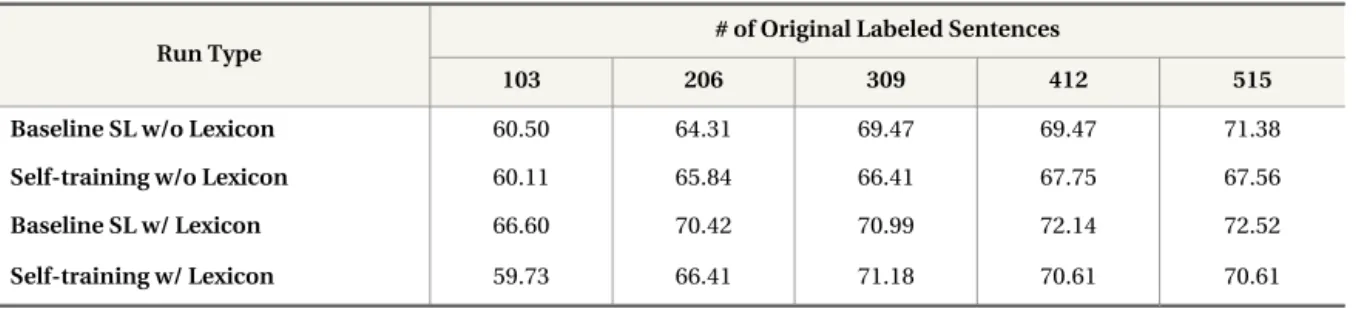
In Table 3 and Table 4, the baseline supervised learning runs using domain-independent opinion lexicon features (i.e., Baseline SL w/ Lexicon) pro-duced higher classification accuracies than base-line supervised learning runs that did not use lexicon features (i.e., Baseline SL w/o Lexicon). However, self-training runs that used opinion lexi-cons (i.e., Self-training w/ Lexicon) did not general-ly improve the baseline run (i.e., Baseline SL w/ Lexicon); in some cases, performance was even lower than that of the corresponding self-training runs that did not use domain-independent opinion lexicon information (i.e., Self-training w/o Lexicon). For example, using opinion lexicon fea-tures with 86 labeled blog sentences, supervised learning yielded a classification accuracy of 63.76%, 8.71% higher in absolute value than the classifica-tion accuracy produced by the supervised learning run that made no use of opinion lexicon features; however, after self-training iterations, the perfor-mance of the former run decreased to 51.38%, 3.21% lower in the absolute value of classification accuracy than the classification accuracy produced by the latter run. This may be because, as a closer look at the distribution of opinion lexicon terms in the three datasets indicates, many opinion lexicon terms actually occur frequently in objective, non-opinion sentences.
Table 5 shows the number of unique opinion lexi-con terms that appear in subjective and objective Table 2. Classification Accuracy (%) of Self-training and SL Runs for Blog Posts
Note. Settings for self-training: u=20, p=2, n=2, n-grams=unigrams+bigrams. Full SL runs used an additional 7740 labeled sentences.
Run Type
# of Original Labeled Sentences
86 172 258 344 430
Baseline SL 55.05 58.95 61.93 64.69 66.06
Self-training 54.59 55.73 56.65 58.49 64.45
data in the three data domains as well as the total occurrence of opinion lexicon terms in subjective and objective sentences. Although opinion lexicon terms are used more often in opinion sentences than in non-opinion sentences, their presence does not appear to be a strong indicator of opinions. For example, more than half of the opinion lexicon fea-tures that appear in opinion blog sentences also appear in non-opinion blog sentences. When con-sidering their total occurrence, opinion lexicon
terms are used in opinion sentences approximately three times as often as in non-opinion sentences in both the blog and news data domains; opinion lexi-con terms are used in non-opinion sentences a little more than half as often as they are in opinion sen-tences in the movie review domain. This suggests that automatically created subjective and objective movie review data will not necessarily reflect opin-ion and non-opinopin-ion classes.
Table 3. Classification Accuracy (%) of Self-training With and Without Opinion Lexicon Features for News Articles
Note. Settings for self-training: u=20, p=2, n=2, n-grams=unigrams+bigrams.
Run Type # of Original Labeled Sentences
103 206 309 412 515
Baseline SL w/o Lexicon 60.50 64.31 69.47 69.47 71.38
Self-training w/o Lexicon 60.11 65.84 66.41 67.75 67.56
Baseline SL w/ Lexicon 66.60 70.42 70.99 72.14 72.52
Self-training w/ Lexicon 59.73 66.41 71.18 70.61 70.61
Table 5. Distribution of Domain Independent Opinion Lexicons
Note. Non-Op=non-opinion; Op=opinion.
# of Matches
Dataset
Movie Reviews News Articles Blog Posts
Non-Op Op Non-Op Op Non-Op Op
Unique Terms 1076 1428 502 1127 459 753
Total Occurrence 4867 8596 1865 5576 1778 4668
Table 4. Classification Accuracy (%) of Self-training With and Without Opinion Lexicon Features for Blog Posts
Note. Settings for self-training: u=20, p=2, n=2, n-grams=unigrams+bigrams.
Run Type
# of Original Labeled Sentences
86 172 258 344 430
Baseline SL w/o Lexicon 55.05 58.95 61.93 64.69 66.06
Self-training w/o Lexicon 54.59 55.73 56.65 58.49 64.45
Baseline SL w/ Lexicon 63.76 64.68 63.53 66.51 67.89
The inefficiency of opinion lexicons can be attrib-uted to the fact that opinion features are often very sensitive to the context in which they occur. For example, “like” is included in three opinion lexicons and is therefore treated as a good opinion indicator, but when it is used in the sentence “the lens cap finally snaps into the front of the lens like other makers’ models,” it is no longer an opinion indica-tor. As a result, when there was a limited number of labeled data at the beginning of a self-training run, extra opinion lexicon features helped; however, with more and more unlabeled data labeled auto-matically and used to replenish the labeled dataset, the limitations of opinion lexicons were amplified, undermining overall performance.
4.3.2. Using Labeled Data in Non-Target Domain
A preliminary experiment on the use of movie review data was conducted on the news domain. This analysis was followed by a more in-depth investigation of the use of movie review data in the blog data domain.
From Movie Reviews to News Articles
This experiment tested an extreme situation where there were no labeled data available in the target data domain. To begin, 9,500 labeled movie review sentences were used to train a Naßve Bayes1 classifier. Although this classifier produced a fairly good classification accuracy of 89.2% on movie review data, its accuracy in a domain-transfer SL run on news data was poor (64.1%), demonstrating the severity of the domain transfer problem.
A self-training run starting with the same Naßve1 Bayes classifier trained on movie review data and using unlabeled data from the news domain (i.e., a domain-transfer SSL run) showed some improve-ment, achieving a classification accuracy of 75.1% that surpassed the domain-transfer SL run by more than 17% with no extra efforts for manual annota-tion. To further understand how well SSL handles the domain transfer problem, a full SL run that used all labeled news sentences was also performed. This full SL run achieved 76.9% classification accuracy, only 1.8% higher in absolute value than the domain-transfer SSL run, which had not used any labeled news data.
From Movie Reviews/News to Blog Posts
Domain transfer self-training runs for blog data combined all movie review data and i% labeled blog data to form the initial labeled dataset, and then fol-lowed the traditional self-training procedure. A con-trol factor was introduced and investigated to grad-ually reduce the impact of out-of-domain data (i.e., movie reviews) on each iteration.
Table 6 reports the results of self-training runs to identify opinion sentences in blog posts, both with and without the use of movie review data, as well as corresponding baseline and fully supervised learn-ing runs. The results for baseline SL runs without movie reviews and self-training without movie reviews show that self-training using only blog data decreases baseline SL performance. By keeping the same settings and adding more labeled data from the movie review domain, self-training with movie reviews increased the performance of SL runs by 12% to 15% and came closer to the performance of full SL runs, which used 90% of the labeled blog data. In the case of domain transfer runs, the num-ber of available in-domain labeled data did not appear to have an impact on overall performance: neither supervised nor semi-supervised runs using movie review data produced higher classification accuracies with increasing numbers of labeled blog sentences. For example, the self-training run using movie review data yielded the same classification accuracy of 71.10% with as few as 86 or as many as 430 labeled blog sentences in the original training set. This may be due to the preponderance of movie review data available during training.
A control factor intended to reduce the bias of movie review data was added to weaken the effects of domain transfer gradually (i.e., a decrease of 0.001 on each iteration). The results reported for self-training runs with both movie review data and weight control show that these runs outperformed runs that did not use weight control by 1% to 3%, reaching and occasionally exceeding the perfor-mance of the full SL run.
Overall, for high-challenge data domains, adop-tion of domain independent opinion lexicons resulted in only minimal improvement, but apply-ing simple self-trainapply-ing alone was promisapply-ing for tackling domain transfer from the source domain of
movie reviews to the target domains of news articles and blog posts. Supported by the opinion feature distribution statistics in Table 5, one guess for the success of movie reviews in helping classifying opinions in news articles and blogs is the rich opin-ion features in this data domain.
5. CONCLUSION
Sentiment is an important aspect of many types of information and being able to identify and orga-nize sentiments is essential for information studies. The shortage of labeled data has become a severe challenge for developing effective sentiment analy-sis systems. This study tackled this challenge by investigating a semi-supervised learning (SSL) approach, motivated by limited labeled data and the availability of plentiful unlabeled data. Specifically, this research investigated self-training strategies in dealing with the domain transfer prob-lem via learning unlabeled data in the target domain and labeled data in non-target domain(s).
To understand the feasibility and effectiveness of SSL for sentiment analysis, self-training was applied to three datasets from domains with different char-acteristics (i.e., movie reviews, news articles, and blog posts), and its performance varied across domains. For movie reviews, all self-training runs showed the advantage of using unlabeled data for
opinion detection with both time and cost benefits. Due to the nature of the movie review data, opinion detection in movie reviews is an “easy” problem because it involves genre classification and thus relies, strictly speaking, on distinguishing movie reviews from plot summaries. For other manually created datasets that are expected to reflect real sentiment characteristics, self-training was imped-ed by low baseline precision and demonstratimped-ed only limited improvement. Blog posts are the most chal-lenging domain and blog data showed no benefits from implementing self-training. However, with the addition of out-of-domain labeled data (i.e., movie review data), self-training for identifying opinion sentences in blogs exceeded fully supervised learn-ing uslearn-ing all available labeled blog data. This promising result suggests great value in further exploration of SSL for domain adaptation, especially because of its easy implementation.
The contributions of this research are four-fold. First, the findings of this research indicate a general approach that can be adapted for use in existing sen-timent analysis systems across data domains and across languages. These findings also provide valu-able guidelines and evaluation baselines for later studies applying SSL algorithms in sentiment analy-sis. Second, there are several applications for auto-matically labeled data generated by the effective SSL strategies reported in this research: creating senti-ment labeled corpora directly; providing candidates Table 6. Classification Accuracy (%) of Self-training With and Without Labeled Movie Reviews
Run Type
# of Original Labeled Sentences (Blog)
86 172 258 344 430 Baseline SL 55.05 58.95 61.93 64.69 66.06 Self-training 54.59 55.73 56.65 58.49 64.45 Baseline SL w/ m.r. 63.07 62.16 62.61 62.16 61.70 Self-training w/m.r. 71.10 70.87 71.41 70.41 71.10 Self-training w/m.r. w/w.c. 72.94 72.94 72.48 71.56 71.79 Full SL 71.56 73.17 72.71 72.94 72.48
Note. m.r. = Movie reviews. w.c. = Weight Control.
Settings for self-training: u=20, p=2, n=2, n-grams=unigrams+bigrams. Full SL used an additional 7740 labeled blog sentences.
for manual annotation; and extracting sentiment-bearing features. Third, the SSL strategies investigat-ed in this research, especially those relatinvestigat-ed to domain adaptation, are readily extensible to other text mining systems (e.g., genre identification). Finally, this research contributes to SSL re-search by expan-ding the spectrum of SSL applications to include sentiment analysis, confirming the effectiveness of SSL as a general approach for dealing with insuffi-cient quantities of labeled data, and providing promising new approaches for domain adaptation.
REFERENCES
Abbasi, A., Chen, H., & Salem, A. (2008). Sentiment analysis in multiple languages: Feature selection for opinion classification in Web forums. ACM
Transactions on Information Systems, 26(3).
Aue, A., & Gamon, M. (2005). Customizing sentiment classifiers to new domains: A case study. In
Pro-ceedings of International Conference Recent Ad-vances in Natural Language Processing (RANLP-2005), Borovets, Bulgaria, 21-23 September 2005.
Blitzer, J., Dredze, M., & Pereira, F. (2007). Biogra-phies, Bollywood, boom-boxes and blenders: Domain adaptation for sentiment classification. In Proceedings of the 45th Annual Meeting of the
Association of Computational Linguistics (pp.
440-447). Association for Computational Lin-guistics.
Bloom, K., Garg, N., & Argamon, S. (2007). Extracting appraisal expressions. In Proceedings of the Annual
Conference of the North American Chapter of the Association for Computational Linguistics (NAACL HLT), Rochester, NY (pp. 308-315). Morristown,
NJ: Association for Computational Linguistics. Bollen, J., Mao, H., & Zeng, X. J. (2011). Twitter mood
predicts the stock market. Journal of Computational
Science, 2(1), 1-8.
Breck, E., Choi, Y., & Cardie, C. (2007). Identifying expressions of opinion in context. In Proceedings
of the 20th International Joint Conference on Artificial Intelligence, Hyderabad, India, 6-12
January 2007 (pp. 2683-2688).
Chesley, P., Vincent, B., Xu, L., & Srihari, R. K. (2006). Using verbs and adjectives to automatically
class-ify blog sentiment. In Proceedings of
AAAI-CAAW-06, the Spring Symposia on Computational Approaches to Analyzing Weblogs, Stanford
University, CA., 27-29 March 2006, Menlo Park, CA: AAAI Press.
Conrad, J. G., & Schilder, F. (2007). Opinion mining in legal blogs. In Proceedings of the 11th
Inter-national Conference on Artificial Intelligence and Law, Stanford, CA (pp. 231-236). New York, NY:
ACM.
Constant, N., Davis, C., Potts, C., & Schwarz, F. (2009). The pragmatics of expressive content: Evidence from large corpora. Sprache und
Datenverar-beitung 33, 5-21.
Fillmore, C. J., & Baker, C. F. (2001). Frame seman-tics for text understanding. In Proceedings of
WordNet and Other Lexical Resources Workshop,
Pittsburgh, PA.
Gamon, M. (2004). Sentiment classification on cus-tomer feedback data: Noisy data, large feature vectors, and the role of linguistic analysis. In
Proceedings of the 20th International Confer-ence on Computational Linguistics, Geneva,
Switzerland, 23-27 August 2004. Stroudsburg, PA, USA: Association for Computational Linguistics. Hatzivassiloglou, V., & Wiebe, J. (2000). Effects of
adjective orientation and gradability on sentence subjectivity. In Proceedings of the 18th
Confer-ence on Computational Linguistics, Saarbru
ß
cken, Germany, 31 July-4 August 2000 (pp. 299-305). Stroudsburg, PA, USA: Association for Computa-tional Linguistics.He, Y., & Zhou, D. (2011). Self-training from labeled features for sentiment analysis. Information
Processing and Management, 47(4), 606-616.
Hall, M., Frank, E., Holmes, G., Pfahringer, B., Reutemann, P., & Witten, I. H. (2009). The WEKA data mining software: An update. ACM SIGKDD
Explorations news letter, 11(1), 10-18.
Kessler, J. S., Eckert, M., Clark, L., & Nicolov, N. (2010). The ICWSM 2010 JDPA sentiment corpus for the automotive domain. In Proceedings of the
4th International AAAI Conference on Weblogs and Social Media Data Workshop Challenge (ICWSM-DWC), Washington, D.C., USA.
Ku, L. W., & Chen, H. H. (2007). Mining opinions from the Web: Beyond relevance retrieval.
Journal of the American Society for Information Science and Technology, 58(12), 1838-1850.
Levin, B. (1993). English verb classes and alternations. Chicago, IL: University of Chicago Press.
Marcus, M. P., Santorini, B., Marcinkiewicz, M. A., & Taylor, A. (1999). Treebank-3. Linguistic Data Con-sortium, Philadelphia.
Nigam, K., & Ghani, R. (2000). Analyzing the effec-tiveness and applicability of co-training. In
Pro-ceedings of the Ninth International Conference on Information and Knowledge Management (pp.
86-93). New York, NY, USA: ACM.
Ounis, I., Macdonald, C., & Soboroff, I. (2008). Overview of the TREC-2008 Blog Track. In
Pro-ceedings of the 17th Text REtrieval Conference (TREC 2008).
Ounis, I., Rijke, M. D., Macdonald, C., Mishne, G., & Soboroff, I. (2007). Overview of the TREC-2006 Blog track. In Proceedings of the 15th Text
RE-trieval Conference.
Pang, B., & Lee, L. (2004). A sentimental education: Sentiment analysis using subjectivity summa-rization based on minimum cuts. In Proceedings
of the 42nd Annual Meeting on Association for Computational Linguistics, Barcelona, Spain,
21-26 July 2004, (pp. 271-278). Stroudsburg, PA, USA: Association for Computational Linguistics. Pang, B., Lee, L., & Vaithyanathan, S. (2002). Thumbs
up?: Sentiment classification using machine learning techniques. In Proceedings of the ACL-02
Conference on Empirical Methods in Natural Language Processing, Philadelphia, PA, 6-7 July
2002, (pp. 79-86). Stroudsburg, PA, USA: Associa-tion for ComputaAssocia-tional Linguistics.
Pennebaker, J. W. (2011). The secret life of pronouns:
What our words say about us. New York, NY:
Bloomsbury Press.
Potts, C., & Schwarz, F. (2008). Exclamatives and
heightened emotion: Extracting pragmatic gener-alizations from large corpora. Ms.: UMass Amherst.
Riloff, E., & Jones, R. (1999). Learning dictionaries for information extraction by multi-level bootstrap-ping. In Proceedings of the Sixteenth National
Conference on Artificial Intelligence, Orlando, FL
(pp. 474-479). Menlo Park, CA, USA: American Association for Artificial Intelligence.
Stone, P. J. (1997). Thematic text analysis: New
agen-das for analyzing text content. In C. Roberts (Ed.),
Text analysis for the social sciences. Mahwah, NJ:
Lawrence Erlbaum Associates.
Tan, S., Cheng, X., Wang, Y., & Xu, H. (2009). Adap-ting Na
ßve
1 Bayes to domain adaptation for sen-timent analysis. In Proceedings of the 31thEuropean Conference on IR Research on Advances in Information Retrieval, (pp. 337-349).
Tsou, B. K. Y., Yuen, R. W. M., Kwong, O. Y., Lai, T. B. Y., & Wong, W. L. (2005). Polarity classification of celebrity coverage in the Chinese press. In
Proceedings of the International Conference on Intelligence Analysis, McLean, VA, 2-4 May 2005.
Wiebe, J., Bruce, R., & O’Hara, T. P. (1999). Develop-ment and use of a gold-standard data set for sub-jectivity classifications. In Proceedings of the 37th
Annual Meeting of the Association for Computa-tional Linguistics on ComputaComputa-tional Linguistics,
College Park, MD, 20-26 June 1999 (pp. 246-253). Stroudsburg, PA, USA: Association for Computa-tional Linguistics.
Wiebe, J., & Riloff, E. (2005). Creating subjective and objective sentence classifiers from unannotated texts. In Proceedings of the 6th International
Conference on Intelligent Text Processing and Computational Linguistics (CICLing-2005),
Mexico City, Mexico, 13-19 February 2005 (pp. 486-497). Heidelberg, Berlin: Springer-Verlag. Wiebe, J., Wilson, T., Bruce, R., Bell, M., & Martin, M.
(2004). Learning subjective language.
Compu-tational Linguistics, 30(3), 277-308.
Wilson, T., Pierce, D. R., & Wiebe, J. (2003). Identi-fying opinionated sentences. In Proceedings of
the 2003 Conference of the North American Chapter of the Association for Computational Linguistics on Human Language Technology: Demonstrations, Edmonton, Canada (pp. 33-34).
Stroudsburg, PA, USA: Association for Computa-tional Linguistics.
Yang, K., Yu, N., & Zhang, H. (2007). WIDIT in TREC-2007 Blog track: Combining lexicon-based meth-ods to detect opinionated blogs. In Proceedings
of the 16th Text REtrieval Conference (TREC 2007).
Yu, N., & Ku
ß
bler, S. (2010). Semi-supervised learning for opinion detection. In Proceeding of the IEEE/Intelligence and Intelligent Agent Technology, vol. 3,
Toronto, ON, Canada, 31 August- 3 September 2010 (pp. 249-252). Stroudsburg, PA, USA: Association for Computa-tional Linguistics.
Yu, N., & Ku
ß
bler, S. (2011). Filling the gap: Semi-supervised learning for opinion detection across domains. In Proceeding of the FifteenthConfer-ence on Computational Natural Language Learn-ing (CoNLL 2011), Portland, OR, 23-24 June 2011
(pp. 200-209).
Yu, N., Ku
ß
bler, S., Herring, J., Hsu, Y. Y., Israel, R., & Smiley, C. (2012). LASSA: Emotion detection via information fusion. Biomedical InformaticsInsights, 5(Suppl. 1), 71-76.
Zhang, W., & Yu, C. (2007). UIC at TREC 2007 Blog track. In Proceedings of the 16th Text REtrieval
Conference (TREC 2007).
Zhu, X. (2008). Semi-supervised learning literature
survey: Department of Computer Sciences,
Uni-versity of Wisconsin, Madison. (Technical Report No. 1530).