J Korean Surg Soc 2010;78:199-202
□ 증 례 □
DOI: 10.4174/jkss.2010.78.3.199
199
Correspondence to: Sun Kyo Song, Department of Surgery, Yeungnam University College of Medicine, 317-1, Daemyeong-dong, Nam-gu, Daegu 705-030, Korea. Tel: 053-620-3580, Fax: 053-624-1213, E-mail: [email protected]
Received September 25, 2009, Accepted October 22, 2009
Inflammatory Pseudotumor of Splenic Hilar Node Mimicking Gastric Submucosal Tumor
Department of Surgery, Yeungnam University College of Medicine, Daegu, Korea
Jung Min Bae, M.D., Se Won Kim, M.D., Sang Woon Kim, M.D., Sun Kyo Song, M.D.
Inflammatory pseudotumor (IPT) is an uncommon clinical condition characterized by proliferation of spindle cells, inflammatory cells, and small vessels. IPT has been reported in various anatomical sites, including the orbit, lung, liver, spleen, and so on. IPT of the lymph node is very rare. We recently experienced a 65-year-old woman diagnosed with IPT of the lymph node in the splenic hilar, or distal supra-pancreatic area, mimicking gastric submucosal tumor. The tumor was removed without event using the laparoscopic method. This lesion in the splenic hilum is extremely rare and has not been cited in the current literature. We describe such a rare case of IPT with a review of the literature. (J Korean Surg Soc 2010;78:199-202)
Key Words: Inflammatory pseudotumor, Lymph node, Gastric submucosal tumor
INTRODUCTION
Inflammatory pseudotumor (IPT) is a clinical condition characterized by proliferation of spindle cells, inflammatory cells, and small vessels. IPT was first described in the lung,(1) but has also been reported in other anatomical sites, including the orbit, liver, spleen, and so on. Due to such a variety of anatomical sites, clinical manifestations can vary as well. We recently experienced a 65 year-old woman diagnosed with IPT of the lymph node in the splenic hilar, or distal supra-pancreatic area, mimicking gastric submucosal tumor. This lesion is extremely rare and has not been cited in the current literature. We describe such a rare case of IPT with a review of the literature.
CASE REPORT
A 65-year-old woman presented with gastric submucosal tumor incidentally detected by gastroscopy during physical
examination. Otherwise, the patient was in good health, with no symptoms of unexplained fever, general ache, or weight loss. Findings from physical examination were unremarkable. The initial biochemical and hematologic investigation, including complete blood count, electrolytes, liver function tests, and chest radiograph were all within normal ranges.
Gastroscopic examination showed a bulging mucosa, about 3×3 cm in diameter in the greater curvature side of the gastric body (Fig. 1A). Endoscopic ultrasound of the stomach showed a hypoechoic lesion in the muscularis propria layer, 2.5×2.0 cm in diameter, in the greater curvature side of the gastric body (Fig. 1B). Non-contrast and contrast abdominal computed tomography (CT) found a well-defined exophytic mass, with early enhancing nature in the greater curvature side of the gastric body (Fig. 2).
Our results lead us to consider gastric submucosal tumor, including GIST, schawannoma, leiomyoma, and so on.
Surgical intervention was indicated, and laparoscopic exploration was performed thereafter. There was no specific abnormality in gastric wall. Therefore, there was no evi- dence of gastric submucosal tumor. The tumor was found during surgery in a location between the upper border of the distal pancreas and the splenic hilum (Fig. 3).
200 J Korean Surg Soc. Vol. 78, No. 3
Fig. 1. (A) Gastroscopic finding showed bulging mucosa in the greater curvature side of the gastric body. (B) Endo- scopic ultrasound finding showed a hypoechoic lesion in the muscularis propria layer, 2.5×2.0 cm in dia- meter, in the greater curva- ture side of the gastric body.
Fig. 2. Abdominal CT finding. The black arrow indicates a well-defined exophytic mass, with early enhancing nature in the greater curvature side of the gastric body.
Fig. 3. Intraoperative finding. The white arrow indicates a well-defined mass in a location between the upper border of the distal pancreas and the splenic hilum.
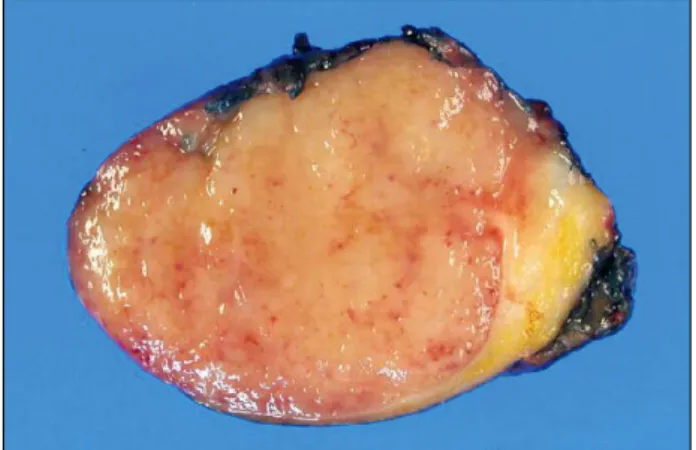
Fig. 4. The lymph node in the specimen measured 3.3×3.0×2.2 cm and weighed 12.7 g.
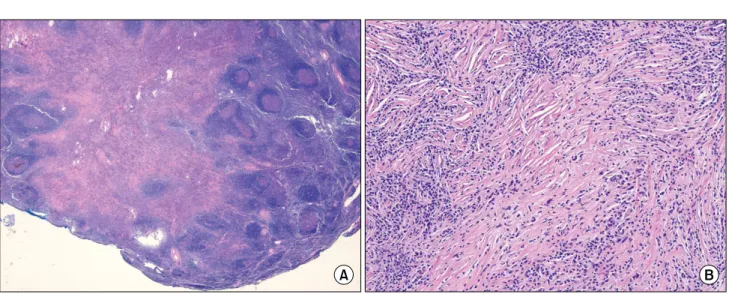
The tumor was removed without event using the laparoscopic method. Examination of frozen sections found lymph nodes with no evidence of malignancy. The lymph node in the specimen measured 3.3×3.0×2.2 cm and weighed 12.7 g (Fig. 4). Microscopically, the lymph node showed plasma cell infiltration and sclerosis in the focal area. The inflammatory cells infiltrate, including plasma cells, lymphocytes, eosinophils, and sclerosis were also noted in the perinodal soft tissues (Fig. 5). There was no evidence of malignancy. Features were consistent with a diagnosis of IPT of the lymph node.
The patient’s postoperative course was uneventful, and she is doing well following surgery.
Jung Min Bae, et al:Inflammatory Pseudotumor of Splenic Hilar Node Mimicking Gastric Submucosal Tumor 201
Fig. 5. Histopathologic finding. (A) This histopathologic features were consistent with lymph node (H&E, ×10). (B) The lymph node showed plasma cell infiltration and sclerosis in the focal area. The inflammatory cells infiltrate, including plasma cells, lymphocytes, eosinophils, and sclerosis were also noted in the perinodal soft tissues (H&E, ×100).
DISCUSSION
IPT is a clinical condition characterized by the appea- rance of inflammatory masses first described in the lung.(1) A number of alternative names have been used to refer to IPT, including inflammatory myofibroblastic tumor, plasma cell granuloma, or pseudotumor, xanthomatous pseudo- tumor, and so on. Although the cause and pathogenesis of IPT still remain controversial, it has been generally accepted that they may correspond with an unusual tissue response to injury.(2)
IPT has been reported in various anatomical sites, including the orbit, lung, liver, spleen, and so on. IPT of the lymph node is uncommon. IPT of the lymph node was first described in 1988.(3) Since then, few case reports or articles on IPT in the lymph node have been published.
However, IPT of the lymph node in the splenic hilum or supra-pancreatic area is extremely rare, with no reports in the literature.
The clinical presentation of IPT varies greatly, depending on location. General symptoms (fever, fatigue, anorexia, weight loss, and sleeplessness) occur in 5∼30% of IPT cases. Abnormal lymph node findings are mostly confined to one or two nodal areas.(4)
In the present case, clinical manifestation incidentally
discovered gastric submucosal tumor with no other sys- temic manifestations.
According to Perrone et al.(3), there are two main patterns of IPT of the lymph nodes. The first group includes asymptomatic patients with localized lymphaden- opathy and the second group comprised symptomatic patients with a number of laboratory abnormalities, such as elevated ESR, polyclonal hypergammaglobulinemia, mild anemia, elevated lactate dehydrogenase (LDH), and evi- dence of one or more enlarged lymph nodes. The clinical manifestation of the second group is similar to fever of unknown origin (FUO). Therefore, the problem of the second group is that differential diagnosis of FUO has to be made among a large number of clinical entities. Only histologic evidence can allow a correct diagnosis.(5) In the radiologic report for IPT of the lymph node, contrast-enhanced CT of the neck demonstrated several lymph nodes with uniform low attenuation. The tumor did not demonstrate significant contrast enhancement.(6) Con- versely, in the present case, the abdomen CT scan showed a well defined mass with enhancement.
Treatment of IPT generally involves the use of high dosages of corticosteroids. In the majority of cases, there is a dramatic effect showing diminished symptoms within 24∼48 hours, and nearly complete resolution within 5∼7 days. In the literature, however, no reports have been
202 J Korean Surg Soc. Vol. 78, No. 3
found on a recommended duration of therapy. In addition, response to several agents has been reported, including nonsteroidal anti-inflammatory agents,(7) chemotherapy and/or radiation therapy, and antibiotics.(8)
While IPT is benign, the outcome for patients with lesions can be a poor one, due to local infiltration, risk of recurrence, and variations in tumor aggressiveness.
According to Kojima et al.,(8) relapse rate following treatment was reported at 15%. Therefore, some authors have proposed surgical excision as the therapy of choice whenever possible.(9) According to Andrade et al.,(10) surgical resection may be the treatment of choice in some cases when surgery can be performed simply for local decompression and relief of symptoms, with the exception of orbital lesions. In the present case, it was difficult to confirm a preoperative diagnosis. Therefore, surgical ex- cision is inevitable when a correct preoperative diagnosis is impossible. We are of the opinion that laparoscopic excision is feasible in abdominal IPT if surgical excision is needed.
In conclusion, IPT of the lymph node in the splenic hilar or distal suprapancreatic area is extremely rare, and no reports have been cited in the literature. Its recognition is important, in order to avoid inadequate therapeutic measures, since it can clinically imitate gastric submucosal tumor.
REFERENCES
1) Umiker WO, Iverson L. Postinflammatory tumors of the lung;
report of four cases simulating xanthoma, fibroma, or plasma cell tumor. J Thorac Surg 1954;28:55-63.
2) Facchetti F, De Wolf Peeters C, De Wever I, Frizzera G.
Inflammatory pseudotumor of lymph nodes. Immunohistoche- mical evidence for its fibrohistiocytic nature. Am J Pathol 1990;
137:281-9.
3) Perrone T, De Wolf-Peeters C, Frizzera G. Inflammatory pseudotumor of lymph nodes. A distinctive pattern of nodal reaction. Am J Surg Pathol 1988;12:351-61.
4) Knockaert DC, Schuermans A, Vlayen J, Dewolf-Peeters C, Bobbaers HJ. Fever of unknown origin due to inflammatory pseudotumour of lymph nodes. Acta Clin Belg 1998;53:367-70.
5) Miras-Parra FJ, Parra-Ruiz J, Gomez-Morales M, Gomez- Jimenez FJ, de la Higuera-Torres-Puchol J. Inflammatory pseudotumor of lymph nodes with focal infiltration in liver and spleen. Dig Dis Sci 2003;48:2003-4.
6) Gunny RS, Akhbar N, Connor SE. CT and MRI appearances of inflammatory pseudotumour of the cervical lymph nodes. Br J Radiol 2005;78:651-4.
7) Kemper CA, Davis RE, Deresinski SC, Dorfmann RF.
Inflammatory pseudotumor of intra-abdominal lymph nodes manifesting as recurrent fever of unknown origin: a case report.
Am J Med 1991;90:519-23.
8) Kojima M, Nakamura S, Shimizu K, Hosomura Y, Ohno Y, Itoh H, et al. Inflammatory pseudotumor of lymph nodes:
clinicopathologic and immunohistological study of 11 Japanese cases. Int J Surg Pathol 2001;9:207-14.
9) Fisher RG, Wright PF, Johnson JE. Inflammatory pseudotumor presenting as fever of unknown origin. Clin Infect Dis 1995;
21:1492-4.
10) Andrade DM, Martins SJ, Paz O, Cardozo JB, Novaes AE, Santiago MB. Inflammatory pseudotumor: A diagnostic dilemma. Eur J Intern Med 2006;17:514-6.