Agric. Chem. Biotechnol. 46(4), 174-176 (2003)
Note
Establishment of Pre-harvest Interval for Cyprodinil in Grape
Joon-Kwan Moon, Ho Joo Lee, Yong Whan Kim1, Youn-Hyung Lee2,*and Jeong-Han Kim*
School of Agricultural Biotechnology, Seoul National University, Seoul 151-742, Korea
1Syngenta Korea Ltd., Seoul 110-702, Korea
2Plant Metabolism Research Center, Kyung Hee University, Suwon 449-701, Korea Received November 17, 2003; Accepted December 16, 2003
Grape was treated with cyprodinil to establish pre-harvest interval. Residue on grape was analyzed by GC/NPD with 0.04ng of LOD. Recovery were 102.8-110.6% and storage stability was 111.4%. The residue levels of cyprodinil in the field grape samples were 3.81-6.78 mg² · kg−1. PHI of cyprodinil for grape was suggested to be 30 days with dual treatment.
Key words: Cyprodinil, Pre-harvest interval (PHI), Grape
Pesticides are essential in modern agricultural production1) however, the risk of residues remaining on the food crop could be possible depending on the residual level. For this reason, maximum residue limits (MRLs) are established internationally and domestically to prevent the circulation and consumption of pesticide contaminated food.2,3)
PHI (Pre-harvest Interval) is a recommended criteria setting the date and frequency of pesticide application before harvest, to meet the MRL in harvested crops. Establishing of PHI for each crop is important to secure the safe grains, vegetables and fruits at harvest.4,5)
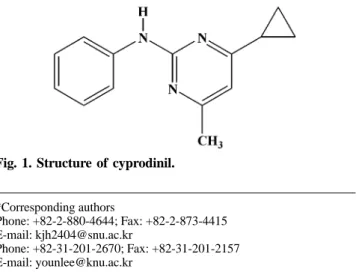
Cyprodinil (Fig. 1) is an aminopyrimidine fungicide whose mechanism of action is the inhibition of methionine biosynthesis, being similar to pyrimethanil and mepanipyrim.6-8) It has been registered in Korea to control white rots (Botryosphaeria dothidea) and alternaria blotch (Alternaria mali) on apple, pear scab (Venturia inaequalis) and leaf spot (Alternaria gaisen) on pears, and brown rot (Monilinia fructigena) on peach.4)
The aim of the present study was establishing PHI of cyprodinil in grape by determination of residue level after application of cyprodinil according to the combination of interval and frequency.
Materials and Methods
Reagents. Cyprodinil (99.5%) was kindly provided by Syngenta Korea Ltd. (Seoul, Korea). Acetone, hexane and dichloromethane were obtained from J.T.Baker (Philipsburg, NJ, USA). Anhydrous sodium sulfate and sodium chloride were purchased from Junsei Chemical Co. (Japan). Silica gel (60-100mesh) for column chromatography was obtained from Merck Co. (USA).
Instrument. The GC system consisted of Model 5890 II plus (Hewlett-Packard, USA), HP-1 column (30 m× 0.25 mm, 0.25µm film thickness), and nitrogen phosphorous detector (NPD). Initial oven temperature was held at 160oC for 1min, then raised to 210oC at rate of 10oC · min−1 and finally raised to 240oC at rate of 5oC · min−1. Injector and detector temperature was 270oC and 280 °C, respectively. Carrier gas (N2) flow rate was 1.1 ml · min−1 while hydrogen (H2) flow rate was 3.5 ml · min−1 and air flow rate was 110 ml · min−1.
Grape field trials. Grape (15 years old) was cultivated under rain shelter with planting density of 10 m2 (5 m× 2 m).
The air temperature and precipitation during grape cultivation period are shown in Fig. 2.
A wettable granule (50% w/v cyprodinil) was applied at recommended rate in 4 different plots, which consisted of untreatment, dual treatment (30+21 days before harvest), and two triple treatments (40+30+21 and 30+21+14 days before harvest) (Table 1). After crop samples (1 kg) were harvested from each treatment, the grape was macerated with Waring blender (USA) and stored −20oC before analysis.
Calibration, LOD (limit of detection) and LOQ (limit of quantitation). Cyprodinil was dissolved in acetone to make the concentration of 100µg · g−1. This solution was
*Corresponding authors
Phone: +82-2-880-4644; Fax: +82-2-873-4415 E-mail: [email protected]
Phone: +82-31-201-2670; Fax: +82-31-201-2157 E-mail: [email protected]
Abbreviations: MRL, maximum residue limit; PHI, pre-harvest inter- val; LOD, limit of detection; LOQ, limit of quantitation
Fig. 1. Structure of cyprodinil.
PHI for cyprodinil in grape 175
sequentially diluted to 10, 1, 0.1, 0.05, 0.02 µg · g−1 and an aliquot (2µl) was analyzed.
Recovery tests and sample analysis. Untreated grape (10 g) was crushed and homogenized before being spiked with standard solution of cyprodinil. Recovery tests were performed at the level of 0.25µg · g−1 and 1.0µg · g−1. Homogenates were extracted with acetone (50 ml) by shaking for 30 minutes and filtered. The brine (saturated, 10 ml) and water (100 ml) were added into the extract, and then partitioned with dichloromethane (50 ml) twice. After the combined solvent was removed in vacuo, the residue was dissolved in acetone/hexane (5 ml, 5+95, v/v) for column clean up.
Silica gel (10 g) was packed into a glass column (40 cm× 2.9 cm i.d.) as a slurry in hexane (100 ml) and sample (1 ml) in acetone/hexane was added. Elution was made with hexane (100 ml) and then acetone/hexane (100 ml, 5+95, v/v).
After the acetone/hexane was removed in vacuo, the residue was dissolved in acetone (2 ml) and an aliquot (2µl) was analyzed with GC/NPD. The field grape samples (10 g) were processed according to the above procedure for residue analysis. At each sample, three replicates were analyzed.
Storage stability. Untreated grape (10 g) was spiked at the level of 1.0µg · g−1 and stored −20oC until analysis.
Results and Discussion
Method validation. The excellent linearity of calibration curve was observed in the range of 0.02-10 mg · l−1
(correlation coefficient, R2= 0.999). LOD was 0.04 ng for cyprodinil with a signal to noise ratio of 3 and therefore, LOQ was set at 0.02 mg · kg−1, suggesting good detection limit.
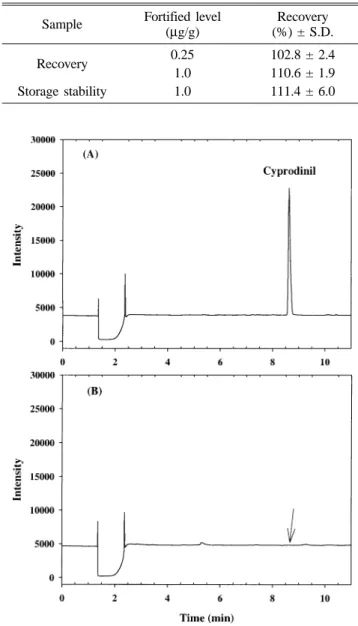
Recoveries were reasonable with low standard deviation and the storage stability of 111.4± 6.0% suggested that cyprodinil did not degrade during storage in −20oC until analysis (Table 2).
No interfering peaks were found on the chromatogram of grape extracts to give retention time of cyprodinil at 8.62 minutes (Fig. 3).
Residue levels and PHI. Synthetic pesticides are gradually dissipated after application and dissipation rate is depending on several factors including (i) the species cultivated; (ii) the chemical formulation and application mode;9-12) (iii) climatic conditions, especially rainfall and temperature; (iv) physical causes, mainly volatilization; (v) biological degradation;13,14) and (vi) chemical degradation, in Table 1. Grape field trial plots
plot Number of
treatment
Treatment days before harvest
I 0 -
II 2 30+21
III 3 40+30+21
IV 3 30+21+14
Fig. 2. Air-temperature and precipitation during grape culti- vation period.
Table 2. Mean recoveries and storage stability Sample Fortified level
(µg/g) Recovery
(%) ± S.D.
Recovery 0.25 102.8 ± 2.4
1.0 110.6 ± 1.9
Storage stability 1.0 111.4 ± 6.0
Fig. 3. Gas chromatograms of grape extracts. A; dual treat- ments sample, B; control.
176 Joon-Kwan Moon et al.
which sunlight plays an important part.15,16) This means that dissipation curves are only valid for given crop in the specific conditions of each growing area.17,18)
The half life of cyprodinil in lettuce and table grape was 2.5 days and 4.6 days, respectively.6) The greater persistence in table grape than lettuce was probably due to the “diluent effect” brought about by the rapid growth of the latter since the residue is expressed as a proportion of weight. As the weight of vegetable material increases, then the proportion of residue decrease. This is known as “apparent elimination” and is important in rapidly growing crops.17)
In case of tomatoes, decrease rate of cyprodinil were 4.9~
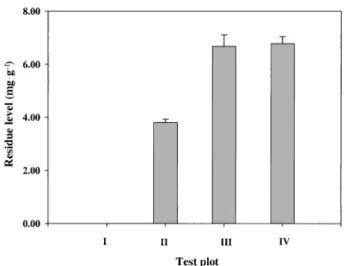
6.7 days and photodegradation half life was 8.5 hours.19) Fig. 4 shows the residual levels of cyprodinil in the field grape samples during study. The only sample at 21 days after dual treatments has cyprodinil residue level below the recommended MRL (5.0 mg · kg−1) for grape while the level of plot III and IV exceeded MRL. Therefore, PHI of cyprodinil for grape was suggested to be 30 days with dual treatments after a further consideration of practical variation of field conditions.
Acknowledgments. This work was supported by the Brain Korea 21 project, and Syngenta Korea Ltd.
References
1. Kim, J. H. and Oh, B. Y. (2001) Agricultural environment and human health. In Agricultural environment, Yang, J. U.
and Lee, K. S.(ed.), pp.221-240, Soc. Kor. Environ. Agr.
2. Chun, O. K. and Kang, H. G. (2003) Estimation of risks of pesticide exposure, by food intake, to Koreans. Food Chem.
Tox. 41, 1063-1076.
3. Lee, S. R. and Lee, M. K. (2001) Present status and reme- dial actions with regard to legal limits of pesticide residues in Korea. Korean J. Environ. Agric. 20, 34-43.
4. Pesticide handbook (2003). Korea Crop Protection Agency.
Samjung Press. Seoul.
5. Food Code (2002) Korea Food and Drug Administration. pp 55-117.
6. Masner, P., Muster, P. and Schmid, J. (1994) Possible methionine biosynthesis inhibition by pyrimidinamine fungi- cides. Pestic. Sci. 42, 163-166.
7. Leroux, P. (1996) Recent developments in the mode of action of fungicides. Pestic. Sci. 47, 191-197.
8. Fritz, R., Lanen, C., Chapeland-Leclerc, F. and Leroux, P.
(2003) Effects of the anilinopyrimidine fungcide pyrimetha- nil on the cystathionine β-lase of Botrytis cinerea. Pestic.
Biochem. Physiol. 77, 54-65.
9. Womac, A. R., Mulrooney, J. E., Scott, W. P. and Willi- ford, J. R. (1994) Influence of oil droplet size on the toxic- ity of bifenthrin on cotton to tobacco budworm (Heliothis virescens). Pestic. Sci. 40, 77-83.
10. Ebert, T. A., Taylor R. A. J., Downer, R. A. and Hall F. R.
(1999) Deposit structure and efficacy of pesticide applica- tion. 1: Interactions between deposit size, toxicant concen- tration and deposit number. Pestic. Sci. 55, 783-792.
11. Lee, C. H., Son, K. A. and Cheon, S. G. (1998) Aphid con- trol effect and chemical residues of dichlorvos by applica- tion methods on cucumbers cultivated plastic film house.
RDA. J. Crop Protec. 40, 124-128.
12. Kim, J. B., Song, B. H., Chun, J. C., Im, G. J. and Im, Y.
B. (1997) Effects of sprayable formulations on pesticide adhesion and persistence in several crops. Korean J. Pestic.
Sci. 1, 35-40.
13. Schocken, M. J., Mao, J. and Schabacker, D. J. (1997) Microbial transformations of the fungicide cyprodinil (CGA-219417). J. Agric. Food. Chem. 45, 3647-3651.
14. Koeppe, M. K., Hirata, C. M., Brwon, H. M., Kenyon, W.
H., OKeefe, D. P., Lau, S. C., Zimmerman, W. T. and Green, J. M. (2000) Basis of selectivity of the herbicide rimsulfuron in maize. Pestic. Biochem. Physiol. 66, 170- 181.
15. Papadopoulou-Mourkidou, E. and Kotopoulou, A. (1995) Disspation of cyproconazole and quinalphos on / in grapes.
Pestic. Sci. 45, 111-116.
16. Sur, N., Pal, S., Banerjee, H., Adityachaudhury, N. and Bhattacharyya, A. (2000) Photodegradation of fenarimol.
Pest Manag. Sci. 56, 289-292.
17. Marin, A., Oliva, J., Garcia, C., Navarro, S. and Barba, A.(2003) Dissipation rates of cyprodinil and fludioxonil in lettuce and table grape in the field and under cold storage conditions. J. Agric. Food. Chem. 51, 4708-4711.
18. Cabras, P., Angioni, A., Garau, V. L., Melis, M., Pirisi, F.
M., Minelli, E. V., Cabitza, F and Cubeddu, M. (1997) Fate of some new fungicides (cyprodinil, fludioxonil, pyrimetha- nil, and tebuconazole) from vine to wine. J. Agric. Food.
Chem. 45, 2708-2710.
19. Garau, V. L., Angioni, A., Real, A. A. D., Russo, M. and Cabras, P. (2002) Disappearance of azoxystrobin, pyrimethanil, cyprodinil and fludioxonil on potatoes in a green house. J. Agric. Food. Chem. 50, 1929-1932.
Fig. 4. Residue level of cyprodinil in field grape samples.