Monitoring of Bacterial Pathogens in Agricultural Products and Environments at Farms in Korea
Shree Prasad Thapa
1, Seong-Soo Kim
1, Sun-Song Hong
2, Dong-Sik Park
1, Chun-Keun Lim
3, and Jang-Hyun Hur
1,*
1Division of Biological Environment, College of Agriculture and Life Sciences, Kangwon National University, Chuncheon 200-701, Korea
2National Institute of Agricultural Science & Technology, Suwon 441-707, Korea
3Division of Bio-resources Technology, College of Agriculture and Life Sciences, Kangwon National University, Chuncheon 200-701, Korea
Received February 27, 2008; Accepted June 9, 2008
A total of 142 samples comprising vegetables, soil, and water collected from different agricultural farms (five provinces) were analyzed for total aerobic bacteria (aerobic plate count [APC]), Bacillus cereus, Escherichia coli, Listeria monocytogenes, Salmonella spp., and Staphylococcus aureus. The average of total APC in all the samples ranged from 4.72×10⁵ to 8.62 ×10⁸ CFU/g (mL).
The prevalence of B. cereus,E. coli, L. monocytogenes, S. spp., and S. aureus for all samples was 17.60%, 2.11%, 1.4%, 0%, and 2.11% respectively, and their counts averaged to 4.87×10⁴ CFU/g (mL), 4.34×10³ CFU/g (mL), 2.15×10² CFU/g, 0 CFU/g, and 3.12×10³ CFU/grespectively. Among the 3 different types of samples, 6 vegetables (10.34%), 24 soil (38.70%), and 3 water (13.64%) samples were found to be positive for bacterial pathogens. The result showed that the occurrence of bacterial pathogen in the samples analyzed was low. Further time to time monitoring and need to wash of raw agricultural products is recommended.
Key words: aerobic plate count, bacterial pathogens, soil, water, monitoring, vegetables
Agricultural products such as fruits and vegetables are in great demand in Korea, and are included in everyday servings. According to Food and Agriculture Organization (FAO), fruits and vegetables consumption and production in Korea has been increasing [FAO, 2007]. Besides increase in consumption, issue of public health concern has arisen. Accordingly, number of foodborne illness outbreaks caused by consumption of bacterial contaminated fruits and vegetables has increased. The Korea Food and Drug Administration (KFDA) reported that number of food poisoning outbreaks associated with fruits and vegetables increased from 1.23% to 5.77% and number of patients increased from 1.43% to 10.66%, from 1996 to 2000 [Park et al., 2001].
A broad variety of agricultural products has been linked to various pathogens. The most common outbreaks have been caused by pathogens, namely Bacillus cereus,
pathogenic Escherichia coli, Listeria monocytogenes, Salmonella spp., and Staphylococcus aureus [Beuchat, 1996; Fang et al., 1999; Heisick et al., 1989].
Pathogens may contaminate agricultural products at all stages from farm to table; during production, harvest, processing, and transportation, as well as in retail and food service establishments [FDA, 2004; Ruiz et al., 1987]. However, there is a recognized potential for the on-farm transfer of pathogens to agricultural products during primary production [Beuchat, 1996]. Soil, faecal matter of both domestic as well as wild animals, contaminated water used for irrigation, floodwater, and surface water has been identified as a source of contamination [Beuchat, 1996; FDA, 2004]. In addition, the use of untreated manure or sewage, lack of field sanitation, and contamination by handlers are also suggested as potential contributing factors [FDA, 2004].
Most of the studies on microbial quality of agricultural products in Korea are focused on retail and post-harvest samples [Kim et al., 2005a; Kim et al., 2004; Lee et al., 2005]. There are limited studies on agricultural products at the farm. The microbial analysis of the agricultural
*Corresponding author
Phone: 82-33-250-6445; Fax: 82-33-241-6640 E-mail: [email protected]
doi:10.3839/jabc.2008.019
products on the farm including the agricultural environment would enhance our understanding of bacterial condition and factors that contribute to contamination. Considering that bacterial pathogens present in agricultural environment can transfer to agricultural products and pose a health hazard to consumers, the objective of this study was to provide an initial estimation on microbiological condition of agricultural products including environments (soil and water) based on collection of samples directly from different agricultural farms.
Materials and Methods
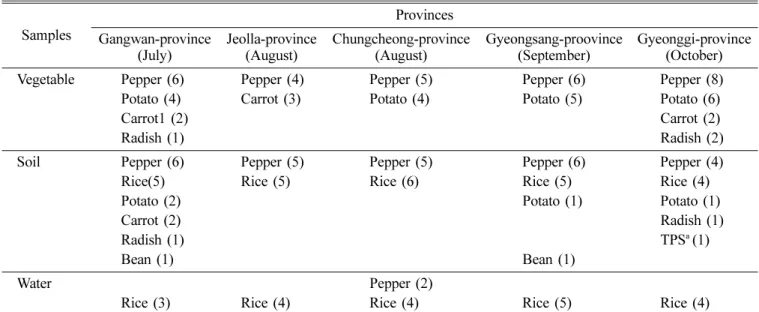
Sample collection. A total of 142 samples, comprising vegetables (58), soil (62), and water (22) were collected at random from different agricultural farms (from five provinces) during harvest seasons between July and October, 2005 (Table 1). Because of sampling limitations, smaller numbers of some samples were collected. All the samples were collected directly from the farms [both upland (pepper) and paddy (rice)] and kept in plastic bags. Vegetable samples were transferred without being washed or soil particles rubbed off. The equipments and instruments used during sampling were sterilized to prevent cross contamination. All samples collected were shipped on ice to laboratory and microbiological analysis was initiated within 48 h of sample collection.
Microbiological analysis. Twenty five grams (mL) of samples were aseptically transferred to 225 mL of buffered peptone water (BPW; Merck KGaA, Germany) and Listeria enrichment broth (LEB; Merck). BPW was used as primary enrichment for B. cereus, E. coli, Salmonella spp., and S. aureus and LEB used for L.
monocytogenes. Vegetable samples were blended in sterile blender for 2 minutes and transferred to Whirl- Pack bags (Nasco, Fort Atkinson, WI), while soil and water samples were kept in Whirl-Pack bags and swirled for 2-5 minutes. Enumeration of total aerobic bacteria (aerobic plate count [APC]) was carried out by surface plating 100µL of dilutions (serially diluted) on plate count agar (PCA; Merck), plates incubated at 30oC for 24 h.
Enumeration and identification of B. cereus was done by surface plating 100µL of inoculum on mannitol egg yolk polymyxin agar (MYPA; Merck) plates (50,000 IU of polymyxin per liter). After 24 h of incubation at 30oC, the plates were examined for typical pink colonies with irregular edge surrounded by white area. These colonies were analyzed for β-hemolysis on blood agar (BA;
Merck) with 5% sheep blood.
Coli ID (Merck) and Sorbitol Macconkey agar containing potassium tellurite and cefixime (SMA-TC; Merck) were
used for enumeration and identification of E. coli and E.
coli O157:H7, respectively. 1000µL (one mL) of diluted inoculum was spreaded in each petri plates and approximately 15 mL of molten coli medium added (maintained at approx. 47oC), mixed carefully and allowed to dry and 100µL of diluted inoculum was surface plated in SMA-TC agar plates. Coli ID plates were incubated at 44oC and SMA-TC at 37oC for 24 h.
Pink colonies on Coli ID and sorbitol-negative colonies on SMA-TC were assumed to be positive for E. coli and serotype O157:H7 respectively.
L. monocytogenes was enumerated and identified using two successive steps. 100µL of enrichment broth was inoculated for secondary enrichment in Fraser broth (Merck) and incubated at 37oC for 24 or 48 h. Positive Fraser broth with black coloration were streaked on Oxford agar (Merck) and were examined for typical colonies (black, shiny, convex with narrow zone of opacity) after 48 h of incubation at 37oC and were also subjected to CAMP (Christie, Atkins, Munch, Petersen) test. For Salmonella spp., 100µL of enrichment broth was inoculated in Rappaport-Vassiliadis (RV; Merck) broth as a sec-enrichment and incubated at 42oC for 24 h.
Positive cultures were serially diluted, 100µL inoculum was spread on Hektoen enteric agar (HEA; Merck) and Rambach agar (Merck) and the plates were incubated at 37oC for 24 h. Blue-green to blue colonies with or without black centers on HEA and red colonies on Rambach agar were assumed as presumptive Salmonella spp. isolates.
Enumeration and identification of S. aureus was done by surface plating 100µL of inoculum (after serial dilution) on Baird parker agar (BPA; Merck) and plates were incubated at 37oC for 48 h. The plates were examined for typical S. aureus colonies (black, shiny, convex with narrow zone of opacity surrounded by zone of clearing).
These colonies were further cultured on mannitol salt agar (MSA; Merck) and blood agar (Merck) for mannitol utilization and hemolytic character and also tested for coagulase-positive staphylococci. Positive controls obtained from Korean Culture Center of Microorganisms (KCCM), Seoul, Korea were simultaneously processed to assist in identification process. Typical bacterial colonies obtained from different selective agar were biochemically characterized using API kits.
Polymerase chain reaction (PCR) was applied to determine the virulence genes of pathogenic bacterial isolates. Total genomic DNA of bacteriamonitored was isolated using modified protease-sodium dodecyl sulfate (SDS) lysis procedure [Sambrook and Russell, 2001].
The primers shown in Table 2 were used to amplify pathogenic genes [Guinebretiere et al., 2002; Oswald et al., 2000; Steven et al., 2002; Malorny et al., 2004;
Berger-Bachi et al., 1989]. Amplification was carried out in 25µL reaction volumes, containing 20pmol of each primer, 20µM concentration of each dNTPs (dATP, dCTP, dGTP, and dTTP) (Promega Co.), 5 units of Taq polymerase (Biotools Co.) with 10 ng of plasmid DNA.
PCR analysis was performed with DNA thermal cycler (Perkin-Elmer Applied Biosystems, foster City, CA, USA). Amplification conditions were followed as listed in Table 3. A 5µL of each amplified PCR products were electrophoresed on a 0.7% agarose gel (Qbiogene, Irvine, CA, USA) stained with 0.5µg/L ethidium bromide and visualized on a UV transilluminator. The resultant PCR products were excised from the gel and purified using a Geneclean® Turbo kit (Qbiogene, Irvine, CA, USA).
Purified DNAs were ligated into the pGEM-T easy vector (Promega Co. Madison, WI, USA). Plasmids containing
the DNA regions were then send for sequencing. DNA homology searches were carried out with the NCBI databases, using the BLAST network service [Altschul et
al., 1990].
Results
Sample collection. A total of 142 vegetables and environmental samples were collected at random from different agricultural farms (from five provinces) during harvest seasons between July and October, 2005.
Samples consisted different types of vegetables, soil (both upland and paddy), and water (both upland and paddy).
Because of sampling limitation small number of some samples was collected. Table 1 specifies number of sample stratified by sample origin.
Microbiological analysis. Total APC in all the samples Table 1. Sampling sites and various types of samples collected at farms from five provinces
Samples Provinces
Gangwan-province
(July) Jeolla-province
(August) Chungcheong-province
(August) Gyeongsang-proovince
(September) Gyeonggi-province (October)
Vegetable Pepper (6) Pepper (4) Pepper (5) Pepper (6) Pepper (8)
Potato (4) Carrot (3) Potato (4) Potato (5) Potato (6)
Carrot1 (2) Carrot (2)
Radish (1) Radish (2)
Soil Pepper (6) Pepper (5) Pepper (5) Pepper (6) Pepper (4)
Rice(5) Rice (5) Rice (6) Rice (5) Rice (4)
Potato (2) Potato (1) Potato (1)
Carrot (2) Radish (1)
Radish (1) TPSa (1)
Bean (1) Bean (1)
Water Pepper (2)
Rice (3) Rice (4) Rice (4) Rice (5) Rice (4)
aTPS-Thermal Power Station
Table 2. Nucleotide sequence and anticipated size of PCR for selective pathogens Bacteria Primer target and
direction Oligonucleotide sequence (5'-3') Size of Amplified
products (bp) References
B. cereus HAF AAGCAATGGAATACAATGGG 2682 12
HBR AATATGTCCCAGTACACCCG
E. coli SK1,F CCCGAATTCGGCACAAGCATAAGC 832 13
SK2, R CCCGGATCGGTCTCGCCAGTATTCG
L. monocytogenes inlAF1, F CCGCCTAATGGGAAAGTAAA 2235 14
inlAR1, R AGGCGGAGATGCTGGTG
Salmonella spp. Malo2-F TATTGTTGATTAATGAGATCCG 373 15
Malo2-R ATATTACGCACGGAAACACGTT
S. aureus GFEMAR-1, F AAAAAAGCACATACCAAGCG 132 16
GFEMAR-2,R GATAAAGAAACCAGCAG
F-forward, R-reverse
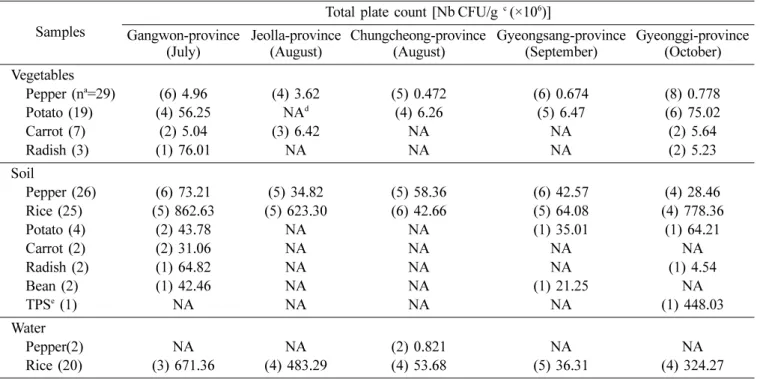
ranged from geometric mean of 4.72×10⁵ to 8.62×10⁸ CFU/g (mL) (Table 4). Total APC was higher in soil samples than those in vegetable and water samples.
Among the vegetable samples, total APC level was higher on potato than those on pepper. The total APC level for potato was higher in those collected from Gangwon-province (July) and Gyeonggi-province (October) than from other provinces, while for pepper it was higher in those collected from Gangwon-province (July) than from other provinces. Among the soil samples, paddy soil had the higher APC level than upland soil, which
increased in July (Gangwon-province), decreased in September (Gyeongsang-province) and again increased in October (Gyeonggi-province). Similar level of APC was found in the water samples collected from the farm, showing similar trend as in soil samples with higher bacterial count in paddy water (rice water) during July and October, and lower during august.
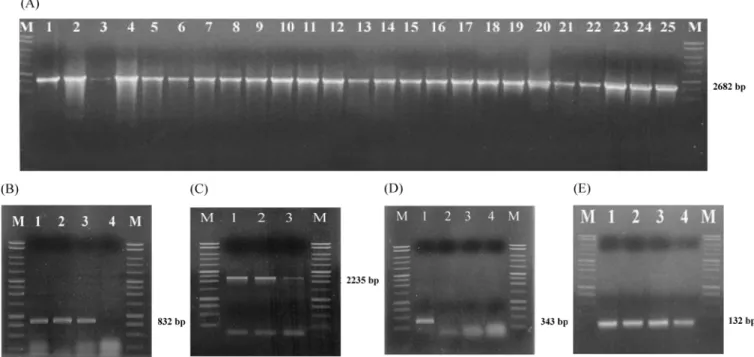
Pathogens detected in the present study were B. cereus, E. coli, L. monocytogenes, and S. aureus (Table 5).
Biochemical characterization of these bacterial pathogens was done using API kits (data not shown) and the Fig. 1. Agarose gel electrophoresis of the PCR amplification products of bacterial isolates from vegetable, soil, and water samples. (A) B. cereus: Lane M, Marker; Lane 1, B. cereus KCCM 1174; Lane 2, Pepper soil; Lane 3, Pepper;
Lane 4, Rice soil; Lane 5, Pepper soil; Lane 6, Rice soil; Lane 7, Rice soil; Lane 8, Rice soil; Lane 9, Rice soil; Lane 10, Pepper soil; Lane 11, Pepper soil; Lane 12, Rice soil; Lane 13, Rice water; Lane 14, Rice water; Lane 15, Radish; Lane 16, TPS soil; Lane 17, Carrot; Lane 18, Rice soil; 19, Pepper soil; Lane 20, Pepper; Lane 21, Rice soil; Lane 22, Pepper soil; Lane 23, Rice soil; Lane 24, Rice soil; Lane 25, Rice soil; Lane 26, Rice soil. (B) E. coli: Lane M marker; Lane 1-3;
PCR for Lane 1, Rice water; Lane 2- Rice soil; Lane 3, Thermal Power generation soil; Lane 4, strain used in this study ( non pathogenic strain obtained from KCCM (KCCM 12119). (C) L. monocytogenes: Lane M, marker; Lane 1-3; Lane 1, L.
monocytogenes KCCM 40307; Lane 2, Potato; Lane 3, Rice soil. (D) Salmonella spp.: Lane M-marker; Lane 1, S.
cholerasesuis KCCM 11806; Lane 2, 3, 4, negative results. (E) S. aureus: Lane M- marker; Lane 1, S. aureus KCCM 12103; Lane 2, Pepper, Lane 3, Pepper, Lane 4, Pepper soil.
Table 3. PCR conditions
Bacteria Genea Initial denaturation Amplification (no. of cycles) Final hold B. cereus Hbl 94oC, 2 min 94oC, 30 sec; 58oC, 30 sec; 68oC, 1 min (30) 68oC 7 min E. coli eae 95oC, 4 min 95oC, 3 min; 66oC, 1 min; 72oC, 2.5 min, (35) 72oC 7 min L. monocytogenes inlA 94oC, 2.30 min 94oC, 30 sec; 54oC, 30 sec; 72oC, 1 min (40) 72oC 7 min Salmonella spp. InvA 95oC, 3 min 95oC, 1 min; 59oC, 1 min; 72oC, 30 sec (30) 72oC 5 min S. aureus femA 94oC, 5 min 94oC, 2 min; 57oC, 2 min; 72oC, 1 min (35) 72oC 7 min
agene encoding pathogenicity for bacterial pathogens, Hbl-haemolysin gene, eae-intiment gene, inlA-virulence gene, InvA- invasive gene, femA-methicillin resistant gene
virulence genes were detected using PCR (Fig. 1). A blast search homology of pathogenic gene sequence (pathogenic gene as described in Table 3) identified the strains as B.
cereus, E. coli, L. monocytogenes, and S. aureus (>98%
sequence similarity). The prevalence of these pathogens for all samples was 17.60, 2.11, 1.4, and 2.11% respectively, and their count averaged to 4.87×10⁴ CFU/g (mL), 4.34×
103 CFU/g (mL), 2.15×10² CFU/g, and 3.12×10³ CFU/g respectively. However, Salmonella spp. were not detected in any of the samples. B. cereus was detected in samples collected from all five provinces, while E. coli, L.
monocytogenes, and S. aureus were detected only in samples collected from Gyeonggi-province, Gangwon- province, and Gyeongsang-province, respectively. Among the 3 different types of samples, 6 vegetables (10.34%), 24 soil (38.70%), and 3 water (13.64%) samples were found to be positive for these pathogens.
Discussion
Many pathogenic microorganisms are natural inhabitants of soil and some others inhabitants of the gastrointestinal tract of livestock, and animal manure have been identified as a vehicle for transmission of pathogens to agricultural products. The present study was conducted to generate data on microbiological condition of agricultural products and environments at farm. The total APC ranged from geometric mean of 4.72×10⁵ to 8.62×10⁸ CFU/g (mL) (Table 4). Soil had higher APC level than water and
vegetables. The total APC in vegetables averaged to 107 CFU/g which in general is consistent to those of other studies that examined microbial level on fresh produce items. Several investigators have reported similar level of APC on green vegetables collected from production and retail establishment [Lynette et al., 2006; PHLS, 2000].
For example, Ruiz et al. (1987) in their survey found APC count ranging from 105 to 107 CFU/g on field samples and from 104 to 106 CFU/g on retail samples.
Among the soil samples, paddy soil had the higher APC level than upland soil which could be due to the difference in physiochemical and nutrient status of paddy soil, thus supporting the growth of microorganisms [Kim et al., 2005b]. The difference in APC in different province by months, could be deduced to, flood contamination during July in Gangwon-province increasing the bacterial count, water-logging during September in Gyeongsang- province (creating anaerobic condition, limiting the growth of aerobes and diluting soil nutrients) decreasing the bacterial count and, drying of soil during October in Gyeonggi-province, favoring proliferation of bacteria (by aeration and organic matters from dead roots and plant debris) and thus increasing the number [Gaunt et al., 1995]. The total APC in soil samples in our study averaged to 107 CFU/g, similar to those detected by Kim et al. (2005) (107 cell/g) but lower than those detected by Gaunt et al. (1995) where they found APC averaging to 7.6×10¹⁰ CFU/g in Japanese paddy soil and 9.8×10⁹ CFU/
g in Philippine water-logged paddy soil.
Table 4. Total aerobic plate counts in vegetable, soil and water samples
Samples Total plate count [NbCFU/g c (×106)]
Gangwon-province
(July) Jeolla-province
(August) Chungcheong-province
(August) Gyeongsang-province
(September) Gyeonggi-province (October) Vegetables
Pepper (na=29) (6) 4.96 (4) 3.62 (5) 0.472 (6) 0.674 (8) 0.778
Potato (19) (4) 56.25 NAd (4) 6.26 (5) 6.47 (6) 75.02
Carrot (7) (2) 5.04 (3) 6.42 NA NA (2) 5.64
Radish (3) (1) 76.01 NA NA NA (2) 5.23
SoilPepper (26) (6) 73.21 (5) 34.82 (5) 58.36 (6) 42.57 (4) 28.46
Rice (25) (5) 862.63 (5) 623.30 (6) 42.66 (5) 64.08 (4) 778.36
Potato (4) (2) 43.78 NA NA (1) 35.01 (1) 64.21
Carrot (2) (2) 31.06 NA NA NA NA
Radish (2) (1) 64.82 NA NA NA (1) 4.54
Bean (2) (1) 42.46 NA NA (1) 21.25 NA
TPSe (1) NA NA NA NA (1) 448.03
Water
Pepper(2) NA NA (2) 0.821 NA NA
Rice (20) (3) 671.36 (4) 483.29 (4) 53.68 (5) 36.31 (4) 324.27
aNo of samples analyzed, bPositive samples, cCFU-Colony forming unit, dNA- Not analyzed, eTPS- Thermal Power Station
B. cereus was detected in 25 (17.60%) samples, and majority of them were soils. Prevalence in vegetables, soil, and water was 5.17, 32.25, and 9.09%, respectively.
The incidence level averaged to 104 CFU/g (mL) for all the samples, consistent with those found by Watanabe and Hayano (1995) (105 to 107 CFU/g) in rice and wheat rotation soils, and Fang et al. (1999) (103 CFU/g) in different vegetarian food products. Vegetable samples positive for B. cereus were pepper, carrot and radish.
Incidence level was higher in carrot and radish which were grown in direct contact with the soil than in pepper grown above soil. Recovery of this bacterium in the samples at farm is not surprising considering its common association with the soil.
In the present study, enteropathogenic E. coli was detected in 2.11% of the samples collected and all the samples were from Gyeonggi-province. It was present in soil and water samples averaging 103 CFU/g (mL). Its presence could be as a result of faecal contamination (animal, human or bird). Animals and birds are natural reservoir of this bacterium, and can be transmitted to soil or water through faeces, and in human by faecally contaminated food or direct contact with animal [Akten et al., 2004]. E. coli normally is not a human pathogen, its presence indicates occurrence of faecal contamination at
some point through production to consumption and is often used for monitoring the sanitary conditions of food processing. However, some strains have gained genetic changes making them pathogenic strain. Pathogenic strain of E. coli was not detected in vegetable samples, and serotype O157:H5 was not detected in any of the samples analyzed, which is similar to the survey on various vegetables (nearly 500 samples) by Kim et al. (2005a) where they did not detect any pathogenic strain of E. coli and serotype E. coli O157:H5 in any of the samples analyzed.
L. monocytogenes is ubiquitous in nature and has been isolated from a variety of environmental sources, including surface water, soil, sewage, food-processing plants and agricultural soils, and has also been frequently isolated from plant vegetation including raw vegetables [Dowe et al., 1997; Fenlon, 1999]. Heisick et al. (1989) reported the highest frequency of L. monocytogenes in potato and radish. In our study, it accounted for the lowest prevalence (1.4%), and was detected in 2 out of 142 samples (only in samples collected from Gangwon-province) with incidence level averaging to 102 CFU/g. Its occurrence in potato tubers collected from the retail markets has been previously reported [Heisick et al., 1989]. Absence of L.
monocytogenes in some vegetables may be explained by Table 5. Prevalence of pathogenic bacteria in vegetable, soil and water samples
Samples B. cereus E. coli L. monocytogenes Salmonella. spp S. aureus Na CFU/gb(×104) N CFU/g(×103) N CFU/g(×102) N CFU/g N CFU/g(×103) Gangwon-province
Vegetables(13) (1) 0.353 NDc (1) 2.20 ND ND
Soil (17) (5) 4.24 ND (1) 2.1 ND ND
Water (3) ND ND ND ND ND
Jeolla- province
Vegetables (7) ND ND ND ND ND
Soil (10) (3) 4.92 ND ND ND ND
Water (4) ND ND ND ND ND
Chungcheong-province
Vegetables (9) ND ND ND ND ND
Soil (11) (4) 6.08 ND ND ND ND
Water (6) ND ND ND ND ND
Gyeongsang-province
Vegetables (11) ND ND ND ND (2) 2.43
Soil (13) (5) 6.41 ND ND ND (1) 3.84
Water (5) (1)0.674 ND ND ND ND
Gyeonggi-province
Vegetables (18) (2) 6.62 ND ND ND ND
Soil (11) (3) 5.36 (2) 3.45 ND ND ND
Water (4) (1) 0.267 (1) 6.14 ND ND ND
aPositive samples, bCFU-Colony forming unit, cND- Not detected
less contact with the soil and in some as it is in carrots could be due to the antibacterial effect of some component of these vegetables [Nguyen-the and Lund, 1992]. These hypotheses are in accordance with our present study where L. monocytogenes was isolated in rice soil and potato and not in pepper, radish and carrot.
Absence of Salmonella spp. in all the samples analyzed is promising. Though Salmonella is the bacteria causing the highest food poisoning illness in Korea, its absence at farm indicates good livestock management and good use of manure. Failure to detect this pathogen could be due to their absence in the soil or due to unfavorable environmental conditions for their survival or growth under the field conditions [Unc and Goss, 2004]. Lack of isolation of this pathogen in organic and conventional vegetables has been described in previous study [Mukherjee et al., 2004]. Though Salmonella spp. were not detected in the present study, these have been isolated from variety of fresh produce mostly in low levels. In a survey conducted by FDA [FDA, 2003] with 1,028 domestically produced fruits and vegetables, Salmonella spp. were detected in 1 of 142 lettuce samples and 1 of 85 cilantro samples. Generally, prevalence and contamination level of Salmonella spp. are considered to be low in fresh vegetables and cereals than in meat and other meat products [Baird-Parker, 1990].
S. aureus is known to be carried by food handlers (up to 50%) which reside in respiratory passages, skin and nasal membranes [Jablonski and Bohach, 1997]. It contributes to contamination of agricultural products due to the errors in human handling. Isolation of this bacterium in vegetables has been reported earlier [Fang et al., 1999;
Johnston et al., 2005]. In our study, S. aureus was detected in 2.11% of the samples analyzed collected from Gyeongsang-province. It was detected in pepper and pepper-growing soil with incidence levels averaging 103 CFU/g. Fang et al. (1999) in their study on different vegetarian food products found higher levels of the bacterium than we did in our study. High level of S.
aureus is required to produce toxin and cause disease, levels higher than 104 CFU/g are potentially hazardous [PHLS, 2000].
In the present study, the presence of high plate count and some bacterial pathogens in vegetable samples could be due to the fact that, the samples were collected with the soil debris in it and were not subjected to any treatment.
Washing would have lowered the incidence of the bacterial population. Climatic differences of total aerobic count in soil and water samples were clearly found.
Presence of soil pathogens B. cereus and L. monocytogenes in soil is not uncommon considering their ubiquitous nature, however lower incidence of enterics is promising.
No significant difference was observed on presence of bacterial pathogens with the climatic difference, though spatial difference could have had some effects in their presence. In general, conditions for survival of enteric pathogens once excreted from the animal are considered unfavorable which could be the cause of absence or lower incidence [Unc and Goss, 2004]. Various studies have previously reported low incidence of pathogens in vegetables at farm [Mukherjee et al., 2004; Johnston et al., 2005]. The present study was designed to provide an initial estimation on microbiological condition of agricultural products including environments (soil and water) based on collection of samples directly from farms. Some characteristic features of the study were random collection of samples, variety of vegetable and environmental samples and diversity of farms. To the best of our knowledge, this is the first study of its kind which provides information of microbial condition of vegetables, soil and water at farm level in Korea. The information gained from this study could help to determine the requirement for further studies into this area.
In conclusion, the result shows lower prevalence of pathogenic bacteria in vegetables, soil and water at the farm. Presence of bacterial pathogens like B. cereus and L. monocytogenes in soil is obvious, however lower presence of the enteric (E. coli, Salmonella spp.) shows excellent agricultural practice and manure management.
Despite high food poisoning cases of Salmonella in Korea, its absence in agricultural products and environments indicates its low prevalence in fruits and vegetables, and hence low impact in food poisoning, compare to meat and meat products. Further increase of samples and sampling sites are needed to corroborate these results. Ultimately, educating farmers and workers with proper knowledge about good agriculture practices will help to lower the pathogen level at farm.
Acknowledgment The authors would like to acknowledge Rural Development Administration, Suwon, Korea for their financial support.
References
Aktan I, Sprigings KA, La Ragione RM, Faulkner LM, Paiba GA, and Woodward MJ (2004) Characterization of attaching-effacing Escherichia coli isolated from ani- mals at slaughter in England and Wales. Vet Microbiol 102, 45-53.
Altschul SF, Gish W, Miller W, Myers EW, and Lipman DJ (1990) Basic local alignment search tool. J Mol Biol
215, 403-410.
Baird-Parker AC (1990) Foodborne salmonellosis. Lancet
336, 1231-1235.
Berger-Bachi B, Barberis-Maino L, Strassle A, and Kayser FH (1989) FemA, a host-mediated factor essential for methicillin resistance in Staphylococcus aureus: molecu- lar cloning and characterization. Mol Gen Genet 219, 263-269.
Beuchat LR (1996) Pathogenic microorganisms associated with fresh produce. J Food Prot59, 204-216.
Center for food safety and applied nutrition. FDA survey of domestic fresh producer; FY 2000/2001 field assign- ment. U.S. Food and Drug Administration, Washington DC, U.S.A (2003)
Dowe MJ, Jackson ED, Mori JG, and Bell CR (1997) Liste- ria monocytogenes survival in soil and incidence in agri- cultural soils. J Food Prot60, 1201-1207.
Fang TJ, Chen CY, and Kuo WY (1999) Microbiological quality and incidence of Staphylococcus aureus and Bacillus cereus in vegetarian food products. Food Micro- biol16, 385-391.
Fenlon DR (1999) Listeria monocytogenes in the natural environment. pp. 21-38. In: T. Ryser and E. H. Marth (ed.) Listeria, listeriosis, and food safety. Marcel Dekker Inc., New York, USA.
Food and Agriculture Organization (2007) The statistic divi- sion. http://faostat.fao.org/site/339/default.aspx. Accessed.
Food and Drug Administration (FDA). 2004. Produce safety from production to consumption: 2004 action plan to minimize foodborne illness associated with fresh pro- duce consumption. Available at: http:/www.cfsan.fda.gov/
~prodpla2.html. Accessed 6/27/05.
Gaunt JL, Neue HU, Cassman KG, Olk DC, Arah JRM, Witt C, Ottow JCG, and Grant IF (1995) Microbial bio- mass and organic matter turnover in wetland rice soils.
Biol Fertil Soils19, 333-342.
Guinebretiere MH, Broussolle V, and Nguyen-The C (2002) Enterotoxigenic profiles of food-poisoning and food- borne Bacillus cereus strains. J Clin Microbiol40, 3053- 3056.
Heisick JE, Wagner DE, Nierman ML, and Peeler JT (1989) Listeria spp. found on fresh market produce. Appl Envrion Microbiol55, 1925-1927.
Jablonski LM and Bohach GA (1997) Staphylococcus aureus. In: Food Microbiology Fundamentals and Fron- tiers ed. Doyle MP, Beuchat LR, and Montville TJ. pp.
353-375, Washington DC: American Society for Micro- biology.
Johnston L, Jaykus LA, Moll D, Martinez M C, Anciso J, Mora B, and Moe CL (2005) A field study of the microbiological quality of fresh produce. J Food Prot
68, 1840-1847.
Kim C, Woo GJ, Lee DH, Park SH, Kwak HS, Kang YS, Park JS, and Lee SH (2005a) Department of a rapid detection method for pathogenic E. coli group by multi- plex PCR and determination of profiles of food patho- gens from imported seafood in the Republic of Korea.
Proceedings of a Final Research Coordination Meeting, pp. 71-82, International Atomic Energy Agency, Mexico City, Mexico.
Kim JS, Bang OK, and Chang HC (2004) Examination of
microbiological contamination of ready-to-eat vegetable salad. J Food Hyg Saf19, 60-65.
Kim MS, Ahn JH, Jung MK, Yu JH, Joo D, Kim MC, Shin HC, Kim T, Ryu TH, Kweon SJ, Kim T, Kim DH, and Ka JO (2005b) Molecular and cultivation-based charac- terization of bacterial community structure in rice field soil. J Microbiol Biotechnol15, 1087-1093.
Lee JW, Park SY, Yeon JH, Lee MJ, Chung DH, Lee KH, Kim MG, Lee DH, Kim KS, and Ha SD (2005) Micro- bial contamination levels of fresh vegetables distributed in Markets. J Food Hyg Saf20, 43-47.
Lynette MJ, Jaykus LA, Moll D, Anciso J, Mora B, and Moe CL (2006) A field study of the microbiological quality of fresh produce of domestic and Mexican ori- gin. Int J food Microbiol112, 83-95.
Malorny B, Hoorfar J, Hugas, M, Heuvelink A, Fach P, Ellerbroek L, Bunge C, Dorn C, and Helmuth R (2004) Interlaboratory diagnostic accuracy of Salmonella spe- cific PCR-based method. Int J food Microbiol 89, 241- 249.
Mukherjee A, Speh D, Dyck E, and Diez-Gonzalez F (2004) Preharvest evaluation of coliforms, Escherichia coli, Salmonella, and Escherichia coli O157:H7 in organic and conventional produce grown by Minnesota farmers. J Food Prot67, 894-900.
Nguyen-the C and Lund BM (1992) An investigation of the antibacterial effect of carrot on Listeria monocytogenes. J Appl Bacteriol73, 23-30.
Oswald E, Schmidt H, Morabito S, Karch H, Marches O, and Caprioli A (2000) Typing of intimin genes in human and animal enterohemorrhagic and enteropathogenic Escherichia coli: Characterization of a new intimin vari- ant. Infect Immun68, 64-71.
Park HO, Kim CM, Woo GJ, Park SH, Lee DH, Chang EJ, and Park KH (2001) Monitoring and trends analysis of food poisoning outbreaks occurred in recent years in Korea. J Food Hyg Saf16, 280-294.
Public Health Laboratory Service (PHLS) (2000). Microbio- logical guidelines for some ready-to-eat foods sampled at the point of sale. Communicable Disease and Public Health3, 163-167.
Ruiz BG, Vargas RG, and Garcia-Villanova R (1987) Con- tamination of fresh vegetables during cultivation and marketing. Int J Food microbial 4, 285-291.
Sambrook J and Russell DW (2001) Molecular Cloning: A Laboratory Manual. Cold Spring Harbor Laboratory Press, Cold Spring Harbor, New York, USA
Steven C, Kabuki DY, Kuaye AY, Cargioli TG, Chung MS, Nielsen R, and Wiedmann M (2002) Rational design of DNA sequence-based strategies for subtyping Listeria monocytogenes. J Clin Microbiol40, 3319-3325.
Unc A and Goss MJ (2004) Transport of bacteria from manure and protection of water resources. Appl Soil Ecol
25, 1-18.
Watanabe K and Hyano K (1995) Seasonal variation of soil protease activities and their relation to proteolytic bacte- ria and Bacillus spp. in paddy field soil. Soil Biol Bio- chem27, 197-203.