ABSTRACT
Background: We purposed to evaluate the seasonality and associated factors of the incidence of gout attacks in Korea.
Methods: We prospectively enrolled patients with gout attacks who were treated at nine rheumatology clinics between January 2015 and July 2018 and followed them for 1-year.
Demographic data, clinical and laboratory features, and meteorological data including seasonality were collected.
Results: Two hundred-five patients (men, 94.1%) were enrolled. The proportion of patients with initial gout attacks was 46.8% (n = 96). The median age, body mass index, attack duration, and serum uric acid level at enrollment were 50.0 years, 25.4, 5.0 days, and 7.4 mg/
dL, respectively. Gout attacks were most common during spring (43.4%, P < 0.001) and in March (23.4%, P < 0.001). A similar pattern of seasonality was observed in the group with initial gout attacks. Alcohol was the most common provoking factor (39.0%), particularly during summer (50.0%). The median diurnal temperature change on the day of the attack was highest in the spring (9.8°C), followed by winter (9.3°C), fall (8.6°C), and summer (7.1°C) (P = 0.027). The median change in humidity between the 2 consecutive days (the day before and the day of the attack) was significantly different among the seasons (3.0%, spring; 0.3%, summer; −0.9%, fall; −1.2%, winter; P = 0.015). One hundred twenty-five (61%) patients completed 1-year follow-up (51% in the initial attack group). During the follow-up period, 64 gout flares developed (21 in the initial attack group). No significant seasonal variation in the follow-up flares was found.
Original Article
Hyo Jin Choi ,1 Ki Won Moon ,2 Hyun-Ok Kim ,3 Yeon-Ah Lee ,4
Seung-Jae Hong ,4 Ju-Yang Jung ,5 Hyoun-Ah Kim ,5 Chang-Hee Suh ,5 You-Jung Ha ,6 In Je Kim ,7 Jisoo Lee ,7 Eun-Kyoung Park ,8 Seung Geun Lee ,8 Mi Ryoung Seo ,1 Han Joo Baek ,1 Sang Tae Choi ,9 and Jung Soo Song 9
1 Division of Rheumatology, Department of Internal Medicine, Gil Medical Center, Gachon University College of Medicine, Incheon, Korea
2 Division of Rheumatology, Department of Internal Medicine, Kangwon National University School of Medicine, Chuncheon, Korea
3 Division of Rheumatology, Department of Internal Medicine, Gyeongsang National University School of Medicine, Jinju, Korea
4Division of Rheumatology, Department of Internal Medicine, Kyung Hee University Hospital, Seoul, Korea
5Department of Rheumatology, Ajou University School of Medicine, Suwon, Korea
6 Division of Rheumatology, Department of Internal Medicine, Seoul National University Bundang Hospital, Seongnam, Korea
7 Division of Rheumatology, Department of Internal Medicine, Ewha Womans University College of Medicine, Seoul, Korea
8 Division of Rheumatology, Department of Internal Medicine, Pusan National University School of Medicine, Busan, Korea
9 Division of Rheumatology, Department of Internal Medicine, Chung-Ang University School of Medicine, Seoul, Korea
Seasonal Variations and Associated Factors of Gout Attacks: a Prospective Multicenter Study in Korea
Received: Jan 14, 2020 Accepted: Mar 13, 2020 Address for Correspondence:
Jung Soo Song, MD, PhD
Division of Rheumatology, Department of Internal Medicine, Chung-Ang University School of Medicine, 102 Heukseok-ro, Dongjak-gu, Seoul 06973, Korea.
E-mail: [email protected]
© 2020 The Korean Academy of Medical Sciences.
This is an Open Access article distributed under the terms of the Creative Commons Attribution Non-Commercial License (https://
creativecommons.org/licenses/by-nc/4.0/) which permits unrestricted non-commercial use, distribution, and reproduction in any medium, provided the original work is properly cited.
ORCID iDs Hyo Jin Choi
https://orcid.org/0000-0001-5192-6151 Ki Won Moon
https://orcid.org/0000-0002-4182-8328 Hyun-Ok Kim
https://orcid.org/0000-0002-0904-1584 Yeon-Ah Lee
https://orcid.org/0000-0001-8007-9131 Seung-Jae Hong
https://orcid.org/0000-0002-9803-529X Ju-Yang Jung
https://orcid.org/0000-0001-7313-0795 Hyoun-Ah Kim
https://orcid.org/0000-0003-2609-3367 Chang-Hee Suh
https://orcid.org/0000-0001-6156-393X You-Jung Ha
https://orcid.org/0000-0001-6107-9523
Immunology, Allergic
Disorders & Rheumatology
In Je Kim
https://orcid.org/0000-0002-5286-0593 Jisoo Lee
https://orcid.org/0000-0001-6279-7025 Eun-Kyoung Park
https://orcid.org/0000-0002-9728-5094 Seung Geun Lee
https://orcid.org/0000-0002-5205-3978 Mi Ryoung Seo
https://orcid.org/0000-0002-5037-6087 Han Joo Baek
https://orcid.org/0000-0001-7558-052X Sang Tae Choi
https://orcid.org/0000-0002-2074-1733 Jung Soo Song
https://orcid.org/0000-0001-8651-5125 Disclosure
The authors have no potential conflicts of interest to disclose.
Author Contributions
Conceptualization: Choi HJ; Data curation:
Choi HJ, Moon KW, Kim HO, Lee YA, Hong SJ, Jung JY, Kim HA, Suh CH, Ha YJ, Kim IJ, Lee J, Park EK, Lee SG, Seo MR, Baek HJ, Choi ST, Song JS; Formal analysis: Choi HJ;
Investigation: Choi HJ, Moon KW, Kim HO, Lee YA, Hong SJ, Jung JY, Kim HA, Suh CH, Ha YJ, Kim IJ, Lee J, Park EK, Lee SG, Seo MR, Baek HJ, Choi ST, Song JS; Software: Choi HJ; Writing - original draft: Choi HJ; Writing - review & editing: Choi HJ, Song JS.
Conclusion: In this prospective study, the most common season and month of gout attacks in Korea are spring and March, respectively. Alcohol is the most common provoking factor, particularly during summer. Diurnal temperature changes on the day of the attack and humidity changes from the day before the attack to the day of the attack are associated with gout attack in our cohort.
Keywords: Gout; Season; Alcohol; Temperature; Humidity
INTRODUCTION
Gout is an inflammatory arthritis that occurs worldwide. The prevalence and hospitalization rates of gout are increasing,1-3 and gout carries a large national economic burden.4 Understanding the risk factors and pathogenesis of gout may help manage gouty arthritis appropriately and reduce its socioeconomic burden. Gout shows a seasonal variation that widely differs among geographic areas, and we previously reported a seasonal effect on gout in Korea.5 We previously suggested that these gout attacks were provoked by increased physical activity and dehydration in summer.
However, we had no information regarding changes in diet and had only limited laboratory data because this was a retrospective study in patients receiving a urate-lowering therapy (ULT).
Consequently, the relationship between gout attacks and provoking factors such as diet-meat/
seafood/alcohol, etc., serum uric acid/lipid levels, or weather conditions, all of which had been reported as possible gout triggers,6 was difficult to determine. Therefore we designed this prospective study to elucidate the seasonality and associated factors of gout attacks in Korea.
METHODS
We prospectively enrolled patients with gout attacks who were treated at nine rheumatology clinics between January 2015 and July 2018 and followed them for 1-year. The study subjects consisted of patients who received treatment for gout attacks at rheumatology clinics, including initial attacks or flares during management or loss to follow-up. The diagnosis of gout attacks was made on the basis of findings of monosodium urate crystals on polarization microscopy or dual-energy computed tomography, or clinical classification criteria.7 Patients were excluded if they refused to be enrolled in this study.
Demographic data, clinical and laboratory features, seasonality and meteorological data were collected at baseline, consecutive flares, and 6-month and 1-year follow-up visits. All the patients provided information, including gout onset date, life habitual status-presence of smoking/alcohol/exercise, pain visual analogue scale (VAS) score, provoking factors of gout attacks, family history of gout, and demographic data such as age, height, and weight, by answering a questionnaire. A physical examination was performed by a rheumatologist at each visit. Blood sampling and analysis were performed at each institute according to routine practice. Laboratory data included complete blood count, biochemical analyses for uric acid level, fasting glucose level, liver function, lipid profiles, and serum cortisol at each time point and at the time of flares during follow-up if any.
Seasons were classified by 3-month time intervals (i.e., the period from March 1 through May 31 was defined as spring). Internet-based open source meteorological data were obtained from the Korea Meteorological Administration.
Statistical analysis
The season and month of gout attacks were tested using a goodness-of-fit test and point estimation with 95% confidence interval. The χ2, Mann-Whitney, and Kruskal-Wallis tests after testing normality (using Kolmogorov-Smirnov) were used. SPSS version 19 (SPSS, Inc., an IBM company, Chicago, IL, USA) was used for all statistical analyses. The null hypotheses of no difference were rejected if the P values were < 0.05.
Ethics statement
The Institutional Review Board (IRB) of each hospital approved this study (GCIRB 2015-16 Gachon University Gil Hospital; KNUH-2014-12-008-001 Kangwon National University School of Medicine; 2014-12-024 Gyeongsang National University School of Medicine; KMC IRB 1507-04 Kyung Hee University Hospital; AJIRB-MED-SUR-14-409 Ajou University School of Medicine; B1412/280-301 Seoul National University Bundang Hospital; 2014-12-021-003 Ewha Womans University College of Medicine; 1501-003-025 Pusan National University School of Medicine; C2014253 [1450] Chung-Ang University School of Medicine). Consent was obtained from the patients at the time of enrollment.
RESULTS
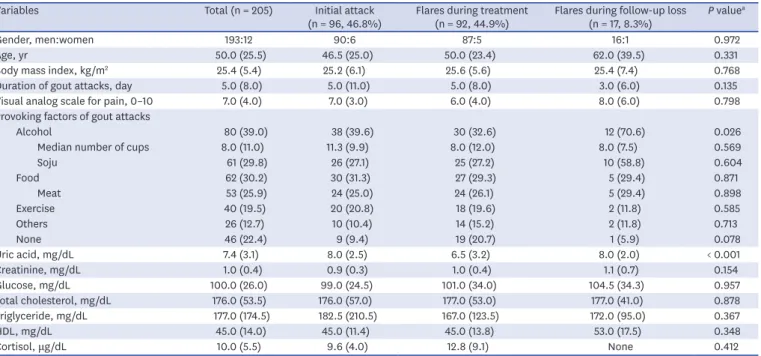
Two hundred-five patients (men, n = 193, 94.1%) were enrolled. The median age, body mass index, gout attack duration, serum uric acid level and VAS score for pain at enrollment were 50.0 years, 25.4, 5.0 days, 7.4 mg/dL, and 7.0 (range, 0–10), respectively (Tables 1 and 2).
Hypertension was the most common comorbidity (41.0%). Tophus was found in 9.8% of the patients. One hundred thirty patients (63.4%) were alcohol drinkers, and 101 patients (49.3%) were current or past smokers. The proportions of patients with initial gout attack, flares during treatment, and flares during follow-up loss were 46.8% (n = 96), 44.9% (n = 92), and 8.3% (n = 17), respectively (Table 2). The median serum uric acid level was higher in the group with initial gout attack or flares without treatment than in the group with flares during treatment as expected (8.0 vs. 8.0 vs. 6.5 mg/dL). According to season, triglyceride level was significantly lower in the winter season at enrollment (137 mg/dL, interquartile range [IQR], 92.0; P = 0.030 by Kruskal-Wallis test), and serum cortisol level was lower in the spring season (7.8 μg/dL; IQR, 3.7; P = 0.011, data not shown).
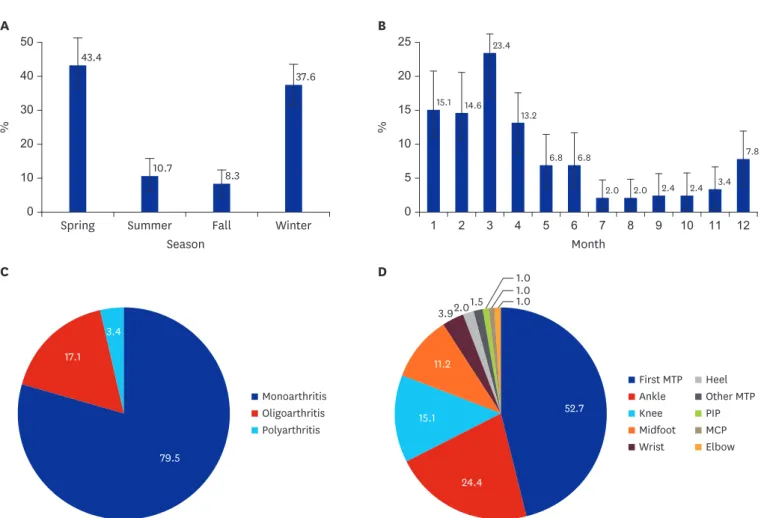
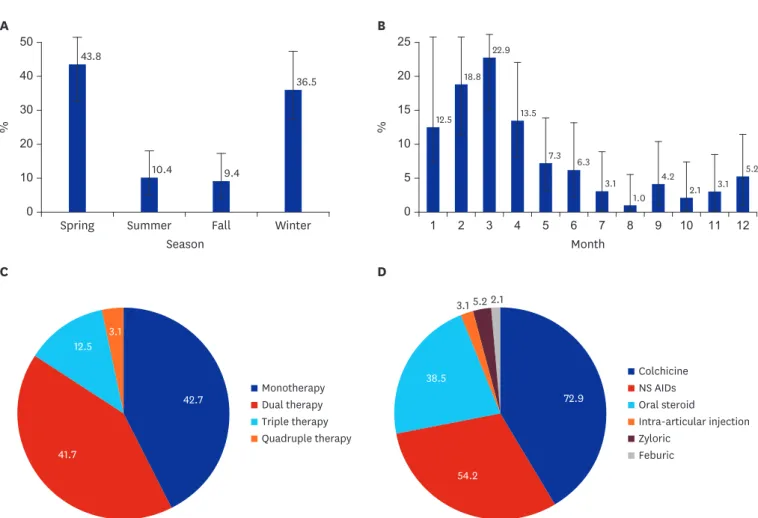
Gout attacks were most common in the spring season (43.4%, P < 0.001) and in March (23.4%, P < 0.001) (Fig. 1A and B). A similar pattern of seasonality was demonstrated in the initial gout attack group (Fig. 2A and B) and in the group of patients who completed 1-year follow-up (n = 125, data not shown). Alcohol was the most common provoking factor (39.0%) in the total cases, especially in the group with flares during loss to follow-up (70.6%, P = 0.026), followed by food such as meat (25.9%), and exercise (19.5%). The patients who reported no provoking factors accounted for 22.4% of the total cases (Table 2). Alcohol was the first provoking factor in all the seasons; however, the proportion of patients who reported alcohol as a provoking factor was highest in the summer (50%) (Table 3). Monoarthritis (79.5%) and first metatarsophalangeal joint (52.7%) were the most common pattern and site of joint involvement, respectively (Fig. 1C and D).
The median diurnal change in temperature on the day of gout attack was highest in spring (9.8°C) (Table 4). The median change in humidity between the 2 consecutive days (the day before and the day of the attack) was significantly different among the seasons (3.0%, spring;
0.3%, summer; −0.9%, fall; −1.2%, winter; P = 0.015). For the subgroup analysis, the same significant differences in meteorological factors were shown in the patients who completed 1-year follow-up (n = 125, data not shown).
The patterns of prescription for the patients with initial gouty attack in Korea were variable, such as monotherapy (42.7%), and dual (41.7%), triple (12.5%), and quadruple therapies (3.1%) (Fig. 2C). The most commonly used medication for initial management was colchicine (72.9%, n = 70/96), followed by nonsteroidal anti-inflammatory drugs (NSAIDs;
54.2%, n = 52), oral steroid (38.5%, n = 37), urate lowering agents (ULT; 7.3%, n = 7), and intra-articular glucocorticoid injection (3.1%, n = 3) (Fig. 2D). Colchicine (35.9%, n = 33/92) was also the most common prophylactic medication in Korea, which was taken at enrollment in the group with flares during treatment, followed by oral glucocorticoid (8.7%, n = 8).
Fifty-nine patients (64.1%, n = 59/92) in this group were treated with ULT (allopurinol, 21.7%; febuxostat, 40.2%; and benzbromarone, 2.2%). Oral glucocorticoid was the most common additional medication for flares (34.8%), followed by NSAIDs (29.3%), colchicine (22.8%), and intra-articular glucocorticoid injection (8.7%; data not shown).
The median total uric acid level at enrollment (7.4 mg/dL) decreased to 6.3 mg/dL at 6 months, and to 5.9 mg/dL at 12 months. Unlike the total cholesterol level at 6 months (lowest in the Table 1. Demographic and clinical characteristics of patients at baseline
Characteristics Values
Gender, men:women 193:12
Age, yr 50.0 (25.5)
Body mass index, kg/m2 25.4 (5.4)
Family history of gout 31 (15.1)
Monosodium urate crystal
Present 37 (18.0)
Absent 94 (45.9)
Not done 74 (36.1)
Presence of tophi 20 (9.8)
First metatarsophalangeal joint 9 (4.4)
Ankle joint 5 (2.4)
Others (finger, elbow, foot, etc.) 5 (2.4) Comorbidity
Hypertension 84 (41.0)
Diabetes mellitus 24 (11.7)
Hypercholesterolemia 50 (24.4)
Hypertriglyceridemia 31 (15.1)
Heart failure 10 (4.9)
Myocardial infarction 7 (3.4)
Coronary artery disease 10 (4.9)
Stroke 7 (3.4)
Chronic kidney disease 40 (19.5)
Renal/ureter stone 12 (5.9)
Smoking
Current 69 (33.7)
Median packs per day (IQR) 1.0 (0.5)
Ex-smoker 32 (15.6)
Alcohol: yes 130 (63.4)
Median number of cups (IQR) 8.0 (12.0)
Soju (Korean whisky) 115 (56.1)
Exercise: yes 81 (39.5)
Median time (IQR), min 60.0 (57.5)
Values are presented as median (IQR) or number (%).
IQR = interquartile range.
winter season, 164.0 mg/dL; IQR, 52.5; P = 0.010; data not shown), uric acid, creatinine, glucose, triglyceride, high-density lipoprotein, and cortisol levels showed no significant seasonal differences at 6 and 12 months. During the follow-up period, 64 gout episodes Table 2. Clinical features according to gout attack group at baseline
Variables Total (n = 205) Initial attack
(n = 96, 46.8%) Flares during treatment
(n = 92, 44.9%) Flares during follow-up loss
(n = 17, 8.3%) P valuea
Gender, men:women 193:12 90:6 87:5 16:1 0.972
Age, yr 50.0 (25.5) 46.5 (25.0) 50.0 (23.4) 62.0 (39.5) 0.331
Body mass index, kg/m2 25.4 (5.4) 25.2 (6.1) 25.6 (5.6) 25.4 (7.4) 0.768
Duration of gout attacks, day 5.0 (8.0) 5.0 (11.0) 5.0 (8.0) 3.0 (6.0) 0.135
Visual analog scale for pain, 0–10 7.0 (4.0) 7.0 (3.0) 6.0 (4.0) 8.0 (6.0) 0.798
Provoking factors of gout attacks
Alcohol 80 (39.0) 38 (39.6) 30 (32.6) 12 (70.6) 0.026
Median number of cups 8.0 (11.0) 11.3 (9.9) 8.0 (12.0) 8.0 (7.5) 0.569
Soju 61 (29.8) 26 (27.1) 25 (27.2) 10 (58.8) 0.604
Food 62 (30.2) 30 (31.3) 27 (29.3) 5 (29.4) 0.871
Meat 53 (25.9) 24 (25.0) 24 (26.1) 5 (29.4) 0.898
Exercise 40 (19.5) 20 (20.8) 18 (19.6) 2 (11.8) 0.585
Others 26 (12.7) 10 (10.4) 14 (15.2) 2 (11.8) 0.713
None 46 (22.4) 9 (9.4) 19 (20.7) 1 (5.9) 0.078
Uric acid, mg/dL 7.4 (3.1) 8.0 (2.5) 6.5 (3.2) 8.0 (2.0) < 0.001
Creatinine, mg/dL 1.0 (0.4) 0.9 (0.3) 1.0 (0.4) 1.1 (0.7) 0.154
Glucose, mg/dL 100.0 (26.0) 99.0 (24.5) 101.0 (34.0) 104.5 (34.3) 0.957
Total cholesterol, mg/dL 176.0 (53.5) 176.0 (57.0) 177.0 (53.0) 177.0 (41.0) 0.878
Triglyceride, mg/dL 177.0 (174.5) 182.5 (210.5) 167.0 (123.5) 172.0 (95.0) 0.367
HDL, mg/dL 45.0 (14.0) 45.0 (11.4) 45.0 (13.8) 53.0 (17.5) 0.348
Cortisol, μg/dL 10.0 (5.5) 9.6 (4.0) 12.8 (9.1) None 0.412
Values are presented as median (interquartile range) or number (%).
HDL = High-density lipoprotein.
aThe P values were obtained using the χ2 and Kruskal-Wallis tests.
Table 3. Provoking factors according to season at baseline
Aggravating factors Total
(n = 205) Spring
(n = 89, 43.4%) Summer
(n = 22, 10.7%) Fall
(n = 17, 8.3%) Winter
(n = 77, 37.6%) P valuea
Alcohol 80 (39.0) 29 (32.6) 11 (50) 8 (47.1) 32 (41.6) 0.345
Median cups (IQR) 8 (11.0) 16 (14.7) 8 (19.0) 16 (14.7) 8 (8.0) 0.569
Food 62 (30.2) 26 (29.2) 4 (18.2) 6 (35.3) 26 (33.8) 0.491
Exercise 40 (19.5) 17 (19.1) 5 (22.7) 2 (11.8) 16 (20.8) 0.744
Others 26 (12.7) 12 (13.4) 2 (9.1) 0 12 (15.6) 0.523
None 46 (22.4) 20 (22.5) 6 (27.3) 5 (29.4) 15 (19.5) 0.850
Values are presented as number (%) or median (IQR). The percentage was calculated for each group.
IQR = interquartile range.
aThe P values were obtained using χ2 and Kruskal-Wallis tests.
Table 4. Meteorological factors associated with gout attacks
Changes Total
(n = 205) Spring
(n = 89, 43.4%) Summer
(n = 22, 10.7%) Fall
(n = 17, 8.3%) Winter
(n = 77, 37.6%) P valuea Temperature, °C
Diurnal
The day before the attack 8.6 (4.2) 9.1 (5.9) 8.2 (4.0) 8.7 (3.1) 8.2 (3.5) 0.268
The day of the attack 9.2 (5.0) 9.8 (5.8) 7.1 (4.4) 8.6 (4.2) 9.3 (4.7) 0.027
Average 0.4 (3.2) 0.5 (3.4) 0.4 (1.4) −0.3 (2.3) 0.5 (4.2) 0.397
Highest 0.3 (4.3) 0.9 (5.2) −0.1 (2.8) −0.4 (3.9) 0.8 (4.1) 0.396
Lowest −0.2 (3.6) −0.2 (3.5) 0.2 (0.8) −0.5 (4.8) −0.4 (5.0) 0.710
Humidity, % −0.1 (16.3) 3.0 (16.1) 0.3 (6.1) −0.9 (24.0) −1.2 (17.4) 0.015
Wind speed, m/sec 0.0 (0.9) −0.1 (0.8) −0.1 (0.6) 0.1 (1.1) −0.1 (1.3) 0.475
Daylight time, hr 0.1 (4.8) 0.1 (4.0) −0.3 (4.4) −0.4 (6.3) 0.2 (5.5) 0.445
Values are presented as number (%) or median (interquartile range).
aThe P values were obtained using Kruskal-Wallis tests.
occurred in 51 patients and 21 flares occurred in 18 patients in the initial attack group. The median duration to the second episode after the first attack was 8.6 months (IQR, 8.9) in the initial attack group. Three patients had a third attack, and 5 had a fourth attack. One hundred twenty-five patients (61%) completed 1-year follow-up (51%, initial attack group; 71.7%, group with flares during treatment; and 58.8%, group with flares during loss to follow-up). Forty-five flares occurred during follow-up in 35 patients who completed 1-year follow-up.
DISCUSSION
To our knowledge, this is the first prospective study on gout seasonality. We found that spring and March were the most common season and month of gout attacks in Korea. Spring season was the dominant season of gout attack in many previous studies.8-10 In Italy,11 the highest incidence was in spring (March to May) for both gout and pseudogout. In a UK study,12 by contrast, the incidence of gout increased from late April to mid-September (the summer period). Our previous retrospective study also showed that summer was the most common season in the patients who received a ULT for > 1 year after discontinuing prophylactic medications.5 However, in this study, we included patients with initial attacks, gout flares during management, or flares during loss to 50
0
%
Spring Summer
Season Month
Fall Winter
37.6
10.7 8.3 43.4
40 30 20 10
25
0
%
1 2 3 4 5 6 7 8 9 10 11 12
15.1 20 15 10 5
14.6 23.4
13.2
6.8 6.8
2.0 2.0 2.4 2.4 3.4
7.8
1.01.0
C D 1.0
A B
Monoarthritis Oligoarthritis Polyarthritis
First MTP Ankle Knee Midfoot Wrist
Heel Other MTP PIP MCP Elbow 79.5
52.7
24.4 15.1
11.2 3.92.01.5
17.1 3.4
Fig. 1. Characteristics of the gout attacks in the total cases (n = 205). (A) Distribution of the gout attacks (point estimation, 95% confidence interval) according to season and (B) month, (C) pattern of arthritis, and (D) distribution of joint involvement. Season is classified by 3-month intervals. The P values for (A) and (B) are < 0.001 in the goodness-of-fit test.
MTP = metatarsophalangeal, PIP = proximal interphalangeal, MCP = metacarpophalangeal.
follow-up. A similar seasonal pattern was observed in the initial gout attack group, which suggests that in Korea, spring is the most common season especially in patients with initial onset.
Gout attack was associated with some meteorological factors in this study. The median diurnal change in temperature on the day of gout attack and the median change in humidity between 2 consecutive days were highest in spring. These findings suggest that diurnal change in temperatures and change in humidity are associated with gout seasonality in this study and are provoking factors of gout attacks. Park et al.13 reported that gout attacks occurred more frequently during the period in which the temperature significantly increased between neighboring days. They also reported that this period was spring by season and between March and July by month in the northern hemisphere, using a meta-analysis. According to a study from the United States, the risk of nocturnal gout attacks was 2.36 times higher than that of daytime gout attacks.14 They suggested that the lower body temperature at night and early morning is one of the potential biological mechanisms. Neogi et al.15 reported that high temperature and low humidity over the prior 48 hours were associated higher risk of gout attacks than moderate temperatures. They also reported that high ambient temperature and, possibly, extremes of humidity were associated with an increased risk of gout attack. Recently, the climate pattern has changed in Korea, getting hotter in the summer, and getting colder 50
0
%
Spring Summer
Season Month
Fall Winter
36.5
10.4 9.4 43.8
40 30 20 10
25
0
%
1 2 3 4 5 6 7 8 9 10 11 12
12.5 20 15 10 5
18.8 22.9
13.5
7.3 6.3 3.1
1.0 4.2
2.1 3.1 5.2
2.1
C D
A B
Colchicine NS AIDs Oral steroid
Intra-articular injection Zyloric
Feburic 42.7
41.7
72.9
54.2 38.5
3.1 5.2
12.5 3.1
Monotherapy Dual therapy Triple therapy Quadruple therapy
Fig. 2. Characteristics of the gout attacks in the initial gout attack group (n = 96). (A) Distribution of the gout attacks (point estimation, 95% confidence interval) according to season and (B) month, (C) prescription pattern, and (D) class of medications. Season is classified by 3-month intervals. The P values for (A) and (B) are < 0.001 in the goodness-of-fit test.
NSAIDs = nonsteroidal anti-inflammatory drugs.
in the winter. However, the change in the meteorological factors during those seasons are minimal as compared with those in the spring. Dehydration and hot or cold temperatures could be associated with gout attacks, but our study shows that the changes in weather conditions such as temperature or humidity are factors related to gout attack.
The lifestyle-related risk factors of gout attack were also identified in this study. We found that alcohol was the most common cause of gout attacks in all seasons. Although no statistically significant difference was found, the highest proportion of alcohol consumption was observed in the patients with gout attacks in the summer, similar to our previous study.5 Purine-rich food intake such as meat or seafood increased serum uric acid level and provoked gout attacks.16 Food (30.2%) was the second cause of gout attack in our study. Among them, 53 patients reported (85.4%, n = 53/62) meat as a provoking factor. Seafood intake was 6.5% (n = 4).
In the comorbidity survey, the patients had combined hypertension (41%), chronic kidney disease (19.5%), and hypertriglyceridemia (15.1%). Low high-density lipoprotein level was an independent indicator of acute gout attack,17 and therapy for hypertriglyceridemia reduced the serum uric acid levels in gout patients.18 The serum cortisol levels in healthy men were higher in the winter,19 and low cortisol levels during spring might facilitate acute gouty arthritis.6 Serum cortisol level, which was lowest in the spring season, could be associated with the gout attacks in our cohort.
Only 61% of the patients completed 1-year follow-up, and the ratio was lowest (51%) in the initial attack group as expected. The median uric acid level during follow-up did not reach the ideal target level (< 5 mg/dL) in the total cases or in each gout attack groups. These findings indicate that physicians must provide more intensive care to achieve the target uric acid level,20-22 and that patients need more education and an adherence program.23,24
The strength of this study was the fact that it is the first prospective multicenter study for gouty attack. We identified risk factors precisely and clinical features at the time of gouty attack.
Detailed aggravating factors elucidate the association factors of gout attack in Korea. Otherwise, this study has some limitations. First, this study was conducted exclusively in Koreans. However, this study was conducted in 9 representative rheumatology clinics geographically well distributed throughout Korea. Second, because our cohort was enrolled from tertiary hospitals, selection bias was possible, such as the dominance of severe or advanced gout cases.
In conclusion, the most common season and month of gout attack were spring and March, respectively, in this prospective study in Korea. Alcohol consumption was the most common provoking factor, especially in the summer. Diurnal changes in temperatures on the day of the attack and humidity changes between the day before and the day of the attack were associated with the gout attacks in our cohort. In addition to abstaining from alcohol consumption or heavy meat intake, physicians' recommendation for avoidance of extreme change of temperature or humidity in daily life could be helpful to decrease risk of gout attack.
REFERENCES
1. Robinson PC, Kempe S, Tebbutt I, Roberts L. Epidemiology of inpatient gout in Australia and New Zealand: temporal trends, comorbidities and gout flare site. Int J Rheum Dis 2017;20(6):779-84.
PUBMED | CROSSREF
2. Annemans L, Spaepen E, Gaskin M, Bonnemaire M, Malier V, Gilbert T, et al. Gout in the UK and Germany: prevalence, comorbidities and management in general practice 2000–2005. Ann Rheum Dis 2008;67(7):960-6.
PUBMED | CROSSREF
3. Cea Soriano L, Rothenbacher D, Choi HK, García Rodríguez LA. Contemporary epidemiology of gout in the UK general population. Arthritis Res Ther 2011;13(2):R39.
PUBMED | CROSSREF
4. Xia Y, Wu Q, Wang H, Zhang S, Jiang Y, Gong T, et al. Global, regional and national burden of gout, 1990- 2017: a systematic analysis of the Global Burden of Disease Study. Rheumatology (Oxford) 2019:kez476.
PUBMED | CROSSREF
5. Choi HJ, Lee CH, Lee JH, Yoon BY, Kim HA, Suh CH, et al. Seasonality of gout in Korea: a multicenter study. J Korean Med Sci 2015;30(3):240-4.
PUBMED | CROSSREF
6. Schlesinger N. Acute gouty arthritis is seasonal: possible clues to understanding the pathogenesis of gouty arthritis. J Clin Rheumatol 2005;11(4):240-2.
PUBMED | CROSSREF
7. Wallace SL, Robinson H, Masi AT, Decker JL, McCarty DJ, Yü TF. Preliminary criteria for the classification of the acute arthritis of primary gout. Arthritis Rheum 1977;20(3):895-900.
PUBMED | CROSSREF
8. Schlesinger N, Gowin KM, Baker DG, Beutler AM, Hoffman BI, Schumacher HR Jr. Acute gouty arthritis is seasonal. J Rheumatol 1998;25(2):342-4.
PUBMED
9. Arber N, Vaturi M, Schapiro JM, Jelin N, Weinberger A. Effect of weather conditions on acute gouty arthritis. Scand J Rheumatol 1994;23(1):22-4.
PUBMED | CROSSREF
10. Rovenský J, Mikulecký M, Masárová R. Gout and pseudogout chronobiology. J Rheumatol 1999;26(6):1426-7.
PUBMED
11. Gallerani M, Govoni M, Mucinelli M, Bigoni M, Trotta F, Manfredini R. Seasonal variation in the onset of acute microcrystalline arthritis. Rheumatology (Oxford) 1999;38(10):1003-6.
PUBMED | CROSSREF
12. Elliot AJ, Cross KW, Fleming DM. Seasonality and trends in the incidence and prevalence of gout in England and Wales 1994–2007. Ann Rheum Dis 2009;68(11):1728-33.
PUBMED | CROSSREF
13. Park KY, Kim HJ, Ahn HS, Yim SY, Jun JB. Association between acute gouty arthritis and meteorological factors: An ecological study using a systematic review and meta-analysis. Semin Arthritis Rheum 2017;47(3):369-75.
PUBMED | CROSSREF
14. Choi HK, Niu J, Neogi T, Chen CA, Chaisson C, Hunter D, et al. Nocturnal risk of gout attacks. Arthritis Rheumatol 2015;67(2):555-62.
PUBMED | CROSSREF
15. Neogi T, Chen C, Niu J, Chaisson C, Hunter DJ, Choi H, et al. Relation of temperature and humidity to the risk of recurrent gout attacks. Am J Epidemiol 2014;180(4):372-7.
PUBMED | CROSSREF
16. Choi HK, Liu S, Curhan G. Intake of purine-rich foods, protein, and dairy products and relationship to serum levels of uric acid: the Third National Health and Nutrition Examination Survey. Arthritis Rheum 2005;52(1):283-9.
PUBMED | CROSSREF
17. Mak A, Ho RC, Tan JY, Teng GG, Lahiri M, Lateef A, et al. Atherogenic serum lipid profile is an independent predictor for gouty flares in patients with gouty arthropathy. Rheumatology (Oxford) 2009;48(3):262-5.
PUBMED | CROSSREF
18. Jung JY, Choi Y, Suh CH, Yoon D, Kim HA. Effect of fenofibrate on uric acid level in patients with gout. Sci Rep 2018;8(1):16767.
PUBMED | CROSSREF
19. Walker BR, Best R, Noon JP, Watt GC, Webb DJ. Seasonal variation in glucocorticoid activity in healthy men. J Clin Endocrinol Metab 1997;82(12):4015-9.
PUBMED | CROSSREF
20. Richette P, Doherty M, Pascual E, Barskova V, Becce F, Castañeda-Sanabria J, et al. 2016 updated EULAR evidence-based recommendations for the management of gout. Ann Rheum Dis 2017;76(1):29-42.
PUBMED | CROSSREF
21. Sivera F, Andrés M, Carmona L, Kydd AS, Moi J, Seth R, et al. Multinational evidence-based
recommendations for the diagnosis and management of gout: integrating systematic literature review and expert opinion of a broad panel of rheumatologists in the 3e initiative. Ann Rheum Dis 2014;73(2):328-35.
PUBMED | CROSSREF
22. Khanna D, Fitzgerald JD, Khanna PP, Bae S, Singh MK, Neogi T, et al. 2012 American College of Rheumatology guidelines for management of gout. Part 1: systematic nonpharmacologic and
pharmacologic therapeutic approaches to hyperuricemia. Arthritis Care Res (Hoboken) 2012;64(10):1431-46.
PUBMED | CROSSREF
23. Scheepers LE, van Onna M, Stehouwer CD, Singh JA, Arts IC, Boonen A. Medication adherence among patients with gout: a systematic review and meta-analysis. Semin Arthritis Rheum 2018;47(5):689-702.
PUBMED | CROSSREF
24. Aung T, Myung G, FitzGerald JD. Treatment approaches and adherence to urate-lowering therapy for patients with gout. Patient Prefer Adherence 2017;11:795-800.
PUBMED | CROSSREF