• 검색 결과가 없습니다.

Multiple Aortic Operations in Loeys-Dietz Syndrome: Report of 2 Cases

N/A
N/A
Protected

Academic year: 2021

Share "Multiple Aortic Operations in Loeys-Dietz Syndrome: Report of 2 Cases"

Copied!
5
0
0

로드 중.... (전체 텍스트 보기)

전체 글

(1)

ISSN: 2233-601X (Print) ISSN: 2093-6516 (Online)

Department of Thoracic and Cardiovascular Surgery, Seoul National University Bundang Hospital, Seoul National University College of Medicine Received: May 8, 2014, Revised: July 22, 2014, Accepted: September 3, 2014, Published online: December 5, 2014

Corresponding author: Kay-Hyun Park, Department of Thoracic and Cardiovascular Surgery, Seoul National University Bundang Hospital, Seoul National University College of Medicine, 82 Gumi-ro 173beon-gil, Bundang-gu, Seongnam 463-707, Korea

(Tel) 82-31-787-7140 (Fax) 82-31-787-4050 (E-mail) [email protected]

C

The Korean Society for Thoracic and Cardiovascular Surgery. 2014. All right reserved.

CC
This is an open access article distributed under the terms of the Creative Commons Attribution Non-Commercial License (http://creative- commons.org/licenses/by-nc/3.0) which permits unrestricted non-commercial use, distribution, and reproduction in any medium, provided the original work is properly cited.

Multiple Aortic Operations in Loeys-Dietz Syndrome:

Report of 2 Cases

Kwon Joong Na, M.D., Kay-Hyun Park, M.D., Ph.D.

Due to its low prevalence and because there is lack of awareness about it, Loeys-Dietz syndrome is often mis- diagnosed as Marfan syndrome, which has similar skeletal abnormalities and aortic pathology. However, the differ- ential diagnosis between these two connective tissue diseases is critical because they correspond to different surgi- cal indications and surgical decision-making. We report two cases of successful thoracoabdominal aortic replacement in patients with previously undiagnosed Loeys-Dietz syndrome.

Key words: 1. Loeys-Dietz syndrome 2. Marfan syndrome 3. Aortic aneurysm 4. Aorta, surgery

CASE REPORT 1) Patient 1

A 32-year-old man visited the emergency room of Seoul National University Bundang Hospital with a complaint of sudden-onset back pain. He had undergone several aortic sur- geries at other hospitals and had been diagnosed with Marfan syndrome. At the age of 16, he underwent a Bentall oper- ation for an acute Stanford type A aortic dissection. Eight years after the first operation, to address the increased size of the aortic aneurysm, he underwent a replacement of the aortic arch and descending thoracic aorta to the level of the seventh thoracic vertebra via a T-shaped thoracosternotomy. After the second operation, he had been followed up regularly with yearly computed tomography (CT) scans for a remaining thoracoabdominal aortic aneurysm, which remained stable with a maximal diameter of 53 mm over the prior five years.

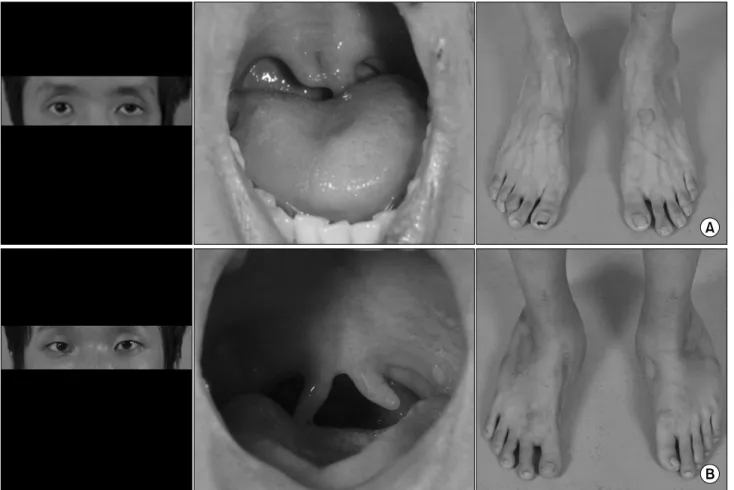
A thorough physical examination and review of previous CT images demonstrated hypertelorism, bifid uvula, arach- nodactyly, and a tortuous aorta, which suggested Loeys-Dietz syndrome (LDS) rather than Marfan syndrome (Fig. 1A).

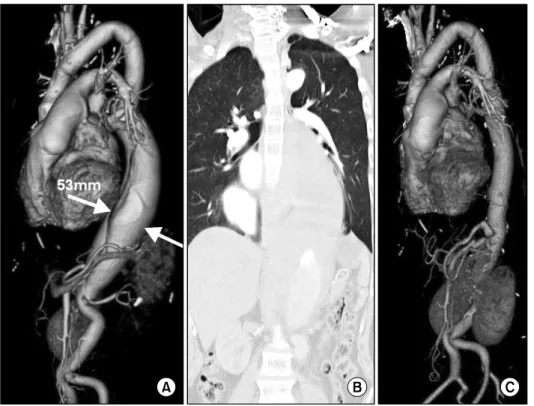
Preoperative CT imaging showed a periaortic hematoma from the descending thoracic aorta to the abdominal aorta compat- ible with the concealed rupture of a thoracoabominal aortic aneurysm (Fig. 2).

An urgent operation was performed. The left thoracic cav- ity was entered through the seventh intercostal space and the incision was extended to a curvilinear thoracoabdominal incision. The left femoral artery and vein were cannulated for cardiopulmonary bypass. As severe pleural adhesion caused by previous aortic surgeries made it difficult to find a safe site for proximal cross-clamping, the proximal anastomosis was made under total circulatory arrest in deep hypothermia (rectal temperature 20

o

C). The remaining anastomoses were

Korean J Thorac Cardiovasc Surg 2014;47:536-540 □ Case Report □

http://dx.doi.org/10.5090/kjtcs.2014.47.6.536

(2)

Fig. 1. Characteristic phenotypic findings in (A) case 1 and (B) case 2.

made during the rewarming period after cardiopulmonary by- pass was reinstituted via the side branch of a four-branch polyester vascular graft (Gelweave Coselli Thoracoabdominal Graft; Vascutek, Renfrewshire, Scotland, UK) and the left femoral artery. Two pairs of intercostal arteries, from thoracic ribs 10 and 12, were reimplanted to the main body graft as separate Carrel patches. In addition, the visceral branches of the abdominal aorta were reimplanted to the branch grafts, and the distal anastomosis was made at the infrarenal aorta.

The operation took 455 minutes including 17 minutes of total circulatory arrest and 132 minutes of cardiopulmonary bypass.

The postoperative course was uneventful, and the patient was discharged 21 days postoperatively without any complications.

2) Patient 2

An 18-year-old male was referred to Seoul National University Bundang Hospital for a rapidly increasing thor-

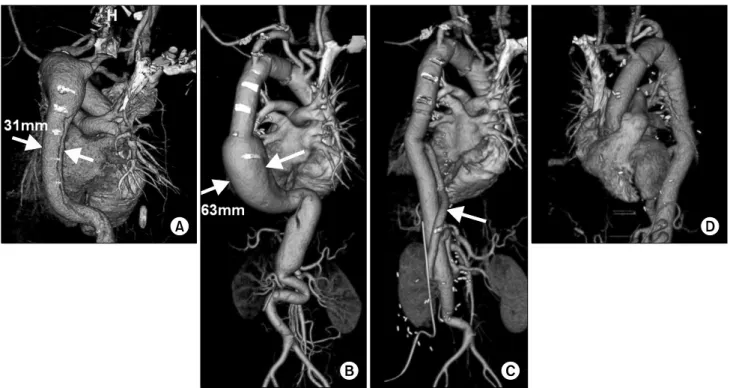
acoabominal aortic aneurysm. Seven months prior, the sur- geon in the referring center replaced the proximal half of the descending thoracic aorta based on the diagnosis of acute type B dissection, an aberrant right subclavian artery, and Marfan syndrome. The maximal diameter of the remaining thoracic aorta, which had been 31 mm at the time of the first operation, was found to have increased to 63 mm in a post- operative CT scan taken six months later (Fig. 3). A physical examination revealed bifid uvula, hypertelorism, and a clubfoot deformity that had required multiple orthopedic operations (Fig.

1B). Moderate dilatation of the aortic root (diameter 41 mm) along with marked tortuosity of the entire aorta and its major branches were noted in the CT scan. Those findings led to the diagnosis being revised to LDS.

An elective thoracoabdominal aortic replacement was

performed. The incision and exposure of the aorta were per-

formed in the same manner as the first patient. As there was

(3)

Kwon Joong Na and Kay-Hyun Park

Fig. 2. Computed tomography imag- ing of case 1. (A) 13 months before surgery, (B) at the time of rupture, and (C) postoperatively.

no severe pleural adhesion despite previous surgeries, a pre-existing proximal thoracic graft was easily mobilized for cross-clamping. All of the anastomoses were made under aortic cross-clamping and partial cardiopulmonary bypass via the left femoral artery and vein. Two pairs of intercostal ar- teries, from thoracic ribs 10 and 12, were reimplanted to a parallel 10 mm Dacron graft (Vascutek, Renfrewshire, Scotland, UK) that had been anastomosed to the main body graft be- fore aortic clamping [1]. Visceral branch reimplantation and distal anastomosis were performed in the same manner as the first patient. The durations of the entire operation and of the cardiopulmonary bypass were 365 and 123 minutes, respe- ctively.

The patient recovered rapidly and was discharged on the ninth postoperative day. He was readmitted 30 days later and underwent a second surgery: a valve-sparing aortic root replace- ment (David’s reimplantation) and a total arch replacement.

This operation was also uneventful and the patient was in good condition at the most recent follow-up, eight months af- ter the operation.

DISCUSSION

Although LDS has similarities with Marfan syndrome, which is the most common connective tissue disorder, they have distinctive phenotypic and genetic features. LDS is an autosomal dominant genetic disorder caused by the mutation of the transforming growth factor beta receptor 1 or 2 genes, whereas Marfan syndrome is caused by the mutation of the gene coding for fibrillin-1 [2]. Both genes are related to the transforming growth factor beta signaling pathway, which leads to the overproduction of collagen, disarrangement of elastic fiber, and loss of elastin content within aortic media.

Because of these histological changes, vascular media become weak, which makes the aorta extremely prone to aortic aneur- ysms and dissection [2]. LDS is phenotypically characterized by the triad of hypertelorism, bifid uvula and/or cleft palate, and generalized arterial tortuosity throughout the entire aortic system [2]. As these findings are not found in patients with Marfan syndrome, it is clinically important to recognize the characteristic phenotypic findings to differentiate between the two syndromes [2-4].

The differential diagnosis between these connective tissue

(4)

Fig. 3. Computed tomography (CT) imaging of case 2 (A) before the first operation, (B) six months after the first operation. (C) The post- operative CT after thoracoabominal aortic replacement and (D) the postoperative CT after the David operation. (C) Two pairs of intercostal arteries were implanted to a parallel longitudinal graft (white arrow).

diseases is important because the progression and prognosis of aortic and branch vessel disease is significantly different.

Although the two syndromes share genetic mutations in the same signaling pathway, previous studies have reported that vascular disease in LDS seems to be more widespread and aggressive than it is in Marfan syndrome [4]. Williams et al.

[4] reported the following distinctive features of LDS: fatal aortic events at a very young age, fatal aortic dissection and rupture in the aortic root with diameters smaller than 45 mm, aneurysmal changes in the entire aortic and major arterial tree, and high rates of repeat surgical interventions. For these reasons, elective surgical intervention should be considered for young LDS patients with smaller aortic diameter as op- posed to the general population and even Marfan patients [2-4].

The exact incidence of LDS is unknown and there have been very few cases reported in South Korea [5]. However, more cases might have gone undiagnosed because of an un- awareness of this recently recognized syndrome. This spec- ulation is based on the past medical history of our cases; in these patients, the characteristic phenotypic features of LDS

were not noticed and Marfan syndrome was diagnosed with- out referring to the recently established diagnostic criteria [6].

Because LDS results in a much more aggressive aortic dis- ease than Marfan syndrome does, the long-term clinical course of our patients could have been changed if the correct diag- nosis had been made at the time of their initial operations.

The extent of their first operations would have been greater had LDS been diagnosed, thereby obviating the need for mul- tiple operations and the risks involved in repeated thoraco- tomies. In particular, closer follow-up and early elective sur- gery before the rupture might have been possible in the first patient.

In summary, we report two patients with LDS who were

only correctly diagnosed after one or two aortic surgeries. We

conclude that physicians and surgeons dealing with aortic dis-

ease should be aware of this new and rare disorder, to ensure

early proper diagnoses resulting in a timely and efficient

management strategy and the improvement of the long-term

prognosis.

(5)

Kwon Joong Na and Kay-Hyun Park

CONFLICT OF INTEREST

No potential conflict of interest relevant to this article was reported.

REFERENCES

1. Woo EY, Mcgarvey M, Jackson BM, Bavaria JE, Fairman RM, Pochettino A. Spinal cord ischemia may be reduced via a novel technique of intercostal artery revascularization dur- ing open thoracoabdominal aneurysm repair. J Vasc Surg 2007;46:421-6.

2. Loeys BL, Schwarze U, Holm T, et al. Aneurysm syndromes caused by mutations in the TGF-beta receptor. N Engl J

Med 2006;355:788-98.

3. Aalberts JJ, van den Berg MP, Bergman JE, et al. The many faces of aggressive aortic pathology: Loeys-Dietz syndrome.

Neth Heart J 2008;16:299-304.

4. Williams JA, Loeys BL, Nwakanma LU, et al. Early surgi- cal experience with Loeys-Dietz: a new syndrome of ag- gressive thoracic aortic aneurysm disease. Ann Thorac Surg 2007;83:S757-63.

5. Kim HW, Lee TY, Moon DH, Choo SJ, Chung CH, Lee JW. Ascending aortic rupture in a young woman with Loeys-Dietz syndrome: the first case report in Korea. Korean J Thorac Cardiovasc Surg 2009;42:639-44.

6. Loeys BL, Dietz HC, Braverman AC, et al. The revised

Ghent nosology for the Marfan syndrome. J Med Genet

2010;47:476-85.

수치

Fig. 1. Characteristic phenotypic findings in (A) case 1 and (B) case 2.
Fig. 2. Computed tomography imag- imag-ing of case 1. (A) 13 months before  surgery, (B) at the time of rupture,  and (C) postoperatively.
Fig. 3. Computed tomography (CT) imaging of case 2 (A) before the first operation, (B) six months after the first operation

참조

관련 문서