Effect of Inhibitors of Ethylene Production on Growth and Gravitropism Inhibited by Oryzalin in Arabidopsis Roots
Ho Yeon Park, Donggyu Ahn and Soon Young Kim*
School of Biotechnology, Biological Science Major, Andong National University, Andong 36729, Korea Received October 27, 2020 /Revised December 7, 2020 /Accepted December 16, 2020
Oryzalin is a herbicide that disrupts the arrangement of microtubules by binding to tubulin, thereby blocking the anisotropic growth of plant cells. Microtubules and microfilaments are cytoskeleton com- ponents that have been implicated in plant growth through their influence on the formation of cell walls. Microtubules also play roles in the sedimentation of amyloplasts in the root tip columella cells;
this sedimentation is related to gravity sensing and results in downward root growth in the soil for absorption of water and minerals. However, the orientation of microtubules changes depending on the level of ethylene in plant cells. A recent study reported that oryzalin stimulated ethylene pro- duction via 1-aminocyclopropane-1-carboxylic acid (ACC) synthase and ACC oxidase and caused a concentration-dependent inhibition of root growth and gravitropic responses. The aim of the present study was to investigate the possibility that oryzalin-induced inhibition might be recovered by the ap- plication of inhibitors of ethylene production, such as 10
-4M cobalt ions and 10
-8M aminoethox- yvinylglycine (AVG). The inhibition of root growth and gravitropic response was overcome by 10-20%
by an 8 hr treatment with cobalt ions or AVG. These results suggest that ethylene levels could regu- late root growth and gravitropic responses in Arabidopsis.
Key words : Arabidopsis root, AVG, cobalt ions, gravitropic response, oryzalin
*Corresponding author
*Tel : +82-54-820-5647, Fax : +82-54-820-7705
*E-mail : [email protected]
This is an Open-Access article distributed under the terms of the Creative Commons Attribution Non-Commercial License (http://creativecommons.org/licenses/by-nc/3.0) which permits unrestricted non-commercial use, distribution, and reproduction in any medium, provided the original work is properly cited.
Introduction
Oryzalin is a dinitroaniline herbicide that acts on the dis- ruption of microtubules [12, 15]. According to Kim et al. [6], oryzalin inhibited root growth and gravitropic response in maize, and the primary root tip was swelled in the agar plate containing 10
-4M oryzalin. They suggested that the arrange- ment of microtubule might be one of the important factors to determine the cell shape. From these results, they con- cluded that the effect of oryzalin could be related to the or- yzalin-induced stimulation of ethylene production in maize roots. In addition, we found that the growth and gravitrop- ism have been inhibited by oryzalin, and its inhibition is related to the increase of ethylene production in Arabidopsis roots (data submitted).
Polko et al. [13] suggested that the orientation of micro- tubule is changed depending on the level of ethylene in plant cells, and ethylene-induced hyponastic leaf movement
is related to the unequal growth rates between adaxial and abaxial of petiole. Their research concluded that ethylene stimulates cell expansion in a tissue-specific manner with the arrangement of cortical microtubules along the petiole.
Le et al. [9] reported that microtubule reorientation is related to the early response of the root epidermis to ethylene in Arabidopsis root. There are some studies reported that the microtubule arrangement regulated the alignment of cellu- lose microfibrils across the root, which made the uniform mechanical structure [3, 5]. Recent study by Wang et al. [16]
reported that microtubule reorientation was induced by eth- ylene, and it inhibited root growth in Arabidopsis.
Ethylene, one of the stress hormone, participates in vari- ous plant developments and differentiation reactions includ- ing seed germination, fruit ripening and senescence [1, 18].
Ethylene synthesis begins from methionine via two major
intermediates, S-adenosylmethionine (AdoMet) and 1-ami-
nocycopropane-1-carboxylic acid (ACC), in sequence. The
enzyme of ACC synthase (ACS) and ACC oxidase (ACO)
regulate the steps from AdoMet to ACC and from ACC to
ethylene, respectively. Several factors regulate these two en-
zymes, especially auxin which stimulates the ethylene pro-
duction through increasing the expression level of the ACS
gene [4]. The formation of ACC from AdoMet is regulated
by ACC synthase (ACS), and ACS is strongly inhibited by
aminoethoxyvinylglycine (AVG), which is a known inhibitor of pyridoxal phosphate-mediated enzyme reactions [2]. The last step in the ethylene biosynthesis pathway is the con- version of ACC to ethylene by ACC oxidase (ACO), and co- balt ions suppress the ACO activity [1].
Based on these facts, we tried to figure out that the in- hibition of root growth and gravitropic response by oryzalin could be recovered by cobalt ions and AVG, inhibitors of ethylene production.
Material and Methods
Plant material
The sterilized seeds of Landsberg erecta (Ler), Arabidopsis
thaliana were planted on the agar medium with half-strengthof MS salts, 1% sucrose and 1 mM MES (pH 5.8). The seeds were incubated in vertical position at 4℃ for 1 day and then were incubated for another 6 days at 22℃.
Measurement of ethylene production
Ethylene production was measured in 100 root segments (10 mm). The root segments were placed in vials containing 1 ml of MES buffer (100 mM, pH 6.8, 50 μg/ml chlor- amphenicol) with the test compounds. The vials were shak- en in the dark at 27℃ in an incubator. To measure the ethyl- ene production, 1-ml of gas sample was withdrawn from the vial using a syringe and injected to the gas chromato- graph (HP5890 Series II; Hewlett-Packard, USA) equipped with an alumina column (80/100 Porapak-Q; 1.8-m × 2.1- mm).
Measurement of root growth and gravitropic curvature The seedlings were placed in vertical or horizontal posi- tion in petri dishes, depending on the experiments. Growth and gravitropic curvature were measured using a camera (Rexsa, DS-400 PC-camera) with the time-interval software (SupervisionCam ver. 3.2.2.4; http://supervisioncam.com).
Images were recorded every 15 min and analyzed using UTHSCSA Image Tool Program (ver. 3.0; http://comdent.
uthscsa.edu/dig/itdes.html).
Observation of root external structure
Roots were placed in agar medium containing 10
-6M or- yzalin in vertically, and observed roots with the microscope (Olympus SZ51) at 45 folds after 24 hr.
Statistical analysis
All experiments were conducted at least three times, with no fewer than 30 primary roots each. All data were com- puted to establish statistical significance at p of < 0.05 using two-way ANOVA and Tukey test.
Results and Discussion
Effect of cobalt ions and AVG on the oryzalin- induced ethylene production
It has been known that external treatment of oryzalin in- creased ethylene production in maize roots [6]. The stim- ulation of ethylene production by oryzalin was due to in- crease of ACO and ACS activities, which act on the ethylene production pathway.
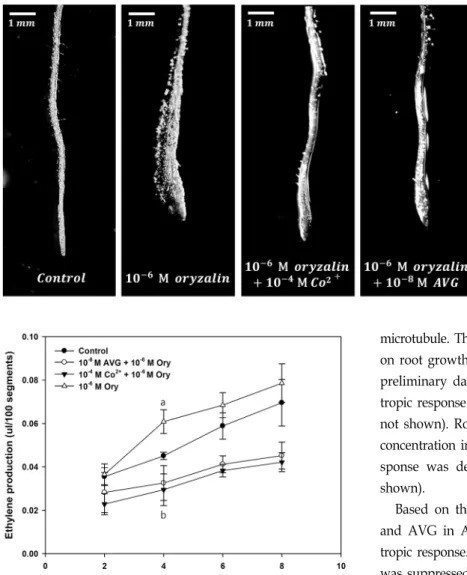
We examined the effect of oryzalin on the external struc- ture in Arabidopsis root. The application of oryzalin for 24 hr caused root tip swelling (Fig. 1). This result suggested that oryzalin disrupt the microtubule formation especially in the meristem regions. However, oryzalin-induced swel- ling in the meristem region was reduced by the treatment of ethylene biosynthesis inhibitors such as Co
2+and AVG.
The swelling of tissue in plants is one of the key roles of ethylene action [1].
Ethylene synthesis starts from methionine via two inter- mediates such as S-adenosyl-methionine (AdoMet) and 1-aminocyclopropane-1-carboxylic acid (ACC). The format- ion of ACC from AdoMet is regulated by ACC synthase (ACS), and ACS is strongly inhibited by AVG, which is a known inhibitor of pyridoxal phosphate-mediated enzyme reactions [2]. The last step in the ethylene biosynthesis path- way is the conversion of ACC to ethylene by ACC oxidase (ACO), and cobalt ions suppress the ACO activity [1].
In this study, we measured how oryzalin-induced ethyl- ene production was regulated by the treatment of cobalt ions and AVG (Fig. 2). Along with the previous results, treatment of oryzalin resulted in 35% increase in ethylene production at 4 hr [6]. However, the stimulated ethylene production by oryzalin decreased by AVG and cobalt ions. When 10
-6M cobalt ions and 10
-4M AVG were treated, the ethylene pro- duction was inhibited 52% and 47% by cobalt ions and AVG at 4 hr, respectively.
From these results, we examined the effect of cobalt ions
and AVG on the oryzalin induced inhibition of growth and
gravitropic response in Arabidopsis roots.
Fig. 1. Morphology of vertically-grown roots treated with 10-6 M oryza- lin, 10-6 M oryzalin + 10-4 M Co2+, 10-6 M oryzalin + 10-8 M AVG for 24 hr. Swelling in oryzalin-treat- ed roots occurred in the root tip which is the meristem.
Fig. 2. Effect of inhibitors of ethylene production on oryzalin-in- duced ethylene production in the root segments of Arabidopsis for 8 hr. Root segments (10 mm) were in- cubated in solution containing 10-6 M oryzalin, 10-6 M oryzalin + 10-4 M cobalt ions, 10-6 M oryzalin + 10-8 M AVG. At every 2 hr, 1 ml of gas sample was withdrawn from the vials for measuring the production of ethylene.
Symbols are mean values ± SE from 3 independent ex- periments. Different letters indicate significant difference based on two-way ANOVA and Tukey test at p<0.05.
Effect of IAA and AVG in root growth and gravitropic response
It is well known that IAA could promote ethylene pro- duction through an activation of ACS, and resulted in in- hibition of root growth [1]. Kim and Mulkey [7] reported that ethylene antagonists such as AVG and silver ions recov- ered the IAA-induced inhibition of root elongation in maize roots. And Ma et al [11] suggested that ethylene regulates root growth and gravitropic responses via the alignment of
microtubule. Thus, we examined the effect of IAA and AVG on root growth and gravitropic response. According to the preliminary data, the inhibition of root growth and gravi- tropic response were depended on IAA concentrations (data not shown). Root growth was further inhibited as the IAA concentration increased, and the onset of the gravitropic re- sponse was delayed compared to the control (data now shown).
Based on these results, we examined the effect of IAA and AVG in Arabidopsis roots on the growth and gravi- tropic response. When treated with 10
-7M IAA, root growth was suppressed 80% compared to the control, but the treat- ment of the 10
-8M AVG recovered the inhibition induced by the IAA (Fig. 3A). Gravitropic curvature was also reduced compared to the control when 10
-9M IAA was treated. The curvature reduced by IAA was recovered to the degree of control roots by the treatment of 10
-8M AVG (Fig. 3B). These results suggested that root growth and gravitropic response could be regulated by ethylene in part.
Therefore, we conducted an experiment to see whether the inhibition of root growth and gravitropic response by oryzalin were related to the ethylene production.
Effect of cobalt ions and AVG on oryzalin-induced inhibition of root growth
For this experiment, roots pretreated with 10
-4M oryzalin
for 2 hr was transferred to the agar plate containing 10
-4M cobalt ions or 10
-8M AVG. As we expected, 10
-4M or-
yzalin inhibited root growth 62% by compared to the control
at 2 hr (Fig. 4A). The effect of oryzalin on root growth in-
hibition was further increase for 8 hr. Cobalt ions, an ethyl-
A B
Fig. 3. Effect of AVG on the pretreated with IAA in root growth (A) and gravitropic response (B) for 8 hr in the Arabidopsis root. Roots were pretreated with 10-7 M IAA for 2 hr vertically, and then transferred to the agar plate containing 10-8 M AVG. The growth was measured for 8 hr using a camera as described in Material and Methods. Symbols are mean values
± SE from 10 independent experiments. Different letters indicate significant difference based on two-way ANOVA and Tukey test at p <0.05.
A B
Fig. 4. Effect of cobalt ions (A) and AVG (B) on the pretreated with oryzalin in root growth for 8 hr in the Arabidopsis root.
Roots were pretreated with 10-4 M oryzalin for 2 hr vertically, and then transferred to the agar plate containing 10-4 M cobalt ions or 10-8 M AVG. The growth was measured for 8 hr using a camera as described in Material and Methods.
Symbols are mean values ± SE from 15 independent experiments. Different letters indicate significant difference based on two-way ANOVA and Tukey test at p<0.05.
ene-producing inhibitor, was treated to see whether the root growth inhibition by oryzalin would recover or not. Cobalt ion recovered the root growth inhibited by oryzalin by 40%
over 8 hr (Fig. 4A). Even in the control root, cobalt ions re- covered 38% of root growth. These data suggested that eth- ylene might play a role of the inhibition in the root growth.
Some studies suggested that ethylene promoted IAA bio- synthesis and increased the capacity of IAA transport by reg- ulating the transcription of AUX1 and PIN2, which is an auxin transport component [14]. The increase in auxin bio-
synthesis could alter the distribution of auxin from root cap to the elongation zone. Therefore, ethylene could inhibit the root growth elongation in plants.
We applied with AVG, which is another inhibitor of ethyl-
ene production to confirm the role of ethylene in root
growth. As cobalt ions did, treatment of AVG restored root
growth inhibited by oryzalin (Fig. 4B). Roots pretreated with
or without 10
-4M oryzalin was transferred to the agar me-
dium including 10
-8M AVG, and then root growth was
measured for 8 hr. Both of these were expected to be in-
A B
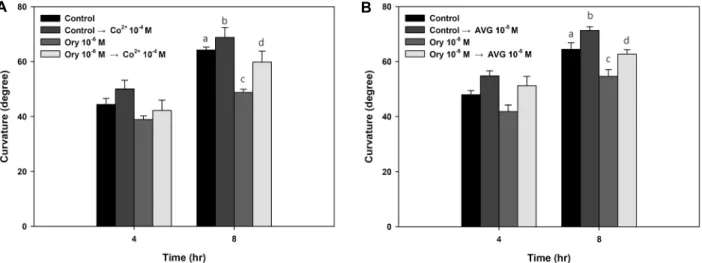
Fig. 5. Effect of cobalt ions (A) and AVG (B) on the pretreated with oryzalin in gravitropic response for 8 hr in the Arabidopsis root. Roots were pretreated with 10-6 M oryzalin for 2 hr vertically, and then transferred to the agar plate containing 10-4 M cobalt ions or AVG. The growth was measured for 8 hr using a camera as described in Material and Methods. Symbols are mean values ± SE from 15 independent experiments. Different letters indicate significant difference based on two-way ANOVA and Tukey test at p<0.05.
hibited from ethylene production, and root growth was in- creased compared to roots that was not pretreated with AVG as we predicted. When roots pretreated with oryzalin was transferred to AVG agar medium, root growth was recov- ered from the oryzalin-induced inhibition of root growth 58% at 4 hr and 100% at 8 hr.
Effect of cobalt ions and AVG on oryzalin-induced inhibition of root gravitropic response
We measured the effect of cobalt ions and AVG on or- yzalin-induced inhibition of gravitropic response in Arabid- opsis roots. For this experiment, roots were pretreated with 10
-6M oryzalin for 2 hr in vertical position, and then were transferred to the agar plate containing 10
-4M cobalt ions or 10
-8M AVG horizontally. Gravitropic response did not occurred when 10
-4M oryzalin were treated (data not shown). Therefore, we used 10
-6M oryzalin to measure the gravitropic response instead of 10
-4M oryzalin which was used for the root growth.
Application of 10
-4M cobalt ions restored the inhibition of gravitropic response by oryzalin as well as in root growth (Fig. 5A). The curvature was recovered by 6~8% in the con- trol root, and 10~20% in roots pretreated with 10
-6M or- yzalin over 8 hr.
Further, we examined the effect of 10
-8M AVG on the oryzalin-induced inhibition of gravitropic response (Fig. 5B).
The curvature was recovered by 22% in roots pretreated with 10
-6M oryzalin at 4 hr. The curvature of roots pre-
treated with 10
-6M oryzalin was recovered to the same de- gree as the control at 8 hr.
Several researches suggested that ethylene regulates growth and gravitropism in plants. Lee et al. [10] suggested that ethylene affects the gravity induced-lateral auxin trans- port, resulted in regulation of gravitropic curvature. And an optimal concentration of ethylene might be required for the regulation of gravitropism in maize roots [8]. Further, there are several reports that ethylene changed the arrangement of microtubule in plants [17].
In conclusion, oryzalin inhibited both gravitropic re- sponse and growth of Arabidopsis roots, and increased the ethylene production via activation of ACO and ACS. The increased ethylene might regulated the orientation of micro- tubule, resulting in inhibition of root growth and gravitropic sensing. Oryzalin, a known inhibitor of microtubule arrange- ment, promoted the ethylene production resulted in the in- hibition of root growth and gravitropic response in Arabid- opsis root. And this inhibition by the treatment of oryzalin could be recovered by cobalt ions and AVG which were in- hibitors of ethylene production. These results suggest that the oryzalin-induced inhibition both of growth and gravi- tropic response were recovered by the treatment of oryzalin.
This study suggested that the effect of oryzalin connected
with the ethylene production and root growth and gravi-
tropic response could be regulated according to the level of
ethylene.
Acknowledgement
This work was supported by a grant from 2018 Research Fund of Andong National University.
The Conflict of Interest Statement
The authors declare that they have no conflicts of interest with the contents of this article.
References
1. Abeles, F. B., Morgan, P. W. and Saltveit, M. E. Jr. 1992.
Ethylene in plant physiology. 2nd edn, Academic Press. San Diego, USA.
2. Amrhein, N. and Wenker, D. 1979. Novel inhibitors of eth- ylene production in higher plants. Plant Cell Physiol. 20, 1635-16428
3. Baskin, T. I., Beemster, G. T. S., Judy-March, J. E. and Marga, F. 2004. Disorganization of cortical microtubules stimulates tangential expansion and reduces the uniformity of cellu- lose microfibril alignment among cells in the root of Arabidopsis. Plant Physiol. 135, 2279-2290.
4. Bleecker, A. B. and Kende, H. 2000. Ethylene: a gaseous signal molecule in plants. Ann. Rev. Cell Dev. Biol. 16, 1-18.
5. Chan, J. 2012. Microtubule and cellulose microfibril ori- entation during plant cell and organ growth. J. Microscopy 247, 23-32.
6. Kim, C., Mulkey, T. J., Kim, J. S. and Kim, S. Y. 2015. Effect of oryzalin on the gravitropic response and ethylene pro- duction in maize roots. J. Life Sci. 25, 1223-1229.
7. Kim, S. Y. and Mulkey, T. J. 1997. Effect of ethylene antago- nists on auxin-induced inhibition of intact primary root elongation in maize (Zea mays L). J. Plant Biol. 40, 256-260.
8. Kim, S. Y., Kim, Y. K., Kwon, K. S. and Kim, K. W. 2000.
Action of malformin A1 on gravitropic curvature in primary roots of maize (Zea mays L.). J. Plant Biol. 43, 183-188.
9. Le, J., Vandenbussche, F., Van Der Straeten, D. and Verbelen, J. P. 2004. Position and cell type=dependent microtubule reorientation characterizes the early response of the Arabid- opsis root epidermis to ethylene. Plant Physiol. 121, 513-519.
10. Lee, J. S., Chang, W. K. and Evans, M. L. 1990. Effects of ethylene on the kinetics of curvature and auxin redis- tribution in gravistimulated roots of Zea mays. Plant Physiol.
94, 1770-1775.
11. Ma, Z. and Ren, Y. 2012. Ethylene interacts with auxin in regulating developmental attenuation of gravitropism in flax root. J. Plant Growth Regul. 31, 509-518.
12. Morejohn, L. C., Bureau, T. E., Mole-Bajer, J., Bajer, A. S.
and Fosket, D. F. 1987. Oryzalin, a dinitroaniline herbicide, binds to plant tubulin and inhibits microtubule polymer- ization in vitro. Planta 172, 252-264.
13. Polko, J. K., Zanten, M., Rooji, J. A., Maree, A. F. M., Voe- senck, L. A. C. J., Peeters, A. J. M. and Pierik, R. 2012.
Ethylene-induced differential petiole growth in Arabidopsis thaliana involves local microtubule reorientation and cell expansion. New Phytol. 193, 339-348.
14. Ruzicka, K., Ljung, K., Vanneste, S., Podhorska, R., Beeck- man, T., Friml, J. and Benkova, E. 2007. Ethylene regulates root growth through effects on auxin biosynthesis and transport-dependent auxin distribution. Plant Cell 19, 2197- 2212.
15. Strachan, S. D. and Hess, F. D. 1983. The biochemical mech- anism of action of the dinitroaniline herbicide oryzalin.
Pesticide Biochem. Physiol. 20, 141-150.
16. Wang, Y., Ji, Y., Fu, Y. and Guo, H. 2018. Ethylene-induced microtubule reorientation is essential for fast inhibition of root elongation in Arabidopsis. J. Integr. Plant Biol. 60, 864-877.
17. Yuan, M., Shaw, P. J., Warn, R. M. and Lloyd, C. W. 1994.
Dynamic reorientation of cortical microtubules, from trans- verse to longitudinal, in living plant cell. Proc. Natl. Acad.
Sci. USA. 91, 6050-6053.
18. Zarembinski, T. I. and Theologis, A. 1994. Ethylene biosyn- thesis and action: a case of conservation. Plant Mol. Biol.
26, 1579-1597.
초록:애기장대 뿌리에서 ethylene 생성 억제제가 oryzalin에 의해 억제된 뿌리 생장과 굴중성 반응에 미치는 영향
박호연․안동규․김순영*
(안동대학교 생명공학부 생명과학전공)