Korean J Biol Psychiatry 2018;25(3):72-78
Introduction
Although South Korea has shown a dramatic development in economy, there is inevitable dark side of the successful story.
The high suicide rate in South Korea has risen as a main con- cern not only in the public health sector, but in the society as a whole due to its magnitude and destructiveness. Despite the recent effort to reduce the rate, Korean suicide rate is still the highest in the western pacific area rating 32 people per 100000 and ranks third among all nations reporting the suicide rate, following Sri Lanka and Lithuania, 35.3 and 32.7, respectively.1) The suicide rate for the elderly in Korea is even higher as it re-
cords 80.3 people per 100000, which is 3.8 times higher than the Organization for Economic Cooperation and Development (OECD) average of 20.9. It has been predicted that the rate will grow higher as the aging population increases.
Many researches have been carried out to explore the possi- ble reasons for the higher suicide rates among the elderly peo- ple to date. Psychiatric illness including depression and alco- holism has been consistently reported to be related to suicides of the elderly through many studies.2)3) Other related factors are physical health and functioning and social factors such as stress and being solitary.4) Social connectedness in particular has caught interest in relation with suicide prevention, which
A Study on Factors Affecting Suicidal Tendency of the Elderly Living Alone on Care Services
Hwoyeon Seo, MD,
1,2Jee Hoon Sohn, PhD,
1Sung Jun Cho, PhD,
3,4Su Jeong Sung, PhD,
5Maeng Je Cho, PhD,
6Seung Hee Ahn, MSW
21Seoul National University Hospital Public Health Medical Service, Seoul, Korea
2JongnoGu Community Mental Health Center, Seoul, Korea
3Department of Psychiatry, Seoul National University Hospital, Seoul, Korea
4Seoul Mental Health Center, Seoul, Korea
5Department of Psychiatry, Hallym University Kangdong Sacred Heart Hospital, Seoul, Korea
6Seoul National University, College of Medicine, Seoul, Korea
ObjectivesZZThe high suicide rate has risen as a main concern in South Korea. Given the complexity of the mechanism resulting in complete suicide, studies targeting various populations are needed for broader understanding of its risk factors. This study aims to an- alyze the factors affecting the suicidal tendency in the population of the elderly living alone in Seoul depending on basic elderly-care services.
MethodsZZA total number of 415 people participated in the study. Home-visit interviews were administered by trained interviewers.
Suicidal tendency was measured by the Korean version of mini international neuropsychiatric interview (K-MINI). Health-related quality of life was measured by a brief version of the World Health Organization Quality-of-life Scale (WHOQOL-BREF). Alcohol problem was assessed by the Korean version of the alcohol use disorders identification test (AUDIT-K). Among total subjects of 415 in- terviewees, the actual responses of 408 people were used for the final analysis.
ResultsZZThe result showed that the suicide risk was high in persons isolated from social support [odds ratio (OR) = 4.49], having depression (OR = 14.85), and having low quality of life (OR = 4.39).
ConclusionsZZWe found that social support, depression and health-related quality of life are associated with suicidal tendency in the elderly living alone on basic services. Our evidence will contribute to suicide prevention policy for the elderly living alone on care ser- vices.
Key WordsZZThe elderly living alone ㆍSuicide ㆍDepression ㆍSocial connectedness.
Received: May 11, 2018 / Revised: June 18, 2018 / Accepted: July 30, 2018 Address for correspondence: Seung Hee Ahn, MSW
JongnoGu Community Mental Health Center, 10 Sungkyunkwan-ro 15-gil, Jongno-gu, Seoul 03066, Korea Tel: +82-2-745-0199, Fax: +82-2-745-3549, E-mail: [email protected]
has been well reflected in the strategy to tackle the suicide prob- lem published by centers for disease control and prevention (CDC).5) Living alone has been considered as a factor that in- creased the possibility of suicide via depression-however, living alone doubled the risk of suicide directly, regardless of depres- sion.6)7)
From the perspective of public health, it is suggested that se- lective prevention is more effective than universal prevention as the former targets the high-risk population based on the risk factors rather than the whole population.8) Consequently, in de- veloping strategies to tackle the elderly suicide, the aged popula- tion living alone is considered to be central as the number ex- ceeds 1.2 million, occupying 6.4% of all family types in Korea.9)
Studies investigating the risk factors causing suicidal idea among Korean elderly living alone reported controversial re- sults. Rim and colleagues reported that suicidal ideation in this population is caused by family types, physical health and daily life functioning.10) Seo and Lee,11) however, recently suggested that social support is not directly associated with suicidal ide- ation, but indirectly via depression. Given the complexity in the mechanism resulting in complete suicide, studies targeting various populations are needed for broader understanding of the risk factors. This study aims to analyze the factors affecting the suicidal tendency of the elderly living alone on basic elderly- care services in Seoul to prevent repeated suicide attempts and make productive suggestions to the clinical implication for so- cial welfare system.
Methods
Participants
We collected participants from Jongno District, one of 25 districts in Seoul. We utilized the data of the elderly over 65 liv- ing alone in 2012, provided by the department of Elderly Wel- fare of Jongno District.
Subjects were 415 people out of 440 who gave the informed consent. Home-visit interviews were administered by trained interviewers. Among total subjects of 415 interviewees, respons- es of 408 people who gave answers were utilized in the final analysis. This study used the secondary data.
Assessment
Suicidal tendency was measured by the Korean version of mini international neuropsychiatric interview (K-MINI). The MINI is an abbreviated interview developed for Diagnostic and Sta- tistical Manual of Mental Disorders 4th edition (DSM-IV) and International Classification of Diseases and Related Health Prob- lems 10th edition (ICD-10) psychiatric disorders. We employed
the K-MINI which Yoo et al.12) translated into Korean. The Sui- cidal module was composed of 6 questions. Points less than 5 was marked as low, 6-9 as middle and over 10 as high. For the measurement of depression, depression module of K-MINI was employed. Health-related quality of life was measured with a brief version of World Health Organization Quality-of-life Scale (WHOQOL-BREF). The WHOQOL was developed in the proj- ect initiated by the World Health Organization (WHO) to evalu- ate quality of life cross-culturally.13) The WHOQOL-BREF, an abbreviated version of the WHOQOL for the convenience in research, is comprised of 26 items covering 4 domains, namely physical health, psychological health, social relationships, and environment. We utilized the Korean version of the instru- ment translated and validated by Min and colleagues.14) In this study, the result score was converted into the 100-point scale.
Alcohol problem was assessed by the Korean version of the alcohol use disorders identification test (AUDIT-K). The original version was developed by Babor and Grant15) for the WHO in 1989 and Lee et al.16) translated the tool into Korean and stan- dardized it in 2000. The AUDIT-K consists of 10 questions, with 5-point scale for each. Tests that scored over 12 were considered to have alcohol problems, over 15 to be sufficiently diagnosed with an alcohol use disorder, and over 26 to have alcohol depen- dence. The frequency of interaction with family, friends and neighbors was questioned to measure the degree of social sup- port that the participants had. The participants were asked to choose one of the three level of the interaction. No interaction was marked as 0, occasional interaction as 1, and frequent interac- tion as 2. Information on sex, education level, age, and income was also gathered as controlled variables. The Korean version of mini-mental state examination (MMSE-KC) was used to assess the cognitive decline.
Data analysis
Chi-square and Fisher’s exact test was used to examine the association of suicidal tendency with variables such as demo- graphical characteristics, social activity and mental health problems. Multiple logistic regression was used to identify vari- ables associated with suicidal tendency. Level of significance was p = 0.05 (two-sided). We performed all exploratory and formal statistical analyses with SPSS version 18.0 (SPSS Inc., Chicago, IL, USA) for Windows.
Results
Characteristics of the study population
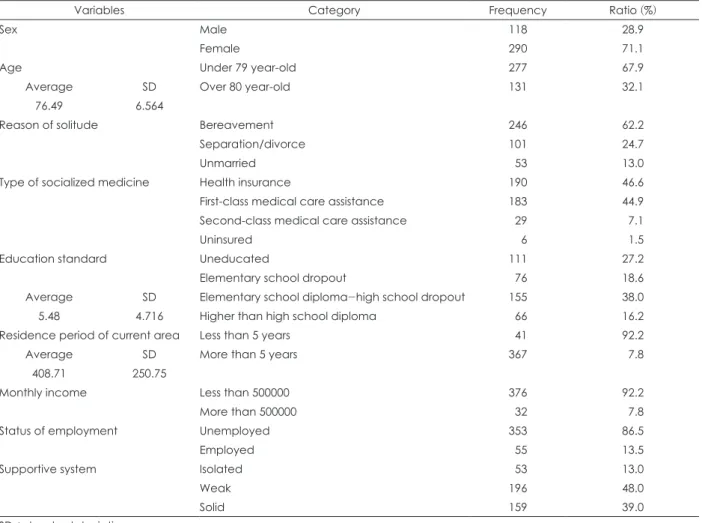
Demographic information of all participants is presented in Table 1. Women were predominant than men (71.1% vs. 28.9%).
Average age was relatively high marking 76.5, with 67.9% (277 out of 408) of the group over 80 and 32.1% of the group less than 80. Bereavements mostly accounted for the reason for living alone, as suspected by the high average age, followed by separa- tion/divorce and unmarried state. An absolute majority of par- ticipants (98.5%, 402 out of 408) reported any form of health in- surance while 1.5% (6 people) had no insurance at all. 16.2% (66 out of 408) had high school education or higher, and average years of education was 5.48 years. Most of the participants re- ported the relatively stable residence state as 90% (367 out of 408) did not move over 5 years. Economic state was relatively poor as most participants (92.2%) had a living with under 500000 won of monthly income. The state of unemployment outweighed
employment, with 86.5% (353 out of 408) to 13.5% (55 people).
People in complete isolation accounted for 13%(53 out of 408), while the others had some degree of relationship (87%, 345 people). 94.9% (387 out of 408) did not participate in social ac- tivities, while 5.1% (21 people) participated in any form of so- cial activities.
The Suicidal tendency by sex
Table 2 shows that suicidal tendency covering suicidal ideation, suicidal plan and the history of suicidal attempt was higher in men than women. Separately, there was a significant difference between male and female on suicide ideation and suicidal plan, with male higher in both (p = 0.02, p = 0.03, respectively), while Table 1. Characteristics of the study population
Variables Category Frequency Ratio (%)
Sex Male 118 28.9
Female 290 71.1
Age Under 79 year-old 277 67.9
Average SD Over 80 year-old 131 32.1
76.49 6.564
Reason of solitude Bereavement 246 62.2
Separation/divorce 101 24.7
Unmarried 53 13.0
Type of socialized medicine Health insurance 190 46.6
First-class medical care assistance 183 44.9
Second-class medical care assistance 29 7.1
Uninsured 6 1.5
Education standard Uneducated 111 27.2
Elementary school dropout 76 18.6
Average SD Elementary school diploma-high school dropout 155 38.0
5.48 4.716 Higher than high school diploma 66 16.2
Residence period of current area Less than 5 years 41 92.2
Average SD More than 5 years 367 7.8
408.71 250.75
Monthly income Less than 500000 376 92.2
More than 500000 32 7.8
Status of employment Unemployed 353 86.5
Employed 55 13.5
Supportive system Isolated 53 13.0
Weak 196 48.0
Solid 159 39.0
SD : standard deviation
Table 2. The suicidal tendency by sex
Variables Male Female
Frequency Ratio (%) Frequency Ratio (%) p
Concrete suicide ideation 43 36.8 63 21.8 0.02
Experience of suicidal plan 21 17.9 29 10.0 0.03
Experience of suicidal attempt 12 10.3 23 8.0 NS
NS : not significant
experience of suicidal attempt showed no statistical difference.
Distribution of suicide risk by demographical variables
A univariate analysis was conducted to identify suicide-risk distribution by demographical variables, health, and the quali- ty of life. Table 3 shows that the younger age group under 79 (p = 0.024), depressive disorder (p < 0.000), low quality of life (p = 0.002), and alcohol problems (p = 0.022) were likely to predict the higher previous suicidal attempt, while cognitive dysfunc- tion did not make any significant differences.Factors influencing the suicidal tendency in the elderly living alone
An analysis of logistic regression was conducted to identify the influence of factors on the entire suicide risk including sui-
cidal ideation, suicidal plan, and suicide attempt (Table 4). The result showed that the suicide risk was high in persons isolated from social support [odds ratio (OR) = 4.49, 95% confidence in- terval (CI) = 1.23-16.33, p = 0.02], having depression (OR = 14.85, 95% CI = 5.88-37.52, p < 0.001), and having low quality of life (OR = 4.39, 95% CI = 0.97-19.78, p = 0.05).
Discussion
The aim of this study is to investigate the risk factors affect- ing suicidal tendency in the elderly living alone on basic care services and to find a approach for future interventions. Our finding confirmed that depression, social support and health- related quality of life are risk factors for suicidal attempts in the elderly living alone on basic care services. Depression showed Table 3. Suicide-risk distribution by demographical variables
Variable Category
Previous suicide attempt
p No (n = 372) Yes (n = 34)
Frequency Rate (%) Frequency Rate (%)
Sex Male 88 28.8 10 29.4 NS
Female 265 71.2 24 70.6
Age Under 79 year-old 247 66.4 29 85.3 0.024
Over 80 year-old 125 33.6 5 14.7
Education standard Uneducated 99 26.6 12 27.3 NS
Elementary school dropout 67 18.0 8 18.5
Elementary school diploma-high school dropout
142 38.2 12 37.9
Higher than high school diploma 64 17.2 2 16.3
Residence period of current area Under 5 year 39 10.5 1 2.9 NS
Over 5 year 333 89.5 33 97.1
Monthly income Over 500000 won 340 91.4 34 100 NS
Under 500000 won 32 8.6 0 0
Employment Unemployed 321 86.3 30 88.2 NS
Employed 51 13.7 4 11.8
Social support Isolated 47 12.6 6 17.6 0.064
Weak 175 47.0 19 55.9
Solid 150 43.1 9 26.5
Participation of social activities No 350 95.1 37 92.5 NS
Yes 18 4.9 3 7.5
Presence of depressive disorder No 302 81.2 14 41.2 0.000*
Yes 70 18.8 20 58.8
Quality of life Low 84 22.6 17 50.0 0.002
Middle 206 55.4 12 35.3
High 82 22.0 5 14.7
Presence of cognitive impairment Yes 208 55.9 16 52.9 NS
No 164 44.1 18 47.1
Having alcohol problem Yes 164 2.2 4 10 0.022
No 360 97.8 36 90
* : p < 0.001. NS : not significant
the strongest association with suicidal tendency in both univari- ate and multivariate analyses, which is consistent with many previous studies.4-17) While the prevalence of depression was re- ported relatively low in this study (22%, 90 out of 406) consid- ering the known higher prevalence in this population, the pro- portion of people with depression among suicidal attempters (58.8%, 20 out of 34) approximated to other studies.18)19) While males were more likely to show suicidal ideation and planning, we were unable to find the difference in the experience of sui- cidal attempts by sex in the univariate analysis. Although sui- cidal idea and plan as symptoms of depression are generally known to be more prevalent in women across the life span, liv- ing alone affects more men than women in the elderly.20)21) A Ko- rean study investigating gender difference in mental health among elderly Koreans reported that men living alone were ap- proximately three times more likely to have depressive symp- toms and five times to have suicidal ideation while women were
not affected by the factor of living alone.22)
As for the discrepancy between experience of suicidal attempt and plan, many studies investigated the gap between simple ide- ation and suicidal attempts.23)24) For example, Lewitzka et al.23) compared a group of people with only suicidal ideation to the group with history of suicidal attempts. It showed that while the proportion of female was higher in both groups, female were significantly more likely to have suicidal ideation without attempts. This seemingly different report of suicidal ideation by sex may be down to the difference in the study population as the previous reserch was conducted with the patients with an affective disorder, whereas our study was conducted with people living within a community. It should be noted, however, that male complete suicides outnumbered female in most studies.25)26)
Those who have younger age, depression, low health-related quality of life and an alcohol problem were significantly more likely to report the experience of suicidal attempts, as shown in Table 4. Influencing factors on the suicidal tendency in the elderly living alone
Variable Category OR 95% CI
Lower Upper p
Sex Male 1
Female 0.48 0.17 1.32 0.15
Age Under 79 year-old 1
Over 80 year-old 0.41 0.15 1.14 0.09
Education Uneducated 1
Elementary school dropout 2.03 0.68 6.09 0.21
Elementary school diploma-high school dropout
0.59 0.19 1.87 0.37
Higher than high school diploma 1.94 0.48 7.94 0.35
Monthly income Under 500000 won 1
Over 500000 won 0.61 0.11 3.54 0.58
Employment Unemployed 1
Employed 0.45 0.15 1.38 0.16
Social support Solid 1
Weak 2.00 0.76 5.27 0.16
Isolated 4.49 1.23 16.33 0.02
Reason for living alone Bereavement 1
Separation/divorce 0.91 0.34 2.47 0.86
Unmarried 1.28 0.35 4.67 0.71
Presence of depression No 1
Yes 14.85 5.88 37.52 0.00*
Quality of life High
Middle 2.76 0.64 11.91 0.17
Low 4.39 0.97 19.78 0.05
Presence of cognitive impairment No 1
Yes 1.84 0.72 4.69 0.20
Having alcohol problem No 1
Yes 0.19 0.03 1.09 0.06
* : p < 0.001. OR : odds ratio, CI : confidence interval
the univariate analysis. The weaker social support showed the moderate association with history of suicidal attempts. Depres- sion is a predominant risk factor reported consistently for sui- cidality regardless of the population. Although health condi- tion affects the mental health factors and vice versa, and both interplay in forming suicidality, one study suggested that phys- ical health solely had an independent influence on the suicidal ideation.27) Some authors argued that physical illness is more associated with men than women in terms of suicidality, which could be a hint for developing interventions specific to this pop- ulation. Alcohol problem showed the significant association not with suicidal tendency, but suicidal attempts. Consistent with the previous study conducted with the elderly living alone in Seoul, our study strongly suggested that the alcohol problem played an important role in pushing the ideation into action.28) Interestingly, our study showed less suicidality in age over 80, which is counter-intuitive given the fact that the group over 80 shows the highest suicidal rate among all age groups in Korea.29) This may imply the distinctive mechanism between suicidal ide- ation and suicidal attempt.
The recent understanding of suicide highlighted the internal psychological process of “build-up to the final action”, called an
“ideation-to-action” framework.30) This framework has shed light on contributors and protective factors by emphasizing a three- step process from suicidal ideation to attempt. This theory hy- pothesizes that suicidal ideation develops in combination with pain and hopelessness and lack of social connectedness, and varied contributors play a role in facilitating the progression from ideation to attempts.
Several limitations need to be addressed. First, although the sample size is relatively large compared with previous studies on the elderly living alone conducted in Korea, the larger sam- ple may be needed to investigate possible risk factors compre- hensively. Second, as our study was conducted in a specific context of Jongno district, we should be cautious with the generalization of the result.
In conclusion, suicidality is a complex phenomenon caused by internal and external contributors. We found that social support, depression and health-related quality of life are asso- ciated with suicidal tendency in the elderly living alone on ba- sic services. Our evidence will contribute to establishing suicid- al prevention policy for the elderly living alone on care services.
Conflicts of interest
The authors have no financial conflicts of interest.
REFERENCES
1) World Health Organization [homepage on the Internet]. Geneva:
World Health Statistics Data Visualizations Dashboard 2017 [cited
2018]. Available from: http://apps.who.int/gho/data/node.sdg.3-4- viz-2?lang=en.
2) Schulz R, Drayer RA, Rollman BL. Depression as a risk factor for non-suicide mortality in the elderly. Biol Psychiatry 2002;52:205- 3) Berglund M, Ojehagen A. The influence of alcohol drinking and 225.
alcohol use disorders on psychiatric disorders and suicidal behav- ior. Alcohol Clin Exp Res 1998;22:333S-345S.
4) Conwell Y, Van Orden K, Caine ED. Suicide in older adults. Psy- chiatr Clin North Am 2011;34:451-468, ix.
5) Centers for Disease Control and Prevention. Promoting Individual, Family, and Community Connectedness to Prevent Suicidal Behav- ior. Atlanta, GA: Cent. Dis. Control Prev;2008. p.3-5.
6) Schneider B, Lukaschek K, Baumert J, Meisinger C, Erazo N, Ladwig KH. Living alone, obesity, and smoking increase risk for suicide in- dependently of depressive mood findings from the population-based MONICA/KORA Augsburg cohort study. J Affect Disord 2014;152- 154:416-421.
7) Fukunaga R, Abe Y, Nakagawa Y, Koyama A, Fujise N, Ikeda M.
Living alone is associated with depression among the elderly in a rural community in Japan. Psychogeriatrics 2012;12:179-185.
8) Gordon RS Jr. An operational classification of disease prevention.
Public Health Rep 1983;98:107-109.
9) Statics Korea. 2016 the Elderly Statistics. Daejeon: Statics Korea;2016.
10) Rim CS, Jang GS, Jeong MS. A study on influential factors for the suicide ideation of the elderly living alone. Social Science Studies 2013;22:192-223.
11) Seo IK, Lee YS. Mediated effects of depression on the relationship between social resources of the elderly living alone and their suicid- al ideation-With a focus on the comparison between the elderly liv- ing alone in rural and urban areas. J Welf Aged Inst 2016;71:219-247.
12) Yoo SW, Kim YS, Noh JS, Oh KS, Kim CH, Nam KG, et al. Validity of Korean version of the mini-international neuropsychiatric inter- view. Anxiety and mood 2006;2:50-55.
13) World Health Organization [homepage on the Internet]. Geneva:
WHO Quality of Life-BREF (WHOQOL-BREF) [cited 2018 Apr 10]. Available from: http://www.who.int/substance_abuse/research_
tools/whoqolbref/en/.
14) Min SK, Lee CI, Kim KI, Suh SY, Kim DK. Development of Korean version of WHO Quality of Life Scale abbreviated version (WHO- QOL-BREF). J Korean Neuropyschiatr Assoc 2000;39:571-579.
15) Babor TF, Grant M. From clinical research to secondary prevention:
international collaboration in the development of the Alcohol Disor- ders Identification Test (AUDIT). Alcohol Health and Research World 1989;13:371-375.
16) Lee BO, Lee CH, Lee PG, Choi MJ, Namkoong K. Development of Korean version of Alcohol Use Disorders Identification Test (AU- DIT-K): its reliability and validity. J Korean Acad Addict Psychiatry 2000;4:83-92.
17) Harris EC, Barraclough B. Suicide as an outcome for mental disor- ders. A meta-analysis. Br J Psychiatry 1997;170:205-228.
18) Harwood D, Hawton K, Hope T, Jacoby R. Psychiatric disorder and personality factors associated with suicide in older people: a descrip- tive and case-control study. Int J Geriatr Psychiatry 2001;16:155-165.
19) Conwell Y, Duberstein PR, Hirsch JK, Conner KR, Eberly S, Caine ED. Health status and suicide in the second half of life. Int J Geriatr Psychiatry 2010;25:371-379.
20) Girgus JS, Yang K, Ferri CV. The gender difference in depression:
are elderly women at greater risk for depression than elderly men?
Geriatrics 2017;2:35.
21) Albert PR. Why is depression more prevalent in women? J Psychia- try Neurosci 2015;40:219-221.
22) Jeon GS, Jang SN, Rhee SJ, Kawachi I, Cho SI. Gender differences in correlates of mental health among elderly Koreans. J Gerontol B
Psychol Sci Soc Sci 2007;62:S323-S329.
23) Lewitzka U, Spirling S, Ritter D, Smolka M, Goodday S, Bauer M, et al. Suicidal ideation vs. suicide attempts: clinical and psychoso- cial profiledifferences among depressed patients: a study on per- sonality traits, psychopathological variables, and sociodemograph- ic factors in 228 patients. J Nerv Ment Dis 2017;205:361-371.
24) Nock MK, Kessler RC, Franklin JC. Risk factors for suicide ideation differ from those for the transition to suicide attempt: the impor- tance of creativity, rigor, and urgency in suicide research. Clinical Psychology: Science and Practice 2016;23:31-34.
25) Conwell Y, Duberstein PR, Cox C, Herrmann JH, Forbes NT, Caine ED. Relationships of age and axis I diagnoses in victims of complet- ed suicide: a psychological autopsy study. Am J Psychiatry 1996;153:
1001-1008.
26) Henriksson MM, Marttunen MJ, Isometsä ET, Heikkinen ME, Aro
HM, Kuoppasalmi KI, et al. Mental disorders in elderly suicide. Int Psychogeriatr 1995;7:275-286.
27) Cattell H. Suicide in the elderly. Advances in Psychiatric Treatment 2000;6:102-108.
28) Kwon JD, Kim YJ, Um TY. Suicidal ideation among older adults who live alone with care services: a moderating effect of alcohol drinking in the relationship between previous suicidal attempts and suicidal ideation. J Welf Aged Inst 2011;51:297-320.
29) Korea Suicide Prevention Center [homepage on the Internet].
Seoul: Suicide Rates by Gender and Age [cited 2018 Apr 30]. Avail- able from: http://www.spckorea.or.kr/new/sub03/sub03.php#.
30) Klonsky ED, May AM. The three-step theory (3ST): a new theory of suicide rooted in the “ideation-to-action” framework. International Journal of Cognitive Therapy 2015;8:114-129.