산초열매의 채집 시기별 일반성분, 지방산 및 정유성분 조성 변화
배성문*†·진영민*·정은호*·김만배*·신현열*·노치웅*·이승철**
*경남농업기술원, **경남대학교 식품생명학과
Studies on Proximate Composition, Fatty Acids and Volatile Compounds of Zanthoxylum schinifolium Fruit According to Harvesting Time
Sung Mun Bae
*†, Young Min Jin
*, Eun Ho Jeong
*, Man Bae Kim
*, Hyun Yul Shin
*, Chi Woong Ro
*and Seung Cheol Lee
***
Gyeongnam Agricultural Research and Extension Services, Jinju 660-985, Korea.
**
Department of Food Science and Biotechnology, Kyungnam University, Changwon 631-701, Korea.
ABSTRACT : Biological characteristics of 5 Zanthoxylum schinifolium (Zs) fruits such as Z1 (early August), Z2 (middle August), Z3 (middle September), Z4 (early October) and Z5 (middle October) according to harvesting time were evaluated.
As fruits ripened, average weight of Zs increased from 4.8 ㎎ (Z1) to 50.7 ㎎ (Z5), while moisture contents decreased from 74.6% (Z1) to 55.2% (Z5). Crude fat contents of the fruits during ripening increased from 1% (Z1) to 10.6% (Z5). The major fatty acids in Zs were palmitic (C16:0), palmitoleic (C16:1), oleic (C18:1), and linoleic (C18:2) acids. Linoleic acid (C18:2) was a main fatty acid in Z1 and Z2, whereas oleic acid (C18:1) was found as a main one in the other Zs. The ratio of unsaturated fatty acid to total fatty acids increased from 60% (Z1) to 80% (Z3~Z5) during ripening. Among ripening stages, Z4 had the highest contents of total fatty acids (3,355 ㎍ /g) and total unsaturated fatty acids (2,753 ㎍ /g). Forty six volatile compounds in Zs were also identified. The major volatile compounds were α -pinene, β -myrcene, β -ocimene, 2-nonanone, estragole, 2-undecanone, and β -caryophyllene. Major volatile components of Z1 were β -ocimene (20.8 peak area %) and α - pinene (9.7 peak area %). In Z2, estragole (30.1 peak area %) was a main volatile compound, but the contents of α -pinene (0.4 peak area %), β -myrcene (0.3 peak area %), and β -ocimene (0.6 peak area %) were lower than those in Z1. Especially, estragole used as perfumes and as a food additive for flavor was drastically increased to 91.2 (Z3) and 92% (Z4) as fruits ripened.
Key Words : Zanthoxylum schinifolium, Harvesting Time, Fatty Acid, Volatile Compound
서 언
산초나무 ( Zanthoxylum schinifolium ) 는 우리나라를 비롯한
중국 , 일본 , 대만 등의 동북아시아에 주로 자생하는 운향과 (Rutaceae) 의 산초나무속 ( Zanthoxylum Linne) 식물로 전세계 적으로 105 종이 있으며 이중 64 종이 향신료로 이용되고 있으 며 , 우리나라에는 6 종이 자생하고 있다 . 대표적인 산초나무속 식물로는 화초나무 ( Zanthoxylum bungeanum Maxim.) 와 산 초나무 ( Zanthoxylum schinifolium Sieb et Zucc), 초피나무
( Zanthoxylum piperitum DC.) 가 있다 (Jeong and Shin, 1990). 산초나무는 예로부터 , 건위 , 소염 , 이뇨 , 구충제 , 위하수
증 , 위장확대 등에 유용하며 , 식욕증진 , 치통 , 신경통 , 저혈압 증 , 냉증 , 참식증 , 요로결석 , 지사제 , 감기 , 중풍치료 등에 이용 되어왔다 (Lee, 1998; Lee, 1996). 민간에서는 8~9 월 경의 어
린 산초열매를 이용하여 산초장아찌 , 술 등 식품류로 이용하 고 있으며 , 10 월 전후 성숙된 열매는 과피를 제거하고 착즙한 산초유의 형태로 이용하는데 , 위장병 , 기관지 천식의 치료의
목적으로 이용하고 있다 .
최근 , 약초의 특정 약리성분이나 생리활성성분이 가장 많이 생산되는 시기를 구명하여 약초생산에 이용하고 있는데 , 최 등
(2009) 은 인삼 잎의 총사포닌함량은 4 월 15 일에 비해 한 달 뒤 5 월 25 일의 함량이 약 9 배 증가한 것을 보고한 바 있고 ,
장 등 (2008) 은 4 월에서 7 월사이의 선학초 전초의 항산화 활 성은 7 월이 가장 높아 채취시기별로 항산화 활성이 다름을 보
고한바 있다 . 산초열매의 경우에도 , 산초유로 이용되는 10 월경
의 성숙된 산초열매에는 oleic acid 와 linoleic acid 와 같은 불 포화 지방산이 다량 함유되어 있는 것으로 밝혀진 바 있으나 열매의 성숙과정중의 변화에 대한 연구는 보고된 바 없다
†
Corresponding author: (Phone) +82-55-960-5830 (E-mail) [email protected]
Received 2010 December 20 / 1st Revised 2011 January 19 / 2nd Revised 2011 February 9 / Accepted 2011 February 11
(Cha et al. , 2000). 산초에는 다양한 휘발성 성분이 함유되어
있다고 알려져 있다 (Shin et al., 2006). Lee 등 (1998) 은
연속증류추출법 (SDE) 법을 이용하여 10 월 경의 산초열매에서
57 종 , 산초나무에서 44 종의 휘발성 향기 성분을 확인하였으며 ,
주요 성분으로는 geranyl acetate, geraniol 등이었다고 보고하 였다 . 또한 , Lee 등 (1999) 도 산초의 휘발성 성분을 Solid phase micro extraction (SPME) 법과 Simultaneous steam distillation and extraction (SDE) 법으로 비교하였는데 , 그 결과 SPME 법에서는 limonene 이 가장 많았고 , SDE 법에서는 geranyl acetate 가 가장 많이 함유되어 있어 시료의 추출법에 따라 함유된 정유 성분의 함량 및 조성비가 다르다고 보고하 였다 . 시기별 산초의 정유 함량을 분석한 결과 산초열매는 9
월에 정유 함량이 가장 많았으며 , 잎은 8 월에 가장 많았으나 이후로 감소하였다고 보고하였다 (Seo, 1994). 대부분의 산초 열매의 정유 성분 분석 연구는 건조된 채로 판매되는 성숙 과 실을 대상으로 연구한 결과로서 , 산초열매의 성숙 과정 중의
정유 성분의 변화를 관찰할 수는 없었다 . 또한 , 국내에서 많이 이용되는 초피와 산초나무는 형태적으로 유사한 식물로서 , 산 초와 초피의 잎과 열매의 향기 성분의 분석 비교 , 산초의 재 배지역과 생육시기 간의 정유 성분 변이를 분석한 바 있지만
(Cho et al. , 2001; Cho et al. , 2002; Cho et al. , 2003),
열매가 맺히기 전인 6 월과 열매가 성숙되기 시작하는 9 월의
두 시기만의 분석비교로 열매성숙에 따른 정유성분의 변화를 관찰하기에는 부족한 면이 있다 . 최근의 연구결과 , 산초나무의 부위에 따라 항산화 (Shin et al. , 2006; Jang et al. , 2005;
Mun et al. , 1994), 항균 (Kim et al. , 2000; Kim and Han, 1997; Kim et al. , 2004), 항암 (Chen et al. , 1995; Chang et al. , 1997; Jun et al. , 2008; Jun et al. , 2007) 등 다양한 생리활성이 보고되고 있으며 , 이러한 기능성을 이용한 항균치
약 , 냉동 건조미꾸라지의 저장성 연장 , 산초가 들어가는 발효
콩 제품인 담두시의 제조에 관한 연구 등 다양한 상품이 개발 되고 있다 (Mun et al. , 1999; Lee, 2003). 산초열매의 다양 한 이용가능성에 비하여 열매의 성숙 정도에 따른 구성 성분 의 조성 및 생리활성의 변화에 대한 연구는 미비한 실정이다 .
따라서 , 본 연구에서는 산초열매가 생성되어 성숙되는 시기 인 8~10 월 사이에 시기별 5 단계로 채집한 산초열매의 일반
성분 , 지방산 및 정유 성분의 조성 변화를 분석하고자 한다 . 재료 및 방법
1. 실험재료
산초나무 ( Zanthoxylum schinifolium Sieb et Zucc) 의 열매 는 2008 년 8 월부터 10 월까지 경남농업기술원약초시험사업장
( 경남 함양군 ) 에서 재배된 산초나무의 열매를 본 연구에 사용
하였으며 , 8 월초에 채취한 산초열매를 Z1, 8 월 중순에 채취한
산초열매를 Z2, 9 월 중순에 채취한 열매를 Z3, 10 월 초순에
채취한 열매를 Z4, 10 월 중순에 채취한 열매를 Z5 로 명명 하
였다 . 채취한 열매는 − 40 ℃ 보존하면서 일부 생체시료는 정유 성분 분석용으로 이용하였으며 , 나머지는 자연 음건하여 분쇄 한 뒤 시험재료로 사용하였다 . 냉동 보관된 건조 산초분말
10 g 에 95% methanol 50 ㎖을 가하여 상온에서 24 시간 3 회 반복 추출하였고 , 40 ℃에서 감압농축한 뒤 dimethyl sulfoxide (DMSO) 에 50 ㎎ / ㎖ 농도로 녹여 실험에 사용하였다 .
2. 종자 채취 시기별 외형 특성
결실초기인 8 월 초순부터 결실이 완료되는 10 월 중순까지
5 단계에 걸쳐 열매의 색 , 폭 , 높이 , 무게 , 껍질의 두께를 측정 하였다 .
3. 일반성분
산초열매의 조단백질은 Semi micro kjeldahl 법 (Foss digester 2020 and Foss Kjeltec 2400 analyzer, Foss Tecator, Huddinge, Sweden), 수분 함량은 상압가열건조법으로 측정하였고 , 조지 방은 Soxhlet 법 , 회분 함량은 직접회화법으로 분석하였고 모
두 AOAC 법에 준하는 방법으로 분석하였다 .
4. 지방산
건조 산초분말 8 g 을 취하고 100 ㎖의 ether 를 가하여 상온 에서 24 시간 추출한 후 , 감압농축하여 추출물을 제조하였다 .
농축물을 환저플라스크에 취하고 3 ㎖의 0.5 N NaOH/MeOH
를 가하여 100 ℃ 모래상자에서 10 분간 반응시키고 , 14% BF
33 ㎖를 넣고 2 분간 반응한 후 , 5 ㎖의 헥산을 넣어 1 분간 반 응시킨 후 상온에서 냉각한다 . 포화식염수 15 ㎖를 가한 뒤
10 초간 격렬히 반응시키고 헥산층을 취한 뒤 무수황산나트륨
을 가하여 탈수한 뒤 GC (Agilent GC6890, Agilent Tech- nologies, Santa Clara, USA) 로 분석하였다 . 분석 컬럼은 HP INNOWAX (30 m × 0.25 ㎜ × 0.25 ㎛ ) 을 사용하였고 , 이동상은 질소가스를 사용하였으며 이동상의 속도는 1 ㎖ /min 으로 하였 다 . 오븐온도는 150 ℃에서 1 분간 유지 후 , 180 ℃까지 1 분당
20 ℃ 승온하여 2 분간 유지하였고 , 230 ℃까지 1 분당 3 ℃ 승온 하여 5 분간 유지하였으며 , 250 ℃까지 1 분당 5 ℃ 승온하여 5 분
간 유지하였다 . Injector 와 Detector 의 온도는 250 ℃로 하였다 .
5. 정유성분
− 40 ℃에서 동결 보존된 산초열매를 Head-space 법으로 정유 성분을 추출한 뒤 GC-MS (Clarus 600 GC-MS, Perkin Elmer, USA) 를 이용하여 분석하였다 . 분석 컬럼은 Perkine- lmer Elite-5ms (30 m × 0.3 ㎜ × 0.25 ㎛ ) 로 , 이동상은 헬륨 가
스를 사용하였고 , 이동속도는 1.0 ㎖ /min 으로 하였다 . 오븐 온
도는 40 ℃에서 100 ℃까지 1 분당 10 ℃ 승온한 후 1 분간 유지
하였고 , 230 ℃까지 1 분당 3 ℃ 승온한 후 5 분간 유지하였다 . Injector 의 온도는 200 ℃ , Detector 의 온도는 250 ℃로 하였다 .
분석된 결과는 NIST 와 Willy 를 이용하여 동정하였다 .
6. 통계처리
데이터의 통계처리는 각 시료를 3 회 반복으로 행해졌으며 , SAS (Statistical Analysis System) 를 이용하여 평균값과 , Duncan's multiple range tests 로 평균값들에 대한 유의성을 검 정하였다 .
결과 및 고찰
1. 종자 채취 시기별 외형 특성
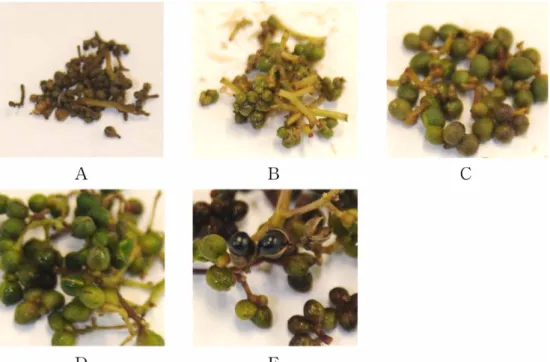
산초나무는 7 월 ~8 월 개화가 시작되어 10 월에 결실이 완료 되는 운향과 식물이다 (Lee, 1998). 채취 시기별 산초열매의 외형적 특성은 Fig. 1 과 Table 1 과 같다 . 결실초기의 열매는
작고 , 옅은 노란색을 띄며 생육이 진행됨에 따라 점차 외형적 증가와 색이 변화됨을 알 수 있었다 . 색의 변화는 8 월초 (Z1)
에 노란색에서 생육이 진행됨에 따라 연녹색 (Z2), 녹색 (Z3, Z4), 갈색 (Z5) 으로 변화되었다 . Z1 의 열매의 폭과 높이는 각 각 0.8 ㎜ , 1.1 ㎜로서 매우 작았지만 , Z5 에서 3.8 ㎜와 4.8 ㎜ 로 4~5 배 증가 하였다 . 또한 무게의 변화도 Z1 에서 산초열매
의 중량은 4.8 ㎎이었지만 , 생육이 진행되어 10 월 중순경인
Z5 에서는 50.7 ㎎으로 약 10 배 증가되었다 . 이는 산초열매가 결실초기에 비해 결실이 완료되는 시기에 외형적 크기보다 밀 도의 증가가 더 큼을 알 수 있었다 . 산초열매 껍질의 두께는 결실초기에는 측정이 불가능하였고 , Z3 시기 이후로 0.3 ㎜ 정 도로 일정하게 유지되었다 .
2. 일반성분
산초 열매의 일반성분 분석결과는 Table 2 과 같다 . 수분함 량은 Z1 이 74.6% 이었고 , Z5 는 55.2% 로 20% 정도 감소되어
Fig. 1.Shape of Zanthoxylum schinifolium fruit according to ripening stages. A : early August, B : middle August, C : middle September,
D : early October, E : middle October.
Table 1.
General growth properties of Zanthoxylum schinifolium fruit.
Sample Width (
㎜) Height (
㎜) Thickness of peel (
㎜) Weight (
㎎)
Z1
†0.8±0.15d 1.1±0.20c n.d.
§84.8±0.26d
‡Z2 2.4±0.17c 2.8±0.11b n.d. 13.2±0.07d
Z3 3.5±0.14b 4.8±0.11a 0.3±0.05 29.5±1.62c
Z4 3.8±0.10a 4.9±-.05a 0.3±0.02 30.7±1.21b
Z5 3.8±0.19a 4.8±0.11a 0.3±0.02 50.7±3.80a
†
Z : Zanthoxylum shinifolium fruit,
‡Different letters (a-d) within a column are significantly different (p < 0.05, n = 3),
§not detected.
생육이 진행됨에 따라 수분함량이 감소됨을 알 수 있었다 . 조 단백질의 함량은 Z1 이 4.2%, Z3 가 4.4%, Z5 가 5.2% 로 열매 생육 진행에 따라 일정하게 유지되었다 . 조지방 함량은 Z1 에 서 1% 가량 함유되어 있었지만 , Z3 에서 8.5% 로 급격히 증가 되었고 Z5 에서는 10.6% 로 Z1 과 비교시 약 10 배 가량 증가된 값이었다 . 이 결과는 산초 열매의 생육 진행에 따른 중량 증 가와 유사한 경향을 보이는 것을 알 수 있었다 . 회분 함량은 Z1 의 1.6% 에서 Z5 의 2.7% 로 성숙하면서 약간 증가되는 경향 이었다 .
3. 지방산
Gas chromatography 를 이용한 지방산분석을 위하여 탄소사슬
14~22 개인 지방산 11 종을 표준물질로 사용하였다 (Table 3). 채
Table 2.
Proximate composition of Zanthoxylum schinifolium fruit.
Sample Moisture (%) Crude protein (%) Crude fat (%) Ash (%)
Z1
†74.6±0.51 4.2±0.05 81.0±0.07 1.6±0.04
‡Z2 69.1±0.01 3.2±0.11 84.2±0.16 1.7±0.02
Z3 62.4±0.62 4.4±0.44 88.5±0.06 2.0±0.05
Z4 59.6±0.91 4.7±0.25 10.0±0.22 2.5±0.12
Z5 55.2±0.87 5.2±0.09 10.6±0.30 2.7±0.15
†
Z : Zanthoxylum shinifolium fruit,
‡All values are mean±SE (n = 3).
Table 3.
Calibration curves of the 11 fatty acids standard compounds.
Fatty acid Calibration curves r
2Myristic acid (C14:0) y = 1.2659x
−0.35 0.9982 Palmitic acid (C16:0) y = 1.3778x
−0.7 0.9960 Palmitoleic acid (C16:1) y = 1.3313x
−0.35 0.9981 Stearic acid (C18:0) y = 1.227x
−0.5 0.9939 Oleic acid (C18:1) y = 1.1013x
−2×10
−140.9978 Linoleic acid (C18:2) y = 1.4005x + 1.1 0.9914 Linolenic acid (C18:3) y = 1.3602x
−0.1 0.9959 Arachidic acid (C20:0) y = 1.6016x + 1.9 0.9826 cis-11-Eicosenoic acid (C20:1) y = 1.6997x + 0.2 0.9762 Arachidonic acid (C20:4) y = 1.276x
−0.55 0.9964 Behenic acid (22:0) y = 1.2006x
−0.25 0.9955
Fig. 2.
GC chromatogram of Zanthoxylum schinifolium fruit.
A : Z1, B : Z2, C : Z3, D : Z4, E : Z5
STD : 1 : myristic acid (C14:0), 2 : palmitic acid (C16:0), 3 : palmitoleic acid (C16:1), 4 : stearic acid (C18:0), 5 : oleic acid (C18:1),
6 : linoleic acid (C18:2), 7 : linolenic acid (C18:3), 8 : arachidic acid (C20:0), 9 : cis-11-eicosenoic acid (C20:1), 10 :
arachidonic acid (C20:4), 11 : behenic acid (22:0)
집시기별 산초열매의 지방산을 분석한 결과 11 종의 지방산 중 myristic acid (C14:0), linolenic acid (C18:3), arachi- donic acid (C20:4) 를 제외한 8 종의 지방산이 검출되었다
(Fig. 2). 다양한 지방산이 존재하는 동물조직에 비해 식물조직 에는 주로 짝수 탄소를 지닌 palmitic acid (16:0), stearic acid (18:0), oleic acid (18:1), linoleic acid (18:2), linolenic acid (18:3) 등 5 가지 장쇄지방산이 존재하며 , 중쇄지방산 중
윤활유 , 비누 , 초콜릿 등 공업용 재료로 이용되는 myristic acid (14:0) 는 붓꽃에 많이 함유되어 있으며 (Kim et al ., 2001), 달맞이꽃처럼 드물게 γ -linolenic acid 가 함유되어 있기 도 하다 (Kim et al., 1995). 그러나 , 탄소 사슬이 더 길고 이중결합이 3 개 이상인 Polyunsaturated fatty acids (PUFA) 는
고등 식물에서 생산되지 않는 것으로 알려져 있다 (Kim et
al ., 2009). 검출된 지방산 함량 , 불포화지방산 및 포화지방산
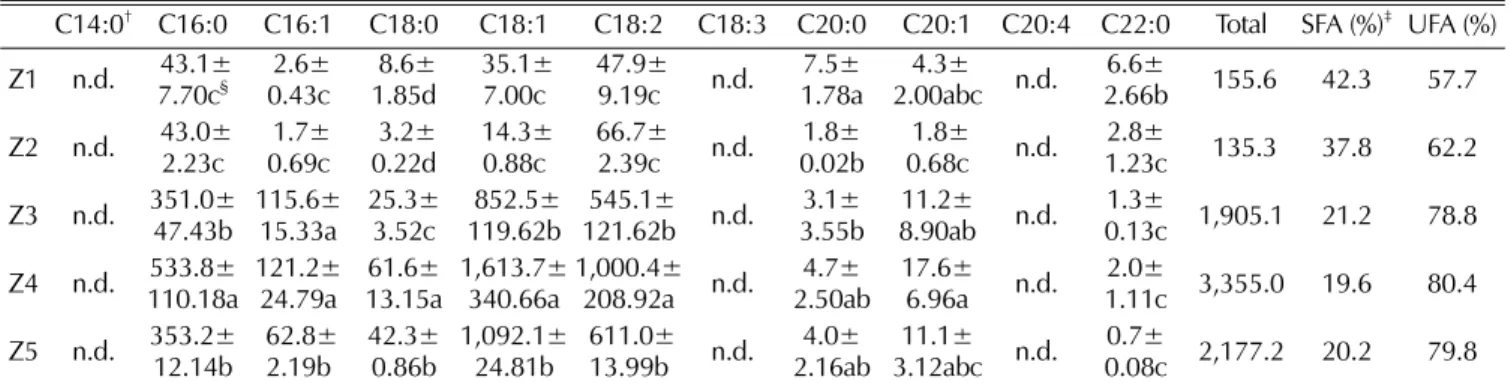
의 비율은 Table 4 와 같다 . 산초열매의 성숙과정별 전체 지방
산함량은 생육초기인 Z1 이 155.6 ㎍ /g, Z2 가 135.3 ㎍ /g 이었고
9 월 중순 경인 Z3 이 1,905 ㎍ /g 으로 급격히 증가되었고 , 10 월 초순경인 Z4 에서는 3,355 ㎍ /g 으로 조사 시기 중 가장 높은 함량을 보였다 . 이는 Z1 과 비교시 약 22 배 높은 함량이었으 며 , 중량은 6 배 , 조지방 함량은 10 배 증가한 것과 비교해서 매우 높은 값이었다 . 지방산의 비율은 Z1 에서 palmitic acid (C16:0) 가 43.1 ㎍ /g, linoleic acid (C18:2) 가 47.9 ㎍ /g 로 가
장 많이 함유되어 있었으며 , Z2 에서도 유사한 경향이었다 . 반 면 , Z3 에서는 palmitic acid (C16:0) 가 351 ㎍ /g, palmitoleic acid (C16:1) 가 115.6 ㎍ /g, oleic acid (C18:1) 와 linoleic acid (C18:2) 가 각각 852.5, 545.1 ㎍ /g 으로 주되게 함유되어 있었다 . 이전 시기와 비교해서 oleic acid (C18:1) 의 함량이 현저히 증가된 것을 알 수 있었다 . Z4 는 Z3 과 비교해서도 지
방산의 함량이 급격히 증가되었고 , 특히 oleic acid (C18:1) 의 함량이 1,613.7 ㎍ /g 으로 가장 많이 함유되어 있었다 . 차 등
(Cha et al., 2000) 은 10 월 초순경의 산초 열매를 수확하여
제유한 뒤 지방산을 분석한 결과 유리지방산의 함량은 oleic acid (34.3%) > palmitic acid (20.9%) > cis-11-eicosenoic acid (20.0%) > linoleic acid (15.7%) 의 순이었다고 보고하였으며 이
결과는 본 연구의 유사 시기인 Z4 의 함량과 유사하였다 . Z5
에서도 지방산이 많이 함유되어 있었지만 Z4 와 비교해서 전
체 지방산 함량이 약 38% 정도 감소되었다 . 산초열매추출물
의 불포화지방산의 비율은 Z1 이 약 60% 이었고 Z3 이후로
80% 로 높은 함량을 보였다 . 불포화지방산 함량 또한 Z4 에서
2753 ㎍ /g 으로 가장 많이 함유 되어 있었다 .
시기별 지방산 구성비는 Fig. 3 과 같다 . 지방산의 구성비는 Z1 에서 linoleic acid (C18:2) 가 30.8% 로 가장 높았고 , palmitic acid (C16:0) 와 oleic acid (C18:1) 가 각각 27.7 와 22.5% 로 높은 비율을 보였으며 전체 지방산 중 이들 3 종의 지방산 비
Table 4.Fatty acid contents in Zanthoxylum schinifolium fruit. Unit (
㎍/g)
C14:0
†C16:0 C16:1 C18:0 C18:1 C18:2 C18:3 C20:0 C20:1 C20:4 C22:0 Total SFA (%)
‡UFA (%) Z1 n.d. 43.1± 7.70c
§2.6±
0.43c 8.6±
1.85d 35.1±
7.00c 47.9±
9.19c n.d. 7.5± 1.78a 4.3±
2.00abc n.d. 6.6±
2.66b 155.6 42.3 57.7 Z2 n.d. 43.0± 2.23c 1.7±
0.69c 3.2±
0.22d 14.3±
0.88c 66.7±
2.39c n.d. 1.8± 0.02b 1.8±
0.68c n.d. 2.8±
1.23c 135.3 37.8 62.2 Z3 n.d. 351.0± 47.43b 115.6±
15.33a 25.3±
3.52c 852.5±
119.62b 545.1±
121.62b n.d. 3.1±
3.55b 11.2±
8.90ab n.d. 1.3±
0.13c 1,905.1 21.2 78.8 Z4 n.d. 533.8± 110.18a 121.2±
24.79a 61.6±
13.15a 1,613.7±
340.66a 1,000.4±
208.92a n.d. 4.7±
2.50ab 17.6±
6.96a n.d. 2.0±
1.11c 3,355.0 19.6 80.4 Z5 n.d. 353.2± 12.14b 62.8±
2.19b 42.3±
0.86b 1,092.1±
24.81b 611.0±
13.99b n.d. 4.0±
2.16ab 11.1±
3.12abc n.d. 0.7±
0.08c 2,177.2 20.2 79.8
†
Fatty acid : C14:0 : myristic acid, C16:0 : palmitic acid, C16:1 : palmitoleic acid, C18:0 : stearic acid, C18:1 : oleic acid, C18:2 : linoleic acid, C18:3 : linolenic acid, C20:0 : arachidic acid, C20:1 : cis-11-eicosenoic acid, C20:4 : arachidonic acid, C22:0 : behenic acid.
‡
SFA : saturated fatty acid, UFA : unsaturated fatty acid.
§
Different letters (a-d) within a column are significantly different (p < 0.05), n = 3.
Fig. 3.
Fatty acid composition ratio in Zanthoxylum schinifolium fruit.
Fatty acid : C16:0 : palmitic acid, C16:1 : palmitoleic acid, C18:0 : stearic acid, C18:1 : oleic acid, C18:2 : linoleic acid, C20:0 : arachidic acid, C20:1 : cis-11- eicosenoic acid, C22:0 : behenic acid.
Z: Zanthoxylum schinifolium fruit , Z1: early August, Z2:
middle August, Z3: middle September, Z4: early October,
Z5: middle October.
율은 81% 정도였다 . Z2 에서도 linoleic acid (49.3%) >
palmitic acid (31.8%) > oleic acid (10.6%) 순의 비율을 보였
고 3 종의 지방산은 전체 지방산 함량에서 90% 이상을 차지하
였다 . Z3 에서는 oleic acid (44.7%) > linoleic acid (28.6%) >
palmitic acid (18.4%) 의 순서로 함유되어 있어 Z1 과 Z2 와 비교시 oleic acid (C18:1) 의 비율이 증가된 것을 알 수 있었 다 . Z4 와 Z5 는 Z3 과 유사한 지방산조성비를 보였고 주요 3 종 지방산의 총비율 또한 90% 이상으로 유지되었다 .
4. 정유성분
기존의 산초열매의 정유성분에 관련된 연구는 전년도에 수 확되어 유통 중인 건조 산초열매를 대상으로 실험하거나 야생 의 산초를 수집하여 수행한 것이 대부분이었다 . 다양한 지역
에 분포하는 야생 상태의 산초열매간의 비교를 살펴보면 분포 지역 및 시기에 따라 구성하는 물질의 종류 및 함량이 일치하 지 않는 결과를 보였다 . 특히 열매의 성숙과정에 따른 정유의
변화를 살펴본 연구결과는 없었다 .
직접 재배 중인 산초나무 열매를 건조하지 않고 Head-
space 법을 이용하여 추출한 정유성분을 GC/MS 및 표준물질 로 확인한 결과 전체 채집시기에서 총 46 종의 성분을 확인하 였다 (Table 5). 이중 많이 함유된 물질은 α -pinene, β - myrcene, β -ocimene, 2-nonanone, estragole, 2-undecanone,
β -caryophyllene 등의 8 종 이었다 . 특히 , 3 종의 물질이 산초
생육시기별로 함량이 크게 변하였는데 이들은 α -pinene, β - ocimene 및 estragole 이었다 . α -pinene 은 cyclic monoterpene
으로 소나무 송진에 많이 존재하며 , 곤충들의 신호전달에 사
Table 5.Identified volatile compounds in Zanthoxylum schinifolium fruit.
Peak
No. Retention time
(min) Volatile compound Peak
No. Retention time
(min) Volatile compound
81 5.53 N-Methyltaurine 33 31.76 3-Methyl-1.3-pentadiene
82 7.61 Dimethylphosphine 34 33.73 Citronellal
83 7.65 Thioacetic acid 35 35.54 Octyl acetate
84 8.85 Isobutanal 36 36.09 Estragole
85 9.77 3-Diazopentane-2,4-dione 37 36.92 Methyl salicylate
86 10.42 3-Penten-2-ol 38 38.62 cis-Anethol
87 11.27 2-Isopropoxyethylamine 39 40.29 2-Undecanone
88 11.52 3-Methyl-butanal 40 42.04 Citronellyl acetate
89 11.80 2-Methyl-butanal 41 43.27
α-Cubebene
10 12.17 2-Ehtyl-furan 42 44.01
β-Elemene
11 12.58 2-Penten-1-ol 43 45.54 Methyl-eugenol
12 16.96 3-Ethyl-2-methyl-1-pentene 44 45.93
β-Caryophyllene
13 18.81 Ethylbenzene 45 48.69 Germacrene D
14 19.13 1,3-Dimethyl-benzene 46 49.47
δ-Cadiene
15 19.61 1,6-Hexane diol 16 19.80 Allyl methallyl ether
17 19.82 1-Hexanal
18 21.38
α-pinene19 23.55
ρ-Mentha-1(7), 3-diene
20 23.73
β-Myrcene
21 24.93
α-Phellandrene
22 25.51 1,2-Dioxalan-3-one,5-ethyl-5methyl-4-methylene
23 26.07 D-Limonene
24 26.13 Octanal
25 26.34
β-Cymene
26 26.48
β-Phellandrene
27 26.65
β-Ocimene
28 30.59 2-Nonanone
29 30.78 Linalool
30 30.83 Linalyl anthranilate
31 31.14 cis-Sabinol
32 31.69 Cosmene
용되기도 하며 , 천연의 테레빈 오일의 주성분으로 바질 (basil)
의 주성분 합성에 의해 항균활성을 가지는 α -terpineol 이나 염
증 신경통에 사용하는 Camphor 의 제조에 이용되는 물질이다
(Mann et al., 1994). β -Ocimene 은 acyclic monoterpene 으로 꽃향기의 일반적인 물질중의 하나로서 초식동물이나 곤충을 유인하는 물질로 알려져 있으며 일반적으로 꽃에 풍부하게 존 재하며 열매로 발전될수록 감소된다 (Takehiko et al., 2005;
Pichersky and Gershenzon, 2002; Arimura et al., 2002).
Estragole 은 천연유기화합물로 벤젠 고리에 methoxy 그룹과
propenyl 그룹을 가진 화학구조를 가졌다 (John, 1994). 또한 , anethole 의 이중결합 이성질체로 개사철쑥 , 방아 등에 많이 존
재하며 , 강한 향을 필요로 하는 향료나 음식첨가물로 이용되
고 있다 (Guenther and Althausen, 1949; Leung, 1980).
8 종의 주요정유성분의 함량을 peak 면적비율로 환산한 결과 는 Table 6 과 같다 . 열매형성이 시작되는 시기인 Z1 에서는 β - ocimene 이 20.8% 로 많았으며 α -pinene 이 9.7%, β -myrcene 이
1.8%, estragole 은 2.1% 등이 함유되어 있었다 . 이 결과는 5
월 ~10 월에 채집한 산초 잎에서 α -pinene 과 ocimene 이 전체 함량의 40% 로 가장 많이 함유되었다는 보고 (Chae et al.,
2001) 와 유사한 결과로 열매가 형성되는 초기의 정유성분은
잎과 유사한 형태의 정유성분을 가지는 것으로 생각된다 . Z2
는 estragole 의 함량이 30.1% 로 급격히 증가되었고 α -pinene
이 0.4%, β -myrcene 이 0.3%, β -ocimene 이 0.6% 로 Z1 과 비 교하여 감소되는 경향을 보였다 . 특히 , 방아 ( Agastache rugosa O. Kuntze) 의 주요성분으로 알려져 있는 estragole 은
산초열매가 성숙됨에 따라 양이 급격히 증가되어 Z3 과 Z4 에
서 각각 91.2% 와 92% 로 정유성분의 대부분을 차지하였다 . 이 결과는 9 월 중 , 하순에 채집한 산초열매의 주요 정유성분 중
estragole 이 80% 이상 함유된 결과 (Cho et al., 2003) 와 일 치하는 것이다 .
한편 , 가을에 수확한 산초 열매의 정유를 추출하여 분석한 결과 , β -phellandrene (22.5%), citronellal (16.5%), geranyl acetate (11.4%), β -myrcene (7.7%) 등이 주로 함유되어 있다
고 보고 (Chang and Kim, 2008) 되었지만 유사시기에 해당하 는 Z3~Z5 의 정유 성분 함량과는 상반된 결과를 보였으며 , 특
히 , estragole 의 경우 거의 존재하지 않는 것으로 보고하였다 .
전체적으로 산초 열매가 미성숙된 결실 초기에서는 상대적으 로 휘발성이 강한 α -pinene, β -myrcene, β -ocimene 의 함량이 높았으며 , 성숙이 진행되면서 α -pinene, β -myrcene, β -
ocimene 은 현저히 감소되고 휘발성이 상대적으로 약한
estragole 의 양이 급격히 증가되었다 . 채집 시기별 산초열매의 정유 성분 함량은 9 월 초 (0.51%) > 10 월 초 (0.38%) > 8 월 초 (0.18%) 의 순이었다고 보고 (Seo, 1994) 되었지만 , 본 연구 결과에서 Z3 (9 월 중 ), Z4 (10 월 초 ) > Z5 (10 월 중 ) > Z2 (8
월 중 ) > Z1 (8 월 초 ) 의 순으로 유사한 경향을 보였다 . 또한 조 등 (Cho et al., 2002) 의 보고에 따르면 , 열매가 맺히기
전인 6 월 경과 열매가 성숙되는 9 월 경의 산초 잎의 정유 성
분의 변이를 보면 , 6 월에 비해 9 월의 잎에서는 estragole 은
120 배 증가한 결과로 열매의 정유 성분 변이와 잎의 성분 변
이가 유사한 경향을 보이는 것을 알 수가 있었다 . LITERATURE CITED
Arimura G, Ozawa R, Nishioka T, Boland W, Koch T, Kuhnemann F and Takabayashi J. (2002). Herbivore-induced volatiles induce the emission of the ethylene in neighboring lima bean plants, Plant Journal. 29:87-98.
Chae YA, Cho MG and Song JS. (2001). Identification of chemotypes in traditional aromatic plant resources
Z.schinifolium
Siebold et Zucc. and
Z. piperitumDC. Korean Journal of Breeding. 33:126-132.
Cha JY, Shin SR and Cho YS. (2000). Fatty acid composition of serum and liver in mice and sancho (
Zanthoxylum schinifolium) seed oil. Korean Journal of Postharvest Science Technology.
7:308-312.
Chang CT, Doong SL, Tsai IL and Chen IS. (1997). Coumarins and anti-HBV constituents from
Zanthoxylum schinifolium.Phytochenmistry. 45:1419-1422.
Chang KM and Kim GH. (2008). Analysis of aroma components from
Zanthoxylum. Food Science Biotechnology. 17:669-764.
Chen IS, Lin YC, Tsai IL, Teng CM, Ko FN, Ishikawa T and Ishii H. (1995). Coumarins and anti-platelet aggregation constituents from
Zanthoxylum schinifolium. Phytochemistry.
39:1091-1097.
Cho MG, Chae YA and Song JS. (2001). Volatile components
Table 6.
Contents of main volatile compounds in Zanthoxylum schinifolium fruit.
Sample Volatile compound (peak area %)
α
-pinene
β-myrcene
β-ocimene 2-nonanone Estragole 2-undecanone
β-caryophyllene Z1 9.7±0.75a
†1.8±0.42a 20.8±7.62a 0.6±0.29bc 52.1±0.82b 0.1±0.05c 0.2±0.04b Z2 0.4±0.05b 0.3±0.03bc 50.6±0.09b 1.6±0.22a 30.1±2.69b 2.5±0.50a 0.3±0.04a Z3 0.7±0.09b 0.5±0.15b 50.4±0.23b 2.4±1.72cd 91.2±3.39a 0.6±0.06b 0.2±0.02b Z4 0.4±0.05b 0.2±0.01c 50.3±0.02b 0.9±0.09b 92.0±9.63a 0.9±0.47bc 0.2±0.08b
Z5 0.2±0.01b n.d.
‡50.4±0.01b 0.2±0.01d 87.2±3.31a 0.6±0.04c 0.4±0.08a
†