Note
Selection of model viruses for foot-and-mouth disease virus-related-experiments
Tae-Hwan Kim
1†, Thilina U. B. Herath
1†, Jae-Hoon Kim
1, Kwang-Nyeong Lee
2, Jong-Hyeon Park
2, Chul-Joong Kim
1, and Jong-Soo Lee
1*
1
College of Veterinary Medicine, Chungnam National University, Daejeon 34134, Republic of Korea
2
Foot and Mouth Disease Division, Animal Quarantine and Inspection Agency, Gimcheon 39660, Republic of Korea
구제역 바이러스를 대체할 모델 바이러스 선별
김태환
1†・ 틸리나
1†・ 김재훈
1・ 이광녕
2・ 박종현
2・ 김철중
1・ 이종수
1*
1
충남대학교 수의과대학 수의학과,
2농림축산검역본부 구제역진단과
(Received September 14, 2017; Revised October 13, 2017; Accepted October 17, 2017)
†These authors contributed equally to this work.
*For correspondence.
E-mail: [email protected];Tel.: +82-42-821-6753; Fax: +82-42-825-7910
Researchers have comparatively fewer opportunities to conduct experiments on foot-and-mouth disease virus (FMDV), owing to the limited availability of biosafety level 3 facilities. Bovine rhinovirus (BRV) and human rhinovirus (HRV), which are genetically closely related to FMDV, have been evaluated in this study as model viruses for FMDV. To discover whether BRV and HRV have similar physicochemical properties as FMDV, virus susceptibility tests have been performed in different physical (pH and heat) and chemical (acidic/alkaline solutions and commercial disinfectants) conditions in vitro.
Our data revealed that the physicochemical characteristics of BRV and HRV were nearly similar to those of FMDV.
Keywords: bovine rhinovirus, FMDV-like virus, foot-and- mouth disease virus, human rhinovirus, model viruses
Foot-and-mouth disease (FMD) is one of the most contagious and economically consequential diseases affecting cloven-hoofed animals, including cattle, pigs, sheep, goats, and more than 70 other wildlife species. Its etiological agent, FMDV, belongs to
the genus Aphthovirus of the family Picornaviridae (Arzt et al.,
2011; Stenfeldt et al., 2016). FMDV is non-enveloped, has
icosahedral symmetry, contains a single-stranded RNA virus,
and is resistant to harsh environmental conditions. It is highly
transmissible, with the potential to cause severe economic
losses (Alexandersen et al., 2003), as outbreaks can deliver a
fatal blow to national animal industries. Regardless of their
causality, such outbreaks are highly relevant for disease modeling,
for which it is critical to account for species-specific aspects of
FMDV infection dynamics and transmission to precisely model
distinct scenarios. Therefore, continuous research is required
for the investigation of effective preventive and control methods
against FMDV. However, as it is presently necessary to conduct
FMDV experiments in BSL-3 rather than general laboratory
conditions, this study has focused on identifying and developing
model viruses to be used as substitutes in FMDV-related experi-
ments, allowing those experiments in general laboratory con-
ditions. Molecular and phylogenetic analyses have shown that
human rhinovirus (HRV) and bovine rhinovirus (BRV) are
closely related to FMDV, especially as regards the genomic
structure of BRV (Hollister et al., 2008). The amino acids
sequences of P1 region in FMDV and BRV genomes are 41%
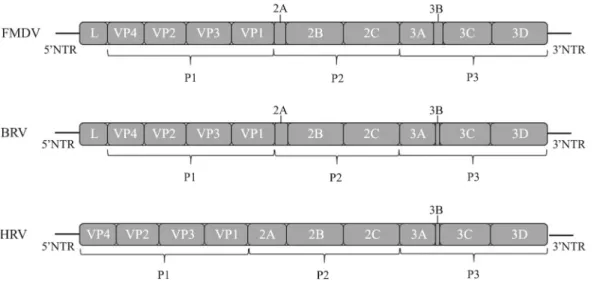
Fig. 1. Schematic representation of the genomic organization of FMDV, BRV, and HRV genomes is shown with the individual protein coding regions boxed and shaded gray. Solid lines represent the 5′ and 3′ NTRs (nontranslated regions). Capsid proteins are encoded by VP4–VP1 gene regions. Remaining gene regions encode non-structural proteins (L, P2, P3).
identical with each other. Furthermore, 2A, 2C, 3B3, 3C, and 3D regions of FMDV and BRV are 67%, 52%, 52%, 50%, and 64% identical, respectively. Importantly, the proteins that HRV encodes are identical to those that FMDV or BRV does excepting Leader protein (L
PRO) (Fig. 1) (Hollister et al., 2008).
Depending on certain physicochemical properties, picorna- viruses are subdivided into six groups (Newman et al., 1973).
To demonstrate whether BRV and HRV have physicochemical properties similar to those of FMDV, we have performed virus susceptibility tests in high temperatures, using acidic/alkaline solutions and commercial disinfectants, which have shown deactivating effects on FMDV infectivity in previous reports.
The present study applies a practical and feasible approach.
Bovine rhinovirus 668 and human rhinovirus 14 were assessed and amplified or tested in ZZ-R cells and HeLa cells, respec- tively. To evaluate the susceptibility of BRV and HRV to diverse environments, BRV668 (10
5TCID
50/0.1 ml) and HRV14 (10
5TCID
50/0.1 ml) were treated with heat, a low- or high-pH medium, chemical disinfectants (5% acetic acid, 2% sodium hydroxide, 0.2% citric acid, 0.05% citric acid), and commercially available disinfectants such as Virkon-S (oxygenated oxidant, Bayer), Shinilclow-T (chlorinated oxidant, Shinil Biogen), and Citric-Zon (acidic disinfectant, Shinil Biogen), which were purchased from the Korean market.
In the cases of pH and disinfectant tests, the viruses were neutralized with either acidic or basic solutions, depending on
the pH, to minimize cell toxicity before infection. According to
previous papers, FMDV is only stable within a pH range of 7 to
8, outside of which the virus becomes inactive at increasing
speed (Fellowes, 1960; Bachrach, 1968). In this study, HRV
and BRV were incubated with the indicated pH medium for 20
min, and cells were then infected with the treated viruses. Cell
viability was determined by trypan blue exclusion test. Clarified
cells from each treatment group were mixed with 0.4% trypan
blue (Invitrogen) (ratio 1:1) at 24 HPI and mounted to the
hemocytometer to obtain the percentages of viable cells. The
cell viability percentage was plotted against the relevant viral
inactivation treatment. As shown in Fig. 2A, both HRV and
BRV were almost inactivated in conditions of < pH 5.5 or > pH
11.0. However, BRV is more susceptible than HRV in alkaline
conditions. Previous reports have clarified that the heat resistance
of strains of FMDV at lower temperatures (50°C) is not sero-
type specific, with the effective inactivating temperature being
approximately 60°C for 20 min (Kamolsiripichaiporn et al.,
2007). Based on this report, the susceptibility of HRV and BRV
against high temperatures has been observed. The viruses were
incubated at 56°C for the indicated times before infecting the
cells. Cells survived completely at 24 h post infection (HPI),
indicating that all viruses had been inactivated at 56°C for 10
min (Fig. 2B). Collectively, these findings suggest that the
susceptibility of HRV and BRV is similar to that of FMDV
against pH and temperature.
Fig. 2. Susceptibility of HRV and BRV against different physical (pH and heat) conditions. HRV (top, 1 × 10⁵ TCID50) and BRV (bottom, 1 × 10⁵ TCID50) were incubated with the medium having different indicated pH levels for 20 min (A) or at 56°C for the indicated times (B) before infecting the cells. Cell viability was measured via trypan blue staining at 24 HPI. Data are representative of at least two independent experiments. Error bars, mean ± SD. *P < 0.05,
**P < 0.01 (Mann-Whitney U test).
During outbreaks of highly transmissible livestock pathogens, disinfection is crucial to prevent the spread of the disease and facilitate the repopulation of livestock at agricultural facilities.
We next investigated whether BRV and HRV are susceptible to disinfectants which have been used successfully against FMDV during outbreaks (Engvall and Sternberg, 2004; US EPA, 2010). Recently published reports have suggested that citric acid is effective at inactivating FMDV within 30 min and is recommended by the World Organization for Animal Health for field use at a concentration of 0.2% (OIE Standards Commission, 2000; Krug et al., 2012). BRV and HRV were treated with each of 2% sodium hydroxide, 5% acetic acid, 0.2% citric acid, and 0.05% citric acid for the indicated times before infecting the cells, and cell viability was measured via trypan blue staining (Fig. 3A) at 24 HPI. Interestingly, HRV and BRV were completely inactivated with all treated dis- infectants under conditions of 1 min or more. However, HRV was not fully inactivated with 0.05% citric acid within 15 min.
This result indicates that HRV is more resistant to citric acid as compared to BRV.
Moreover, we have tested the susceptibility of the viruses to commercialized disinfectants (Virkon-S, Shinilclow-T, and
Citric-Zon) reported to have been used as disinfecting agents for a broad range of viruses, including FMDV (Zou et al., 2013;
Gall et al., 2015; Li et al., 2015). Thus, HRV and BRV were co-incubated with each disinfectant as an indicated diluent for 20 min before infecting the cells (Fig. 3B). We found that all disinfectants affected BRV and HRV at high concentrations.
Even though low dilutions of Citric-Zon (0.05%) had a high effect against BRV, the same dilution of Citric-Zon showed less effect against HRV. This confirms that BRV is more susceptible to Citric-Zon as compared to HRV.
In summary, we have investigated the susceptibility of BRV and HRV to different physical and chemical treatment conditions.
Although BRV and HRV have been demonstrated to have
different susceptibilities to some extent, the physicochemical
characteristics of BRV and HRV are similar to those of FMDV
in those conditions. Especially, it seems that BRV has more
similar physiochemical characteristics to FMDV compared
with HRV. This results are may be owing to the molecular and
phylogenetic similarity between FMDV and BRV. Our obser-
vations suggest that BRV and HRV are substitutable model
viruses of FMDV in that they may be used for FMDV-related
experiments necessary to prevent outbreaks.
Fig. 3. Susceptibility of HRV and BRV against different chemical (acidic/alkaline solutions and commercial disinfectants) conditions. HRV (top, 1 × 10⁵ TCID50) and BRV (bottom, 1 × 10⁵ TCID50) were incubated with 2% sodium hydroxide, 5% acetic acid, 0.2% citric acid, and 0.05% citric acid for the indicated times (A) or with Virkon-S, Shinilclow-T, and Citric-Zon with the indicated diluent (B) before infecting the cells. Cell viability was measured via trypan blue staining at 24 HPI. Data are representative of at least two independent experiments. Error bars, mean ± SD. *P < 0.05, **P < 0.01 (Mann-Whitney U test).
This study was supported by a grant (No. 2012-0619) from Animal Quarantine and Inspection Agency (QIA), Republic of Korea and Chungnam National University.
적 요
구제역 바이러스 연구가 BSL-3 시설에 제한되기 때문에 여 러 가지 소독제나 항바이러스 제제에 대한 효력 및 효능 평가 가 쉽게 이루어질 수 없다. 따라서 구제역 바이러스와 계통학 적으로 유사한 bovine rhinovirus (BRV)와 human rhinovirus (HRV)의 특성을 열, pH 그리고 여러가지 소독제를 이용하여 평가하였다. 그 결과 구제역 바이러스의 성상과 매우 흡사한 것을 확인할 수 있었다. 이러한 결과로 BRV와 HRV는 구제역 바이러스를 대체할 수 있는 모델 바이러스로 이용이 가능하다.
References
Alexandersen, S., Zhang, Z., Donaldson, A., and Garland, A. 2003.
The pathogenesis and diagnosis of foot-and-mouth disease. J.
Comp. Pathol. 129, 1–36.
Arzt, J., Baxt, B., Grubman, M., Jackson, T., Juleff, N., Rhyan, J., Rieder, E., Waters, R., and Rodriguez, L. 2011. The patho- genesis of foot-and-mouth disease II: viral pathways in swine, small ruminants, and wildlife; myotropism, chronic syndromes, and molecular virus–host interactions. Transbound. Emerg. Dis.
58, 305–326.
Bachrach, H.L. 1968. Foot-and-mouth disease. Annu. Rev. Microbiol.
22, 201–244.
Engvall, A. and Sternberg, S. 2004. Other health related issues:
veterinary practice, pp. 604–615. In Fraise, A., Lambert, P., and Maillard, J. (eds.), Russel, Hugo & Ayliffe’s Principles and Practice of Disinfection, Preservation & Sterilization, 4th ed.
Blackwell Publishing Ltd., Oxford, UK.
Fellowes, O. 1960. Chemical inactivation of foot-and-mouth disease virus. Ann. N. Y. Acad. Sci. 83, 595–608.
Gall, A.M., Mariñas, B.J., Lu, Y., and Shisler, J.L. 2015. Waterborne viruses: a barrier to safe drinking water. PLoS Pathog. 11, e1004867.
Hollister, J.R., Vagnozzi, A., Knowles, N.J., and Rieder, E. 2008.
Molecular and phylogenetic analyses of bovine rhinovirus type 2 shows it is closely related to foot-and-mouth disease virus.
Virology 373, 411–425.
Kamolsiripichaiporn, S., Subharat, S., Udon, R., Thongtha, P., and
Nuanualsuwan, S. 2007. Thermal inactivation of foot-and-mouth disease viruses in suspension. Appl. Environ. Microbiol. 73, 7177–7184.
Krug, P.W., Larson, C.R., Eslami, A.C., and Rodriguez, L.L. 2012.
Disinfection of foot-and-mouth disease and African swine fever viruses with citric acid and sodium hypochlorite on birch wood carriers. Vet. Microbiol. 156, 96–101.
Li, R., Baysal-Gurel, F., Abdo, Z., Miller, S.A., and Ling, K.S. 2015.
Evaluation of disinfectants to prevent mechanical transmission of viruses and a viroid in greenhouse tomato production. Virol.
J. 12, 5.
Newman, J., Rowlands, D., and Brown, F. 1973. A physico-chemical sub-grouping of the mammalian picornaviruses. J. Gen. Virol.
18, 171–180.
OIE Standards Commission. 2000. General recommendations on
disinfection and disinsectisation. terrestrial animal health code, Paris, France.
Stenfeldt, C., Diaz-San Segundo, F., De Los Santos, T., Rodriguez, L.L., and Arzt, J. 2016. The pathogenesis of foot-and-mouth disease in pigs. Front. Vet. Sci. 3, 41.
US Environmental Protection Agency. 2010. Product performance test guidelines OPPTS 810.2200: disinfectants for use on hard surfaces-efficacy data recommendations. available from: http://
www.regulations.gov (Docket ID: EPA-HQ-OPP-2009-0681- 0004).
Zou, S., Guo, J., Gao, R., Dong, L., Zhou, J., Zhang, Y., Dong, J., Bo, H., Qin, K., and Shu, Y. 2013. Inactivation of the novel avian influenza A (H7N9) virus under physical conditions or chemical agents treatment. Virol. J. 10, 289.